
The Dodgers Bullpen as a Roadmap
How do you build a bullpen? How do you turn a bad one around? Fans in Detroit and other inquiring minds might like to know. The Dodgers might have a bit of a blueprint for us.
The bullpen in Chavez Ravine last year… it wasn’t good? Only four National League teams were worse by Wins Above Replacement, and it doesn’t get any better if you use ERA. “You can say it was bad,” said A.J. Ellis with a smile before a game with the Giants.
Things are a little different this year. Of course, it’s a small sample, but 41 innings in, the Dodgers bullpen is the best in ball. The components look good, too, with the best strikeout rate in baseball and good velocity. “It’s a nice arsenal of arms that keep coming out as the game progresses, guys that can fill multiple roles, guys that can go long, guys that can come in and face just one hitter,” Ellis said of the new look pen.
But is there a road map here? Dave Cameron talked about the way many of these relievers were acquired, but is there a way you use the relievers they acquired as a road map for future bullpen turnarounds?
1) Find a few crafty veterans with good intangibles.
Yes, you just read that on FanGraphs. But if you have a better way to describe how Joel Peralta and J.P. Howell have continued to get high-leverage outs as their stuff has declined, I invite you to replace the “i” word with that description.
Even if you ask Howell, he knows. “Growing up I thought I threw hard, and even now, I feel like I throw fuzz, but it isn’t,” the reliever admitted. So in order to get guys out, Howell has a plan. “I gotta chop and screw it up, I gotta make the ball dance, I gotta read hitters, I gotta figure it out, I gotta know the best odds for me to win in that situation,” said the frenetic lefty.
In particular, Howell has learned how to make the most of his breaking ball. “I have to figure out the bat path, and then I can throw a hard one, a slow one, a soft one, a loopy one, make it stay big, make it short,” he said of his curveball. “Mix it up, different angles — not with the arm, but with the wrist, different effort for sure.” Take a look at the pitch, and you’ll see that there’s almost no patterns here — he can change the velocity and movement on the pitch at will. Look also at that flat, hard flat breaking ball in particular (“It’s almost an hanger, but it can get popups”):
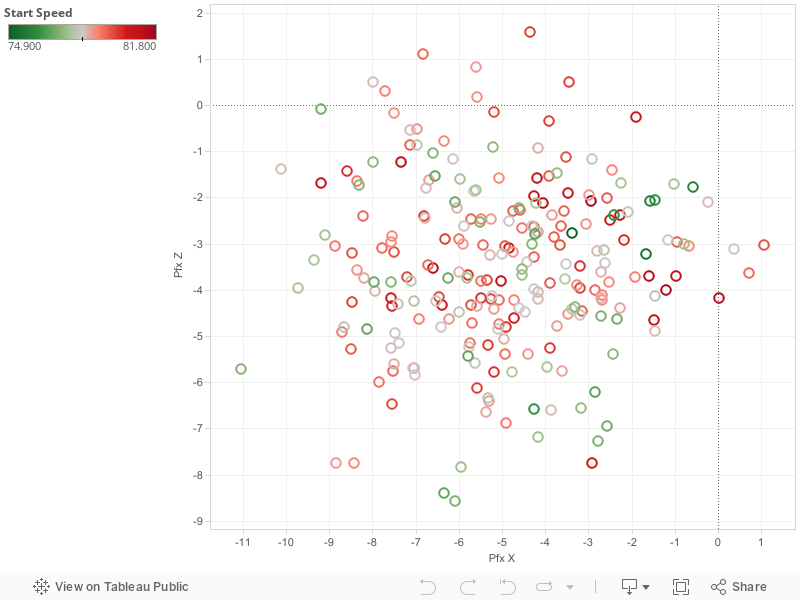
This sort of thing might seem exhausting, and it is for the fast-paced Howell. “That’s the worst part, is always having to focus, I can’t just go out and out-talent you. I have to slow down and pay attention. It’s not always relaxing and fun, like some of these guys make it look,” Howell said. If you’re going to call the multiple breaking balls a tangible, then it’s this willingness to focus and study body language and figure out the best uses for his different versions that we’ll call an intangible.
But it’s that kind of thinking that has made him last, and it’s that kind of thinking that has helped former/current teammate Joel Peralta escape his former status as a Righty One Out GuY. Peralta attributed his late-career success to thinking when he talked to Jonah Keri — “I just got smarter, figuring out how to pitch.”
The rest of the interview provides the clues for what that meant. Peralta alters his time to the plate, and he pitches backwards by throwing offspeed stuff in fastball counts. But one adjustment might sound familiar after hearing Howell talk: he throws his splitfinger high in the zone sometimes. Just like Howell’s high hard curve, it looks like a hanger, but it’ll get a swing. “And that’s what I want: for them to swing at that pitch,” Peralta said.
You can call these things tangible, but throwing hanging breaking balls and splitters on purpose is not something that’ll show up in most peripherals.
2) Convert position guys with good arms.
The top of the organization wasn’t here when Kenley Jansen was converted from catcher, but the pen now has three former position players, so you have to include it as part of the answer. It takes some risk to do this — Pedro Baez and Kenley Jansen *could* have helped at third and catcher respectively — but the benefit is obvious.
“The organization felt like I was young I had a good arm and they didn’t want to waste it, they didn’t want to take too much time,” Jansen said about his conversion. “They wanted me in the big leagues, and it worked — I was young, 22 years old and in the big leagues.”
Jansen now has five years of pitching under his belt, so he knows how to refine his craft. While the bread and butter cutter is “just natural” — he has a long middle finger, and just tries to throw a four-seamer and then “it just moves” because of his arm action and slot — there are things he can do to improve. In the bullpen, he tries to extend properly. “Once I have my extension, that’s when the ball is going to cut the most.”
And then he also makes sure to spend some time hitting the outside corner on the glove side. Not only is that good for his command, but it sets him up for when he has to face a lefty. “I try to start it middle-in to the lefty, and make sure it gets all the way in, so that it looks like a strike until it’s a ball at the end.”
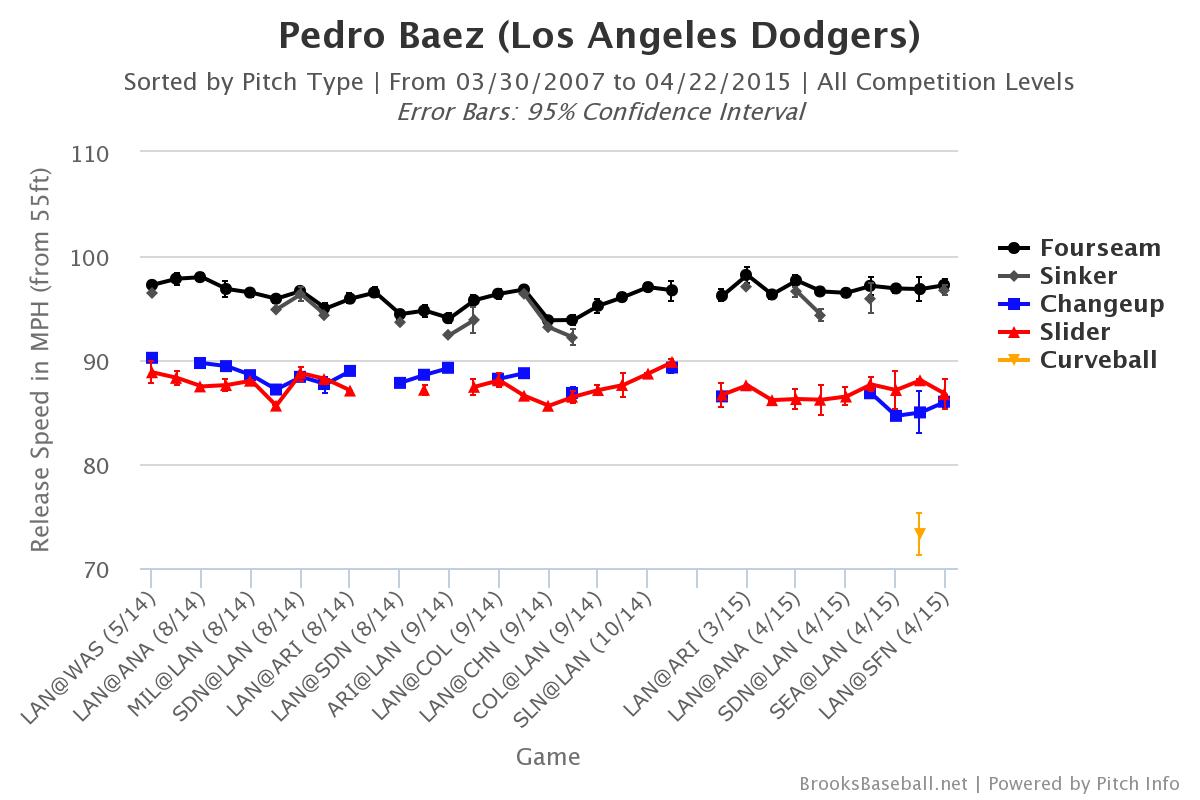
Pedro Baez was converted from third base at the beginning of 2013, and for him the key might be maintaining his velocity throughout the season, as Daniel Brim has noted. Not surprising, considering he hasn’t been a reliever long.
Chris Hatcher was converted by the Marlins, but the Dodgers made sure he was included in the Dee Gordon / Andrew Heaney deal last year. He’s working on finding his ideal mix between his 95 mph fastball, devastating splitter, and decent breaking ball, but he’s also striking everyone out.
And having three former position players actually has an ancillary benefit, according to their catcher. “Their game awareness is off the chart, Kenley and Hatch both, they have a really good feel for the game, for the running game, which comes in handy behind the plate,” Ellis said. “Sometimes you have relievers come in and they’re so singularly focused on getting hitters out that the running game goes wild.” The Dodgers’ pen has only allowed two stolen bases this year, and only two teams have allowed fewer.
3) Take a shot on the kids.
This is related to the last — if you convert a position player into a pitcher to get him into the bigs sooner, you’ve shown an understanding that the pen is a great way to get a player into the big leagues quickly. Intuitively, it makes sense — big velocity and a good secondary pitch is enough to be a good reliever, and the skillsets involved with position players or starting pitchers is broader. You’ve seen the Toronto Blue Jays take shot on two kids under 22 in Miguel Castro and Roberto Osuna, and the Dodgers are doing something similar.
Ellis was impressed with his front office in this regard. “I give the organization a lot of credit for letting these guys break with us to start the season. The easy thing is to always option somebody down and create depth, but these guys made a commitment to us and this team about making the best team they could. So you see guys like Yimi Garcia, Pedro Baez, they were probably slated to start the season in Triple-A, but the way they performed in spring training separated themselves, they made themselves necessary, must-have kind of guys,” the catcher said.
The Dodgers are tied with a scrum of teams at 15th in the league with an average age of 29 in the bullpen, but that’s dragged down by Peralta’s 39 years. Still, a pen giving high leverage innings to players like Garcia and Baez is a pen that’s valuing young players.
4) Get lucky.
Watch Paco Rodriguez and you’ll notice the funky way he brings the ball up, straight up behind him. That makes him tough to pick up, but it’s out of necessity that those mechanics were born. “The ball’s a little slicker in pro ball, and I had get out from under a little quicker, and that helped me stay on top of the ball,” the lefty said. College baseballs have higher laces, but Rodriguez pointed out that the balls in the bigs are even a little different than the minors because of the mud.
Yimi Garcia has always had decent velocity and great strikeout numbers in the minor leagues, but he felt that something wasn’t quite right with his slider. So he spent the winter in the Dominican Republic working on the pitch, and his brother spotted something. “I was getting around the side on the pitch,” Garcia admitted.
An offseason of work, and now he’s showing the biggest drop on his slider of his career.

And that didn’t even happen in America, or with Dodgers’ coaches.
So how do you convert this roadmap into actionable items? It’s maybe not that hard. Line up all your position players in the spring when all the minor leaguers are there, and have them throw to the radar gun. Investigate those that throw hard but have had trouble with the bats. When making deals, consider not only standout pitches on relievers, but also good makeup and ‘wily’ smarts.
And, finally, amass as many relievers as you can, particularly ones with velocity, and then hope a few of your young relievers find a new pitch in the offseason.
With a phone full of pictures of pitchers' fingers, strange beers, and his two toddler sons, Eno Sarris can be found at the ballpark or a brewery most days. Read him here, writing about the A's or Giants at The Athletic, or about beer at October. Follow him on Twitter @enosarris if you can handle the sandwiches and inanity.
It seems to me that the real overarching strategy that the new FO has used to build a bullpen has been this:
1. Bring in a lot of guys for spring training.
2. Take the best ones irrespective of service time and contract status.
These two things are antithetical to how the team built bullpens in the past. The Colletti FO was a fan of signing guys and basically guaranteeing them a bullpen spot. Last year, there wasn’t even a place for a young guy to make the team, as Colletti had just signed the bullpen. The first thing the new FO did was DFA Brian Wilson. To them, there’s no such thing as a guaranteed bullpen spot.
They probably can find guys who are more likely to succeed than others, to an extent, but I’m sure they didn’t use some sort of super-scout techniques to hand pick 7 quality relievers. I think they picked 15 guys who could be quality, and then let them battle it out.
Agreed! Bring a ton of guys, some wily vets, some young guys with velocity and shaky secondary pitches, some former catchers, throw them in the mix, see what happens. Make it a priority, but not with money.
Isn’t 41 innings a bit too-small of a sample to build the Next Great Bullpen?
It’s probably not the Next Great Bullpen, but 44 innings of a 2.66 xFIP is probably enough to conclude they are better than last year’s.
Great article as usual!
I would note that all of these techniques for building a bullpen has been done by the Giants for a long while now.
For crafty vets, they signed Affeldt and traded for Lopez. Dave Cameron wrote about how acquiring Affeldt was buying a stealth closer for non-closer money, and boy, was he correct, 100%! And Lopez somehow just shuts LHH down most of the time. And the Giants have been doing this for a long time, picking up veterans who are crafty.
For intangibles, the Giants just find them all around. Affeldt could demand to be closer in the past when the job was open, he didn’t. And like Howell, he learned to adjust, for him, from being starter to reliever, and he did it. Both Romo and Casilla have been demoted from being the closer, and both resigned with the team. Romo, in fact, said this off-season that he wasn’t even interested in signing elsewhere, said the Giants didn’t have to wait, he was an easy sign.
For the Giants, Joe Nathan is a great example of a position player converted to a pitcher, while with the team. There have been other experiments along the way, but no real successes like Nathan. More recently, they went for Crick, who only started pitching in his senior year of high school. But this prospect development characteristic is well known enough that when a position player with a strong arm is drafted by the Giants, certain prospect hounds would note that even if the prospect fails to develop as a hitter, there is always pitching.
Young guys and I would add to that, any unproven prospect, have been given important bullpen jobs on the Giants regularly, basically annually. Romo came up late season, never went back down. Casilla was released by the A’s, once he made the Giants, never went back down. Petit was a failed major leaguer, and the Giants got him to the point where he was one out away from a perfect game then set the record for most hitters set down without getting on base, the first reliever on the list. Machi and Kontos got bullpen jobs immeidately as well, Machi was a long time minor leaguer when he made the Giants. They have also picked up a number of relievers off waivers and got them to up their performance, like Eyre and others. Again, this is a Sabean specialty, the bullpen has always been near and dear to his heart.
As far as getting lucky, I would name Casilla and Petit. Both are kind of similar to your examples. Petit you know because I think you were the one to write the article here, but he has a similar throwing mechanics as Paco, where the ball hides behind him as part of his windup. Casilla learned a new pitch and the Giants benefited from that, though I am not sure if he learned it before the A’s released him, while he was a free agent, or after he joined the Giants. Perhaps you can check, you have been writing a lot of Giants related articles and interviewing a lot of their players.
And he wasn’t in the bullpen, but lucky for the Giants, Vogelsong famously begged the Giants for a minor league contract when the Dodgers offered him a contract, then soon Zito was in a huge car accident in LA and eventually DLed, giving Vogelsong the opportunity he needed to show what he got. It’s still amazing to me, as he wasn’t all that good with his prior team the year before, and that was in the minors, but it seems to me like it was something intangible about returning “home” to the team that drafted and developed him, that freed his abilities finally to be put on display on a major league field.
And speaking of conversions, people might not remember, but Posey was the closer on his college team, so I’ve been hoping that maybe once he finally stops being a catcher, he might try to become a reliever/position player, like Kieschnick for the Brewers, only better.
And going the other way, I’m surprised that there hasn’t been any pitcher like Babe Ruth, who was so good a hitter that he forces his way into playing regularly while also being a starting pitcher (or even reliever).
I came here specifically to post what you did – except you said it better than I would have!
Thanks, appreciate that!
The Giants have had basically the same bullpen for five years. I don’t know if that’s luck or skill or what, but whatever it is, it doesn’t seem like anyone else can do that.
When it comes to pitching, there is always some element of “luck” because of health. Particularly given Romo’s seemingly ready to fall apart elbow, it has been on and off for years now. And Affeldt always seemed one bad hamburger patty or active child away from another injury.
But the bullpen under Sabean has almost always been important to maintain, except during the after-Nen period, when the payroll was weighted first by his remaining contract, then Benitez’s. And perhaps those years without a good bullpen led him to be more vigilant about having a good bullpen.
Ultimately, you have to credit Sabean because he kept on signing them all to a new contract, despite all the saber-rules that relievers are fungible and easy to replace. You don’t need to see any further than the recent article on the Dodger’s new bullpen to see that philosophy being spread around.
But as Giants fans going through the post-Nen period, we saw that it is not that easy. So he did a little of everything Eno noted above, had a little luck, then held on tight once he got the Core Four going. Meanwhile, he’s doing the above, picking up cheap (Strickland, Cordier) and via the draft (Law, Okert, Black, Osich, others), and trade (Kontos?) for the transition from the Core Four.
I think the correction has started. This is not a good bullpen.
Not good, but not bad either. As I commented on Cameron’s article, you got both SSS and the fact that if you look at the projections for the relievers they currently have, they project to be roughly league average (when compared to the majors average for relievers in 2014 and 2015). And if they dump one or two guys and bring in better guys, then they have a chance to be a good bullpen, as the majority of them are good, just that three of the projects to be on the below average side, especially Nicasio and Baez, who are performing great now, but will regress, looking at those projections, heck, their careers, Nicasio is not going to continue 12.9 K/9 and Baez 13.5 K/9.
I was going to mention Bolsinger because the Cameron article mentioned him too, but he projects to a 4.26 ERA and 4.13 FIP. If you look at his history, that makes a lot of sense, as he has a career ERA around 4.50 in AAA before this season. It is just extremely odd that a saber-oriented site like FG is just ignoring SSS. Dave is better than that.