The Horror! The Horror! (Of Pitching to Nick Kurtz)
You’re probably pretty good at baseball if you end up on this list:
| Player | wOBA |
|---|---|
| Aaron Judge | .805 |
| Nick Kurtz | .778 |
| Christian Yelich | .749 |
| Shohei Ohtani | .746 |
| James Wood | .727 |
| Kyle Stowers | .700 |
| Kyle Schwarber | .682 |
| Riley Greene | .662 |
| Elly De La Cruz | .660 |
| Gunnar Henderson | .614 |
I get it. “Doing damage when you elevate the ball” isn’t the only skill that’s necessary to be a good major league hitter. It’s not even close to the only necessary skill. On the other hand, look at that list! It goes 10 hitters deep, and they’re all great. The worst guy on that list is probably Christian Yelich, and he’s having a nice year despite dealing with his chronic case of can’t-ever-get-the-ball-off-the-ground-itis.
Psh! Who cares about wOBA? What even is wOBA? First of all, good news, here’s an article explaining it in great detail. Second, fine, let’s use a different statistic then. Here’s slugging percentage, same minimum of 100 batted balls:
| Player | SLG |
|---|---|
| Aaron Judge | 1.402 |
| Nick Kurtz | 1.370 |
| Shohei Ohtani | 1.321 |
| James Wood | 1.234 |
| Christian Yelich | 1.225 |
| Kyle Stowers | 1.174 |
| Kyle Schwarber | 1.172 |
| Riley Greene | 1.104 |
| Cal Raleigh | 1.077 |
| Elly De La Cruz | 1.068 |
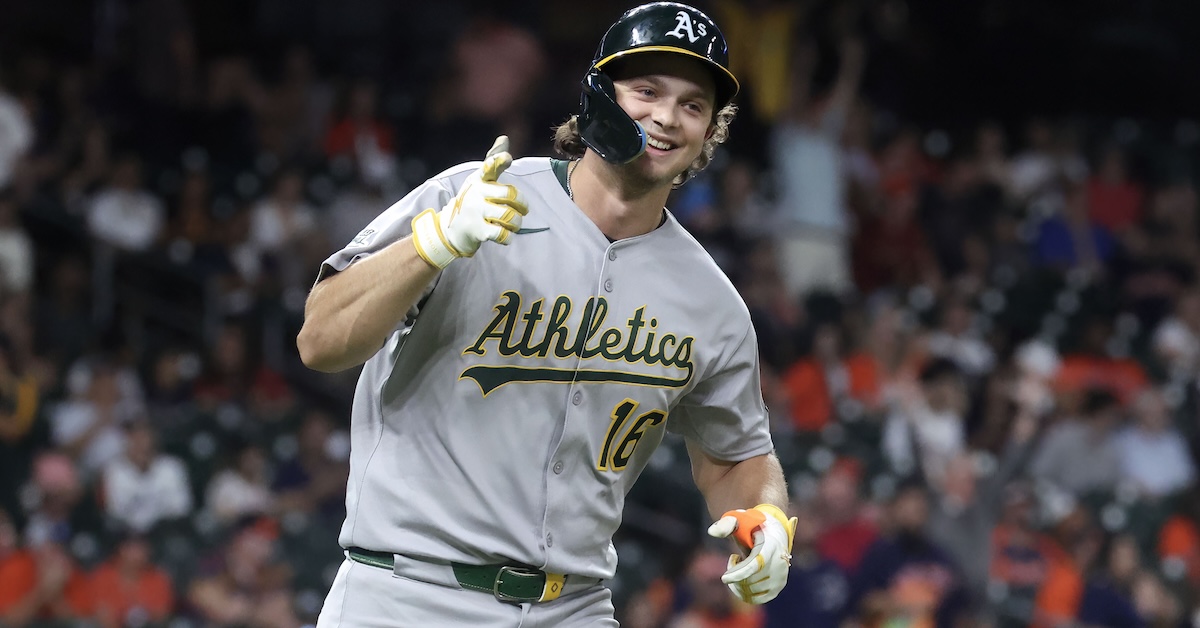
The title and image have already given it away, but this is an article about Nick Kurtz, and no matter how you slice it, he ends up at the top of the league if you’re looking for power in the air. He’s second in wOBA, seventh in xwOBA, second in slugging, fifth in xSLG, seventh in average exit velocity, 10th in hard-hit rate, and eighth in barrel rate. He looks right at home on a list of giant major league hitters doing giant major league hitter things. And why wouldn’t he? After all, he’s one of the best hitters in baseball.
You heard me. Consider this a mea culpa to Kurtz, who absolutely should have been on my Top 50 Trade Value list, but got lost in the shuffle because he didn’t embark on his power-hitting binge until after I got going on the list and instead ended up as an Honorable Mention. I won’t mention it again, but I’m just getting it out here: This dude rocks and I’m totally in on him. Slide him somewhere close behind Ketel Marte. Anyway, on with the article!
Another quick look over that list of top hitters makes one thing clear: These are large men who generate huge bat speed to get to their results. Kurtz fits right in. Lower the minimums so that he qualifies, and he’s fourth in the majors in bat speed this year. He’s second in fast swing rate, the percentage of his swings that are 75 mph or harder. This isn’t rocket science. Well, it is, actually – we’re using incredibly advanced technology to measure ballistics – but “why is Nick Kurtz doing well?” is an easy enough question to answer. He swings really hard and hits the ball really hard.
Oh, you think pitchers should lean into the art of pitching and keep this guy from getting off his best swing? It doesn’t work that way. Change his timing, mess with his eye level, put him in a situation where he should be defensive? Good luck! If he swings, he’s swinging with an intent to capture extra bases, regardless of where you put the ball. Give him a sinker down? He’s made contact with 12 of them so far, and he’s batting .667 with two doubles and two homers. Get him to two strikes? First, hey, congratulations, everyone is bad with two strikes. Second, Kurtz still swings ludicrously hard with two strikes; his swing speed declines by less than a mile an hour. And when he makes contact with two strikes, he’s batting .510 and slugging 1.000. If you want to beat Kurtz, you can’t let him get his bat on the ball.
That brings me to Kurtz’s next great skill: discernment. Plenty of guys swing hard. He’s a standout even there, but still, Riley Adams, Jordan Walker, and Jhonkensy Noel are in about the same spot on the bat speed leaderboard. Jac Caglianone, a fellow top-10 draft pick from 2024, has the same bat speed – and a 29 wRC+ in his first 41 games as a big leaguer. Swing as big as you want; if you can’t make contact with the ball, no one cares. Those less-fearsome sluggers have an aggregate chase rate of 37%. Kurtz checks in at 21.9%, in the 82nd percentile for major league hitters.
That’s the Kurtz skill set: Wait for a ball in the strike zone and take the biggest imaginable hack at it. It’s a really effective skill set! It has one obvious flaw, one that he shares with many of his big-swingin’ brethren: contact. Yes, Kurtz is great at figuring out which pitches to hit. No, he doesn’t always hit them. His 70% contact rate and 79% zone contact rate are both well below average. That’s not an unworkable issue – Shohei Ohtani and Aaron Judge have similar numbers – but it’s definitely his weak point. His 30.3% strikeout rate is scary. The only player in baseball who chases less often and strikes out more often is Pavin Smith.
So yes, Kurtz is one of the best hitters on the planet, but as is the case with all of the elite offensive players who’ve come before him, he is going to have to make adjustments if he’s going to become a regular member of this camp. You simply can’t strike out this often and hit this well in the long run. Oh, you can be very good, but not quite as good as Kurtz has been.
What adjustment should he make? From the outside, I can only guess at what his thought process is at the plate. Even so, it seems to me that he still needs to learn how to rein his swing in at times. He hits the ball so cartoonishly hard that it would still go far if he eased off a little bit. Here’s one way of thinking about it: Most hitters have similar whiff rates with and without two strikes. You might think that’s weird, that their whiff rates should decline when they start defending the plate, but they’re not operating in a vacuum. Pitchers start throwing nastier, more chase-seeking pitches with two strikes. Across the majors, batters whiff 25.4% of the time without two strikes and 24.4% with two strikes, pretty much indistinguishable.
Kurtz is always going to come up empty more often than the average big leaguer. His non-two-strike whiff rate is 30.7%. But with two strikes, it jumps to 38.6%. He’s not doing his part to make more contact, so the nastier pitches balloon his whiff rate. That, in turn, means more strikeouts. Kurtz strikes out on 28.1% of the two-strike pitches he sees. The only player in the majors worse than that is Michael Toglia, and Toglia is two wins below replacement level this year. Major league pitchers are so good that two-strike counts come up frequently for everyone. To keep his absurd power production going, Kurtz is going to have to change what he does in those situations.
Well, I’m being a little generous there. There’s no chance Kurtz keeps hitting for this much power. He’s sporting a .609 wOBA on contact. Don’t try to make it about the park, either; he has a 178 wRC+ at home and a 180 wRC+ on the road. I don’t need to give you xStats or anything like that to tell you that this can’t continue. I can just use recent history as a guide.
The best wOBACON of the Statcast era belongs to Judge, at .566. The only other guys above .500 in any meaningful amount of time are Ohtani (.506) and Mike Trout (.504). I’m not ready to say that Kurtz is a standard deviation better than Judge as a power hitter. Let’s instead call it a really nice hot streak from an already-high true-talent level. Joey Gallo put up a .644 wOBACON one year. Judge set his full-season high of .617 last year, though he is topping that by more than 20 points this season (.639). It’s almost not worth considering the exact magnitude of how much damage Kurtz is doing on contact – he’s not going to keep doing this much, period.
If you think about it, that makes sense. Kurtz strikes out 30.3% of the time, walks only 11% of the time, and has a 179 wRC+. Shohei Ohtani strikes out 26.8% of the time, walks 13.7% of the time, and has a 164 wRC+. Kurtz is hitting for so much power that he’s more than making up for his disadvantages in strikeouts and walks. If you scale his true talent down to merely having top-shelf power instead of top-shelf-on-a-hot-streak power, the strikeouts will start to matter more. To be a truly transcendent hitter, he’ll need to figure them out.
A rookie needing to improve on something? That happens all the time. A rookie needing to improve on something, yet still posting a 179 wRC+? That’s a lot more interesting. It also gives me a chance to make more tier lists – this time for rookie performance. Here’s how I look at it: Over the past 15 years, you can break rookie performers up into several tiers. The top two tiers are the interesting ones, as you’ll see.
At the top, you’ve got the guys with no holes in their offensive performance. My archetypical recent examples here are Trout, Yordan Alvarez, and Juan Soto. They posted huge seasonal lines. They got on base. They hit a pile of homers and made enough contact to keep their strikeouts under control. They had solid plate discipline across the board, from low chase rates to high walk rates. You could look through the entirety of their rookie statistical records and find very little to dislike. The players in this group are shooting stars, guys who seem can’t-miss and probably are. It’s more about breadth of performance than raw wRC+. These guys are great and without flaws, that’s the key thing.
The next tier down? It’s certifiably elite too. This group has plenty to like but a flaw or two that will need sorting out. The flaw is almost, but not always, strikeout rate. Ohtani, Pete Alonso, Fernando Tatis Jr., Gary Sánchez, Matt Olson, Keston Hiura, and Miguel Sanó each put up a 150ish wRC+ but a scary strikeout rate. Trea Turner, Michael Harris II, and Julio Rodríguez had great rookie years with chase rate/walk rate concerns. Adley Rutschman and Jackson Merrill were amazing but with middling power output.
Below that, you get to the merely good rookie seasons that make me continue to think whatever I previously thought about the prospect. In recent years, think of Bobby Witt Jr., Wyatt Langford, and Jordan Walker. The guys in this group can go either way; they are still adjusting to the majors, and their careers still have both considerable upside and considerable risk. These are tough evaluations, the time to dig in the most.
The bottom tier of the list is just everyone else. There’s no reason these guys can’t pan out, they just haven’t yet. Maybe there are some potentially fatal flaws, maybe the upside is unclear, but writing a player off after a single season never makes sense. Certainly, though, they’ll need to do some improving to succeed long-term in the major leagues. The bottom group is the biggest, naturally; it’s really hard to succeed as a rookie against a group of grown men who have been doing this as a full-time job for years.
For me, Kurtz’s season has already landed him solidly in the second tier. He can unquestionably demolish major league pitching. Even if that always comes with a huge strikeout rate, his otherworldly power gives him a high floor. In my head, I’m picturing his season as an updated version of Alonso’s rookie campaign, with similarly huge power (Alonso set the rookie home run record) and plenty of strikeouts. If Kurtz hits his current projection for the rest of the year (125 wRC+), he’ll finish with a wRC+ in the mid-150s and a ton of great counting stats; that sounds a lot like a good Alonso season to me.
That’s not the extreme upside case, though. The extreme upside case is that he just keeps doing what he’s been doing so far, and that his Judgian batted ball quality only declines to otherworldly instead of falling way back to the pack. If you’ll notice, I didn’t include Judge’s rookie year in the tiers above. He’s something else. His rookie year had an obvious red flag – he struck out 30.7% of the time — but he also posted a 174 wRC+, the highest in AL/NL history since Joe Jackson in 1911, and set the rookie home run record that would be eclipsed by Alonso a year later. It was an off-the-charts start to a career that suggested a previously untraveled path to stardom.
That’s probably a 99th percentile outcome for Kurtz, just so we’re clear. There’s only one Aaron Judge. But Kurtz is off to the kind of start to a career that everyone should sit up and take notice of. He’s not a complete hitter yet – but he hasn’t needed to be. He’s a premium power threat with elite plate discipline. He was in college last year. The trajectory is hard to ignore. I’m very excited to watch Kurtz try to handle everything the league throws at him, and to watch teams try to grapple with the horror — yes, the horror — of his monstrous, game-altering power.
Note: All statistics current through August 2, 2025.
Ben is a writer at FanGraphs. He can be found on Bluesky @benclemens.
I am hoping he develops horrid plate discipline so I can make “Are my methods unsound?/I don’t see any method at all, sir” jokes
What number will he wear on my Yankees. Everyone wants to play in the best city in the world
Oakland – I mean Sacramento.
Every kid dreams of playing ball in
OaklandSacramentoLas VegasMexico City!
We need to drop everything and ensure that we make the nickname “the Colonel” happen for Kurtz
Someone in Calcaterra’s newsletter suggested “The Horror”. Either one would be better than “Big Amish” I think.
That was me relaying my friend Josh Wood’s suggestion. The Colonel is wonderful, but it would be completely lost on most people. Even if people don’t get the reference, the Horror is quite descriptive. And then later, they can discover the deep cut.
Mistah Kurtz—He dead
Puns are always better when they have a Colonel of truth to them
Despite what the bat speed metrics say, I don’t think Kurtz has anywhere near the max raw power of someone like Aaron Judge, James Wood, Shohei Ohtani, etc. I don’t think he can let up without those ferocious max effort hacks and still get the same sort of outcome. Maybe you can calculate out something like EV95 or something to show something different but he’s 21st in Max EV and 21st in EV90, so I’m going to guess that his raw power is a 70 rather than an 80.
He still might be better off adjusting his two strike approach, have a different swing to avoid getting blown up there. But that’s going to come at a much bigger cost than someone like Aaron Judge.
I see I have some doubters. How many 80 raw power guys do we think exist in MLB at any given point? Let’s look at Max EV, minimum 100 PAs.
Right now it’s Oneil Cruz, Stanton (when healthy), Judge, Ohtani, Vlad Jr, and James Wood at the top of the Max EV charts. By almost any metric, these are the guys at the top.
Then you’ve got Naylor, who has a huge max EV readings this year but it’s entirely possible that one is measurement error because it’s way out of line with everything else he’s showing in the past or present.
Then you’ve got EDLC, Ramirez, Schwarber, Jarren Duran, Jhonkensy Noel, Agustin Ramirez, and Caminero. And in the past, we had Matt Olson, Pete Alonso, and Acuna with massive max EVs although they’re lower now.
How far down do you want to go with 80 raw power? Remember, bat speed is only one component of raw power, it also includes things like bat weight. Kurtz is at #60 when you drop the minimum PAs that low. And sure, maybe it’s just that he hasn’t had as many chances, but his max in the minors was something like 110.5. His max EV in 2024 in college was 117.3 with an aluminum bat, and he’d barely crack the top 10 this year with that number (Noel is at #10 with 117.2).
There is no shame in having 70 raw! And who knows, he might grow into more, he’s only 22.
I mean, what kind of EVs do you think Ohtani could get with an aluminum bat?
What do you think would happen if we let Giancarlo Stanton swing an aluminum bat? The ball would literally disintegrate before our eyes. (but that’s not entirely fair, Stanton’s raw is probably a 90 on the 20-80 scale)
“$50 says Ohtani could hit 130 with an NCAA bat.”
~anonymous Dodger DH
The thing I always find goofy with conversations using the scouting scale is that this is supposed to be a normal distribution and we kind of just use the eye test on the EVs. If we look at hitters with 100 battled ball events this year, then 80 grade power by max EV is topping 119.75 mph. That’s just Oneil Cruz and Vlad Jr. There are only 9 guys at at least 70 (Agustin Ramirez makes is and Schwarber just misses). Nick Kurtz is just behind Cam Smith, who absolutely does not have 80 raw, and by this admittedly bad metric grades out at just 60 raw.
Now, for one thing, these distributions aren’t far from normal but they’re definitely not quite normal. And I’m not sure that this tells you a ton other than that (1) max EV probably isn’t a great proxy for raw power and far more importantly (2) people really don’t understand what an 80 is. 3 standard deviations is a ton! Taylor Walls is not even 3 standard deviations below the mean, and he has the lowest max EV in this sample, so there are literally no 20 raw powers in the sample (again taking some liberties with the distribution).
I love the statistical nut you’re busting here but it’s important to remember that the 20-80 scouting scale is overall talent, and so therefore most of the 20s would be in the minors, and low ones at that (hence the sort of heuristic knowledge that you gotta hit 45 overall to be useful in the show)
I don’t think that I’m forgetting that here. Even if you’re applying the scale to all players, it only makes sense to define your distribution based on major league players. Otherwise it wouldn’t make sense to have the vast majority of players below a 50. My point here is just that I don’t think people understand how massive 3 standard deviations is at the major league level.
It’s been a while since I have read Future Value, and that would probably be the place I would go to look to resolve this question.
But I do know that basically any major league player for any length of time is at least a 35. A 20 is an org guy who basically never sees the majors, and a 30 is a guy who is up and down as long as they have options and typically have negative WAR. I think a 35 is about replacement level.
But in Future Value they actually stake out approximate benchmarks for each level. And just for fun I went to see how many 20 raw power grades were on the board. Here is the total list from all years.
William Bergolla
Wyatt Young
Tsung Che-Cheng
Gabriel Mejia
So for whatever reason, there are typically not graded prospects with raw power of 20, probably because the lack of raw power makes them non-prospects.
There are a lot more 80 raw prospects, probably because if you have 80 raw you are almost automatically a graded prospect at some point. I count 30-35 over all the years.
But a lot of those guys don’t make it either. Jose Pujols, Jake Gatewood, Dermis Garcia, Jhailyn Ortiz, Anthony Garcia, Seuly Matias, Albert Feliz, Connor Cannon, Chris Gittens, and Yosy Galan have had MLB careers that were either nonexistent or very brief. And some of the players with 80 raw grades showed more like 70 when they did get chances in the majors (Jordan Walker) or even a bit lower (Eloy Jimenez, Triston Casas).
I think of each 10 point increase in grade as a standard deviation. So to me, when you ask “how many 80 grade” anythings are there in MLB, I usually think there is probably only one. Almost a unicorn. Even a 70 score on anything is pretty exceptional and a 60 means you are better at that skill than about 5/6 of the most talented baseball players on the planet.
I don’t think people really understand that talent at the top is pyramidal in distribution and not linear.
I think at some point Eric defines it like that, but he gives out more 80 raw grades than the roughly 3 or so that would fit that description.
But I can’t really buy that there are ever double-digit players with 80s on a given tool. I’m fine with stretching things a little bit but when you get past about 5 or 6 I start to object.
Nothing wrong at all wit 70 raw at present. Question is will he add more?
Comparing 22-year-old Kurtz’s raw statcast metrics to a 23-year-old rookie Ohtani, they are quite comparable.
I agree current Kurtz doesn’t seem to be able to access to raw power of a present-day Ohtani, but he could definitely get there over the next few years.
Heck, it only took James Wood one year to go from “very promising” in this category to “quantifiably elite”. Not to mention Kurtz gets to his power better because he’s not hitting it into the ground as much.
People often forget that most men keep putting on muscle mass up through their mid-20s. Maybe things are different for professional athletes who for the most part develop their bodies way earlier, this is what Eric refers to as “the cement is dry.”
But I think it’s very likely he adds more raw strength over the next couple years. Maybe not enough to start blasting at 119 MPH but maybe into the 116 or 117 range (which is what we usually associate with 70 grade raw).
And I don’t think it’s reasonable for him to compare him to guys like Soto and Trout. Not everyone can be Trout, Yordan Alvarez, or Juan Soto. If it were so easy to just make that level of contact a lot more players would do it. I have repeatedly compared him to Ryan Howard, Matt Olson, and Chris Davis and he compares pretty well to the first two (but not Davis, who was more swing happy). Using Sports Info Solutions, so it’s the same method, here is Kurtz vs Howard in 2007 and Olson in 2019:
O-Swing %: Kurtz 26, Howard 25.2, Olson 28.6
Z-Swing %: Kurtz 63.6, Howard 69.4, Olson 67.6
O-Contact %: Kurtz 56.1, Howard 38.3, Olson 68.5
Z-Contact %: Kurtz 77.6, Howard 76.4, Olson 78.7
You can pick other years if you want, it’s not that different, I just picked them because those weren’t their absolute best years at the plate, probably the third best years. The O-Contact is way different (seriously, look at Ryan Howard, and it’s not like this was an outlier) but in terms of plate discipline and the contact rates when they’re in the zone it’s not that different.
I don’t know that you could remake any of these guys (including Kurtz, and Davis for that matter) into Mike Trout, Soto, or Yordan Alvarez. Using SIS (again, for consistently), Trout’s Z-Contact was consistently between 87% and 92% until 2021, Soto’s is consistently between 86% and 90% after his rookie year, and Yordan Alvarez’s was between 89% and 92% between 2021-2024. If we lower the PA levels to 250, we have 237 batters in 2025. A 90% Z-Contact rate puts you at about #60, an 86% gives you about #140, and Kurtz is at…232. Out of 237.
Have there been examples of players with this kind of ferocious power who were near the very bottom of the league in Z-Contact in their first year or two who improved to around the 85th percentile while keeping most of that power? Or even the median?
“And I don’t think it’s reasonable for him to compare him to guys like Soto and Trout.”
Agreed, Soto and Trout aren’t great comps because they were performing in MLB as teenagers.
You’re thinking of Soto & Harper.
Trout had an 87 wRC+ (135 PA) during his age-19 season.
I meant Trout but could have included Harper as well since he’s another guy that debuted in MLB as a teenager.
Not sure why you’re getting downvotes for offering analysis. Kurtz does clearly have a weakness and it’s making contact. But I think that of your trio, Olson is by far the closest comp. Fairly compelling, actually. And most players would be pretty dang happy with Olson’s career.
I think there’s a high-end outcome where he’s more like Thome or Delgado, but that only happens if he ages well and he’s already had a bunch of weird injuries crop up.
That’s not gospel, I thought Judge was going to have the same problem and he has been mostly okay (mostly). But it’s hard to hit that well into your 30s even with good health.
I think he probably hits well during his team control years and occasionally goes nova like he is now. Maybe he has a year like Jim Thome in 2002 or Delgado in 2000 if teams basically decide to stop pitching to him and he’s murdering things over the heart of the zone, but more likely he peaks in the 160s wRC+ area during his team control years, kind of like the peak years of Chris Davis, Carlos Pena, Ryan Howard, and Matt Olson.
And that would be pretty awesome. We’re spoiled rotten by Aaron Judge being the best hitter since Mantle. In 2021, there were only 3 hitters in MLB who qualified with a wRC+ greater than 160. In 2016 it was two. Usually someone in the 160s is in the Top 5 hitters in MLB in a given year. He does that once or twice and I think we’ll all be pretty pleased.
We’re spoiled rotten by Aaron Judge being the best Yankee hitter since Mantle.
FIFY
And has trouble hitting lefties…. Oh, and is not a good fielder. But, against righties, yes sir he can hit it.
These are areas where he is more like Ryan Howard and less like Olson and Davis.
Take a look a Howard’s righty / lefty splits sometime before he hit the wall, some of the time he didn’t have much of a split but there were years when his wRC+ was 70 or 80 points higher against right handed pitching. Between 2004 and 2007 he was 4th out of 142 against right handed pitching and 134 out of 171 against left handed pitching.
Dramatically improving your Z-Contact% is rare, but George Springer is proof that it’s possible. He went from high 60s in the minors and 68.7% as a rookie to consistently finishing in the low 80s by his fourth season without sacrificing his power.
That’s a very good example, I had forgotten about him. I remember being shocked at his improvement because what he did was so unusual.
Before Springer, I doubted that it was even possible. Even so, Z-Contact% is still one of my favorite metrics and I’m extremely skeptical of any hitter who scores poorly there.
Yeah, you can still be a very productive hitter (even elite) with a low Z-Contact if you hit for enough power and walk. Aaron Judge and Ohtani are both bottom 10 among qualified hitters this year. But it’s not likely at all you’re going to improve much on that metric, you can’t project on anything more than small gains.
Mea culpa accepted.
What blows me away about Kurtz isn’t that he’s doing what he’s doing as a rookie, it’s that he’s doing it as a 22 year old rookie that debuted in MLB with only 150 professional at bats. He’s literally learning how to hit professional pitching at the highest level possible. Just comping him to rookies is selling him short. Judge was 25 as a rookie, Alonso 24, Yordan 22 (that works), Trout and Soto 19 (so crazy).
It’d be interested in seeing how he comps to other 22 year olds historically or other hitters that made their debuts with such little professional experience. Langford debuted at 22 with only 200 pro at bats so that’s pretty similar.
Where other than FanGraphs are you getting a Joseph Conrad reference?
Stats oswing% Zcontact% GB/FB
Judge 24.3% 79.1% 0.78
Ohtani 26.5% 78.9% 1.02
Schwarber 22.2% 80.6% 0.74
Kurtz 21.9% 79.6% 0.84
Even when looking at barrel% and hard%, there’s not much difference between Judge, Ohtani, Schwarber, and Kurtz. They didn’t become the hitters they are today until their late 20s, and Kurtz hasn’t even been in the league for a year yet…
Considering his past performance, I think it wouldn’t be surprising if he were to walk more and strike out less
Looking at his rolling 15 game metrics, it’s already happening.
I also love how short and quick Kurtz’s swing is for a kid his size.
His swing reminds me of a more upright Jason Giambi.
Great article, and great title! “Big Amish” is a great nickname, but I think maybe they should call Nick Kurtz “The Apocalypse”.