
The Mets Go Defensive, Lock up Juan Lagares
With yesterday’s news that the Mets signed Juan Lagares to a new four-year, $23 million contract, another puzzle piece for the Mets’ future plans was put into place. Calling the deal an extension is a bit of a stretch, as it’s mostly just a buyout of Lagares’ arbitration years with a club option for his first year of free agency, with the contract not officially starting until 2016. Still, it gives us an opportunity to reflect on a similar recent defensive-minded deal, see how Lagares excels on the field, and place the deal in a larger context for the Mets.
The extension is very similar to the five-year, $23.5 million deal the White Sox just agreed to with Adam Eaton. That’s not a surprise, given that Lagares and Eaton are, at face value, pretty similar players: 26-year-old speedy outfielders with some (but limited) offensive upside. There are differences – Eaton’s ceiling on offense may be higher, while the same could be said of Lagares’ defense – but the comparison is a pretty sound one.
We don’t fully know what the future picture looks like for the Mets, but in centerfield, they’re now set with a team-friendly contract on a mainly defensive player that can hopefully be league-average with the bat. That’s a pretty useful thing to have, especially when said player just got done with two of the best defensive seasons by an outfielder in the past five years. Those seasons looked something like this:
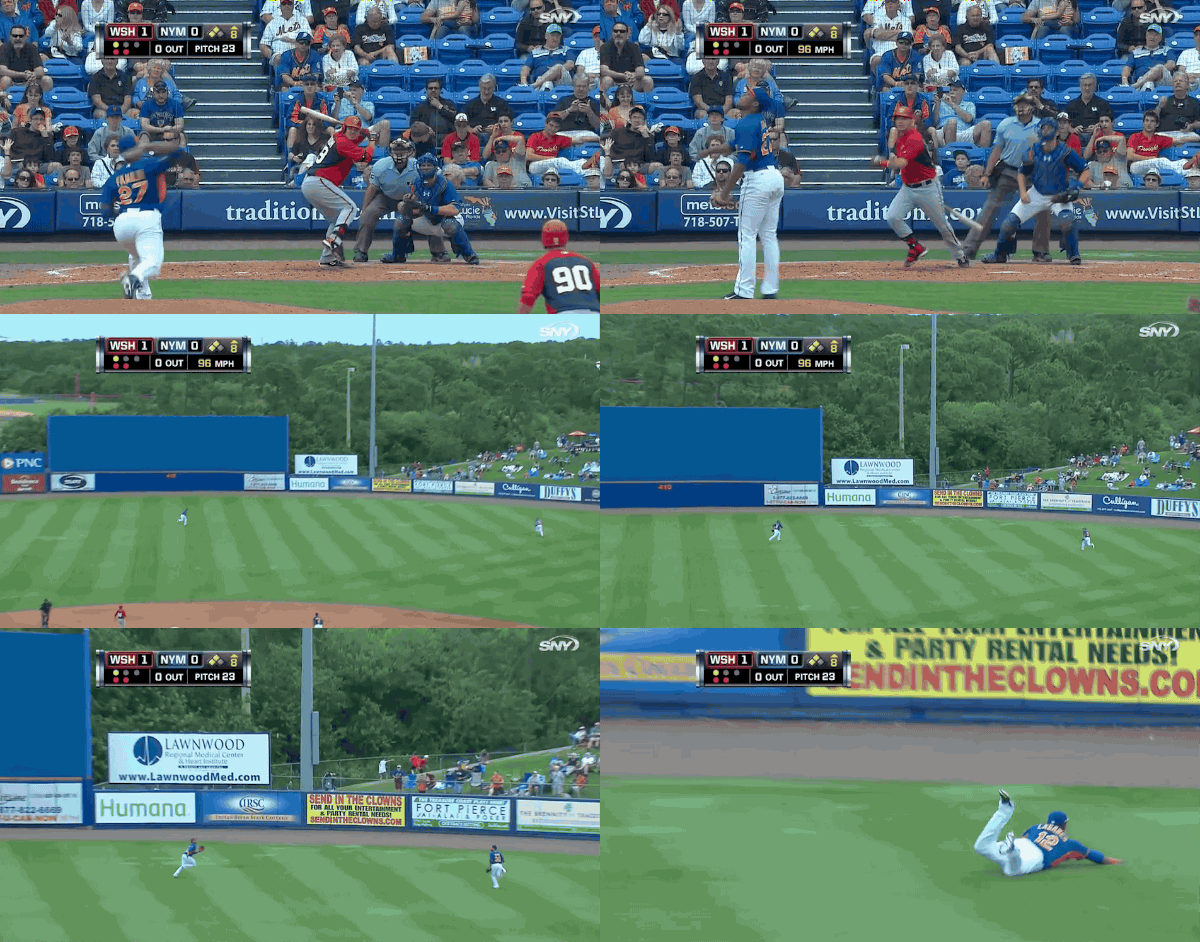
It’s easy to see the traits Lagares has in centerfield just by watching the GIF above or by watching a few videos of his highlights. The guy’s really fast. He seems like he takes routes directly to where balls are going to land. He robs homers. He’s got an awesome arm. The eye test lies a lot with outfield defense, making some players look good when they aren’t, but it doesn’t lie with him in regard to the stats: Lagares’ 2013 was the 2nd-best defensive year in the outfield during the past five years by UZR/150 (+34.1) since Nyjer Morgan in 2009 (+35.0), and those two players are over 2.5 runs better than the next closest player. His 2014 was also incredibly good, ranking 12th-best in the past five years (+25.3).
With that said, a caveat: we know UZR in specific years can be inflated or depressed by randomness in the form of a lot of different things, like the fielding chances a player experiences. The data is far from perfect. That’s one of the reasons we recommend heavily regressing UZR. However, when a player like Lagares gets called up and puts up two straight years of incredible UZR while drawing universal praise in scouting reports, there’s probably something to it. Jeff wrote about this specifically with Lagares in mind last year, and it’s a great read to better understand UZR and the guy we’re talking about.
Those two years of fielding data aren’t a whole lot, but they’re something, and they tell us Lagares was one of the best defensive players in the game during 2013 and 2014. To that end, I’ve created a table with the top 10 outfielders by UZR/150 over the past two years. We should keep in mind that a little weight should be given to 2014 over 2013 (Lagares had a lower UZR/150 in 2014) due to aging, so these could fluctuate a little bit, and everyone should be regressed toward the mean (zero):
| Name | Innings | Plays | ARM | RngR | UZR/150 |
|---|---|---|---|---|---|
| Juan Lagares | 1849 | 390 | 17.3 | 25.8 | 29.9 |
| Lorenzo Cain | 2059.2 | 460 | 3.1 | 34.0 | 24.3 |
| Jason Heyward | 2178.2 | 383 | 1.1 | 32.4 | 20.3 |
| Carlos Gomez | 2511.2 | 553 | 5.1 | 24.6 | 17.5 |
| Josh Reddick | 1848.2 | 302 | 0.7 | 22.0 | 15.8 |
| Gerardo Parra | 2516.1 | 404 | 14.5 | 17.1 | 15.8 |
| Alex Gordon | 2737 | 448 | 16.5 | 14.9 | 15.2 |
| Yoenis Cespedes | 2060 | 315 | 13.4 | 3.8 | 11.5 |
| Leonys Martin | 2375 | 533 | 18.4 | 4 | 10.7 |
A great arm and elite range are usually the foundation of a defensive wizard, and that is supported by these metrics. There aren’t a lot of surprises on this list: everyone of these players has some sort of reputation for being above-average at defense either with their arm, range, or both.
Now onto the other part of Lagares’ game. This is where the Mets think “anything here is a bonus”. Lagares was about dead-on league average last year, posting a wRC+ of 101. He doesn’t walk much (4.6% since his call up in 2013), strikes out at an average rate (21%, but slightly improved in 2014), and has basically no power (.105 ISO). His high BABIP in 2014 (.341) caused his average to come in at a nice .281, but his OBP was still rough with the limited walks.When he gets on, he’s a threat to steal given his speed, and he swiped 13 bases last year.
The BABIP is a big question, as a regression would pull his on-base marks (and thus his overall offense) down below league-average. His speed is his main ticket to maintaining that high BABIP mark. As it reads on his profile page: any offense he provides is gravy; the Mets didn’t extend Lagares primarily because of his bat.
Finally, we’ll take a look at where Lagares fits in with the rest of the Mets’ salary commitments and players under team control. I’ve charted the players who should make the 25-man roster this coming year, trying to avoid serious injuries. This is a little limited, because the roster is constantly going to change, and there will be trades, demotions, and promotions along the way. However, this still gives us an idea of some of the pieces that should make up the building blocks of the Mets roster for the next few years, barring any sort of huge trade.
The chart should be read as years until free agency, and I’ve simply combined the yearly salaries for all team control years without consideration of arbitration hearings (the pre-arb players should mainly be viewed through a years of team control lens here for that reason). Apologies in advance for leaving Noah Syndergaard off, and for any injuries or moves I might have missed:

I’ll go ahead and say it: there’s reason for optimism in this Mets roster for the first time in many years. Even with the long-term elbow injury to Zack Wheeler, there’s a young pitching core of Matt Harvey and Jacob deGrom under team control for at least the next four years (hopefully with Syndergaard soon). Add a few new names to the bullpen, rumblings of a possible extension for the quietly very good Lucas Duda, and the hope that David Wright can get back to being David Wright, and you have a few reasons to hope. The main point that we should take from this is that the team has control over a lot of good, key pieces for an extended period of time. At this point, that’s a big step forward for the Mets, and Lagares is a part of that.
Will Juan Lagares lead the Mets in WAR in 2015, like he did last year? It might be a long shot, but his heroics in the outfield don’t hurt his cause. Even if his defense isn’t quite as amazing as UZR says it is, the Mets still just locked up a many years of team control on a very useful player entering his prime for a reasonable price. You can do a lot worse than having an elite defensive center fielder with a league-average bat: I’m confident Lagares will remind us of that often.
Owen Watson writes for FanGraphs and The Hardball Times. Follow him on Twitter @ohwatson.
It’s also worth mentioning that DRS likes him even better than UZR. I’ve seen cases of players that look good according to one method, but they look below average according to the other. Lagares ranks elite via both calculations. According to UZR, he saved 43 runs over the last two years (24 in 2013, 19 in 2014). According to DRS, he saved 56 runs over the last two years (28 each season).
I’m not in love with that visualization of that contract commitments/years of team control visualization. The AAV coloring really doesn’t do a great job of conveying anything *except* where the expensive players are, as the shades of blue/grey all just look kind of grey to me with the only ones jumping out being Wright and Granderson, and the text on the greys is hard to read, making it even more difficult to see.
Not quite sure how I’d do it differently, but … yeah. Ask Sean!
Contracts are hard to visualize in just one graph because there are just so many variables. This does a pretty good job showing the basic information about the contracts. One of the things I took away is that there are a lot of players under team control, and the shorter contracts tend to have higher AAV. Then Lagares fits in the middle of the AVV spectrum.
We are trying to develop a suite of contract and value graphics, so feedback is great — colors will contrast more.
also worth mentioning that Lagares played in just 116 major league games last year which gets to the plus and minus – a) can he stay healthy and play in 140-160 games? and b) if so, how much more would he be worth at that?
interesting also to note that he had 10 of his 13 steals last year in the last 6 weeks of the season when the Mets suddenly decided to see how effective a base-stealer he could be. I am very interested to see if he tried more SB over the full season and ends up with 30+ this year.
He’s only attempted one stolen base this spring though. I would think that now is the perfect time to keep running because it doesn’t matter if he gets thrown out. If he’s not working on his timing, then I’m not so sure he would steal plenty of bases when the regular season begins.
On the other hand, maybe he just doesn’t want to waste the energy and risk a freak injury in the spring.
I noticed that too. I think you’re right – doesn’t want to risk injury.
BTW I do not get tired of watching that GIF.
With regard to the chart, don’t the Mets have 6 years of control for Lagares? He is already signed for 2015. The new contract kicks in next year, covering 2016-2019, plus a team option for 2020.
I think the problem is that he chart includes both the “commitment” and “years of team control” – you can’t really put him down for 6 years without including the price of that option in the commitment.
I can see that, except Niese is signed thru 2016, with team options for 17 and 18, and he appears with the Mets having 3 years of control. Is 2015 skipped in terms of commitment/control?
No, Wright’s deal has a hard end at 2020 and he is listed as 6 years. The Lagaras number is a little weird in that it is 23 million, which I’m guessing is because .5 million of that 23.5 million is the buyout on the option, but then again his .5 million salary from 2015 should be included. My guess is Niese is just an error. The amount for Niese also doesn’t make sense no matter how you are slicing it.
Thanks for the catch, everyone. Lagares should be at 23.5, and Niese is definitely out of whack with his option years: https://spreadsheets.google.com/pub?key=tfJWfaPG4VXbDyBscIZf1MQ&output=html
Maybe they could add option years in a second color to the right of the mutually assured years.
…
Batting eighth and pitching for your NY Mets, Bartolo Colon.
Batting ninth and playing center field, Juan Legares.
This will happen at some point this year. Almost certain it did last year.
I’m pretty sure it didn’t.
I can’t say I see this deal as a major win for the Mets. It is certainly not going to be a disaster but the Mets only received 1 additional year of team control in exchange for their 23 MM dollar investment.
Defense first player do not receive high arbitration salaries. The Mets commitment to pay Lagares $2.5MM in 2016, $4.5MM in 2017, $6.5MM in 2018 and $9MM in 2019 are probably a bit higher than he would have received via arbitration. The two best comparison I can find to Lagares are Nyjer Morgan and Peter Bourjos. Lagares’ minor league offensive numbers (.281/.322/.403) are better than Morgan’s but are actually inferior to those of Peter Bourjos (.291/.345/.455. Neither Morgan nor Bourjos produced consistent MLB offense and did not come anywhere near 20 MM dollar guaranties.
It seems like the Mets paid a high price to secure a single option year on player whose value is based on defense and a high BABIP.
there is potentially bat and mlb financing issues at play in his arbitration outcomes without the contract. Bourjos also has playing time issues, and last year hit .231. Lagares has been the starter, very important for arb.
my point being that, even if they’re not saving tons of money over the arb years, there is a good chance they could, they get an extra year of leverage, and they aren’t overpaying, or taking on a big risk. I’d say its a pretty darn good deal.
Lagares has room to grow offensively. He’s a hard worker and committed to being a better player. Now that he has the security for the next 5 seasons it’s on him to make it worth the investment.