The Mets Made a Trade for Marcus Semien; Texas Is Bringing Brandon Nimmo In
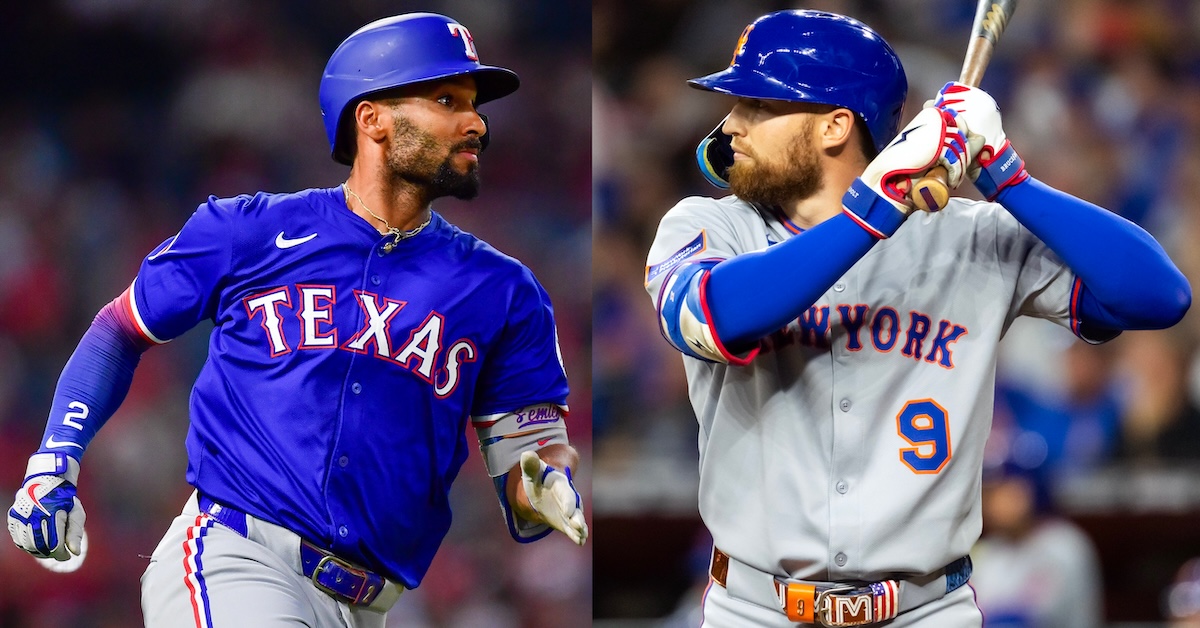
The New York Mets are trading outfielder Brandon Nimmo to the Texas Rangers in exchange for infielder Marcus Semien, ESPN’s Jeff Passan reported Sunday night. You don’t often see one-for-one trades involving two players with a combined 66.9 career WAR in their past, but this deal was made possible by the combined $173.5 million owed Nimmo and Semien in the future.
The Mets and Rangers are both top-10 payroll teams and recidivist whales in the free agent market (with the caveat that the Mets are somewhat more top-payroll than the Rangers are), so this is not a straight-up salary dump. Indeed, only a trivial amount of money — $5 million moving from New York to Texas, according to Jon Heyman — is changing hands. That greases the skids, but it’s only about 5% of what Nimmo’s owed, and less than 3% of the total remaining value of the contracts being moved.
Semien and Nimmo have both been excellent players in the recent past, as reflected in their compensation. Semien is on a seven-year, $175 million contract he signed with the Rangers before the 2022 season; Nimmo had a .385 career OBP, and was coming off a 5.5 WAR season, when he signed with the Mets a year later for $162 million over eight years.
As good as both players have been in the recent past, the remaining freight on their contracts (three years, $72 million for Semien; five years, $101.5 million for Nimmo) all but certainly outstrips the on-field value they’re likely to provide going forward. Semien is 35; he’s seen his offensive output decline each of the past two seasons, and while he was a very good defensive second baseman in 2025, that’s a decline from what he was in 2023 and 2024, namely an elite defensive second baseman.
Semien also missed the last month of the 2025 season with a broken foot, though it was the result of an unlucky foul ball, rather than some chronic age-related degeneration. That’s encouraging, but when a player Semien’s age takes his first trip to the IL in eight years, it’s worth flagging no matter the cause of the injury.
Speaking of foot injuries, Nimmo was dealing with plantar fasciitis — otherwise known as Albert Pujols’ Disease — through 2024 and early 2025. Whether through foot injuries or some other mechanism, Nimmo has been hemorrhaging athleticism over the first three years of his deal. In his walk year (well, his run year, given how Nimmo takes his free passes), Nimmo had 84th-percentile sprint speed. This year, he had 44th-percentile sprint speed.
Through it all, Nimmo has played at least 151 games in each of the past four seasons, and after crossing the five-steal threshold only once in his first eight seasons, he’s 28-for-29 in stolen bases since 2024.
But the version of Nimmo the Mets signed up for in the winter of 2022 needed to be able to run. Back then, Nimmo did the most important thing a position player can do — get on base — extremely well. Sincerely, he was one of the best non-Aaron Judge, non-Juan Soto, non-space alien on-base guys on the planet.
At the same time, he’d hit 10 homers in a season only twice to that point. He had never — and still has never — hit .300 or slugged .500. His career strikeout rate was 22.3% in 2022, and it has not budged even a tenth of a point three years later.
In short, this was an average hitter — using “hitter” here to mean strictly the bat-to-ball component of the game — whose elite on-base talent made him a very good offensive player overall. If you’re paying that guy more than $20 million a year, it’d be nice to be able to use him in center field.
Nimmo was never Kevin Kiermaier, but at his peak he could at least fight center field to a draw. Not anymore, and the athleticism markers are going the wrong way. Over time, that started to cause problems for the Mets. Soto’s not a good defender in right, but even if he’d be willing to DH, the Mets were using that spot on Starling Marte. Pete Alonso probably should’ve been DHing, but he had to play first. Mark Vientos is probably a first baseman, but he had to play third. Brett Baty is a third baseman, but he had to play second. Jeff McNeil is probably a corner outfielder, but he couldn’t play there because of Nimmo and Soto.
What a headache. Even with terrific defense up the middle, the Mets ended up with the 19th-best defense overall last season. Obviously, that logjam was already starting to solve itself. Alonso and Marte are free agents, and McNeil just had surgery for thoracic outlet syndrome, which will probably end any dreams he had of being a pitcher. More to the point, McNeil will at least start the season on the IL.
Nevertheless, being tied to Nimmo in left reduces a team’s options. At the same time, Nimmo has been changing his approach to become a more conventional hitter. He’s averaged 24 home runs a year since signing his contract, but at a huge cost in OBP. Over the past two seasons, Nimmo has hit .244/.326/.418. In 2025, he posted his first single-digit walk rate since his 32-game major league debut in 2016. There are one or two additional yellow flags if you squint — a declining in-zone contact rate combined with an increasing pull rate, most notably — but I don’t want to overstate things when Nimmo is self-evidently in decline.
Qualitatively, he’s now just a normal dude, rather than the guy you can stick in front of Alonso and have him score 100 runs a year. Quantitatively, Nimmo is now a 110 wRC+ guy, rather than a 130 wRC+ guy.
Personally, I think the downside risk with five years of a declining corner outfielder is huge, especially when he starts from a 110 wRC+ baseline. The Phillies found this out when they signed Nick Castellanos to a contract that almost exactly matches what the Rangers owe Nimmo going forward.
But Nimmo clearly has a good eye, and he’s already made one major approach adjustment, and left field isn’t especially physically taxing. At any rate, he’s miles better than Adolis García, who was non-tendered on Friday, has been the past two seasons.
Semien, in addition to being two and a half years older than Nimmo, has an offensive style that has far greater risk of going to zero. Over the past two seasons, Semien has a .307 OBP, and he’s seen his power drop from 29 homers and a .201 ISO in 2023 to 15 homers and a .134 ISO in 2025. Semien’s contact rate is declining gradually — it went under 80% last season for the first time since 2020 — while he’s swinging and chasing more.
I’m not going to go as deep on Semien as I did on Nimmo, because while Peak Nimmo was an odd player, Peak Semien is much easier to understand. In 2023, Semien had a 128 wRC+ with elite defense at second base, and was worth 6.5 WAR. In 2024, he had a 101 wRC+ with elite defense at second, and was worth 4.3 WAR. In 2024, he had an 89 wRC+ with above-average defense at second, and was worth 2.1 WAR. Maybe push that last WAR total up a couple tenths to account for time missed with the broken foot.
There’s a wide, wide range of reasonable opinion on whether Nimmo or Semien is better now. All the more so if you’re talking about how the two are going to age over the next three seasons.
Me? I’d probably take Semien right now, but they’re of similar value out of context.
That said, context is why this trade got made. I’d take Semien over Nimmo for two reasons: First, I place a high value on the team-building advantage granted by having a solid, reliable second baseman. You can find a slightly above-average hitter who can stand in left field a lot more easily than a good defensive middle infielder who has a clue at the plate.
For the Mets, Semien’s a better fit. You can plug him in next to Francisco Lindor, turn a million double plays, and forget about him until October. The Rangers don’t have anything like the clutter the Mets had last year at the left end of the defensive spectrum. There’s Wyatt Langford, and then… I don’t think I’d be especially attached to either Joc Pederson or Jake Burger if push came to shove. And if Evan Carter is healthy enough to get in the lineup every day, but not healthy enough to play center, well, you can cross that bridge when you get there.
Second, the contract situation. Semien will cost the Mets $26 million this year in cash and $24 million in CBT value; Nimmo costs the Rangers $19 million a year for both, once you factor in adjustments for signing bonus and what the Mets are chipping in for processing and handling.
If I were building a team with limited resources (which the Mets might not be, to be fair), I’d rather have Semien than Nimmo because you can get out of the Semien business two years quicker, and for about $25 million less overall, than you can get out of the Nimmo business. The Rangers are paying less money year-by-year, but the Mets are paying less over the life of the contract. That comes with the obvious follow-up question: What are you going to use that savings on? How much of it will be redirected to fill other needs? This isn’t a sport where cap space is a tangible concept; every decision with a financial motive needs to be followed by, “And then what?”
That uncertainty makes this move — simple as it is — hard to judge so early in the offseason. As pessimistic as I am bout Nimmo’s long-term career path, no one can deny that the Mets’ lineup looks extremely short at the moment. By acquiring Nimmo, the Rangers replaced, and improved on, García. But do they have a plan for replacing Semien, or have they just robbed Peter to pay Paul?
Ultimately, this trade of useful players on massive contracts ought to make the path forward easier for both teams. In an ideal world, everyone walks away happy.
Michael is a writer at FanGraphs. Previously, he was a staff writer at The Ringer and D1Baseball, and his work has appeared at Grantland, Baseball Prospectus, The Atlantic, ESPN.com, and various ill-remembered Phillies blogs. Follow him on Twitter, if you must, @MichaelBaumann.
What an interesting swap. I think I agree that I’d rather have Semien just because it’s a slightly shorter commitment, but it’s close.
In two years, I feel like Semien is a pinch runner/defensive replacement, once a week start guy.
In two years, I think Nimmo might be a league average bat, with no speed, no defense, essentially a DH who you’re still on the hook for a few more years.
Semien is two and a half years older, but if you watched both of them play last year, you’d be hard pressed to notice an age difference.
Sadly, Nimmo is not moving around well anymore…
I think their opinion of declining in athleticism corner OFs moving down the defensive spectrum may be colored by the last couple years of Marte. I don’t think that Nimmo follows that path as he started from a better place in terms of defensive skill and batters eye (things that don’t necessarily decline with age the same), but it’s a reasonable concern to wonder if he’ll become unusable quick in the OF while bringing a league average at best bat
i dont see nimmo recovering from the plantar fascias.
I think both guys can rebound a bit. That park played horribly for Semien right handed power. Also he was hurt. Nimmo has shown the ability to make adjustments prior, and was also hurt. Should we expect either guy to improve? Not really. But I wouldn’t be shocked at a 100ish wrc for Semien and 120 for nimmo. Also wouldn’t be shocked if neither happens.
Yup
This is a straight up challenge trade.
Semien was not good last year but his statcast page was basically identical to his previous three years, two of which had him as a league average bat and one above average. The Rangers suffered through a year where Semien was hurt for the first time in his Rangers career (maybe his entire life) and said “nope, not gonna do that again.”
But the Mets clearly think he’s going to bounce back to his career norms, and while Nimmo might still be better in 2026 the arrow is definitely pointing down for him long term.
I can’t say who is going to get the better of this trade but I like the way the Mets are thinking about it. Teams suffer from too much recency bias.
Yeah, I went into his page after the deal and noticed the drop, but also that his xWOBA last year was higher than 2024 and hasn’t dropped off as much as his actual production.
Advanced stats show some dropoff on D, probably in range, but he can still make great plays and earned a good glove
The other piece of this is that it is clear the Mets *do not trust* McNeil playing second base in 2026.
I don’t know whether they don’t like his defense at second base, and they want to move McNeil to left field (or center field, or first base, both of which seem like a less good idea) because of that. Or if they think McNeil won’t be the same after surgery. But for whatever reason they have decided that they didn’t trust McNeil there for 2026.
I have seen enough people suggest that this means that they are going after Kyle Tucker or Cody Bellinger. I have no idea whether that is part of it or if they just feel better about McNeil in left field than at second base. But I do think they’re going to have to find a way to put plus defenders in both left and center field to compensate for Soto. Moving McNeil to left may or may not get them closer to that.
Moving McNeil may not get them there, but this swap does give them more options to improve their D without hamstringing them too hard on offense.
Yeah, I had a comment apparently eaten by the filter saying just this. For the 2026 Mets roster, even if they don’t make another move, this is about moving McNeil to LF, and presumably also about being pessimistic about Nimmo’s mobility.
Also it is funny that the Rangers’ “youth movement” apparently involves bringing in Brandon Nimmo.
I know they are moving in that general direction with this deal but he is not particularly young anymore!
At least he’s an interesting role model for Evan Carter. I know I thought of Carter as a potential Nimmo-type player when he was coming up.
I think this makes a lot of sense for the Mets. When you already have Juan Soto locked into a corner outfield or DH spot for the next fourteen years, you would really prefer not to have the other corner outfield spot occupied for five years by a player who’s much more good than great. The Mets clearly need to substantially improve to become a true World Series contender, and Nimmo was going to make it harder for them to make substantial improvements. I also think Semien is a good player; the underlying metrics are concerning, but you could easily say “He just had a horrible slump the first two months and hit basically the same as ever after that”.
I think it’s ~fine for the Rangers, but Nimmo is going to be a lot easier to replace than Semien, even if Nimmo was better last season.
I guess, but Nimmo is projected to be the 38th outfielder in WAR over 600 PAs by Steamer. The only four players ahead of him who are realistically available are Kyle Tucker (1.6 WAR advantage), Steven Kwan (0.4 WAR advantage), and Cody Bellinger (0.4 also). Those three plus Jarren Duran are also the only ones who had more WAR than him last year (he was #20 on that one). I guess you can throw in Brendan Donovan too, but he’s more valuable in the infield.
I know he’s down from 2022 / 2023 but improving on 2.5-win outfielders isn’t super easy. It’ll definitely cost them either in terms of money or prospects.
Those numbers are fine but the player is the player.
Marcus Semien won the Gold Glove at second base in 2025. Despite the author’s assertions to the contrary, Semien does not provide average leather for the middle infield.
He said “above average” this past year and elite before that and describes him as a good defensive middle infielder going forward. You can argue that’s underselling him, but I don’t think he suggests he’s just average anywhere in the piece.
Yeah, I would say above average may be slightly underselling him, I haven’t looked at his advanced stats but the eye tests suggests he’s still good/great even if no longer elite.
GG still isn’t like fully embracing advanced metrics but you usually don’t win by being merely “above average”
There were only 4 players with 100 GS at 2B in the AL last year, and Semien was the only one with a positive FRV. If Gimenez, Chisholm, or Rengifo see Semien’s volume at 2B, any one of them likely win the GG last year (Gimenez had a decent argument for it even with 400 fewer innings).
That said, Semien is probably still an above average defender at worst for 2026, but I think projecting above average defense (something like a 55 grade & 3-5 FRV/150 games) over the last 3 years of his contract is pretty close to what will happen barring serious injury.
Now that’s an interesting nugget surprised that there were so few that started 100 games or more.
I’ll miss Brandon he was a great Met but it was time to go given that he was a declining from his 2018 through 23 peak and had five year left on his deal. Nimmo had a obp in the low 300’s and a 114 and 109 the past two years when he was a130 wRC+ guy previously. I was glad Nimmo re-signed a few years ago but giving him eight years was nutty no way would have Stearns made that move. Brandon imo is the third best outfielder in franchise history and carved out a very good career after having managers and a gm not believing in him early in his career.
Semien is a few years older but his deal is two years shorter and that’s big imo. Marcus’ offense has declined but his defense is very good and there could be some rebound getting out of glove life. McNeil played good defense at second and can go back to the jack of all trades and play everywhere and start three days a week if he isn’t traded. He could be a hedge if Benge isn’t ready.
I already thought Jett was getting traded and I’d be shocked if he isn’t traded in a package for Ryan or someone of that ilk.
I was looking for a post from you, David, because you always give good, thoughtful responses on this site on Mets topics.
I agree with you and feel the biggest takeaway was that Stearns was able to get rid of a bad contract he never would’ve agreed to for a veteran player, admittedly seemingly on the decline, but a workhorse who plays everyday at a needed position.
With the MI now (health-willing) potentially locked up for 150+ games each, it gives Stearns much more roster flexibility to platoon at other positions and/or get some of the younger, more athletic talent up like Suero and Morabito, along with top prospects like Benge.
Doing so could allow Stearns/Uncle Stevie to use that money to lock up a free agent like Pete, or one or more of their young guys to a Kristian Campbell-esque long-term contract.
Thank you for the compliment I very much appreciate it! I agree with you on more flexibility for sure.
They both seem to enjoy playing baseball in a refreshing way. I hope they both do well and have fun making new friends on their new teams.
If you look at some of the Rangers moves (Heim, Garcia and Semien out, Nimmo in), they seem to be placing an emphasis on reaching base. Those 3 were a drag in 2025, with a combined OBP well under .300.
Combined average, that is.
Or the Rangers offense was even worse than I remember!
Nah, it’s OBP, though combining them is slightly unfair to Semien. Heim and Adolis each had OBPs of .271, Semien’s OBP was .305.
Texas’s team OBP was not great, at .302 coming in only ahead of rhe White Sox, Angels, Guardians, and Rockies. Josh Jung (.294 OBP) and Jake Burger (.269 OBP) were also big culprits.
Can you, tho? I accept that there is more than a little semantic wiggle-room embedded in rigorous statistical concepts like “can stand in left field” and “has a clue at the plate”, but I’m not sure that’s true.
Semien has dropped 2 WAR per year since 2023. If he does that again he will be replacement level in 2026 then out of baseball. Seems likely that Nimmo can at least be a playable DH against RHP for awhile.
You’re criticizing the author for taking “semantic wiggle room” in the same comment in which you just assume that Semien will just continue to hemorrhage 2 WAR a year until he’s put out to pasture. Interesting.
Yes. I figured someone who is paid to write about baseball on the stats site might do a little bit of analysis instead of just vibing.
It is rare for over-35 guys to be worth even 2 WAR at 2B, and when they do it it is usually with productive bats. But Semien’s peripherals have collapsed and he’s moving into a more difficult division, so his bat is unlikely to substantially improve. Look at Nolan Arenado’s trajectory, it’s a very similar situation.
The broader point is that good-hitting LF are actually pretty rare now, compared with competent-fielding 2B.
At 35, Semien is already one of the oldest position players in the league and still has three more seasons of $26 million, $26 million, and $20 million. DRS and OAA both say that he took a big step back defensively in 2025 from great to above average. His bat speed was also at a career low.
The Rangers clearly got the better player in this swap but I understand the positional element from the Mets’ point of view. If they end up signing Tucker then they’ve obviously made their team much stronger.
It is rare to see bonafide major leaguers traded one for one. The only one that jumps out to me was way back after the 1959 season when Rocky Colavito, the HR leader that year, and Harvey Kuenn, the batting average leader, changed uniforms. In that trade both players were at the peak of their careers but in this one it looks like both teams realize that the guy they had is cooked and were willing to find out if the other team was wrong in its assessment. Very strange.
For some reason, I always think of the Jim Thome for Aaron Rowand swap, which worked out well for both sides. Or the Ian Kinsler for Prince Fielder trade that was pretty lopsided.
Two one-for-one trades in Cardinals history, involving 3 HoF and a HoVG:
Rogers Hornsby for Frankie Frisch
Scott Rolen for Troy Glaus
In both cases the players were getting older but all were still productive. Hornsby and Frisch both won an MVP after the trade. Rolen made two All Star games and won one more Gold Glove. Glaus wasn’t nearly as good, but he did have a 4+ WAR season before injuries took him down.
I remember Prince Fielder for Ian Kinsler. You would think that the Rangers would be more careful trading away their second basemen after that, but Chris Young was bouncing around the league then trying to get guys out with an 86 MPH fastball so he might have had his attention elsewhere.
My wildly speculative take on this trade is that Cohen wants to trim off some long-term commitments in case the rest of the league demands a salary cap. They’re already projected for a $106-7M luxury tax number for 29/30. So if there’s a number to get under, getting out of that contract two seasons earlier might end up being a big deal.
I don’t think that’s a crazy take. There’s a labor argument (hopefully not a *fight* per se) coming up, and I don’t doubt that teams are making moves with that in mind
This is the first big trade I can think of where I really don’t have any strong feelings about it. I think the most surprising thing here is that Nimmo waived his no trade clause to leave the only team he’s known for the Rangers. If winning matters most I’d pick the team with Soto, Lindor, and the free spending owner.
Made some money on taxes
Nimmo was always a great interview and seemed to love playing for the Mets pretty genuinely, but it does seem at least possible to me that the aw-shucks country boy from Wyoming was a little more sick of living in New York, and being constantly screamed at by New Yorkers, than he was letting on.
Excellent article. Small correction: reports from when he had surgery had McNeill back by spring training not opening the year on the IL.