The Worst Bunts of the Season (So Far)

Here at FanGraphs, we’re always looking for an excuse to paraphrase Tolstoy, so let me introduce you to a principle I’ve recently noticed about sacrifice bunts. Successful sacrifice bunts are all alike (and boring). Every unsuccessful sacrifice bunt is unsuccessful in its own way. Let’s talk about the worst sacrifice bunts of the year and explore the myriad “own ways” you can fail.
First, some ground rules. I’m looking at every bunt through June 9; that’s the last day I pulled data for. (Don’t you worry: I don’t need an excuse to write about future bad bunts later this year.) I’m ranking them based on win probability added. I’m considering the results of the play, not just the decision to call for a bunt in the first place. That might be more theoretically useful, but it’s a lot less fun; we want to watch bunt train wrecks, not debate the finer points of ex-ante strategy. The worst bunting decision of the year is arguable, and dependent on many factors which can be hard to pin down. The worst result? It’s pretty clear, as you’ll see.
First, let’s dole out an honorable mention. This bunt is the one you’ve all been waiting for:
June 5, Danny Mendick, Chicago White Sox
The situation: It’s the bottom of the sixth, runners on first and second, no outs. The White Sox trail by a run. With an ineffective Derek Holland on the mound, Chicago has been doing damage. The first four batters of the inning have all reached, driving in two runs and leaving two runners aboard. Mendick isn’t a great hitter, but he had the platoon advantage, and Holland hadn’t retired a batter yet.
The play:
The cost: -.091 WPA
Look, just don’t do this! The White Sox didn’t need to bunt. Tigers first baseman Jonathan Schoop made a high-risk decision, and it paid off. The Sox didn’t score again in this game. It’s not one of the five worst bunts of the season, though.
With that one out of the way — and it was bad, don’t bunt there! — let’s get down to brass tacks.
5. April 17, Anthony DeSclafani, San Francisco Giants
The situation: Runners on first and third with no one out in a tie game in the top of the 10th inning. Reliever Jake McGee was due up for the Giants, but he probably doesn’t even own a bat. There were no hitters left, but DeSclafani, the previous day’s starting pitcher, at least has some bunting experience.
The play:
The cost: -.167 WPA
I’ll be honest: I’m not quite sure what Donovan Solano was doing on this play. I watched it from several angles, and it still feels impossible that he would be out by such a margin on an overall solid bunt. Solano isn’t fast, and Jorge Alfaro has a cannon, but he wasn’t even close to beating the throw. He simply seemed to react late when the ball was put in play. The run ended up costing the Giants; DeSclafani was stranded on third, and they lost in the bottom of the inning.
4. June 6, Nicky Lopez, Kansas City Royals
The situation: It’s the bottom of the third with runners on first and second and no outs. The Royals trail by a run. Twins rookie Bailey Ober, making his second start of the season, breezed through the first two innings before allowing back-to-back singles to start the third. Lopez leads baseball in sacrifice bunts by a position player, so it’s a safe bet that Minnesota knew what was coming.
The play:
The cost: -.17 WPA
Oof. Oooooooof. That one is going to sting for a while. Please don’t elevate your bunts. If you must, please don’t elevate your bunts towards a solid defensive infielder. If you must, please don’t do it with no one out and two men on. It’s really hard to give up so much of a win so early in the game — most big WPA swings come late in the ballgame. Making three outs with one bunt is a good way to make this list, though.
3. April 18, Eli White, Texas Rangers
The situation: It’s the bottom of the tenth inning, and Charlie Culberson has been placed on second base. It’s a scoreless ballgame, so a successful bunt here would put the Rangers in the driver’s seat. White showed bunt on the first pitch of the at-bat, but the Orioles still played their defense reasonably straight — with no force play at third, it’s hard to commit to crashing.
The play:
The cost: -.176 WPA
This is a rare case where a bunt was a solid tactical decision. The math is solid if you get the bunt down; a runner on third with less than two outs is phenomenally valuable in a tie game. The defense was all but conceding the bunt as well, for reasons I can’t quite understand. But uh, don’t bunt the ball directly at the pitcher. Travis Lakins Sr. made a fantastic play to get a runner that his team wasn’t even particularly gunning for. Despite that, the Rangers ended up winning later in the inning, with White the deciding run. All’s well that ends well.
2. April 6, Geraldo Perdomo, Arizona Diamondbacks
The situation: Arizona scored in the tenth inning, but the Rockies answered with a run of their own in the bottom half. The Diamondbacks had a secret weapon, though: blindingly fast Tim Locastro made the last out of the tenth, so they started the 11th inning with one of the best baserunners in the majors on second. Perdomo isn’t a major league caliber hitter; he was playing while the team waited for Nick Ahmed to return from the IL. A sacrifice attempt was in order.
The play:
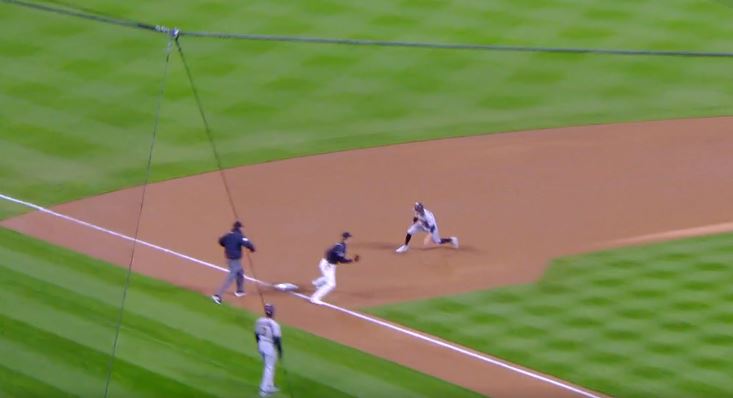
The cost: -.222 WPA
Bunting is hard! There are so many things to keep track of. Where are the infielders? Who’s covering the relevant base when the infielders crash? What kind of pitch should you look for? Is the runner far enough afield that you need to offer to keep him from getting hung up? Perdomo might have been thinking about those things… but he just hit the ball directly into the ground, so close to home plate that Elias Díaz was still in the batter’s box when he fielded the ball. Locastro is the best baserunner you could ask for, or at least on a short list… and he was out by so much:
1. June 3, José Rondón, St. Louis Cardinals
The situation: The Cardinals trailed by two runs in the bottom of the ninth inning. Lucas Sims gave up a single to start the inning. Edmundo Sosa followed with a perfectly placed bunt down the third base line — going for a hit all the way — and St. Louis had the tying run on base with no one out. Rondón, a depth call-up, was due up next. Mike Shildt put the bunt on, and disaster nearly struck on the first pitch when the Reds ran a pickoff play at second base. Then disaster struck for real.
The play:
The cost: -.267 WPA
Oh no. Oh no no no. Rondón is not a bunter. Since the start of the 2017 minor league season, he’s only sacrificed three times successfully. Matt Carpenter isn’t exactly a burner; the Reds had a good chance at getting him if the bunt wasn’t good. Not only that, but outs were at a premium, as the Cardinals only had three of them left and couldn’t afford to spend them willy-nilly.
That bunt was abysmal. Rondón was trying to pull back when he made contact with the ball. Even worse, he had one of the worst home-to-first times of the year. I clocked him at just over five seconds, which is Yadier Molina territory. Rondón is average down the line — he’s in the 4.35 range normally — but his brain just shorted out. He got confused when Tucker Barnhart charged the ball and just stood in the batter’s box for nearly a half-second.
If he had bunted the ball five feet farther in any direction, it would have been fine. If he had been bunting on the run, letting his momentum carry him up the line, it would have been fine. If he’d successfully pulled his bat back, it would have been fine. He did none of those things.
It’s hard to blame Rondón, though. Why would you bunt here? There were only three outs left in the game. If the Cardinals had pulled off a bunt, they would still have lost 3.7% of a win by bunting. They had pinch-hitters available; they’d only used one all game at the time. If Shildt honestly thought Rondón was such a bad batter that he would cost the team so much by batting, he could replace him.
Asked about it after the game, Shildt didn’t exactly make his case convincingly. “Either one can hit the ball out of the ballpark,” he said of the next two batters, pinch-hitter Paul Goldschmidt and Tommy Edman. That sounds like a great reason not to bunt if you ask me. But maybe he thought Rondón was secretly a great bunter? “We probably should work on our bunting more in spring training with guys like him who don’t get many opportunities,” Shildt said. Oh. Well then. If you want to have one of the worst bunts of the year, you need this kind of thought process and this kind of execution.
Will another bunt topple Rondón’s (and Shildt’s) as the worst of the year? Only time — and another GIF-filled article — will tell.
Ben is a writer at FanGraphs. He can be found on Bluesky @benclemens.
Bunting into a triple play is so funny, it’s literally the worst possible baseball outcome for that at-bat. The gap between the desired and actual result could not possibly be larger. Incredible.
I’m more curious about the gap between the expected and the desired result.
(great article, Mr. Clemens… I love stuff like this!)