
They Don’t Make Barrels Like They Used To
Here’s a weird chart:
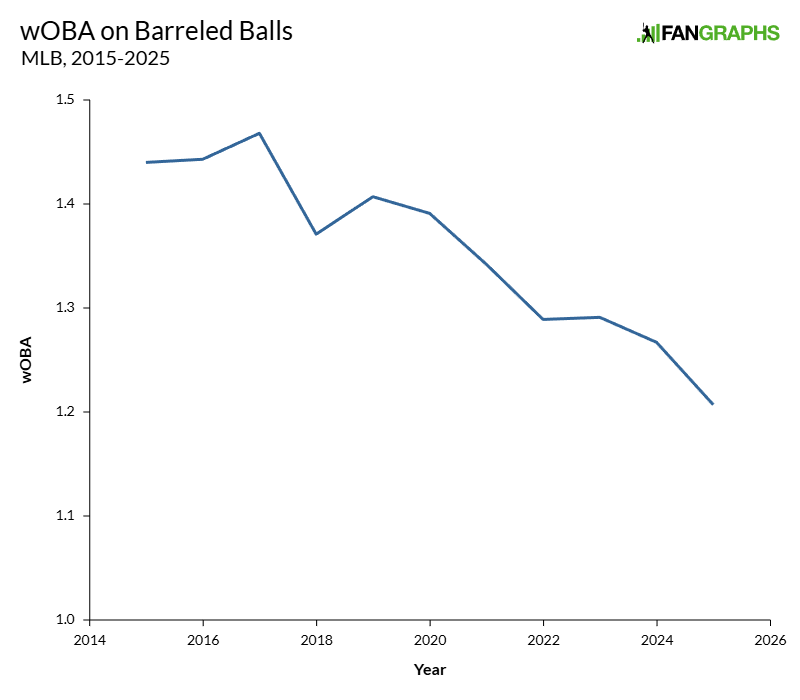
If you’re like me, you’re struggling to make sense of it. The value of a barrel? But aren’t barrels a measure of value themselves? That’s like asking how many dollars a ten dollar bill is worth, or how you’d rate The Lion King on a scale of one to The Lion King. But that’s not actually how it works. Barrels are defined based on exit velocity and launch angle pairs that, according to the dataset MLB used in their creation, were extremely likely to result in extra-base hits. Those cutoffs have remained the same. The results on barrels haven’t.
What gives? Well, some of it is the ball, of course. I’m not breaking new news in the long-running ball aerodynamics debate; you can read some good recent entries into tracking drag coefficients and the like here and here. Indeed, if you’re measuring barrels that way, you can see a pretty straightforward decline. Here are home runs per barrel over the years:
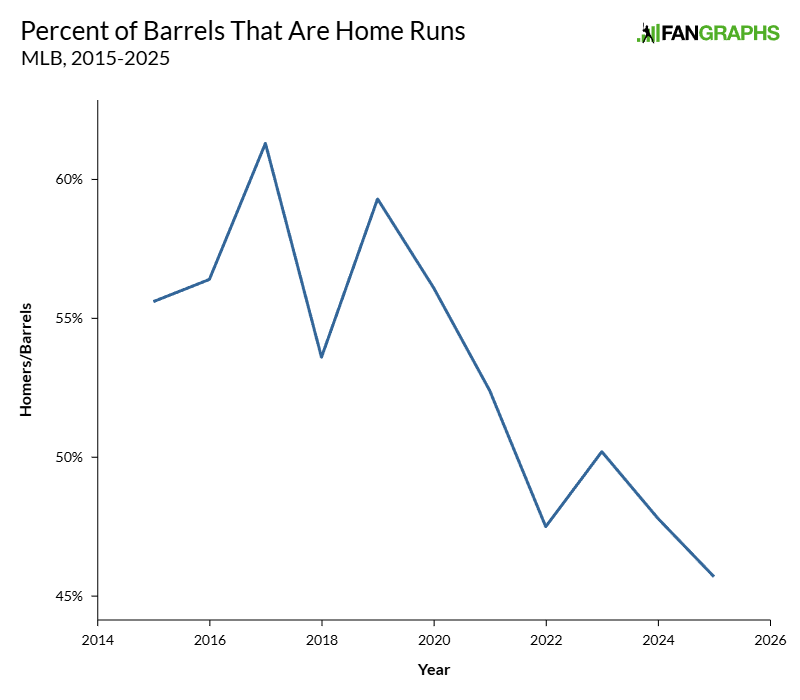
Fewer balls are leaving the yard. That’s definitely true. But that’s not what I’m hunting for. Let’s exclude all the home runs from barrels and focus on the balls that stayed in the yard. Here’s wOBA and xwOBA on non-homer barrels, 2015 to present:
| Year | wOBA | xwOBA |
|---|---|---|
| 2015 | .656 | 1.206 |
| 2016 | .678 | 1.202 |
| 2017 | .656 | 1.218 |
| 2018 | .610 | 1.140 |
| 2019 | .632 | 1.154 |
| 2020 | .639 | 1.109 |
| 2021 | .612 | 1.044 |
| 2022 | .582 | 1.024 |
| 2023 | .573 | 1.019 |
| 2024 | .550 | 1.022 |
| 2025 | .508 | .977 |
Or how about this one, barrel BABIP:
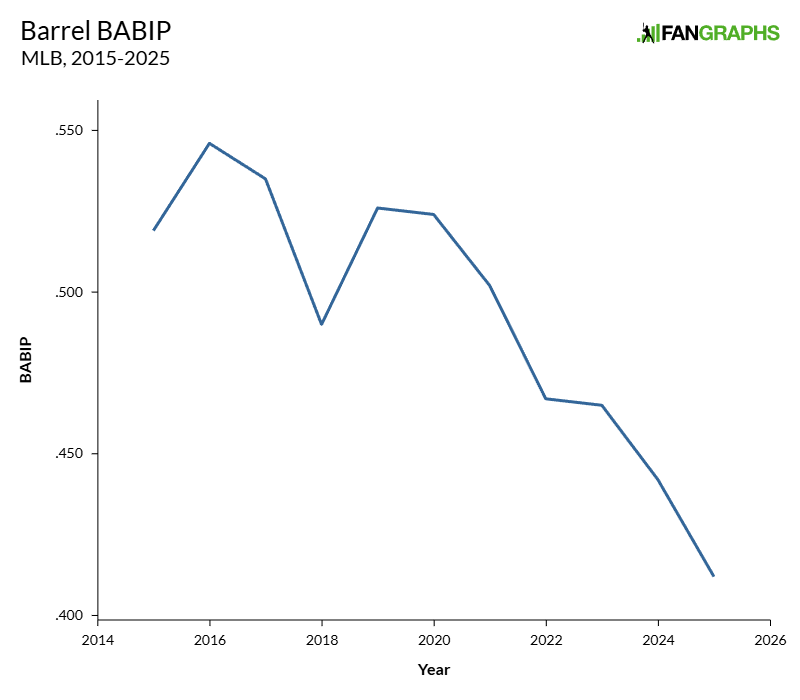
Or how about this overly specific one, BABIP on barrels hit between 300 and 400 feet to center:
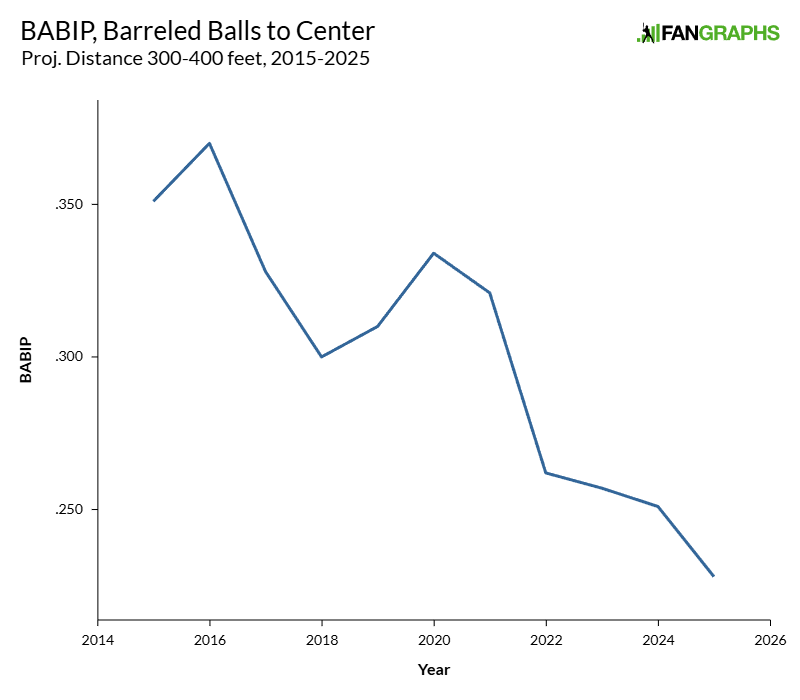
All of these graphs are pointing towards the same conclusion. And even without thinking too hard about the aerodynamics of the ball, you can take a pretty good guess as to what’s going on here: Outfielders are catching too dang many barrels these days.
In a common refrain for sabermetricians, Rob Arthur has already looked into this. All the way back in 2021, Rob dug into how balls in the outfield were falling less often. Better defensive positioning? Some downstream effect of the universal DH? Who knows. But outfielders were catching more baseballs than ever, and that trend has only increased in the years since. Russell Carleton confirmed the finding in 2024. Like Arthur, he didn’t come to a conclusion about why outfield defense was improving, but the fact of the matter is that outfielders are more effective than they were a decade ago.
It’s worth mentioning that you can split this trend into two. Softer-hit aerial contact is turning into hits about as often as ever. Hard-hit balls, on the other hand? They’re getting turned into outs more frequently. Well, the fly balls are, at least. Line drives seem to be pretty hard to catch:
| Year | FB | LD |
|---|---|---|
| 2015 | .150 | .661 |
| 2016 | .152 | .676 |
| 2017 | .158 | .672 |
| 2018 | .149 | .658 |
| 2019 | .153 | .668 |
| 2020 | .117 | .662 |
| 2021 | .153 | .663 |
| 2022 | .157 | .653 |
| 2023 | .142 | .668 |
| 2024 | .139 | .650 |
| 2025 | .130 | .647 |
I think that a major reason for this change is improved defensive positioning. The average center fielder starts 10 feet further back than they did in 2015. Left fielders and right fielders have backed up too. That had all happened by 2019, but outfielders have presumably gotten more accustomed to starting deep in the intervening years, re-learning routes and refining jumps. The natural counter to the offense realizing that extra-base hits are where the runs are is to start guarding against extra-base hits more often.
Remember that chart of home runs per barrel from up above? With all of those well-struck batted balls not leaving the yard, you’d expect the rate of doubles per barrel to increase. But instead, it’s static, checking in at 17.8% in 2025 as compared to 18.2% in 2015, and 18.2% for the Statcast era as a whole. We’ve never had a lower rate of triples per barrel, either, though batters only hit 197 barreled triples in 2025 as compared to 8,000-ish doubles and 5,000-ish homers, so triples are obviously less meaningful in this equation. On the other hand, singles per barrel are generally increasing – an effect of the outfielders playing back, presumably.
What does all of this mean for us stat-following nerds? Basically, they don’t make barrels like they used to. Here’s a mathematical example. Imagine a slugger from 2016. Our hypothetical hitter strikes out 23% of the time, walks 10% of the time, and barrels up 12.5% of his batted balls, a top-20 rate in baseball. Give him exactly average results on contact for his barrels and his non-barrels, and that works out to a .363 wOBA, a number that ranked 33rd in baseball that year.
Next, imagine a hitter with the exact same results in 2025. He strikes out 23% of the time, walks 10% of the time, and barrels up 12.5% of his batted balls. Barrels becoming less valuable has made our hitter meaningfully worse; with league average results on his barrels and non-barrels, he now posts a .337 wOBA. That would have been 57th in baseball last year; in addition to being worse in the absolute sense given that offense was lower in 2025, it’s worse on a relative basis too. In other words, a guy who hits a ton of barrels just isn’t as valuable as he used to be.
Now, are there mitigating circumstances here? Of course there are. Batters are barreling the ball up more frequently now, for one thing. Hitters smashed nearly 3,000 more barrels in 2025 than they did in 2017, the year when those colossal drives were most valuable. That 12.5% barrels-per-batted-ball mark that was one of the best in the sport in 2016? It would have been 55th among qualifying hitters in 2025. Loud contact is happening a lot more frequently now than it was then, even if it’s less valuable per event.
There’s also the problem of Goodhart’s Law. If you hadn’t heard of that one, here it is in a sentence: “When a measure becomes a target, it ceases to become a good measure.” In other words, if a group of people starts targeting some specific variable that’s associated with success, that variable’s association with success will decrease. Tell hitters that barrels get them paid, and they might start to change their behavior in a way that produces less valuable barrels, squared up to center field or in other ways that are easier to produce but less likely to land safely.
Do hitters know that they should be targeting barrels? Most definitely. Are they targeting a Statcast-defined barrel at the expense of just generally hitting the ball hard? I have absolutely no idea. But it’s unquestionably true that if you tell players “start hitting more barrels, and by the way, here’s a leaderboard for barrels,” some of their barrel-increasing behavior will probably be counter-productive in unexpected ways.
So are defenders better? Are hitters worse? Are they fooling themselves? Is the ball just dead? It’s definitely some of those things. But regardless of what’s causing it, if you’ve been in on Statcast data since the start and have developed a mental rule for how productive a hitter with a barrel rate of X is, you need to update your priors. Slug is still in the air. There’s just a little less of it than there used to be.
Ben is a writer at FanGraphs. He can be found on Bluesky @benclemens.
Ben, does this mean that the xWOBACON stat is just totally flawed and unreliable at this point?
WO BACON is always a reliable metric, especially in the presence of bacon.
Not at all. xwOBA has pros and cons that are more lengthy than I’m going to get into here, but it’s recentered every year based on that year’s data. For example, in 2015, batters produced a .361 wOBA and .357 xwOBA on batted balls. In 2025, they managed a .364 wOBA and .369 xwOBA. If xwOBA weren’t being re-defined every year, that would not happen.
I mean, what are you using the stat for? It doesn’t really do anything.
Wonder if the NL getting a DH slot had any contribution towards the better outfield defense possibility
Could this be a standardization effect? More hitters are gearing their approach around barrels, which have fairly consistent speed and launch angles, which makes them easier to read and thus to position for and catch?
I’m just theorizing here, but it’s got to be easier to make plays if more balls look the same than if every ball looks different, right?
To that point, in 2016, the second year Statcast data’s available, barrels/BBE jumped a full percentage point from 2015 alone, and has been steadily increasing. But that immediate jump says a lot about how the data has been used.
On all straightaway air contact, slugging has dropped 50ish points since the start of Statcast (and 130 points from its 2019 high). This is while the hard-hit% and barrel per BBE have never been higher. That’s huge.
This is excellent, and why I come here.
To me, this highlights just how necessary good outfield defense is, now. I wonder if an “ideal” launch angle might actually be lower than it has been in previous years, because those balls might be falling in at a higher rate thanks to defensive positioning.
Also, what is a liner vs a ball hit at a high EV? I’m honestly confused there.
I’m just using the Baseball Savant definitions, though I happen to agree with the way they’re done. They do everything off of launch angle. So if you hit it on a line, it’s a line drive, whether it’s one that ends up bouncing in the infield or a homer. Their pop up category is just batted balls 50 degrees or higher, so they don’t have a separate infield fly ball bucket, for example. I think they do a pretty good job of using one set of words to describe angle, and one set to describe speed.
Thank you!
I don’t know that the “lower launch angle” theory checks out. In fact, the 2025 SLG/BABIP numbers are better relative to previous years as you increase the launch angle (to a certain point).
In other words, on balls hit 200ft or greater, the 15-25 degree bucket performed worse relative to previous seasons than the 20-30 degree bucket (up to 30-40, which is where I stopped looking).
Great article, sucky trend! Not the better outfield defense part–that’s good! But the part where MLB basically remade the baseball and then pretended it hadn’t done anything, thus driving the home run rate down significantly, is bad for the style of baseball and also unfair to teams and players who targeted the hard-hit approach. If you want to change the dynamics of the game, do it openly and not sneakily!
This pairs nicely with Davy’s article from a few months ago: https://blogs.fangraphs.com/are-we-at-peak-center-field-defense/. Among many other changes, it seems teams are putting even better pure athletes in the outfield than ever before. It’s crazy that the average mlb CF sprint speed has increased from 28.4 ft/sec to 28.6 ft/sec in under a decade.
I’m glad you mentioned Goodhart’s because that’s definitely most of what’s going on here.
As barrel rate continues to surge, we’ll probably have enough barrels to further discriminate between “good” and “bad” barrels. Then, we’ll be able to see who is cheating to the measure most effectively.
I have a guess for the poster child. Few hitters saw a bigger surge in barrel rate than Jo Adell. But his results improved only moderately.
Don’t a lot of rate stats exclude strikeouts and walks? Like your barrel rate is the % of PAs that aren’t Ks or BB so it’s not really 12% of all PAs but 12% of the PAs when you didn’t strike out or walk.
So if you K or BB 35% of the time that 12% barrel rate is less impressive and more limited in the total damage you’re doing at the plate. That to me is the Adell Barrel fallacy.
*unless I’m wrong about how the percentage is calculated in which case I’ll turn in my abacus and show myself out.
The thing about Adell is his BB+K% is around lg average (and went down a couple points in 2025). His barrel rate increased 50% to one of the highest in the league. His offense only jumped from 10% below average to 10% above average.
Yea, that’s meaningful, but it tells me it’s barrel or bust with him. He had 65 barrels but only 124 hits.
What about the impact of the universal DH, which moved some bad defenders out of the NL outfields, and shrank benches, requiring more subs to be versatile UT guys that are decent fielders? Remember when Schwarber, Alvarez, and other clunkers used to be in LF every day?
What does the difference between wOBA and xwOBA indicate?
Connected with the other thoughts/comments, but assume the downward trend in hitter ages that Ben showed in his article last week is also contributing to the better athleticism and better defense contributions.
We should consider the value of outfielders wearing PitchCom receivers. I played a lot of SS, and it was a huge benefit to know what pitch was coming from the catcher’s signs, especially when familiar with the hitters. Easy to anticipate where a hitter was likely to hit a fastball away vs. a breaking ball low and in.
Huge advantage on jumps. Now outfielders have that benefit as well. Combine that with better positioning and everything else mentioned here.