
When Chases and Whiffs Don’t Lead to Outs
A pitcher goes to the mound hoping to record outs without allowing runs. Unfortunately, a lot goes on between the ball leaving the pitcher’s hand and the scoreboard changing. You can’t just toe the rubber, chuck the ball, and say, “God’s will be done,” as you stare glassy-eyed into the distance like Martin Sheen as Robert E. Lee in Gettysburg.
I mean, you could, but you wouldn’t like the results.
A modern pitcher goes to the mound with a plan to influence events much further up the causal chain. Every pitcher is special in his own way, but every plan boils down to this: By changing speed, movement, or location, trick the hitter into swinging somewhere other than where the ball will be.
Even when that plan is executed well, the results are not entirely within the pitcher’s control. So I got to thinking about which pitchers were good at the important stuff but got bad results. Can we identify specific reasons for these anomalies, or is someone just always going to get screwed in a universe that works on a bell curve?
I had two underlying numbers in mind for this: Chase rate and contact rate. (Baseball Savant shows the latter as whiff rate; Contact% is the yin to whiff rate’s yang, and it’s what we’ve got on our site.)
Last season, Andrew Kittredge led all pitchers (with 50 or more innings; that’s the minimum I’ll be using throughout this article) in chase rate, at an astonishing 41.0%. Despite his 1930s delivery, Kittredge had a good year in 2025; he posted a K-BB% over 25; he had a 3.39 ERA with slightly better FIP and xERA numbers, and he held opponents to a .208 batting average.
The second-best O-Swing% belonged to Josh Hader; he was third in opponent batting average, fifth in strikeout rate, and 12th out of 339 in ERA. Mason Miller, Aroldis Chapman, and Tarik Skubal were all also in the top 20 for O-Swing%.
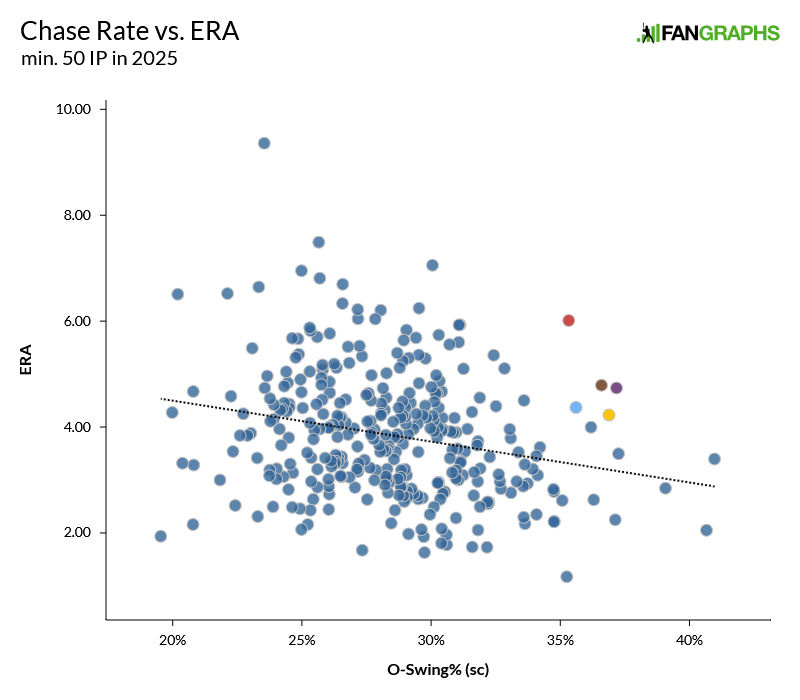
As you can see, as chase rate goes up, ERA goes down. Most of the time. On the above graph, I’ve highlighted the five pitchers with the best O-Swing% numbers who also had an ERA above the league-wide average of 4.16. They are, in descending order: Tanner Scott (purple), Griffin Jax (yellow), Devin Williams (brown), Jeff Hoffman (light blue), and Aaron Nola (red).
Getting a lot of hitters to chase almost always leads to at least respectable results; outside of these five pitchers, only two others (Graham Ashcraft and Ryan Helsley) with top-30 chase rates failed to beat the league-average ERA by half a run or more.
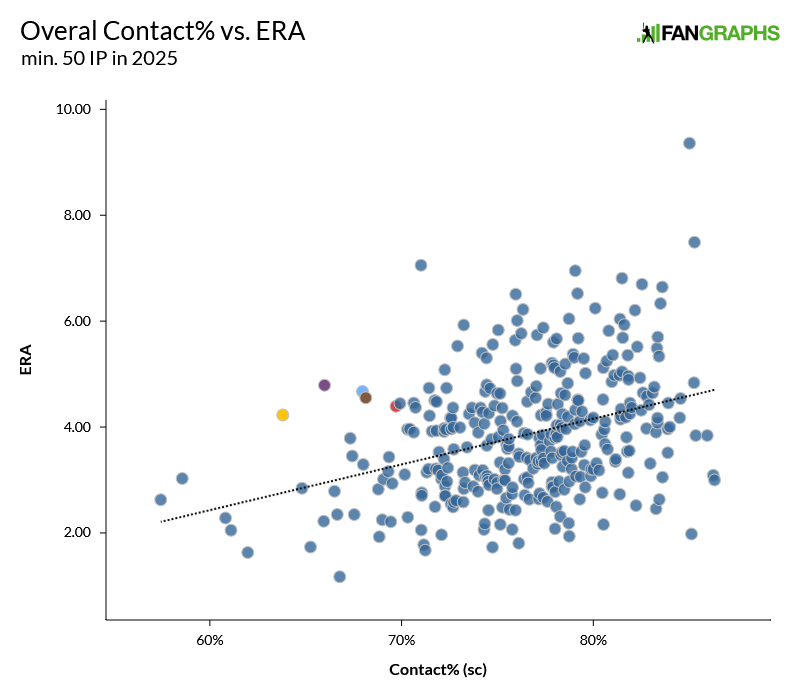
The effect of contact rate on ERA is even more pronounced. The lowest contact rate in baseball last year belonged to Miller; you probably know him, he’s pretty good. The only other pitcher with a contact rate under 60% was Brendon Little, whose bat-missing success has been well-documented. But mostly in frustrated tones, because his tendency to walk hitters (15.3%, the highest mark in the league last year) is even more notorious.
Let’s run down those colorful dots in this chart: Jax (yellow), Williams (purple), Cole Ragans (light blue), Dylan Cease (brown), and Brandon Eisert (red, mostly eclipsed by a dot representing Mason Fluharty).
Eisert kind of flew under the radar; nobody cared much about a 27-year-old rookie non-closer reliever for the White Sox, especially when that excellent whiff rate led to a good-but-not-great 24.2% strikeout rate. And Eisert wasn’t that far above the league average for ERA; his 4.39 translates to an ERA- of 107.
When Eisert did allow contact, he got punished (.276 opponent batting average). But he probably didn’t deserve to be (.238 xBA, .332 BABIP, 15.2% HR/FB ratio). Based on that information alone, I’d be bullish about him heading into 2026, but unless you’re either a White Sox fan or playing in the deepest fantasy baseball league known to man, I don’t know why you’d find that opinion useful.
What’s wrong with Jax feels pretty simple; he underperformed his xERA by almost exactly a run, and his FIP by the best part of two runs. Jax put up monster strikeout numbers (35.0%, the eighth-best mark in baseball), but also allowed the highest BABIP in the league, .368. This high-leverage reliever playing mostly in Minnesota beat out Antonio Senzatela for this ignominious distinction.
Jax was less than a tenth of a run above average in ERA anyway, and even that figure doesn’t do him justice. I know this isn’t how it works, but in two specific outings — April 18 against the Braves and July 30 against the Red Sox — Jax just didn’t have it. Across those two games, he faced eight batters and seven of them scored.
ERA for relievers can be misleading, because one or two bad outings can put a pitcher in a hole that can’t be climbed out of within a season. Take away those two outings for Jax and his ERA drops from 4.23 to 3.56. In short, we could’ve figured out what the deal was with Jax just by using tools we had 15 years ago.
What was wrong with Ragans might be even more simple; he tweaked his groin early in 2025, then strained his rotator cuff in his first start after coming back from the first injury. That shoulder issue kept him out until mid-September, leaving the Royals’ presumptive no. 1 starter with a highly disjointed and injury-plagued record. Assuming his shoulder and groin remain in working order, he should be just fine in 2026.
The other five guys — Williams, Cease, Scott, Hoffman, and Nola — are all big names. The two starters are both on seven-year contracts worth a combined $382 million. The three relievers have all signed, within the past 18 months, free agent contracts at least three years in length, with AAVs in the eight-figure range.
And the teams they play for — the Blue Jays, Mets, Dodgers, and Phillies — are among the sport’s most heavily scrutinized. Those four teams are all in the top five in payroll; the first three play in the league’s three biggest home markets. All four of those teams have made it at least to the LCS phase in the past three years; two of them went to seven games in the World Series last fall.
Which means these guys are in the news a lot. When talented, expensive pitchers underachieve for teams with championship aspirations, it gets noticed. Including by us. Here’s Davy Andrews on Nola from last April, me on Scott a week later, and Davy on Scott six weeks ago. Here’s my write-up of Williams’ bizarre 2025 campaign from September, followed by Davy’s take when Williams changed boroughs in December. I also wrote about the bizarre disconnect between Cease’s underlying stats and his ERA when he signed his contract with Toronto in November.
Nola, like Ragans, missed a big chunk of 2025 due to injury, though he was awful even when healthy. With Scott, there was a legitimate change in his approach — previously an effectively wild pitcher, he started pounding the zone with the Dodgers and got rocked.
But the fact that Williams and Cease both got paid this offseason says that teams care more about the underlying numbers than the results. As they should, if we’re being honest. That’s what the pitcher can control.
Michael is a writer at FanGraphs. Previously, he was a staff writer at The Ringer and D1Baseball, and his work has appeared at Grantland, Baseball Prospectus, The Atlantic, ESPN.com, and various ill-remembered Phillies blogs. Follow him on Twitter, if you must, @MichaelBaumann.
I remember watching that July 30 Griffin Jax outing, it was brutal luck. He allowed a few soft hit singles to load the bases then got taken out for a position player who of course allowed the runs to score. Jax was traded the next day.