
White Sox Sign Seranthony Domínguez
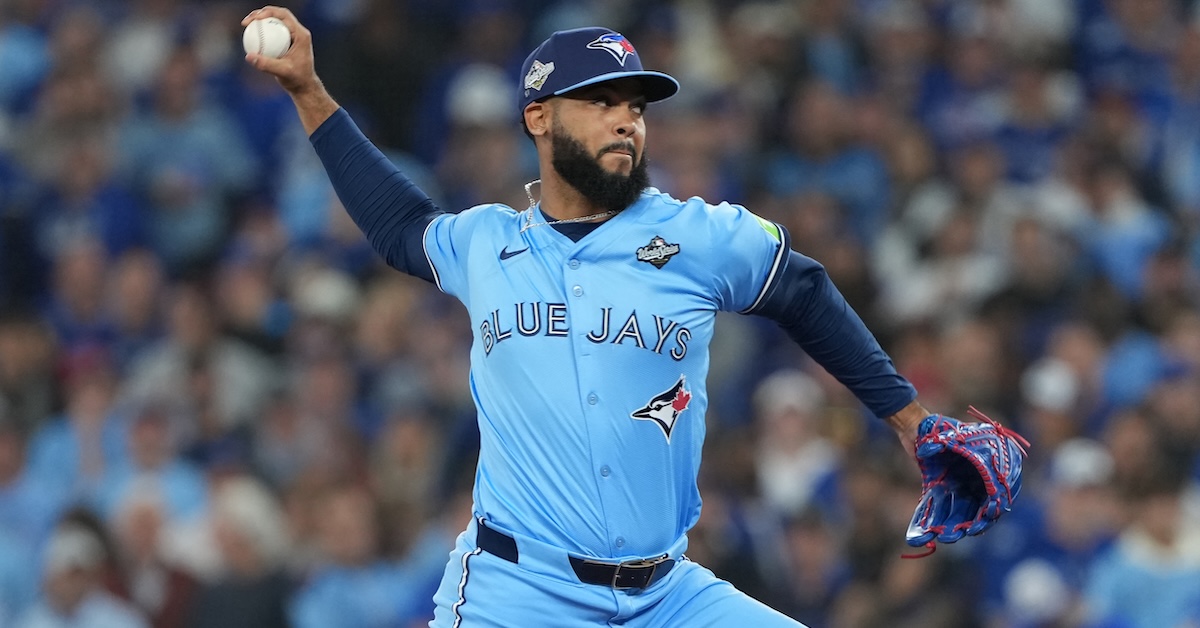
Last week, the White Sox admitted defeat in their handling of Luis Robert Jr.’s contract, shipping him out to the Mets for two lottery tickets and salary relief. That salary relief must have been burning a hole in their pocket, though. Or perhaps someone looked at their books, said “Guys, we play in Chicago but we’re projected for the lowest payroll in baseball and people are going to talk,” and handed GM Chris Getz a list of players who hadn’t yet signed. In any case, Seranthony Domínguez and the White Sox have agreed to terms on a two-year deal worth $20 million, as ESPN’s Jeff Passan first reported.
The right-handed Domínguez is no stranger to high-pressure relief work. In both the 2022 and 2023 postseasons, he appeared in mid- and high-leverage situations for the Phillies, and he handled them quite well (1.13 ERA, 0.78 FIP in 16 innings). In 2024, Philadelphia didn’t have much use for his services after his slow start, and so they sent him and Cristian Pache to the Orioles for platoon bat Austin Hays (whom they promptly non-tendered after the season). The O’s employed Domínguez for a year (he made two appearances for them in the playoffs), then dealt him and cash to the Blue Jays in exchange for Juaron Watts-Brown, a 40-FV relief prospect. He pitched for the Jays in October, and memorably had some ups and downs in their long run.
In other words, playoff teams have been employing Domínguez for years, but they haven’t been placing particularly high importance on his performance. He’s twice been traded to contenders in deadline deals, and at no point did his suitors offer much to get him. Those teams considered him a mid-leverage option; even the Blue Jays had him as a second-tier option out of their weak-link bullpen that flailed its way through October.
Intriguingly, Domínguez’s most recent run at a ring was keyed by a brand new splitter that he threw 17% of the time in 2025. It propelled him to a new career high strikeout rate. Spectacular! The cost? Yeah, you won’t like the cost – a career-high walk rate, and one that increased by a whopping 5.6 percentage points year-over-year. For comparison, his strikeout rate went up by 3.6%. The new splitter is pretty much unhittable – and that’s a good thing, because Domínguez only landed it in the strike zone a quarter of the time. It’s a great pitch, but it doesn’t change my overall view of his talent level.
You might hear that Domínguez is a FIP-beater. Indeed, he’s posted a 3.78 ERA in the past three years, as compared to a 4.28 FIP. By FIP-based WAR, he’s not even one of the top 100 relievers in baseball over the past three years; he’s 136th, to be precise. By RA9-WAR, which cares about results on the field, though, he’s… 135th, basically the same. That’s because his “FIP-beating” is actually just a lot of unearned runs scoring. Eight of the 30 runs he allowed to score in 2025 were unearned, which will push your ERA way down and mask the true amount of runs on your ledger.
That’s especially worrying when you consider that Domínguez received a ton of help defensively. Per Statcast, fielders playing behind him were seven outs above average, the 14th-best mark in baseball. Everyone ahead of him on that list pitched at least 50 more innings than he did. On a per-inning basis, no major leaguer received better defensive help than Domínguez did last year. It puts the FIP-beating in perspective; many components go into beating or falling short of ERA estimators, and many of them are completely outside of a pitcher’s control.
Put that all together, and Domínguez looks to me like a pretty average reliever. That’s not meant to be a mark against him; there’s always plenty of work for average relievers in a league floundering for innings. That’s presumably Chicago’s plan here, in fact; keep him around for a few months, let him close, and hope that a decent ERA and some shiny saves make him an attractive deadline acquisition for some contender. If that contender offers the Sox the modern-day equivalent of Gleyber Torres or John Smoltz, or whatever famous trade blunder you want to reference, then bam! That’s what the White Sox are going for here.
Now, is that going to happen? I don’t think so. Domínguez is the 33rd reliever to sign for $2 million or more this winter. He’s getting the 12th-highest AAV, the eighth-highest guarantee. Generally speaking, relievers who sign this late in the process are reclamation projects or bargains. There’s a pretty clear pattern to free agency – early signees beat their projections, while late signees fall short. That’s not weird; typically, the guys who sign late are doing so because no one offered them what they wanted earlier in the winter. Domínguez beat his projections handsomely despite his late signing date, which is strange.
The reason isn’t that wild if you think about it long enough, though. It’s the White Sox tax. Would you, a competent major league baseball player, willingly agree to play for a team that is actively trying to be one of the worst clubs in the majors? Presumably not, at least not if all else were equal. To sign Domínguez, the White Sox made all else unequal; they offered him a nice fat sack full of money.
Like I said, I think that the Sox had some ulterior motives here. Their payroll was so comically low after trading Robert that I imagine there was some internal consternation about how that would look. That’s how you end up giving one of your team’s biggest free agenct contracts of the 2020s to a solid-but-not-elite reliever when you’re a 100-loss team. If we’re evaluating this deal based on making the South Siders look less penny-pinching, it has to get high marks. Domínguez is going to be more than 10% of the club’s payroll this year, one of only three guys making eight figures. The Sox have a less egregious salary commitment today than they did immediately after trading Robert, and that definitely counts for something.
If they’re trying to win on the baseball field with this move, though, I don’t quite get it. I could be wrong, of course. That’s a key thing to remember when you read analysis of a baseball decision. I don’t actually know what’s going to happen, any more than the players on the field do. Domínguez could be much better or much worse than our projections. But with that caveat in mind, I think it’s pretty clear that the White Sox should not expect a big return for Domínguez at the deadline.
Why not? Because he’s been traded at the last two deadlines! We definitely know the price of Seranthony Domínguez in a trade. It’s actually one of the best-known trade prices; he’s twice been swapped to a contender with a weak bullpen, and twice the trading team has gotten a mere pittance in return. The O’s even paid down some of his salary in their deal last year, and that was for a contract with a lower salary than this one and that featured no second-year guarantee.
Now, the Sox can showcase Domínguez a bit more than his previous employers. We have him penciled in as their closer, a role that he couldn’t reasonably expect on a playoff contender. They’re going to spotlight him as much as they can, and when another team calls to ask about anyone on the squad, they’re going to have to hear the pitch on Domínguez first. That’s why bad teams sign good relievers – to ship them out.
I’m a realist, though. My best expectation for what Domínguez will fetch in trade is heavily informed by what he has already fetched in trade. If he’s dealt at this deadline, I’d expect the Sox to retain a lot of his salary and also not get a ton in return. This is not a fringe prediction. It’s an easy one to make, based on a clear pattern. I’d be absolutely floored if a neutral observer saw it meaningfully differently.
Maybe that makes me sound like a pessimist, but I actually think that this deal is great for everyone. Domínguez is obviously the biggest beneficiary – he just got $20 million! That more than doubles his career earnings, mere months after running a 22% walk rate in the playoffs. How in the world could he say no to that?! It’s an easy win.
The Sox are also beneficiaries, because it’s hard to focus on their extreme aversion to spending when they’re splashing out well above expectations to sign someone. Are you mad at them for not putting a good product on the field? Well, they spent all of their salary savings on a guy who was in the World Series just last year. What else are they supposed to do? On the scoreboard of public opinion, I bet you the Sox come out ahead. Between this and the Munetaka Murakami deal from earlier in the winter, they’re real free agency players again for the first time in a while. That definitely counts for something, especially for Getz, who is in his third year running the team after the first two seasons produced 221 losses.
Even the rest of the league is a beneficiary. I think it’s pretty clear that no contenders were looking to spend this kind of money on Seranthony Domínguez. If they were, they would have signed him already! But now they can wait until July and trade for him if they’re in the playoff race. It’s not going to cost them a ton, most likely. Heck, if past is prologue, the Sox will have to assume a decent portion of his salary in a trade. What will it cost to acquire him? A plausible future major leaguer who is nonetheless not a top prospect, something that teams are perennially happy to trade for bullpen help.
So don’t think of this deal as an overpay by Chicago, though solely by accounting it is that. Think of it as proof that not everyone acts to maximize their long-term on-field expected value with every move. I’m certain everyone involved is happy with the way this one went down. Can you really ask for anything more?
Ben is a writer at FanGraphs. He can be found on Bluesky @benclemens.
Yeah, this one wasn’t on my bingo card
I am obviously not privy to his personal situation, but would you take half as much money to be a lower leverage guy on a team that had a chance of winning? That seems like it would be a lot more fun way to spend 6+ months, albeit much less lucrative.
On the other hand, there are definitely people who are wired to be “if you’re not playing, you’re losing”, and I would assume that a higher than normal percentage of those people are present in the population of MLB players.
Fuck no. If I’m a Major League reliever, my elbow and shoulder and ticking time bombs. If I’m one of the very lucky few, I’ve got maybe 8 years to earn enough money to be able to do what I want from my mid-30s until I kick the bucket. This is my job, not a fun fandom like it is for us fans. The only way I’m taking the lesser route is if I’m a dude who’s all set financially, see e.g. Scherzer, Max and Verlander, Justin.
A fair and valid point. Does your answer change if you’re a position player?
And this is before you get to intangible things like “this club has a good recommendation for helping guys get better” and the like, but I also assume those are the kind of things you only worry about when you’ve got the money in the bag already.
On the other hand, Jose Ramirez could have gotten a lot more money leaving Cleveland.
My answer indeed would differ if I was a position player. Also, Dominguez is still at the low (enough) level of career earnings where money he earns still means something. 20 mil is a huge boost to establishing his wealth for the rest of his life. If I’m Edwin Diaz, and the white sox offered me 20m more than the dodgers, I’d say no, I already have plenty of money.
I would absolutely choose “as much money as possible” every time. Maybe if I’m 36 years old with $200m in the bank I might consider taking less money for a contender, but Dominguez isn’t in that position
I think that players have made decisions that cost them money based on quality of life and feeling comfortable with the organization. But as much as these guys want to win it’s probably third behind money and enjoying your coworkers / city.
Half as much? Maybe if I’m at the end of my career and have already made a ton of money, but not if it represents half my career earnings.
So I was fortunate and did not grow up poor in the DR… but even so, I didn’t grow up rich enough to turn down the bag, to get half the bag.
All these guys, even the ones on crappy teams, are pros, and they go to work just the same. They know what their value is and the injury risk… the benefit to SD is he gets the premium role with less leverage, intensity, and if things work out, he gets another bag.
Personally, I dream of doing data analytics in sports… however, other less desirable industries offer better hours and a big bag. Maybe one day…
What are we like 6 years old? No one is having fun in this hellhole except master, who deserves it after being selected to become a biwwionaiwe basically god.
‘Mericans and their vibes, man. Its fascinating to witness an entire population openly getting clowned, incapable of existing in the real, patting itself on the back all day for being bwave and smert/advanced, speaking and believing obvious nonsense
Seriously I can’t believe – had to revisit and comment again – a fully grown person in ‘Merica 2026 is like “take less money to have fun.” Liberalism is so friggin weird and detached from the real world lol
Dominguez will get lots of high leverage opportunities, a long leash if he hits a rough patch, and probably end up on a contender. The White Sox have a better track record with pitchers than hitters so he might even get better. They will probably get something back at the deadline that they didn’t have before.
But I think the low payroll is secondary. White Sox fans have seen nearly half a century of this ownership and aren’t going to fall for meaningless gestures. They stopped falling for “we tried” a long time ago. They aren’t going to be satisfied with simply not having the lowest payroll or signing guys from good teams. They are going to wait for an actual winning team to get invested.
This does reek a little bit of “we don’t want Leasure or Taylor to drive up their arb $$ by racking up saves.” It’s rational but gross
I can’t believe the Save stat, a number players have zero influence over, is actually influencing arbitration figures
Are you f*cking ridiculous? that’s been the case forever. There are Fangraphs blogs explaining how saves are valued in arbitration and Dellin Betances famously lost an arb case because he didn’t have saves.
It is well known that arbitration rewards “traditional” stats like saves and RBI
The whole bullpen has been pretty much garbage for two+ years and the team stinks. There’s not enough saves to go around in the first place.
When the White Sox traded Robert, Getz talked about how this deal was going to give them newfound financial flexibility to address other parts of the roster.
I found that absurd. They play in Chicago, and any financial difficulties they have are self-inflicted from being terrible.
Their response is to deal away their best trade chip and someone who hopefully would help them win a couple games for salary relief. Which makes them worse.
This allowed them to sign a guy who has a proven track record of bringing back a small return at the trade deadline.
Absolutely none of this makes sense. It’s fine to sign Seranthony Dominguez to close games for you and flip him at the deadline but not if it means you don’t get anything for your better trade candidate! And not if it makes you a worse team by dealing away the other guy! This is how the team go into this mess in the first place.
Huh? They got an FV45 (albeit more of a post-prospect who’s out of options) and an FV35 for Robert. Bats return diddly at the trade deadline, so Getz getting something for Robert is not bad. Dominguez has returned an FV40 at the last 2 deadlines. While not exciting, I don’t agree with Ben that that’s nothing. The WSox only had 37 prospects of note according to James Fegan which is far short of the Orioles’ 65 or so. They need more. (They did a nice job of getting FV45 Paez in Rule 5).
The WSox don’t have much else to trade. Maybe Murakami, Quero, Shane Smith, but these are also guys they might want in their next playoff push. They have payroll capacity and roster slots currently occupied by Everson Pereira. Dominguez makes perfect sense. After Bader’s signing yesterday, the remaining FA’s either have QO’s or have bigger salary expectations than their recent performance would warrant. Maybe the WSox could sign Austin Hays or absorb a bad contract from another team for the cost of another FV40 or FV45.
The 2025 White Sox led the league in blown saves even though they also had the fewest opportunities. They have a young team with some decent talent, so there’s value in not constantly losing those games, even if they’re obviously not a contender. Dominguez will help.
The bullpen has been a huge part of the Sox’s epic failures over the past two years. They were bottom in the league in WPA two years running, including a historic -11 in 2024.
So I agree. This move actually may make them better.
It would have been so much easier to simply use this $20M to pay down Roberts salary and get a better prospect return. Now they are hoping Seranthony doesn’t get hurt, doesn’t suck, and is suddenly worth more than he’s been worth the last two times he was traded at the deadline. And by paying down Roberts salary you would also have that prospect now, instead of sometime in the future via Seranthony trade. Roberts at 1yr/$2M (plus team option) definitely gets a decent return.
What is that return? Who is that prospect? Dominguez will return an FV40, at least. Would Robert at 1/$2M return something markedly better than Acuña, FV40, and the FV35 pitcher the Mets threw in? And the WSox still have another $10M in payroll capacity this year?
Maybe the Reds would have given Chase Petty, a true FV45, but I think you’re overestimating Robert’s value.
I know it’s not the point, but the Cubs make the Gleyber trade 100 out of 100 times with hindsight.
Also, Chapman was an incredible relief pitcher – and without hindsight you can make an argument that while it was an overpay, getting an elite reliver on a very good Cubs team made sense, and they had a sense of urgency (rightly, as it turned out – the Cubs superteam burned brightly but not as long as hoped).
His best season was worth 3.2fWAR. Domínguez’s entire career has been 3.3fWAR.
I think a better trade example is the Dodgers trading away Yordan Alvarez for Josh Fields. Or Oneil Cruz for Tony Watson.
White Sox fans will tell you that Fernando Tatis Jr for James Shields is the standard for trading a prospect too soon in the current century. And they are probably right.
It feels like many of the worst deals were guys traded for nobodies. Almost nobody can tell you who Cristopher Sanchez, Junior Caminero, and Yordan Alvarez were traded for. But everyone knows who James Shields is.
You can also make an argument for the Archer – Glasnow / Meadows / Baz trade as the worst deal that involved dealing away prospects.
But IMO the worst trade that involved trading away prospects is definitely Ozuna for Alcantara and Gallen. Not that Ozuna was bad or anything, but unlike the Pirates (who were always going to be bad) the Cardinals really could have used Alcantara and Gallen the last 5 years. The Cardinals won 93 and 90 games but didn’t get out of the wild card game in either 2021 or 2022. Alcantara was a beast those years, putting up 10.2 fWAR and beating his FIP in both of them, and Gallen put up over 4 wins in 2022 as well. And there was definitely space in the rotation, they gave John Gant, Johan Oviedo, and Jon Lester 40 starts over those two years.
(You can make an argument for Yelich as the worst overall but that’s going the other way)
This type of half-cocked thinking is why the White Sox are in hell.
It’s totally reasonable to sign a reliever who throws hard so you can to try and flip him at the deadline. I am surprised more bad teams don’t do this. It’s everything else that is the problem.
More like lack of spending.