
Peering Into the Crystal Ball: The Next Five Years of BBWAA Hall of Fame Elections
The following article is part of Jay Jaffe’s ongoing look at the candidates on the BBWAA 2026 Hall of Fame ballot. For a detailed introduction to this year’s ballot, and other candidates in the series, use the tool above; an introduction to JAWS can be found here. For a tentative schedule, see here. All WAR figures refer to the Baseball Reference version unless otherwise indicated.
Last week, BBWAA voters elected Carlos Beltrán and Andruw Jones to the Hall of Fame — and in doing so, they once again foiled my chances at a perfect five-year projection of upcoming elections. Not that I had any real expectation of running the table given my spotty track record regarding this endeavor, but while a year ago I correctly projected that Beltrán, who received 70.3% on the 2025 ballot, would make it this year, I was somewhat surprised that Jones, who received 66.2% last time — leaving him with what has typically been roughly coin-toss odds of reaching 75% the next year — made it as well.
If I’ve learned anything from 14 years of doing these five-year outlooks, dating back to the wrap-up of my 2014 election coverage at SI.com, it’s humility, because there are far more ways to be wrong in this endeavor than to be right; when a candidate gets elected more quickly than I expect, or lags relative to my expectations, it creates a ripple effect. The presence of a high-share holdover means less space for and less attention paid to the mid-ballot holdovers, so clearing one from the ballot can have ramifications that won’t be felt for a few years; likewise, a more rapid election than predicted can accelerate other candidates’ timelines. What’s more, the Hall can change the rules for election without warning, and candidates can do unforeseen things that compromise their chances.
The first time I tried this was so long ago that candidates still had 15 years of eligibility instead of 10, so I could afford to project Tim Raines for election in 2018, his 11th year of eligibility. The Hall’s unilateral decision to truncate candidacies to 10 years would come just months later, though thankfully voters accelerated their acceptance of Raines, who was elected in 2017. Both the eligibility shortening and Hall vice chairman Joe Morgan’s open letter pleading with voters not to elect candidates linked to performance-enhancing drugs changed the landscape in ways I couldn’t foresee. Meanwhile, Ichiro Suzuki made a two-game comeback that bumped his eligibility back a year, Curt Schilling found increasingly elaborate ways to offend voters, Omar Vizquel became the subject of multiple allegations of domestic violence against his wife and sexual harassment of an autistic batboy, and Beltrán lost a shot at first-year election because of his involvement in the Astros’ illegal sign-stealing scheme. My Magic 8 Ball didn’t see any of that coming.
This exercise has always been more art than science, requiring some amount of imagination and speculation. The changes to the election process have undercut some of my research into the history and mechanics of the voting, rendering it less useful for prognostication purposes. The dynamics of Hall candidacies have certainly changed, as evidenced by the elections of 18 first-year candidates over the 2014–25 span, as well as those of so many slow-starting candidates. From 1966 to 2005, only three candidates recovered from debuts below 25% and eventually reached 75%, even with 15 years of eligibility: Duke Snider (17.0% in 1970, elected in ’81), Don Drysdale (21.0% in 1975, elected in ’84), and Billy Williams (23.4% in 1982, elected in ’87). With Jones’ election, over the past 21 cycles we’ve seen nine players overcome such slow starts, including one in each of the past four cycles. From the 15-year eligibility period came Bruce Sutter (23.9% in 1994, elected in 2006) and Bert Blyleven (17.5% in 1998, elected in 2011), then once the eligibility window was shortened — less to clean up the ballots than to try to move the intractable debate over PED-related candidates out of the spotlight and give voters less time to soften their attitudes — Raines (24.3% in 2008, elected in ’17), Mike Mussina (20.3% in 2014, elected in ’19), Larry Walker (20.3% in ’11, elected in ’20), Scott Rolen (10.2% in 2018, elected in ’23), Todd Helton (16.5% in 2019, elected in ’24), Billy Wagner (10.5% in 2016, elected in ’25), and now Jones (7.3% in 2018, a new record for lowest vote share in a debut year for a player eventually elected by the writers).
Revising this annually is a necessity because I am routinely wrong, sometimes happily so, as in those instances where I’ve underestimated how quickly a given candidate might gain entry. This time around, for the first time I audited my past performance starting with the 2019 cycle, my first at FanGraphs. Here’s what I projected (be sure to scroll to see 2030):
| Year | 2020 | 2021 | 2022 | 2023 | 2024 | 2025 | 2026 | 2027 | 2028 | 2029 | 2030 |
|---|---|---|---|---|---|---|---|---|---|---|---|
| 2019 | Jeter Walker | Schilling | Bonds Clemens | Ortiz Beltrán | Beltré Suzuki Mauer | ||||||
| 2020 | Schilling | Bonds Clemens* | Ortiz | Beltré Mauer | Suzuki Vizquel Rolen | ||||||
| 2021 | — | Ortiz Rolen | Beltré Wagner Sheffield** | Suzuki Mauer Helton | Sabathia Beltrán | ||||||
| 2022 | Rolen | Beltré Helton | Suzuki Mauer Wagner | Sabathia Jones | Posey Beltrán | ||||||
| 2023 | Beltré Helton | Suzuki Mauer Wagner | Sabathia Jones | Posey Beltrán | Pujols Molina | ||||||
| 2024 | Suzuki Sabathia Wagner | Jones | Posey Beltrán | Pujols Molina | Cabrera Utley | ||||||
| 2025 | Beltrán | Posey Jones | Pujols Molina | Cabrera Votto Greinke | Utley | ||||||
| Actual | Jeter Walker | — | Ortiz | Rolen | Beltré Helton Mauer | Suzuki Sabathia Wagner | Beltrán Jones |
* = caveat “which isn’t to say that they will be.” ** = caveat “(maybe)”
Yellow = Correctly predicted entire slate. Blue = Projected year of election for Beltrán. Green = Projected year of election for Jones. Bold = Correctly predicted individual year of election.
That’s a mess, right? Look at me outsmarting myself regarding Beltrán and Jones, five times getting one or the other right from years away, but never getting both.
Here’s my performance broken down by how far ahead I looked:
| Years Away | Predicted | Correct | Later Than Proj | Earlier Than Proj | Aged Off | Pending |
|---|---|---|---|---|---|---|
| 1 | 10 | 9 | 0 | 0 | 1 | 0 |
| 2 | 14 | 6 | 0 | 3 | 3 | 1 |
| 3 | 15 | 4 | 1 | 4 | 3 | 3 |
| 4 | 16 | 4 | 1 | 5 | 0 | 6 |
| 5 | 15 | 4 | 1 | 3 | 0 | 7 |
When it comes to predicting that a given candidate will be elected next year, I’ve done very well, with Schilling my only miss in that direction; because he fell off the ballot without being elected by the writers, he goes into the “Aged Off” column. Things get much spottier when it comes to projecting two years away, with Schilling and the PED-linked Barry Bonds, Roger Clemens, and Gary Sheffield all getting thwarted and eventually aging off. I was correct on as many elected five years out — the obvious first-ballot guys — as I was in looking either three or four years ahead. Beyond that, my predominant tendency has been to underestimate how quickly candidates would be elected. It’s happened 15 times in seven years, most notably with David Ortiz, Joe Mauer, and CC Sabathia gaining first-ballot entry instead of taking an extra year or years. On the other hand, at certain points I overestimated how quickly Beltrán, Wagner, and Jones would be elected… and then at other points I got them right.
I can’t feel too badly about any of these errors, because as with the 18 first-year candidates’ getting elected in 12 years, the election of as many as 25 candidates over a 10-year span (2011–20), or even 22 candidates (every other rolling 10-year cycle starting with 2009–18) was unprecedented in the annals of BBWAA voting. Also, I have no real baseline for comparison, as I’m unaware of anyone else regularly predicting five years worth of elections on an annual basis.
For the sake of this year’s exercise, I have assumed that the basic mechanics of these elections will remain in place: 10 votes per ballot, with a 5% minimum to avoid falling off, and 10 years of eligibility for new candidates. Note that each ballot’s year refers to the year of induction; that ballot is released in November of the previous year, with ballots due on December 31. To be eligible, a candidate must not have played in the majors for five full seasons, but his eligibility year will actually be six years after his last appearance.
2027
Top newcomers: Buster Posey, Jon Lester, Brett Gardner, Kyle Seager, Ryan Zimmerman
Top holdovers: Chase Utley, Andy Pettitte, Félix Hernández
Most likely to be elected: Posey, Utley
Falling off: Vizquel
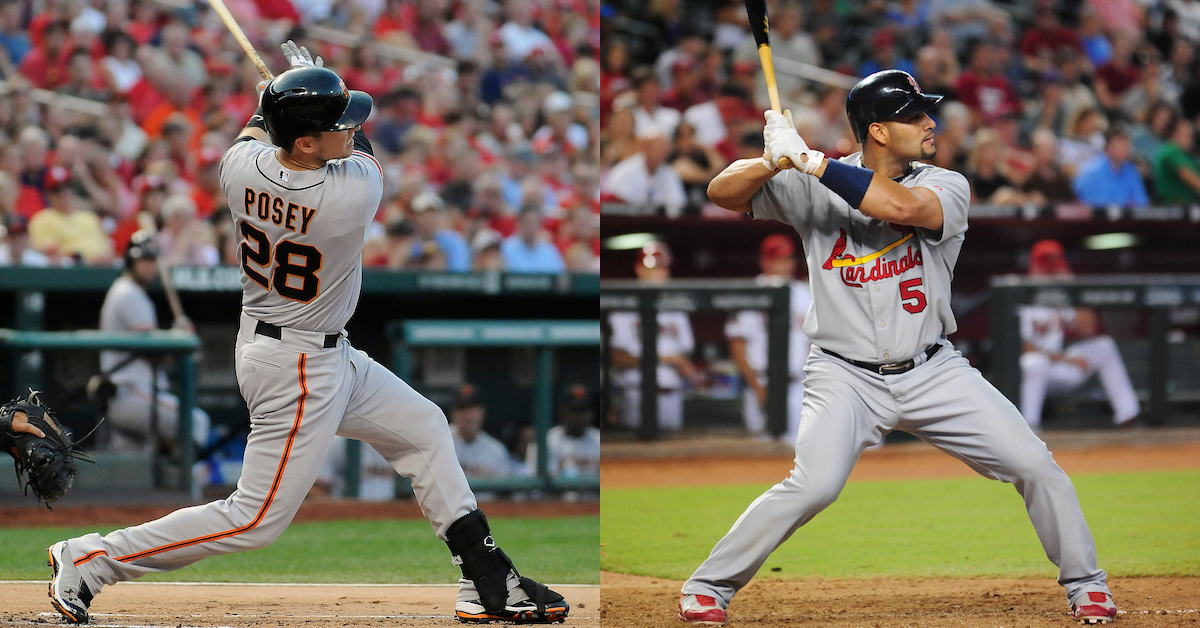
Posey’s sudden retirement at age 34, after his strongest offensive performance in at least half a decade, left him with just 1,500 career hits, but his seven All-Star appearances, three championships, MVP, Rookie of the Year, and Gold Glove awards, and 129 OPS+ make for a full enough résumé for Cooperstown. All that’s missing is watching him break down, and who really needs to see that? By JAWS, his 36.6 peak WAR is 10th all time, 1.7 WAR above the standard, and that’s without considering the impact of his elite pitch framing. He’s fifth in our version of the metric covering the 2009–21 span of his career and second in that of Baseball Prospectus. In both, he’s just ahead of Yadier Molina, who caught roughly twice as many innings (though only 44% more in the window covered by our metric). What’s more, Posey is third in my framing-inclusive JAWS behind only Mike Piazza and Ivan Rodriguez, ahead of Mauer, Russell Martin (sigh), and Molina.
| Player | Career | WAR | FG FRM | BP Fram | WAR Adj | frWAR | frPeak | frJAWS |
|---|---|---|---|---|---|---|---|---|
| Mike Piazza | 1992-2007 | 62.5 | n/a | 93.2 | 9.04 | 71.5 | 52.4 | 62.0 |
| Ivan Rodriguez | 1991-2011 | 68.4 | 2.9 | -16.0 | -1.6 | 66.7 | 40.1 | 53.4 |
| Buster Posey | 2009-2021 | 57.9 | 128.8 | 0.0 | 0.0 | 57.9 | 47.7 | 52.8 |
| Joe Mauer | 2004-2018 | 53.5 | 27.6 | 43.7 | 4.3 | 57.8 | 42.7 | 50.3 |
| Russell Martin | 2006-2019 | 54.5 | 165.7 | 47.7 | 4.6 | 59.1 | 40.8 | 49.9 |
| Yadier Molina | 2004-2022 | 55.6 | 151.1 | 37.6 | 3.7 | 59.3 | 37.6 | 48.5 |
| Brian McCann | 2005-2019 | 52.1 | 165.6 | -15.6 | -1.5 | 50.6 | 37.2 | 43.9 |
Even given the brevity of his career, I believe Posey will join Mauer, Rodriguez, and Johnny Bench on the ridiculously short list of catchers elected on their first ballot.
Of the other newcomers, the one who will generate significant discussion is Lester. With his 200 wins, three championship rings, and big-game reputation, his candidacy will get some attention, particularly in light of this year’s results. He’s got a great postseason résumé (9-7, 2.51 ERA in 154 innings while helping three teams win the World Series), but his 43.4 WAR is about 15-17 WAR lower than what the Mark Buehrle/Cole Hamels/Andy Pettitte trio of holdovers accumulated, and 6.4 lower than what Hernández put up. He’s 153rd in S-JAWS, 98 spots (and 12 points) below Sabathia, and just 12 spots above Jack Morris. Gardner, Seager, and Zimmerman each spent their careers with one franchise and deserve their spots in the hearts of fans, but none had the value, the accomplishments, or the staying power to make a dent in Hall voting.
This is where Vizquel drops off the ballot. The aforementioned domestic violence and sexual harassment allegations led to his setting a modern record with a 25.2% drop on the 2022 ballot, from 49.1% to 23.9%, and he’s lost further ground since then, while also embarking upon a PR campaign that has lacked any hint of introspection or accountability. His situation is without parallel in the annals of Hall of Fame voting, though it remains to be seen if he finds a more sympathetic ear on a future Era Committee.
Utley’s rapid ascent from 28.8% in his debut to 59.1% this year has made him a likely inductee. While he will need a sizable jump to cross the 75% threshold in one fell swoop, over the past 11 cycles, all top returning holdovers not named Curt Schilling have been elected the next year:
| Year | Candidate | YoB | Previous % | % | Gain |
|---|---|---|---|---|---|
| 2016 | Mike Piazza | 4 | 69.9% | 83.0% | 13.1% |
| 2017 | Jeff Bagwell | 7 | 71.6% | 86.2% | 14.6% |
| 2018 | Trevor Hoffman | 2 | 74.0% | 79.9% | 5.9% |
| 2019 | Edgar Martinez | 10 | 70.4% | 85.4% | 15.0% |
| 2020 | Curt Schilling | 8 | 60.9% | 70.0% | 9.1% |
| 2021 | Curt Schilling | 9 | 70.0% | 71.1% | 1.1% |
| 2022 | Curt Schilling | 10 | 71.1% | 58.6% | -12.5% |
| 2023 | Scott Rolen | 6 | 63.2% | 76.3% | 13.1% |
| 2024 | Todd Helton | 6 | 72.2% | 79.7% | 7.5% |
| 2025 | Billy Wagner | 10 | 73.8% | 82.5% | 8.7% |
| 2026 | Carlos Beltrán | 4 | 70.3% | 84.2% | 13.9% |
Hat tips to the Tracker team’s Anthony Calamis and reader Juan Ramón Vallarino for calling my attention to that streak. Given that this will be another ballot light on slam-dunk candidates, I think it’s more likely than not that Utley gets elected.
As to what this portends for the other top two holdovers, Pettitte’s big jump — the 11th largest since the voters returned to annual balloting in 1967 — to 48.5% still leaves him further out than either Raines (55% in 2015) or Martinez (58.6% in 2017) were in their eighth year, though in better shape than Walker (34.1% in 2018) in his eighth, but getting to 75% in two steps is a tall order nonetheless. On the other hand, time is on the side of Hernández after his record-setting year-over-year gain to 46.1%. I do think the growth of his support will slow down, but he’s in a good place. Bobby Abreu (30.8% in his seventh year) is ahead of where Walker was in his seventh (21.9%), but he’ll still need the fifth-largest three-year gain in modern history to reach 75%; he’s probably going to need to wind up around where Hernández and Pettitte were this year to keep hope alive.
2028
Top newcomers: Albert Pujols, Robinson Canó, David Price, Yadier Molina
Top holdovers: Pettitte, Hernández, Abreu, Alex Rodriguez
Most likely to be elected: Pujols, Molina
Falling off: Pettitte
Though he spent more than nine years of his 10-year, $240 million deal disappointing in Anaheim, Pujols enjoyed a strong finish to his 22-year major league career, pushing his home run total to 703 (fourth all time), his hit total to 3,384 (10th all time, and the most by a player born outside the United States), and his career WAR back into triple digits (101.3) while making his 11th and final All-Star team during a victory-lap season in St. Louis. Although it won’t erase all memories of his diminishing returns, going out on a high note should goose Pujols’ share of the vote into the high 90s.
The celebration may well help Molina get to 75% by riding his coattails. A 10-time All-Star and nine-time Gold Glove winner, Molina earned a reputation as one of the best at handling pitchers, both in terms of framing and game-calling. We have metrics to back up the first of those assertions, in that he’s fifth in our version of framing runs dating back to 2008 (131) and fourth in BP’s version that goes back to 1988. As for the second, we have a lot of anecdotes as well as the fact that he was a part of 13 playoff teams, and the starter on two World Series winners and one more pennant winner, but we don’t have a real means of quantifying that value in runs. He’s just 22nd in JAWS among catchers, well below all but three Hall of Famers, but as with Russell Martin, Brian McCann, and Posey, I don’t think off-the-shelf JAWS is the right thing to use; as noted above, I have Molina fifth in my FanGraphs Framing-Inclusive JAWS. Combine that with the industry consensus of his future in Cooperstown, and I think he’ll have enough momentum to get in.
An eight-time All-Star who collected 2,639 hits and 335 homers, Canó ranks seventh in JAWS among second basemen, but his Hall of Fame chances are as dead on arrival as those of the twice-suspended Manny Ramirez (who just fell off after a 10-year run) given his two PED suspensions, an 80-gamer in 2018 and a full season in ’21. Like Ramirez and Rodriguez, he’ll linger on the ballot anyway.
As a former Cy Young winner (and two-time runner-up) who made five All-Star teams, pitched for nine playoff teams, and helped the Red Sox win a championship in 2018, Price certainly packed a lot into his 14-year career. Elbow problems and the pandemic limited him to just one 30-start season past his age-30 campaign, however, leaving him with 157 wins, a 123 ERA+, 40.1 WAR, and the no. 180 ranking in S-JAWS. Even with the electorate beginning to lower its expectations for starters, I suspect that’s too low to merit much consideration.
As for Pettitte, while his 2024 and ’25 gains have given him an outside shot at election, I still expect he’ll fall short here given reservations about his low peak and HGH use. Unfortunately, the recent Era Committees have demonstrated no capacity for nuance in assessing PED-linked candidates, so I wouldn’t retain a ton of optimism for that pathway; it’s not a stretch to imagine committee voters viewing a player’s use of HGH before MLB banned it (2005) or began testing for it in-season (2012) any differently than a failed test. Another surge on the 2027 ballot could still convince me that Pettitte will have a real shot here; that’s why I update these things annually. I do expect Hernández to continue building support, and maybe Abreu will make enough progress to have a shot at a 10th-year election, but even if he does, he’ll face a crowded ballot.
2029
Top newcomers: Miguel Cabrera, Zack Greinke, Joey Votto, Evan Longoria, Josh Donaldson, Adam Wainwright, Nelson Cruz, Corey Kluber, Madison Bumgarner
Top holdovers: Hernández, Abreu
Most likely to be elected: Cabrera, Votto, Greinke
Falling off: Abreu
With three first-year candidates above the JAWS standard (Cabrera, Greinke, and Votto) and a fourth (Longoria) above 50.0 JAWS, this is the strongest first-year class since 2018 (Chipper Jones, Jim Thome, and Rolen above the standards, plus Andruw Jones above 50.0), and that accounting doesn’t even include a two-time Cy Young winner, an MVP, and a couple of big postseason heroes. Like Pujols, Cabrera struggled for most of the period covered by his big contract (eight years and $248 million from 2016–2023), but even so, he became the seventh player to reach the dual milestones of 3,000 hits and 500 home runs after Henry Aaron, Willie Mays, Eddie Murray, Rafael Palmeiro, Rodriguez, and Pujols — elite company. He’ll sail into Cooperstown easily.
He’s hardly the only Hall-worthy newcomer on this ballot. After a 17-year run in Cincinnati, Votto tried to continue his career with the Blue Jays in 2024, only to be sidelined by an ankle injury; he struggled in a minor league stint and then retired before reaching the majors, so he’s still eligible for this class. While his 2,135 hits and 356 home runs might look light for a first baseman, he’s a former MVP, a six-time All-Star, and seven-time on-base percentage leader. His .409 on-base percentage and 144 OPS+ are exceptional, and his 55.7 JAWS ranks 12th, 2.6 points above the standard at the position, and 1.5 points ahead of Helton. Ball writers love them some Joey Votto, so I think he’ll make it on the first ballot.
The same is true for Greinke. While he didn’t return in 2024 to collect the 21 strikeouts he needed to reach 3,000, I suspect that shortfall bothers me more than it does him; this is a man who said he didn’t want the “hassle” of throwing a no-hitter, so you can imagine what he thinks about milestones. His 225 wins and 121 ERA+ are impressive, as is his 62.9 S-JAWS, which ranks 25th all time, between Hall of Famers Fergie Jenkins and Tom Glavine, with Max Scherzer two spots and 1.3 points below him.
Longoria and Donaldson are two third basemen who had exceptional peaks (41.9 for the former, 41.7 for the latter) but are short of the JAWS standard at third base. Longoria was the Rays’ lineup centerpiece for a decade, a former Rookie of the Year who made three All-Star teams and won three Gold Gloves. Had he done more upon leaving the Rays than produce just 7.3 WAR from ages 32–37 for the Giants and Diamondbacks, we’d be talking about him as Cooperstown material; his 50.6 JAWS is a respectable 21st but about three to five points below the likes of Graig Nettles, Ken Boyer, Buddy Bell, and Sal Bando. Donaldson, a converted catcher, didn’t make 300 plate appearances in a season until age 27; he made three All-Star teams, won an MVP award, and placed third in the AL in WAR three straight years (2013–15), but he fizzled out at age 37, that after becoming one of the game’s most unpopular players after derisively calling Tim Anderson “Jackie.”
Cruz spent 19 years in the majors with eight different teams, playing past his 43rd birthday. Along the way he made seven All-Star teams, played for seven squads that reached the postseason, and clubbed 464 home runs with his boomstick, topping 40 three times and leading the league once. For all of that, he totaled just 42.2 WAR while spending more than half of his games as a DH, and for as widely respected as he was throughout the game, his 2013 PED suspension will doom his chances here.
Unlike his Cardinals teammates Pujols and Molina, the 41-year-old Wainwright chose to return for one more season, but it turned into an absolute slog due to age and injury. He finished with a 7.40 ERA and -2.0 WAR — and that was after winning his final two starts to reach an even 200 for his career. Given that Wainwright tallied four top-three finishes in the Cy Young rankings and pitched in nine postseasons for the Cardinals, winning two pennants and one championship (with a 2.83 ERA in 114 1/3 postseason innings, to boot), it might be a surprise that he ranks just 132nd in S-JAWS at 40.8, 0.1 below Bartolo Colon, and tied with both Javier Vazquez and Brad Radke. He pitched just 2,668 1/3 innings, however, missing all of 2011 due to Tommy John surgery, all but seven appearances in ’15 due to surgery to repair a torn Achilles tendon, and all but eight appearances in ’18 due to elbow inflammation. (The Cardinals won the 2011 World Series, but because he was out hurt for the entire season, he does not get credit for that title.) He banked four seasons of at least 6.0 WAR, but the other three seasons rounding out his peak score feature WAR totals of 4.0, 3.5, and 3.0 (including offense). I think he’ll linger on the ballot, but he’s a significant cut below Hamels and Hernández.
Kluber won two Cy Young awards, but between his late start and a slew of injuries, he threw 100 or more innings in a season just seven times, totaling 1,641 2/3 innings and 116 wins. Bumgarner helped the Giants win three World Series and put together an 8-3, 2.11 ERA line in 102 1/3 innings in the postseason, but his regular season numbers (134 wins, 110 ERA+, 32.5 WAR) aren’t Hall caliber, and after leaving the Giants following his age-29 season, he produced more value with his bat (0.3 WAR) than his arm (-0.4).
Previously I figured this might be the year for Utley, but now I see him on a faster track. And while I hope that I’m wrong given my longstanding support for his candidacy, I think this ballot will be too crowded to fit Abreu.
2030
Top newcomers: Anthony Rizzo, Anthony Rendon, Johnny Cueto, J.D. Martinez, José Abreu
Top holdovers: Hernández, Rodriguez, Jimmy Rollins, Hamels, Buehrle
Most likely to be elected: Hernández
Falling off: Buehrle, Torii Hunter
Five years out, it’s often unclear just which players are packing it in; while they’re under no obligation to abide by my publishing schedule, they don’t make this project any easier. The newcomers mentioned above all have a higher JAWS than anyone I mentioned in this space last year (Elvis Andrus, Charlie Blackmon, Brandon Crawford, and Kevin Kiermaier), but had yet to either announce their retirements or ghost us by not finding landing spots for 2025. Either way, this is a considerably weaker first-year class than the 2026 one; none of these candidates has a JAWS of 40.0, let alone 50.0, and Rizzo is the only one within 20 points of the standard at his position.
A four-time Gold Glove winner and three-time All-Star, Rizzo was a key player in helping the Cubs win their first championship in 108 years. He produced 34.4 WAR in his 20s, but injuries limited him to just 520 games and 6.0 WAR from his age-30 season onward, and he was less than two months past his 35th birthday when he played his last game. Rendon, who helped the Nationals win their first championship in 2019, had a similar split (30.3 WAR in his 20s, 3.9 in his 30s), with a seven-year, $245 million contract covering that second leg, which was accompanied by statements that suggested an indifference to playing. Odds are he won’t even be on the ballot.
Martinez was at the vanguard of the swing change movement, going from a groundball-hitting cast-off by the Astros to a slugging six-time All-Star thereafter. He totaled 331 homers with a 131 OPS+, but subpar defense and the DH penalty limit him to 30.8 WAR. Cueto, a two-time All-Star who helped the Royals win a World Series and placed second, fourth, and sixth in three Cy Young votes, was a ton of fun given his unconventional, herky-jerky deliveries. With a 144-113 record, 116 ERA+, and 38.4 WAR, however, he’s one for the fondly remembered one-and-done pile. José Abreu played his best ball in Cuba before defecting in 2013. He won Rookie of the Year and MVP awards while leading the AL in slugging twice, but slipped below replacement level upon signing a three-year deal with the Astros ahead of his age-36 season. His Serie Nacional stats don’t count for Cooperstown purposes, but is there a Hall of ZiPS?
In terms of holdover candidates, this feels like Hernández’s opening to cross the 75% threshold. I expect Buehrle and Hunter to receive 10th-year surges that will make them viable Era Committee candidates, with Rollins (who will be in his ninth year) probably headed in that direction as well. Maybe Hamels (who will be in his fifth year), Dustin Pedroia (sixth), or David Wright (seventh) will have built momentum at this point, but I have a hard time imagining they’ll be within range of election by this juncture.
2031
Top newcomers: Clayton Kershaw, Yu Darvish, Kyle Hendricks, Rich Hill
Top holdovers: Rodriguez, Rollins, Hamels
Most likely to be elected: Kershaw, Pedroia
Falling off: Rodriguez, Rollins
Toward the end of the 2025 season — during which he made an impressive rebound from a seven-start campaign that was bracketed by shoulder and foot surgeries — Kershaw announced his retirement, and he was appropriately feted by the Dodgers. With 223 career wins, a 2.53 ERA (154 ERA+), 3,052 strikeouts, 11 All-Star selections, three Cy Young Awards, and the no. 20 ranking in S-JAWS, he’s an obvious first-ballot Hall of Famer. Not even his spotty postseason record will prevent him from a high-90s share of the vote; any quibbling about his winning the last two of his three World Series rings while retiring exactly one batter in those World Series should be offset by the litany of the times his managers rode him a batter or an inning too far in a postseason game, with disastrous results.
At this writing, fellow three-time Cy Young winners and 3,000-strikeout club members Justin Verlander and Scherzer — respectively 18th and 27th in S-JAWS, both well above the standard — are unsigned, but neither have made noise about calling it quits yet. If they do decide to hang it up, or if things go sideways before they get to make their 2026 debuts, they’ll be easy first-ballot choices here, too, but here’s hoping they pitch this coming season, if only to give us a chance for a proper goodbye.
As for the other pitchers listed above, Darvish hasn’t made his retirement official, but conflicting reports suggest he may or may not forgo the final three years and $43 million on his contract. Back when he made All-Star teams in his first three seasons after coming stateside (2012–14), his starts were appointment viewing, and in all he made five All-Star teams while finishing second in the Cy Young voting twice and going 115-93 with a 3.65 ERA (116 ERA+) and 33.6 WAR. Since voters aren’t voting based upon his combined career in Japan and the U.S., he won’t have any real chance of election, but he’ll deserve a proper send-off.
Hill, with his umpteen uniform changes and comebacks over the course of a fascinating 21-year career, nonetheless accumulated only 90 victories and 17.0 WAR, so he’s a longshot to be on the ballot. Fellow soft-tosser Kyle Hendricks, with his 105 wins, an ERA title, and central role in that Cubs 2016 championship, is a better bet for a ballot spot, not that he’ll wind up in Cooperstown either.
Barring a lag in Hernández’s climb to 75%, nobody else who might still be on the 2031 ballot except for A-Rod has polled higher than Rollins’ 25.4%, so it’s difficult to imagine who could be close enough to 75% here to suggest they’ll be elected. If I had to guess one, I’d pick Pedroia with his MVP award and multiple championships. I do imagine that voters will still be batting around the arguments for Rollins, Hamels, and Wright as well.
Leaving the highly speculative suggestions of Scherzer and Verlander aside, that’s 10 players elected over the next five years, the same number I picked in three of the past four years. (I had 11 for the 2024–28 span.) Beyond the numbers, the end of Pettitte’s candidacy in 2028 will close the door on the Wild West era of PED usage as far as the BBWAA is concerned. The remaining PED-linked candidates either currently on the ballot or scheduled to debut, namely Rodriguez and Canó, were both suspended at least once. Less PED chatter could improve the tenor of the conversation around the ballot.
My track record in this is wobbly enough to know that I haven’t gotten everything correct. The fun (hopefully) will be in watching all of this unfold and depart from the script. The first-ballot entries and holdovers rallying from sluggish early showings are both high points of the process, and I’m hopeful we’ll get a few more of the latter while also having the opportunity to celebrate the more obvious choices. After all, variety is the spice of life, in Cooperstown as elsewhere.
Brooklyn-based Jay Jaffe is a senior writer for FanGraphs, the author of The Cooperstown Casebook (Thomas Dunne Books, 2017) and the creator of the JAWS (Jaffe WAR Score) metric for Hall of Fame analysis. He founded the Futility Infielder website (2001), was a columnist for Baseball Prospectus (2005-2012) and a contributing writer for Sports Illustrated (2012-2018). He has been a recurring guest on MLB Network and a member of the BBWAA since 2011, and a Hall of Fame voter since 2021. Follow him on BlueSky @jayjaffe.bsky.social.
This is as good an analysis of anything pertaining to baseball that I have seen, perhaps ever. Just plain perfect.