
JAWS and the 2026 Hall of Fame Ballot: Ryan Braun
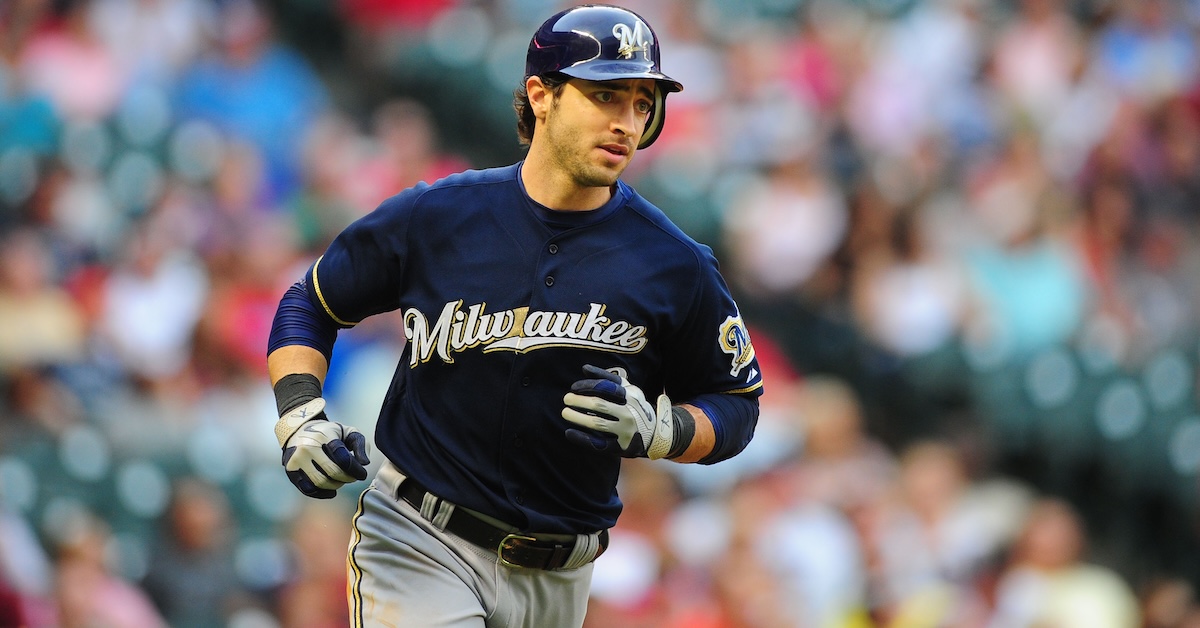
The following article is part of Jay Jaffe’s ongoing look at the candidates on the BBWAA 2026 Hall of Fame ballot. For a detailed introduction to this year’s ballot, and other candidates in the series, use the tool above; an introduction to JAWS can be found here. For a tentative schedule and a chance to fill out a Hall of Fame ballot for our crowdsourcing project, see here. All WAR figures refer to the Baseball Reference version unless otherwise indicated.
Along with Prince Fielder, who debuted in mid-2005 and joined the lineup as a regular the following season, Ryan Braun was a transformative figure in the history of the Brewers. Including its one-off season as the Seattle Pilots, the franchise made the playoffs just twice in its first 38 campaigns, back in 1981 and ’82. With Braun — the club’s first-round pick in 2005 — bopping 34 homers in just 113 games en route to NL Rookie of the Year honors in ’07, the Brewers finished above .500 for the first time in 15 years, and the next year, with Braun moving from third base (where he was terrible) to left field and making his first of six All-Star teams, they made the playoffs as the National League Wild Card. They would go on to qualify for the playoffs four more times during Braun’s career, with division titles and trips to the National League Championship Series in 2011 and ’18, though they fell just short of trips to the World Series.
Braun won NL MVP honors in 2011 and went on a memorable October run before the Brewers were eliminated, then led the league in home runs while finishing as runner-up in the voting the following year. He accumulated at least 30 homers and 30 steals in both seasons, but by that point, the legitimacy of those accomplishments was in question. In December 2011, less than a month after he beat out Matt Kemp for MVP, Major League Baseball suspended him for 50 games for testing positive for elevated levels of testosterone, later discovered to be synthetic; the sample had been taken after the Brewers’ first postseason game. With a spokesman citing “highly unusual circumstances,” “Ryan’s complete innocence,” “impeccable character and no previous history” of violations, Braun challenged the suspension. In February 2012, an arbitration panel overturned it due to a technicality involving the delay between when he submitted his sample and when the collector, a man named Dino Laurenzi Jr., sent it to the lab.
Both that reversal and Braun’s following actions — smearing Laurenzi both publicly and privately, even alleging that the collector was anti-Semitic (Braun’s father is Jewish, and Braun publicly embraced his Jewish heritage) — are without parallel in MLB’s long steroid saga. What’s more, Braun’s indignation and proclamations of innocence turned out to be a total sham; in 2013, he was discovered to have received PEDs through the Biogenesis Clinic, and earned a 65-game suspension. Thereafter, he publicly apologized, made amends with Laurenzi, and did his best to rehabilitate his image and demonstrate solid citizenship by continuing his involvement in several charitable organizations; he even earned multiple nominations for the Roberto Clemente Award. While he continued to play a supporting role on some very good Brewers teams (and some not-so-good ones), age and injuries limited his availability and effectiveness.
Braun played his last game in 2020, two months shy of his 37th birthday, though he waited nearly a year to formalize his retirement. While he won back many fans and finished with strong rate stats, his early exit left him with career totals that likely won’t sway Hall of Fame voters — or at least the ones willing to overlook his multiple PED transgressions. He’s left a complicated legacy, one that quite clearly won’t end in Cooperstown.
| Player | Career WAR | Peak WAR | JAWS |
|---|---|---|---|
| Ryan Braun | 47.2 | 38.8 | 43.0 |
| Avg. HOF LF | 65.3 | 41.7 | 53.5 |
| H | HR | SB | AVG/OBP/SLG (OPS+) |
| 1,963 | 352 | 216 | .296/.358/.532 (134 OPS+) |
Ryan Joseph Braun was born on November 17, 1983 in Mission Hill, California. His father, Joe Braun, was born in Tel Aviv, a descendent of Holocaust survivors, and emigrated to the United States when he was seven. He worked as an insurance claims adjuster while his mother, Diane Braun, was a brewer — literally — for Anheuser-Busch, “adding the hops and on through fermenting and the whole bit,” as she explained to the Los Angeles Times in 2008.
Both Joe and Diane played significant roles in the baseball upbringing of their children, Ryan and Steve (b. 1985), who would go on to spend three seasons in the Brewers minor league system before retiring due to vision problems. Joe coached both of his sons during the years they played Little League together and threw batting practice to the boys in a full-sized batting cage that Diane — who herself grew up in a house previously owned by Hank Greenberg — built in their backyard when Ryan was 14 and Steve 12.
At Granada Hills High School — the same school that produced Pro Football Hall of Famer John Elway as well as major leaguers Gary Matthews Jr. and Kameron Loe, Braun’s future teammate in Milwaukee — Braun was expected to play for the junior varsity team as a freshman. When the varsity second baseman failed to show up on time on Opening Day, though, Braun was plucked out of class and inserted into the lineup; he hit a single, a double, and a homer, capturing the attention of scouts on hand to examine Loe, then a senior. “He was the only kid in the game who didn’t have his name on his back, and all the scouts were like, ‘Who is this guy?’” Joe Braun recalled in 2011.
Braun lettered all four years at Granada, where he primarily split his time between shortstop and designated hitter, earning All-City honors three times and setting a school record for home runs. Considered one of the country’s top prep shortstops and a strong student to boot, he priced himself out of being drafted out of high school, and turned down athletic scholarships to Stanford and University of California-Berkeley in favor of a full academic scholarship to the University of Miami. In 2003, Baseball America named him Freshman of the Year and a first-team Freshman All-American. A rib cage strain curtailed his sophomore season and led to struggles in the Cape Cod League that summer, but as a junior, after shifting from shortstop to third base, he made BA’s All-American Team and was the Atlantic Coast Conference Baseball Player of the Year and a finalist for the Golden Spikes Award. The Brewers selected him with the fifth pick of the 2005 draft, after Justin Upton, Alex Gordon (another newcomer on this ballot), Jeff Clement, and Ryan Zimmerman, and signed him for a $2.45 million bonus.
Braun began his professional career with Rookie-level Helena of the Pioneer League, but he played just 10 games there before being promoted to A-level West Virginia of the South Atlantic League; between the two stops, he hit a combined .352/.393/.632 with 10 home runs in 47 games before a right elbow strain ended his season two weeks early. Baseball America placed him 49th on its Top 100 Prospects list the following spring, praising his five-tool ability and comparing his approach and power to Pat Burrell, who preceded him as a third baseman at Miami (1996–98). The publication did express concern regarding Braun’s “less-than-textbook swing,” adding, “He could use more balance and a more consistent, less exaggerated load.” BA also suggested Braun’s future might lay in an outfield corner rather than at third base. He hit .289/.357/.514 with 22 homers in 118 games split between High-A Brevard County and Double-A Huntsville in 2006, played in the Futures Game, starred in the Arizona Fall League, and moved to 26th in the Top 100.
Braun hit an absurd .342/.418/.701 with 10 homers in 34 games at Triple-A Nashville in 2007 before being called up to the Brewers, who had bolted from the gate to 28-19. With his arrival, they suddenly had an all-homegrown infield of players 24 or younger: Fielder at first base, Rickie Weeks Jr. at second, J.J. Hardy at short, and Braun at third. Debuting on May 25 against the Padres, Braun went 0-for-3 against Greg Maddux, but smacked a two-run double off Doug Brocail for his first hit after Maddux departed; the next night, Braun went 3-for-4 with a solo home run off Justin Germano.
While the Brewers had their share of ups and downs — including a 20-34 skid in July and August — they nosed across the finish line with an 83-79 record, their first above .500 since 1992, but finished two games behind the first-place Cubs in the NL Central. Braun absolutely raked, hitting .324/.370/.634 (154 OPS+) with 34 homers and 15 steals. He led the NL in slugging percentage even with 10 phantom at-bats. The only knock on his performance was dreadful defense — he made 26 errors, falling below the Hobson Line with an .895 fielding percentage as well as a jaw-dropping -32 DRS, tied for the second-lowest single-position DRS since the metric’s inception in 2003 — that limited him to 2.0 WAR. He beat out Troy Tulowitzki (chosen seventh in that same 2005 draft) by just two points for Rookie of the Year honors.
(Update: As a commenter pointed out, Adam Dunn totaled -43 DRS between his play at first base and the outfield corners in 2009.)
During his rookie season, Braun’s links to Judaism captured the attention of publications such as the Wisconsin Jewish Chronicle, the Jewish Herald Voice, and The Forward. He took on the nickname “The Hebrew Hammer,” previously bestowed upon 1950s slugger Al Rosen, and in June 2007 told the Milwaukee Journal-Sentinel, “Being Jewish is something I take great pride in. There aren’t too many Jewish athletes that have achieved success at the highest level, so it’s something I am very proud of.” Among those publications taking interest in his heritage, questions abounded as to whether he would play on Yom Kippur (September 22), Judaism’s holiest holiday, or would sit out a game, as predecessors such as Greenberg, Sandy Koufax, and Shawn Green had done. In the end, he chose to play, explaining to the Journal-Sentinel, “I don’t really celebrate the (Jewish) holidays so it won’t be much of an issue with me. Growing up half-Jewish, half-Catholic, I’ve never really celebrated one holiday over the other.”
Braun took up residence in left field in 2008, played above-average defense (7 DRS) and showed that his offense was no fluke. He hit .285/.335/.553 (130 wRC+) with 4.6 WAR while ranking fourth in the NL in home runs (34) and fifth in slugging percentage. He signed an eight-year, $45 million extension (through 2015) in May, and was voted to start in left field on the NL All-Star team in July. Like so many other Brewers, he slumped in September; the team even fired manager Ned Yost with 12 games remaining in the regular season. Nonetheless, the Brewers went 92-70 and claimed the NL Wild Card on the last day of the season, their first playoff berth since 1992. Braun went 5-for-16 with a pair of doubles in the Division Series against the Phillies, but the Brewers fell in four games. After the season, he placed third in the NL MVP voting.
Though the Brewers slipped below .500 in both 2009 and ’10, Braun continued to elevate his game. He hit .320/.386/.551 (146 OPS+) with 32 home runs in 2009, leading the NL with 203 hits and cracking the top 10 in batting average, slugging percentage, and WAR (6.2), then followed up with a .304/.365/.501 (131 OPS+) season with 5.7 WAR. He was voted into the All-Star lineup in both years, shoehorned into right field in 2009, while Raúl Ibañez started in left.
In April 2011, Braun and the Brewers agreed to a five-year, $105 million extension, putting him under contract with the team through 2020, with a mutual option for 2021; $18 million of his salary was deferred. Braun went on to set career highs in WAR (7.7) and OPS+ (166) while hitting .332/.397/.597 with 33 homers and 33 steals, becoming the second Brewer to join the 30/30 club, after Tommy Harper in 1970. The Brewers set a franchise record with 96 wins while capturing the NL Central, and they beat the Diamondbacks in a five-game Division Series before falling to the Cardinals in a six-game NLCS. Braun went on a rampage during the postseason, hitting a combined .405/.468/.714 with two home runs and 10 RBI in 11 games, and collecting multiple hits in six of them. He tallied three apiece in the first two NLDS contests, one of them a two-run first-inning homer in Game 2 off Daniel Hudson. In the first inning of the NLCS opener, he hit a two-run shot off Jaime García, then added a two-run double against him in the fifth, keying a 9-6 win.
While the MVP voting took place before the postseason, Braun’s October run was still fresh in mind when he narrowly beat out Kemp (who’d hit 39 homers and stolen 40 bases, with 8.0 WAR) for the award. Less than a month later, however, MLB handed down its 50-game suspension, which Braun challenged. After arbitrator Shyam Das overturned the suspension on February 23, 2012, on the grounds that the testing protocol had not been adhered to because of the delay between the collection of the urine sample (on a Saturday) and the shipping to the testing facility (on the following Monday). Braun took a victory lap, proclaiming, “Today is for everybody who has ever been wrongly accused… The simple truth is that I’m innocent. The truth is always relevant and the truth prevailed.”
“I would bet my life this substance never entered my body,” he added.
He continued to lay it on thick after reporting to the Brewers’ spring training facility, smearing Laurenzi by telling reporters, “There were a lot of things that we learned about the collector, about the collection process, about the way that the entire thing worked, that made us very concerned and very suspicious about what could have actually happened.”
With the matter seemingly behind him, Braun turned in another stellar campaign in 2012, hitting .319/.391/.595 with a league-leading 41 homers, 30 steals, a 158 OPS+ (third in the league) and 6.9 WAR (fifth); for the fourth time in five years, he started the All-Star Game. On September 16 at Miller Park, he hit the 200th home run of his career, off the Mets’ Chris Young. The Brewers, however, slumped to 83 wins and a third-place finish.
On January 31, 2013, the Miami New Times dropped a bombshell report implicating several major and minor league players, including Alex Rodriguez, Melky Cabrera, Bartolo Colon, and Nelson Cruz as having received performance-enhancing drugs from the Miami-based Biogenesis Clinic. The clinic’s chief, Anthony Bosch, had previously been connected to Manny Ramirez’s 2009 suspension for using HCG, a compound often used at the end of steroid cycles. On February 5, Yahoo Sports’ Tim Brown and Jeff Passan reported that Braun’s name had surfaced in the clinic’s records, though it wasn’t listed next to any specific PEDs. Braun said that his lawyers had employed Bosch as a consultant during his appeal, but once MLB secured Bosch’s cooperation a few months later, the slugger — who had already missed nearly four weeks due to a nerve injury in his right thumb — was in hotter water. Presented with what an MLB source described as “overwhelming” evidence that he had used PEDs, Braun accepted a suspension covering the final 65 games of the 2013 season. The hits kept coming; in August, Passan reported that in attempting to rally support for his cause among his peers, Braun “told players around baseball before spring training 2012 that the man who collected his urine that tested positive for synthetic testosterone was anti-Semitic and a Chicago Cubs fan in an effort to gather support throughout the game.” ESPN’s Buster Olney reported the allegations of anti-Semitism, as well. Between lying through his teeth about the 2011 tests, impugning workers in the testing process, and using his religion as a shield, Braun had managed to find a new low in the annals of baseball’s PED saga. Such chutzpah!
In a statement on August 23, 2013, Braun explained that he had begun using testosterone lozenges and a cream (which reportedly contained human growth hormone) while battling nagging injuries in 2011. He apologized for “some serious mistakes, both in the information I failed to share during my arbitration hearing and the comments I made to the press afterwards… For a long time, I was in denial and convinced myself that I had not done anything wrong.” He publicly apologized to Laurenzi, and also met with him privately over dinner at the collector’s home. Braun said in November 2013, “We’ve made amends and I think we’re both excited to be able to move forward and put this behind us.”
Braun returned to the Brewers in 2014, this time as a right fielder, and a 30-year-old one at that. With his right thumb still a problem, he hit .266/.324/.453 (113 OPS+) after tailing off drastically over the final two months of the season. He rebounded to hit .285/.356/.498 (131 OPS+) with 25 home runs and 3.4 WAR in 2015, making his final All-Star team. After moving back to left field, he had his best post-suspension season — his last really good season — in 2016, batting .305/.365/.538 (135 OPS+) with 30 homers and 4.4 WAR.
The Brewers were a fourth-place, sub-.500 team in both of those seasons, the second of which was David Stearns’ first at the helm. By the time the general manager’s rebuilding efforts had begun to bear fruit, Braun was back in left field, and a less productive player. From 2017–19, he hit for a 112 OPS+ while averaging 124 games, 20 homers, and 1.1 WAR, with a left calf strain and back issues taking bites out of his playing time. Highlights such as his 300th career homer, off the Cubs’ John Lackey on September 8, 2017, were fewer and further between.
The Brewers went 96-67 in 2018, winning the NL Central thanks to a 3-1 victory over the Cubs in a Game 163 tiebreaker; Braun added the insurance run with an eighth-inning RBI single. He went 5-for-13 as the Brewers swept the Rockies in the Division Series, but just 7-for-29 with two doubles and nine strikeouts in a seven-game loss to the Dodgers in the NLCS. Milwaukee won 89 games and claimed a Wild Card berth in 2019, then lost the Wild Card game as Josh Hader squandered a 3-1 lead in the eighth.
Braun hit just .233/.281/.488 for a career-low 101 OPS+ in 2020, playing just 39 games during the pandemic-shortened season while missing additional time due to back and right index finger injuries. The Brewers made the expanded playoffs despite a 29-31 record, but they lost a two-game Wild Card Series to the Dodgers. Braun went 0-for-2 in the first game before leaving in the fifth inning, having apparently aggravated his back earlier in the game when he crashed into the padded wall while catching a fly ball. He sat out Game 2, and as it turned out, he never played again.
In late October, the Brewers declined their end of a $15 million mutual option, choosing instead to pay Braun a $4 million buyout. It was the first time he’d ever reached free agency, but while he stayed in touch with the Brewers during the winter, paid a visit to their spring training facility, and continued to stay in shape, he said he wasn’t interested in playing. He declined overtures from both Team USA and Team Israel when it came to participating in the Summer Olympics, which the pandemic had delayed by a year. Finally, on September 14, 2021, he officially announced his retirement.
…
Braun was 29 years old when he was suspended. To that point, he offered durability to go with a package of power, speed, and patience; from 2008-12, he averaged 154 games, 34 homers, 22 steals and 5.4 WAR while hitting for a 148 wRC+. Post-suspension, he slipped to averages of 130 games, 22 homers, 14 steals and 2.1 WAR per year. That’s not to say that he was simply a product of whatever he was putting into his body; it’s a pretty typical aging pattern.
It’s one that left him with too short of a career to draw serious consideration for the Hall of Fame, even if one could set aside his PED suspension. Among Hall of Fame position players who debuted after integration in 1947, only Tony Oliva played fewer games than Braun’s 1,766. With 1,963 career hits, Braun did come closer to 2,000 than Oliva, the first post-1960 expansion player elected to the Hall with a total below that. He’s also closer to 2,000 than this ballot’s Chase Utley (1,885) or Andruw Jones (1,917), both of whom are trending toward eventual election, but the difference is that each of those players starred at more difficult defensive positions, which helped them accrue at least 15 more WAR.
While Braun has the 17th-highest peak WAR among left fielders (38.8), he’s merely 31st in career WAR (47.2) and 25th in JAWS (43.0), 10.5 points below the standard. That’s closer to the mark than current candidates Torii Hunter, Jimmy Rollins, or Omar Vizquel are at their respective positions, but none of them is getting elected by the writers, either; Rollins’ 18% was the highest any of that trio received in 2025, while Hunter received just one vote more than he needed to remain eligible.
Though the Brewers and their fans viewed Braun as someone special and treated his retirement announcement accordingly, I remain less reverential. As someone who defended Braun on the grounds of due process and breaches of confidentiality — foundational necessities for a fair and functional drug testing program — both at Baseball Prospectus, after his 2011 suspension was announced, and again in 2013, when MLB’s leaks during the Biogenesis investigation painted a picture of a league overzealously pursuing individual stars without having demonstrated their guilt, I’m one of those people described in Braun’s confessional statement, one of “[t]hose who put their necks out for me [who] have been embarrassed by my behavior.”
I suppose that merely puts me in the same boat as a previous generation of reporters who felt betrayed by the likes of Barry Bonds, Roger Clemens, and other stars after their PED misdeeds were revealed. I haven’t shied away from disagreeing with those voters in my annual Hall of Fame coverage, where I differentiate between PED allegations that date to the “Wild West” era before the game’s testing-and-suspension regimen was introduced, and those that came after the point at which MLB and the union began cracking down, but I understand their ire.
I must admit that I’m rather shocked Braun has already received three votes from among the first 25 ballots published in Ryan Thibodaux’s tracker. I can understand voting for Bonds and Clemens (I did so in 2021 and ’22, my first two years with a ballot), and while I haven’t voted for Ramirez and Rodriguez because their infractions crossed into the testing era, I can grasp why a voter would include them on a performance-only basis or as a thumb in the eye of MLB’s bungling of its PED issues. I can’t, however, grasp why a voter would recognize a much lesser player, one who tried to burn the whole drug testing regime to the ground, lying repeatedly in public while veering closer to cyclist Lance Armstrong’s organized bullying of teammates and testers than anyone else suspended by MLB. Yes, Rodriguez waged his own scorched-earth battle against suspension by filing lawsuits against commissioner Bud Selig, the players union, and a Yankees team doctor, but all of those felt like desperate diversions rather than credible, vindictive defenses. Besides, Rodriguez would clear the bar for any performance-only voter, whereas Braun’s numbers fall short of the standard.
The truth is, I can better understand why voters would be willing to overlook Rodriguez’s conduct than Braun’s, and beyond the performance aspect, the other matter that still sticks in the craw of this Jewish scribe (a descendent of a family similarly decimated by the Holocaust) — and that separates Braun from Rodriguez — is his reported invocation of anti-Semitism. The list of Jewish ballplayers isn’t a long one in the grand scheme, but the annals are full of stories of Jewish fans celebrating the likes of Greenberg and Koufax as they publicly acknowledged their heritage. Braun tapped into that goodwill, proclaiming himself “extremely proud to be a role model for young Jewish kids.” Crying wolf as he did feels like a particularly acute betrayal of the legacy he embraced.
I could belabor this for another thousand words — I went deeper on some of this stuff in the retirement piece four years ago — but it will suffice to say that Braun is the easiest NO vote for me on this ballot; I didn’t need half a second to consider him. It’s good he apologized, and I’m glad he did things in Milwaukee that put him back in the good graces of Brewers fans, but when it comes to whether he belongs in Cooperstown, as generations of Jaffes before me would say in Yiddish, “Feh.”
Brooklyn-based Jay Jaffe is a senior writer for FanGraphs, the author of The Cooperstown Casebook (Thomas Dunne Books, 2017) and the creator of the JAWS (Jaffe WAR Score) metric for Hall of Fame analysis. He founded the Futility Infielder website (2001), was a columnist for Baseball Prospectus (2005-2012) and a contributing writer for Sports Illustrated (2012-2018). He has been a recurring guest on MLB Network and a member of the BBWAA since 2011, and a Hall of Fame voter since 2021. Follow him on BlueSky @jayjaffe.bsky.social.
Cheat!
IDK – people say that players cheat don’t seem to have much knowledge of what competitive athletes do with their bodies/sports/trying to get a competitive edge.
I mean, there is a competitive edge and then there is knowlingly taking a prohibited substance, getting caught, lying about it, trying to get the tester fired, and being banned from baseball for a period.
He cheated.
It’s kind of impressive that you’ve managed to insinuate both that this wasn’t cheating and that the problem is other people.