
JAWS and the 2026 Hall of Fame Ballot: Hunter Pence
The following article is part of Jay Jaffe’s ongoing look at the candidates on the BBWAA 2026 Hall of Fame ballot. For a detailed introduction to this year’s ballot, and other candidates in the series, use the tool above; an introduction to JAWS can be found here. For a tentative schedule, see here. All WAR figures refer to the Baseball Reference version unless otherwise indicated.
| Player | Pos | Career WAR | Peak WAR | JAWS | H | HR | SB | AVG/OBP/SLG | OPS+ |
|---|---|---|---|---|---|---|---|---|---|
| Hunter Pence | RF | 30.9 | 26.2 | 28.6 | 1,791 | 244 | 120 | .279/.334/.461 | 114 |
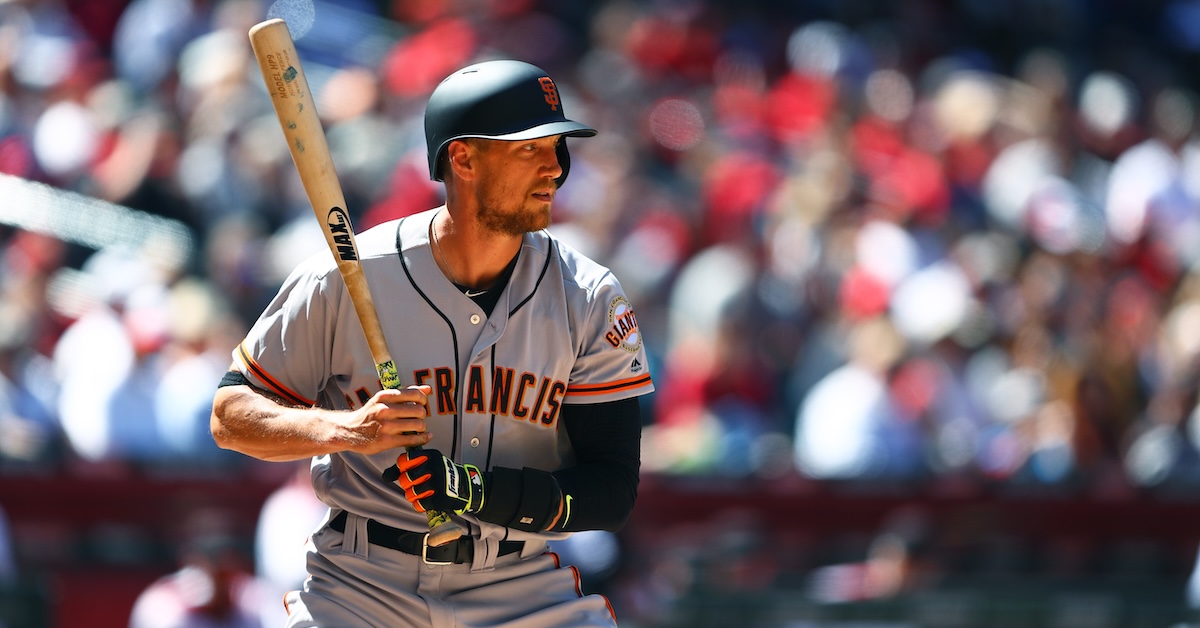
The great Vin Scully often described Hunter Pence as “all elbows and kneecaps,” and if you never understood the meaning of that colorful phrase, one look at the gangly 6-foot-4 right fielder, with his unorthodox swing, gait, and throwing mechanics, would explain a whole lot. Amplified by his high socks and what more than one writer termed his “bug-eyed intensity,” Pence’s on-field style was anything but textbook. As it turns out, there was a reason for that: In 2013, he was diagnosed with a condition called Scheuermann’s Disease, which caused his vertebrae to grow at different rates, deprived him of flexibility in his thoracic spine, and led him to find ways to compensate. Despite that significant disadvantage, Pence carved out an impressive 14-year major league career, making four All-Star teams and helping the Giants win the 2012 and ’14 World Series.
…
Hunter Andrew Pence was born on April 13, 1983, in Fort Worth, Texas, the youngest of three children born to Howard and Gail Pence. Howard worked in the oil and cattle industries, but his fortunes fluctuated. “Sometimes there was plenty of money; sometimes there was no room for anything beyond the necessities,” wrote Daniel Brown in a 2016 feature. “Pence even resisted contact lenses in high school because they were too expensive.”
The family bounced around when Hunter was young, spending a year in Denver and eventually moving to Arlington, Texas. When possible, he played baseball with his brother Howie, four years older and a talented player in his own right. Howie would eventually provide his younger brother a roadmap of the ups and downs of pursuing baseball. He grew eight inches during his freshman year of high school, causing issues with his hamstrings and back. He reached 6-foot-5 and developed a mid-90s fastball, but multiple elbow surgeries — including Tommy John surgery — cost him a shot at being drafted. After playing at Sam Houston State and University of Texas-Arlington, he was signed as a free agent by the Padres in 2003, then spent five seasons pitching professionally in the affiliated minors (2003–06) and the independent Northwest League (2006–07).
Hunter also drew from the athletic example of his older sister Stacy, who competed in power tumbling from ages five to 10 and earned state champion honors at age nine. Despite his back condition, Hunter was able to do backflips à la Ozzie Smith even during his major league career, and chose uniform no. 8 — which he wasn’t able to secure at the major league level until he became a Giant — because it looked the same upside down, when he executed his flips.
Hunter experienced a similar growth spurt to Howie, costing him a summer of baseball after he turned 16 and grew to 6-foot-4. He separated his shoulder rolling down a hill in a race during his junior year of high school, exacerbating what Howie termed “a weird throwing motion” because he didn’t wait for the injury to heal fully. Hunter’s throwing issues scared away some scouts, as well as some four-year colleges. He spent a year as a designated hitter at Texarkana Junior College, after which he was drafted by the Brewers in the 40th round in 2002. He didn’t sign, instead transferring to UT-Arlington, where a tweak of his arm slot improved his throwing, allowing him to learn the outfield. He earned first-team All-Conference honors as a sophomore in 2003, and in ’04 was named the Southland Conference Player of the Year after leading the conference in batting average (.395) and slugging percentage (.616).
Pence “isn’t going to win any beauty contests, but he swings one of meanest bats in Texas,” wrote Baseball America in its 2004 pre-draft evaluation. “He looks gangly at 6-foot-4 and 215 pounds, and his swing isn’t a classic stroke. But he has good plate coverage and strength, and he runs well for his size. His arm strength will limit him to left field.” On that last note, BA wound up being particularly off base, as Pence would prove to be a thoroughly capable right fielder, more or less average over the course of his career according to the metrics.
The Astros drafted Pence in the second round in 2004, and signed him to a $575,000 bonus. He began his professional career by hitting a robust .296/.369/.518 with eight homers in 51 games at Low-A Tri-Cities. He followed that up by batting .327/.400/.598 with 31 homers in 121 games split between A-level Lexington and High-A Salem in 2005, then .283/.357/.533 with 28 homers in 136 games at Double-A Corpus Christi in ’06, when he moved to right field after playing mostly center at lower levels. He cracked the Baseball America Top 100 Prospects list at no. 38 in the spring of 2007, with the publication noting, “Pence doesn’t do anything pretty, but he does most things well. His approach at the plate is anything but textbook, as he chokes up on the bat and has a hitch in his swing.” His quick hands and bat speed drew praise, and BA also noted, “He brings a high energy mindset to the ballpark every day.”
Pence started the 2007 season at Triple-A Round Rock, but got the call to Houston in late April, about two weeks after turning 24. He debuted on April 28 against the Brewers, playing center field and going 1-for-3 with a single off Dave Bush, who had hit him in his previous plate appearance. Pence hit his first home run on May 5, a ninth-inning grand slam off the Cardinals’ Dennis Dove. Though a chip fracture in his right wrist sidelined him for four weeks, he hit a sizzling .322/.360/.539 (129 OPS+) with 17 homers, 11 steals, and 3.4 WAR, a performance that helped him finish third in the National League Rookie of the Year voting behind Ryan Braun and Troy Tulowitzki.
Pence’s .377 batting average on balls in play and 5.4% walk rate suggested he might struggle to maintain his rookie level of production. Indeed, he never hit for a higher batting average (and maxed out at a .361 BABIP), and only produced a higher OPS+ twice. Increasingly prone to chasing breaking balls and offspeed pitches, he hit a combined .278/.330/.466 (111 OPS+) and averaged 3.1 WAR while hitting exactly 25 homers a year from 2008–10. During the best of those seasons (2009), he hit .282/.346/.472 (116 OPS+) with 4.0 WAR and made his first All-Star team.
During this period, the Astros were mired in the mediocrity that characterized the latter days of Drayton McLane’s ownership of the franchise. After winning the NL pennant in 2005 — their sixth season out of nine qualifying for the playoffs — they finished above .500 only in ’06 (82-80) and ’08 (86-75). Once McLane and Jim Crane struck a deal for the franchise in May 2011, general manager Ed Wade began stripping the roster for parts. As a Super Two under club control through 2013, Pence emerged as one of their more attractive trade targets, particularly after he made his second All-Star team that summer.
With the Astros heading towards 106 losses (a total they would surpass in each of the next two seasons), Pence was traded to the Phillies on July 29 in exchange for pitching prospects Jarred Cosart and Josh Zeid, first baseman Jon Singleton, and a player to be named later (outfielder Domingo Santana). Pence joined a star-laden team — one that included this ballot’s Cole Hamels, Jimmy Rollins, and Chase Utley, among others — that was en route to its fifth straight NL East title. He put up a 159 OPS+ with 11 homers in 54 games for the Phillies, and finished with career bests in both WAR (5.7) and OPS+ (139, via a .314/.370/.502 line) along with 22 homers. In the Division Series against the Cardinals, Pence went 2-for-5 with a pair of RBIs in the opener, an 11-6 win, but went just 2-for-14 thereafter, and the Phillies lost in five.
After a typically solid start with the Phillies in 2012, Pence went into a slump in July that dragged his numbers down. The team was in even worse shape, sinking to last place in the NL East with a 45-57 record as the trade deadline arrived. On July 31, the Phillies traded him to the Giants for a trio of prospects, catcher Tommy Joseph, righty Seth Rosin and outfielder Nate Schierholtz. Though he quickly gained popularity with fans for commuting to and from AT&T Park on his electric scooter, Pence’s slump continued; after posting a 109 OPS+ for the Phillies, he managed just a 90 OPS+ for the Giants, and finished with a .253/.319/.425 (103 OPS+) line and 1.3 WAR. That didn’t stop the Giants from winning the NL West with a 94-68 record, and while Pence’s slump continued through the postseason (.210/.231/.290), he emerged as an emotional leader thanks in part to his rousing pre-game speech before Game 3 of the Division Series against the Reds, when the Giants were down two games to none. His bases-loaded double off the Cardinals’ Joe Kelly — during which the ball made contact three separate times with Pence’s splintered bat — broke open Game 7 of the NLCS.
After going hitless in Game 1 of the World Series against the Tigers, Pence went 4-for-10 and scored the game’s first run in each of the final three games of the team’s sweep; he led off the seventh inning of Game 2 with a single off Doug Fister, then plated the Giants’ second run with an eighth-inning sacrifice fly off Octavio Dotel. It was the Giants’ second championship in three years.
Though Pence’s regular season struggles made him a non-tender candidate, the Giants brought him back on a $13.8 million contract for 2013, and he rewarded their faith by playing in every game and setting career highs with 27 homers and 22 steals to go with a .283/.339/.483 (133 OPS+) line and 3.8 WAR. The Giants slipped to 76-86, but in late September, they signed Pence to a five-year, $90 million extension. During his pre-signing physical, Pence discovered he suffered from Scheuermann’s Disease, which helped the outfielder understand his own body much better. From a December 2014 interview with ESPN’s Tim Keown:
It made things make a lot more sense. Earlier that spring, they measured my [thoracic] spine flexibility, and I was like off-the-charts low. They told me I have to work on flexibility, but after two days my back was locking up so bad I couldn’t even swing properly. I said, ‘Hey, can I stop doing this?’ As soon as I stopped, my back went back to feeling great. At the end of the year, they said, ‘Oh, this is why you couldn’t do those stretches — it’s bone on bone.’ Coming up in baseball it’s always been the same: ‘Oh, Hunter just does things differently. I’ve never seen anyone like him before.’
… “[Because of the condition] You just have to be really careful reversing your car. You can’t really turn around very well. They said, ‘Well, that’s probably why your warm-up swing is so weird.’ But here’s the way I look at it: They say I was supposed to be 6-8 but I’m 6-4, and that’s a huge advantage for baseball. I don’t have as big a strike zone and I have the wingspan of a 6-8 person.”
In 2014, Pence again played in every game, made his third All-Star team, and hit .277/.332/.445 (121 OPS+) with 20 homers, 10 triples, 13 steals, and 4.0 WAR. The Giants won 88 games and claimed a Wild Card berth. While Pence hit just .256/.341/.333 during the first three rounds of the playoffs — a Wild Card win over the Pirates (during which he scored two runs), a Division Series win over the Nationals (highlighted by his spectacular catch of a Jayson Werth fly ball in the Game 4 clincher), and an NLCS win over the Cardinals — he had key RBI singles in their victories in Games 3 and 4 against St. Louis.
Pence caught fire in the World Series against the Royals; if not for Madison Bumgarner’s stellar pitching performance, he would have contended with teammate Pablo Sandoval for MVP honors, but then again, it was Bumgarner whose work ensured the victory. Pence hit .444/.500/.667 during the series, with at least one hit in every game; his 12 hits, seven runs scored, and five RBIs led or at least tied for the lead among all hitters. He hit a two-run homer off James Shields in the first inning of the Giants’ Game 1 victory, went 3-for-5 with three RBIs in their Game 4 win, and 2-for-4 with a run scored in Game 7.
Pence finished the 2014 regular season riding a streak of 383 consecutive games played, but injuries sent him to what was then the disabled list three times in ’15, limiting him to 52 games. He fractured his left forearm when he was hit by a pitch from Cubs prospect Corey Black during spring training, and didn’t make his season debut until May 16. Less than three weeks later, he was sidelined for another seven weeks by a bout of tendinitis in his right wrist, and an oblique strain suffered on August 17 ended his season.
Alas, it was mostly downhill from there. Pence hit .289/.357/.451 (118 OPS+) with 13 homers and 2.2 WAR in 2016 while helping the Giants earn another Wild Card berth, but he lost nearly two months to a right hamstring strain. Though he played in 134 games in 2017, he lost three weeks to a left hamstring strain and hit for just an 84 OPS+ with 0.2 WAR. He sank to a 64 OPS+ and -1.0 WAR in 97 games in 2018, missing six weeks due to soreness in his right thumb.
That dismal season marked the end of Pence’s five-year deal with the Giants; he hit free agency for the first time in his career at age 35. Not surprisingly, he couldn’t secure a major league contract, but he spent the offseason reworking his swing with Doug Latta, the hitting instructor known for helping Justin Turner revitalize his career. In early February, Pence inked a minor league deal with the Rangers, his hometown team, and lo and behold, his adjustments — which included a more open stance, a lower back elbow and a higher front elbow, and better balance — paid off. He hit .294/.353/.608 through June 16, when a groin strain sent him to the injured list, costing him four weeks and the opportunity to participate in the All-Star Game, though he was one of the year’s most surprising selections. Lower back issues later sidelined him for another five weeks, but his .297/.358/.552 (126 OPS+) overall showing with 18 homers and 1.6 WAR in just 83 games rated as a small-scale triumph.
A free agent again, Pence returned to the Giants on a one-year deal worth $3 million plus incentives, but he didn’t make it through the pandemic-shortened shortened season. In late August, after going 5-for-52 in 17 games, he was designated for assignment. He never played again, and a month later officially announced his retirement.
Since hanging up his spikes, Pence has worked as a broadcaster for NBC Sports Bay Area and for MLB Network. Beyond baseball, he’s turned his attention to environmental advocacy and serving as an unofficial ambassador to San Francisco. “His teammates called him The Reverend for his inspiring clubhouse pep talks,” wrote the San Francisco Chronicle’s Heather Knight in 2021, “and he might as well be San Francisco’s Reverend now.”
Brooklyn-based Jay Jaffe is a senior writer for FanGraphs, the author of The Cooperstown Casebook (Thomas Dunne Books, 2017) and the creator of the JAWS (Jaffe WAR Score) metric for Hall of Fame analysis. He founded the Futility Infielder website (2001), was a columnist for Baseball Prospectus (2005-2012) and a contributing writer for Sports Illustrated (2012-2018). He has been a recurring guest on MLB Network and a member of the BBWAA since 2011, and a Hall of Fame voter since 2021. Follow him on BlueSky @jayjaffe.bsky.social.
Hunter Pence for HOF? Seriously? He barely makes it into the “Hall of very good”.
“The following article is part of Jay Jaffe’s ongoing look at the candidates on the BBWAA 2026 Hall of Fame ballot.”
In support:
Notice that the table at the top doesn’t have a row for “average hall of fame player at <position>”, which Mr. Jaffe includes for most candidates. I’d assume that this is because there’s no reason to rub it in that Pence is not in fact a good Hall of Fame candidate.
But everyone who takes the field in a regular season MLB game is a very good balllplayer, and even in that group, you can have been a very MLB player without being a good Hall of Fame candidate.
Covering all the candidates means covering them all, and there’s no reason the article should belabor the fact that Pence will almost certainly and quite reasonably fall short of 5% of the vote, being on the ballot means he was a very good player.
.
Yeah I mean the title of the article implies we’re taking about JAWS but Jay never really mentions the guy’s JAWS, or really any career stats. Not worth discussing I guess?