
JAWS and the 2026 Hall of Fame Ballot: Gio Gonzalez
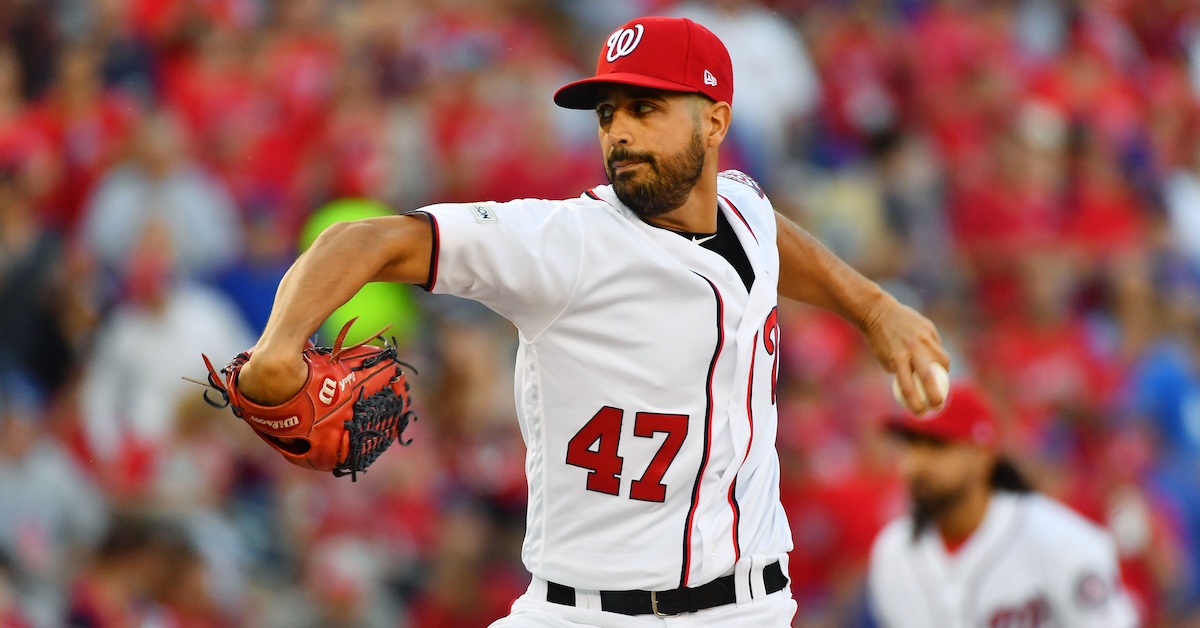
The following article is part of Jay Jaffe’s ongoing look at the candidates on the BBWAA 2026 Hall of Fame ballot. For a detailed introduction to this year’s ballot, and other candidates in the series, use the tool above; an introduction to JAWS can be found here. For a tentative schedule, see here. All WAR figures refer to the Baseball Reference version unless otherwise indicated.
| Pitcher | Career WAR | Peak WAR Adj. | S-JAWS | W-L | SO | ERA | ERA+ |
|---|---|---|---|---|---|---|---|
| Gio Gonzalez | 28.3 | 26.2 | 27.2 | 131-101 | 1,860 | 3.70 | 111 |
The baseball industry loves its pitching prospects — and sometimes seems to love dreaming on them by using them as trade chips almost as much as it does actually letting them pitch. Considered to have one of the best curveballs in the game from the outset of his professional career, Gio Gonzalez was traded three times before he’d thrown a major league pitch, and five times during a career that ended just after he turned 35. Along the way, the undersized southpaw made two All-Star teams, received Cy Young votes twice, and helped his teams reach the playoffs five times. While he wasn’t always easy to watch given his high walk rates, his ability to miss bats was a testament to the quality of his stuff.
…
Giovany Aramis Gonzalez was born on September 19, 1985 in Hialeah, Florida, a city in Miami-Dade County where roughly three-quarters of the population is of Cuban ancestry. He’s the oldest of six children of Max and Yolanda (Yoly) Gonzalez. Max, a first-generation Cuban-American, installed billboards and owned a scooter shop, while Yoly, an immigrant from Cuba, worked at various jobs to help the family make ends meet.
Gio was just four years old when his parents introduced him to baseball. Growing up, he played sandlot baseball with neighborhood kids in a narrow, rocky strip of land behind the family’s townhouse. “We broke so many windows that I found a guy who would replace them for 15 bucks apiece,” Yoly recalled in 2011.
“Max grew up tough, never got to play as much ball as he wanted and, when it rained on too-rare Sundays when he had a game as a child, he broke down in frustration and cried. But he never stopped studying the sport,” wrote the Washington Post’s Thomas Boswell in 2012. When his eldest son showed an aptitude for the game, Max taught him the curveball that would become his signature.
“I can’t explain it or show how to do it,” Gio told Boswell with regards to the pitch. “It’s a different grip, a snap of the wrist he taught me. I’ve done it all my life. ‘Make it fall off the table, always 12-to-6,’ he’d say.”
“He taught me how to try to make it look exactly like a fastball,” Gio told FanGraphs’ David Laurila in 2012.
Gio had such an advanced feel for pitching that he won Florida 6-A state title games for Hialeah High School as a freshman (2001) and sophomore (2002). Disputes between Yoly and Hialeah High’s coach over younger brother Max Jr.’s playing time led both brothers to be dismissed from the team. They transferred to private Monsignor Pace High School for Gio’s senior season; he went 5-0 with a 0.93 ERA and 81 strikeouts in 37 innings, but was suspended during the playoffs due to a similar dispute (the head coach told the Miami Herald that both players had violated team policy). Those incidents and his physical stature (listed at 6 feet — but perhaps shorter — and 170 pounds) concerned some scouts, but his arsenal was undeniable. From Baseball America’s pre-draft report in 2004:
His track record on the field, as well as his stuff and great feel for pitching, still have him poised to go late in the first round. Gonzalez pitches in the 87-90 mph range, touching 93-94, and complements it with what may be the nation’s best curveball, a tight spinner that he commands well. He’s also shown good feel for a changeup. He has polish and could move quickly.
The White Sox chose Gonzalez during the supplementary phase of the first round in 2004, as compensation for losing Tom Gordon to free agency; he was the 38th pick overall. Signed to an $850,000 bonus, the 18-year-old began his professional career at Rookie-level Bristol, then was promoted to A-level Kannapolis after seven appearances; in all, he put up a 3.20 ERA with 9.7 strikeouts per nine in 64.2 innings. After boosting that strikeout rate to 11.2 per nine in a season split between Kannapolis and High-A Winston-Salem in 2005, the White Sox — who had just won their first World Series in 88 years — traded Gonzalez to the Phillies as the player to be named later from a three-player package that had sent Jim Thome to Chicago in November 2005.
Gonzalez cracked BA’s Top 100 Prospects List at no. 73 the following spring, his first of four times making the list. His stay in the Phillies’ organization was not long. He spent 2006 at Double-A Reading, where he battled command issues and was hit for 1.4 homers per nine en route to a 4.66 ERA, though he still struck out 9.7 batters per nine. He was more impressive in a stint in the Arizona Fall League, and two days shy of a year after being traded from the White Sox, he was sent back to them along with Gavin Floyd in exchange for Freddy Garcia. He was overpowering at Double-A Birmingham in 2007, leading the minors with 185 strikeouts (11.1 per nine) in 150 innings while posting a 3.18 ERA. BA noted his maturation both as a pitcher and a person, while also lauding both his curve and his fastball (“…generally parks in the low 90s but can spike upward to 96 mph… has some natural sink, allowing him to get his share of groundballs. He can change speeds with his fastball, adding and subtracting throughout the game and sometimes saving his best velocity for the late innings.”). While the publication anointed him the White Sox’s no. 1 prospect as the Baseball America Prospect Handbook 2008 went to press, on January 3 he was traded to the A’s along with Fautino De Los Santos and Ryan Sweeney in exchange for Nick Swisher. When BA’s Top 100 was released in February, he placed 26th.
Gonzalez made a solid showing at Triple-A Sacramento over the first four months of the 2008 season, then was called up to debut on August 6 against the Blue Jays in Toronto. He notched his first strikeout by getting David Eckstein looking at a curveball, but served up a three-run homer to Rod Barajas before completing the first inning. “I think he might have killed a fan in the stands, that’s how hard he hit that ball,” Gonzalez recalled with some amusement for La Vida Baseball in 2018. He held on to complete six frames that night, allowing just one more run, but took the loss. He earned his first win in his next start, a five-inning, one-run effort against the Rays, but that was the high point of his call-up; struggling with his control, he walked 25 batters in 34 innings while yielding a 7.68 ERA.
Gonzalez spent the first half of 2009 shuttling between Sacramento and the majors, making two long relief appearances for the A’s. He joined the big club for good in late June, but his command and control issues continued; he walked 5.1 per nine while striking out 9.9 per nine in 98.2 innings, finishing with a 5.75 ERA. “Gonzalez has driven his employers to fits of frustration for years now… [due to] his puzzling combination of swing-and-miss stuff and baffling inconsistency,” wrote Baseball Prospectus in its 2010 annual, but things were about to change. Still just 24 years old, he broke out thanks to a much-improved changeup, better overall command, and a more contact-oriented approach; he went 15-9 with a 3.23 ERA in 200.2 innings in 2010, good for 3.9 WAR.
Gonzalez continued to improve in 2011. Though he led the American League with 91 walks, he struck out 197 (8.8 per nine) in 202 innings while going 16-12 with a 3.12 ERA and 4.4 WAR, and made his first All-Star team. With his first year of arbitration eligibility approaching, A’s general manager Billy Beane made him available, and in December traded him to the Nationals along with righty prospect Robert Gilliam in exchange for four prospects: lefty Tommy Milone, righties A.J. Cole and Brad Peacock, and catcher Derek Norris. In January, Washington then signed him to a five-year, $42 million extension with a couple of additional options — the largest extension to that point for a first-time arbitration-eligible pitcher.
Though he was chased in the fourth inning of his Nationals debut, Gonzalez then strung together 24 scoreless innings over his next four starts, and lasted at least six innings in 13 of his 17 starts before the All-Star break. He made the National League All-Star team and continued to roll, throwing a five-hit shutout against the Cardinals on August 31 for his 17th win of the year and adding four more wins in September to go 21-8 with 207 strikeouts. His win total and 9.3 strikeouts per nine both led the league, while his 5.0 WAR ranked fourth and his 2.89 ERA sixth.
After the 98-win Nationals made the playoffs for the first time since moving from Montreal in 2004, Gonzalez started the Division Series opener, ahead of Jordan Zimmermann (recall that Stephen Strasburg had been shut down due to workload concerns). Despite walking seven hitters in five innings, he allowed just one hit and two runs; he left trailing 2-1, but the Nationals pulled out a 3-2 win. He threw five innings in Game 5 as well, walking four while allowing three runs and departing with a 6-3 lead; alas, the Nationals’ bullpen squandered it, losing 9-7. After the season, Gonzalez placed third in the NL Cy Young voting behind R.A. Dickey and Clayton Kershaw; he even received a first-place vote.
Before the start of the 2013 season, Gonzalez’s name surfaced in the Miami New Times’ report regarding the distribution of performance-enhancing drugs out of the Biogenesis Clinic. Gonzalez denied receiving or using PEDs, either from the clinic or anywhere else, and he passed a drug test shortly after the story broke. His father chimed in, telling a reporter that he was a client of the clinic:
“My son works very, very hard, and he’s as clean as apple pie,” the elder Gonzalez says. “I went to Tony [clinic owner Anthony Bosch] because I needed to lose weight. A friend recommended him, and he did great work for me. But that’s it. He never met my son. Never. And if I knew he was doing these things with steroids, do you think I’d be dumb enough to go there?”
Gonzalez was cleared to pitch for Team USA in the 2013 World Baseball Classic, delivering five shutout innings against Puerto Rico in front of a crowd of 32,872 in Miami.
In August, when Major League Baseball announced the suspensions of 13 players for receiving PEDs from Biogenesis, the league officially exonerated Gonzalez: “Major League Baseball’s investigation found no violations of the Joint Drug Prevention and Treatment Program by either Washington Nationals pitcher Gio Gonzalez or Baltimore Orioles infielder Danny Valencia.”
Gonzalez couldn’t replicate his 2012 season, though he settled in as a solid midrotation starter for the Nationals. From 2013–15, he averaged 176.2 innings with a 3.57 ERA (107 ERA+), 8.9 K/9, and 2.5 WAR, though he missed a month during the first half due to shoulder inflammation in 2014. He pitched very well down the stretch that year, posting a 2.36 ERA with just nine walks in 45.2 innings over his final seven starts as the Nationals ran away with the NL East title. He started Game 4 of the Division Series against the Giants, with the Nationals facing elimination; after he allowed two runs in four innings, he was pulled for a pinch-hitter with the tying run on second, but the move didn’t work, and Washington lost the series.
Gonzalez began the 2016 season with his average four-seam fastball velocity down about two ticks relative to the year before (92.8 mph in 2015, 90.5 mph in April 2016). Though he fared well that month, and recovered some of the missing velo — the pitch averaged 91.8 mph for the season — his 4.57 ERA (93 ERA+) and 1.0 homers per nine were his worst full-season marks to that point, as was his 0.8 WAR. Even so, the Nationals won the NL East again, and with their rotation behind Max Scherzer thinned out by the loss of Strasburg to an elbow injury, Gonzalez started Game 3 of the Division Series against the Dodgers. He allowed three runs in 4 1/3 innings, but the Nationals’ bullpen and offense came through in an 8-3 win, though again they lost the series.
Despite Gonzalez’s subpar season, the Nationals picked up his $12 million club option for 2017. The 31-year-old lefty developed a strong bond with new catcher Matt Wieters and made adjustments, using his changeup and curveball more and his four-seamer (which now averaged 90.0 mph) and sinker less, and doing a better job of avoiding hard contact. His season rivaled 2012 as the best of his career. He went 15-8 with a 2.96 ERA in 201 innings, striking out 8.4 per nine and ranking second in the NL with 6.5 WAR; his ERA was fifth. On July 31 in Miami, he took a no-hitter into the ninth inning against the Marlins before surrendering a single to Dee Strange-Gordon.
Again the Nationals won the NL East going away, and again they were bounced in the Division Series, this time by the Cubs. Gonzalez allowed three runs in five innings in Game 2, leaving trailing 3-1 before his teammates rallied to win. He started Game 5 as well, and was staked to a 4-1 lead but was pulled after a double, two walks, and a wild pitch in the third inning cut the score to 4-3; ultimately, Washington lost, 9-8. In November, Scherzer won the Cy Young, with Strasburg third and Gonzalez sixth.
Gonzalez pitched enough innings to vest another $12 million option for 2018, but neither he nor the Nationals — who had let manager Dusty Baker go despite winning back-to-back division titles — fared as well. With the team just 67-67 as the August 31 waiver deadline approached, Gonzalez and his 4.57 ERA were sent to the Brewers along with some international bonus money in exchange for two prospects. He was Milwaukee’s most effective starter (3-0, 2.13 ERA in 25.1 innings) as the Brewers went 20-7 in September, erasing a five-game deficit to tie the Cubs for the NL Central lead, then beating them in a Game 163 tiebreaker to determine the division winner and Wild Card team. While the Brewers swept the Rockies (who themselves had lost a tiebreaker to the Dodgers) in the Division Series, Gonzalez didn’t pitch again until the NLCS against the Dodgers, when he made two abbreviated starts totaling three innings in Games 1 and 4. The first one, in which he surrendered only a solo homer to Manny Machado, was part of a gambit, as manager Craig Counsell preferred to play matchups in a bullpen game against the righty-heavy Dodgers; it worked, as the Brewers won, 6-5. In Game 4, Gonzalez suffered a high left ankle sprain while fielding a comebacker from Yasiel Puig as he led off the second inning. His removal from the roster ended his season; the Brewers lost in seven games.
A free agent for the first time in his career, the 33-year-old Gonzalez — who had finished with a 4.21 ERA, but his worst strikeout and walk rates since 2009 — received interest from the Padres, Mets, A’s, and Giants, but he couldn’t find a multiyear contract, so in March settled for a minor-league deal with the Yankees after they lost Luis Severino to rotator cuff inflammation. After he signed, he said it was “pretty much” the only formal offer he received. After three starts for the Yankees’ Triple-A Scranton/Wilkes-Barre affiliate, he exercised an opt-out clause, and in late April returned to the Brewers on a $2 million-plus-incentives major league deal, choosing them over the Mets.
Gonzalez made half a dozen starts for the Brewers before landing on the injured list with what was variously described as “dead arm” and shoulder inflammation, an issue the pitcher traced to throwing too frequently over the winter amid his uncertainty. He returned just after the All-Star break, and finished with a 3.50 ERA and 8.0 strikeouts per nine in 87.1 innings for a team that claimed a Wild Card berth but lost to the Nationals.
Gonzalez came full circle in December 2019, signing a one-year, $5 million deal with the White Sox, with an option for ’21. He battled further shoulder woes early in spring training, before the coronavirus pandemic shut down baseball; when play resumed in late July, he made four starts and one long relief appearance before being sent to the bullpen with a 6.00 ERA. After one appearance, he landed on the IL with a groin strain, then spent the final three weeks of September pitching in relief. The White Sox went 35-25 and made the expanded playoffs, but Gonzalez was left off the roster for the Wild Card Series against the A’s, which Chicago lost in three games.
The White Sox declined Gonzalez’s $7 million option for 2021. In March 2022, three weeks after signing a minor league deal with the Marlins, he announced his retirement on Instagram, expressing gratitude for the chance to pitch in front of a hometown crowd. “I gave my best effort, but my body struggled to keep up,” he said while thanking the Marlins and all of the other organizations in which he spent time. It wasn’t quite a storybook ending, but he had come home.
Brooklyn-based Jay Jaffe is a senior writer for FanGraphs, the author of The Cooperstown Casebook (Thomas Dunne Books, 2017) and the creator of the JAWS (Jaffe WAR Score) metric for Hall of Fame analysis. He founded the Futility Infielder website (2001), was a columnist for Baseball Prospectus (2005-2012) and a contributing writer for Sports Illustrated (2012-2018). He has been a recurring guest on MLB Network and a member of the BBWAA since 2011, and a Hall of Fame voter since 2021. Follow him on BlueSky @jayjaffe.bsky.social.
Incredible amount of time and effort on this piece. For a guy who won’t sniff Cooperstown. Jay owns the Hall of Fame analysis corner.