
Jay Jaffe’s 2026 Hall of Fame Ballot
The following article is part of Jay Jaffe’s ongoing look at the candidates on the BBWAA 2026 Hall of Fame ballot. For a detailed introduction to this year’s ballot, and other candidates in the series, use the tool above; an introduction to JAWS can be found here. For a tentative schedule and a chance to fill out a Hall of Fame ballot for our crowdsourcing project, see here. All WAR figures refer to the Baseball-Reference version unless otherwise indicated.
There’s no getting around the fact that the 2026 BBWAA Hall of Fame is a lean one. With three candidates elected by the writers in both 2024 and ’25 — following a mini-drought in which just two were elected over the previous three years — the top newcomers didn’t linger, while some long-lasting holdovers were finally elected. That left the cupboard comparatively bare, and when it came to restocking, the best of this year’s first-year candidates bowed out after their age-36 seasons without accumulating massive career totals.
Given all that, I suspected even before I received my favorite piece of annual mail that I wouldn’t max out my ballot by voting for 10 candidates. I only got to 10 in each of the past two years by using my last spot to include a pitcher whose S-JAWS is short of the standard but who offers other compelling reasons for inclusion. For the 2024 ballot, I tabbed Andy Pettitte due in part to his massive postseason contributions, while for ’25 I selected Félix Hernández due to his stellar early-career run and a concern that he could slip off the ballot without a longer discussion, à la two-time Cy Young winner Johan Santana on the 2018 ballot.
Both choices were a reaction to the dearth of starting pitchers elected in recent years and the reality that such a trend isn’t likely to change. BBWAA voters have elected just three starters born in 1969 or later, namely Pedro Martinez (1971), Roy Halladay (1977) and CC Sabathia (1980). While Zack Greinke, Clayton Kershaw, Max Scherzer, and Justin Verlander will likely join them someday, the industry’s trend towards smaller workloads — coupled with the greater injury risk that comes with chasing higher velocities and spin rates — has made the familiar milestones that virtually guarantee election even more remote. Voters need to rethink their standards for starters, and I believe that discussion is well served by keeping the candidacies of those on the ballot alive for further deliberation. With five of the 10 players I voted for last year not carrying over (Sabathia, Ichiro Suzuki, and Billy Wagner were elected, while Russell Martin and Brian McCann fell short of 5%), I suspected I’d be able to fit both Hernández and Pettitte as well as newcomer Cole Hamels and holdover Mark Buehrle.
I had all that in mind as I worked through this year’s top 19 candidates in my series over the past six weeks (I’ve still got eight one-and-done stragglers to cover in early January, none of whom were in serious consideration for space on my ballot). This is my sixth year with an actual ballot, but even with the heightened scrutiny that comes with it, filling one out remains a privilege and still feels like a novelty in the context of 25 years of analyzing Hall of Fame elections, and 23 of doing so while armed with the system that became JAWS (the official 20th anniversary of the metric’s introduction was in January 2024).
Regarding this slate’s perceived weakness, my primary way of tracking ballot strength is by counting both how many candidates meet or exceed the JAWS standard at their position, and how many have a JAWS of at least 50.0 (40.0 for catchers). At the outset of this cycle, just two met the standard (with two others less than a point away) and six reached 50.0, but with the Era Committee election of Jeff Kent, the standard at second base dropped by 0.4 points, enough to nudge Chase Utley above the bar and raise the first of those two totals to three:
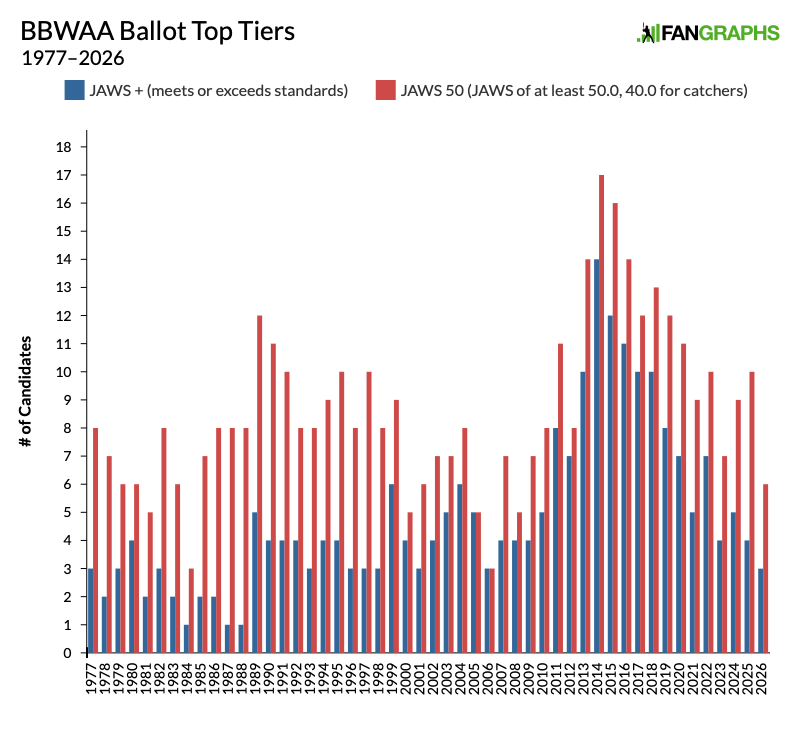
Before Kent’s election, you had to go back to 1988 to find a ballot where two or fewer candidates met the JAWS standard, not that JAWS or WAR existed then. Now you only have to go back to 2006, when Bert Blyleven, Alan Trammell, and Rich Gossage cleared their respective standards. You still have to go back to 2008 to find a ballot with six or fewer candidates with a JAWS of 50.0, but enough about ancient history. Here’s how the aforementioned 19 candidates stack up via JAWS:
| Player | YoB | Standards | Career WAR | Peak WAR | JAWS | Margin |
|---|---|---|---|---|---|---|
| Alex Rodriguez | 5 | 3 | 117.4 | 64.3 | 90.8 | 35.4 |
| Manny Ramirez | 10 | 2 | 69.3 | 40.0 | 54.6 | 1.1 |
| Chase Utley | 3 | 2 | 64.6 | 49.3 | 56.9 | 0.3 |
| Carlos Beltrán | 4 | 0 | 70.0 | 44.4 | 57.2 | -0.8 |
| Andruw Jones | 9 | 1 | 62.7 | 46.4 | 54.6 | -3.4 |
| Bobby Abreu | 7 | 0 | 60.2 | 41.6 | 50.9 | -5.1 |
| Cole Hamels | 1 | 0 | 59.0 | 37.4 | 48.2 | -8.6 |
| Mark Buehrle | 6 | 0 | 59.0 | 35.8 | 47.4 | -9.4 |
| Andy Pettitte | 8 | 0 | 60.2 | 34.1 | 47.2 | -9.6 |
| Dustin Pedroia | 2 | 0 | 51.8 | 40.9 | 46.4 | -10.2 |
| Ryan Braun | 1 | 0 | 47.2 | 38.8 | 43.0 | -10.5 |
| Francisco Rodríguez | 4 | 0 | 24.2 | 17.6 | 20.9 | -10.7 |
| David Wright | 3 | 0 | 49.1 | 39.5 | 44.3 | -11.8 |
| Félix Hernández | 2 | 0 | 49.8 | 38.5 | 44.1 | -12.7 |
| Jimmy Rollins | 5 | 0 | 47.9 | 32.7 | 40.3 | -15.1 |
| Torii Hunter | 6 | 0 | 50.6 | 30.8 | 40.7 | -17.3 |
| Omar Vizquel | 9 | 0 | 45.6 | 26.8 | 36.2 | -19.2 |
| Alex Gordon | 1 | 0 | 34.9 | 31.1 | 33.0 | -20.5 |
| Edwin Encarnación | 1 | 0 | 35.3 | 27.2 | 31.2 | -22.3 |
As noted, I’ve used my workload-adjusted S-JAWS for starting pitchers (detailed here), which brings the above starters closer to the standard but still leaves even the highest-ranked one, Hamels, more than eight points off the pace. Likewise, I’ve used my leverage-adjusted R-JAWS (explained here) for Francisco Rodríguez, the ballot’s only reliever. The yellow cells show that a candidate meets or exceeds the WAR or JAWS standard at their position, and as you can see, the table is light on those relative to years past.
Before going any further, it’s worth mentioning the “integrity, sportsmanship, [and] character” section of the voting rules. I don’t put much stock in the clause, which was the brainchild of Kenesaw Mountain Landis, who brimmed with such integrity that he spent his entire 24-year term as commissioner upholding the game’s shameful color line, and which was never really used to exclude anyone until Mark McGwire landed on the 2007 ballot. The hypocrisy of electing Bud Selig, a key figure in the owners’ collusion in the 1980s and the commissioner overseeing the so-called Steroid Era, only bolsters my disdain for the clause, though I have my own ways of dealing with the darker aspects of players’ candidacies. The line I’ve maintained for candidates connected to performance-enhancing drugs is to distinguish between those whose allegations date to the time when the game had no testing regimen or means of punishment (i.e., prior to 2004) and those that came afterwards. With no means of enforcing a paper ban, and with players flouting such a ban being rewarded left and right amid what was truly a complete institutional failure that implicated team owners, the commissioner, and the players union as well as the players, I simply don’t think voters can apply a retroactive morality to that period.
Hence the difference between my votes for the likes of Barry Bonds, Roger Clemens, and Gary Sheffield, and my exclusions of A-Rod and Manny, both of whom would be on my ballot on a performance-only basis — they’re two of the best hitters I’ve ever seen, with numbers that place them among the all-time greats — or if failing the supposedly anonymous 2003 survey test were their only PED-related transgression. Every year, I consider whether to take a new approach with such candidates, but I’m not changing my mind this year.
Note that I have not used allegations of domestic violence to disqualify candidates from consideration, though such matters are far more serious than PEDs. I can certainly understand voters choosing to rule such candidates out.
As for who’s on my ballot, each of the bolded names below links to their profiles where I go into much greater detail than I can here. For the players who have gone unmentioned, likewise you can read about my reservations within their profiles linked in the navigation bar above.
To begin, the top three holdovers in terms of vote shares — each with at least one cell shaded in the table above — get my vote yet again:
Carlos Beltrán (Ninth among center fielders in JAWS, 70.3% in 2025)
The quintessential five-tool player, Beltrán is one of eight with at least 300 homers and 300 steals, and owns the highest stolen base success rate (86.4%) of any player with at least 200 attempts. He’s a bit below all three standards at a very top-heavy position, but he’s the best eligible center fielder outside the Hall, and one of the top 10 all time.
Beltrán might already be enshrined if he hadn’t been at the center of the Astros’ illegal sign-stealing scandal, which nipped his managerial career in the bud. While his own performance didn’t benefit, he did something against the rules, and it continued through a postseason in which his team won a championship. Not every teammate was comfortable with it, but according to various reports, nobody stood up to him firmly enough to derail the scheme. Given that manager A.J. Hinch reportedly destroyed two monitors, it’s worth questioning both his leadership capabilities and the convenient scapegoating of Beltrán as a lone actor. The asymmetry of Hinch and bench coach-turned-Red Sox manager Alex Cora returning to the dugout after one-year suspensions while Beltrán hasn’t even gotten another interview after stepping down from the Mets job ought to raise an eyebrow as well. It’s also worth noting that like spitballing/ball-doctoring, sign-stealing is a behavior that exists along a continuum of baseball history that stretches back nearly a century and a half. The fan in me empathizes with that great 2017 Dodgers team being cheated out of a title, but the industry professional in me knows that the Astros were merely the most extreme example of a team stealing signs electronically, some of which were ultimately reported and others just whispered about.
Long story short, after spending hours talking about Beltrán’s case with friends and fellow voters, I returned to the framework of my PED policy: If the commissioner didn’t punish him, I’m not going to play the vigilante and administer frontier justice on behalf of MLB or the Hall. So I’m again voting for Beltrán, and I expect this to be the year he clears the 75% bar.
Andruw Jones (11th among center fielders in JAWS, 66.2% in 2025)
The defensive cornerstone of the Braves’ dynasty, Jones was an elite flychaser who won 10 Gold Gloves and ranks first among center fielders in fielding runs (+235). He could hit, too, bopping 434 career homers. His career collapsed at age 31, however; he played just 435 games over his final five seasons, disappearing from the majors at age 35, and so while he’s well above the peak standard, he’s short on the career one and in JAWS. I’m not so bothered by that, given his relative ranking and the fact that the standards in center and right field are a few points higher than every other position. After two years in the mid-7% range, he added nearly 60 percentage points over the past six cycles, and while his progress has slowed in recent years, he has a good shot at election by the writers, either this year or next.
Chase Utley (12th among second basemen in JAWS, 39.8% in 2025)
Despite not drawing more than 300 plate appearances in a season until age 26, Utley clears the JAWS standard at the keystone, and ranks ninth in peak as well thanks to the tremendous impact of his fielding and baserunning, which reflected his high baseball IQ. His late arrival contributed to his finishing with just 1,885 hits; even with the Era Committee election of Tony Oliva, the writers have yet to elect anybody from the post-1960 expansion era who finished with fewer than 2,000, but the race between Utley and Jones (1,933) will change that.
Between his comparatively low hit total and voters’ failure to recognize him in the MVP races and Gold Glove awards — he was bypassed in favor of teammates Rollins and Ryan Howard in the former and somehow never won the latter — Utley appeared to be facing an uphill battle for election. Still, his first year share (28.8%) was higher than those of recent honorees Todd Helton, Tim Raines, Scott Rolen, Larry Walker, and after last year’s gain, he’s already at the point where future induction is more likely than not. I suspect he’ll underscore that by crossing the 50% threshold this year, but election is still at least a couple years away.
I almost — almost — left another holdover off my ballot last year for strategic reasons, but this year, his spot is secure:
Bobby Abreu (22nd among right fielders in JAWS, 19.5% in 2025)
A five-tool player with dazzling speed, a sweet left-handed stroke, and enough power to win a Home Run Derby, Abreu was a stathead favorite thanks to his otherworldly plate discipline. He posted on-base percentages of .400 or higher eight times (.395 for his career) thanks to his ability to take a walk (100 or more eight years in a row). Yet despite routinely reaching traditional seasonal plateaus — a .300 batting average (six times), 20 homers (nine times), 30 steals (six times), 100 runs scored and batted in (eight times apiece) — he was ridiculously underappreciated by the mainstream, making just two All-Star teams and winning one Gold Glove. Abreu barely scraped by in his 2020 ballot debut with 5.5%; he broke into double digits for the first time in ’23 (15.4%), but after six cycles still hasn’t cleared 20%. I remain convinced he belongs.
That’s the easy stuff. With room to spare, I did include all four starting pitchers, three of whom have a case as the best on the ballot:
Félix Hernández (97th among starting pitchers in S-JAWS, 20.6% in 2025)
A year ago, King Félix was at the root of my ballot-crowding problem, as a pitcher whose reputation for greatness didn’t particularly jibe with his S-JAWS, but whom I felt deserved a longer look. In light of the workload changes that will require us to dial down our expectations for starting pitchers, it’s worth considering other approaches. The closest I’ve come to being convinced is based on Mike Petriello’s look at WAR across seven consecutive seasons, something I tried myself on the occasion of two-time Cy Young winner Corey Kluber’s 2024 retirement, with iterations of five and 10 years as well. For the 2005–14 stretch, Hernández did have the highest WAR of any pitcher (45.4), and as Petriello noted, of the 19 pitchers who can make a similar claim going back to 1950, 13 are enshrined, with two more on their way (Kershaw and Scherzer), and one who would be in if not for his own PED connections (Clemens). That leaves Dave Stieb, Ron Guidry, and Hernández — three pitchers with great but short careers — to reckon with.
For that 2005–14 stretch, Hernández additionally led the majors in strikeouts (1,951) while ranking fourth in ERA (3.07) and sixth in ERA+ (130); during that span, he won a Cy Young (the only pitcher on this ballot with that claim), finished second twice, and fourth once. For the seven-season span from 2009–15, he was the best pitcher in the American League by ERA, strikeouts, and WAR, and had six All-Star selections, and six seasons with Cy Young support. He had a couple of pretty good seasons before that, at ages 21 and 22, as well, but piling on the innings may have done him a disservice in the long run. Through his age-29 season (2015), he had thrown more innings than any other starter who had debuted after 1972 except for Fernando Valenzuela. He was just 33 when he threw his last competitive pitch; his fastball had lost its zip and he failed to make the adjustments necessary to further his career, for as much as the Mariners tried to push him.
Hernández’s S-JAWS places him in only the 21st percentile relative to the enshrined starters, but his adjusted peak is in the 45th percentile, the highest among the pitchers on this ballot. While I’d characterize my support for him as soft, I’ll note that a sizable chunk of the electorate seems convinced to one degree or another. After a solid debut last year in which he avoided falling into the decades-long limbo Santana did, he has received a 59.8% share from the 87 ballots published in the Tracker as of 8 AM ET Tuesday, going 13-for-14 among first-time voters while flipping 20 “no” votes from last year to “yes.” Even if his final share comes in around half his current share, it would represent a 10-point gain and surpass Pettitte’s highest share to date.
Andy Pettitte (82nd among starting pitchers in S-JAWS, 27.9% in 2025)
Though he only made three All-Star teams and never finished higher than second in the Cy Young voting, Pettitte was a rotation mainstay on five championship teams, eight pennant winners, and 14 that reached the playoffs. His postseason totals of 44 starts, 19 wins, and 276.2 innings are all records, thanks in part to the expanded format, and his 3.81 postseason ERA is a ringer for his 3.85 regular season mark. That latter figure would be the second highest in the Hall, ahead of only Jack Morris, but Pettitte’s 117 ERA+ is 12 points better than Morris’, matching that of Hall of Famer Gaylord Perry as well as Buehrle and Hernández. Pettitte has more innings than either of the last two, as well as the highest WAR of this year’s quartet. His Mitchell Report appearance and use of human growth hormone belongs to the “Wild West era,” which doesn’t disqualify him from my support.
Pettitte’s S-JAWS places him only in the 27th percentile (with a 20th-percentile adjusted peak), but with the bonus for his impact upon October baseball, I’m convinced enough to check his box, at least this time around.
Cole Hamels (72nd among starting pitchers in S-JAWS,)
Like Hernández, the top newcomer on this year’s ballot fell short of 3,000 career innings, leaving him with career numbers — most notably a 163-122 record and 2,560 strikeouts — that don’t immediately scan as Hallworthy. While Hamels doesn’t have Hernández’s peak score or his hardware, his WAR and S-JAWS are both substantially higher, and his 123 ERA+ is six points better than the other three starters. He won NLCS and World Series MVP honors in 2008, and despite struggling in the ’09 postseason even as the Phillies won another pennant, his October numbers are plenty respectable (7-6 with a 3.41 ERA in 100.1 innings), giving him another significant advantage over Hernández. He’s admittedly short in the “fame” element, with almost no black ink, just four All-Star teams, and just four seasons with Cy Young votes, never finishing higher than fifth. I do think he was undervalued when it came to those honors, given that he ranked among his league’s top 10 in strikeouts eight times (as high as third), and in ERA and WAR six time apiece; he never finished higher than fifth in ERA, but he had finishes of third, fourth, and fifth in WAR. His S-JAWS only places in the 29th percentile, but his adjusted peak score is in the 39th. As with Hernández and Pettitte, I’m not entirely convinced he’s a Hall of Famer, but I certainly want to keep thinking about the matter.
Mark Buehrle (79th among starting pitchers in S-JAWS, 11.4% in 2025)
Buehrle was Mr. Consistency, a soft-tossing lefty with pinpoint control who delivered 15 straight seasons of at least 31 starts and 14 of at least 200 innings, with five All-Star selections, two no-hitters (one of them a perfect game), and a key role on the White Sox’s 2005 champions. While I have a harder time pinpointing a particularly strong rationale for including him, I also have a hard time separating him from the other three starters. He slightly outranks Pettitte in S-JAWS (28th percentile), with a higher adjusted peak score (34th percentile), and he was under-recognized when it came to both All-Star and Cy Young support. He’s never topped 12% in five years on the ballot, and he barely scraped by with 5.8% in his second year (2022). I don’t think he’ll fall off or get in during his 10-year run on the writers’ ballot, but so long as we’re kicking around ideas about the future shape of Hall of Fame starters, I’m happy to include him in the discussion, and wish that Tim Hudson (who ranks 73rd in S-JAWS but fell off in 2022) were on as well.
Those eight candidates leave me with two open spots on my ballot. While I could use them to include players such as Dustin Pedroia and David Wright, both of whom appeared to be Hall-bound before injuries derailed them, the fact that my last four picks were reaches to one degree or another with respect to JAWS — the guiding light of my process — leads me to stop before padding this out just for padding’s sake. This isn’t my first time using fewer than 10 slots; I had nine in 2021, and seven in ’23.
So it goes. Another imperfect ballot in the books and the mailbox (accompanied by a few dried drops of Brooklyn Black Ops Imperial Stout, a bit too on-brand):
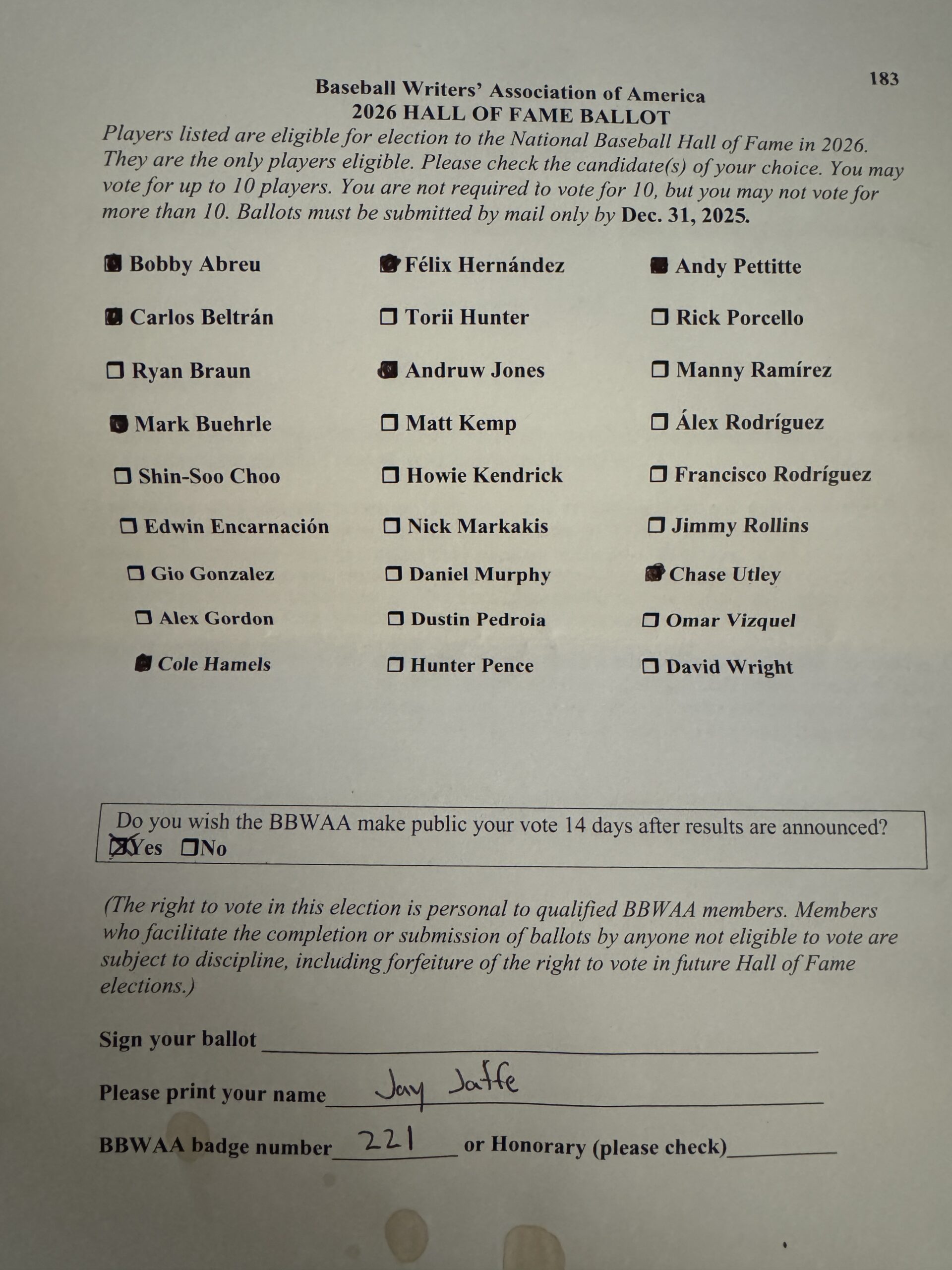
Once again, I’m gratified that after covering baseball and analyzing Hall of Fame elections for so long on the outside, I get to cast a ballot. It’s still just one vote from among 400-something, less impactful than my work to sway actual voters and help the likes of Raines, Walker, Rolen, Edgar Martinez, Mike Mussina, and others find homes in Cooperstown, but it’s also symbolic. I’m standing on the shoulders of giants in the field of baseball analysis, people who entered this industry without going through the traditional newspaper outlets and who either were never admitted to the BBWAA or didn’t last long enough within it to vote. People such as John Thorn, Bill James, Rob Neyer, Joe Sheehan, Christina Kahrl, and Steven Goldman opened my eyes to different ways of viewing baseball decades ago, and their thoughts on the Hall of Fame and its processes inevitably seeped into my own views of the institution and who is worthy of admission. Of that group, only the trailblazing Kahrl is a BBWAA voter. I’d prefer a voting process that found room for all of the above and other experts from beyond the mainstream, but so long as it doesn’t, I’ll do my best to represent.
Brooklyn-based Jay Jaffe is a senior writer for FanGraphs, the author of The Cooperstown Casebook (Thomas Dunne Books, 2017) and the creator of the JAWS (Jaffe WAR Score) metric for Hall of Fame analysis. He founded the Futility Infielder website (2001), was a columnist for Baseball Prospectus (2005-2012) and a contributing writer for Sports Illustrated (2012-2018). He has been a recurring guest on MLB Network and a member of the BBWAA since 2011, and a Hall of Fame voter since 2021. Follow him on BlueSky @jayjaffe.bsky.social.
The beer on the ballot is the best thing on it!
Kidding of course! So appreciative of the work you do around the HOF candidates and voting this time of year, every year. Really helps to bridge that interminable gap between the end of the World Series and the start of spring training.
Looks like coffee 🙂
Thought so too, but he says right above the picture that it’s Brooklyn Black Ops Imperial Stout