
JAWS and the 2026 Hall of Fame Ballot: Daniel Murphy
The following article is part of Jay Jaffe’s ongoing look at the candidates on the BBWAA 2026 Hall of Fame ballot. For a detailed introduction to this year’s ballot, and other candidates in the series, use the tool above; an introduction to JAWS can be found here. For a tentative schedule, see here. All WAR figures refer to the Baseball Reference version unless otherwise indicated.
| Player | Pos | Career WAR | Peak WAR | JAWS | H | HR | SB | AVG/OBP/SLG | OPS+ |
|---|---|---|---|---|---|---|---|---|---|
| Daniel Murphy | 2B | 20.8 | 18.7 | 19.7 | 1,572 | 138 | 68 | .296/.341/.455 | 113 |
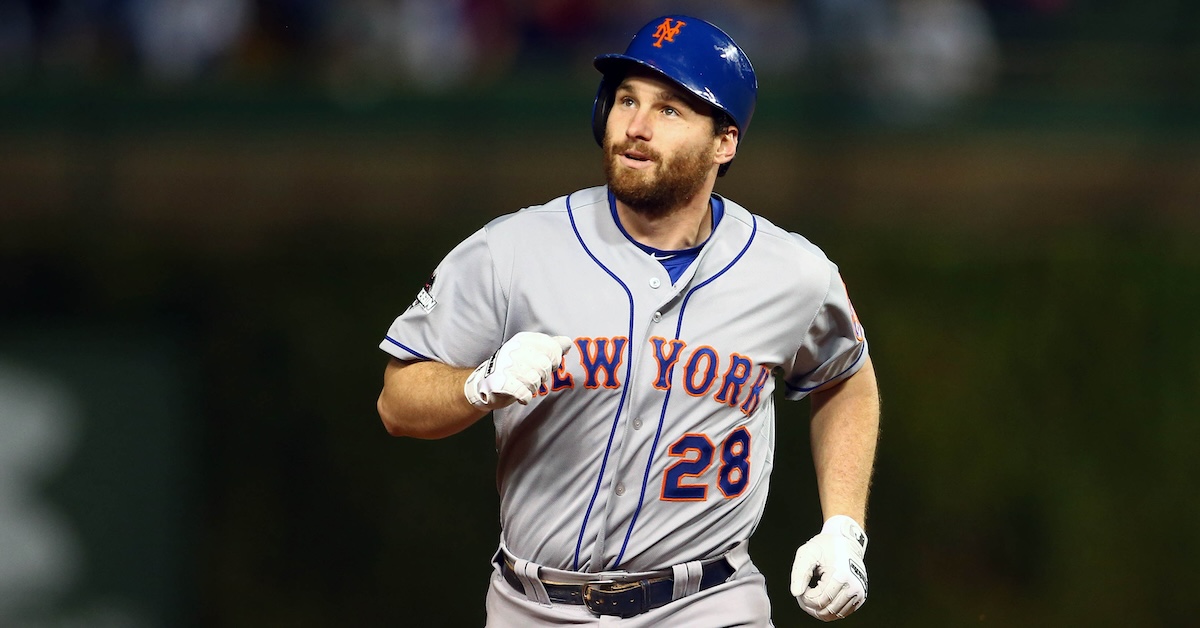
Daniel Murphy was not a home run hitter. Over the course of a 12-year major league career that was interrupted by knee injuries, he reached double digits in just seven seasons, topping 20 homers just twice. Like Howie Kendrick — another Jacksonville-born second baseman debuting on this Hall of Fame ballot, one who even played on the same team as Murphy in 2017–18 — the lefty-swinging, righty-throwing Murphy was known for his exceptional bat-to-ball ability. And like Kendrick, he went on a memorable, power-driven October run and won NLCS MVP honors. In 2015, he set a record by homering in six straight postseason games, carrying the Mets to their first pennant in 15 years. While it didn’t culminate in a championship, it earned him an indelible spot in postseason history; without that run, he probably wouldn’t even be on this ballot.
…
Daniel Thomas Murphy was born on April 1, 1985 in Jacksonville, Florida, the oldest of three children of Tom and Sharon Murphy. Tom taught kindergarten while Sharon sold insurance (in one amusing anecdote, an 11-year-old Murphy declared he wanted to be “an insurance person” for his school yearbook). Younger brother Jonathan (b. 1990) was a 19th-round pick by the Twins in 2012 and spent three seasons as an outfielder in their minor league system.
As a child, Murphy was undersized — “the runt of the litter,” as Little League coach Anton Dawson recalled for Time in 2015 — but he took to baseball. “He could always hit with his eyes,” Mell Harris, another one of his Little League coaches, told Time, referring to Murphy’s ability to keep his head down and swing through the ball. And he worked hard. “If I pitched the ball to him 100 times, he’d want 200,” said Harris.
Growing up, Tony Gwynn was Murphy’s favorite player “because he was such a good contact hitter,” as he explained in 2015. At Englewood High School, Murphy earned all-conference honors three times, hitting .395 as a senior. He was a four-year letterman on the swim team as well. He didn’t go far to continue his career after high school, as Jacksonville University was the only Division I program to offer him a college scholarship.
After famously introducing himself to his college teammates by saying, “I’m Daniel Murphy from Englewood High School, and I bat third,” Murphy played mostly third base and hit for high averages at JU. He hit .398 with six homers and 55 RBIs in 57 games as a junior in 2006, earning Atlantic Sun Player of the Year and catching the eye of Mets scout Steve Barningham, who loved his sweet swing. From NJ.com’s Mike Vorkunkov in 2014:
What drew in Barningham was not just the skill, but Murphy’s approach to hitting — a deep study of the skill. Where Barningham would spend five minutes talking to other players, he and Murphy could speak for a half hour on life and hitting.
“I’ve been around a lot of baseball, this guy, he’s thinking on another level,” Barningham said. “Almost too much, to a point where he talks himself out of being a good hitter sometimes. He just eats it, sleeps it, it’s always going through his mind each at-bat.”
Murphy was only “a fair defender [and] a fringe runner who did not hit for power,” as Tim Rohan wrote for the New York Times in 2015. Knowing that he would be a tough sell to general manager Omar Minaya, after watching Murphy spray the ball all over the field during a batting practice session, Barningham asked him to focus on pulling the ball. “Daniel took his next 10 swings and hit eight of the balls over the lights in right-center field. I was sold,” he told Rohan.
The Mets drafted Murphy in the 13th round, in part due to his modest bonus demands. “It’s worth $50,000 to find out if this guy can scout,” vice president of scouting Sandy Johnson said — of Barningham, that is, as he had joined the organization about seven months earlier.
Murphy signed quickly, and split his first professional season between the Mets’ rookie-level affiliates in the Gulf Coast and Appalachian Leagues before finishing the season with Low-A Brooklyn. Knee and arm injuries limited him to DH duty; in 25 games, he hit just .213/.312/.300 with two homers. He fared better at High-A Port St. Lucie in 2007, hitting .285/.338/.430 with 11 homers and ranking second in the Florida State League with 143 hits, but making 35 errors in 131 games at third base. “Footwork is the main culprit, as he’s inconsistent with his setup and has somewhat limited mobility,” wrote Baseball America while ranking him 15th on the Mets’ prospect list in early 2008. The publication added, “He has a steady, contact-oriented approach and a short, balanced swing. He has a feel for RBI situations and for moving runners along… The problem is Murphy’s gap-to-gap power doesn’t profile well at a less challenging position, though optimistic scouts believe he might hit 20 homers annually.”
Murphy spent most of 2008 at Double-A Binghamton, hitting .308/.374/.496 in 96 games, with 13 homers and 14 steals. After a one-game stop at Triple-A New Orleans, he was called up to the Mets. With David Wright entrenched at third base, Murphy wound up in left field, where he had all of four games of minor league experience. He debuted on August 2, 2008 in Houston, going 1-for-4 with a single off Roy Oswalt on an 0-2 curveball in his first plate appearance. A week later, he hit his first homer, a pinch-hit two-run shot off the Marlins’ Renyel Pinto. Though he added just one more homer, he hit .313/.397/.473 (130 OPS+) with 1.3 WAR in 49 games, even holding his own in left field (3 DRS) according to the metrics. Alas, the Mets squandered a playoff berth by dropping six of their final nine games.
The 24-year-old Murphy started 2009 as the Mets’ left fielder, but moved to first base in mid-May when Carlos Delgado needed surgery to repair a torn right hip labrum. Though very good defensively (10 DRS), his offense (.266/.313/.427, 96 OPS+) was meager for the position; he produced just 1.6 WAR in 155 games for a 70-92 team. His 2010 season never got off the ground, as he sprained his right medial collateral ligament running the bases during spring training, then played just 11 games on a rehab assignment before a takeout slide at second base — a position where he had just 19 games of minor league experience — led to an even more severe MCL tear. Though he dodged surgery, he was out for the season without taking a single major league plate appearance.
Murphy made an impressive return, batting .320/.362/.448 (126 OPS+) with 2.8 WAR in 109 games while bouncing around the infield; he covered first base when Ike Davis (who took over the position in 2010) was lost for the season due to an ankle injury, third base when Wright suffered a stress reaction in his spine, and second base when he wasn’t needed elsewhere, though he usually sat against lefties. Alas, on August 6, Murphy suffered a Grade 2 tear of his left MCL in a collision at second base — yet another season-ending injury that at least didn’t require surgery.
For as clear as the hazards of the defensively-challenged Murphy playing the keystone had proven to be, the Mets decided that was where he was best deployed. Though he played 156 games in 2012 and 161 in ’13, he was a combined 20 runs below average for a pair of 74-88 teams that used the sadly unproductive Davis at first base and had a no great solutions in left field either. Murphy put up a 103 OPS+ with six homers and 1.5 WAR in the former year, and a 108 OPS+ with 13 homers, a career-high 23 steals, and 2.5 WAR in the latter.
As the 2014 season began, Murphy missed the Mets’ first two games to join his wife as she gave birth to the couple’s first son via a C-section. WFAN sports talk chuckleheads Mike Francesca and Boomer Esiason publicly blasted Murphy for doing so, but he weathered the criticism, and manager Terry Collins expressed the organization’s support, pointing out he’d missed just one game the year before. In June, Murphy accepted an invitation to the White House to speak about parental rights at the Working Families Summit. Since then, taking paternity leave — a right included in the Collective Bargaining Agreement — has become far more popular and less controversial.
With a banged-up Wright in the midst of a subpar season on a team bound for 79 wins, Murphy was the Mets’ sole representative for the 2014 All-Star Game; he described himself as “stunned” by being selected, and credited coach Tim Teufel for helping him improve at second base. A September slump took the shine off his offensive numbers, though; he finished at .289/.332/.403 (111 OPS+) with nine homers and 2.3 WAR.
In the spring of 2015, Murphy embroiled himself in controversy when MLB’s inclusion ambassador Billy Bean — the second player to publicly reveal that he was gay following his major league career (the late Glenn Burke was first) — spent a day in a Mets uniform as part of an outreach effort. The front office had run the idea by Murphy over the winter, and he reportedly called the move “forward thinking,” but his comments in relation to Bean’s visit caused a backlash. From NJ.com’s Mike Vorkunov:
Murphy, a devout Christian, said he would embrace Bean despite a divergence in their beliefs.
“I disagree with his lifestyle,” Murphy said. “I do disagree with the fact that Billy is a homosexual. That doesn’t mean I can’t still invest in him and get to know him. I don’t think the fact that someone is a homosexual should completely shut the door on investing in them in a relational aspect… I would say, you can still accept them, but I do disagree with the lifestyle, 100 percent.”
“I do not have a lifestyle. I didn’t choose my sexuality the same way you didn’t choose yours,” wrote Jon Raj, a gay father and a Mets fan, in an open letter to Murphy published at the Huffington Post. “Second, being gay is not what defines me, but rather it is just one important part of who I am. So when you say that you disagree with who I am, you are also disagreeing with my son and my family. We are not a lifestyle choice — we are a family.”
“After reading his comments, I appreciate that Daniel spoke his truth,” wrote Bean at MLB.com while lauding Murphy’s advocacy for paternity leave and stressing a need for patience. “He was brave to share his feelings, and it made me want to work harder and be a better example that someday might allow him to view things from my perspective, if only for just a moment. I respect him, and I want everyone to know that he was respectful of me. We have baseball in common, and for now, that might be the only thing. But it’s a start.” Through a team spokesman, Murphy said he would no longer discuss his religious beliefs and would stick to baseball.
With Mets hitting coach Kevin Long advising him to use his legs more at the plate and to focus more on pulling the ball, he set a new career high with 14 homers in 2015, again filling in at the infield corners while scuffling defensively. Still, his regular season numbers (.281/.322/.449, 111 OPS+, 1.1 WAR) hardly hinted at what was to come. Driven by their rotation, the Mets won 90 games and the NL East, then faced the Dodgers in the Division Series. Despite slugging just .349 with one homer against lefties during the regular season, Murphy was in the lineup for Game 1 against Clayton Kershaw. In the fourth inning of a scoreless game, Kershaw sent a 2-0 fastball down Broadway, and Murphy hammered it for a 415-foot solo homer, keying a 3-1 win. He connected against Kershaw again in Game 4 for the Mets’ only run in a 3-1 loss that evened the series. That marked the beginning of the home run streak.
Facing Zack Greinke — whose 1.66 ERA and 8.9 WAR had both led the National League — for Game 5, Murphy mashed an RBI double in the first inning. After the Mets fell behind 2-1, he led off the fourth with a single, then not only took second on Lucas Duda’s base on balls but, noticing that nobody was covering third base due to the infield shift, stole the base unchallenged, and scored the tying run on Travis d’Arnaud’s sacrifice fly. Murphy broke the tie in the sixth, battling Greinke to a full count before launching a low-and-away fastball for a solo homer that proved decisive.
Murphy then steamrolled the Cubs in the NLCS with homers in all four games, starting with an upper-deck solo shot off Jon Lester in the first inning of Game 1, followed by a two-run poke into the right field corner off Jake Arrieta (who would beat out Greinke for the NL Cy Young) in the first inning of Game 2. Murphy then tied Carlos Beltrán’s 2004 streak of five straight postseason games with a homer via his third-inning solo blast of Kyle Hendricks in Game 3; at 421 feet, it was the longest of the bunch. In Game 4, having already singled twice and doubled, and with the Mets well on their way to a sweep, Murphy claimed the record with a towering two-run homer off Fernando Rodney in the eighth inning. His .529/.556/1.294 line earned him NLCS MVP honors.
While Murphy went 2-for-7 during a 14-inning loss to the Royals in the World Series opener, his unlikely streak ended. After that, the Royals held him to 1-for-13 with five walks, winning the series in five games.
Murphy’s hot streak was particularly well-timed, as he was poised for free agency. Viewing rookie Dilson Herrera as the heir apparent at second base — yes, really — and mindful of Murphy’s limitations, the Mets let him walk after he declined a $15.8 million qualifying offer. He signed a three-year, $37.5 million deal with the division-rival Nationals, then tormented his old team by hitting a ridiculous .386/.435/.700 with nine homers in 154 plate appearances against them in 2016 and ’17. Those were his best two seasons, as he helped the Nationals win back-to-back division titles while making the NL All-Star team in both years.
In 2016, Murphy hit .347/.390/.595 with career highs in WAR (4.7), homers (25), and doubles (a league-leading 47) while tying the Nationals’ franchise record for hits (184); he also led the NL in slugging percentage, ranked second in batting average, third in OPS+ (155), and seventh in on-base percentage. He went 7-for-16 with six RBIs against the Dodgers in the Division Series, with four RBIs in a losing cause in Game 4 (two against Kershaw on an RBI single and a sacrifice fly). Making a rare relief appearance after Kenley Jansen’s 2 1/3-inning effort in Game 5, Kershaw induced Murphy to pop out with one out and runners on first and second in the ninth inning; one Wilmer Difo strikeout later, the Nationals were eliminated.
In 2017, after hitting .322/.384/.543 (136 OPS+) with 23 homers and 3.2 WAR, Murphy went 4-for-19 in a five game Division Series against the Cubs. He saved his best performance for Game 5, hitting a game-tying solo homer off Hendricks in the second inning, and then an RBI double off Mike Montgomery in the sixth when the Nationals trailed by three. He led off the eighth by drawing a walk against Wade Davis and coming around to score to cut Chicago’s lead to 9-8, but the Nationals didn’t score again.
After the season, Murphy underwent cartilage debridement and microfracture surgery on his right knee. His recovery lagged, and he didn’t make his season debut until June 12. When he returned, he hit .300/.341/.442 in 56 games, but his small-sample -7 DRS knocked his WAR to -0.5 in that span. With Murphy slated to hit free agency and the Nationals bound for an 82-80 season, on August 18 they sent the second baseman and an undisclosed amount of cash to the Cubs in exchange for infield prospect Andruw Monasterio. The Cubs faced a backlash for acquiring Murphy when his 2015 comments resurfaced, though both general manager Jed Hoyer and board member Laura Ricketts (the first openly gay owner of a major American professional sports franchise) said they consulted with Bean as part of their pre-trade due diligence, with Ricketts telling fans at the LGBTQ-themed “Out at Wrigley” event, “After these considered and thoughtful conversations, which took place precisely because of the Cubs’ sensitivities on the matter, I was on board with the trade.”
Murphy hit .297/.329/.471 with six homers in 35 games for the Cubs, who led the NL Central by five games as of September 2. The red-hot Brewers erased that deficit, forced a Game 163 tiebreaker, and beat the Cubs, bumping them into a Wild Card slot. They lost the Wild Card Game to the Rockies, with Murphy going 0-for-4.
Those Rockies signed Murphy to a two-year, $24 million deal, slotting him at first base and bumping Ian Desmond, who had been below replacement level while covering the position in 2018, to the outfield. A fractured left index finger, suffered when Murphy jammed his hand while diving for a ball in his second game with his new team, cost him 23 games early in the season. When he returned, he hit .279/.329/.471 with 13 homers, a slash line superficially similar to his career numbers, but good for just an 89 OPS+ in high-scoring Colorado. Even while handling first base well, he was a major drag on the offense, producing 0.7 WAR for a 91-loss team. He was even less productive (.236/.275/.333, 55 OPS+) during the pandemic-shortened 2020 season.
In January 2021, the 35-year-old Murphy announced his retirement. “This is a beautiful game, and I really just feel humbled and blessed that it let me jump on the ride for a little bit,” he told SNY. Yet he wasn’t quite done with baseball. In fact, watching Ken Burns’ nine-part Baseball documentary rekindled his desire to play. After sitting out the 2021 and ’22 seasons, he signed a contract with the Long Island Ducks of the independent Atlantic League.
“I think when you’re in it, and you’re trying to be as productive as you can and as good a teammate as you can be, and a husband and a father, I underestimated just how cool our game was and how cool the guys were who played before me,” he said at the Ducks’ Fan Fest after signing. Playing under former Met Wally Backman, on a team that suited up more than a dozen ex-major leaguers including former Mets teammate Rubén Tejada, former Nationals teammate Wilson Ramos, and 46-year-old Lew Ford, Murphy hit .331/.410/.451 in 37 games. In June, the Angels purchased his contract; after two games with their Arizona Complex League affiliate, he hit .288/.369/.353 in 38 games with Triple-A Salt Lake City. In mid-August, however, he retired again.
Of this ballot’s 20 position players, none had as short a career as Murphy. Yet while Beltrán, Kendrick, and other candidates had similarly impressive Octobers, Murphy’s 2015 run earned him a spot here, and in baseball history.
Brooklyn-based Jay Jaffe is a senior writer for FanGraphs, the author of The Cooperstown Casebook (Thomas Dunne Books, 2017) and the creator of the JAWS (Jaffe WAR Score) metric for Hall of Fame analysis. He founded the Futility Infielder website (2001), was a columnist for Baseball Prospectus (2005-2012) and a contributing writer for Sports Illustrated (2012-2018). He has been a recurring guest on MLB Network and a member of the BBWAA since 2011, and a Hall of Fame voter since 2021. Follow him on BlueSky @jayjaffe.bsky.social.
Nice tribute to a good player