
JAWS and the 2026 Hall of Fame Ballot: Bobby Abreu, Torii Hunter, and Jimmy Rollins
The following article is part of Jay Jaffe’s ongoing look at the candidates on the BBWAA 2026 Hall of Fame ballot. For a detailed introduction to this year’s ballot, and other candidates in the series, use the tool above; an introduction to JAWS can be found here. For a tentative schedule and a chance to fill out a Hall of Fame ballot for our crowdsourcing project, see here. All WAR figures refer to the Baseball Reference version unless otherwise indicated.
For the past several election cycles, as a means of completing my coverage of the major candidates before the December 31 voting deadline, I’ve grouped together some candidates into a single overview, inviting readers wishing to (re)familiarize themselves with the specifics of their cases to check out older profiles that don’t require a full re-working because very little has changed, even with regards to their voting shares. This year, I’m adding Bobby Abreu — a candidate for whom I’ve voted five times thus far and intend to include again — to a pair I’ve yet to include on my ballots.
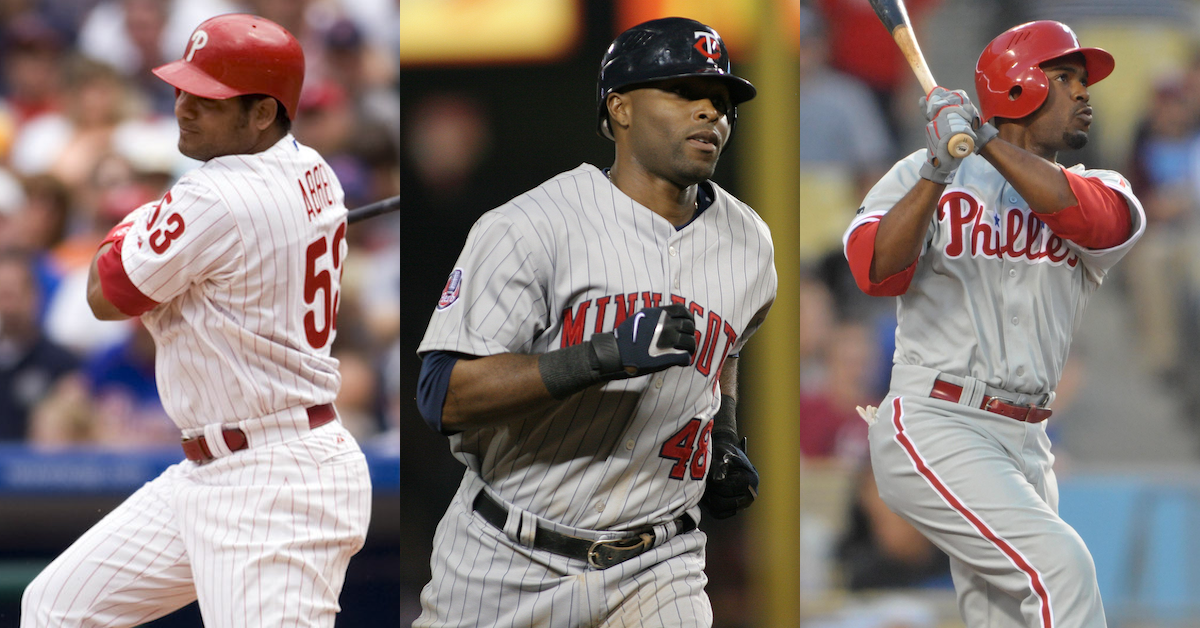
Before Joe Mauer began starring for the Twins, there was Torii Hunter. Before Chase Utley began starring for the Phillies, they had Abreu and Jimmy Rollins. Hunter, a rangy, acrobatic center fielder who eventually won nine Gold Gloves and made five All-Star teams, debuted with Minnesota in 1997 and emerged as a star in 2001, the same year the Twins chose Mauer with the number one pick of the draft. The pair would play together from 2004 to ’07, making the playoffs twice before Hunter departed in free agency. Abreu, a five-tool player with dazzling speed, a sweet left-handed stroke, power, and outstanding plate discipline, quickly blossomed upon being traded to the Phillies in November 1997. But even while hitting at least 20 homers, stealing at least 20 bases, and batting above .300, recognition largely eluded him until he made All-Star teams in 2004 and ’05. Rollins, a compact shortstop who carried himself with a swagger, debuted in 2001 and made two All-Star teams before he and Utley began an 11-year run (2004–14) as the Phillies’ regular double play combination. By the time the pair of middle infielders helped Philadelphia to five NL East titles, two pennants, and a championship — with Rollins winning NL MVP honors in 2007 and taking home four Gold Gloves — Abreu was gone, traded to the Yankees in mid-2006.
All three players enjoyed lengthy and impressive careers, racking up over 2,400 hits apiece with substantial home run and stolen base totals. From a Hall of Fame perspective, Rollins and Hunter have credentials that appeal more to traditionally minded voters than to statheads — particularly their Gold Gloves — while Abreu, despite half a dozen .300 seasons and eight with at least 100 RBI, was a stathead favorite. Regardless, they’ve all spent years languishing on the ballot. Hunter debuted with 9.5% in 2021 but has yet to match that since, scraping by in 2025 with just 5.1%; one fewer vote and he’d have been bumped off the ballot. Rollins debuted with 9.4% in 2022 and has gained roughly two or three points in each cycle since, with 18% in ’25. Abreu barely made the cut with just 5.5% in his 2020 debut, and since then has alternated small gains and losses; he received 19.5% in 2025.
Electorally speaking, Mauer left Hunter in the dust, as he was elected in January 2024, and Utley is threatening to do the same to his former teammates; he debuted with 28.8% in 2024 and climbed to 39.8% in ’25, more than Rollins’ and Abreu’s shares combined. The two ex-Phillies are likely to persist on the ballot for awhile, with enough support for us to keep reliving their careers and discussing their merits on an annual basis. We’ll see if Hunter can hang on as well.
Torii Hunter (5.1% in 2025)
| Player | Career WAR | Peak WAR | JAWS |
|---|---|---|---|
| Torii Hunter | 50.6 | 30.8 | 40.7 |
| Avg. HOF CF | 71.3 | 44.6 | 58.0 |
| H | HR | SB | AVG/OBP/SLG (OPS+) |
| 2,452 | 353 | 195 | .277/.331/.461 (110 OPS+) |
From the 2023 profile intro:
Torii Hunter could go get it. Fluid and graceful while patrolling center field, he was renowned for his leaping, acrobatic catches and his willingness to sacrifice his body. He made a strong enough impression upon those who watched him that he won nine Gold Gloves during his 19-year career, more than all but three center fielders, namely Willie Mays, Ken Griffey Jr., and Andruw Jones. Hunter earned the nickname “Spider-Man” for his ability to climb outfield walls to steal home runs — something he did more than just about anybody else during his career — though one attempt to do so at Fenway Park left him with a broken ankle, and another a concussion.
“I’ll do anything to get that little white ball. I’ll put my life on the line,” Hunter told Sports Illustrated’s Albert Chen in 2005, sounding very much like the football player he was during his high school days in Pine Bluff, Arkansas. Hunter rose from difficult circumstances in Pine Bluff, including a father who was addicted to crack cocaine and friends who fell into the dead-end life of drugs, guns, and gangs. His athleticism helped him escape, though when he entered professional baseball as a first-round pick of the Twins in 1993, his talent was more raw than most.
The development of Hunter’s bat lagged behind his glove early in his career, but eventually he improved to became an above-average hitter with multiple dimensions to his game. From 2001-13, he averaged 23 homers and 13 steals per year while hitting for a 115 OPS+, delighting fans with his penchant for the spectacular play, and gaining a reputation within the game for being a vocal clubhouse leader. In that span, he made five All-Star teams and helped the Twins, Angels, and Tigers to the playoffs eight times, though he never got further than the American League Championship Series with any of them.
More here.
Jimmy Rollins (18% in 2025)
| Player | Career WAR | Peak WAR | JAWS |
|---|---|---|---|
| Jimmy Rollins | 47.9 | 32.7 | 40.3 |
| Avg. HOF SS | 67.7 | 43.2 | 55.4 |
| H | HR | SB | AVG/OBP/SLG (OPS+) |
| 2,455 | 231 | 470 | .264/.324/.418 (95 OPS+) |
From the 2023 profile intro:
Few players have ever been more central to the Phillies than Jimmy Rollins. In fact, with the exception of Mike Schmidt, no player spent more time in a Phillies uniform than Rollins, and even counting the Hall of Fame third baseman, none collected more hits or stole more bases. The pint-sized shortstop — 5-foot-7, 175 pounds according to Baseball Reference — spent 15 of his 17 major league seasons with Philadelphia, where he was at the center of the team’s return to contention following a slide into irrelevance at the outset of the Wild Card era.
Rollins was the starting shortstop on the Phillies’ five straight NL East champions from 2007-11, including their ’08 World Series winning squad — just the second in franchise history — and ’09 pennant winner. A slick fielder who offered speed and pop from both sides of the plate atop the lineup, he garnered the nickname “J-Roll” from legendary Phillies broadcaster Harry Kalas. J-Roll projected a confidence that bordered on cockiness, and carried himself with a swagger. “We’re the team to beat,” he said at the outset of the 2007 season, all but thumbing his nose at the reigning NL East champion Mets, who had outdistanced the Phillies by 12 games.
After losing their first three games and 10 of their first 13 to start the 2007 season — including two out of three at Shea Stadium, where he was booed lustily by New York fans — the Phillies didn’t spend a day in first place until September 27, when they tied the Mets with three games remaining. While they took two out of three from the Nationals, the Mets dropped two of three from the Marlins. Not only was Philadelphia back in the playoffs after a 14-year absence, setting off a run during which the team became just the fifth to win five straight division titles, but Rollins took home NL MVP (Most Valuable Prognosticator) honors. A year later, he added a World Series ring to a collection that also grew to include four Gold Gloves.
More here.
Bobby Abreu (19.5% in 2025)
| Player | Career WAR | Peak WAR | JAWS |
|---|---|---|---|
| Bobby Abreu | 60.2 | 41.6 | 50.9 |
| Avg. HOF RF | 69.7 | 42.2 | 56.0 |
| H | HR | SB | AVG/OBP/SLG (OPS+) |
| 2,470 | 288 | 400 | .291/.395/.475 (128 OPS+) |
From the 2025 profile intro:
Bobby Abreu could do just about everything. A five-tool player with dazzling speed, a sweet left-handed stroke, and enough power to win a Home Run Derby, he was also one of the game’s most patient, disciplined hitters, able to wear down a pitcher and unafraid to hit with two strikes. While routinely reaching the traditional seasonal plateaus that tend to get noticed — a .300 batting average (six times), 20 homers (nine times), 30 steals (six times), 100 runs scored and batted in (eight times apiece) — he was nonetheless a stathead favorite for his ability to take a walk (100 or more eight years in a row) and his high on-base percentages (.400 or better eight times). And he was durable, playing 151 games or more in 13 straight seasons. “To me, Bobby’s Tony Gwynn with power,” said Phillies hitting coach Hal McRae in 1999.
“Bobby was way ahead of his time [with] regards to working pitchers,” said his former manager Larry Bowa when presenting him for induction into the Phillies Wall of Fame in 2019. “In an era when guys were swinging for the fences, Bobby never strayed from his game. Because of his speed, a walk would turn into a double. He was cool under pressure, and always in control of his at-bats. He was the best combination of power, speed, and patience at the plate.”
The one thing Abreu couldn’t seem to do was gain full appreciation for his broad set of gifts. Despite enough promise to land on Baseball America’s Top 100 Prospects list four times, his first two teams, the Astros and Rays, sold unfathomably low on him. On the advice of Ed Wade, who was about to replace him as the Phillies’ general manager, Lee Thomas scored quite a coup in acquiring Abreu just before he turned 24. He excelled perennially, but the core of players that Wade and the Phillies amassed — some of whom would eventually help Philadelphia dominate the NL East — didn’t jell during Abreu’s tenure with the team, and so he toiled in semi-obscurity.
From 1998, his first year as a regular in Philadelphia, to 2004, Abreu was the game’s fifth- or sixth-most valuable player according to the two flavors of WAR, behind only Barry Bonds, Alex Rodriguez, Todd Helton (via B-Ref), Andruw Jones, and teammate Scott Rolen. Yet not until the last of those seasons, his age-30 campaign, did Abreu make his first All-Star team. He made just two during his 18 seasons and won a single Gold Glove, albeit only after his fielding took a turn for the worse.
More here.
Brooklyn-based Jay Jaffe is a senior writer for FanGraphs, the author of The Cooperstown Casebook (Thomas Dunne Books, 2017) and the creator of the JAWS (Jaffe WAR Score) metric for Hall of Fame analysis. He founded the Futility Infielder website (2001), was a columnist for Baseball Prospectus (2005-2012) and a contributing writer for Sports Illustrated (2012-2018). He has been a recurring guest on MLB Network and a member of the BBWAA since 2011, and a Hall of Fame voter since 2021. Follow him on BlueSky @jayjaffe.bsky.social.
If Crasnick really called Abreu a “serial compiler,” he’s an effing idiot.