
A Candidate-by-Candidate Look at the 2026 Hall of Fame Election Results
The following article is part of Jay Jaffe’s ongoing look at the candidates on the BBWAA 2026 Hall of Fame ballot. For a detailed introduction to this year’s ballot, and other candidates in the series, use the tool above; an introduction to JAWS can be found here. For a tentative schedule, see here. All WAR figures refer to the Baseball Reference version unless otherwise indicated.
The 2026 Hall of Fame election is history, with a pair of center fielders who were born one day apart, fourth-year candidate Carlos Beltrán (born April 24, 1977) and ninth-year candidate Andruw Jones (born April 23, 1977), elected by the Baseball Writers Association of America. This is the fourth time two players from the same position besides pitcher were elected by the writers in the same year. Right fielders Harry Heilmann and Paul Waner were the first pair in 1952, followed by right fielders Henry Aaron and Frank Robinson in ’82, with left fielders Rickey Henderson and Jim Rice elected in 2009. That’s some impressive company!
Beltrán and Jones will be inducted into the Hall along with Contemporary Baseball honoree Jeff Kent on July 26, 2026, on the grounds of the Clark Sports Center in Cooperstown, New York. There’s no official word yet on which caps the players will be wearing on their plaques — the Hall has the final word — but odds are they’ll be the ones that you expect. Said Beltrán, who’s currently a special assistant for the Mets, “There’s no doubt that the Mets are a big part of my identity.” Kent has expressed his desire to wear a Giants cap, and Jones is almost certain to wear a Braves cap.
As usual, beyond the topline results, there’s plenty to digest from Tuesday’s returns. So as promised, here’s my candidate-by-candidate breakdown of the entire slate of 27 candidates, 13 of whom will return to the ballot next year. Note that references to percentages in Ryan Thibodaux’s indispensable Tracker may distinguish between what was logged at the time of the announcement at 6 p.m. ET on Tuesday (245 total ballots) and what’s in there as of Thursday at 9 a.m. ET (254 total ballots)
Gio Gonzalez, Howie Kendrick, Daniel Murphy (1st year on the ballot, 0.0%)
It’s that time of year, my annual opportunity to invoke the memory of Vin Scully, who liked to remind viewers, “They also serve who only stand and wait.” According to Baseball Reference, 130 players last appeared in the majors in 2020, but just 12 of them (9.2%) lasted long enough and had careers substantial enough to land on this ballot. So this bears repeating annually: There is no shame in being shut out on a Hall of Fame ballot. A checkbox next to these players’ names is the reward for their individually impressive careers, and with every year that I do this, my appreciation for the endurance, perseverance, and good luck it takes just to get to this point grows.
All three of these guys — each a Florida native, coincidentally, with the two Jacksonville-born position players among the best contact hitters of their time — had some memorable moments and great seasons. I particularly enjoyed revisiting the career of Kendrick, who never won the batting title that was expected of him after a minor league career with a .358 batting average but did nothing less than hit a Game 7-winning home run in the 2019 World Series against the Astros, that after winning NLCS MVP honors and, oh, also hitting a decisive grand slam in Game 5 of the Division Series against the Dodgers. I think if you told any baseball-loving kid that he’d reach the majors and get to do all that but wouldn’t get a single vote for the Hall of Fame, he’d take that deal in a heartbeat. I know I would.
Alex Gordon (1st, 0.2%), Matt Kemp (1st, 0.5%)
We don’t yet know — and may never know, unless they come forward — which voters included these candidates on their ballots, not because they earnestly believed they had a shot at election but because they had room and wanted to salute them for their fine careers, make a special note of their significance, or offer gratitude for making the writer’s job a bit easier or more interesting. Such gestures used to be more common before the ballots became overcrowded. On what was a comparatively weak ballot in which voters included an average of 5.77 players — the lowest mark since 2012 — there was room to do that.
Nick Markakis (1st, 0.2%), Hunter Pence (1st, 0.5%), Rick Porcello (1st, 0.5%)
A few voters did explain their reasons for including these guys within their ballot explainers, providing some welcome perspective.
Our Esquina’s José deJesus Ortiz, who covered Pence for the Houston Chronicle: “I closed my ballot with a vote for Hunter Pence, one of my all-time favorite guys to cover. My vote for Pence is more of a tribute to the way he played the game and the fun he brought to fans.”
NJ.com’s Steve Politi, who covered Porcello at the Newark Star-Ledger: “This no doubt will lead to some social media vitriol, but when you’re the sports columnist for a New Jersey website, every now and then, you get to salute one of your people. Porcello, a former Seton Hall Prep ace, is likely going to drop from consideration after one year. I had room on my ballot, and so I’m tipping my cap to the Jersey guy on a tremendous career.”
Former Orioles beat writer Dan Connolly, who covered Markakis for the Baltimore Sun: “Markakis is one of the most underrated and underappreciated in the history of the game. No one in the Orioles’ clubhouse during that time was more respected. No one in that clubhouse played harder or more often than Markakis.”
Shin-Soo Choo (1st, 0.7%)
A decade ago, I raised a bit of an international stink when Chan Ho Park — who spent 17 seasons in the majors (1994–2010), won 124 games (still the major league record for a player born in Asia, one ahead of former teammate Hideo Nomo), and became the first South Korea-born player to make an All-Star team — was left off of the 2016 Hall of Fame ballot. It felt like a needless snub. “Like Hideo Nomo, who blazed a trail for modern Japanese players to come to the majors, Park deserves the recognition that comes with a spot on the ballot,” I wrote for SI.com. I’ve made noise about other slights since then, and thankfully the situation has improved over time, so I was particularly glad to see Choo make the ballot. He wasn’t the majors’ first South Korean position player to reach the majors, but he’s been by far the most successful.
Choo received three votes, though only one is identified in the Tracker. Rangers beat writer Jeff Wilson explained his Choo vote at length, concluding, “Someday a player from Korea will make the Hall of Fame and will reference Choo as the countryman who paved the way. The pioneering aspect of his career is worthy of a checkmark on my Hall of Fame ballot.”
Edwin Encarnación (1st, 1.4%)
Six voters tipped a wing to the slugger and his parrot. With the elections of Beltrán and Jones, Encarnación now ranks 19th in home runs (424) among players outside the Hall of Fame. Two of those above him on the list, Miguel Cabrera and Albert Pujols, will be first-ballot choices in the next few years, one (Giancarlo Stanton) is still active, and 11 have been linked to performance-enhancing drugs, which leaves Encarnación in the company of Carlos Delgado, Adam Dunn, and Paul Konerko, all of whom went one-and-done on their respective ballots as well but are fondly recalled nonetheless.
Ryan Braun (1st, 3.5%)
The best position player among a comparatively weak crop of first-year candidates was doomed to fall off the ballot by both his short career and his two PED suspensions, the first of which was overturned by an arbitrator in 2012 and surrounded by rather despicable conduct, and the second of which was one giant “Told Ya So.”
Torii Hunter (6th, 8.7%, up 3.6%)
A year ago, Hunter scraped by with exactly enough votes to remain eligible, but this time around, the coattails of the two elected center fielders were long enough to carry him to his highest percentage since his 2021 debut (9.5%). All 16 of the ballots that include Hunter in the Tracker at this writing include Beltrán as well, and all but two include both Beltrán and Jones; among the eight returning voters who added Hunter, seven had the other two.
Hunter’s nine Gold Gloves and 110 OPS+ will keep some supporters comparing him to Jones (10 Gold Gloves and 111 OPS+), but the defensive metrics don’t put them in the same league. According to Baseball Reference, they’re separated by 201 fielding runs (Jones ranks first at the position with 235) and thus 12.1 career WAR, 15.6 peak WAR, and 13.9 points of JAWS; Jones ranks 11th, Hunter 35th. I suspect we’ll keep hearing about him as a potential Era Committee candidate someday nonetheless.
Francisco Rodríguez (4th, 11.8%, up 1.6%)
Despite last year’s election of Billy Wagner and a small coattail effect, K-Rod did not experience a sudden surge of new interest from voters. While he has the highest saves total of any eligible reliever outside the Hall (437, sixth all-time), he’s been bumped down in those rankings in the past two years by the still-active Kenley Jansen (476) and Craig Kimbrel (440), and he’s just 14th in R-JAWS, where Wagner is seventh and Jansen has climbed to sixth. Rodríguez won’t generate the same goodwill as Wagner because he was arrested twice, first in 2010 for assaulting his girlfriend’s father (resulting in a guilty plea, a season-ending injury, and the loss of his salary for the time missed) and then in 2012 for a separate incident of domestic violence against his fiancée (those charges were dismissed when she and a witness to the alleged assault left the country). Unlike last year at this juncture, he’s got less support on private ballots than public. I don’t think he’s going anywhere, electorally speaking.
David Wright (3rd, 14.8%, up 8.7%)
Again, Wright appears to have benefited from the arrival of Dustin Pedroia, with his similarly shaped career as a player on a Cooperstown path before injuries intervened. According to the Tracker, of the 16 voters who added Wright to their ballots this year, 12 included Pedroia either as a holdover or a fellow new addition. While I don’t think Wright is going to rally like Jones to gain entry from the writers — if he did, he’d set a new record for the lowest first-year percentage (6.2%) — he’s probably built enough of a cushion to complete a 10-year run on the ballot. The last candidate to make it through at least three ballots before slipping below 5% was the PED-linked Rafael Palmeiro, who topped out at 12.6% in 2012, his second year, but fell off just two years later in the final cycle before the Hall unilaterally truncated candidacies to 10 years. Since then, everybody who’s cleared 5% in their second year has lasted all 10 years, though as noted, Hunter had a very close call.
Omar Vizquel (9th, 18.4%, up 0.6%)
Time continues to run off the clock for Vizquel, who appeared to be on a path towards election — with 52.6% on the 2020 ballot — before bombshell reports at The Athletic took away the good-guy image that undergirded a candidacy long on traditional credentials but short in terms of advanced stats. In December 2020, Katie Strang and Ken Rosenthal reported allegations from Vizquel’s now ex-wife regarding multiple domestic violence incidents, while in August ’21, Strang and James Fegan reported on a sexual harassment lawsuit brought by a former batboy from the minor league team Vizquel managed; the latter was settled out of court. Vizquel fell only a few points from 2020 to ’21, as many voters had already cast their ballots by the time the report was published, but he plummeted to 23.9% in 2022 — an unprecedented drop — and is net-negative since then, even with decimal-point gains in the last two cycles. This time around, we didn’t get any reports of desperate outreach efforts; Vizquel did return to managing for the first time since 2021, piloting a team in Nicaragua’s winter league. Of the 37 new voters whose ballots were published prior to the announcement, just two voted for him.
Mark Buehrle (6th, 20%, up 8.6%)
Though he didn’t gain nearly as much ground as Félix Hernández or Andy Pettitte, the focus on starting pitching standards benefited Buehrle as well. As I said in a Tuesday afternoon spot on MLB Now (click the link, or scroll to 3:11 on the video within the Bobby Abreu entry below), once I came around to supporting those two starters — each of whom I included as my 10th man in recent years — and Cole Hamels, I found reasons to justify Buerhle’s inclusion. He had a higher peak WAR than Pettitte, was similarly underappreciated in the Cy Young voting like Hamels, and unlike Hernández (who never pitched in the postseason) had a significant role on a World Series winner. Above all, he exhibited a level of durability we’re unlikely to see again. I’d still characterize my support for Buehrle as soft, and I’m sure I’m hardly alone in that regard, but this year’s boost pretty much guarantees he’ll spend the full 10 years on the ballot and remain part of the ongoing discussion about starters.
Dustin Pedroia (2nd, 20.7%, up 8.8%)
The former MVP and two-time champion (three if you count 2018, when his knee injury limited him to three games) took a step forward in terms of his voting share, and I think he stands to make even bigger gains in the coming years thanks to a confluence of factors.
The election of Jones opens the door for the writers to elect other candidates with fewer than 2,000 hits (Pedroia has 1,805). The eventual election of Chase Utley could create a coattail effect; like Utley, Pedroia fits into the “short-career second basemen who were stars on multiple pennant winners” bucket, but with considerably more hardware (MVP, Rookie of the Year, four Gold Gloves, three World Series rings). And the election of Kent provides an example of a recent honoree among second baseman with inferior advanced statistics; Pedroia is 20th in JAWS, Kent 22nd in a career with over 40% more plate appearances.
Given the literally dozens of great players who might have been Hall of Famers if not for career-curtailing injuries, I’m not yet convinced Pedroia belongs on my ballot. I had room this year but bypassed him, but I have eight more years to reconsider that decision.
Cole Hamels (1st, 23.8%)
Hamels made a solid ballot debut, notably outdoing both Hernández (20.6% last year) and Mike Mussina (20.3% in 2014). The difference is that Mussina did that on the most crowded ballot of the modern era (post-1966) in term of players meeting the JAWS standard at their position (14), while Hamels did it on the weakest one in two decades using that same measure (three):
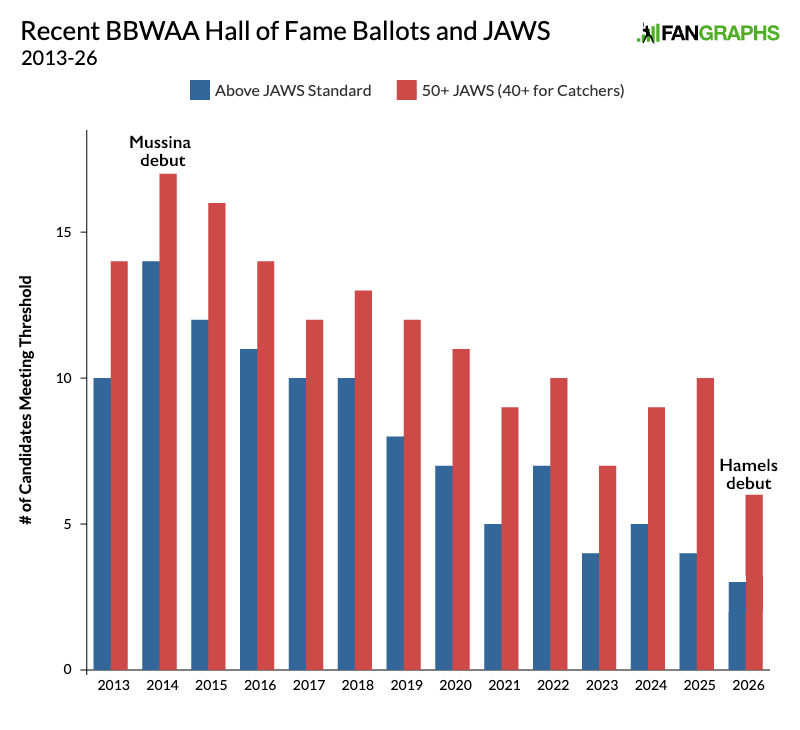
At this writing, Hamels has the fourth-largest public-to-private drop of any candidate at 18.2% (31.1% public, 12.9% private). Mussina had even wider gaps in all but his first year, and of course he accumulated much bigger counting stats in a career that was over 800 innings longer (albeit with the same 123 ERA+), but the times they are a-changin’. Maybe not enough to help Hamels get elected à la Mussina half a decade from now, but certainly enough to keep him in the conversation.
Jimmy Rollins (5th, 25.4%, up 7.4%)
Tuning into MLB Network’s coverage on Tuesday both before and after the results were announced, I heard some junk-drawer stats about extra-base hits by shortstops (going by strict splits, Rollins trails only Cal Ripken Jr., outdoing Derek Jeter by one) and having some better counting stats than his longtime double-play partner Utley, but I don’t find that stuff convincing. WAR and JAWS both emphatically favor Utley, and the gap between the double play partners’ shares of the vote has only grown, from 14% in 2024 (28.8% vs. 14.8%) to 21.8% in ’25 (39.8% vs. 18%) to 33.7% in ’26 (59.1% to 25.4%). The 37 new voters whose ballots were published prior to the announcement were about half as likely to include Rollins as the rest of the electorate (13.5% to 26.5%). Those aren’t trends that portend election by the writers, but Rollins could still follow the same well-worn path that led Kent and Fred McGriff to Cooperstown.
Bobby Abreu (7th, 30.8%, up 11.3%)
Abreu posted the sixth-largest gain of any candidate during this cycle and has doubled his support over the past three. In my MLB Now spot, Brian Kenny invited me to make my case for him:
As the Tracker team pointed out, in terms of published ballots, Abreu’s sixth- and seventh-year trajectories match up well with those of Larry Walker. In terms of actual voting shares, Abreu outdid both Walker’s 15.5% in 2016 and 21.9% in ’17. But from that point until his election in 2020, Walker made the largest three-year gain (54.7%) of the modern era, and from ’18 (34.1%) to ’20, he had the second-largest two-year gain (42.5%). Even if Abreu only needs what would amount to the fifth-largest three-year gain to reach 75%, the odds are strongly against him, as his case isn’t as strong as that of Walker, who outranks him in JAWS while also having earned an MVP award, three batting titles, and seven Gold Gloves — Abreu has none of those — while outdoing him in All-Star selections, five to two. For Abreu’s candidacy, the hard work is just beginning.
Manny Ramirez (10th, 38.8%, up 4.5%), Alex Rodriguez (5th, 40%, up 2.9%)
Though he received the highest share of his 10-year run, Ramirez aged off the ballot, his candidacy weighed down by his two PED suspensions, and even with this year’s bump, he added just 10.6 percentage points over his final six cycles. Given the way the Era Committees have been engineered to embarrass Bonds and Clemens and perhaps to remove their eligibility altogether, it’s to Ramirez’s advantage not to land on the 2029 Contemporary Baseball ballot. He’ll not only take space away from a candidate who won’t be an automatic “no” from a sizable chunk of the voters, he’ll risk receiving his first of just two strikes if he doesn’t get at least five votes and be rendered ineligible for the 2032 ballot. Not that anyone but Manny bears responsibility for his fate, as he knew he risked suspension for getting caught doping.
Rodriguez may be ahead of Ramirez’s pace halfway through his own run, but the end result will be the same even if he winds up in Clemens/Bonds/Sheffield territory, with over 60%. Interestingly enough, the 37 new voters were only slightly more supportive of both of these guys than the rest of the electorate, each giving them a 40.5% share.
Félix Hernández (2nd, 46.1%, up 25.5%)
Among the most interesting and historically significant developments in the election was the surge of King Félix. No, he doesn’t have the traditional or advanced stats one generally associates with a Hall of Fame starter, but he’s at the vanguard of the electorate’s collective reconsideration of those hurlers in an age of reduced workloads, higher injury rates, and increasingly remote milestones. MLB.com’s Mike Petriello’s use of rolling WAR totals across seven- and 10-year spans has helped to illuminate Hernández’s dominance across sizable stretches; as Petriello noted, he’s second in pitching WAR from 2009–15, third from both ’07–13 and ’08–14, and first in the 10-year span from ’06–15. The last of those puts him in the company of 13 Hall of Fame starters plus future honorees Clayton Kershaw and Max Scherzer, the PED-exiled Clemens, and the fondly-remembered Ron Guidry and Dave Stieb, the last two of whom lacked the longevity to impress voters when they landed on ballots in 1994 and 2004, respectively.
Petriello’s work may have particularly clicked with his fellow first-time voters, because 28 of those 37 who published their ballots (75.7%) included Hernández, leading to what I pointed out on Tuesday was the largest year-over-year gain since the voters returned to annual balloting in 1967 (with Utley and Pettitte cracking the leaderboard as well):
| Rk | Player | Yr0 | Pct0 | Yr1 | Pct1 | Gain |
|---|---|---|---|---|---|---|
| 1 | Félix Hernández | 2025 | 20.6% | 2026 | 46.1% | 25.56% |
| 2 | Luis Aparicio+ | 1982 | 41.9% | 1983 | 67.4% | 25.45% |
| 3 | Barry Larkin+ | 2011 | 62.1% | 2012 | 86.4% | 24.3% |
| 4 | Gil Hodges+ | 1969 | 24.1% | 1970 | 48.3% | 24.2% |
| 5 | Nellie Fox+ | 1975 | 21.0% | 1976 | 44.8% | 23.8% |
| 6 | Hal Newhouser+ | 1974 | 20.0% | 1975 | 42.8% | 22.8% |
| 7 | Jim Rice+ | 1999 | 29.4% | 2000 | 51.5% | 22.1% |
| 8 | Don Drysdale+ | 1976 | 29.4% | 1977 | 51.4% | 22.1% |
| 9 | Larry Walker+ | 2019 | 54.6% | 2020 | 76.6% | 22.0% |
| 10 | Vladimir Guerrero+ | 2017 | 71.7% | 2018 | 92.9% | 21.2% |
| 11 | Andy Pettitte | 2025 | 27.9% | 2026 | 48.5% | 20.6% |
| 12 | Larry Walker+ | 2018 | 34.1% | 2019 | 54.6% | 20.5% |
| 13 | Todd Helton+ | 2022 | 52.0% | 2023 | 72.2% | 20.2% |
| 14 | Johnny Sain | 1974 | 14.0% | 1975 | 34.0% | 20.0% |
| 15 | Early Wynn+ | 1970 | 46.7% | 1971 | 66.7% | 20.0% |
| 16 | Chase Utley | 2025 | 39.8% | 2026 | 59.8% | 19.3% |
| 17 | Minnie Miñoso+ | 1985 | 1.8% | 1986 | 20.9% | 19.1% |
| 18 | Phil Cavarretta | 1974 | 16.7% | 1975 | 35.6% | 18.9% |
| 19 | Early Wynn+ | 1969 | 27.9% | 1970 | 46.7% | 18.8% |
| 20 | Yogi Berra+ | 1971 | 67.2% | 1972 | 85.6% | 18.4% |
Of the eight modern candidates with second-year shares within six points of that of Hernández, the five elected by the writers needed an average of 4.6 more ballots, with a high of seven (Andre Dawson and Rich Gossage) and a low of two (Wynn). Two more were elected by the Veterans Committee, and the one outside both groups is Vizquel. As some of Hernández’s support (including my own vote) is softer than it might normally be given the lighter ballots, I don’t know how quickly this will lead to Cooperstown. But I do know that Hernández and this cycle’s other biggest gainers have crossed what I’m now calling the Maris Line, the point above which future election becomes more likely than not, with some caveats:
| Player | Year | Highest % | Most Recent Ballot |
|---|---|---|---|
| Curt Schilling | 2021 | 71.1% | 2023 Contemporary Baseball |
| Barry Bonds | 2022 | 66.0% | 2026 Contemporary Baseball |
| Roger Clemens | 2022 | 65.2% | 2026 Contemporary Baseball |
| Gary Sheffield | 2024 | 63.9% | 2026 Contemporary Baseball |
| Chase Utley | 2026 | 59.1% | 2026 BBWAA (3rd) |
| Omar Vizquel | 2020 | 52.6% | 2026 BBWAA (9th) |
| Andy Pettitte | 2026 | 48.5% | 2026 BBWAA (8th) |
| Félix Hernández | 2026 | 46.1% | 2026 BBWAA (2nd) |
| Roger Maris | 1988 | 43.1% | 2022 Golden Days |
| Steve Garvey | 1995 | 42.6% | 2025 Classic Baseball |
| Maury Wills | 1981 | 40.6% | 2022 Golden Days |
| Marty Marion | 1970 | 40.0% | 2015 Pre-Integration |
Everybody above Maris is either a current BBWAA candidate or an Era Committee candidate who, thanks to bad behavior (PED connections and, uh, self-sabotage), received too little support in his most recent appearance to have his actual share reported. All the others who have landed in that range recently, including Beltrán, Jones, and Kent, have since been elected. Odds are that someday Hernández joins them.
Andy Pettitte (8th, 48.5%, up 20.6%)
Pettitte didn’t have Hernández’s dominance, but his longevity, postseason résumé, and similarities to 2025 honoree CC Sabathia in terms of win totals and ERA+ helped him build upon last year’s 14.4-point gain. That’s an increase of 35 points in two years, the fifth-largest of the modern era. It still leaves Pettitte in a difficult position, as he’s further out than either Tim Raines (55% in 2015) or Edgar Martinez (58.6% in 2017) were in their eighth year. He doesn’t need to replicate what Walker did by jumping from 34.1% in his eighth year, but it’s a tall order nonetheless.
Additionally, Pettitte’s HGH admission is a drag on his candidacy, which could affect both how BBWAA holdouts and future Era Committees view him. As Sheffield can attest, nuance isn’t exactly in abundant supply in the latter venue. Particularly since I place Pettitte’s transgression in the “Wild West” era and don’t view it as disqualifying, my resolve to support him through the remainder of his ballot run is firm.
Chase Utley (3rd, 59.1%, up 19.3%)
With the election of Jones, BBWAA voters have finally elected a post-1960 expansion player with fewer than 2,000 hits, which opens the door for Utley (1,885). He’s fourth in WAR among all players below 2,000 hits, behind two future Hall of Famers, Mike Trout and Mookie Betts, as well as Bobby Grich, a proto-Utley who’s eighth in JAWS among second baseman yet can’t buy a spot on an Era Committee ballot.
With one- and two-year gains that crack their respective top 10s, Utley is knockin’ on Cooperstown’s door, and with the election of the 2025 ballot’s top two holdovers, he heads into next year as the top returning candidate, joined by newcomers Buster Posey and Jon Lester. To cross the 75% threshold in one fell swoop, he’ll need a jump that would be just outside the top 10 as those things go; Walker (54.6%) and Ralph Kiner (58.9% in 1974) reached 75% from lower percentages, but both were in their final year of eligibility, lending urgency to their situations.
Andruw Jones (9th, 78.4%, up 12.2%)
It bears repeating that Jones completed the greatest comeback in voting history, having climbed from a meager 7.3% in his 2018 ballot debut:
of BBWAA-Elected Players
| Player | Year | % | Year Elected | YoB |
|---|---|---|---|---|
| Andruw Jones | 2018 | 7.3% | 2026 | 9 |
| Scott Rolen | 2018 | 10.2% | 2023 | 6 |
| Billy Wagner | 2016 | 10.5% | 2025 | 10 |
| Todd Helton | 2019 | 16.5% | 2024 | 6 |
| Duke Snider | 1970 | 17.0% | 1980 | 11 |
| Bert Blyleven | 1998 | 17.5% | 2011 | 14 |
| Larry Walker | 2011 | 20.31% | 2020 | 10 |
| Mike Mussina | 2014 | 20.32% | 2019 | 6 |
Jones is the first native of Curaçao to be elected to the Hall, a fact we’re sure to be reminded of in March when he manages the Netherlands team in the World Honkbal Baseball Classic. The flip side of his breaking the 2,000 hit barrier is that he’ll have the second-lowest batting average of any position player in the Hall (.254), ahead of only catcher Ray Schalk (.253).
Additionally, Jones is the sixth player from the 1996–97 Braves teams to be elected, after McGriff, Greg Maddux, Tom Glavine, John Smoltz, and Chipper Jones. While that isn’t an all-time record, nearly all of the teams with seven to nine Hall of Famers predate integration. Here are the post-integration ones:
| Team | Season | # | Player List |
|---|---|---|---|
| Cleveland | 1949 | 8 | Lou Boudreau, Larry Doby, Bob Feller, Joe Gordon, Bob Lemon, Minnie Miñoso, Satchel Paige, Early Wynn |
| Dodgers | 1956 | 7 | Roy Campanella, Don Drysdale, Gil Hodges, Sandy Koufax, Pee Wee Reese, Jackie Robinson, Duke Snider |
| Cleveland | 1948 | 6 | Lou Boudreau, Larry Doby, Bob Feller, Joe Gordon, Bob Lemon, Satchel Paige |
| Dodgers | 1948 | 6 | Roy Campanella, Gil Hodges, Pee Wee Reese, Jackie Robinson, Duke Snider, Arky Vaughan |
| Cleveland | 1950 | 6 | Lou Boudreau, Larry Doby, Bob Feller, Joe Gordon, Bob Lemon, Early Wynn |
| Dodgers | 1955 | 6 | Roy Campanella, Gil Hodges, Sandy Koufax, Pee Wee Reese, Jackie Robinson, Duke Snider |
| Cleveland | 1955 | 6 | Larry Doby, Bob Feller, Ralph Kiner, Bob Lemon, Hal Newhouser, Early Wynn |
| Dodgers | 1957 | 6 | Roy Campanella, Don Drysdale, Gil Hodges, Sandy Koufax, Pee Wee Reese, Duke Snider |
| Giants | 1964 | 6 | Orlando Cepeda, Juan Marichal, Willie Mays, Willie McCovey, Gaylord Perry, Duke Snider |
| Giants | 1965 | 6 | Orlando Cepeda, Juan Marichal, Willie Mays, Willie McCovey, Gaylord Perry, Warren Spahn |
| Braves | 1996 | 6 | Tom Glavine, Andruw Jones, Chipper Jones, Greg Maddux, Fred McGriff, John Smoltz |
| Braves | 1997 | 6 | Tom Glavine, Andruw Jones, Chipper Jones, Greg Maddux, Fred McGriff, John Smoltz |
Finally, Jones is the 11th player out of 14 whom I profiled at length in The Cooperstown Casebook to be elected since 2017:
| Player | Elected |
|---|---|
| Tim Raines | 2017 |
| Alan Trammell | 2018 |
| Edgar Martinez | 2019 |
| Mike Mussina | 2019 |
| Mariano Rivera | 2019 |
| Ted Simmons | 2020 |
| Larry Walker | 2020 |
| David Ortiz | 2022 |
| Minnie Minoso | 2022 |
| Dick Allen | 2025 |
| Andruw Jones | 2026 |
| Bobby Grich | — |
| Lou Whitaker | — |
| Curt Schilling | — |
I’d be delighted if that count reaches 13 through the elections of Grich and Whitaker in the near future. On that note, with the election of the ninth- and 11th-ranked center fielders according to JAWS, it’s about damn time 10th-ranked Kenny Lofton — whose chapter in the Casebook wound up on the cutting room floor — gets a look on an Era Committee ballot after going one-and-done with 3.2% in 2013, the year that Bonds, Clemens, et al. debuted. An exceptional leadoff man with a career on-base percentage of .372, he made six All-Star teams, led the American League in stolen bases five times, won four Gold Gloves, and helped his teams to 11 playoff berths and two pennants.
Carlos Beltrán (4th, 84.2%, up 13.9%)
I must admit that even having called my shot on Beltrán’s election five years ago — alongside Sabathia, I figured, with Jones primed to become another 10th-year honoree — I thought he’d encounter more resistance from the voters due to his involvement in the Astros’ illegal sign-stealing scheme. I know there’s a temptation to claim that with Beltrán in and Bonds, Clemens, and so many other PED users out, the writers believe one kind of cheating is acceptable but another is not, but it’s hardly as simple as a binary in/out distinction suggests. Bonds and Clemens drew the support of over 65% of the voters by the end of their 10-year runs, and even the previously-suspended Ramirez and Rodriguez are in the 40% range. It’s more accurate to say that the percentage of voters who feel that the illegal electronic sign-stealing is permanently disqualifying is smaller than the percentage who feel that way about all PED use. In turn, that percentage is smaller than the percentage who feels that only PED use from the testing-and-penalty era is permanently disqualifying.
Along those lines, with the help of Jason Sardell — whose probabilistic model once again was the most accurate at predicting Tuesday’s outcome — The Athletic’s Jayson Stark tracked the growth of Beltrán’s support among two groups: writers who voted for Bonds and Clemens in 2022 (their final year on the ballot, conveniently one year before Beltrán’s arrival), and those who didn’t:
| Year | Included Bonds/Clemens* | Excluded Bonds/Clemens* |
|---|---|---|
| 2023 | 66% | 13% |
| 2024 | 74% | 25% |
| 2025 | 87% | 42% |
| 2026 | 93% | 50% |
BBWAA voters aren’t a monolith, and since neither PED use nor the illegal sign-stealing were attached to permanent ineligibility for playing, I don’t think it’s reasonable to expect every voter to view these players’ transgressions as permanently disqualifying. Even as a voter who hasn’t yet checked the box for Rodriguez or Ramirez, I review my stance every year, and if a certain previously-ineligible Hit King is elected by the Era Committee down the road, I’ll consider the so-called character clause null and void.
Even as we close the books on this year’s election, there’s still more to explore, but before I do, I’d like to thank the Tracker team — Ryan Thibodaux, Anthony Calamis, and Adam Dore — as well as Jason Sardell for keeping the public so well informed throughout this cycle, and for providing so much behind-the-scenes help when I needed it. I’ll close out this cycle with my five-year electoral outlook in the coming days.
Brooklyn-based Jay Jaffe is a senior writer for FanGraphs, the author of The Cooperstown Casebook (Thomas Dunne Books, 2017) and the creator of the JAWS (Jaffe WAR Score) metric for Hall of Fame analysis. He founded the Futility Infielder website (2001), was a columnist for Baseball Prospectus (2005-2012) and a contributing writer for Sports Illustrated (2012-2018). He has been a recurring guest on MLB Network and a member of the BBWAA since 2011, and a Hall of Fame voter since 2021. Follow him on BlueSky @jayjaffe.bsky.social.
I had hoped Pettitte would break 50% this go round, though missing that mark by just 1.5% is nothing to sneeze at. Really hoping that this surge he’s on continues next year, because otherwise he ain’t getting voted in by the Vets/Eras Committee.