
JAWS and the 2026 Hall of Fame Ballot: Edwin Encarnación
The following article is part of Jay Jaffe’s ongoing look at the candidates on the BBWAA 2026 Hall of Fame ballot. For a detailed introduction to this year’s ballot, and other candidates in the series, use the tool above; an introduction to JAWS can be found here. For a tentative schedule and a chance to fill out a Hall of Fame ballot for our crowdsourcing project, see here. All WAR figures refer to the Baseball Reference version unless otherwise indicated.
Though he was athletic enough to be drafted as a shortstop, Edwin Encarnación never found much success in the field. Through his first seven seasons with the Reds and Blue Jays, his defensive miscues offset generally solid offense, so much so that he earned the derisive nickname “E5” (as in error, third base). But as with his late-blooming teammate in Toronto, José Bautista, when adjustments to Encarnación’s swing unlocked his in-game power, he became a force to be reckoned with.
Surrendering his third baseman’s mitt and splitting time between first base and designated hitter definitely helped. From 2012–19, Encarnación hit a major league-high 297 homers, with at least 32 in every season, and a high of 42, set in ’12 and matched in ’16. He never led the league, but placed among the AL’s top five four times, and within the top 10 in three other seasons. Among players with at least 2,500 plate appearances in that span, his 138 OPS+ ranks 10th.
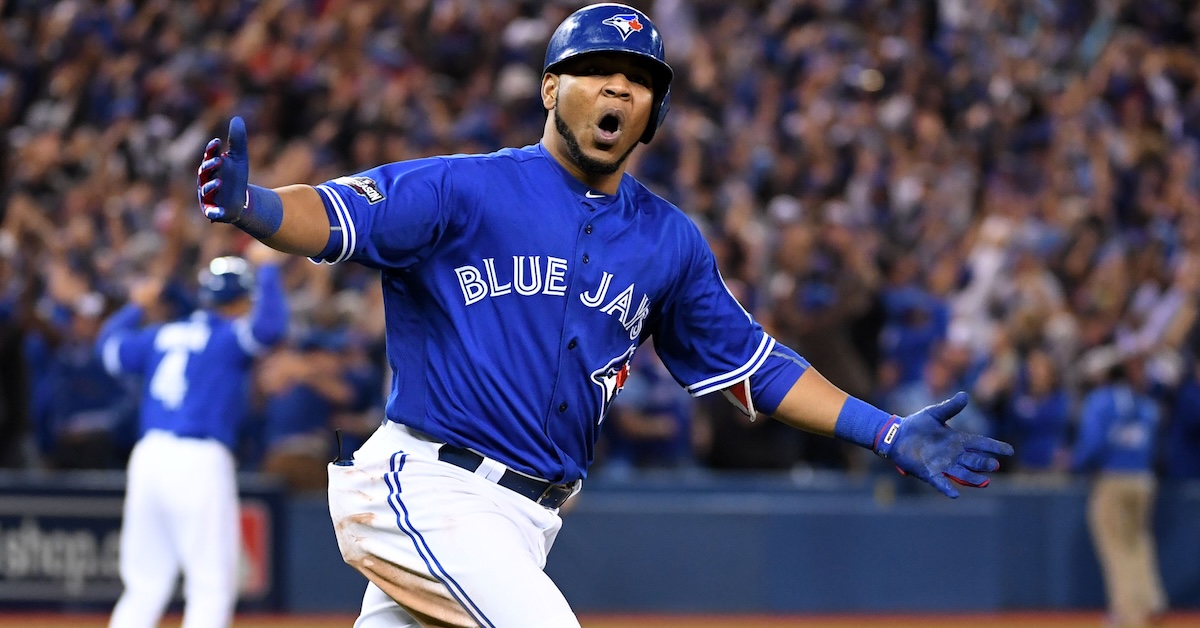
The one-two punch of Bautista and Encarnación kept the Blue Jays entertaining through some lean years, and with the arrivals of third baseman Josh Donaldson and catcher Russell Martin in 2015, the team reached the playoffs for the first time since winning back-to-back World Series in 1992–93. Toronto did it again the next year, punctuated by Encarnación’s three-run walk-off homer off the Orioles’ Ubaldo Jiménez to win the 2016 AL Wild Card Game.
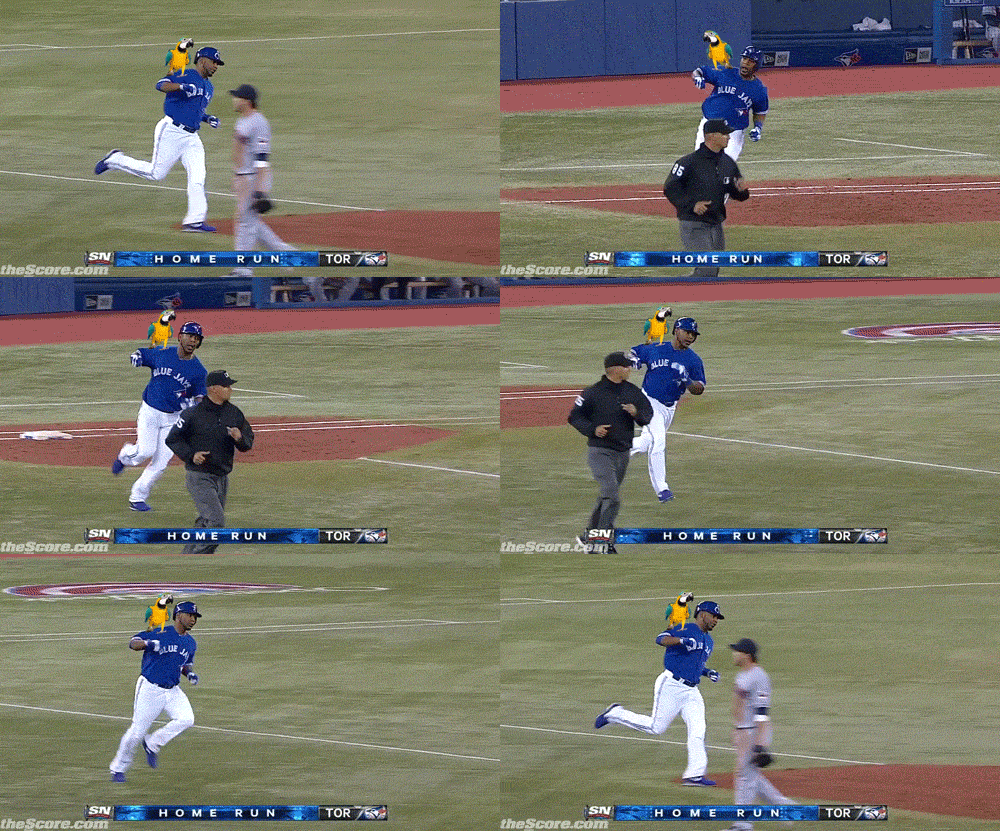
For as iconic as Encarnación had become in Toronto with his titanic blasts — accompanied by his “Edwing” home run trot, in which he held his right forearm at a 90-degree angle while circling the bases as though supporting a parrot — he soon found himself on the move. From 2017–20, he played for Cleveland, the Mariners, the Yankees, and the White Sox; while he hoped to reach 500 home runs, an abysmal short season on the South Side ended his career at age 37. Neither traditional nor advanced statistics suggest he’ll get traction with Hall of Fame voters, but as perhaps the most revered of this year’s crop of one-and-done candidates, he gets the expanded treatment here.
| Player | Career WAR | Peak WAR | JAWS |
|---|---|---|---|
| Edwin Encarnación | 35.3 | 27.2 | 31.2 |
| Avg. HOF 1B | 64.9 | 42.0 | 53.5 |
| H | HR | AVG/OBP/SLG | OPS+ |
| 1,832 | 424 | .260/.350/.496 | 123 |
Edwin Elpidio Encarnación was born on January 7, 1983 in La Romana, Dominican Republic, the third of four children of parents Elpidio Encarnación, a track and field coach, and Mireya Rivera. According to a 2014 SportsNet feature by Stephen Brunt, before his marriage to Mireya, Elipdio also fathered 12 children by other women, and they became part of the greater Encarnación clan. One of Edwin’s older brothers, Julio Encarnación (b. 1981) played in the White Sox system in 2000–01.
Young Edwin grew up in a barrio called Rio Salado, selling mangos he picked from trees in his yard, and playing a street variant of baseball called vitilla with his brothers, trying to hit spinning water bottle caps with sticks. Conscious of his own reputation as an athlete, Elpidio — who won 45 track and field medals and is in the Dominican Athletic Hall of Fame — pushed his kids to succeed in sports. He built a batting cage in his backyard, paying the fisherman across the street 500 Dominican pesos to make a net. Young Edwin hit in the cage every day, and became the best player among the youth in Rio Salado.
When Edwin was a teenager, Elipdio took a job coaching at a college in Puerto Rico. His children split their time between the two islands, with Edwin playing baseball at Manuela Toro High School in Caguas, Puerto Rico, which made him subject to Major League Baseball’s amateur draft. The Rangers chose him in the ninth round in 2000, signed him for a $55,000 bonus, and sent him to their Gulf Coast League affiliate, where he hit .311/.381/.379 without a home run in 51 games — not too bad for a 17-year-old.
Encarnación wasn’t long for the Rangers organization, however. At A-level Savannah in 2001, he hit .306/.355/.453 in 45 games, though he also made 12 errors at third base. On June 15, 2001, he and outfielder Ruben Mateo were traded to the Reds for right-hander Rob Bell. Encarnación, still just 18 years old, continued his season at Rookie-level Billings before a late-season promotion to A-level Dayton, where he returned for 2002. Though he hit .282/.338/.458 with 17 homers and 25 steals, he made 40 errors between third base and a 17-game trial at shortstop, mainly because he rushed his throws.
After splitting 2003 between High-A and Double-A, Encarnación spent ’04 at the latter level, batting .281/.352/.443 with 13 homers and 17 steals for the Reds’ Chattanooga affiliate. He placed 56th on Baseball America’s Top 100 Prospects list in the spring of 2005, with the publication lauding his bat speed, power, patience, and willingness to use the opposite field after being pull-happy when he was younger. BA also graded his arm as plus and praised his quick hands, but noted that his footwork was causing poor throws.
A hot start at Triple-A Louisville in 2005 earned Encarnación a call-up. He debuted on June 24 in Cleveland, going 0-for-4 against Scott Elarton and two relievers while striking out twice. He came off the bench for the next week, and was 0-for-8 before finally collecting his first hit, a pinch double off the Astros’ Andy Pettitte. While he was optioned back to Louisville (where he would hit .314/.388/.548 with 15 home runs in 78 games overall), he returned to Cincinnati after incumbent third baseman Joe Randa was traded to the Padres on July 23. “The Edwin Encarnación Era — and that’s exactly what his predecessor expects it to be — got underway Sunday in Cincinnati,” wrote the Cincinnati Post’s Mark Lancaster after the 22-year-old prospect returned and went 1-for-3 while making a couple of good defensive plays. “To me, he’s got All-Star written all over him,” said Randa. “I enjoyed my time (with him) because he listened, he asked questions, and that’s the first step of a young player wanting to step up his game. I hope he does really well and I think he’s going to be here for a long time.”
On July 29, Encarnación clubbed his first major league home run, off Padres reliever Craig Breslow (yes, the current Red Sox chief baseball officer).
Encarancion hit .232/.308/.436 (93 OPS+) with nine homers in 69 games as a rookie, and for the only time in his career posted a positive DRS (4). His offense improved in 2006 (.276/.359/.473, 15 HR, 108 OPS+), but he led all third basemen with 25 errors in just 111 games, finishing with -13 DRS.
Encarnación spent two and a half more seasons in Cincinnati, hitting a combined .262/.346/.443 (101 OPS+) with highs of 26 home runs and a 108 OPS+ in 2008, but netting just 1.4 WAR due to a combined -36 DRS. His struggles on both sides of the ball frustrated the Reds to the point that he was optioned to Louisville for a couple of weeks in May 2007, though by the spring of ’09, they saw enough to sign him to a two-year, $7.6 million extension. Alas, he missed 66 days in the first half of 2009 due to a chip fracture in his left wrist.
On July 31, 2009, the Reds traded Encarnación and righty pitching prospects Josh Roenicke and Zach Stewart to the Blue Jays in exchange for Scott Rolen, who would help the Cincinnati make the playoffs twice at the tail end of his Hall of Fame career. The move would benefit Encarnación eventually, but not immediately, and in fact, the Blue Jays only took him on to offset dumping Rolen’s even bigger salary. “Candidly, we did not want him to be part of the deal,” Alex Anthopoulos, then Toronto’s assistant GM, told Brunt. Encarnación finished with a subpar .225/.320/.410 (91 OPS+) line and zero WAR.
Statistically, Encarnación had a solid 2010 season despite playing just 96 games, hitting .244/.305/.482 (109 OPS+) with 21 home runs, and thanks to improved defense (-3 DRS) set what to that point was a career high of 1.6 WAR. Below the surface, his season was a mess, his hold on a roster spot tenuous. His spring training was interrupted by surgery to remove a bone spur in his left wrist, then in mid-April, he lost a month to a right forearm strain. A late-June slump led to a demotion to Triple-A Las Vegas, and days later, the Blue Jays designated him for assignment, then outrighted him off the 40-man roster once he cleared waivers… only to bring him back to Toronto on July 2 after he went 14-for-32 in Triple-A. In late August, he missed more time due to a sprained left wrist. Concerned he would make $7–8 million in arbitration, the Blue Jays waived him in early November, and lost him to the A’s; after failing to work out a contract, Oakland non-tendered him, and he returned to Toronto on a one-year, $2.5 million contract with a club option for 2012. “We thought there was upside to the bat, and if we could get him away from third base we might get more out of him,” Anthopoulos told Brunt.
Encarnación was drawn to return in part by the presence of Bautista, a fellow Dominican who had bounced around the majors before landing with the Blue Jays in 2008, and who under the guidance of hitting coach Dwayne Murphy had broken out to hit a majors-leading 54 homers in ’10 by focusing more on pulling the ball. The Blue Jays promised to give Encarnación at least 400 at-bats and play him first base and DH, but on the last day of spring training, they asked him to play third. He struggled and at one point was nearly released; as of June 22, he was hitting just .250/.287/.364 with rough defense. From Brunt:
Thus began the painful era of “E5” (and yes, it was as bad as you remember, eight errors in 74 chances). It was painful for both Encarnación and Jays fans, although because the fans rarely heard from him, because the language barrier prevented him from fully expressing himself, few outside of his closest teammates actually knew how he felt. “The fans started yelling at me,” he says. “I understand that’s part of the game if I don’t do my work. I know they’re going to be pissed. I tried to do the best I could. But it got in my head — and when that gets in your head, it’s hard to get it out. I got frustrated a little bit. I couldn’t hit because I was thinking about defence.”
Primarily DHing in the second half, Encarnación finished at .272/.334/.453 (111 OPS+) with 17 home runs but just 1.0 WAR. Through his age-28 season, he’d netted just 6.5 WAR — about 1.3 per 162 games — to go with 117 homers. Few could have anticipated what would come next.
In the winter of 2011-21, Encarnación called up fellow Dominican Robinson Canó and asked him for advice. The Yankees second baseman brought Encarnación to his personal hitting guru, Luis Mercedes, who counseled his new pupil to make some adjustments. Via Brunt:
The first day, he swung the bat and didn’t say anything — and I didn’t say anything. But I saw with his swing that it was too long, and he only used one hand. The next day, I told him, ‘You have to change your bat from that position. You don’t do the high leg kick no more. I want you to get your bat down. Use two hands. And if you don’t do what I say, you’re running.’ He didn’t like that. He got mad at me. We fought every day. I told him that I wanted to exploit what he had. It was good, but he had to work with it. And I told him, ‘If you don’t do good, you don’t have to pay me.’”
While Encarnación initially felt odd without the leg kick, the changes quickly paid dividends. In April 2012, he bopped eight homers, including an April 28 opposite-field grand slam off the Mariners’ Hisashi Iwakuma, after Bautista had been intentionally walked. Encarnación circled the bases with his right arm to a 90-degree angle, “turning like an airplane,” as he explained a few years later. The home runs and the celebration continued, though it would take a year for blogger Andrew Zuber from TheScore to christen the gesture “walking the parrot.” Parrot memes sprung up on social media in the wake of his homers, stuffed parrots filtered into ballparks, and years later, Cleveland even created a special emoji once he joined the team.
Encarnación walked the parrot 42 times in 2012, good for fourth in the AL, accompanied by additional across-the-board career bests with a 153 OPS+ (third in the AL), a .280/.384/.557 line (fifth in both OBP and SLG), and 5.0 WAR (10th); it helped that he only played one game at third base, compared to 82 at DH and 68 at first, and three in left field (?!). In July, the Blue Jays signed him to a three-year, $29 million extension with a club option for 2016. At season’s end, he received a smattering of support on MVP ballots, finishing 11th; he would get similar levels of support in four of the next five seasons (all but 2014) — never cracking the top 10, but always with a few writers acknowledging his contributions.
Encarnación showed his breakout was no fluke, following up with a 4.1-WAR season in which he bashed 36 homers and slashed .272/.370/.534 (145 OPS+). His home run total ranked third in the league, his slugging fifth, and his OPS+ sixth. He made his first All-Star team, and did it again the next year; despite missing 40 games with a right quad strain, Encarnación still posted a 152 OPS+ with 34 homers and 3.8 WAR in 2014. The Blue Jays went 83-79, a nine-game improvement from the year before, for their first winning record since 2010 and their first during manager John Gibbons’ second stint in Toronto’s dugout.
With Donaldson homering 41 times en route to MVP honors, Bautista adding 40 and Encarnación 39, the Blue Jays led the majors with 232 homers in 2015. They went 93-69, capturing their first division title in 22 years. Encarnación hit .277/.372/.557 (148 OPS+) with 4.8 WAR, then went 6-for-18 in their five-game Division Series against the Rangers, highlighted by a game-tying sixth-inning solo shot off Cole Hamels in Game 5; the next inning, all hell broke loose, punctuated by Bautista’s epic bat flip after walloping a three-run homer off Sam Dyson. Though Encarnación had a pair of two-hit games in the ALCS against the Royals, he went just 5-for-22 with a double and two RBI in Toronto’s six-game series defeat.
The Blue Jays exercised Encarnación’s $10 million option for 2016, and the slugger matched his career high with 42 homers while driving in a league-leading 127 runs, batting .263/.357/.529 (134 OPS+) with 3.8 WAR, and making his third and final All-Star team. On August 12, 2016, he hit his 300th home run, a ninth-inning solo shot off the Astros’ Will Harris. On October 4, he hit the most famous homer of his career in the AL Wild Card Game. In the bottom of the 11th inning, with the score tied, Orioles manager Buck Showalter called upon Jiménez, a starter who had been lit for a 5.44 ERA that year — instead of dominant closer Zack Britton, who had posted a 0.54 ERA while leading the league with 47 saves. After Jiménez surrendered back-to-back one-out singles to Devon Travis and Donaldson, Encarnación annihilated a first-pitch, middle-middle fastball for a 440-foot game-winner.
Encarnación stayed hot, going 5-for-12 in a three-game Division Series sweep of the Rangers, with a solo homer off Yu Darvish in Game 2 and a two-run blast off Colby Lewis (plus an RBI single off reliever Tony Barnette) in Game 3. He was mostly quiet in Toronto’s five-game loss to Cleveland in the ALCS, going 4-for-19 with a pair of RBI.
He must have made an impression, however. With free agency looming, Encarnación spoke of wanting to stay in Toronto, and the Blue Jays reportedly offered him a four-year deal around $80 million, one said to include either a vesting or club option to take it to $100 million. But Encaracion and his agent, Paul Kinzer, expected bigger offers, as he ranked among the top hitters on the market, so he spurned that one and the Blue Jays’ $17.2 million qualifying offer, as well. The Blue Jays pivoted to sign Kendrys Morales, another first base/DH type, to a three-year, $33 million deal. While they left the door open for Encarnación to return — and while he received additional interest from the Rangers, A’s, Astros, and Yankees — just before Christmas he settled for a three-year, $60 million deal with Cleveland, with a $20 million option for 2020.
Spending less time in the field and more at DH for the defending AL champions, Encarnación clubbed 38 homers, drew a career-high 104 walks, and drove in 107 runs while batting .258/.377/.504 (132 OPS+) with 2.8 WAR. After winning 102 games and the AL Central, Cleveland fell to the Yankees in a five-game Division Series; Encarnación went 0-for-7, spraining his right ankle in the first inning of Game 2 while retreating to second base (he was doubled off) and not returning until Game 5. He slipped to 32 homers, a 116 OPS+ and 1.9 WAR in 2018, then went 1-for-10 in another Division Series loss, this one a three-game sweep by the Astros.
In December 2018, Cleveland traded Encarnación to Seattle as part of a three-team, six-player deal that sent Carlos Santana from Seattle to Cleveland and Yandy Díaz from Cleveland to Tampa Bay. He wasn’t long for the Pacific Northwest; the Mariners had won 89 games in 2018, but by June 15, they were 30-44. Encarnación homered 21 times in 65 games, with the 400th of his career on June 9 off the Angels’ Nick Tropeano; it was his second of the game and seventh in a nine-game span.
Six days later, Encarnación was traded to the Yankees for righty prospect Juan Then. While he hit reasonably well for New York, he missed more than seven weeks due to injuries, first a hairline fracture of his right wrist after Red Sox reliever Josh A. Smith hit him with a pitch, then an oblique strain. He finished with 34 homers, a .244/.344/.531 (131 OPS+) line, and 2.9 WAR. After being sidelined for three weeks, he opened the Division Series with back-to-back two-hit games in victories over the Twins, driving in the Yankees’ first run in each, but went just 1-for-22 from Game 3 through the remainder of the series and a six-game ALCS loss to the Astros.
The Yankees declined Encarnación’s $20 million option for 2020, paying him a $5 million buyout. While the Blue Jays showed interest in bringing him back, he instead signed a $12 million, one-year-plus-option deal with the White Sox. He never got going on the South Side during the pandemic-shortened season, battling left shoulder inflammation and hitting just .157/.250/.377 (70 OPS+) in 44 games; he had as many singles (10) as home runs. The White Sox went 35-25 and made the expanded playoffs, but Encarnación played just once during their Wild Card Series loss to the A’s, going 0-for-2. After Chicago declined Encarnación’s $12 million option, the 37-year-old slugger said he planned to play in 2021, continuing his pursuit of 500 home runs, but the decision not to adopt the universal DH for 2021 after using it in ’20 reduced his job market. He never did play again.
…
Outside of his impressive home run total, Encarnación doesn’t really have much of a Hall of Fame case. He made just three All-Star teams, never finished higher than 11th in the MVP voting, had just one league lead in a key category, and despite his 2016 AL Wild Card Game walk-off dinger, finished with a .216/.324/.360 postseason line with four homers in 145 plate appearances.
The advanced statistics don’t help his cause. Encarnación’s defense at third base, first base, and left field was a combined 68 runs below average, and his baserunning and double play avoidance another 21 below average. Positional adjustments take a bite out of his WAR, too, though there’s no disputing he was more valuable after moving off third, particularly as a hitter:
| Position | PA | HR | AVG | OBP | SLG | wRC+ |
|---|---|---|---|---|---|---|
| as 1B | 2,083 | 132 | .264 | .357 | .537 | 141 |
| as DH | 3,287 | 185 | .262 | .358 | .510 | 132 |
| as 3B | 2,697 | 105 | .255 | .334 | .451 | 103 |
| Other | 59 | 2 | .280 | .379 | .460 | 130 |
His 35.3 career WAR ranks 63rd among first basemen, two spots below the second-lowest Hall of Famer, Jim Bottomley. He’s 63rd in JAWS as well, below Bottomley, Carlos Santana, and Kevin Youkilis, among others.
Perhaps if he’d landed with an AL team earlier in his career, and also had a bit of luck on the back end, Encarnación might have reached 500 homers, in which case he would have ignited a debate on whether attaining the milestone with a clean reputation is enough for the Hall. In general, I think the answer is no, and with Encarnación 55th out of 59 in WAR among those with 400 homers, I don’t think he would have made for a strong test case:
| Player | Seasons | PA | HR | WAR |
|---|---|---|---|---|
| Dave Kingman | 1971–1986 | 7,429 | 442 | 17.4 |
| Adam Dunn | 2001–2014 | 8,328 | 462 | 18.0 |
| Paul Konerko | 1997–2014 | 9,505 | 439 | 28.0 |
| Alfonso Soriano | 1999–2014 | 8,395 | 412 | 28.6 |
| Edwin Encarnación | 2005–2020 | 8,126 | 424 | 35.3 |
| Juan Gonzalez | 1989–2005 | 7,155 | 434 | 38.7 |
| Nelson Cruz | 2005–2023 | 8,396 | 464 | 42.0 |
| Jose Canseco | 1985–2001 | 8,129 | 462 | 42.4 |
| Carlos Delgado | 1993–2009 | 8,657 | 473 | 44.4 |
| Giancarlo Stanton | 2010–2025 | 7,177 | 453 | 46.8 |
None of these players are enshrined; Stanton, a former MVP, still has a shot, but has his work cut out to reach both 500 homers and 50 WAR. Delgado went one-and-done on the 2015 BBWAA ballot, then received nine out of 16 votes (56.3%) in the most recent Era Committee election, a result that makes more sense as a referendum on the PED-linked Barry Bonds, Roger Clemens, and Gary Sheffield than anything else.
Encarnación won’t be shut out entirely — at this writing, he’s got one vote out of 40 published on the Tracker — but in all likelihood, he won’t get the 5% needed to remain on the ballot. Still, he figures to be fondly remembered, both as one of the top sluggers of his era and as a key contributor to some memorable Blue Jays teams.
Brooklyn-based Jay Jaffe is a senior writer for FanGraphs, the author of The Cooperstown Casebook (Thomas Dunne Books, 2017) and the creator of the JAWS (Jaffe WAR Score) metric for Hall of Fame analysis. He founded the Futility Infielder website (2001), was a columnist for Baseball Prospectus (2005-2012) and a contributing writer for Sports Illustrated (2012-2018). He has been a recurring guest on MLB Network and a member of the BBWAA since 2011, and a Hall of Fame voter since 2021. Follow him on BlueSky @jayjaffe.bsky.social.
He was a fun player, but most definitely a HOVG not a HOF.
He and his teammates, Donaldson and Bautista, would be shining examples for the HOVG wing of “could have been HOF if they’d broken out at 22 instead”