
JAWS and the 2026 Hall of Fame Ballot: Alex Gordon
The following article is part of Jay Jaffe’s ongoing look at the candidates on the BBWAA 2026 Hall of Fame ballot. For a detailed introduction to this year’s ballot, and other candidates in the series, use the tool above; an introduction to JAWS can be found here. For a tentative schedule and a chance to fill out a Hall of Fame ballot for our crowdsourcing project, see here. All WAR figures refer to the Baseball Reference version unless otherwise indicated.
Alex Gordon spent nearly a decade and a half embodying the ups and downs of the 21st-century Kansas City Royals. His 14-year career began with unreasonably high hopes and then typical growing pains before culminating in one of the more unlikely championships in recent memory, followed by a steep decline.
After dominating at both the high school and college levels in Lincoln, Nebraska, Gordon was drafted as a third baseman by the Royals with the second pick in 2005, and touted as the Next George Brett, a nearly impossible bar to live up to in any era, let alone one in which his team was a perpetual doormat in need of a savior. He hadn’t even played a major league game before Brett himself claimed to be flattered by the comparisons. In the spring of 2007, as Gordon worked to make the jump from Double-A to the majors, the Hall of Fame third baseman with three batting titles, 3,154 career hits, and a rock-solid claim as the best player in franchise history told a reporter, “I take it as a compliment. When I watch him play, he makes the game look pretty easy. When I played the game, I knew how hard it was. He’s better than I was at (23). Much better.”
Even setting aside the fact that Brett made his first All-Star team and won his first batting title at age 23, Gordon couldn’t live up to that billing, not that it was his fault. “He was wildly cheered before he ever did anything, faced next-to impossible circumstances for a rookie, and showed some flashes of promise,” wrote the Kansas City Star’s Sam Mellinger in the spring of 2008, looking back on Gordon’s first season.
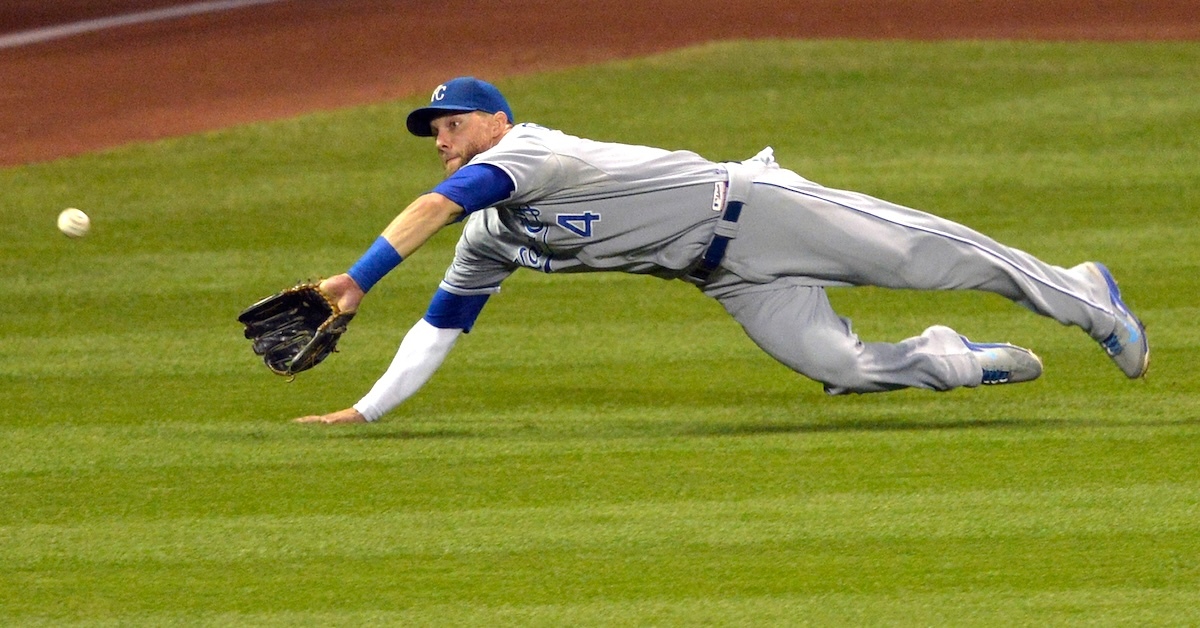
Injuries contributed to Gordon’s early-career struggles. He got so lost at the plate that in both 2009 and ’10, he was optioned back to Triple-A. A shift from third base to left field under the auspices of roving instructor Rusty Kuntz, and an overhaul of his swing with hitting coach Kevin Seitzer, helped him finally put it all together. From 2011–15, he was one of the majors’ 10 most valuable position players by WAR; within that span, he reeled off streaks of four straight Gold Gloves (2011–14), three straight All-Star selections (2013–15), and helped the Royals win back-to-back pennants (2014–15), not to mention their first championship in 30 years (2015), an effort he aided with an iconic ninth-inning homer in Game 1 of the 2015 World Series against the Mets. After that, further injuries turned his 30s into a slog, but even so, his defense — or at least his defensive reputation — was strong enough that he brought home another four straight Gold Gloves, with a Platinum Glove in 2018 to join the one he won in ’14.
Gordon was inducted into the Nebraska High School Sports Hall of Fame in 2018, the College Baseball Hall of Fame in ’23 and the Royals Hall of Fame this past season, but Cooperstown is another story. By both traditional and advanced reckonings, his numbers don’t measure up to Hall standards. He’s one of many candidates on this ballot — among the weakest in recent memory — who are likely to go one and done, falling short of the 5% of the vote needed to retain eligibility. Still, his is a career worth celebrating.
| Player | Career WAR | Peak WAR | JAWS |
|---|---|---|---|
| Alex Gordon | 34.9 | 31.1 | 33.0 |
| Avg. HOF LF | 65.3 | 41.7 | 53.5 |
| H | HR | AVG/OBP/SLG | OPS+ |
| 1,643 | 190 | .257/.338/.410 | 102 |
Alex Jonathan Gordon was born on February 10, 1984 in Lincoln, Nebraska, the second of four sons of Mike and Leslie Roux Gordon. Baseball ran in the family. Mike’s father, Charlie Gordon, coached baseball at Lincoln Southeast High School, winning five state championships during his 25-year coaching career (1955-80). Mike played high school baseball at Lincoln Southeast, and collegiate baseball at the University of Nebraska; later he worked as a sales manager for Coca-Cola and for K&Z Distributing, a beer distributor, and coached his sons from Little League through Babe Ruth League. All four sons played at Lincoln Southeast and then at the collegiate level, with Eric (the oldest) and Brett (the second-youngest, named after you-know-who) both doing so at University of Nebraska-Omaha; Eric went on to a brief stint in the independent Frontier League in 2003. Derek Gordon, the youngest, played at Park University in Parkville, Missouri, then had a five-year run in professional baseball from 2014–18, including two seasons (2015–16) pitching in the Royals’ system. Leslie, who worked as a registered nurse and owned an antique store, had an older brother (John Roux) who played at the University of Nebraska as well.
A natural right-hander, Alex was just four years old when his father — who would spend hours throwing batting practice to his kids — noticed that he placed his hands on the bat like a lefty. He encouraged Alex to move to the other side of the plate and try swinging like that; the experiment took. While Alex was advanced for his age both in hitting and throwing, his father/coach made sure to instill lessons about being a good teammate, rotating him in and out of games along with all of the other kids, and making sure he didn’t hog the ball on defense. When Alex was nine, he made a team of 12-year-olds.
At Lincoln Southeast, Gordon played football and basketball as well as baseball. He earned all-state honors as a defensive back, and numerous honors on the diamond, including the Omaha World-Herald’s Male High School Athlete of the Year in 2001 (he was the first player to win the award as a junior) after hitting .597 with 10 homers, and the Gatorade Nebraska Player of them Year in ’02 after hitting .500 with 31 RBIs. Thanks to his baseball and football exploits, the Nebraska High School Sports Hall of Fame named him its Prep Athlete of the Year in 2002.
“I remember his mom and dad asking me when he was a junior, ‘How high of a level do you think Alex can play at in college? Is he a junior college player? Can he play Division I?’ They knew I had played in college,” Mike Dobbs, who coached Gordon’s American Legion team, told the Lincoln Journal Star in 2007. “I looked them in the eye and said there probably isn’t a Division I school in the country that couldn’t use Alex.”
While schools such as Baylor and the University of Tennessee recruited Gordon, he chose to follow in his father’s footsteps by staying close to home. He absolutely thrived at Nebraska, becoming the most decorated player in school history. He was a Freshman All-American in 2003, and a first-team All-American in ’04 and ’05 as well as the Big 12 Player of the Year in both of those seasons. In 2004, he won MVP honors while leading Team USA to a gold medal at the World University Championship in Taiwan. In 2005, he won the Golden Spikes Award, the Dick Howser Trophy, and Baseball America College Player of the Year Award. The Royals chose him with the second pick of the 2005 draft, after the Diamondbacks selected Justin Upton; Ryan Zimmerman, Gordon’s Team USA teammate, went fourth to the Nationals, Ryan Braun fifth to the Brewers, and Troy Tulowitzki seventh to the Rockies.
Gordon signed with the Royals for a $4 million bonus in late September, too late to play in the minor league regular season, but he went straight to the Arizona Fall League, where he hit a respectable .260/.403/.460 for Surprise. Baseball America placed him 13th on its Top 100 Prospects list in the spring of 2006, and the Royals sent him straight to Double-A Wichita, where he hit .325/.427/.588 with 29 homers and 22 steals and became the first player to win BA’s College Player of the Year and Minor League Player of the Year awards in consecutive seasons. He rocketed to no. 2 on their Top 100, with the publication praising his swing:
“He has a smooth stroke with impressive bat speed and is able to generate power to all fields… He finds ways to get hits even when his swing isn’t at its best, further evidence of his knack for centering the ball on the barrel of the bat. He has a strong concept of the strike zone and is willing to draw walks.”
BA did note the Royals working to get him to generate backspin and more loft with his swing, and expressed some concern about his stiffness at third base, offset by the belief that his offense could support a move to first base or an outfield corner.
Gordon made the Royals out of spring training in 2007, and in honor of his pending debut, the Lincoln Journal Star devoted three pages of its six-page season preview to him, including a full-page cover photo, with Gordon-related factoids sprinkled across the other three pages. No pressure, kid! The next day — April 2, Opening Day — Gordon began his rough introduction to the majors. A season-high 41,527 fans packed into Kauffman Stadium and gave him a standing ovation before his first plate appearance, but the Red Sox’s Curt Schilling spoiled the moment, striking him out swinging at an inside fastball with the bases loaded to cap a seven-pitch battle.
“Lot of hype, lot of hype,” Brett, by then a Royals executive, recalled in 2008. “Sitting up in the suite with [general manager] Dayton [Moore], it was like, ‘Wow, can you believe this?’ This guy’s never been in the big leagues before.’”
Schilling struck out Gordon looking in his next trip to the plate, and while he later reached base when Javier López hit him with a pitch, he was 0-for-8 by the time he collected his first hit, a single off Daisuke Matsuzaka in his third game, on April 5.
Gordon went 1-for-24 before clubbing a homer off the Blue Jays’ Josh Towers in his sixth game, on April 9. He was still hitting just .173/.285/.281 as of June 6, with the possibility of a demotion to Triple-A Omaha looming, but hitting coach Mike Barnett helped him correct a flaw in his swing. He began to turn things around, going 4-for-4 with two singles, a double, and a triple against three Cleveland pitchers on June 7; from that point to the end of the season, he batted a respectable .285/.330/.478. Though he finished with just a 90 OPS+, he tallied 15 homers, 14 steals, and a combined 8 DRS between third base and first, good for 2.0 WAR. His season ended on an embarrassing note: A bad hop on a groundball broke his nose during the final game, forcing his fiancée to cancel a pre-wedding photo session. Still, after losing 100 games in each of the previous three seasons and four out of five since an anomalous 83-79 finish in 2003, the Royals improved to 69-93.
Gordon took a step forward in 2008, hitting .260/.351/.432 (109 OPS+) with 16 homers and 2.8 WAR; notably, his walk rate improved from 6.8% as a rookie to 11.6%. Alas, despite homering off the White Sox’s Mark Buehrle in his first plate appearance of the season in 2009, he went just 1-for-20 before being diagnosed with a tear in his right hip labrum. He underwent surgery and missed three months, but a month after his return, scuffled to the point that he was optioned to Omaha until rosters expanded in September. He finished the season with a .232/.324/.378 (87 OPS+) line, six homers, and 0.3 WAR in 49 games.
Things would get worse before they got better. In a Cactus League game in early March, Gordon fractured his right thumb on a headfirst slide into second base. He began the season on a rehab assignment at Omaha, missing the Royals’ first 10 games. After two weeks of disappointing play upon being activated, he was optioned back to Triple-A, with Royals manager Trey Hillman announcing that he would shift from third base (where he’d totaled -15 DRS since the start of 2008) to left field; Alberto Callaspo would man the hot corner for the near term, but by that point, the team envisioned 2007 no. 2 draft pick Mike Moustakas as its future third baseman.
Gordon remained upbeat despite the demotion, calling it another “speed bump.” “I want to play with Kansas City,” he said after his second game back in Omaha and in left field. “I think in the long run it’s going to help (being an outfielder in the organization), and I’m going to get better.”
“If he can catch a fly ball in this mess, he’s going to be OK,” said Kuntz after Gordon’s left field debut. “If you take a guy who’s pretty athletic, usually it works out.”
After two and a half months in Omaha, Gordon returned to Kansas City and played average defense in left field, but he continued to sputter at the plate, finishing with dismal numbers (.215/.315/.355, 84 OPS+, -0.5 WAR). The Royals lost 95 games, their sixth straight losing season and the 15th out of their last 16; Hillman was fired less than two weeks after Gordon’s demotion, replaced by Ned Yost.
Gordon retained his optimism. In a statement that raised eyebrows at the time, in late September he told the Kansas City Star‘s Bob Dutton, “I’m going to dominate next year.” The Athletic’s Rustin Dodd later called it “one of the most uncharacteristic declarations” of the otherwise stoic and introverted Gordon’s career, but it proved prophetic. Over the winter, Seitzer, the Royals hitting coach since 2009, worked with Gordon to revamp his swing, and during spring training, Yost kept him in spring games for longer than usual to help him get more comfortable with his mechanical adjustments. From Fox Sports’ Ken Rosenthal in April 2011, after Gordon jumped out to a hot start:
“We did a major overhaul with his upper body and swing path,” Seitzer says. “It was basically a month of drills. We wanted him to pretty much forget what the old swing felt like, ingrain a whole new path, lose tension in the upper body, stay short through the ball.
…“I was kind of an all-effort guy,” Gordon says. “I’m kind of gearing back a little bit, trying to swing nice and easy, nice and free, take what pitchers give me.”
The changes stuck, and Gordon set across-the-board career bests by batting .303/.376/.502 (140 OPS+) with 23 homers and 17 steals. His 20 DRS ranked second among all left fielders and helped him earn his first Gold Glove, while his 7.3 WAR ranked sixth in the AL. Just before the start of the 2012 season, he signed a four-year, $37.5 million extension with escalators for awards and a player option for ’16. While he backslid a bit offensively (.294/.368/.455, 14 HR, 123 OPS+), he led all major leaguers with 51 doubles, and all left fielders with 24 DRS while ranking fifth in the AL with 6.3 WAR.
The Royals won 71 games in 2011, and 72 in ’12. With catcher Salvador Perez, first baseman Eric Hosmer, and designated hitter Billy Butler joining the 29-year-old Gordon as the lineup’s only above-average hitters, James Shields and Ervin Santana anchoring the rotation, and closer Greg Holland and reliever Luke Hochevar bolstering the bullpen, the team rocketed to 86 wins, its highest total since 1989. Gordon’s offensive numbers dipped again (.265/.327/.422, 20 HR, 102 OPS+), but he made his first All-Star team, and his defense remained elite; his 4.1 WAR was 0.1 shy of the team lead.
With Wade Davis moving from the rotation (where he had been unsuccessful) to the bullpen (where he became lights-out dominant) and several other pitchers old and new stepping up, the Royals went 89-73 and claimed a Wild Card berth in 2014. The offense was a feeble one, with Gordon’s 118 OPS+ (.266/.351/.432) and 6.1 WAR both the best on the team. Still, it was enough, particularly with Yost relying upon a lockdown late-game bullpen starring Kelvin Herrera, Davis, and Holland. In the American League Wild Card game, the franchise’s first postseason game in 30 years, Gordon went 0-for-5, but the Royals overcame a 7-3 deficit to beat the A’s 9-8 in 12 innings. Gordon went 3-for-10 with four RBIs in a Division Series sweep of the Angels, highlighted by a three-run first-inning double off C.J. Wilson in Game 3. He followed that by going 3-for-4 in the ALCS opener against the Orioles, with a three-run double off Chris Tillman in the third inning, and a tie-breaking solo homer off Darren O’Day in the 10th; while he didn’t collect another hit in the series, he played some stellar defense, and the Royals swept the Orioles.
Gordon went just 5-for-27 in the seven-game World Series against the Giants, driving in his only runs via doubles off Tim Hudson in Games 3 (a 3-2 win) and 7. In the ninth inning of the latter, with the Royals trailing by a run and down to their final out, Gordon blooped a single into center field off Madison Bumgarner, and reached third when the ball got past center fielder Grégor Blanco and eluded left fielder Juan Perez as well. The question of whether third base coach Mike Jirschele should have waved him home loomed large when Perez fouled out; here at FanGraphs, Jeff Sullivan dug in and concluded that Jirschele probably made the right call to hold him up, though that was cold comfort.
Gordon helped the Royals get another bite at the apple in 2015, but his season was marred by a severe groin strain, suffered while running down a fly ball off the bat of the Rays’ Logan Forsythe on July 8. Forsythe rounded the bases for an inside-the-park home run as Gordon crumpled to the ground, and he had to be carted from the field. Hitting .280/.394/.459 (136 OPS+) with 11 homers at the time, he was one of four Royals voted into the AL’s starting lineup for the following week’s All-Star Game in Cincinnati. He missed eight weeks and struggled in September, with his final OPS+ sinking to 119.
While Gordon posted a modest .241/.349/.426 line in 63 plate appearances in the postseason, he had some key hits. His ground-rule double off Collin McHugh in the fifth inning of Division Series Game 5 chased the Astros’ starter; Gordon scored the go-ahead run moments later when Alex Rios doubled off Mike Fiers, and the Royals never looked back. He again drove in the go-ahead run and knocked out the starter in Game 2 of the ALCS, this time with a seventh-inning double off the Blue Jays’ David Price.
The Royals won that series in six and advanced to the World Series against the Mets. In Game 1, Gordon clubbed a game-tying homer off Jeurys Familia with one out in the bottom of the ninth; by Championship Win Probability Added, it was the most impactful play of the season. The Royals won that game in 14 innings, and won the series in five, just their second championship in franchise history. On that score at least, Gordon had finally matched Brett.
After the World Series, Gordon declined his $14 million player option, but he soon returned to the fold on a four-year, $72 million deal that included a mutual option for 2020. Unfortunately, his career mostly went downhill from there. From 2011–15, he had been the majors’ eighth-most valuable position player according to WAR:
| Player | PA | AVG | OBP | SLG | OPS+ | WAR |
|---|---|---|---|---|---|---|
| Mike Trout | 2877 | .304 | .397 | .559 | 169 | 37.1 |
| Miguel Cabrera | 3233 | .334 | .417 | .579 | 170 | 32.3 |
| Andrew McCutchen | 3358 | .302 | .396 | .509 | 152 | 31.4 |
| Robinson Canó | 3398 | .306 | .366 | .500 | 137 | 31.1 |
| Adrian Beltré | 3102 | .309 | .358 | .514 | 133 | 29.3 |
| Joey Votto | 2887 | .308 | .438 | .517 | 161 | 28.6 |
| José Bautista | 2921 | .270 | .393 | .540 | 154 | 28.3 |
| Alex Gordon | 3176 | .281 | .359 | .450 | 121 | 26.3 |
| Dustin Pedroia | 3112 | .294 | .361 | .431 | 115 | 25.7 |
| Ben Zobrist | 3229 | .272 | .359 | .437 | 123 | 25.4 |
| Buster Posey | 2618 | .313 | .380 | .483 | 143 | 25.2 |
| Ian Kinsler | 3469 | .272 | .334 | .432 | 107 | 24.5 |
| Evan Longoria | 2949 | .263 | .340 | .463 | 125 | 23.7 |
| Jason Heyward | 2806 | .266 | .344 | .426 | 111 | 23.5 |
| Adrián González | 3343 | .297 | .357 | .487 | 132 | 23.4 |
Gordon actually ranked sixth at the time of his groin injury, but from that point through the remainder of his career, he netted just 3.8 WAR, less than in any season from 2011-14, as his offense completely collapsed; amid the launch angle revolution, he hit more groundballs than ever. He hit a combined .234/.318/.362 (82 OPS+) over his final five seasons as the Royals receded from contention, first to 81 wins in 2016, then 80, then dreadful seasons of 58 and 59 wins, and a 26-34 record during the pandemic-shortened 2020 season. Further injuries were part of the problem. He collided with Moustakas in pursuit of a foul ball in May 2016, fracturing his right wrist and spending just over a month on what was then the disabled list, and two years later suffered a tear of his left hip labrum while sliding into second base; instead of undergoing another surgery, he missed just the 15-day minimum, but that had to take a toll.
The worst of Gordon’s offensive seasons was in 2017, when he hit .208/.293/.315 with nine homers in 148 games, not to mention the dubious distinction of ranking last among all batting title qualifiers in both slugging percentage and OPS+ (63, tied with Rougned Odor and José Peraza). Even with a respectable 10 DRS, he finished with -0.1 WAR, though he did win a Gold Glove and kick off his second streak of four straight. He did make some late-season adjustments to his approach, notably using the opposite field more often, which helped him rebound somewhat in 2018 (.245/.324/.370, 90 OPS+) and put up a respectable 2.0 WAR. Though he improved to a 95 OPS+ in 2019, his DRS dropped from 11 to -1 (and his FRV from 4 to -7); that year’s Gold Glove was won on reputation, not metrics. At the end of the season, the Royals declined their end of a $23 million mutual option, instead paying him a $4 million buyout. In January, he re-signed with the team on a one-year, $4 million deal, but he hit for just a 65 OPS+ with four homers and 0.3 WAR during the short season. His eighth Gold Glove tied him for the franchise lead with Frank White, another Royals icon who had starred alongside Brett and then managed Gordon at Wichita in 2006.
Gordon didn’t put up Hall of Fame numbers in Kansas City, let alone live up to the legend of George Brett. Even so, through his perseverance and his significant role on the 2014–15 teams, he carved his own niche in the franchise’s history. That’s impressive enough.
Brooklyn-based Jay Jaffe is a senior writer for FanGraphs, the author of The Cooperstown Casebook (Thomas Dunne Books, 2017) and the creator of the JAWS (Jaffe WAR Score) metric for Hall of Fame analysis. He founded the Futility Infielder website (2001), was a columnist for Baseball Prospectus (2005-2012) and a contributing writer for Sports Illustrated (2012-2018). He has been a recurring guest on MLB Network and a member of the BBWAA since 2011, and a Hall of Fame voter since 2021. Follow him on BlueSky @jayjaffe.bsky.social.
2015 was a very cool WS because I love defense and pitching.