
JAWS and the 2026 Hall of Fame Ballot: Andy Pettitte
The following article is part of Jay Jaffe’s ongoing look at the candidates on the BBWAA 2026 Hall of Fame ballot. For a detailed introduction to this year’s ballot, and other candidates in the series, use the tool above; an introduction to JAWS can be found here. For a tentative schedule and a chance to fill out a Hall of Fame ballot for our crowdsourcing project, see here. All WAR figures refer to the Baseball-Reference version unless otherwise indicated.
As much as Derek Jeter, Jorge Posada, Mariano Rivera, and Bernie Williams, Andy Pettitte was a pillar of the Joe Torre-era Yankees dynasty. The tall lefty Texan played such a vital role on 13 pinstriped playoff teams and seven pennant winners — plus another trip to the World Series during his three-year run with Houston — that he holds several major postseason records. In fact, no pitcher ever started more potential series clinchers, both in the World Series and the postseason as a whole.
For as important as Pettitte was to the “Core Four” (Williams always gets the short end of the stick on that one) that anchored five championships from 1996 to 2009 — and to an Astros team that reached its first World Series in ’05 — he seldom made a case as one of the game’s top pitchers. High win totals driven by excellent offensive support helped him finish in the top five of his leagues’ Cy Young voting four times, but only three times did he place among the top 10 in ERA or WAR, and he never ranked higher than sixth in strikeouts. He made just three All-Star teams.
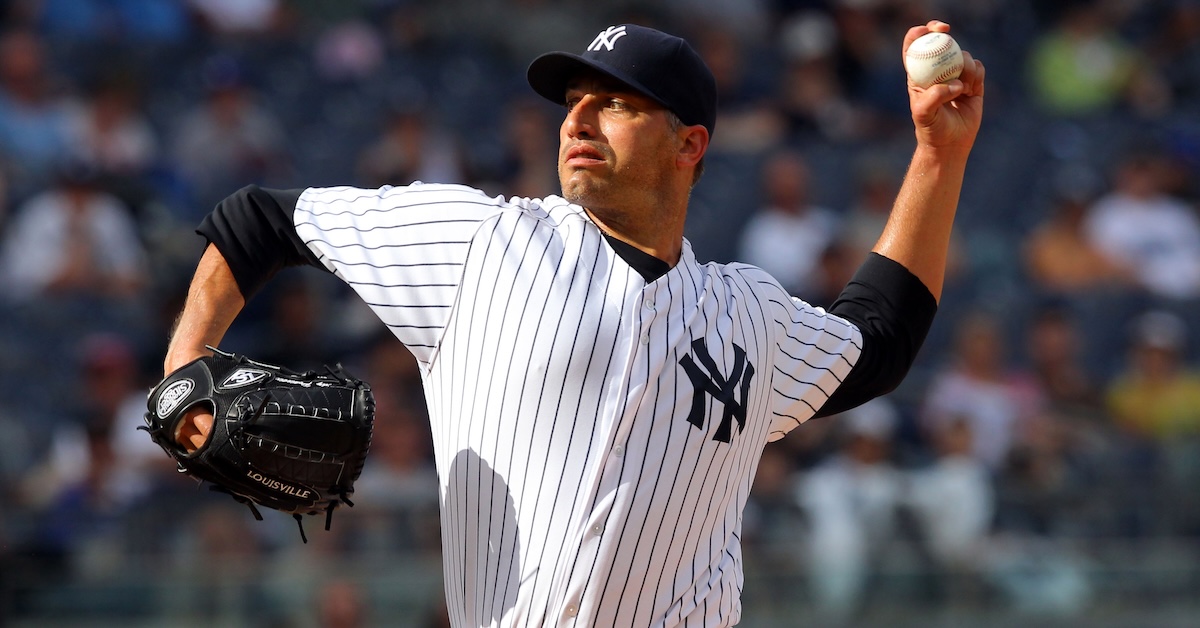
Indeed, Pettitte was more grit than glamour. A sinker- and cutter-driven groundballer whose pickoff move was legendary, he was a championship-level innings-eater, a grinder rather than a dominator, a pitcher whose strong work ethic, mental preparation, and focus compensated for his lack of dazzling stuff. About that focus: his peering in for the sign from the catcher with eyes barely visible underneath the brim of his cap was such a visual signature that the Yankees used it on a commemorative patch when they retired his no. 46 in 2015.
Pettitte made at least 32 starts 10 times, a mark that’s tied for seventh in the Wild Card era. Within that span, his total of 10 200-inning seasons is tied for fourth, and his 13 seasons of qualifying for the ERA title with an ERA+ of 100 or better is tied for first with fellow candidate Mark Buehrle, former teammate (and Hall of Famer) CC Sabathia, and future Hall of Famers Zack Greinke and Justin Verlander. He had his ups and downs in the postseason, but only once during his 18-year career (2004, when he underwent season-ending elbow surgery) was he unavailable to pitch once his team made the playoffs.
Even given Pettitte’s 256 career wins, he spent the first four years of his candidacy overshadowed by two other starters on the ballot (Roger Clemens and Curt Schilling) who were better at missing bats and preventing runs, and who also had plenty of postseason success. Both of those pitchers offered reasons for voters to exclude them from their ballots even while finding them statistically qualified, and the same is true for Pettitte, who was named in the 2007 Mitchell Report for having used human growth hormone to recover from an elbow injury. Between those dents and dings and the additional presence of both Roy Halladay and Mike Mussina, Pettitte received just 9.9% in his 2019 ballot debut. He spent the next five years in the teens (a low of 10.7% in 2022, a high of 17% in ’23) before jumping to 27.9% last year, helped by the presences of both Sabathia (another pitcher with 250-plus wins and strong postseason work) and Félix Hernández (a pitcher with a high peak but a short career who nonetheless generated better-than-expected support from voters). Now entering his eighth year of eligibility, he could gain even more ground given a particularly thin ballot whose top newcomer is another short-career starter, albeit one with solid postseason credentials, Cole Hamels (who emulated Pettitte growing up and faced him in the 2009 World Series). While I don’t expect him to get to 75% before his run is over, Pettitte may reach a share of the vote that catches the attention of a future Era Committee.
A note about pitcher wins: Regular readers know that I generally avoid dwelling on the stat, because in this increasingly specialized era, they owe as much to adequate offensive, defensive, and bullpen support as they do to a pitcher’s own performance. While one needn’t know how many wins Pettitte amassed in a season or over his career to appreciate his true value, those totals have affected the popular perception of his career.
| Pitcher | Career WAR | Peak WAR Adj. | S-JAWS |
|---|---|---|---|
| Andy Pettitte | 60.2 | 34.1 | 47.2 |
| Avg. HOF SP | 72.9 | 40.7 | 56.8 |
| W-L | SO | ERA | ERA+ |
| 256-153 | 2,448 | 3.85 | 117 |
Andrew Eugene Pettitte was born on June 15, 1972 in Baton Rouge, Louisiana. His father Tom, a police sergeant, built a mound in the family’s back yard and began teaching his son by using a library book that showed how Nolan Ryan gripped his pitches. When Andy was eight, the family moved to Deer Park, Texas, a suburb of Houston, where Tom coached Andy’s teams right up until high school. Pettitte stood over six feet tall by his junior year at Deer Park High School, with a fastball in the low 80s and an advanced feel for mixing his pitches. By the time he was a senior, he stood 6-foot-5, but was pudgy enough to play center and nose tackle on the football team.
Pettitte received scholarship offers from Louisiana State University and other schools, but after the Yankees drafted him in the 22nd round in 1990, he didn’t sign, nor did he head off to a major college program. Instead he chose to attend San Jacinto Junior College for a year, where he played for future Rice University coach Wayne Graham, who called him “a left-handed Roger Clemens.” The comparison resonated, for not only had Pettitte grown up idolizing Clemens, but Graham had coached the right-hander at San Jacinto in 1981. Graham helped transform Pettitte into a legitimate pitching prospect with a 91-93 mph fastball and better conditioning. The Yankees retained his rights up until a week before the 1991 draft, and ultimately landed him for an $80,000 bonus just before the signing deadline.
Pettitte split his first professional season (1991) between the Yankees’ Gulf Coast and New York-Penn League affiliates. At the latter stop, Oneonta, he crossed paths with the 19-year-old Posada, a 24th-round pick from the same draft and still primarily a second baseman. The pair spent 1992 together at A-level Greensboro of the South Atlantic League, where they were eventually joined by an 18-year-old Jeter, the Yankees’ 1992 first-round pick. At Greensboro, Pettitte posted a 2.20 ERA and seven strikeouts per nine, and in each of his next two minor league seasons, he kept his ERAs near or below 3.00; he spent most of 1993 at High-A Prince William, with a taste of Double-A Albany-Colonie, where he returned for the start of 1994 before heading to Triple-A Columbus, where he posted a 2.98 ERA and a modest 5.7 strikeouts per nine.
In the spring of 1995, Pettitte placed 49th on Baseball America’s Top 100 prospects list, with the publication praising “an above-average lefty repertoire: a fastball that he can tail both in and out, a down-breaking curveball and a great pickoff move.” BA also noted that he needed to improve his command of his curve and changeup. He lost the battle to be the Yankees’ fifth starter to Sterling Hitchcock but made the roster as a reliever, and debuted on April 29, 1995, with a rough outing against the Royals: two-thirds of an inning, three hits, two runs, and a wild pitch. Joe Vitiello was his first strikeout victim.
Pettitte made five relief appearances, the last of them 3 1/3 scoreless innings at Fenway Park against the Red Sox. After a brief return to Columbus, he joined the big club’s rotation when Jimmy Key tore his rotator cuff, an injury that required season-ending surgery. Pettitte enjoyed a very solid rookie campaign, going 12-9 with a 4.17 ERA (111 ERA+) and 4.01 FIP in 175 innings en route to 2.9 WAR, helping the Yankees make the playoffs for the first time since 1981. Manager Buck Showalter gave him the ball to start Game 2 of the Division Series against the Mariners; Pettitte allowed two runs through six innings before being touched up for two more in the seventh, including the go-ahead run. The Yankees won the game in 15 innings but ultimately lost the series. The 23-year-old southpaw finished third in American League Rookie of the Year voting, which was won by the Twins’ Marty Cordova.
Pettitte produced one of the biggest seasons of his career in 1996: 34 starts, 221 innings, a 3.87 ERA (129 ERA+), and an AL-high 21 wins, the last thanks to a robust 5.6 runs per game of offensive support. His 5.8 WAR ranked eighth in the AL. He did all of this while rotation-mate David Cone missed four months due to an aneurysm in his arm, Key served two stints on what was then the disabled list, and Kenny Rogers scuffled. Pettitte made his first All-Star team and finished a very close second in the AL Cy Young race behind the Blue Jays’ Pat Hentgen, but not before helping the Yankees to their first championship in 18 years. After allowing four runs apiece in his Division and League Championship Series starts (both of which the Yankees won, 5-4), he delivered eight strong innings on three days of rest in the ALCS Game 5 clincher against the Orioles. The Braves pounded him for seven runs in 2.1 innings in the World Series opener, but Pettitte rebounded to pitch 8.1 innings of five-hit shutout ball opposite 1996 NL Cy Young winner John Smoltz, a performance that in 2015 he called “the best game of my career.” The Yankees eked out a 1-0 victory and took a three-games-to-two series lead; they would win in six games.
Though he “only” won 18 games, Pettitte actually had a better season in 1997, when he made a league-high 35 starts and threw a career-high 240.1 innings with a 2.88 ERA (156 ERA+, both good for fourth in the league) and just seven homers allowed (a league-best 0.3 per nine). His 8.4 WAR ranked second in the league behind the Cy Young-winning Clemens, but he finished just fifth in the voting. He was lousy in the postseason, getting rocked for 11 runs in 11.2 innings by Cleveland in two Division Series starts, both losses. It would be five years before the Yankees took such an early vacation in October again.
In three major league seasons, Pettitte had established himself as one of the game’s top starters, thanks in part to his development of a nasty cut fastball. His 16.9 WAR for the period ranked sixth in the majors from 1995-97 behind only Greg Maddux, Clemens, Kevin Brown, Randy Johnson, and Pedro Martinez. He’d done it while pitching through a sore elbow, dating back to a three-inning relief stint in Baltimore on May 1, 1997, a day after getting torched for nine runs in one-plus inning. But whether it was his elbow or his over-reliance on his sinker-cutter combo at the expense of his curve and changeup, his performance took a significant step back even as the fate of the Yankees improved. From 1998-2000, while the Yankees won three straight championships, Pettitte averaged 32 starts and 204 innings, albeit with a 4.42 ERA (105 ERA+) and just a 1.53 strikeout-to-walk ratio, down from 2.21 for the three years prior. He was still good enough to average 2.8 WAR in that span, but the Yankees pondered trading him as he grew more expensive.
In July 1999, as the trade deadline loomed, the Yankees and Phillies neared a deal that would send Pettitte (then carrying a 5.65 ERA) to Philadelphia in exchange for three prospects including pitcher Adam Eaton and outfielder Reggie Taylor. In an organizational clash, Torre, pitching coach Mel Stottlemyre, and general manager Brian Cashman won out over owner George Steinbrenner and his cabal of Tampa-based advisors, who wanted to turn the rotation spot over to the immortal Ed Yarnall. Pettitte stayed, began working out with Clemens (who had been acquired in the spring) and allowed just three runs over his next four starts totaling 31 innings. That winter, he signed a three-year, $25.5 million extension with an $11.5 million club option for 2003.
As uneven as the 1998-2000 seasons were for Pettitte, he did place fourth in the AL Cy Young voting with the best of those years (2000, a 19-9, 4.35 ERA, 3.6 WAR effort). During that stretch, he delivered eight quality postseason starts out of 11 with a combined 3.26 ERA; the Yankees went 10-1 in those starts, rallying to win even when he took early exits in Game 3 of the 1999 World Series against the Braves and Game 5 of the 2000 Division Series against the A’s. He threw seven shutout innings in Game 4 of the 1998 World Series against the Padres, helping the team complete a sweep, and made good starts in Games 1 and 5 in the 2000 “Subway Series” against the Mets. He left the latter tied at 2-2 through seven innings; the Yankees plated two runs in the ninth and Rivera closed it out for the team’s third straight championship.
The work with Clemens began to rub off on Pettitte. In 2001, his fastball showed more zip, he worked inside more often, posted career-best strikeout and walk rates (7.4 and 1.8 per nine), brought his ERA below 4.00 (3.99) with a FIP nearly a run lower (3.02), and made his second All-Star team. He pitched well in his first three postseason starts agains the A’s and Mariners, allowing just five runs in 20.2 innings, and hung with the Diamondbacks’ Johnson for six innings in his World Series Game 2 start, entering the seventh trailing 1-0 before serving up a three-run homer to Matt Williams.
After losing the first two games in Arizona, the Yankees won three straight in New York to position themselves for their fourth straight title. Pettitte again took the ball opposite Johnson, but was pummeled for six runs in two-plus innings; on ESPN Radio’s international broadcast, analyst Rick Sutcliffe noticed that he was tipping his pitches by double-pumping on every fastball from the stretch. The Yankees didn’t discover the problem until it was too late; they lost both Game 6 and — thanks to a two-run rally against Rivera — Game 7 as well.
While elbow, back, and groin injuries sent Pettitte to the DL annually from 1999 through 2001, the ’02 season brought his first major injury, a bout of tendonitis that sidelined him for two months, from mid-April to mid-June. Limited to 22 starts, he nonetheless went 13-5 with a 3.27 ERA (135 ERA+ in 134.2 innings), and while he lasted just three innings in his lone postseason start against the Angels, the Yankees picked up his option that winter. Pettitte rewarded them with another strong, workhorse season, though his 21-8 record and 7.8 strikeouts per nine were flashier than the other numbers (4.02 ERA, 110 ERA+, 3.1 WAR, his fourth straight season between 3.1 and 3.6). In the best October showing of his career, he posted a 2.10 ERA in five starts, allowing more than two runs just once. He whiffed a postseason career high 10 Twins in his Division Series start, and came within one out of a shutout in Game 2 of the World Series before the Marlins plated an unearned run. Though he allowed just two runs (one earned) in seven innings in Game 6, Josh Beckett shut out the Yankees on five hits, giving the upstart Marlins a championship.
In December 2003, Pettitte shocked the baseball world by returning home to Texas, bypassing a three-year, $39 million offer from the Yankees in favor of a heavily backloaded three-year, $31.5 million deal with the Astros. “He wanted to go home to Houston,” said Steinbrenner. “And I admire him for wanting to be with his family. He couldn’t do that in New York. He was a great competitor for me.”
Soon joined in Houston by Clemens, whom he’d coaxed out of retirement, Pettitte made just 15 starts in 2004 due to forearm woes that culminated in season-ending surgery to repair a torn flexor tendon. He returned better than ever in 2005, going 17-9 with a career-best 2.39 ERA (177 ERA+, with both marks second in the NL behind Clemens) and 6.8 WAR (fourth in the league). During one stretch in June and July, he allowed no more than one earned run in eight straight starts. His postseason performance wasn’t great (4.26 ERA in 25.1 IP), as he wound up on the losing end three times while making four quality starts. The Astros, in their first World Series appearance, were swept by the White Sox.
Pettitte made a league-high 35 starts in his final year in Houston, but battled elbow tendonitis, and his ERA ballooned to 4.20 (106 ERA+), with his WAR dipping to 1.5. He had other problems as well. In October 2006, the Los Angeles Times published a report citing an affidavit from former Yankees pitcher Jason Grimsley, who alleged that both Pettitte and Clemens had used performance-enhancing drugs, and that he himself had obtained amphetamines, anabolic steroids, and human growth hormone from Brian McNamee, a former Yankees trainer who maintained a close working relationship with both pitchers. Pettitte vehemently denied the allegations, saying, “I’ve never used any drugs to enhance my performance on the baseball field before.”
In December, the 34-year-old lefty agreed to return to the Yankees on a one-year, $16 million deal with a $16 million player option for 2008. On September 19, near the end of a typical season (15-9, 4.05 ERA, 5.9 K/9, 3.8 WAR), he beat the Orioles with a seven-inning, one-run performance to claim the 200th victory of his career. His 6.1 shutout innings against Cleveland in Game 2 of the Division Series went for naught when Joba Chamberlain was devoured by a horde of midges.
Feeling the pull of family and mulling retirement, Pettitte declined his player option, mainly to allow the team to free up a roster spot while he deliberated. On December 3, he agreed to return at that same salary, but nine days later, his name was among the 89 included in the Mitchell Report. Two days later, he admitted to injecting HGH obtained through McNamee to recover from his 2002 elbow injury. “In 2002 I was injured. I had heard that human growth hormone could promote faster healing for my elbow,” he said in a statement released to the Associated Press. “I felt an obligation to get back to my team as soon as possible. For this reason, and only this reason, for two days I tried human growth hormone. Though it was not against baseball rules, I was not comfortable with what I was doing, so I stopped.”
Pettitte’s name remained in the headlines when Clemens appeared before Congress in February 2008 to challenge the findings pertaining to him in the report. Pettitte said in his deposition that Clemens had told him of using HGH nearly 10 years earlier, and that McNamee had told him that Clemens used steroids in 2003 or ’04 (Clemens claimed Pettitte “misremembered”). He also admitted that after tearing his flexor tendon in 2004, he obtained HGH from his ailing father, who had been using it to treat a heart condition. He took two doses, one in the morning and one at night. “I was desperate, and you know, I really knew that it wasn’t going to help me,” he said in the deposition. “My flexor tendon was already torn. I knew I needed surgery.”
When he reported to camp just days later, Pettitte apologized to fans for his HGH use and conceded that his testimony had strained his friendship with Clemens. Like every other player mentioned in the Mitchell Report, he was not disciplined by Major League Baseball. While he suffered damage to his reputation, he also displayed — or was compelled to display — considerably more candor than most other players named in the report.
On the field, Pettitte scuffled in 2008. While his 4.54 ERA was not a career worst, his 97 ERA+ represented the only time in his 18-year career that he allowed runs at a worse-than-average clip (his 3.71 FIP, his best in three years, told a different story). The Yankees missed the playoffs for the first time since the 1994 players’ strike, which triggered a major spending spree; $420 million worth of commitments brought Sabathia, A.J. Burnett, and Mark Teixeira to the Bronx. Pettitte, working on an incentive-laden one-year deal, served as a solid number three starter behind the two newcomers, rebounding to a 4.16 ERA and 3.4 WAR in 2009, then turned in one of his most memorable postseason runs. Though his overall 3.52 ERA in five starts totaling 30.2 innings wasn’t remarkable, he joined the 2004 Red Sox’s Derek Lowe by winning three clinching games in a single postseason, over the Twins (Division Series), Angels (ALCS), and Phillies (World Series).
While he made the AL All-Star team on the strength of an 11-2, 2.70 ERA first half, Pettitte’s 2010 was abbreviated by a groin strain that sidelined him for two months and limited him to just one September start longer than four innings. Nonetheless, he turned in a pair of seven-inning, two-run starts in the Yankees’ Division Series Game 2 victory over the Twins and their ALCS Game 3 defeat by the Rangers. Again deliberating on the retirement question, he pulled the plug in early February, just before pitchers and catchers reported.
Pettitte sat out all of 2011, but he could not stay retired. In March 2012, the 39-year-old southpaw quietly agreed to return to the Yankees — who had, in essence, left the light on for him — on a $2.5 million deal. He returned to the majors on May 13, and pitched as well as ever (3.22 ERA, 9.1 K/9) until a one-hopper off the bat of Cleveland’s Casey Kotchman fractured his left fibula. After missing nearly three months, he made a three-start September tuneup followed by a pair of good postseason starts totaling five runs allowed in 13.2 innings. Alas, he wound up on the short end both times, and the Yankees bowed to the Tigers in the ALCS.
Still hankering for more, Pettitte returned for his age-41 season, and for the first time since 2009 made 30 starts, finishing with a 3.74 ERA and 2.2 WAR in 185.1 innings. Unlike Rivera, who received a grand farewell tour that culminated with Jeter and Pettitte pulling him from his final appearance, Pettitte didn’t announce his intentions until September 20, 2013. He threw seven innings of two-run ball against the Giants in his final Yankee Stadium start two days later, and then a complete-game five-hitter against the Astros in Houston, his home away from home, on September 28.
…
From a Hall of Fame standpoint, Pettitte’s claim rests on a high win total, very good run prevention after adjusting for his park and league, and a strong postseason résumé, all of which are worth a closer look. First, the wins. Pettitte’s total of 256 ranks 43rd all-time, and is higher than 33 of the 67 enshrined non-Negro Leagues starters, including Halladay (203), Sabathia (251), and 2018 Modern Baseball Era Committee honoree Jack Morris (254). However, 256 wins does not guarantee a spot in the Hall; there are eight pitchers with more on the outside looking in, including Clemens (354), Tommy John (288), and Jamie Moyer (269), though the rest are either not yet eligible (Verlander, 266) or are 19th-century workhorses.
Wins, of course, are the product not just of a pitcher’s skill at run prevention but also of the support he receives from his offense, his defense, and his bullpen. In Pettitte’s case, prior to his original retirement he received offensive support that was about 10 percent better than the park-adjusted league average. That’s according to research done for the Baseball Prospectus book Extra Innings by Colin Wyers and myself in the fall of 2011, with said support for all starters defined simply as the runs scored on the day (or night) the starter pitched, and therefore available via game logs back into the 19th century. Wyers and I found just 12 Hall of Fame starters with better support, led by Chief Bender (117).
Pettitte was less well-supported by his defenses, in that he had a .312 career batting average on balls in play where the major league average was .298. The 11-point gap between his ERA (3.85) and FIP (3.74) doesn’t seem like a lot; it’s in a virtual tie with Hall of Famers Mussina and Bert Blylelven, placing in the 88th percentile among pitchers with at least 3,000 innings. As for bullpen support, Pettitte and Rivera — the best ever at his job — combined to set a record for teaming up, with Rivera saving 72 of Pettitte’s wins, far beyond the 57 wins of Oakland’s Bob Welch–Dennis Eckersley combo.
Pettitte’s career ERA would be the second-highest in the Hall, in front of only Morris, but the adjustments for park and league are everything in this case. Pettitte has a 117-105 edge on Morris in ERA+. His 117 ERA+ matches that of Hall of Famer Gaylord Perry, who’s tied for 44th among enshrined starters, and it’s two points better than Jim Bunning, Steve Carlton, Phil Niekro, Fergie Jenkins, and Eppa Rixey, who are tied for 47th. The problem for Pettitte is that all of those pitchers except Bunning threw at least 1,000 more innings.
Postseason-wise, the frequency of the Yankees’ participation in the three-tiered playoff format, the introduction of which coincided with the start of Pettitte’s career, helped him set records for starts (44), innings (276.2) and wins (19, against 11 losses); meanwhile, he’s fourth in strikeouts (183). While Pettitte certainly hit some high notes within that large body of work while helping the Yankees win five championships, he also had some duds, including seven starts with five or more runs allowed, only one of which went longer than five innings. His 3.81 postseason ERA is a ringer for his regular season mark, with his 4.06 World Series ERA in 13 World Series starts (the second-highest total behind Whitey Ford’s 22) slightly worse; he’s tied for seventh in World Series strikeouts (56) and eighth in innings (77.2) and wins (five). His ERA in his record 12 potential postseason series clinchers is 3.95 (the Yankees won eight); in four potential World Series clinchers, it’s 3.68 (the Yankees won three). Cool stuff, but he was more like the second coming of, well, Andy Pettitte than he was Schilling or Madison Bumgarner.
In terms of WAR, Pettitte’s career total of 60.2 is 12.7 WAR short of the standard at the position. He’s tied for 64th — 21 spots lower than his win total, remember — and behind 46 of the 67 enshrined starters. Among those he outranks who were elected by the BBWAA, only Ford (57.1) and Catfish Hunter (40.9) threw at least 3,000 innings, where Bob Lemon (48.2) fell just short, with Sandy Koufax (48.9) short of 2,500 innings and Dizzy Dean (46.2) short of 2,000 innings. That’s not a great argument in Pettitte’s favor.
A few years ago, I introduced S-JAWS, which I designed to reduce the skewing caused by the impact of 19th century and Deadball-era pitchers, some of whom topped 400, 500, or even 600 innings in a season on multiple occasions, generally under much more pitcher-friendly conditions than hurlers of today enjoy (modern medicine being a notable exception). The way I’ve chosen to do this is by prorating the peak-component credit for any heavy-workload season to a maximum of 250 innings, which gives a boost to more recent pitchers by suppressing the peak-score impact of the massive seasons by those ancient hurlers. Since Pettitte never reached 250 innings (he maxed out at 240.1), his adjusted seven-year peak score is the same as his original seven-year peak score, 34.1 WAR, but in the rankings he jumps from 179th to 128th. Instead of being 4.0 points behind 2022 Golden Days honoree Jim Kaat and 0.5 behind Ford, he’s now 0.3 behind the former (who topped 250 innings seven times under more pitcher-friendly conditions) and 0.1 ahead of the latter. That’s still not much to write home about; he had just three seasons worth more than 4.0 WAR, the only times he dented his league’s top 10.
By S-JAWS, which is calculated by averaging career WAR and the adjusted peak score — and which for Pettitte is unchanged from his 47.2 JAWS — our dandy Andy climbs from 92nd to 81st. That’s still 9.6 points below the standard, and below 50 of the 67 enshrined starters, ahead of only Ford (45.8), Koufax (44.2), Dean (41.7), Lemon (41.4), and Herb Pennock (40.4) among BBWAA honorees. Of the active or recently retired starters whose progress towards Cooperstown I’ve been monitoring, he’s well behind Verlander, Greinke, Clayton Kershaw, and Max Scherzer — all of whom rank among the top 27 — as well as the recently elected Sabathia (55th at 50.8) and Hamels (72nd at 48.2), the ballot’s top first-year candidate.
If you’ve seen past editions of my Pettitte profiles or the ones from earlier this week on Hamels and Hernández, you’ll recognize this type of table showing the percentile rankings in adjusted peak score and JAWS for the starters on the ballot as well as a few notable non-candidates, including the already-elected Sabathia:
| Version | Median | 25th | 75th | CCS% | JS% | CH% | MB% | AP% | FH% | AW% |
|---|---|---|---|---|---|---|---|---|---|---|
| Peak Adj. Median | 39.4 | 34.6 | 48.7 | 50 | 77 | 39 | 34 | 20 | 45 | 7 |
| S-JAWS Median | 53.6 | 46.2 | 65.3 | 39 | 30 | 29 | 28 | 27 | 21 | 12 |
Sabathia’s adjusted peak score is right at the median, and his S-JAWS in the 39th percentile. Aside from the active and recently-retired starters I just mentioned, it’s anyone’s guess as to whether we’ll see anyone on the BBWAA ballot that high again. I’ve included Johan Santana here, a two-time Cy Young winner who went one-and-done on the 2018 ballot and won’t be eligible again until the 2029 Contemporary Baseball Era Committee one (if the format remains unchanged); here you can see that not only does he have the best peak of any of these pitchers but even with far fewer innings, his S-JAWS is superior to those of the four starters on this ballot. I threw in Adam Wainwright, the higher-ranking of two 200-win starters upcoming; he’s eligible in 2029, while Jon Lester, with whom he’s tied, hits the ballot next year.
Pettitte’s peak and S-JAWS are both well below the median but in the second quartile. If you’re of a mind that the voters should be electing more starting pitchers — just three have been born since 1969, namely Martinez (1971), Halladay (1977), and Sabathia (1980) — the likelihood is that they’re going to be drawn from somewhere in that second quartile. Pettitte’s long postseason résumé augments those modest rankings to some degree; whether that’s enough to get him over the bar depends in large part on how much weight one gives his October body of work.
For the most part voters haven’t been convinced. Though Pettitte’s never been in danger of falling off the ballot, he barely made waves during his first six cycles, gaining less than five points from 2019 (9.9%) to ’24 (13.5%). He more than doubled that level of support in 2025, shooting to 27.9%. His 14.4% gain was the largest of any returning candidate, and the best explanation for that jump is a coattail effect. According to data at Ryan Thibodaux’s Ballot Tracker, 38 returning voters added Pettitte to their ballots, of whom 36 also voted for Sabathia in his first year; meanwhile, 16 of those 38 also voted for Hernández. Only two returning voters who published ballots dropped Pettitte; I was one of them, needing to make room not just for the two first-year starters but for catchers Russell Martin and Brian McCann, both of whom ended up falling short of the 5% share necessary to stay on the ballot.
I’ve only voted for Pettitte once, in 2024; finding myself with room on that year’s ballot, I opted to include a player in whose career I had a considerable investment as a fan. I don’t hold the Mitchell Report-related transgression against Pettitte, as it took place during the “Wild West” era of the game’s drug problems; if MLB couldn’t punish him, I don’t think voters should do so either. With space again on this year’s ballot, I’m leaning towards including Pettitte, even if I’m still not fully convinced he’s a Hall of Famer. I don’t think the ballot is in danger of becoming overcluttered before his eligibility expires, and I think the longer voters weigh the variety of career shapes of the starting pitchers on the ballot, the more likely it is that some consensus will emerge. I don’t expect Pettitte to get to 75% via the writers; he seems more like an Era Committee selection à la Morris, and a better one at that. But even if he’s not a fit for Cooperstown, flags fly forever, and he’ll always be fondly remembered in the Bronx.
Brooklyn-based Jay Jaffe is a senior writer for FanGraphs, the author of The Cooperstown Casebook (Thomas Dunne Books, 2017) and the creator of the JAWS (Jaffe WAR Score) metric for Hall of Fame analysis. He founded the Futility Infielder website (2001), was a columnist for Baseball Prospectus (2005-2012) and a contributing writer for Sports Illustrated (2012-2018). He has been a recurring guest on MLB Network and a member of the BBWAA since 2011, and a Hall of Fame voter since 2021. Follow him on BlueSky @jayjaffe.bsky.social.
My Flamin’ Hot™ take is that I think Pettitte has the strongest overall case of any SP on the ballot
He was hurt by playing so many years with an awful Yankees defense behind him. Look at what he did in 2005 with an elite defense.
Completely agree. People massively overrate Felix Hernandez
I’m an enthusiastic supporter of Pettitte’s candidacy and he might have the best case because of his postseason accomplishments but Hamels was a better pitcher