
JAWS and the 2026 Hall of Fame Ballot: Shin-Soo Choo
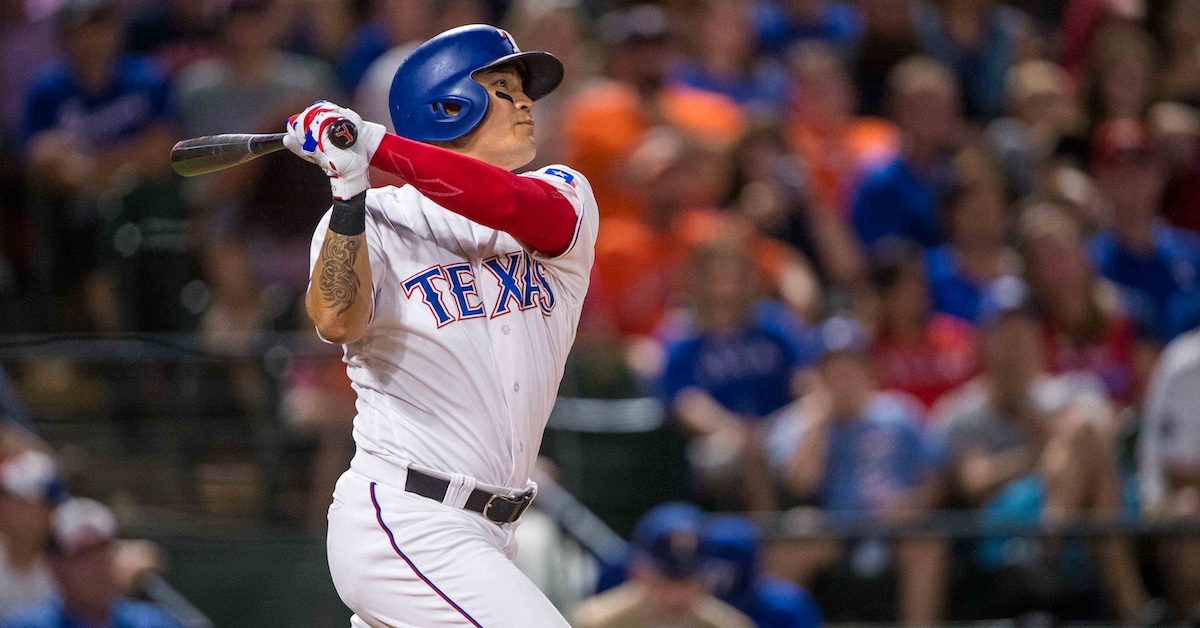
The following article is part of Jay Jaffe’s ongoing look at the candidates on the BBWAA 2026 Hall of Fame ballot. For a detailed introduction to this year’s ballot, and other candidates in the series, use the tool above; an introduction to JAWS can be found here. For a tentative schedule, see here. All WAR figures refer to the Baseball Reference version unless otherwise indicated.
| Player | Pos | Career WAR | Peak WAR | JAWS | H | HR | SB | AVG/OBP/SLG | OPS+ |
|---|---|---|---|---|---|---|---|---|---|
| Shin-Soo Choo | RF | 34.7 | 29.3 | 32.0 | 1,671 | 218 | 157 | .275/.377/.447 | 122 |
By the time Shin-Soo Choo reached the majors with the Mariners in 2005, nine South Korea-born pitchers had followed in the wake of Chan Ho Park, who debuted with the Dodgers in 1994, but just one position player preceded him, namely Hee-Seop Choi. It took a few years and a lopsided trade before Choo’s major league career got off the ground, and he lost significant time to a variety of injuries, but over the course of his 16 seasons with Seattle, Cleveland, Cincinnati, and Texas, he established himself as an on-base machine with considerable pop. He set a number of firsts, including becoming the first South Korean position player to make an All-Star team and now, the first such player to make a Hall of Fame ballot.
To these eyes, that latter distinction is a big deal. Most of the 12 newcomers on this year’s Hall of Fame ballot don’t have the numbers to merit election or even much debate. Their appearance on the ballot after spending at least 10 seasons in the majors with some distinction is its own reward, and with the deadline for voting now past, we’re in the part of the cycle where we can take the time to celebrate these players’ fine careers in their own right. A decade ago, I raised a bit of an international stink when Park — who spent 17 seasons in the majors (1994–2010), won 124 games (still the major league record for a player born in Asia, one ahead of former teammate Hideo Nomo), and became the first South Korea-born player to make an All-Star team — was left off. It felt like a needless snub. “Like Hideo Nomo, who blazed a trail for modern Japanese players to come to the majors, Park deserves the recognition that comes with a spot on the ballot,” I wrote for SI.com. I’ve made noise about other slights since then, and I think the situation has improved over time, so I’m particularly glad to see Choo here.
…
Shin-Soo Choo was born on July 13, 1982 in the Nam district of Busan, South Korea, a coastal city that is the country’s second-largest, behind Seoul. He’s the oldest son of father So-min Choo and mother Yu-jeon Park. He was born into a baseball family, as his mother’s brother, Jeong-Tae Park, starred as a second baseman for the KBO’s Lotte Giants from 1991–2004, winning five Gold Gloves (given to the best all-around player at each position, not just the best defender) and sealing the Giants’ 1992 championship by recording the final out in their Korean Series victory over the Binggrae Eagles.
Choo started playing baseball when he was nine, encouraged by his uncle, who would leave tickets to Giants games. “I’d get on the bus after practice, still wearing my uniform, and take it to the stadium and he’d leave a ticket for me or the guards knew me and I’d be able to get in for the last couple of innings of games,” he told the Dallas Morning News’ Evan Grant in 2020.
Choo even changed elementary schools so that he could be part of a baseball program. He took a 30-minute bus ride each way to Suyeong Elementary School, where he became friends with future KBO star and Seattle Mariner Dae-Ho Lee. He excelled as both a pitcher and a hitter, and focused entirely on the sport at Busan High School, where he was teammates with another future Mariner, Cha Sueng Baek. From the New York Times’ Tyler Kepner in 2010:
Imagine a high school where baseball is the only curriculum. How many boys would love that? No more pencils, no more books, only fastballs, changeups and hooks?
…As Choo described it at Progressive Field this week, he started a five-hour practice every morning at 7. More practice followed after an hour break. At 5 o’clock, the player-students broke for showers and dinner, then lifted weights from 9 to 10 p.m. They slept on campus and visited their families on Sundays.
Choo led the school to back-to-back championships in the President’s Cup in 1999 and 2000, winning both the Best Player Award and the Outstanding Pitcher Award in both of those years.
Choo was selected for the Korean Junior National Team, and starred as the team (which also featured Lee) won the 2000 World Junior Championship in Edmonton. In the Gold Medal game against a United States team that featured Joe Mauer, Jeremy Bonderman, and J.J. Hardy, Choo won tournament MVP honors, capped by going 2-for-5 with 2 1/3 innings of scoreless relief — spread over two appearances, with a stint in center field — in the 13-inning championship game. Overall, he went 2-0 with a 3.48 ERA and 33 strikeouts in 21 innings spread over six games.
Choo had dreamed of playing on the same team as his uncle, and the Lotte Giants drafted him with their first pick in the 2001 KBO Rookie Draft (held in June 2000). However, by that point, the Mariners — one of the first teams to scout aggressively in Asia — had taken a significant interest. Former major league pitcher Jim Colborn, who as Seattle’s Pacific Rim scout was instrumental in signing NPB superstar Ichiro Suzuki, scouted Choo and in mid-August signed him for a $1.335 million bonus, outbidding several other teams. “He’s the best kid in Asia that we’ve seen,” said Roger Jongewaard, the Mariners’ director of scouting and player development. “He’s a legitimate two-way guy.”
Though Choo could reach 95 mph with his fastball, the Mariners decided he would play center field upon coming stateside, which he first did for instructional league activity that fall. Though he was listed at just 5-foot-11, 178 pounds at the time, Baseball America noted his “tremendous power potential,” strong running, and outstanding arm while ranking Choo 14th on the Mariners’ 2001 top prospects list. He debuted with the team’s rookie-level Arizona League affiliate that year, hitting .302/.420/.513 with 10 triples, 14 steals, and four homers in 51 games, then went 6-for-13 in a three-game stint after being promoted to A-level Wisconsin. He continued to rake, batting .303/.421/.451 with seven homers and 37 steals while spending most of 2002 at Wisconsin, with a brief promotion to High-A San Bernardino; he was one of the Mariners’ representatives at the Futures Games that year, his first of three times being selected for that honor.
Choo made Baseball America’s Top 100 Prospects list at no. 61 in the spring of 2003, but dropped off the list the following year despite hitting a respectable .286/.365/.459 with nine homers and 18 steals at High-A Inland Empire; his move out of center field was probably a factor. He was back on the list for 2005 at no. 51 — and third on the Mariners’ list behind Félix Hernández and Jeremy Reed — after hitting .315/.382/.462 with 15 homers and 40 steals for Double-A San Antonio, with BA grading his arm plus-plus but sounding notes of caution about both his offense and defense: “He has the strength to hit 25 homers, but Choo’s approach isn’t conducive to power. He’ll need to close his swing and do a better job of recognizing inside pitches. His outfield instincts are lacking and limit him to the corners. His throws could use more accuracy.”
Though he spent most of 2005 at Triple-A Tacoma — where he got too pull-conscious and hit just 11 homers — Choo got his first taste of the majors that year, not that it went well. Recalled on April 20 after the team placed Scott Spiezio on what was then the disabled list, he debuted the next day, and made the final out of a 3-0 defeat by the A’s; pinch-hitting for Miguel Olivo, he grounded out against Octavio Dotel. Shuttling back and forth to Tacoma, he made back-to-back pinch-hitting appearances on May 2 and 3 against the Angels, and collected his first major league hit in the latter, a ninth-inning RBI single off Scot Shields. That turned out to be his only major league hit of the season; he went 0-for-15 with three walks in a stint during the second half of September.
With Suzuki and Raúl Ibañez entrenched at the outfield corners, and with the Mariners already awash in left-handed reserves, the team couldn’t find room for the 23-year-old Choo in 2006. He spent most of the first four months of the season at Tacoma, hitting .323/.394/.499 with 13 homers and 26 steals in 94 games, interrupted by a four-game stint with the big club in early July, covering center field while Reed was injured; he went 1-for-11 with a double off the Angels’ Jered Weaver. On July 26, he caught a break, as he and a player to be named later (lefty Shawn Nottingham) were traded to Cleveland for lefty-swinging DH/first baseman Ben Broussard.
The deal would turn out to be an incredibly unbalanced one, as Broussard netted -0.7 WAR in a season and a half with Seattle, while Choo went on to produce 21.8 WAR for Cleveland. His first game for his new team was against the Mariners, coincidentally enough, and he made them pay by walking twice and hitting his first major league home run — all off the 20-year-old Hernández, no less, with the homer providing the game’s only run. He hit .295/.373/.473 (119 OPS+) with 1.5 WAR in just 45 games for Cleveland while playing mainly right field.
While Cleveland came within one win of a World Series berth in 2007, Choo’s season was a lost one. Initially slated to platoon with Casey Blake in right field, he was instead bumped back to Triple-A Buffalo when the team signed free agent Trot Nixon, who despite a hot start would net -1.2 WAR. Choo played in just six games for Cleveland in late April, going 5-or-17 with five RBIs. Back at Buffalo, he was sidelined by soreness in his left elbow, and ended up undergoing Tommy John surgery in late September. After rehabbing, he returned to the majors on May 31 2008, initially as part of a platoon with Franklin Gutierrez. Lo and behold, he broke out, earning time against lefties as well while hitting .309/.397/.549 (151 OPS+) with 13 homers and 3.6 WAR in 94 games split between the two outfield corners and DH. He was the American League’s Player of the Month for September.
Over the winter of 2008–09, Choo was selected as a member of Korea’s team for the World Baseball Classic. He was the only current major leaguer on a roster that included former major leaguer Jung Bong and several KBO stars who would eventually come stateside including Lee, Hyun Soo Kim, Kwang Hyun Kim, Seunghwan Oh, and Hyun Jin Ryu. Serving as a DH with limited play in the outfield (as stipulated by Cleveland), he hit .188/.409/.563 in seven games, with two of his three hits home runs, and big ones at that, namely a three-run homer off Venezuela’s Carlos Silva in the semifinal game and a solo homer off Japan’s Hisashi Iwakuma in the championship game, though Korea lost 5-3 and finished as runners-up.
While the members of South Korea’s gold-medal-winning 2006 Olympic team had their two-year military service obligations waived, the country decided that a second-place finish in the WBC wasn’t enough to merit similar treatment. That left the going-on-27-year-old Choo still obligated to fulfill his requirement by the time he turned 30. The issue hardly hindered his play, as he showed his breakout was no fluke, hitting .300/.394/.489 and ranking eighth in the AL in on-base percentage, 10th in OPS+ (136), and 12th in WAR (5.5). With 21 homers and 20 steals, he became the first player born in Asia to go 20-20. While Cleveland won just 65 games that year, Choo provided one of their lighter moments on June 11, when he hit a walk-off single that scattered a flock of seagulls in shallow center field, distracting the Royals’ Coco Crisp as the ball scooted by him while Mark DeRosa scored the winning run.
Choo hit 22 homers to go with 22 steals in 2010, while batting .300/.401/.484 with a career-high 5.9 WAR, good for 10th in the AL; his OBP ranked fourth. After the season, he joined South Korea’s team for the Asian Games in Guangzhou, China, still hoping that an international gold medal would earn him a military exemption. He went 8-for-14 with three homers and 11 RBIs overall, with two hits and two RBIs in the final, a 9-3 win over Taiwan. Shortly after the victory, South Korean officials informed Choo and his team that he had received the exemption.
Between a broken left thumb that required surgery — the result of being hit by a Jonathan Sánchez pitch — and a recurrent left oblique strain, Choo played in just 85 games in 2011, dipping to a 107 OPS+ with 1.6 WAR. He was back to full health the next year, playing in 155 games and hitting .283/.373/.441 (129 OPS) with 16 homers, 21 steals and 3.6 WAR.
For as well as Choo played with Cleveland, the team lost at least 93 games three times in five years from 2008–12, maxing out at 81 wins in the first of those seasons. With Choo — a Scott Boras client — having gone year-to-year with his contracts instead of signing an extension, it was apparent he wasn’t going to stick around long-term. On December 11, 2012, he was dealt to the Reds as part of a three-team, nine-player trade that additionally sent Trevor Bauer from the Diamondbacks to Cleveland and Didi Gregorius from the Reds to the Diamondbacks.
In Cincinnati, Choo joined a team that had reached the playoffs in two of the previous three seasons under manager Dusty Baker, one that had a strong rotation but some obvious holes in the lineup. With light-hitting Drew Stubbs dealt to Cleveland in the three-way trade, the Reds put Choo in center field, and Baker installed him as his leadoff hitter as well — a vast improvement given that his leadoff hitters (mainly Zack Cozart and Brandon Phillips) had produced just a .254 on-base percentage, the lowest full-season mark by a team in 43 years. With Choo getting hit by a pitch a league-leading 26 times to go with his career-high 112 walks, he hit .285/.423/.462 with 21 homers, 20 steals, and, despite rough defense in center (-17 DRS), a solid 4.6 WAR; his OBP ranked second in the National League only to teammate Joey Votto — the two built a friendship as they tried to keep up with one another in that category — while his 145 OPS+ ranked sixth. The Reds won 90 games and claimed a Wild Card berth; while Choo scored both of the Reds’ runs against the Pirates in the Wild Card Game, coming around after being hit by a Francisco Liriano pitch in the fourth and hitting a solo homer off Tony Watson in the eighth, Cincinnati fell, 6-2.
With that, the 31-year-old Choo hit free agency. From 2008-13, he had produced 24.8 WAR despite missing significant time in both ’08 and ’11; only five outfielders outproduced him during that span, and only seven had a higher OPS+ than his 137. That run helped Boras land Choo a monster seven-year, $130 million deal with the Rangers. The Yankees actually offered $140 million for seven years, though Choo explained that the team pulled it after signing Carlos Beltrán, before he could even respond.
In each of the four seasons before signing Choo, the Rangers had won at least 90 games, winning pennants in 2010 and ’11, losing the AL Wild Card Game in ’12, then losing a Game 163 tiebreaker that could have given them a Wild Card berth in ’13. Unfortunately, both they and Choo took a drastic turn for the worse in 2014. The team lost 95 games as its rotation collapsed and its two big offseason acquisitions battled injuries. First baseman Prince Fielder was limited to 42 games due to surgery for a herniated disc, while Choo played in just 123 games, hitting .242/.340/.374 (100 OPS+) and netting zero WAR before undergoing season-ending surgeries to remove a bone spur in his left elbow and repair cartilage in his left ankle.
Choo and the Rangers both bounced back in 2015; the team took the AL West crown with 88 wins, and Choo hit .276/.375/.463 (125 OPS+) with 22 homers, though another year of defensive struggles (-11 DRS in right field, his fourth straight year with a double-digit negative mark) limited him to 3.3 WAR. On July 21, 2015 at Coors Field against the Rockies, he became the first Asia-born player to hit for the cycle, with his double and homer coming against starter Kyle Kendrick.
Choo went 5-for-21 during the Rangers’ five-game Division Series loss to the Blue Jays, with four of his hits — including a go-ahead solo homer off Aaron Sanchez, half an inning before the chaos that culminated with Jose Bautista’s three-run-homer and bat-flip — coming in Texas’ final two defeats.
Age and injuries continued to take their toll. Calf, hamstring, and back injuries sent Choo to the DL three times in 2016, limiting him to 48 games, and while he returned to play 149 games in 2017, he netted 1.0 WAR with a 100 OPS+ for those two seasons. A hot six-week stretch in June and July of 2018 helped him make his only All-Star team, an honor that was long overdue; finally spending more time at DH than in the outfield, he finished with a modest .264/.377/.434 (114 OPS+) line with 21 homers and 2.8 WAR. He set a new career high with 24 homers in 2019, hitting the 200th of his career on June 4 off the Orioles’ Dylan Bundy, but for the second year in a row, he tailed off substantially in the second half. He finished with a 109 OPS+ and, with a career-worst -17 DRS in just 81 games in the outfield, just 1.5 WAR.
When COVID-19 shut down the majors and minors in the spring of 2020, Choo donated $1,000 apiece to 190 Rangers minor leaguers, no strings attached, to help them cope with the loss of their already-meager incomes. Around the same time, he also pledged $200,000 to the Community Chest of Korea in Daegu for coronavirus relief. When the abbreviated major league season began, a sprain in his right wrist limited Choo to 33 games. He returned in time for the season’s final game, and beat out a bunt for a base hit in what was already planned to be his final plate appearance with the Rangers… but sprained his left ankle tripping over first base. D’oh!
While Choo sought a major league contract for 2021 and had interest from as many as eight teams (some of them contenders), in February 2021 he agreed to return to his home country on a one-year deal with the SK Wyverns (soon to be renamed the SSG Landers) of the KBO. “I want to play in Korea because I want to play in front of my parents and I want to give back to Korean fans,” he told the Fort Worth Star-Telegram’s Jeff Wilson. His contract, for 2.7 billion won (the equivalent of $2.4 million) was the largest in KBO history, surpassing his old friend Lee; as part of the deal, he agreed to donate 1 billion won to charity. The Wyverns had acquired the rights to Choo via a special 2007 draft of players who had been overseas for five years. Those rights can’t be traded, which prevented Choo from joining the Lotte Giants.
Choo ended up playing four years (his ages 38–41 seasons) for the Landers, hitting a combined .262/.388/.423 (127 wRC+) while averaging 14 homers a year. He helped the Landers finish first in the 10-team league in 2022, then win the Korean Series in six games over the Kiwoom Heroes. Upon retiring, he joined the Landers’ front office as a special assistant to the owner and head of player development.
Choo doesn’t have Hall of Fame numbers, but among the players who debuted in this century and have accumulated at least 3,000 plate appearances, he’s 15th in on-base percentage. And while there were just four South Korea-born position players in the majors in 2025, namely Ji Hwan Bae, Hyeseong Kim, Ha-Seong Kim, and Rob Refsnyder (KBO veteran Jung Hoo Lee was born in Japan while his father played in NPB), Choo blazed the trail, and opened the door to Major League Baseball just a little wider.
Brooklyn-based Jay Jaffe is a senior writer for FanGraphs, the author of The Cooperstown Casebook (Thomas Dunne Books, 2017) and the creator of the JAWS (Jaffe WAR Score) metric for Hall of Fame analysis. He founded the Futility Infielder website (2001), was a columnist for Baseball Prospectus (2005-2012) and a contributing writer for Sports Illustrated (2012-2018). He has been a recurring guest on MLB Network and a member of the BBWAA since 2011, and a Hall of Fame voter since 2021. Follow him on BlueSky @jayjaffe.bsky.social.
What a ballplayer. I hadn’t known about his gift to Rangers minor leaguers – that’s a lovely gesture. And I’m glad he had such a nice coda back in the KBO. I love these opportunities to celebrate players like him. At their best, Hall of Fame ballot conversations should evoke memories like these.