
Hitters Keep Getting Younger. Pitchers Stay The Same Age.
I have a confession to make. I started this article with a conclusion in mind, only to find that that conclusion was spectacularly untrue. But then I pivoted, and found something else I think is quite interesting. Is it obvious, in retrospect? I kind of think so. But I had fun doing it and learned something in the process, so I decided to write about it anyway.
I had a theory that the average catcher age, along with the average age for all the hardest defensive positions, had plummeted over the past decade, with the average DH age increasing as a counterbalance. My theory was that the universal DH allowed teams to massively alter their behavior. National League teams that had been playing older sluggers in the field could shift them down the defensive spectrum, either directly to DH or by displacing other old players to DH via a chain reaction of moving to easier defensive spots.
It’s beautiful logic, with just one problem: It’s untrue. Here’s the average seasonal age (as of July 1 each year) of catchers, shortstops, and DHs since 2002, the first year we have positional splits that allowed me to run this analysis:
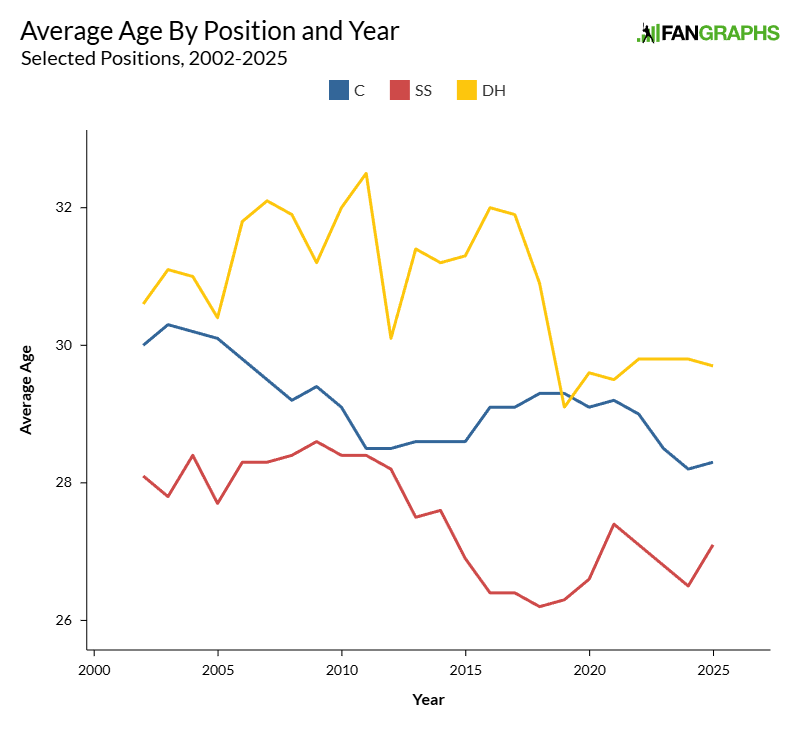
The data is pretty noisy, which makes sense to me. It’s not like teams are targeting a given age; they’re just making baseball decisions about cost, team control, and production. Average age is a downstream result of a lot of decisions that are made for other reasons. But in the aggregate, the pattern I hoped to see just wasn’t there:
| Period | C | SS | DH |
|---|---|---|---|
| 2002-2010 | 29.7 | 28.0 | 31.4 |
| 2011-2020 | 28.9 | 27.1 | 31.0 |
| 2021-2025 | 28.7 | 26.7 | 29.7 |
| 2002-10 vs. 2021-25 | -1.1 | -1.3 | -1.6 |
In fact, DH has experienced the greatest decline in average age across all positions. That’s very much not what I expected. I do think that some of that is overstated. First base has had the smallest decline among positions, and I’d expect many of the displaced older hitters I mentioned in my hypothesis to end up there too. But if you average the age changes of first base and DH, they’re almost exactly the league average for position players. Clearly, the data do not support my claim.
But wait! That’s just position players. My initial theory was about DHs, but there’s another group of older players I always think of when I broadly categorize the league into age cohorts: pitchers. I’ve been writing about the new team-building strategy of drafting hitters and signing older pitchers in free agency for my entire FanGraphs career. If it’s not the Cubs and the Astros, it’s the O’s and the Jays, or the Yankees and the Cardinals, or any number of teams you can think of that fit this model. Last year, only six teams (the Guardians, Dodgers, Phillies, Pirates, Padres, and Mariners) had a pitching group younger than their position player counterparts.
Here’s a different way of looking at the evolution of player age over time:
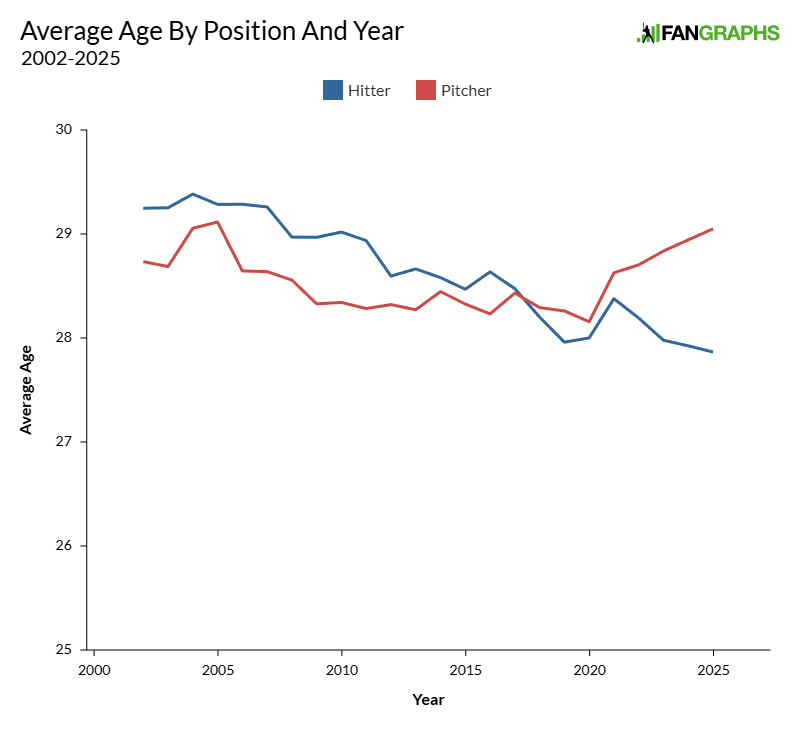
Oh. Yeah. That looks pretty significant.
As I mentioned, this isn’t some great secret. Jeff Lamb wrote about it all the way back in 2016 in the context of the cursebreaking Cubs. But at that point, the average pitcher was still younger than the average hitter, and they had been for decades. Since then, hitter age has continued to decline. Teams are doling out a record low share of plate appearances to batters 35 and older. Recent looks at aging curves have shown hitters declining earlier and pitchers later. It matches the conventional wisdom, as well: Hitters age, while pitchers break.
Many effects have fed this divergence, but I think that the strongest one is the evolution of teams’ opinions about pitcher workloads. Innings caps, workload management, ramp-up plans: Teams are guarding their young pitchers’ health more than ever before, cognizant of the risk of injury that comes with overwork. Meanwhile, pitcher aging isn’t as severe as hitter aging, and the pitchers who are most trusted to deliver big workloads are the ones who are already doing it. That leads to more teams trying to find their pitchers from the group of currently performing veterans. It really is the golden age of the older starting pitcher. Pitchers debut just as early as their hitting counterparts, but modern workload management means teams lean on the olds anyway.
Another way of looking at it: Twenty-seven pitchers in their 30s threw 150 or more innings in 2025. That’s pretty close to the number of 30-year-olds who threw 150 or more innings in 2010 (30). The average from 2000 to 2015 was around 33 30-year-olds hitting 150 innings. That proportion of the game hasn’t changed much at all. On the other hand, 2025 saw 43 pitchers in their 20s hit that 150-inning threshold. Back in 2010, there were 73 20-somethings who hit that mark. The average from 2000 to 2015 was roughly 62. In other words, we’ve seen a bigger decline in workloads for younger starters than older ones.
When team perceptions around health limit the workloads of young pitchers disproportionately, you see the divergence in that chart. It’s not something anyone set out to do on purpose, at least in my opinion. It’s just a natural consequence of the way teams operate these days. The decline in hitter age is that, too: Good young hitters with gobs of team control keep knocking on the door earlier and earlier, and what are teams going to do, not play them? The injury risk looks completely different there; older position players are more at risk, not younger ones, as best as I can tell from the data. And thus, hitter age keeps going down.
Those are hardly the only reasons that this behavior could be occurring. If you can think of a way that the game has changed in the last 25 years, there’s a decent chance that it might, indirectly, change relative pitcher and hitter age. Maybe the universal DH is getting more young fielders playing time. Maybe the latest CBA has changed teams’ relative propensity to start service time clocks on their young hitters who might compete for awards. Maybe, as Eric Longenhagen detailed in 2022, the Rule 5 draft pushes some international pitching prospects to relief roles, getting them to the majors faster but for smaller chunks of playing time. It’s a complex problem, and undoubtedly one with many correct answers.
It’s not entirely accurate to say that Major League Baseball is a young man’s game these days. It’s true to some extent, no doubt. But it’s mostly the case for hitters. Pitchers are headed in the opposite direction. It’s a paradox Matthew McConaughey would appreciate.
Ben is a writer at FanGraphs. He can be found on Bluesky @benclemens.
I’ve pointed this out here a couple of times, but this is very much in line with the Yankees model in the “Judge era”. Based on RosterResource’s current estimated lineup, adjusting for injury, the Yankees have 6 of 9 lineup slots occupied by a 20-something, with only Grisham technically being outside of the initial “control window”. But the rotation is basically a bunch of FA acquisitions well in their 30s (Cole, Rodon, Fried) with only Schlitter really guaranteed a season-long rotation slot from the 20-somethings that they’ve developed.
It really does come down to how the FA market economics have developed — league average pitching is expensive, but the curve bends at the very top end — superstar level starting pitching is cheaper to acquire than superstar level hitting (the Yamamoto/Cole contracts are smaller than even Judge’s, let alone Soto).
90s Yankees were often built like this too
This was also the old Theo Epstein playbook: draft and develop hitters, acquire veteran pitchers.
Interesting group of teams going the opposite direction from this trend (Guardians, Dodgers, Phillies, Pirates, Padres, and Mariners).
I was just thinking this, though when the SuperDodgers were first being constructed, the hitters were younger, and an aging Kershaw was supported by a continuing cast of young phenom pitchers whose arms blew out (Buehler, Miller, May, Gonsolin, and hopefully not Ryan), with the occasional Lance Lynn sighting.
Iirc, he also said during the Cubs 2016-ish era that this plan didn’t come together how he’d expected. Quality veteran pitching became significantly more expensive (in FA $ or trade value) than it had been a few years earlier.
Maybe the increased fastball velocity across the league increasingly disadvantages older hitters? Even a minimal decline in reaction time/bat speed could have some effect with 97-100 mph pitches.
This was one of my initial knee-jerk thoughts as well. Pitchers, by and large, have a ‘mass = gas’ formula they can follow while also optimizing their delivery through a myriad of driveline-style shops to add a tick or two. Add in most teams carrying an extra reliever now than 10 years ago with shorter start lengths and pitchers have more chances to sell out for power during short appearances.
Yes, when I discovered this last year (33 was pretty much The Cliff for position players with some rare Freddie Freeman type outliers) this was my strongest theory as to why
Non-steroid aging curves become even more severe with the demand to hit high velocity and the other pitching advances. Also, with pitching currently out ahead of hitting in maximization, there is a higher demand for all-around athletes who can contribute in other ways, which furthers the bias against the aging
Pitching, on the other hand, has a survivorship effect. Once you figure out how to pitch at a high level in MLB without blowing out your arm (or once you do and have it reconstructed), you’re good to go until your late 30s
Good stuff. Two thoughts:
*This kinda dovetails into a belief of mine that older but still above average starters are the best free agent values in the SP bucket. I think of their older age as being a feature (limits them to shorter deals and have a better chance of avoiding a huge albatross contracts) rather than a bug. Think recent 2-3 year deals for Sonny Gray, Seth Lugo, and Eovaldi. Does anyone really want to have to commit to year 5-6-7 for Nola/Burnes/Cease types? Is it worth the projected gain in years 1 & 2? I don’t like the cost/benefit here.
*I think it’s natural to think universal DH would lead to older players, but few teams seem willing to commit to one DH unless they are truly elite. So then it just becomes a reflection of the rest of your hitting roster which Ben showed is getting younger. So makes sense thru that lens.
For the second part about the DH: The number of DH slots doubled in that time frame and there just aren’t enough players worth committing to as a primary DH.
You could sign Luis Arraez or Josh Bell or Paul Goldschmidt to DH. Or you could try and fill that spot with either someone who costs half as much from your own organization or someone who can actually play a position well.
The guys who I would consider likely to be 90% or greater playing time DHs, currently:
Rooker
Y. Diaz
Y. Alvarez
Stanton
Pederson
Schwarber
Yelich
I. Herrera
Ohtani (even when he’s pitching!)
There are a couple of timeshare teams, where I expect it’ll be one of two guys frequently (BAL, CHW, LAA, KC [I don’t expect India to last long, so Salvy/Jensen], maybe BOS?, maybe CHC?)
Science! You had a theory, you tested, and came to a different conclusion and accepted data! Love it, this is what everyone should do.
Data don’t support your hypothesis? Be a lot cooler if they diiiiid
Meg Rowley, man, she’s a hip, a hip, hip, lady, man…
Pffft. This is 2025 — who cares about “truth”? That’s so 20th century …
This is 2026! But your point stands.
Lol. I guess it will take me a week or two to get used to it.
I guess I made my own point!
“Does anybody really know what time it is?”
I wonder how much of the pitcher increasing age is from high school pitchers no longer being drafted in the first round as often. In 2002 there were 8 high school pitchers taken in the first round, but only 2 last year.
I think it’s more about the different physical demands. Hitting’s all about quick-twitch muscles and reflexes (where declines of hundredths or even thousandths of seconds can make a huge difference), while pitching’s more about stability and repeatability, which is less prone to age-related decline. Stuff/velocity declines with age, but some guys are able to stave that off, and those guys don’t experience the same kind of age-related declines that hitters do. Verlander was throwing as hard or harder at 39 (avg FB & slider velo of 95 & 87.4) as he was at 28 (94.8 & 85.7). I’m sure his reflexes declined a bit over that time but that doesn’t really matter.
Another factor: while FB velocity tends to decline over time, FB usage is also declining around the league. Eovaldi just had maybe his most effective year ever on a per-inning basis with a FB that’s more than 3 ticks down from his peak, but he’s also throwing it less than half as often as he used to and using his slider (which hasn’t declined nearly as much) nearly 3X more often than he did in his 20s. That’s happening around the league. I don’t have more recent data but Andrews wrote a piece here showing that FB% leaguewide declined steadily between 2008 (about 60%) to 2023 (47.6%) while slider usage spiked during that time (~14% to ~22%).
As for your point about HS pitching vs college pitching…there’s still the same number of pitchers, and I’m not sure why the specific draft mix would influence the longevity of the guys who make it. I guess it leads to fewer super-young debuts, but those were always pretty rare. Based on a quick look (note: this is AI assisted so may not be accurate/complete) only 7 pitchers debuted at younger than 21 years old from 2005 to 2015 (Felix, Kershaw, Porcello, Teheran, Bumgarner, Bundy, J. Fernandez) vs 5 from 2016-2025 (Urias, Fuentes, Smith-Shawver, E. Perez, E. Luciano (reliever)). That’s not going to have a huge effect on leaguewide average.
For that to have a real effect I think there’d need to be some reason to believe pitching in college somehow benefits pitchers’ long-term health, but I’m not sure why that would be the case. College programs pretty notoriously abuse their best arms. As one recent example that’s fresh in my mind, Kade Anderson threw multiple 130+ pitch games last year during LSU’s title run. A minor-league manager would get fired for that.
Going by the leaderboards here, there’s 20 pitchers who threw at least one major league inning in their age 20 season or below from 2005 to 2015 and 14 from 2016 to 2025. That’s not quite the same as the question you asked, because it misses a few players who debuted in their age-21 season but before their 21st birthday (Phil Hughes, for instance) and includes a few late-season debut guys who had their 21st birthday late in what’s officially their age-20 season and then debuted after that (Taijuan Walker, for instance). Not a terribly accurate AI there, to miss so many examples.
Yeah, this is why I never rely on AI for anything serious.
Point still stands. That difference by itself isn’t going to move league wide averages a lot.
It has to be the increase in leaguewide velocity, right? Elite hand-eye coordination, barrel control, and strike zone judgment can only take you so far against 96+ heaters and 88+ sliders if you lose even a tiny bit of quick-twitch response time.
For a long time I thought it was just the end of the steroid era sapping durability. I still think there’s something to that in terms of the decline from ~2005-2015, but that doesn’t really explain the further decline from ~2015-2025.
How do we know the performance-enhancement era is over?
certainly a lot harder to pull off the league-epidemic levels of PED usage of the mid-2000s now that they actually test for it and have proven willing to ban even their biggest, youngest stars over it (e.g. tatis)
They test for some things. If there is one lesson I’ve learned from professional sports, it’s that the users (at least the smart ones) are always at least one step ahead of the testers.
I guess we never really know anything we don’t perceive directly (and maybe not even then…memory’s unreliable and the senses can be tricked) but it’s pretty hard to keep something like “everybody in baseball is on roids” under wraps. During what we call the steroid era it was the worst-kept secret imaginable. Players were whistleblowing, trainers were whistleblowing, suppliers were whistleblowing, fans made offhand steroid jokes about literally any player who improved from one year to the next, and the league didn’t test or really care, until it did.
Now there’s testing and a comprehensive discipline scheme, and it’s only catching a handful of guys a year. For PED use to be anywhere near as rampant now as it was then two things would need to be true: (1) there’d need to be new drugs that are impossible to detect (at least by the testing protocol MLB uses) and (2) the hundreds-to-thousands of people who would need to be in on it are better than pretty much any criminal enterprise in history at keeping secrets.
Seems unlikely.
To some extent pitch velocity is a measurement issue. Speed used to be measured halfway to the plate, but now is measured on release. I am not aware of any systematic comparison of these two measures.
Most people have their shortest reaction time when they are 17. The problem is that relatively few have gotten good hitting instruction or fielding instruction.
And it’s uncommon for 17 year olds to have enough strength to consistently impact the ball at MLB levels.
That change happened in 2017 and velocities have still been climbing since then. In 2017 league-average FB velocity was 93.2, a huge jump (relatively speaking) from 2016’s 92.6. In 2025 it was 94.4. It’s increased year-over-year every year during that span except 2 times when it declined by 0.1mph, and one of those was 2020.
This page is always hard for me to find so I thought I’d link it here. https://www.fangraphs.com/leaders-legacy.aspx?pos=all&stats=pit&lg=all&qual=0&type=10&season=2025&month=0&season1=2005&ind=0&team=0,ss&rost=0&age=0&filter=&players=0&startdate=&enddate=
I think part of it is that you just need so many pitchers that teams are forced to employ older ones. No GM ever said “I don’t know where we are going to find enough outfielders to cover 4500 innings” but none of them expects to get a third of that out of just the pitchers that make the opening day roster.
Basically, half the 26 man roster is dedicated to one position. That’s going to create some different demographics.
This is the answer. It’s 100% about attrition.
There’s a general trend towards younger players in MLB. Teams have realized that younger players often do just as good a job as older players and cost less. No need to spend money on a free agent when you have a guy in AAA who would do about the same level.
But they simply cannot do that with pitching because there’s not enough competent healthy pitching to go around.
Pitchers have been blowing out their arms at such a high rate lately. You want to get younger at pitcher because they’re cheaper? Too bad. You might have competent replacements waiting in the wings at AAA, but since they and all the other pitchers on your staff are at such a high risk of blowing out your arms you need those competent replacements waiting in AAA.
How does that explain how the universe of competent healthy pitching is older/experiencing less age decline on average than the universe of competent healthy hitting though? A couple good hitters have been aged out (Brandon Belt’s still a head-scratcher – nobody hired him after a 137 wRC+ season) but most hitters still get to play until they’re bad, they’re just getting bad younger.
Because the younger ones keep getting hurt!
And the older ones too, but you have to hire different older ones because the remaining younger ones can’t do the job.
Are there a lot of taxi squad guys in their mid-30s? Definitely not on my team but I’ll admit I don’t pay much attention to who other teams use as their 9th-15th relievers.
It seems to me that if this were true there would be a ton of borderline useless pitchers in their mid-30s on rosters – guys who you could point to and say “there’s no way a hitter that bad would still have a job” – which I don’t really see much evidence of. Teams generally don’t keep bad players around well into their 30s on purpose.
I guess one way this works is that relievers can hang around the minors longer because the possibility of a late-20s debut for a AAA pitcher’s a lot higher.
It’d take some more research to give anything concrete, but I think pitchers are also staying effective into their 30s at a higher rate than hitters.
Teams still want to roster their best pitchers though, so I’m not sure that’s a satisfying explanation for why pitchers in their 30s are staving off younger competition and hitters aren’t.
Selection bias in the pitchers in their 30s
Totally explained by Verlander (born 1898), Kershaw (born 1911), Scherzer (born 1909), and Sale (born 1916) bringing up the average age of pitchers.
To balance things out on the hitters’ side we need to see some more of Kevin Mitchell, Tim Salmon, Chris Sabo, and Mike Greenwell. Then we would have both pitchers and hitters who could tell us fond tales of the Coolidge administration.
I believe you omitted Andres Galarraga!
I should also add that pitcher attrition is the reason both why pitchers are more valuable even though position players put up more value on average.
People look at the fact that position player prospects are more likely to pan out and think that teams should focus on them at the expense of pitching prospects (the Orioles model). But that assumes that prospects are valuable because of the actual performance. It’s about the actual performance relative to the other options.
Shane Baz ran a 118 ERA- and a 103 FIP- last year and he just got traded for three real prospects and Comp A pick. You think he’s below average relative to the league. And he was, at least in the past, but teams are out there one injury away from having to send Chad Kuhl or Jordan Lyles or Jake Irvin out for multiple innings, and two away from finding out where Justus Sheffield or Spencer Howard are playing now.
On the position player side, your guy is likely to play more and put up more value than the pitcher. But also, you have 12 position players out there who put up more than a win last year who are unsigned in addition to the half dozen guys in AAA who deserve a shot. There’s just not a huge chance of having to find a guy who played his way out of the league like Hunter Dozier or Isan Diaz and play him regularly.
Yet again, I beg you to stop commenting about the Orioles because every single time you do, you say something false. The Orioles model is absolutely not to ignore pitching prospects. I have pointed out to you repeatedly that Baseball America rated Baltimore as a top three organization in “stuff.” Eric’s board currently has six Orioles pitching prospects with a 45 or higher.
If they have been investing resources in getting pitching prospects it’s not working out for them! The pitching has been lousy!
But I think it’s something else. I think it’s related to the…I think only one pitcher? That they took in the top four rounds in total between 2019 and 2022. And that was Nolan McLean, who didn’t sign and was listed as a third baseman.
Here’s the breakdown of the Top 4 rounds:
2019: Five picks. No pitchers.
2020: Four picks. No pitchers.
2021: Five picks. No pitchers.
2022: Six picks. One pitcher, who was announced as a third baseman and who didn’t sign.
There is no way to explain this except to say that they are more focused on using their biggest pools in amateur acquisition on position players than pitchers.
Things got a little better from 2023 to 2025. They had an even mix in 2023, and they selected another pitcher in 2024 in round 4, and two of their whopping eight picks in 2025 were pitchers. That gives them an average of…let’s see, 3/6, 1/5, 2/8…that’s 6 out of 19. That’s still pretty low.
How many teams have spent so few of their high draft picks on pitchers? You might be able to find a couple teams that invested fewer draft picks on pitchers in the top 3 or 4 rounds over a 6+ year stretch, but not many and most of them probably regretted it.
The funny thing about this “argument”, if you can call it that, is that what they did is not inherently bad. A few years ago I went back to take a look and pitching and hitting and where guys were selected, and it turns out you can totally get away with a version of this. You don’t really get that many top hitters after the top 2 rounds, and you get mid-round pitchers turning into quality MLB pitchers all the time.
You could totally get away with just taking position players in the top 2 rounds every year and then switching to pitchers. And the Orioles did great in the top 2 rounds by taking position players exclusively during that 2019-2022 window. They hit on their first three with Adley, Gunnar, and Stowers; hit on one of their next three with Westburg; hit on one of their next three with Cowser; and hit on either one or two of their next four, depending on what you think of Holliday (Beavers was the other hit). 6 out of 13 is a huge hit rate. I don’t think anyone can argue with that.
It’s just that of those six pitchers with a 45 or higher, the highest bonus they gave any of them is $150K. That’s insane! That’s less than 10th round slot. I don’t think they are trying to play this game on hard mode to impress someone, but it would be a more reasonable explanation than “we can turn literally anyone into a major league pitcher” or whatever reasoning they’re using here.
The pitching was lousy in 2025 due to a deluge of injuries. Baltimore was 8th in pitching fWAR for 2024 and 4th for pitching fWAR in 2023, so no, it hasn’t been lousy for very long. It’s genuinely wild that pretty much everything you say about the Orioles is completely false. If you are doing this just to troll me, I would clap and congratulate you on a job well done, but I don’t think you’re doing it on purpose. For whatever reason, you genuinely seem to know nothing whatsoever about Baltimore.
Elias does prefer to use high draft picks on hitters, but that is completely different from saying that the organization ignores pitching prospects. What Elias has done is actually really interesting because he’s clearly targeting certain fastball shapes and breaking ball spin rates. He’s been collecting those pitchers in the later rounds, in trades, and through international signings. He’s not saying that “we can turn literally anyone into a major league pitcher,” he’s betting that certain types of pitchers are undervalued and have a higher chance of becoming major leaguers.
I don’t wanna get in the way of the old married couple dialogue that has made its way into at least 3 or 4 threads at this point but I think “Focus on (hitting prospects) at the expense of (pitching prospects)” is not the same thing as “ignoring pitching prospects”. When you go 4 years in a row drafting one pitching prospect and 19 hitting prospects in the first four rounds it seems like the former is a pretty accurate way to frame it lol. Weird hill to make your stand on
You’re missing important context. One of the reasons sadtrombone and I argue so frequently is that he has repeatedly claimed that Elias ignores pitching prospects and just thinks he’ll trade hitting prospects for major league pitchers. I have told him over and over again that this is not the case, which is why I mentioned previously telling him about Baseball America’s ranking of the Orioles’ pitching prospects.
This has come up before and I keep correcting him, but he still makes the same discredited argument for some unknown reason.
I should know better by now. When jdbolick thinks I have wronged the Orioles (or am wrong about the Orioles) nothing I say makes a difference. It is actually totally fine and I have probably done it too at some point, so I can’t even say I blame ’em.
This is also the reason I don’t use my real name online, it’s so I can just write comments without worrying that someone is going to tell my employer I’m wrong about the Orioles. Not that I think anyone would do that, and I guess even if they did it would mostly be funny. If they really wanted to hurt me they’d send over comments I made about how Aaron Judge was never going to make enough contact to stick in the majors back in 2015 or 2016.
I’ve never accused you of having a bias against the Orioles or against me. My issue is that you keep making statements that are factually wrong, but never correct yourself no matter how many times I provide facts and sources proving you wrong. You just keep repeating the same discredited arguments over and over again as if you had never been proven wrong.
How is the argument factually wrong when a team drafts 6 pitchers versus 13 hitters in the first two rounds over a decent period of time?
Baseball America ranked the Orioles in the top three organizations for best minor league “stuff.” Elias has repeatedly targeted minor league pitchers in trades while also bringing in pitchers through international signings. That[‘s why Baltimore has so many 45+ pitching prospects on The Board.
Exactly this. Someone clearly pissed in jdbolick’s cereal bowl, but I’m not convinced it was sadtrombone. Sad is making a logical argument.
How was his argument logical?
I don’t think you are disagreeing with me anymore. Sure, you might take issue with my wording. But your take on it is now basically the same as mine: They think don’t need to invest in pitching prospects in the higher tiers because they can get them later for less.
And that’s fine, and efficient, etc except for the fact that you need something like 500 pitchers (exaggeration, hyperbole even) to get through the season. Deluges of injuries are normal, especially when the pitchers themselves are coming off injuries. Which was my main point up above–pitchers are way more valuable than they look because you’re at risk of running out.
You literally just said: “If they have been investing resources in getting pitching prospects it’s not working out for them! The pitching has been lousy!“
Not only was that completely wrong at the major league level outside of 2025, it was also wrong at the minor league level given what I told you about BA’s opinion of the Orioles’ system and how Eric has ranked them.
You just don’t know what you’re talking about at all when it comes to the Orioles. Nearly everything you say about the organization is wrong.
No, that isn’t what I am saying. In 2020, Elias wanted to take Nick Bitsko with the pick they would instead use on Westburg. Thankfully, the Rays took him before that could happen, as his injuries have already forced him out of baseball.
Elias isn’t philosophically opposed to taking pitchers early, he just prefers hitters because they safer. They have still invested very heavily in pitching and have made a major focus on developing arms, despite you repeatedly claiming that he ignores them and just plans to trade hitting prospects for major league arms.
Are you Mrs. Elias? Where has Baltimore “invested heavily” in pitching?
I’m not even a Baltimore fan, yet I’ve watched Baltimore run through free agent 1Bs and OFs over the past 3-4 years like they are going out of style while blocking their own young bats that they drafted.
For pitching, since 2023 I see that Baltimore has signed Craig Kimbrel (past his prime), Charlie Morton (past his prime), and Zach Eflin (injuried, serious questions about future performance). All on one, maybe two year deals. They traded for Baz (also serious questions) and Corbin Burnes (good and was in his prime, but then they let him go in free agency).
For drafting, I see two pitchers drafted by Baltimore in the first two rounds since 2021. I also see that the total number of hitters drafted by Baltimore heavily outweighs the total number of pitchers drafted. So quantity and quality, both in favor of hitters.
So explain to us again how Baltimore has “invested heavily” in pitching, because I’m not seeing heavy investments in either free agent signings or on draft day. Are they spending tens of millions of dollars behind the scenes on their minor league pitching staffs?
Elias has made numerous trades targeting minor league pitching prospects, and has focused on pitchers with international signings. They have an impressive program on developing those pitchers, which is why prospect analysts rank the system so highly.
Are you trying to give sadtrombone a run for his money on who can make the most incorrect comments about the Orioles? We just had a FanGraphs article noting that Baltimore has the second most homegrown position-player starters behind Minnesota.
Hey, look who’s wrong again about the Orioles. Elias didn’t “let (Burnes) go in free agency.” Elias offered him the highest AAV for any non-Ohtani pitcher in the history of baseball. Burnes took less to sign with the Diamondbacks because his family already lived in Scottsdale.
“They have an impressive program on developing those pitchers, which is why prospect analysts rank the system so highly.”
Which pitchers?
My reaction everytime I see an article by Ben: Alright, alright, alright.
Been saying similar since even before the pandemic put some weight on the accelerator or w/e: the MLB is the NFL but baseball now. G’luck getting beyond a rookie deal, hell g’luck reaching arb, to Future *starters* (edit: among hitters) let alone players…Hell, g’luck becoming a starter in a more specialized MLs….’Mericans stay getting clowned by master daddy, creator of jobs, and calling it Good and Normal and Free and Brave and Advanced etc etc etc….I’d say can’t wait for the inevitable revolt but knowing ‘Mericans it’ll be guided by sycophancy, idolatry, Disney/gnatsy think
You know what we don’t talk abt? How a team that plays it Right/Smert has 12 years of control over a player* *Pls note I’m checked out and *may* be slightly off prbly not
The MLB Players Union doesn’t want a salary cap. How does that fit into your world view?
Oh they’re so mean my sensibilities I’m clutching a handbag and some pearls as I type
Our owners/Masters/The Creators of Life/Jobs don’t want a profit cap. How does that fit into your worldview?
Everyone is allowed to be wrong. The MLBPA exemplifies this frequently.
whimsical
“Looks like you picked the wrong week to quit sniffing glue…”
“Cocaine’s a hell of a drug….”
I’d assume it’s the improved defensive models, with teams being able to quantify defensive (or lack of) value much more accurately. A generation ago, the aging corner OF types (such as Ryan Braun, slightly above league average hitters their last few seasons) probably play a few seasons. Now, Yelich becomes the primary DH and younger OFs that are capable of playing CF are playing RF/LF. It’s not just moving away from the aging slugger, but allowing a mid-career slugger with declining defensive value to move down the defensive spectrum.
Does the increased success of pitcher surgeries play a role as well? TJS, TOS, and InternalBrace have had much better results for getting pitchers back on the mound than a decade ago. When pitchers “break”, they can now reliably be “fixed” and thus extend their shelf life.
Could be a factor, but I also think there’s a selection issue. Most HS pitchers emphasize fastballs. Few HS hitters can square them up. Older pro pitchers have a couple of other pitches, to keep hitters off balan
That’s “balance.”
For example, Seth Lugo’s FB is unimpressive, but you can’t sit on it. He throws at least four other pitches that vary in speed and break.
Additionally, the guys who are getting hurt are “saving” 12-18 months of pitching younger that might be letting them linger a bit longer when they’re older.
Ah, a reminder to rewatch Dazed and Confused. Will do!
LMAO
This is most certainly a thing, but I feel there are some further avenues worth persuing here. You said this was an average of seasonal ages as of July 1. So this is just players on rosters without regard to how many innings they actually throw?
I would be curious what the aging trends look like if you weigh the average pitcher age by innings thrown. Or if there’s a difference between starters and relievers. Or even how it changes longitudinally for individual players. You’ve got a paragraph mentioning the decline in pitchers in their 20s who thrown 150+ innings, but is it that teams are more gradually ramping up pitcher innings so those young guys get to 150 eventually? Or is there just a cohort of older workhorses that’s going to all of a sudden age out of baseball?
Perhaps this is worded wrong, but it’s the weighted average of seasonal age, weighted by playing time.
In the Steroid Era, there were all these miraculous 40-somethings who had found some magical Fountain of Youth (i.e., massive PED use). That seems much rarer now. If it is, that would affect the average.
A quick Google search of the average age of pitchers who get TJ Surgery is 27.5. Add to that the explosion of the number of TJ surgeries and I think these two things in combination could possibly be making up a significant portion in the reduction of pitchers in their 20’s reaching 150 IP
AWESOME article!! The best part as a retired stats prof is that: I love that you found your hypothesis wrong and pivoted. It is a tragedy that joirnals won’t accept negative findings, however how could any journal look askance at an article that first accepts the null hypothesis, and then pivots into a different theoretical meandering. Bravo for admitting all of your findings!!!