
JAWS and the 2026 Hall of Fame Ballot: Cole Hamels
The following article is part of Jay Jaffe’s ongoing look at the candidates on the BBWAA 2026 Hall of Fame ballot. For a detailed introduction to this year’s ballot, and other candidates in the series, use the tool above; an introduction to JAWS can be found here. For a tentative schedule and a chance to fill out a Hall of Fame ballot for our crowdsourcing project, see here. All WAR figures refer to the Baseball Reference version unless otherwise indicated.
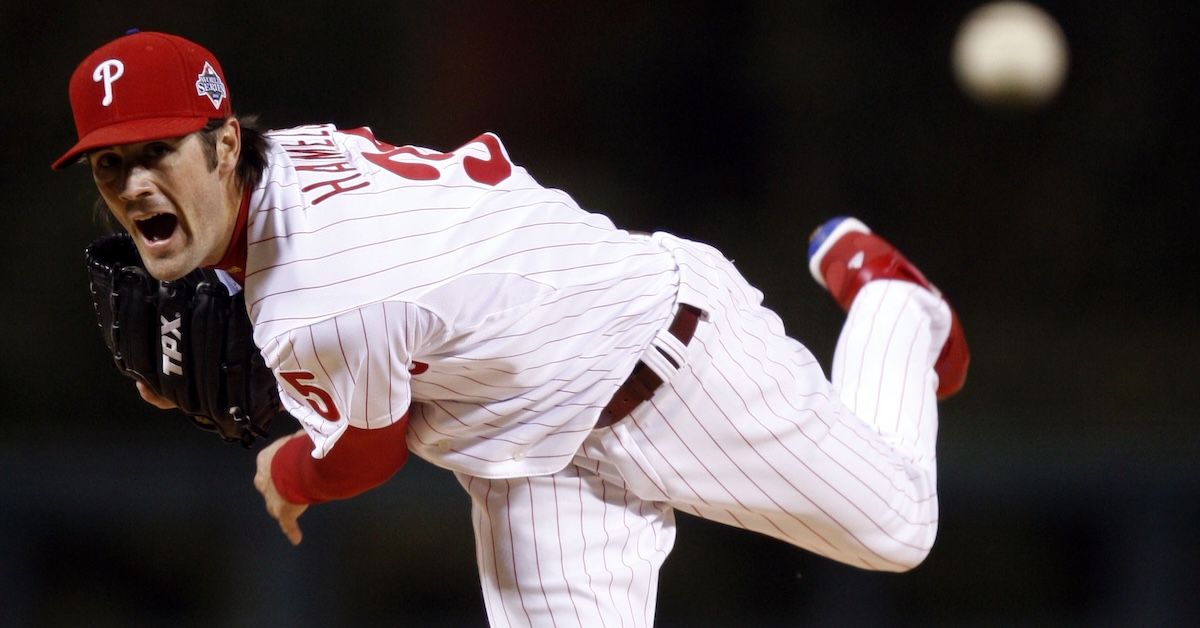
Before he turned 25 years old, Cole Hamels had already reached the pinnacle of the baseball world. At the tail end of his third major league season, the lanky lefty — listed at 6-foot-4, 205 pounds — had gone 4-0 with a 1.80 ERA during the 2008 postseason, leading the Phillies to their first championship since 1980 and winning NLCS and World Series Most Valuable Player honors along the way. Suddenly, the aura he projected — a handsome laidback surfer from San Diego — needed an upgrade. He became a celebrity, expected to dress the part and live up to outsized expectations, both of which he did with some amount of awkwardness but a fair level of success.
Hamels spent the first 9 1/2 seasons of his major league career with the Phillies, part of the nucleus that helped them climb out of the doldrums to become a powerhouse that won five straight division titles. Armed with a fastball that could reach the mid-90s, an above-average curve, and a killer changeup — inspired by watching Padres closer Trevor Hoffman in his heyday — Hamels was a master of deception thanks to his consistency in throwing those three pitches from the same release point. “It’s devastating for a hitter when all of them look like a fastball, and two of them aren’t,” pitching guru Tom House, who worked with Hamels when he was a junior in high school, told Sports Illustrated’s Ben Reiter in 2009.
Hamels’ career wasn’t without hiccups. He missed significant time due to injuries while in the minors, including both the usual arm troubles and a fracture in his pitching hand, sustained during a barroom brawl while standing up for a close friend. Although he helped the Phillies get a shot at repeating their title in 2009, his postseason was a disaster; during the World Series against the Yankees, he nearly came to blows with teammate Brett Myers. At times he was overshadowed by other members of his rotation, Cy Young winners for whom the Phillies traded in case Hamels wasn’t enough, namely Cliff Lee and Roy Halladay. For as well as he pitched, Hamels himself never came close to winning a Cy Young, and he made just four All-Star teams.
Hamels deserved more recognition than that, as he proved to be especially durable and effective. From 2008 through ’15, the season during which he was traded to the Rangers in late July (two days after throwing a no-hitter!), he annually made at least 30 starts and, with one exception, totaled at least 200 innings. Aided by the addition of a cut fastball, over that span he ranked among the game’s top five in innings, strikeouts, and WAR. The Phillies eventually signed him to a $144 million extension — at the time the second-largest contract for a pitcher — and he provided good value for the money even after moving on from Philadelphia, first to Texas and then to Cubs. Once his contract expired, shoulder trouble limited him to just one more major league start, with the Braves during the COVID-shortened 2020 season; a pair of comeback attempts, the last of them with the Padres in 2023, proved unsuccessful.
Like Félix Hernández, who debuted on the BBWAA ballot last year, Hamels has career numbers that don’t immediately scan as Hall-worthy. Yet, as by far the strongest first-year candidate on a pretty lean ballot, he’s worthy of a closer look, particularly in light of the way that reduced pitcher workloads and shorter careers are forcing voters to recalibrate their standards regarding what makes a Hall of Fame starter.
| Pitcher | Career WAR | Peak WAR Adj. | S-JAWS |
|---|---|---|---|
| Cole Hamels | 59.0 | 37.4 | 48.2 |
| Avg. HOF SP | 72.9 | 40.7 | 56.8 |
| W-L | SO | ERA | ERA+ |
| 163-122 | 2,560 | 3.43 | 123 |
Colbert Michael Hamels was born on December 27, 1983 in San Diego, the oldest of three children of Gary and Amanda. Both parents worked in education, Gary as a school district assistant superintendent and Amanda a teacher. Growing up in San Diego, Cole surfed and played beach volleyball in addition to soccer and baseball. “Cole and I were probably the most killer two-on-two beach volleyball combo ever to hit Del Mar,” Red Sox minor leaguer Scott Lonergan — one of Hamels’ closest friends growing up — told Reiter. “We’d fuel up with burritos from Roberto’s Taco Shop, and then we’d go out and just dominate.”
Undersized as a youth, Hamels didn’t play much Little League, and he was just 5-foot-9 and 110 pounds when he tried out for the Rancho Bernardo High School team as a sophomore. Even so, he took to pitching, idolizing and attempting to emulate the mechanics of Braves southpaw Tom Glavine, whose starts on superstation TBS became regular viewing.
Watching the Padres, who won the NL pennant in 1998 when he was a freshman in high school, Hamels noticed Hoffman flummoxing hitters with his signature changeup. When he saw Rancho Bernardo’s star pitcher Matt Wheatland, a future first-round pick by the Tigers, having success with one as well, Hamels had pitching coach Mark Furtak teach him the pitch. It baffled opposing batters. “We had a ton of scouts at all of our games, big tournament games, all these potential first-round picks — and I was able to make guys swing and miss by a mile,” Hamels told Tyler Kepner for K: A History of Baseball in Ten Pitches. “So I’m like, ‘OK, I’m gonna do it again, and they would miss by a mile again. They’re not making the adjustment. I was bouncing them and guys were swinging. I’m like, ‘Well I guess this pitch is really deceptive.’” The pitch would one day become his signature, annually producing whiff rates well above 40%.
One day while throwing a changeup during his sophomore season, the 16-year-old Hamels unleashed a scream. He had fractured his humerus, the upper bone in his arm. “I will never forget the pop sound his arm made,” Furtak told the Philadelphia Inquirer’s Sam Donnellon in 2012. “Like a branch breaking off a tree.”
Hamels had initially injured his arm playing street football, running into a parked car while going out for a pass; pitching exacerbated the injury. Dr. Jan Fronek, the Padres team physician, inserted two rods into the bone, but both he and Furtak believed Hamels had thrown his last pitch. From Donnellon:
“When a doctor says, ‘You need to pick up another sport…’” said Hamels. “I mean, this was everything I ever wanted to do. And I know I’m good at it. And now I can’t? I was like, ‘Doc, give me a shot.’ He never even gave me a shot. Like, ‘You have a percentage of this to get back.’ There was nothing, no hope.
“Now he’s like, ‘Man!’ I see him all the time. And he’s very happy for me. And he’s had a few guys since then who have been in the same situation. And he points to me and tells them there is hope. But what I got was ‘zero percent.’”
The fracture cost Hamels his junior year of high school, but while recovering, he came under the tutelage of House, a former major league pitcher-turned-biomechanics expert, who helped iron out his delivery and improve his conditioning. By the time Hamels was a senior, he had grown to 6-foot-3, though he hadn’t added much weight. “They used to dress up a fungo [bat] in my uniform and put a hat on it and put it out there on the field,” Hamels told Donnellon. “I was little for a long time. And then I had that injury happen. And I had a lot of fire in me because of all of it.”
Hamels dominated as a senior, his fastball touching 94 mph, accompanied by an overhand curve and what Baseball America recognized as “a major league-caliber changeup.” The injury caused him to slip to 17th in the 2002 amateur draft, where the Phillies snapped him up. “If he hadn’t had that injury, there would have been no way that he gets to us at 17,” Darrell Conner, the Phillies scout responsible for signing Hamels, recalled to MiLB.com in 2009.
After signing for a $2 million bonus, Hamels began his career at A-level Lakewood, where he posted an 0.84 ERA and 13.1 strikeouts per nine in 74 2/3 innings before moving up. He rocketed to no. 17 on Baseball America’s Top 100 Prospects list the following spring, but made just four starts in 2004 due to elbow tendinitis and inflammation, and six in ’05 due to a fractured metacarpal in his pitching hand — sustained in a bar brawl involving four other minor leaguers — and back spasms. Two other Phillies prospects involved in the fight were released, and the team was understandably furious with Hamels, particularly given that he needed surgery. “I’ve never been yelled at like that in my life,” he told Reiter regarding the dressing-down he received from general manager Ed Wade.
Wrote Reiter of the brawl: “Those close to Hamels consider the fight an aberration (‘He’s a cruise ship, not a battleship,’ says Lonergan), an expression of fraternal loyalty more than anything else.” Between that and his other injuries, he dropped to no. 68 on Baseball America’s Top 100, though the publication lauded his command and mound presence while calling his changeup “a plus-plus pitch that may be the best in the minors.” In retrospect, those injuries may have spared him the overuse to which young pitchers were still subjected, and the fight may have helped instill a sense of accountability and an edge that would serve him well in Philadelphia. “To me, a Philly guy has to have a sense of toughness deep inside,” Hamels told Main Line Today in 2013. “You have to endure.”
Though he dealt with a bulging disc in his lower back during the spring of 2006, he rocketed up the organizational ladder, putting up a 1.10 ERA in 49 innings across three levels in April and May. The Phillies called him up, and on May 12, 2006, he no-hit the Reds for 4 2/3 innings before Felipe Lopez — who earlier in the game had become his first strikeout victim — doubled off him. After striking out Ken Griffey Jr., his night was done.
Though he made just one more start before landing on the disabled list due to a mild shoulder strain, Hamels notched his first major league win in his return, throwing 5 2/3 innings of one-run ball against the Diamondbacks in Arizona on June 6. He had his ups and downs from there; through his first 11 starts, his ERA ballooned to 5.98, but over his last 11, it was a much tidier 2.70. He finished with 4.08 ERA, which doesn’t look terribly impressive but was good for a 115 ERA+. Even more impressive was his 9.9 strikeouts per nine; among pitchers with at least 100 innings, only Francisco Liriano and Scott Kazmir had higher rates.
With an 85-77 record, the 2006 Phillies finished second in the NL East for the third straight season. The next year, they made it back to the playoffs for the first time since 1993, with shortstop Jimmy Rollins capturing MVP honors, first baseman Ryan Howard bashing 47 home runs, and second baseman Chase Utley turning in a better season than either of them in terms of WAR (7.8). Though he missed a month due to a mild elbow strain, the 23-year-old Hamels emerged as the staff’s top pitcher, going 15-5 with a 3.39 ERA (eighth in the NL) and 8.7 strikeouts per nine (third) in 183 1/3 innings, good for 4.1 WAR (10th); he made his first All-Star team, and after the season, he finished sixth in the NL Cy Young voting. The Phillies won 89 games, the last of which made the difference in the NL East standings; despite trailing the Mets by seven games with 17 left to play, Philadelphia surged to secure the first of its five straight division titles. Alas, the Phillies ran into the red-hot Rockies in the Division Series. Hamels started Game 1, and aside from a three-walk, three-run second inning, he pitched well across 6 2/3 innings of work, but the Phillies lost 4-2 and ended up being swept.
Hamels helped the Phillies take their game to the next level in 2008. The team went 92-70, once again overcoming the Mets in September to take the East. Hamels went 14-10 while ranking sixth in the NL in ERA (3.09, good for a 135 ERA+) and strikeouts (196) in 227 1/3 innings (second) for 4.3 WAR. He then went on an outstanding postseason run, lasting at least seven innings in each of his first four starts and striking out 30 in 35 innings. He threw eight scoreless innings of two-hit ball against the Brewers in the Division Series opener, striking out nine, and had two seven-inning starts against the Dodgers in Games 1 and 5 of the NLCS, allowing two runs in the former and one in the latter; that earned him MVP honors. In the World Series opener, he held the Rays to two runs over seven innings in a 3-2 Phillies win.
Back on the mound again for Game 5, Hamels carried a 2-1 lead into the sixth inning before the Rays scored the tying run as rain and swirling winds made the field increasingly unplayable. The umpires suspended the action after the top of the sixth, a World Series first; without the interruption, Hamels might have kept pitching given that he’d thrown just 75 pitches, though his middle finger had swelled up due to a bunting mishap earlier the game. When play resumed two days later, the Phillies finished off the Rays for their first championship since 1980, and Hamels was named MVP, becoming the fifth player ever to take both the Championship Series and World Series honors in the same season.
That winter, Hamels — a Super Two player eligible for arbitration for the first time — signed a three-year, $20.5 million extension, covering all but his walk year. Unfortunately, his 262 1/3 innings (including the postseason) from 2008 caught up to him. He shut down his offseason throwing program, showed up at camp throwing 81 mph, and was sidelined by biceps tendinitis during spring training, which cost him the honor of an Opening Day start. Though he pitched in the Phillies’ fourth game of the season, he was lit for a 7.27 ERA in four April starts totaling just 17 1/3 innings. He finished with a 4.32 ERA (97 ERA+), though his 3.72 FIP matched his 2008 mark; the big difference was a spike in his BABIP, from .262 to .321. He ended up throwing only 193 2/3 regular season innings, with his WAR sinking to 1.9. The Phillies, who on July 29 traded for Lee, the reigning AL Cy Young winner, nonetheless won 93 games and another division title.
Hamels was pounded for a 7.58 ERA and seven homers allowed in 19 innings across four postseason starts as the Phillies nonetheless beat the Rockies in the Division Series and the Dodgers (again) in the NLCS before losing to the Yankees in the World Series. He did have an excuse, as his wife Heidi Strobel (a former Survivor contestant) went into labor with the couple’s first child during his start against the Rockies.
Up against Andy Pettitte — another childhood hero — in Game 3 of the World Series, Hamels squandered a 3-0 lead, allowing two runs in the fourth and three in the fifth (including an RBI single by Pettitte himself) in an 8-5 loss that gave the Yankees a two-games-to-one lead. His postgame comments created controversy when he said, “I can’t wait for [the season] to end. It’s been mentally draining. At year’s end, you just can’t wait for a fresh start.” While manager Charlie Manuel was taken aback by the comments, he told reporters, “This is the first time that things have not gone his way, and he’s [struggling with it.] He’s never been through this before, and it’s something that he will get through and probably be even better.” Hamels soon clarified his comments, emphasizing that he wasn’t quitting on the team, contrary to tough-guy Myers’ clubhouse assertion. Nonetheless, the Phillies lost in six games, ending Hamels’ season on a sour note.
That winter, the Phillies traded Lee to the Mariners and dealt for Halladay, whom they immediately signed to a three-year, $60 million extension. Taking cues from the two former Cy Young winners, Hamels added a cutter to his repertoire, and set career bests with a 3.06 ERA and 211 strikeouts (both good for sixth in the league) and 5.5 WAR (eighth) in 208 2/3 innings. The Phillies won 97 games, their highest total since 1993, and another NL East flag. Slotted third in the postseason rotation behind Halladay, who no-hit the Reds in the Division Series opener, and deadline acquisition Roy Oswalt, Hamels spun a five-hit, nine-strikeout shutout to complete the sweep. He pitched reasonably well against the Giants in Game 3 of the NLCS, striking out eight while allowing two earned runs in six innings, but Matt Cain and two relievers shut out the Phillies lineup, and when the Giants clinched in six, Hamels didn’t get another chance to pitch.
That winter, the Phillies re-acquired Lee, signing him to a five-year, $120 million deal. Behind their four-ace rotation, they won a franchise-record 102 games in 2011, with Hamels putting together his best season to date, going 14-9 with a 2.79 ERA, 3.05 FIP, and 6.4 WAR; batters slugged just .225 against his changeup and whiffed on 48.9% of their swings against it. He made the NL All-Star team and received Cy Young support, as did Halladay (who finished second in the voting) and Lee (third). But even with that rotation, the Phillies’ stay in the postseason proved short-lived. While Hamels tossed six shutout innings in a Game 3 win over the Cardinals, St. Louis beat up Lee and Oswalt, then eked out a 1-0 win over Halladay in Game 5.
While Hamels had another strong season in 2012 (17-6, 3.05 ERA, a career-high 216 strikeouts, and 4.5 WAR) and placed eighth in the Cy Young voting, the Phillies fell to 81 wins, as Oswalt departed via free agency and Halladay sank into mediocrity due to shoulder troubles. On May 6, Hamels made waves by intentionally drilling Nationals rookie Bryce Harper, who was playing just his eighth major league game. The 19-year-old phenom took it in stride and exacted some revenge by stealing home in that inning, and later collecting a single and a double, but the Phillies won 9-3. “I was trying to hit him, I’m not going to deny it,” said Hamels afterward, “I’m just trying to continue the old baseball because I think some people are kind of getting away from it… It’s just, ‘Welcome to the big leagues.’”
As the trade deadline neared, Hamels — who had just made his third All-Star team — and the Phillies worked out a six-year, $144 million extension, taking him off the market with the largest contract this side of CC Sabathia’s seven-year, $161 million deal with the Yankees. Alas, the core that had driven the team’s success, including Howard, Rollins, Utley, and catcher Carlos Ruiz, was mostly in decline. While the wheezing offense scored just 3.77 run per game, Hamels scuffled in 2013; at the end of June, he was 2-11 with a 4.58 ERA. Manuel was fired in mid-August, replaced by Ryne Sandberg. After the season, Hamels told Philadelphia magazine, “The energy in the clubhouse changed. It used to be all high fives. This season, there weren’t as many high fives. There was a lot of bitterness, pointing fingers — ‘You haven’t played well in a week, why weren’t you in here early?’”
Though he began the 2014 season on the disabled list due to a bout of biceps tendinitis, Hamels set a new career best with a 2.46 ERA — good for fifth in the NL — in 204 2/3 innings. Even so, he went just 9-9 as Philadelphia’s offense continued to sputter and the rotation went to seed, with Lee limited to 13 starts in his final season; the team again went 73-89. Hamels’ 6.4 WAR matched his career high, ranked third in the league, and was more than all of the other Phillies starters’ combined total. The highlight of his season came on September 1, when he no-hit the Braves for six innings before being replaced by a pinch-hitter. He had thrown 108 pitches to that point, striking out seven but walking five, and the Phillies led just 2-0 at the time. They broke the game open after he departed, and three relievers continued the hitless work to complete the first combined no-hitter in franchise history.
Big changes were coming to the Phillies. In December, Rollins was traded to the Dodgers; Utley would join him in Los Angeles the following August. Hamels pitched well through the first half of 2015, save for a nine-run, 3 1/3-inning shellacking by the Giants just before the All-Star break that ballooned his ERA from 3.02 to 3.61. Fifteen days later, on July 25, he pulled off a solo no-hitter, stifling the Cubs while striking out 13 and walking just two. Center fielder Odúbel Herrera was able to catch Kris Bryant’s fly ball for the final out despite having to reverse course at the warning track, snagging the ball just before it hit dirt (and after he himself did).
That turned out to be Hamels’ last start in a Phillies uniform. On July 27, he and Jake Diekman were traded to the Rangers — one of the few teams exempt from his limited no-trade clause — for a six-player package that aside from a couple useful seasons from Jerad Eickhoff and Jorge Alfaro didn’t amount to much. Hamels pitched well for the Rangers, helping them win the AL West and finishing the season 13-8 with a 3.65 ERA, 215 strikeouts, and 4.3 WAR in 212 1/3 innings. He started Games 2 and 5 in the Division Series against the Blue Jays in Toronto, allowing just four earned runs (but five unearned runs) in 13 1/3 innings. The Rangers won Game 2 in 14 innings, and carried a 3-2 lead into the seventh in Game 5 before all hell broke loose, as Texas committed three errors on groundballs behind Hamels, who departed in favor of reliever Sam Dyson. After second baseman Rougned Odor misplayed a Josh Donaldson bloop to add another run, Dyson served up a three-run homer to José Bautista, the one he punctuated with an epic bat flip. Rotten luck for Hamels, to say the least.
Hamels made his final All-Star team with a strong season in 2016, going 15-5 with a 3.32 ERA and 200 strikeouts in 200 2/3 innings, for 5.2 WAR (fifth). The Rangers again won the AL West and faced the Blue Jays in the Division Series; this time Hamels was drubbed for seven runs in 3 1/3 innings in Game 1 of what turned into a three-game sweep.
The 2016 season was Hamels’ ninth in a row making at least 30 starts and eighth out of nine throwing at least 200 innings. Even with the bout of elbow tendinitis that kept him from that plateau in 2009, his only trips to the DL in that span were for a spot of shoulder inflammation in August 2011 and then the biceps tendinitis in ’14. Over that span, only Félix Hernández, James Shields, and Justin Verlander exceeded Hamels’ 1,898 2/3 innings, and only Shields, Verlander, and Jon Lester surpassed his 287 starts. His 42.4 pitching WAR ranked fifth during that span, less than two wins behind Zack Greinke, Verlander, and Hernández, with Clayton Kershaw (53.9) way ahead of the pack.
That run of durability came to an end in 2017, as Hamels missed two months due to an oblique strain. He was still good enough to post a 4.20 ERA (115 ERA+) and 3.0 WAR in 148 innings, but the Rangers slipped from 95 wins to 78. As they headed for the AL West basement with 67 wins in 2018, the team traded Hamels to the Cubs — again one of the small group of teams to whom he could be dealt — on July 27 for a trio of players including righty Eddie Butler. Hamels, who had managed just a 4.72 ERA for the Rangers through 20 starts, cut that in half over his 12 turns with the Cubs, albeit in uneven fashion: a 0.69 ERA in six August starts, and a 4.01 mark in six September turns that was distorted by one seven-run pounding. The Cubs, who held a 2 1/2-game lead in the NL Central at the time of the deal, lost five of Hamels’ September starts, including one in the 161st game of the regular season despite his seven-inning, two-run effort, and wound up tied with the Brewers atop the division after 162 games. Milwaukee beat Chicago 3-1 in the tiebreaker game, bumping the Cubs into a Wild Card slot, and they lost that game to the Rockies (who themselves had lost a tiebreaker game to the Dodgers) in 13 innings. Lester threw six strong innings in that one, while Hamels, working on two days of rest, added scoreless frames in the 10th and 11th, but it wasn’t enough.
The Cubs picked up Hamels’ $20 million option for 2019, and the 35-year-old southpaw started off well, ranking fifth in the NL with a 2.98 ERA through his first 17 starts before missing five weeks due to another oblique strain. He struggled thereafter, finishing with a 3.81 ERA and 2.7 WAR in 141 2/3 innings, and he later explained that he had rushed back to action following the strain, which compromised his mechanics. “There’s just a lot that was really not going well and then I kinda got to that part in the end of September where I really couldn’t lift and throw the ball — my shoulder was just so fatigued,” he said in early December, just before signing a one-year, $18 million deal with the Braves. He was ailing again by the time he reported to camp, having irritated his shoulder while doing weighted ball exercises, and was behind schedule before the COVID-19 pandemic shut down spring training. About a week before camps reopened, the Braves reported that Hamels was expected to be ready to start the shortened season, but triceps tendinitis prevented him from joining the roster until September 16, when he lasted just 3 1/3 innings and 52 pitches, allowing three runs. Before he could take his next turn, he was placed on the 10-day IL with shoulder fatigue.
That turned out to be Hamels’ last major league appearance, though not for a lack of trying. At this stage, he needed to build arm strength before showcasing himself for teams. In August 2021, he signed with the Dodgers, who were always on the hunt for greater rotation depth, but he landed on the IL within two weeks, and underwent surgery to repair a torn rotator cuff in September — a situation he later called “one of the most embarrassing things for me” given that he wasn’t able to contribute, and didn’t realize until later how damaged his shoulder was. While rehabbing, he underwent additional surgeries to repair a torn meniscus in his right knee and a pinched nerve in his left foot. Finally pain-free for the first time in years, the 39-year-old lefty gave it one more go, signing a minor league deal with the Padres in February 2023 with the goal of pitching for them at some point mid-season. They placed him on Triple-A El Paso’s injured list, though he continued to rehab at their spring training complex in Peoria, Arizona, until announcing his retirement in early August.
…
Hall of Fame starters are an endangered species. Just three have been born since 1969: Pedro Martínez (1971), Halladay (1977), and Sabathia (1980). This is primarily a problem of workload volume; just eight pitchers born since 1969 have reached 3,000 innings, namely Sabathia (who was elected last year), current candidates Pettitte and Mark Buehrle, bygone candidates Bartolo Colon, Livan Hernandez, and Tim Hudson, and upcoming candidates (and likely Hall of Famers) Greinke and Verlander. The still-active Max Scherzer — another future Hall of Famer — is just 37 innings away from 3,000 and figures to join them next year. With Kershaw and Charlie Morton retiring, the active innings leader is now Jose Quintana (2,101 1/3).
Meanwhile, between BBWAA and small-committee voters, just eight AL/NL starters from the 20th and 21st centuries with fewer than 3,000 innings have been elected — and the careers of those eight extend back more than a century, which is to say that they’re few and far between. Four of them are also the only 20th- or 21st-century AL/NL starters elected with fewer than 200 wins. Here they are, along with the stats of Hamels, Félix Hernández, and a trio of non-candidates with even fewer innings included as well:
| Player | W-L | Years | IP | SO | ERA | ERA+ | WAR | WAR7Adj. | S-JAWS |
|---|---|---|---|---|---|---|---|---|---|
| Hal Newhouser | 207-150 | 1939–1955 | 2,993 | 1,796 | 3.06 | 130 | 62.8 | 45.1 | 53.9 |
| Dazzy Vance | 197-140 | 1915–1935 | 2966 2/3 | 2,045 | 3.24 | 125 | 60.3 | 45 | 52.7 |
| Bob Lemon | 207-128 | 1941–1958 | 2,850 | 1,277 | 3.23 | 119 | 48.2 | 34.5 | 41.4 |
| Pedro Martínez | 219-100 | 1992–2009 | 2827 1/3 | 3,154 | 2.93 | 154 | 83.9 | 58.2 | 71.1 |
| Roy Halladay | 203-105 | 1998–2013 | 2749 1/3 | 2,117 | 3.38 | 131 | 64.2 | 50.1 | 57.2 |
| Lefty Gomez | 189-102 | 1930–1943 | 2,503 | 1,468 | 3.34 | 125 | 38.7 | 34.1 | 36.4 |
| Sandy Koufax | 165-87 | 1955–1966 | 2324 1/3 | 2,396 | 2.76 | 131 | 48.9 | 39.5 | 44.2 |
| Dizzy Dean | 150-83 | 1930–1947 | 1967 1/3 | 1,163 | 3.02 | 131 | 46.2 | 37.3 | 41.7 |
| Félix Hernández | 169-136 | 2005–2019 | 2729 2/3 | 2,524 | 3.42 | 117 | 49.8 | 38.5 | 44.1 |
| Cole Hamels | 163-122 | 2006–2020 | 2,698 | 2,560 | 3.43 | 123 | 59.0 | 37.4 | 48.2 |
| Roy Oswalt | 163-102 | 2001–2013 | 2245 1/3 | 1,852 | 3.36 | 127 | 50.0 | 40.2 | 45.1 |
| Cliff Lee | 143-91 | 2002–2014 | 2156 2/3 | 1,824 | 3.52 | 118 | 43.2 | 39.7 | 41.4 |
| Johan Santana | 139-78 | 2000–2012 | 2025 2/3 | 1,988 | 3.2 | 136 | 51.7 | 45.0 | 48.3 |
Dean and Vance were elected by the BBWAA in 1953 and ’55, respectively, with Koufax following in ’72; it took almost half a century to add two more sub-3,000-inning pitchers in Martínez (2015) and Halladay (2019). Gomez was elected by the Veterans Committee in 1972, Lemon in ’76, and Newhouser in ’92.
Below that group of eight are Hamels and Hernández, then two of Hamels’ notable Phillies teammates plus two-time Cy Young winner Johan Santana, all of whom had even shorter careers and went one-and-done on their respective BBWAA ballots. Hamels has a lower peak than anyone else in that quintet, but his WAR is the highest of the group, and his JAWS is just a hair under that of Santana, 8.6 points below the standard.
Hall of Fame voters generally aren’t geared to recognize such pitchers. They’ll have no problem electing Greinke and Kershaw even though that duo fell short of 3,000 innings, as both had over 200 wins, claimed at least one Cy Young, and – if voters care to check their advanced statistics — rank among the top 25 in S-JAWS. Meanwhile, Verlander and Scherzer, with their 200 wins, (presumably) 3,000 innings, a trio of Cy Youngs apiece, and similarly high S-JAWS rankings, will sail in. But beyond that group, it’s anyone’s guess as to whom the next starter elected will be. So far, most writers have bypassed both Buehrle and Pettitte, who reached the 200-win and 3,000-inning plateaus but never won Cy Youngs; they’re 79th and 82nd in S-JAWS, respectively, over nine points below the standard. Pettitte’s 27.9% share of the vote last year was the first time either of those two pitchers exceeded 17%.
While small-Hall-minded voters might be fine with the prospect of there never being another starting pitcher elected after the aforementioned quartet, the rest of us would still prefer to see the best ones of their time honored, understanding that doing so will require us to adjust our standards. I’ve addressed this in several profiles within this series in recent years, including that of Hernández, whose 20.6% share of the vote last year reads as a sign that voters are grappling with such questions. They may not be fully convinced that King Félix is a Hall of Famer, but they don’t want to cast him into oblivion à la Santana, who got lost in the shuffle on the 2018 ballot and won’t be eligible again until the 2029 Contemporary Baseball Era Committee one (if the current format is still in place).
Hamels doesn’t have Hernández’s peak score or his hardware, but his ERA+, WAR, and S-JAWS are all substantially higher. Despite his October 2009 struggles, his postseason numbers are plenty respectable (7-6 with a 3.41 ERA in 100 1/3 innings, plus the pair of MVP awards from 2008), giving him another significant advantage over Hernández. Where Hamels is glaringly short is the “fame” element. He has almost no black ink (he tied for the league lead with two shutouts in 2009), made just four All-Star teams, and received Cy Young votes in just four seasons, never finishing higher than fifth. He scores just 57 on the Bill James Hall of Fame Monitor, which gives credit for awards, league leads, milestones, and postseason performance; that’s 10 points below Hernández’s meager score, and 43 below what James considered “a good possibility” for election.
I do think Hamels was undervalued when it came to All-Star selections and Cy Young voting. He ranked among his league’s top 10 in strikeouts eight times (as high as third), and in ERA and WAR six time apiece; he never finished higher than fifth in ERA, but he had finishes of third, fourth, and fifth in WAR. Baseball Reference’s JAWS leaderboard page lists each pitcher’s Cy Young Shares, a Jamesian metric based on the points pitchers receive in each year’s voting (seven for first place, then four, three, two, and one for second through fifth). For example, when Kershaw won his first Cy Young with 207 points in 2011, Hamels’ two fourth-place votes and 13 fifth-place votes yielded 17 points and 0.08 Cy Young Shares for that season. For his career, Hamels totaled just 0.17 shares, a piddling amount. Contrast that with Baseball Reference’s awkwardly named but revealing Most WAR Shares ranking, which maps a player’s WAR ranking onto an exponential curve that approximates the distribution of Cy Young shares among top vote-getters; a player finishing third in WAR, for example, receives a share similar to a typical third-place finisher in the Cy Young voting. Hamels totals 1.0 by that measure, an order of magnitude higher than his Cy Young shares, suggesting he was considerably undervalued by those voters. In that light, Hernández, with 2.46 Cy Young shares but just 0.6 Most WAR Shares, was overvalued by those same voters. The other three contemporaries from the second part of the table above had marks much closer together: Santana (2.72 Cy Young Shares, 2.3 Most WAR Shares), Lee (1.58 Cy Young Shares, 1.7 Most WAR Shares), and Oswalt (0.44 Cy Young Shares, 0.8 Most WAR Shares). Hamels’ 0.08 Cy Young Shares doesn’t even crack the top 200; Carlos Ródon, to pluck one example out of thin air, is tied for 184th with 0.32. The contrast for Hamels brings to mind that of another great but under-recognized pitcher, Dave Stieb (0.29 Cy Young Shares, 2.4 Most WAR Shares).
Tweaking a table that I assembled for the Hernández profile, here are the percentile rankings in adjusted peak score and JAWS for several recent pitchers discussed here:
| Version | Median | 25th | 75th | CCS% | JS% | RO% | CL% | CH% | MB% | AP% | FH% |
|---|---|---|---|---|---|---|---|---|---|---|---|
| Peak Adj. Median | 39.4 | 34.6 | 48.7 | 50 | 77 | 55 | 52 | 39 | 34 | 20 | 45 |
| S-JAWS Median | 53.6 | 46.2 | 65.3 | 39 | 30 | 24 | 14 | 29 | 28 | 27 | 21 |
I swapped out the low man from the previous version, Adam Wainwright, to squeeze in both Oswalt and Lee, who had higher peaks than Hamels and Hernández — higher than the median, even — but are down in the first quartile in S-JAWS due to careers that were shorter by several hundred innings.
Back in the day, I didn’t include Santana, Oswalt, or Lee on my virtual ballots (2018, ’19 and ’20, respectively, the last three years before I could vote) because I didn’t have the space to spare given such jam-packed slates. Beyond Santana — whose awards, strikeouts, and S-JAWS put him substantially ahead of the other two — I’m not sure that I would have even if I had the room. I did have the space to include Hernández last year and checked his box, wanting to ensure that he remained in the discussion instead of falling off the ballot. Particularly with an even less crowded slate this year, I intend to do so for Hamels. I’m not yet convinced he’s a Hall of Famer, but I haven’t dismissed the possibility.
Brooklyn-based Jay Jaffe is a senior writer for FanGraphs, the author of The Cooperstown Casebook (Thomas Dunne Books, 2017) and the creator of the JAWS (Jaffe WAR Score) metric for Hall of Fame analysis. He founded the Futility Infielder website (2001), was a columnist for Baseball Prospectus (2005-2012) and a contributing writer for Sports Illustrated (2012-2018). He has been a recurring guest on MLB Network and a member of the BBWAA since 2011, and a Hall of Fame voter since 2021. Follow him on BlueSky @jayjaffe.bsky.social.
I’m an enthusiastic supporter of his candidacy.
Same – I think he’s the perfect barometer for what a “normal” HoF pitcher looks like, going forward.
Like, if Gerrit Cole comes back and has a 4.5 WAR year, a 4 WAR year, then goes 3-2-1, I’ll be all for putting him in the Hall!
…and he’d have a slightly lower JAWS than Hamels.
I’ll take the under on those numbers for Cole, and think he’s going to have a very very interesting candidacy…
Agreed.
And here’s to Hamels sticking around long enough for folks to realize that he had an objectively better career than Cole in both peak and longevity, while casting their ballots.
(JUSTICE FOR HUDSON!)