
Why Vlad Jr. Fell Short
Nobody in the baseball community expressed surprise when Yordan Alvarez took home the American League Rookie of the Year award on Monday. After all, Alvarez hit like Mike Trout over 369 plate appearances, finishing second in the majors in wRC+ among those with at least 300 trips to the plate. His 3.8 WAR led all AL rookies by a wide margin; second-place John Means was nearly an entire win behind.
But if you had a time machine and went back to the start of the 2019 season, people would undoubtedly be befuddled to learn that Alvarez claimed the ROY hardware. Rather, you might have expected the honor to go to the best hitting prospect in recent memory: Vladimir Guerrero Jr.
At the beginning of the season, Guerrero seemed poised to be the Rookie of the Year. As Eric and Kiley wrote in February, “He should […] immediately become one of the game’s most exciting, productive hitters. He is the cornerstone of the Blue Jays franchise, and perhaps a cornerstone of our sport.” Expectations were through the roof; here at FanGraphs, 20 of the 32 writers who voted in our preseason awards predictions had Guerrero winning the award. Alvarez was not on our collective radar.
In a vacuum, Guerrero did not have a bad season. Not every 20-year-old is Juan Soto, and for Guerrero to hit .272/.339/.433 with a 105 wRC+ at this age is still impressive. Since 2000, there have only been 25 individual position-player seasons with at least 200 plate appearances taken by a player aged 20 or younger. Guerrero’s wRC+ ranks 15th. Granted, there is survivorship bias here, as the only players to even be in the majors by age 20 are those who are supremely talented. But even among those supremely talented youngsters, Guerrero’s bat was still in the middle of the pack. Again, we’re reminded of expectations versus reality. We expected Guerrero to be the best, and when he wasn’t, it came as a bit of a surprise. On the whole, however, he wasn’t bad.
Development isn’t linear, and guys who were projected to be superstars from day one sometimes need time to adjust. Guerrero’s 2019 was wildly inconsistent — from one month to the next, he produced extremely variable results, some of which can probably be attributed to the adjustment period all big-league hitters must face:
| Month | wRC+ | GB% | FB% | BABIP | HR/FB% |
|---|---|---|---|---|---|
| Mar/Apr | 82 | 60.0% | 20.0% | .300 | 0.0% |
| May | 109 | 42.1% | 36.8% | .257 | 21.4% |
| June | 86 | 55.3% | 32.9% | .297 | 8.0% |
| July | 121 | 45.8% | 37.5% | .319 | 11.1% |
| August | 159 | 49.4% | 24.7% | .370 | 21.1% |
| Sept/Oct | 45 | 54.7% | 35.9% | .297 | 13.0% |
One overarching theme here is that Guerrero hit too many groundballs. Even in August, his best month by results, nearly half of his batted balls were on the ground; it just so happened that he sported a .370 BABIP alongside a 21.1% HR/FB rate, both indicators of great short-term performance that is unlikely to stick in the long run.
Indeed, groundballs were an issue for Guerrero the entire season. His average launch angle was only 6.7 degrees. That ranked 372nd out of the 406 hitters with at least 100 batted ball events this year, suggesting that Guerrero hit the ball on the ground more regularly compared to the rest of the league. However, average launch angle isn’t always the best measure of a hitter’s true distribution of batted balls — we could care just as much (if not more) about the variability in launch angle as we do the point estimate. With that said, here is a histogram plotting Guerrero’s launch angles this season, colored by his xwOBA on batted balls within that launch angle interval:
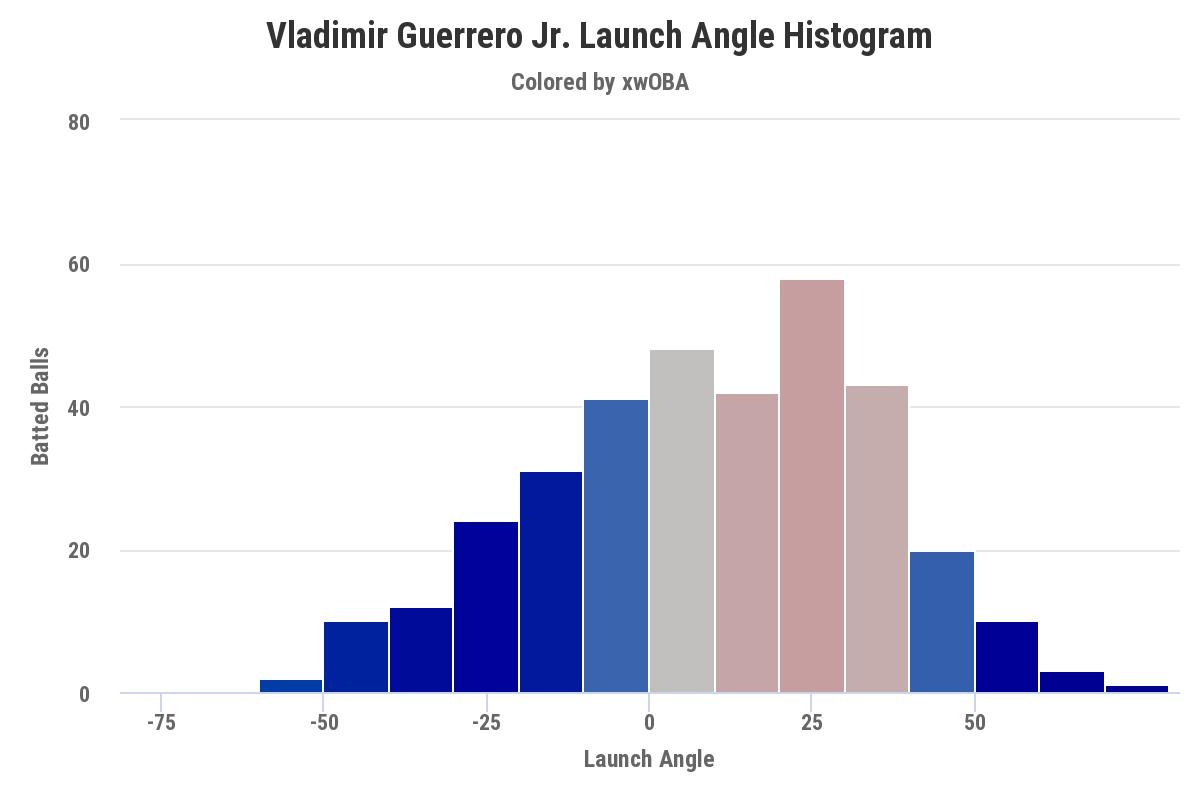
As you can see, there’s quite a bit of variability here. In fact, Guerrero’s launch angles on batted balls this season had a standard deviation of 28.2 degrees, meaning that there was significant spread. Of course, I didn’t really know where this standard deviation compared to other players (and this information isn’t readily available on a site like Baseball Savant), so I took a sample of a few of the league’s best hitters and looked at both their average launch angle and the standard deviation of their launch angles:
| Player | wRC+ | Average Launch Angle | Standard Deviation of Launch Angle | One Standard Deviation Above | One Standard Deviation Below |
|---|---|---|---|---|---|
| Mike Trout | 180 | 22.2 | 23.6 | 45.8 | -1.4 |
| Christian Yelich | 174 | 11.2 | 27.3 | 38.5 | -16.1 |
| Alex Bregman | 168 | 19.6 | 27.2 | 46.8 | -7.6 |
| Nelson Cruz | 163 | 13.1 | 27.1 | 40.2 | -14.0 |
| Cody Bellinger | 162 | 17.6 | 25.8 | 43.4 | -8.2 |
| George Springer | 156 | 10.3 | 27.7 | 38.0 | -17.4 |
| Anthony Rendon | 154 | 19.5 | 25.3 | 44.8 | -5.8 |
| Ketel Marte | 150 | 11.5 | 27.0 | 38.5 | -15.5 |
| Jeff McNeil | 143 | 13.2 | 24.5 | 37.7 | -11.3 |
| Pete Alonso | 143 | 14.8 | 27.3 | 42.1 | -12.5 |
I found this to be rather remarkable, though not unexpected. Since hitters can experience a wide variety of outcomes — groundballs, line drives, fly balls, pop ups — their launch angles should be pretty variable across the board. What defines where their distributions lie, then, is their point estimate, their average. That is why having both statistics is important.
Take Trout, for example. When he is exactly one standard deviation below his average launch angle, the ball came off of his bat at -1.4 degrees. This season, on batted balls hit at a -1 degree launch angle, hitters posted a .332 average and a .324 wOBA. On the flip side, when Trout is exactly one standard deviation above his average launch angle, the ball came off of his bat at +45.8 degrees. When hitters experienced a launch angle of +46 degrees this season, they posted an .067 average and a .080 wOBA.
Let’s contrast that with Guerrero, who had a 6.7 degree average launch angle alongside his 28.2 degree standard deviation. When he is exactly one standard deviation below the mean, the ball came off his bat at -21.5 degrees. Hitters posted an .096 average and a .112 wOBA with -22 degree launch angles this season. When he is exactly one standard deviation above, the ball came off of his bat at +34.9 degrees. There, the results are more favorable for hitters: a .266 average and a .448 wOBA.
On the surface, none of this seems bad. Both Trout and Guerrero have launch angle outcomes that are favorable and unfavorable within one standard deviation of the mean. But, when we think about standard deviations, we tend to assume that our data is normal, and that the bell curve would model the data reasonably well. In the case of launch angles, however, this is not always true. As you can see in the histogram above, Guerrero’s distribution of launch angles is bimodal — he has large clusters in the 0-10 degree range and in the 20-30 degree range. To compare, here is Trout:
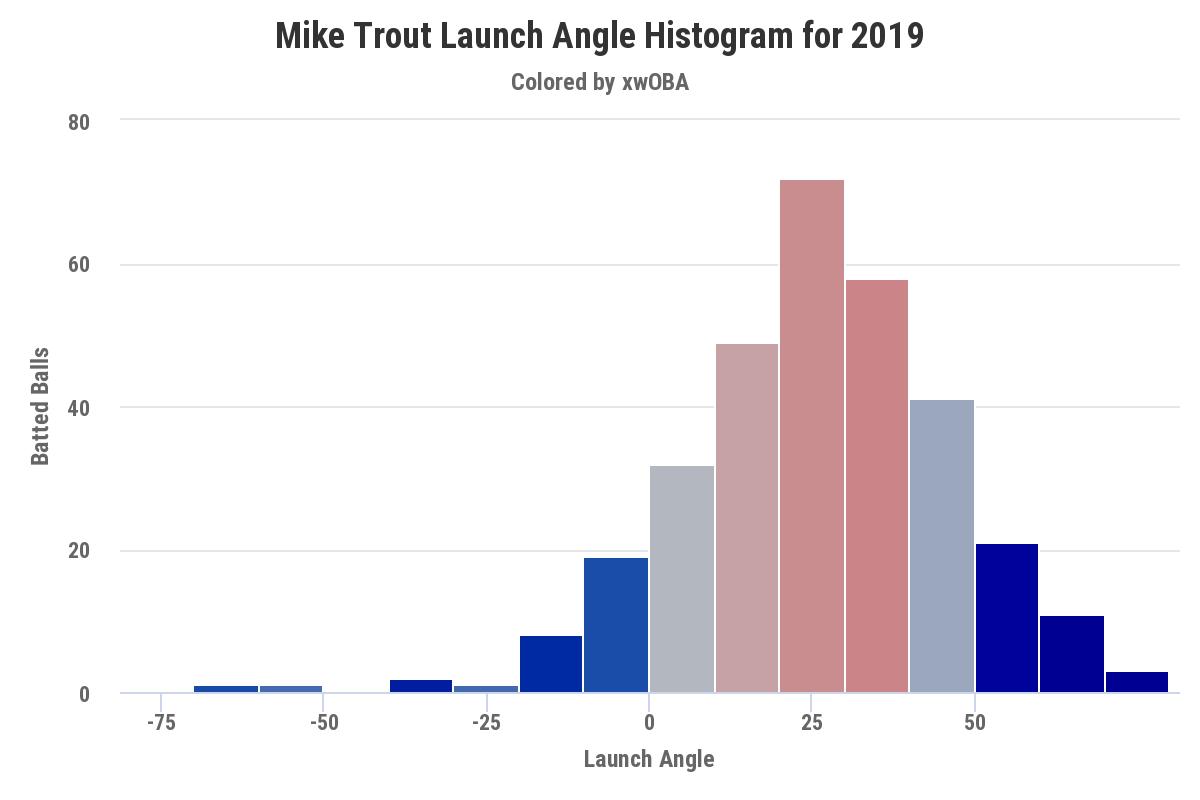
Trout’s distribution is much closer to being normal than Guerrero’s, though he does have some tails on either end that keep it from being so. The main takeaway is that Trout dominates not only because he has less of a spread in his launch angles, but more because he so consistently posts launch angles within the correct intervals. We can break this down on a rate basis:
| Bucket | Trout % | Guerrero % |
|---|---|---|
| -70 to -61 | 0.3% | 0.0% |
| -60 to -51 | 0.3% | 0.6% |
| -50 to -41 | 0.0% | 2.9% |
| -40 to -31 | 0.6% | 3.5% |
| -30 to -21 | 0.3% | 7.0% |
| -20 to -11 | 2.5% | 9.0% |
| -10 to -1 | 6.0% | 11.9% |
| 0 to 9 | 10.0% | 13.9% |
| 10 to 19 | 15.4% | 12.2% |
| 20 to 29 | 22.6% | 16.8% |
| 30 to 39 | 18.2% | 12.5% |
| 40 to 49 | 12.9% | 5.8% |
| 50 to 59 | 6.6% | 2.9% |
| 60 to 69 | 3.4% | 0.9% |
| 70 to 79 | 0.9% | 0.3% |
In 2019, Trout basically cut all batted balls below -20 degrees out of his game. Just 4.1% of Trout’s batted balls fit this description versus 22.9% for Guerrero. There is some good to be found in Guerrero’s breakdown, however: over half the time (55%), his batted balls had a launch angle between 0 and +39 degrees, the range where hitters tend to have the most success (.632 xwOBA). Trout fell in this range nearly two-thirds of the time.
“Fixing” something like this isn’t easy. Sure, the Blue Jays could go to Guerrero and tell him to hit more fly balls — I would be surprised if they haven’t by this point. For him, though, the fix may run deeper. Guerrero’s lack of symmetry within his batted ball data could be the real problem. It doesn’t exist in the sense of pure variability — his standard deviation does not seem to be all that different from the league’s best hitters. The issue more exists in his clustering; his bimodal distribution of launch angles is the problem, especially when his clusters don’t center around favorable launch angles. A more efficient distribution may come with more experience, but what happened in 2019 won’t make Vlad Jr. a superstar.
Devan Fink is a Contributor at FanGraphs. You can follow him on Twitter @DevanFink.
First, Little Vladdy’s got to get his lunch angle under control.
Seconded.
He also looks too bulky to me. Overweight? Maybe.
Why the downvotes? Can we legitimately say that maintaining weight won’t be a problem for him going forward? Maybe he’s fine, but it’s a valid criticism, IMO.
Tone tends to get down-voted in here but yeah, I really don’t think anyone here thinks an athletic body is not an asset to a sports star. I’d certainly have more confidence if I saw him show up like a tower of lean muscle in spring.
Interesting piece, thank you for posting! Of course comparing Vlad to the most consistent hitter of our generation since prime pujols and one of the best hitters of all time is a little unfair, but I believe the stats you have uncovered point to possible underlying areas of improvement in plate discipline rather than a request for a batter just to ‘hit more fly balls’ it comes down to Vlad improving his pitch recognition and plate discipline. There is a reason he sees almost 26% sliders last year and Trout only saw 17% and a reason Vlad only saw 33% Fastballs and Trout saw over 40% fastballs. Trout sits and waits for a pitch he can hit and drive. Trout’s outside zone chase is 20% compared to 30% for Vlad – Trout spits on bad off speed pitches out of the zone. Vlad’s swing rate is also almost 47% and Trout’s has been in the 37-39% range for years, indicating again that Trout hunts the pitch he wants. Yes Trout has talent, but I imagine as well that significant film study goes into that hitting philosophy as well. So, Vlad cam improve without a swing change, he just needs to stop chasing sliders and sinkers which he is already SUCH a good hand-eye hitter he actually makes contact with but ends up banging them into the ground which is what pitchers want. Let those sliders go, and hunt for the pitch you can drive. Most young players face this problem and the ones that surmount those problems with Vlad’s talent, strength and potential go on to be superstars. Those that don’t end up as average players.
If only Vlad knew someone who could help him. Someone who was an expert hitter. Someone who could destroy a pitch no matter if it bounced in the dirt or if it was above his shoulders. Alas…
https://www.youtube.com/watch?v=rFq4Iodq_hM
That might be the problem… for all we know, Big Vladdy taught him when in doubt, swing.
What Doug says. Being able to do something doesn’t mean one can teach another to do it — especially for such a unique skill like Vlad Sr’s. This is consistently true in that ultra, first ballot HOFer, SSS tier of athletes.
IIRC, this was a reason Barry Bonds didn’t last as Miami’s hitting coach. When you’re one of the most talented people ever to do something, you may have trouble relating to others who struggle at it.
Clearly not, though, because Vladito isn’t nearly the free swinger his dad was.
All year, excluding his few hot streaks, it looked like Jr. was waiting too long and being defensive on pitches and simply not being aggressive enough. That slight difference seemed to result in him hitting the ball earlier/back in his swing plane and resulting in more ground balls. To me launch angle is as much about timing and hitting the ball the out in front of the plate as it is about the shape of the swing itself. Jr. is so good that he could probably just hit his way out of a less than optimal approach in the minors, which is harder to do in the bigs.
Considering the astronomical expectations many had for Guerrero he was practically set up to fail to meet them.
Yeah. Pretty much. If, say, in two or three years, he’s “only” incrementally grown from this his 105 wRC+ bat to 125-130, homers will complain about he’s overrated and not all that much. Of course, that would be woefully neglecting the perspective of understanding how he’d be a 125-130 wRC+ 23-yr old.
If, for example, he follows a Bryce Harper-ian career path to a monumental FA contract, he will have been disappointing, but only relatively so given his pedigree.
The issue of how little pedigree means in baseball is alluded to in the article. It mentions the “Vladitooooooo!” vs “Yordan-who?” disparity to now. It’s almost amazing how similar it is to the 2012 season. Prior and early, it was all about Harper and the pedigree and not that guy who has made quite an argument for himself as “best player of all time” so far in his career.
Love the analysis! In particular…
1) You showed distributions not just means + std devs
2) The visuals that very clearly illustrate what we think the ideal distribution should be
3) You then confirmed what the ideal distribution should be (Trout)
This is a great post.
This is some of your best work to date. Nice piece of writing.
Excellent article. So with Std. Dev. LA, Trout is in the 1st quartile and Guerrero is in the fourth. Another related metric that is also very important in contact quality is the amount of backspin. For this metric, Trout is in the 1st quartile again (lowest spin) but Guerrero is in the 4th (highest spin). While there are a few players who perform well with this combination (high SD LA, High backspin), the majority underfperform the averages for both BABIP and wRC+.
Where are you getting the spin data?
Based on a model of LA, EV, Spray Angle and Expected Distance. Have some confirmation w/ actual spin data on a few select players that have been put out in the public domain.
There is also a high inverse correlation between well-hit LA and backspin so the fact that he has a low LA helps support that he is a high backspin hitter.
Sounds like he played like an extraordinarily talented 20 year old, who had fewer than 100 games above A-ball at the time of his debut.
Soto isn’t a fair comparison for anyone.
If your first sentence is correct, then why the calls for him to be in the opening day line-up this season (before he got hurt, that is), or to even get called up at the end of 2018? There was a lot of “he’s absolutely ready for the major leagues, and keeping him down is exclusively for service time considerations”. Yet he was a league average bat with bad defense and baserunning.
Because he (pretty emphatically) wasn’t being challenged at those lower levels.
The fact that he wasn’t ready to immediately dominate the MLB from jump doesn’t mean that it wasn’t absolutely the best place for him to continue to grow as a player, as early as last September.
His 96 wRC+ through the break went up to 112 in the second half. Give him a few weeks after the PCL ended last year, and maybe he adjusts earlier.
Trout is not fair either.
Great analysis!
Great article. A driveline guy posted an article today that it might be a swing issue and they reverse engineered his attack angle of the bat to be slightly negative will most top hitters swing up around 8 to 14 degrees.
He always hit a lot of grounders, even in the minors
link?
Here is the Link
https://twitter.com/dan_aucoin13/status/1194700224347824128?s=19
Thanks.
If you take away his last month, when he was really bad (.557 OPS), none of it looks so bad. He was hitting .282/.356/.477 after hitting his last home run of the year, after which he went 110 ABs without another. I don’t remember hearing about a particular injury, but I do think he utter lack of conditioning caught up with him at the end of the year. But that counts of course. He sucked for more than a month to finish his year, going from a “finish strong and get RoY votes” candidate, to a “”can this season just end already” guy.
Guerrero also “crushed” a lot of his grounders, or at least it seemed that way watching him. He had 13 balls hit over 110 mph that also went less than 90 feet in the air. Pete Alonso had 5 of those. Mike Trout had 3. Cruz had 5. Yelich had 5. Judge had 8. Maybe he had the most of these crushed-grounders in MLB, I don’t see a way to search systematically. With his lack of footspeed, better MLB positioning and fielding, and better MLB field conditions (and no bouncy turf), those hard hit grounders are simply not going to work for him. I think his ability to adjust his swing mid-pitch and make contact actually worked against him at times. I still think he’ll adjust and figure out how to lift those (or just swing and miss, and get another chance later in the AB), but I hope it doesn’t take multiple years.
It’s also worth mentioning that Vlad wasn’t even the best rookie on his team. Bo Bichette was a substantially better player over the season.
Mr. BIGgio would like to say hello!
Vlad’s Jr’s launch angle is an issue, but to me in watching him all season it seemed he was just missing on his timing by that half second or less that would give him enough time to get in front of the pitch a little more and lift it.
I suspect there are many reasons for that but one thing that really stood out to me and seemed to throw him off was the calls he was getting on pitches out of the zone. Vlad came up with a rep for having a very strong sense of the strike zone all throughout the minors and suddenly he was getting called strikes on pitches he was sure weren’t actually strikes. And often he was right. You can look at his cstrike% heat map and he was getting a ton of low or outside pitches called strikes.
This really seemed to frustrate him as the season went on and you could tell he started to guess more, and things went predictably poorly for him. He started missing fastballs right in the sweet part of the zone that he should crush and by the last month he was completely flustered and posted his lowest BB% by far.
Two other Jays’ rookies had a similar experience with the strike zone from umpires, if not worse. Both Biggio and Bichette had a high amount of called strikes in areas out of the zone as well, but the difference is they didn’t seem to let it dramatically affect their approach at the plate. In Biggio’s case he even appeared to get more respect from umpires by the end of the season and fewer strikes called out of the zone.
Hopefully the time off before next season will give Vlad Jr. a chance to reset his mental approach and start fresh. His strike zone awareness isn’t wrong, he just needs more experience and awareness to not let it affect him when calls don’t go his way. Patience will serve him well. He’s apparently putting in a lot of work on conditioning which will help his stamina over the long season as well. I suspect he will adapt quickly and turn it around to become more like the hitter people expected.
Cool article! Personally I think Vlady Jr will eventually have a more consistent launch angle and then Boom he will be a superstar. If I were a Blue Jay fan, I would be hoping he takes his glove more seriously. His defense needs work.