A Defense of Kevin Cash Pulling Blake Snell in the World Series

Sometimes we allow hindsight to cloud our judgment and fall into a trap of second-guessing when assessing managerial decisions. That wasn’t much of an issue last night when discussing whether Kevin Cash should have removed Blake Snell in the sixth inning. That’s because the decision was universally derided as it was happening, just before the Rays blew their lead and the Dodgers won the World Series. As Rachael McDaniel noted:

The Dodgers’ powerful lineup, so productive in this World Series — the Dodgers, you may recall, had held a lead at some point in 27 consecutive innings prior to tonight — seemed utterly useless against Snell. Their fearsome top-of-the-lineup trio of Betts, Seager, and Turner were all 0-for-2 with two strikeouts against him through the first five innings; he was at a very reasonable 73 pitches on the night. Snell’s CSW% on all his pitches was an eye-popping 40%. In short, he looked fantastic. It’s hard to imagine a pitcher looking much better than Snell did for most of Game 6; it’s hard to imagine how the outcome might have differed had he stayed in the game.

Snell was pitching incredibly well up that point in the game, and there was considerable criticism of Cash’s decision as it seemed to be based on numbers, particularly the third time through the order (TTO) penalty, rather than actually paying attention to the feel of the game and just how good Snell was pitching. Cash specifically mentioned the TTO penalty in his postgame comments:

“The only motive was that the lineup the Dodgers feature is as potent as any team in the league,” Cash said. “I felt Blake had done his job and then some. Mookie [Betts] coming around the third time through, I value that. I totally respect and understand the questions that come with [the decision]. Blake gave us every opportunity to win. He was outstanding. These are not easy decisions. … I felt it was best after the guy got on base — Barnes hit the single — I didn’t want Mookie or [Corey] Seager seeing Blake a third time through.

If Cash’s decision had come purely from relying on Snell’s prior history the third time through the order and had ignored what was happening in the game, then the criticism would be justified. Cash did address this somewhat after the game:

“As much as people think that sometimes, there’s no set plan. This organization’s tremendous about giving the staff the trust to make in-game decisions to give us the best chance to win. I respect what unfolded today was pretty tough.”

The crowd coming down hard on Cash was both analytical and traditional in nature. Most believed that, considering how good Snell was pitching at the moment he was taken out, removing him from the game was a mistake, TTO penalty or no. The criticism assumes Cash was not watching the game, or at least ignored what was in front of his own eyes: an ace pitching like one on the way to forcing a Game 7. But it’s also possible that it was not Cash’s eyes that were betraying him, but our own. Snell’s brilliance through the first five innings does not guarantee success in the sixth. Those first five might have served to gloss over the first few batters in the sixth, even as Snell induced a weak popup and gave up a single to center field.

We don’t want to ignore what happened in the first five innings, but instead use those innings as a backdrop for Snell’s start to the sixth. We have just four pitches to go on, but there’s some indication that Snell was no longer his dominant self. Snell’s first pitch of the sixth inning was a curve. It’s the first pitch in this summary of the sixth inning:


The pitch was a 78 mph curveball over the middle of the plate. AJ Pollock didn’t put a good swing on it and it made for a quick and easy first out. Here’s Snell’s curveball velocity during the game.
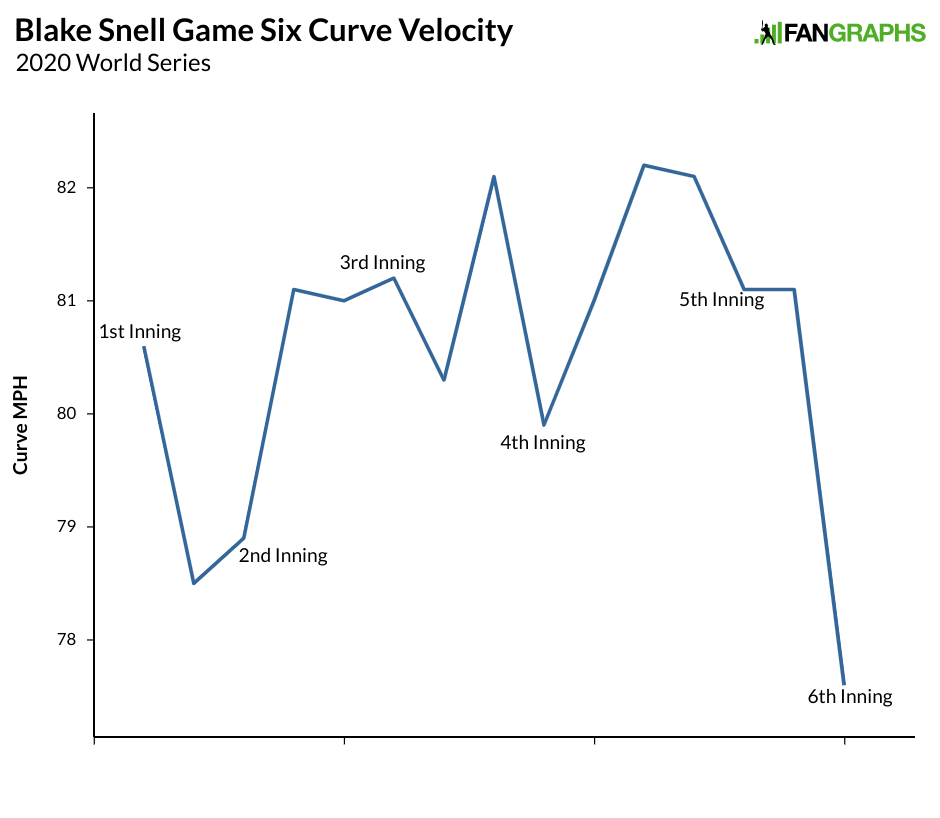
Maybe that’s nothing. It’s just one pitch and Snell induced a popup, but it was 3 mph off of Snell’s average during the game. The first pitch to Austin Barnes was a 94 mph fastball up out of the strike zone. Here’s Snell’s fastball velocity by pitch in last night’s game.
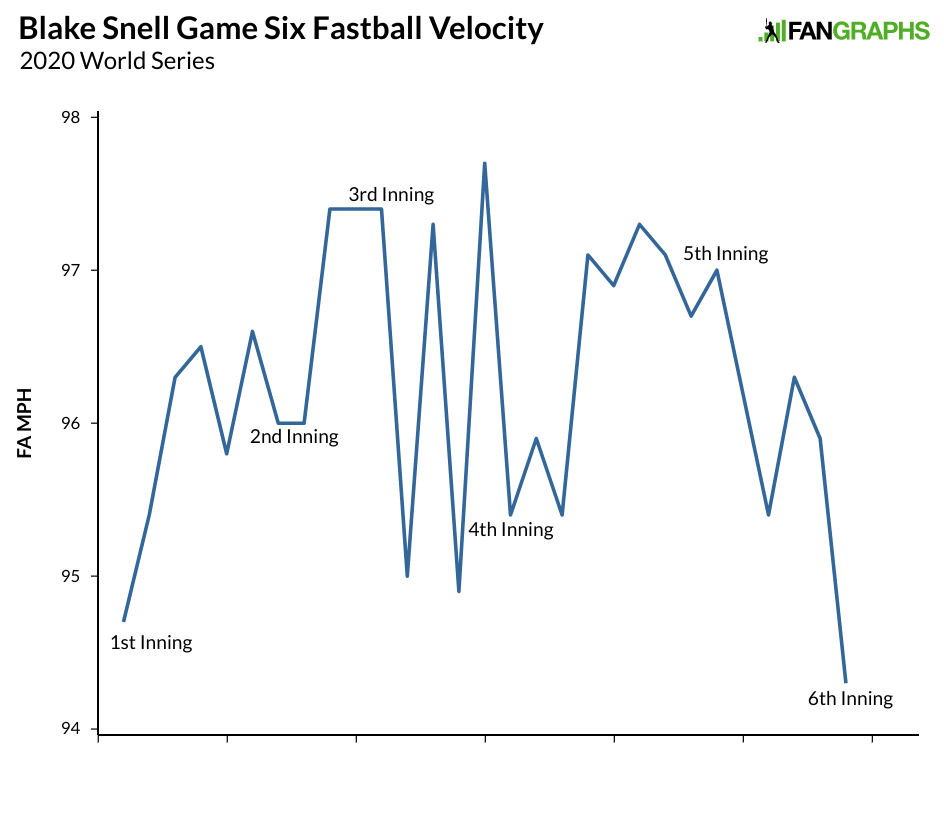
Snell’s fastball to Barnes was 2 mph off his average on the day, and like with most pitchers, velocity matters a lot. When Snell’s fastball was at least 95 mph during the regular season, he induced whiffs on 13% of pitches, but when it was less than 95 mph, his whiff rate was just 9%. The actual results are more footnote than evidence, but there was a significant difference in results when Snell’s fastball loses a few ticks. That was even on display in last night’s game. Snell got four swings and misses on his seven hardest fastballs, and six on his hardest 13. But on the 16 pitches below 96.5 mph, he induced just two whiffs.

Much has been made of Mookie Betts, Corey Seager, and Justin Turner each striking out twice against Snell earlier in the game. On Betts’ strikeout in the third inning, he swung through a 98 mph fastball. It’s not clear that Snell still had that same stuff in the sixth. When Seager and Turner struck out in the fourth inning, they missed on big curves that topped 80 mph. It’s also not clear whether Snell still had that kind of stuff at that point in the game.

It was just two pitches to start the sixth inning, but after a changeup for a strike and a slider over the middle of the plate that Barnes hit for a single, Betts was coming to the plate against a pitcher who wasn’t quite what he was earlier in the game. Maybe a slightly off Snell was still better than Nick Anderson, but it wasn’t just the third time through the order penalty dictating whether Snell should leave the game. There was a little bit of evidence, however small, that he was tiring. It’s a manager’s job to take out the pitcher when he gets tired, and that’s what Cash did. It was a difficult choice, and perhaps not the right one, but it wasn’t made just from data. Watching Snell had to help confirm Cash’s decision was the right one to him at the time.


Craig Edwards can be found on twitter @craigjedwards.

100 Comments
Oldest
Newest Most Voted
kmcgrath98
5 years ago

You can tell this is a stretch by looking at a sample of 4 pitches as evidence for the decision.

storminjnormanMember since 2016
5 years ago
Reply to  kmcgrath98

I thought this too, especially when sss is at play and your amount of pitches is pathetically small anyway.

It’s quite possible to be too smart sometimes; that’s what I think happened here.

springerMember since 2018
5 years ago
Reply to  storminjnorman

The point of the article is that Cash didn’t just think about TTO, he was taking into account what was actually happening.

channelclemente
5 years ago
Reply to  springer

Yeah, I hope he considered that when Urias stepped in to close it out for the Dodgers.

NSSpeedster
5 years ago
Reply to  springer

Did Cash even mention these dips in his velocity at all during postgame conference? Or is this just speculation and giving him an excuse? Seems like Cash’s move was made simply because of TTO

talkinzed
5 years ago
Reply to  kmcgrath98

I respectfully disagree.

A small sample size, while small, does tell you something. I see that phrase “small sample size” trotted out a lot as if it’s the be all end all. For instance, if Cash was truly 50/50 about leaving Snell in or not, the decreased velocity could serve as the tiebreaker in his decision making. Heck, if he was leaning 60/40 to leave Snell in, the velocity dip could still be significant enough over 4 pitches to swing him the other way.

Dominikk85Member since 2020
5 years ago
Reply to  talkinzed

I agree. Cash probably was leaning to pull him due to the data and was actively looking for signs of snell declining. With the rays it is entirely possible that they watch velo and even stuff like spin rate in real time.

It could have gone like this:

Snell was nearing the end and cash is thinking one more batter but at the same time looking for indicators of him slowing down. So he watches velo every pitch since the 4th and then he sees dip

pitch one: “yeah whatever”

Pitch two: “maybe he starts to slow down”

Pitch 3: he really seems to slow down but let him give one more pitch

Pitch 4: ok that’s enough.

Of course the sample is super small and usually you can’t see that but velo stabilizes quickly and if you monitor that as a real time Key performance indicator like the rays probably do that can be used.

Of course not alone but in conjunction with the notion that snell usually never pitches a third time through.

That means the burden of evidence was essentially reversed at that point, in the third he would have been left on but in the 6th the default decision was pull and only if every KPI was right snell would have stayed.

WARrior
5 years ago
Reply to  kmcgrath98

The sample of pitches that the pitches were being compared to were considerably larger. The FB in the 6th inning was the slowest of more than 20 FB thrown to that point. The curve was the slowest of more than a dozen previous CB thrown. What are the odds that two of four pitches would be the slowest of their kind for the entire game?

I’m not saying this validates the decision to pull Snell, but it seems to me these are data worth considering.

channelclemente
5 years ago
Reply to  kmcgrath98

Looking at typical in game variance of each of Snell’s pitches makes you scratch your head a bit at this articles assertions and choice of scaling.

carterMember since 2020
5 years ago

Counter argument: No

carterMember since 2020
5 years ago
Reply to  carter

I mean in all seriousness defending his decision is wrong, regardless of outcome. They shouldn’t of taken him out, but the even bigger mistake was who they replaced him with. Nick Anderson literally set a record for being the worst postseason pitcher in MLB history (first guy ever to allow a run in 7 straight appearances) and was an entirely different pitcher than he was prior. In the regular season he struck out 44.8% of the batters he faced, in the postseason he struck out 14.8%. He looked entirely broken. You don’t put a pitcher in the game in the most important at bat of your franchises entire history who had just set the record for futility. That would be dumb.

Now people will try and bring up small sample size. Well guess what? He faced more batters during the postseason than he did all season long (61 vs 58). And how can you argue on that sample size yet talk about Blake Snell’s 3rd time through the order splits, which he basically never did all season without the same caveats applying? Hitters actually hit for a higher average versus Snell the 2nd time through the order (.307 to .304) . Mookie Betts hadn’t been able to touch Snell. It was rare for him to swing and miss 3x in an entire game. He had done it that game. He had done it the last time he faced Snell as well. Zero times the rest of the series. And how can you argue about the 3rd time through penalty without even mentioning this is the 3rd time he has faced Anderson in 6 games? I know everyone wants to throw out the small sample size caveat on Betts struggles vs LHP, but it goes back farther than one year. It has been the case for his entire career, but not to this extent. He has shown considerably less power over his last few seasons, with this year taking it to an almost unbelievable low. His line this year vs lhp 200/313/218. That is not a misprint. Only 1 xbh. He also strikes out 23.4% of the time vs LHP and 12.6% vs RHP. Correct me if I am wrong, but K rate stabilizes faster? Same sort of deal in 2019 as well. I am unsure what he is doing, because he seems to walk a fair bit more as well, but hit for zero power. His iso was .018, yes there was a 0 in front of it. Seager also, career 111 wrc vs lhp and 140 vs rhp.

Analytics are supposed to help match up with what you see with your eye. In some scenarios they are supposed to replace what you see with your eye. But they aren’t the end all. Snell looked absolutely dominate, and Nick Anderson has been horrible.

Analytics are good, I can agree with that. But this wasn’t analytics. This was the farthest thing from analytics, it was simply wrong. I was joking with my friend that I cannot wait to see the “Actually the Seahawks passing the ball was the correct play” style takes tomorrow, and sure enough here we are.

Cheeknbut
5 years ago
Reply to  carter

I think it’s kind of obvious that Craig doesn’t think this evidence justifies the decision. He was pointing out something of note that happened that no one else really seems to have noticed. It may have played a role in Cash’s decision, it may not have. It would’ve been helpful to see if a velocity decline was consistent with when Snell was taken out all year. Or how his velocity typically fairs after 80+ pitches. But I enjoyed this article for what it was & I think a lot of the commenters are kind of missing the point here.

sweepcut
5 years ago
Reply to  Cheeknbut

totally agree, I would love to see more splits on velo dips as they relate to performance in Snell’s career. I always feel like we in the public too rarely give an organization as smart as the Rays the benefit of the doubt–I mean, imagine the data they have that we’ll never see! Pretty presumptuous to just assume Cash made a dumb decision

Mark Milberg
5 years ago
Reply to  sweepcut

I want to second this opinion. We don’t know what Cash and the Rays based their decision on, and if we knew that we might have made the same decision.

The reason I subscribe to FanGraphs is for number- and data- based articles like this. Thank you Craig for writing this article.

I also think FanGraphs should have the article “Sometimes the decision that’s most likely to lead to victory doesn’t work out” saved in the cue for controversial moments like this.

montrealMember since 2022
5 years ago
Reply to  carter

Excellent post Carter. I also believe in analytics, but this was just stupid. And I also posted earlier that Snell does NOT do better the 2nd time through. He actually does a bit better the THIRD time through. Good explanation. Great post.

sweepcut
5 years ago
Reply to  carter

good point about Anderson; I would have put Castillo/Fairbanks there. One thing I should mention is that platoon splits have been demonstrated to be meaningful at 2200 PA, so your point about Mookie vs lefties may not be accurate…but maybe there was something meaningful there that we in the public domain can’t see

bosoxforlifeMember since 2016
5 years ago
Reply to  carter

Carter, you saved me a lot of typing and the Seahawks comp was perfect.

WARrior
5 years ago
Reply to  carter

I don’t want to get off topic but there’s actually a lot of evidence that passing the ball in that situation was a reasonable thing to do.

Wrt Betts, 2020 was a far too small sample size to draw any conclusions about platoon splits. For his career, he’s pretty even. In his MVP year, he hit better vs. LHP than vs. RHP.

carterMember since 2020
5 years ago
Reply to  WARrior

I agree with you mostly regarding the sample size vs LHP. I would mention however that the things that are supposed to stabilize quicker (K rate and walk rate) show that something is different vs LHP. I even tried to manually do EV, and somehow he doesn’t even make solid contact vs LHP. Again, small sample size but I don’t think it is unreasonable to think there is something there.

williams .482Member since 2016
5 years ago
Reply to  carter

As the Book kindly informs us, you need to regress a RHH’s observed platoon splits with 2200 PAs of average split performance against left handed pitchers to get a good estimate of their platoon skill. Betts has 925 PAs against LHP career and a tiny observed reverse split, with K/BB numbers that are clearly better against LHP.

Nothing he did this season, last season, or over the course of his career should be taking as compelling evidence that he had or has a true talent reverse split.

LordOfTexasMember since 2019
5 years ago
Reply to  carter

I don’t mean to take the piss here, but the Seahawks passing at the end of the SB was actually fine. The Patriots had practiced against the exact play before the SB, Malcolm Butler recognized the play and made an excellent play to blow it up. Analysis has been done and rushing fumbles are basically equally likely as passing interceptions in that spot.

I’m not going back to watch it just for this comment, but how many defenders were in the box when Marshawn was tearing it up on the last drive? How many defenders were present in the box at the goal line? That’s another consideration.

carterMember since 2020
5 years ago
Reply to  LordOfTexas

Heh. Honestly I just wanted to throw that in at the end. I think running was likely correct, but passing wasn’t as bad of a decision as the actual pass was. In a way you could liken it to bringing in Nick Anderson. While I think leaving Snell in was correct (running) the worst part was bringing in Nick Anderson (a slant) when if you are going to pass you could simply run something outside the pocket.

williams .482Member since 2016
5 years ago
Reply to  LordOfTexas

To pile on, the idea that in a situation like that you should only run or only pass is completely insane, and that position is automatically implied by bashing the Seahawks for that single play. You have no way to tell if they were thinking 99% pass in that spot, or 50/50, or 99% run, we only know that they called the play they called.

It’s a completely ridiculous debate.

Sandy Kazmir
5 years ago
Reply to  carter

Maybe you didn’t watch much of this series, but in the second game manager Kevin Cash did keep Blake Snell in after 4 2/3 no hit ball with two walks and 9 strikeouts. The next four batters reached base, two of them scoring, and who knows how many others would have crossed home if Nick Anderson didn’t come in and immediately strike out Justin Turner. If you want a manager to learn from the earlier mistake you cannot criticize him for making the opposite action.

jakelee
5 years ago
Reply to  carter

carter, you leave absolutely no room for disagreement. When Cash went out to get Snell and with Anderson on the way, I could almost see Betts eyes light up. And it was obvious after watching Anderson the entire Post Season that Cash had finally out smarted himself, as you explain so well.

JustinPBGMember since 2018
5 years ago

But can we defend choosing Anderson, who has been truly awful?

Jason BMember since 2017
5 years ago
Reply to  JustinPBG

That one’s behind a paywall …

Jeff Kallman
5 years ago
Reply to  JustinPBG

Justin—Right move: lifting Snell. Wrong move: having Anderson instead of Ryan Thompson ready to go if he was going to bring the righthander in to face Betts. (Anderson: surrendering at least a run in his previous six postseason gigs. Thompson: lights out in the Series.)

jamesbrooksMember since 2021
5 years ago

Good read!

averagejoe15Member since 2018
5 years ago

I didn’t hate removing Snell as much as I hated that the call went to Anderson who has simply not been good. This was easily the most critical point in the game at the time and it should have been Castillo or Fairbanks there.

Say what you will about the Snell decision but my take is that the Rays train their pitchers to operate at the max sustainable effort for 80-90 pitches (or more accurately enough pitches to get through the order twice assuming limited damage). At 73 pitches, with his velocity slipping, the whiffs turning into soft contact, and Mookie Betts – one of the best hitters on the planet regardless of struggles in previous at bats – at the plate it’s justifiable for me. Better to be a batter early than a batter late with the hook (of course it depends on who is then brought in).

I think what makes the Snell decision look so much worse is how central starting pitching was to last year’s WS between the Nats and Stros where Scherzer, Strasburg, Corbin, Velander, Cole, and Greinke (just wow) were afforded more leash.

The big differences being for me that those guys are more stretched out and used to pitching deeper into games, their teams have relatively weak pens compared to the Rays, and quite simply the Rays do things a little differently and that’s how they got to the WS in the first place.

I do think that Snell was a better bet to get Betts out than Anderson (because again, Anderson has not been in 2019 form of late) but had Castillo or Fairbanks been the call I’d truly have no complaint.

sweepcut
5 years ago
Reply to  averagejoe15

all great points!!

rzbzadraMember since 2025
5 years ago
Reply to  averagejoe15

I agree with this sans Fairbanks. He did not pitch very well this series and actually gave up a Home run when he saw Mookie. Was Diego unavailable? I heard someone say he had a sore arm that day but don’t know if its based in any fact.

averagejoe15Member since 2018
5 years ago
Reply to  rzbzadra

Fair enough, Fairbanks ended up giving up a run in 3 straight outings in the WS. If Castillo were unavailable Snell probably was the best choice in that moment (Fairbanks was still a better choice than Anderson at least).

bosoxforlifeMember since 2016
5 years ago
Reply to  averagejoe15

Then why did Cash let a much less effective Glasnow throw over 100 pitches in each of his starts? Your argument holds about as much water as a sieve.

cs3
5 years ago

“It was a difficult choice, and perhaps not the right one, but it wasn’t made just from data. Watching Snell had to help confirm Cash’s decision was the right one to him at the time.”

Are you trying to say that Cash could distinguish a 2mph drop in velocity by watching? I’m not buying it. This was a purely analytical decision and the context of the game and series situation was basically ignored

averagejoe15Member since 2018
5 years ago
Reply to  cs3

By watching the radar gun which literally tells you how fast each pitch was? Yea probably something a good manager pays attention to come the 5th and 6th innings

Rollie's MustacheMember since 2017
5 years ago
Reply to  averagejoe15

In addition to the radar gun, Globe Life Field also displays vertical and horizontal pitch break on the scoreboard.

Metrics that help inform quality of pitch were right there for everyone in the ballpark to see.

SaltyMember since 2017
5 years ago

There should be some consideration that the decision was above Cash, that it’s possible this was a front office pre-game call to get Snell out of there before TTO, and that Cash is just taking the bullet in the postgame.
R & B podcast (think it was Eno) discussed a similar call with Kershaw’s game 5 (if my bad memory remembers). I realize the front office has some input, but never realized how little autonomy in decision making some managers have.
I’d hate to see Cash get destroyed if Snell’s removal was really a shared (or maybe even directed) call from the FO.

hughduffy
5 years ago
Reply to  Salty

From what I understand, the plan with Kershaw was to have him go through the first 21 batters, so twice through the order plus the first three in lineup. That plan had been discussed with Kershaw before the game. If he had been perfect, it would have gotten Kershaw through 7 innings. Since he wasn’t, it got him through 5.2 innings. The next batter Kershaw would have faced was Margot, who had a bunt single and a walk earlier in the game. At 85 pitches, and with Kershaw’s four-seam fastball at 90-91 mph in the 6th inning, I didn’t think Kershaw needed to be pulled at that point, but I didn’t hate it. They followed the plan.

I don’t think that Cash or the Rays had a plan with Snell. At least, one that they shared with Snell.

montrealMember since 2022
5 years ago
Reply to  Salty

If the Rays are so smart they should have known Snell pitches as well or BETTER the 3rd time through compared to the 2nd. Come on all you guys trying to defend. Deep down you know Snell for Anderson was a doubly bad move.

The Ancient Mariner
5 years ago
Reply to  montreal

The Rays are smart enough to know that those numbers are the product of a very strong selection bias and don’t actually prove anything.

texag
5 years ago
Reply to  montreal

He is? Is it the higher OPS the third time through? The higher batter OPS+? The lower strikeout rate? What stats exactly show that Snell is better the 3rd time through as compared to the 2nd time?

Jeff Kallman
5 years ago
Reply to  montreal

Uh, no he doesn’t. The BA/OPS against Snell the first time around: .205/.592. The BA/OPS against him the second time around: .234/.711. The BA/OPS against him the third time around: .247/.742.

I pointed that out to a friend who’s a member of the Hang Cash contingency. He came back with, “C’mon, those aren’t Lou Gehrig numbers!” To which my reply would be, no they’re not Lou Gehrig numbers, but an almost 30 point jump in opposition batting average and a 150 point jump in opposition OPS—the differences between Snell the first time around and Snell the third time around—is profound enough. Especially with a tiring pitcher about to begin third time around the order with just a one-run lead and a guy hitting .304 off him lifetime waiting to face him.

Having Anderson as the first relief option was the real Game Seven mistake. The real reason the Rays lost the Series—forgetting how to hit with men on base.

Deacon DrakeMember since 2017
5 years ago

I mean, I guess there is fair evidence that his stuff was less, but he was facing the equivalent of a pitcher (Betts vs LHP this season) which Snell was as likely to get a GIDP as he would an XBH… more likely harmless contact. Instead he made a move that allowed the Dodgers to replace that pitcher with, well, the Real Mookie Betts.

There is NO WAY that the TTO penalty was as big as Betts’ platoon splits. Cash lost the game.

Wu-Bacca
5 years ago
Reply to  Deacon Drake

Mookie Betts has no platoon split over his career. And in cases like this you really want to look at established performance level over hundreds of PAs rather than his 64 PAs vs LHP in this shortened season. In his career Mookie has GIDP in 0.8% of PAs vs LHP, and gotten an XBH in 10.4% of them, so you could say he was roughly 13 times more likely to get an extra-base hit as ground into a double play. (Even if you just want to take into account 2020 – which, again, would be a mistake – he didn’t GIDP against a lefty all year, so I’m not sure any of the data backs up your point.)

Jeff Kallman
5 years ago
Reply to  Wu-Bacca

Betts also hits .304 lifetime against Snell. Just saying.

OddBall Herrera
5 years ago

I don’t mind pulling Snell, it’s replacing him with a guy who hasn’t had it all postseason that irks me

tonywagnerMember since 2020
5 years ago

Craig, does it matter than those were his first two pitches of the 6th inning? He had previously thrown pitches close to those those speeds and still rebounded to throw 2+ MPH harder after. I don’t doubt that his velocity was generally decreasing but I’m not sure how much I’d want to read into those two pitches. (Especially when there’s evidence that Anderson’s stuff has been in decline all year.)

I know the flip side of that is, by the time you have more evidence of his stuff declining, it might be too late. But with some issues in the pen, letting Snell continue batter-to-batter doesn’t seem like too much of a risk at that point.

MarkMember since 2016
5 years ago
Reply to  tonywagner

Agreed on the first pitches of an inning. Also, Snell was facing the 8 and 9 hitters. He might have intentionally let up a bit to save some for the big hitters. Haven’t we seen guys like Verlander have the velo decline against the softer parts of the lineup and then tick back up when facing the sluggers and at the end of the game?

OTMHeartBBCMember since 2019
5 years ago

counterpoint, all the doyers said he was rolling and were very glad to see him go

Jross
5 years ago
Reply to  OTMHeartBBC

They also said barrels don’t matter

Raincheck
5 years ago
Reply to  Jross

No, they said they are overrated

sweepcut
5 years ago
Reply to  Raincheck

plus, that was a joke stemming from a game where CT3 got 4 cheap hits. Dodgers led the league in barrel percentage!

ScottyBMember since 2017
5 years ago

Analytics are the beginning point for decision-making. But managers also need to have a feel for the game. Crazy.

kp2767
5 years ago

As others have mentioned, while I don’t agree with it, the decision to pull Snell was arguable. The choice of reliever was not. That was a mistake. Ultimately the Rays were unlikely to win a game while only scoring 1 run. But the choice of reliever was not ideal.

Jross
5 years ago

This whole team is pathetic! The pitchers, the hitters, the front office, their strategies, the managers and coaches! Just a terrible organization, and other teams would be smart to stay away from them.

Stovokor
5 years ago
Reply to  Jross

Sarcasm, guys. Where did LAD hire their GM from? Jeez..

drewcorbMember since 2020
5 years ago
Reply to  Jross

Nice try Stu Sternberg.

nevinbrownMember since 2022
5 years ago

I didn’t understand taking Snell out when you needed to win both games 6 and 7. After 73 pitches he wasn’t pitching in a game 7 so I would have thought that the strategy was to milk every last inning out of Snell and see if you can’t save as many arms for a game seven. That, for me, was the only real screw up on Cash’s part.

texag
5 years ago
Reply to  nevinbrown

You can’t win game 7 if you don’t win game 6. Playing like there’s another game when you are facing elimination is a good way to get eliminated.

drewcorbMember since 2020
5 years ago
Reply to  nevinbrown

Yeah I was thinking that if the Rays had a 5-run lead, then they try to get every last inning out of Snell. I was afraid that a close game would force them to go to the bullpen early which was going to make a possible game 7 even harder to win.

Six Ten
5 years ago

I dislike the decision as a fan, and while I was watching, it also felt like it was the wrong decision analytically. And of course as everyone has rehashed, going to Anderson seems plainly wrong.

But one more piece of data to throw out there along with the velocity on the four pitches…

Whiffs plus called strikes by inning:
1 – 8 on 12 pitches (6 whiffs/ 2 called strikes)
2 – 7 on 12 (3/4)
3 – 6 on 15 (1/5)
4 – 5 on 16 (5/0)
5 – 2 on 14 (1/1)
6 – 1 on 4 (0/1)

He had 1 whiff and 2 called strikes in his last 18 pitches. There’s no way to slice that inning by inning trend that looks good. Maybe you don’t think called strikes matter that much; certainly whiffs are better. But the point is that when balls were in a position to earn a strike, they were earning it less and less.

Put that game-long trend together with the lost velocity of four pitches and it’s easy to see why someone would conclude Snell was in less control than it felt like.

I still think it was wrong. The Dodgers just weren’t hitting him hard even when they were making contact. But I’m less sure of it than I was.

ed-ott
5 years ago
Reply to  Six Ten

Oh, my. Now that is a stat I can stand behind. Why has no on else brought this up? That tells the story about as well as any other. Nice one.

bosoxforlifeMember since 2016
5 years ago
Reply to  Six Ten

I guess then that Kyle Hendricks should never pitch another game if strikeouts are the only measure. On a good day, which Snell was obviously having, the aces have many ways to get hitters out. This analytically based idea that if your not striking everybody out then you shouldn’t be on the mound seems a wee bit suspect.

byronMember since 2016
5 years ago

“If Cash’s decision had come purely from relying on Snell’s prior history the third time through the order and had ignored what was happening in the game, then the criticism would be justified.”

No it wouldn’t have been. No hitter had seen Snell 3 times yet. Hitters are better when they see pitchers more times. The numbers don’t tell anyone what to do, they demonstrate that something happens. As Joe Sheehan (and others?) say, pitchers are dealing until they aren’t. The game was about to get harder for Snell, and easier for the Dodgers. It doesn’t mean Cash HAD to take him out, but choosing to do so based solely on the situation would have been absolutely defensible, and would have had little to do with “numbers.”

AGCMember since 2020
5 years ago

It’s fun for us Fangraphs types to debate it, but there’s really no debate. It was a mistake, and each of us knew it before the bad results. Because we’ve seen a lot of baseball and know that the analytics cannot account for what Snell was doing in Game 6 — completely owning the Dodgers. No curve velocity or other information needed to be referenced. He was dominating them. And Cash was a fool for replacing him for anyone.

Shirtless George Brett
5 years ago
Reply to  AGC

The problem is that pitchers are “dominating” right up until they arent. The fact that someone was good the previous inning (or however many innings) generally does not have any predictive value going forward. In other words, being good in the A, B, C innings doesnt mean you are going to be good in inning D. You only have to look at Game 2 of the same series to see that. Snell gave up 0 runs and 0 hits while striking out 8 in the first 4 innings. In inning 5 he walked 2, gave up a single and a HR.

I’m not arguing the move one way or another (although I think it is smart to err on the side of pulling a pitcher too early as opposed to too late) but the line of thinking that he had been pitching well so he would continue to pitch well is just inherently misguided.

montrealMember since 2022
5 years ago

Well that strategy worked well for all the Pitchers in the Hall of Fame. When their Managers left them in, they mostly continued to do well.

The Ancient Mariner
5 years ago
Reply to  montreal

We don’t know that Snell is in the Hall of Fame yet. He might be one of that much longer list of non-HOF Pitchers who, when their Managers left them in, mostly did *not* continue to do well.

yaro
5 years ago
Reply to  montreal

Yeah you’re right, for Hall of Fame caliber players, leaving them in makes sense. Is that the situation here?

Shirtless George Brett
5 years ago
Reply to  montreal

Except, they didnt continue to do well. Pick any hall of fame pitcher you want and look at how they did in the late innings or multiple times through the order. They were all avg to below avg pitchers at that point of the game.

Roger Clemens had a wOBA of .278 the second time through the order. The third time through it jumps to .309. His FIP the second time through is 2.89. The third time its 3.66.

bosoxforlifeMember since 2016
5 years ago

Which is still as good or better than anyone down in the bullpen and the pen can be saved for the days the back end of the rotation has to go out there.

Shirtless George Brett
5 years ago
Reply to  bosoxforlife

If you dont have a single reliever with a FIP better than 3.66 you probably have the worst bullpen in the league by a considerable margin. The Rays alone had 4 relievers under that mark (and a 5th just a bit over). a 3.66 FIP would rank 78th among RP this season.

If your starter has better numbers on his 3TTO than your very best reliever, you have some pretty massive problems.

bosoxforlifeMember since 2016
5 years ago

By that time in the WS the Rays had massive problems. You seem to be overlooking the fact that Cash had gone to the pen so often that Castillo wasn’t available, Anderson was worthless and Fairbanks showed quite a bit if wear and tear. The remainder of the
stable were journeymen. Aaron Loup, four teams in 3 years, could be in the dictionary as the definition of journeyman. Since Snell actually had a better performance the 3rd time through than the 2nd I guess he should only be used as an opener. The Dodger hitters had seen the entire Rays pen as often as the starters so the idea that the Dodgers were going to be more familiar with Snell’s stuff which, despite the attempts by the die -hard number crunchers, was still getting the job done,. after 2 more AB’s is also dubious.

The Ancient Mariner
5 years ago
Reply to  AGC

Take a look at Six Ten’s post just above yours. Snell had stopped owning the Dodgers somewhere between the fourth and the fifth.

Dave from DCMember since 2018
5 years ago

Here’s what I don’t get: the Rays’ thing, and Cash’s thing, is that they grab every edge they can, no matter how small, and no matter what people think of it. Fine–great, even! It’s one of the reasons I was rooting for them. So let’s take Cash at face value when he says it was a hard decision, which means that presumably he saw only a small edge in pulling Snell. That’s our baseline, that it was an incremental gain. Surely Nick Anderson was not the optimal choice, for all the reasons people have pointed out. In other words, Cash seemed to want it both ways–play it strictly by the numbers, but also trust “his guy.” He’s said before his starters need a thick skin, because they’re going to get pulled early. Shouldn’t the same be true of Anderson, who should have fallen way down the pecking order given his poor postseason showing? Did Cash really believe that of all the choices available to him, including leaving Snell in, Anderson was the best? That just doesn’t seem possible, given the numbers.

KCbbq
5 years ago

Something to chew on. In his postgame interview Snell said he had studied the Dodgers lineup to death the night before and had a plan for each hitter in how they reacted to his pitches each time he faced them. He said he chaged tactics each time through the order to keep them off balance and felt he had command of all his pitches and was dealing. Snell had a plan and was executing it at an extremely high level.

Didn’t Cash take the time to talk to Snell before he went out for the 6th inning….like how are you feeling, what is your plan this inning, etc? If not, a manager shoujld have taken that time. IMO, Cash blinked at the first sign of anything resembling trouble and fell back on analytics instead of trusting his eyes. If he has that much faith in his bullpen, as he claims, then he should have had just as much if Snell ran into trouble after facing Betts. One of Snell’s issue in the past has been walks and last night he had none. THAT plus weak contact throughout the game tells me alot about his stuff. If he was at 90 pitches then I could justify the move but not at 73. He was in the Dodgers heads. They were guessing all night.

And then Cash compounded the mistake bu sending Anderson out. He’s been great all year but not in the postseason. You gotta stick with a trend till the trend ends. The trend said Anderson hasn’t had it for the past 2 weeks. Trying to guess when it will end is playing Russian Roulette when the stakes are this high.

montrealMember since 2022
5 years ago
Reply to  KCbbq

Excellent points CubFan. And absolutely valid.

tung_twista
5 years ago

Feels like there is too much talking past each other.
The main question is not about whether a pitcher who has been dominant will continue to be dominant or whether there is a TTO penalty.
It is about whether a slightly less effective version of Snell we saw on game 6 or the marginal Rays reliever that needs to pitch to eat up 3.2 innings left in the game is better.
Aside from Castillo, it is hard to come up with any other pitcher most of us can agree will be more effective than Snell.
So while people are criticizing Cash for using Anderson per se, the real problem is that the best 3.2 innings out of Rays relievers arguably include Anderson and a less effective Snell facing the hitters for the third time is probably better.

montrealMember since 2022
5 years ago

Seriously ?? You are going to embarrass yourself and claim that was NOT a stupid decision. How again was it an OK move to replace a 9K and zero walk pitcher (with only 73 pitches) with Nick Anderson who was horrible in the playoffs. And by the way, there is no difference for Snell the 2nd time through the order compared to the 3rd time. Pathetic post.

sweepcut
5 years ago

Does anyone know how many pitches it takes for velocity to become meaningful?
Also, I thought it was cool that the scoreboard showed horizontal and vertical movement of pitches. I’ve always felt that if I were a manager (I know, never gonna happen) I’d really want to see as much video and raw data as possible. I don’t think people appreciate how difficult it is for managers/coaches to assess performance based on their perspective from the dugout
I agree with Eno Sarris where he says that the Rays’ (who knows how much autonomy Cash really has in his decision?) was less about pulling Snell that about putting Anderson in that spot. Imagine if Castillo/Fairbanks had been pitching there…

bluerum29
5 years ago

Screw the analytics in this situation and roll with the hot guy. If your ace can’t handle going a third time through the order, he isn’t even close to the concept of an ace.

yaro
5 years ago
Reply to  bluerum29

Maybe he isn’t, what exactly is your point? Winning the game is more important than arbitrarily using someone because of outdated label like “Ace”.

bluerum29
5 years ago
Reply to  yaro

He was pitching well. A starter should be able to make it through a minimum of 5 innings. A really good starter can do much more, especially when they are pitching great. At that point his goal should have been to push it to 7 or 8 innings. Winning the game is important, the manager pulled his best pitcher at less than 80 pitches when he was doing great. And as a result he lost the game, as he deserved to do. Thats the point.

bosoxforlifeMember since 2016
5 years ago

When I was reading TTO I asked myself what do Three True Outcomes have to do with what happened last night. Baseball needs a new acronym for at least one of these situations.

hughduffy
5 years ago
Reply to  bosoxforlife

I think TTO is supposed to stand for Through The Order, so I think the appropriate abbreviations should be 1TTO, 2TTO, and 3TTO. For example, if referring to a Third Time TTO penalty, it should be 3TTO Penalty.

Or we should switch Three True Outcomes to 3TO, but that’s just silly.

tomerafan
5 years ago
Reply to  hughduffy

3TO sounds like a wrestling stable that I would have been totally into in college.

bosoxforlifeMember since 2016
5 years ago

Time for a little levity. If the best pitcher on a staff is never going to go more than 5 or 6 then I think the top salary for these guys should be commensurate with their usage. Nobody will pitch 162 innings so there won’t be a single qualifier. Teams will have to use pitchers as position players because every staff will need 18 pitchers for a full 162 game schedule. I can’t see any starter who is worth more than about $5 million with the direction analytics are taking the game.

OddBall Herrera
5 years ago
Reply to  bosoxforlife

I do wonder if the other shoe is going to drop on these bullpen driven teams (Rays, Brewers are the prime examples I can think of) in that the usage is rough on pitchers’ longevity and you’re going to have to constantly churn and be able to replace the guys who burn out, which simply isn’t sustainable, especially if other teams are doing the same thing. We know reliever performance is unreliable season to season, so this feels like hitching your wagon to an unpredictable horse.

There will always be immense value in having guys who can do the job of 2 or 3 pitchers on the day they start, even more so as they become more scarce.

channelclemente
5 years ago

Pulling Snell was a mistake, a critical one. No amount of post hoc analysis can change that fact.

Demiurge
5 years ago

So how do we explain the Glasnow experiment just two games earlier? He was five batters deep into his 3rd time through the order when he allowed a solo HR to Muncy and had already thrown around 100 pitches – and he didn’t look nearly as good as Snell did at any point.

I guess Cash was just true to his word in that game about not “chasing wins”, you know because the Rays were down by a whole run so why not leave Glasnow in. But up by a run in a lose or go home scenario he not only pulls his best pitcher, but replaces him with possibly his worst pitcher at the time?

Seems pretty clear he chased a loss in this game.

maximus74Member since 2025
5 years ago

Kershaw in G1 of the 2014 NLDS is a great example of a pitcher who “had it” until he didn’t. The only thing you can fault Cash for is picking Anderson to come out

KCbbq
5 years ago
Reply to  maximus74

A bit apples to oranges comparison. About the only thing they had in common was they both had a shutout going into the sixth inning in a very close game.

Point #1 – Kershaw exited after having thrown 102 pitches. That’s considerably more than the 73 Snell threw. Snell’s last 4 fastballs in the bottom of the 5th were 95-96. The only one he threw in the 6th was at 94 . In the 4th he also threw several at 95. In my book a 1 mph drop off from the 4th to 6th innings is NOT justification of ineffectiveness. Snell was averaging 13.8 pitches/inning. He had NO stressful ABs so he was cruising, meaning he wasn’t putting any undue stress on his arm. He likely could take it up an notch with his FB if he ran into trouble. While this is certainly speculation an educated guess says he very likely had another inning, possibly two in him.

Point #2 – Kershaw gave up all of the runs himself via a 3 run HR. Snell’s run was at the expense of an ineffective Anderson. Kershaw had placed two men on before the HR. Snell only one. As an add on Kershaw was blasted for 8 runs in his previous outing. In his previous game Snell gave up 2 runs in 4 2/3 innings.

Point #3 – this was the best Snell had looked all year. Ride your horse. At the very least Cash should have gone out to the mound and see how Snell felt, ask your catcher what he thinks. BTW, Cash was a catcher so the least he could have done was ask Zunino his opinion. A manager is one who is supposed to have the pulse of his players. I don’t think Cash did that in this case. He managed scared. Snell was still passing the eye test even after the giving up the single. Had Barnes rocketed a ball off the wall then maybe we can discuss Cash made the right decision.

Point #4 – Cash compounded his error by going with Anderson. A better bet in a do or die situation like this is to go with your best reliever, there’s no sense saving him for later. Anderson hadn’t been their best reliever during the postseason. An argument can be made he was their worst.

maximus74Member since 2025
5 years ago
Reply to  KCbbq

Kershaw didn’t have a shutout going into that 7th inning. But he was cruising with 8Ks. He also has a MUCH longer track record than Snell has. He started the 7th with 81 pitches and a 6-2 lead. He gave up 5 singles in 6 batters before Carpenter cleared the bases to take a 7-6 lead.

cyndigo1
5 years ago

I too was stunned when Cash took Snell out of the game. However, I don’t believe the outcome would have changed much had he stayed in longer. You win games by scoring runs, and the Rays were not hitting well the whole Series. Arozarena was the only consistent bat in the lineup. The offense let them down, not the pitching so much.

ScoreboardMember since 2016🏆 MVP
5 years ago

My counter-counter argument:
https://www.youtube.com/watch?v=u3G8QytAKWA

toecheese
5 years ago

Nice article. But this sentence should have used the word “well” instead of “good.”

…actually paying attention to the feel of the game and just how *good* Snell was pitching

blueshattrick
5 years ago

Um, no. There is NO defense. Either Cash has ZERO actual say in game time decisions (in which case, why bother having a manager at all? Save the $$ and hire an IT intern to deliver WOPR’s plan before each game) ..OR.. He was oblivious to his best SP delivering a masterpiece in Game 6 of the World Fing Series! 🤣 Take your pick.. both answers suck equally ~

mikeyrpl
5 years ago

After Snell got pulled I just shut the game off. How can you cheer for a team that would pull their best pitcher in that circumstance. I have no interest in watching a stupid science experiment instead of a pitcher having and all time great game.

channelclemente
5 years ago

Tamgotiger has an interesting, somewhat contrarian piece on the Snell removal on his blog.