
A Visualized Primer on Vertical Approach Angle (VAA)
This time last year, I investigated where vertical approach angle (VAA) seems to matter most. The short answer: at the top of the strike zone for four-seam fastballs and at the bottom of the zone for sinkers and two-seam fastballs. This piece, which is adapted from a presentation I did as part of the 2022 PitcherList PitchCon, will provide much-needed additional context, like benchmarking and watermelon-colored heat-map-style graphics.
For the uninitiated — which could be many of you — VAA is the angle at which a pitch approaches home plate… vertically. Despite its usefulness, the concept has experienced slow uptake in the public sphere. I think that’s largely due to a lack of data, which, for nerds like me too entrenched in baseball Twitter, has shrouded the metric in mystery. Why are scouts and college baseball R&D departments valuing VAA so highly, why have I barely heard of it, and how can I find it?
To answer the last question: Statcast is granular enough that, fortunately, we can calculate VAA using physics. So, let’s calculate it! Thanks to Baseball Prospectus‘ Harry Pavlidis (who credits baseball’s renowned physicists), here are the equations:
vy_f = -sqrt(vy0² – (2 * ay * (y0 – yf)))
t = (vy_f – vy0) / ay
vz_f = vz0 + (az * t)
VAA = -arctan(vz_f/vy_f) * (180 / pi)where, per Statcast’s documentation:
- vy0 = The velocity of the pitch, in feet per second, in y-dimension*, determined at y=50 feet. (*toward home plate)
- ay = The acceleration of the pitch, in feet per second per second, in y-dimension, determined at y=50 feet.
- y0 = 50 (“y=50 feet”).
- yf = 17/12 (home plate, converted to inches).
- vz0 = The velocity of the pitch, in feet per second, in z-dimension**, determined at y=50 feet. (**vertically)
- az = The acceleration of the pitch, in feet per second per second, in z-dimension, determined at y=50 feet.
Let’s work on that public uptake!
Now it’s primer time.
VAA, being a function of velocity and acceleration in all three dimensions, is largely a product of these physical specifications:
- Release speed (a.k.a. velocity),
- Pitch height, and
- Release point.
VAA correlates strongly with all three, and changes to any of these specs will naturally alter VAA. Here, we can see just how strongly VAA (x-axis) correlates with pitch height (y-axis):

Generally, this amorphous blob illustrates two points: (1) certain VAAs can only be achieved at certain pitch heights, and (2) all VAAs can be achieved at many pitch heights. If all we know about a pitch is that its VAA is –5.0°, we can intuit that the pitch was thrown anywhere between the bottom of the strike zone and a half foot above it — not to mention, we would know little about the velocity or the release point. In a vacuum, that VAA is not particularly helpful. It lacks context.
So let’s add some context! We can convert raw VAA measurements into “VAA Above Average” (VAAAA? Please, Alex, no.) by normalizing for pitch height. If we adjust for pitch height among all pitches at once, with four-seamers, sinkers, curves and so on all compared to one another, our amorphous blob is, well, still amorphous. But it is visibly less correlated with pitch height:

And if we adjust for pitch height within a specific pitch type — like for four-seamers, as you’ll see below — our VAA Above Average blob becomes a nearly perfect circle:

The same is true with change-ups (the line above the graph is the top of the strike zone):

Having added height-related context, if I tell you a pitcher’s four-seamer’s VAA is 0.8° above average, you can know two things immediately: (1) his four-seamer is significantly flatter than average, irrespective of pitch height; and (2) he has (i) above-average velocity and/or (ii) a lower-than-average release point. Flip it to 0.8° below average, and all the inverse points similarly apply.
Moreover, comparing within a pitch type (rather than including all pitch types) creates a uniform, normally distributed scale:
| +/- StDev | Four-Seamer | Sinker | Cutter | Change-Up | Slider | Curve |
|---|---|---|---|---|---|---|
| -3 σ | -1.5° | -1.5° | -1.6° | -1.6° | -2.1° | -2.4° |
| -2 σ | -1.0° | -1.1° | -1.3° | -1.1° | -1.5° | -1.9° |
| -1 σ | -0.5° | -0.6° | -0.7° | -0.6° | -0.8° | -1.1° |
| 0 σ | 0.0° | 0.0° | 0.0° | 0.0° | 0.0° | 0.0° |
| +1 σ | +0.5° | +0.5° | +0.6° | +0.5° | +0.7° | +1.0° |
| +2 σ | +0.9° | +1.2° | +1.1° | +1.0° | +1.4° | +1.9° |
| +3 σ | +1.4° | +1.8° | +1.4° | +1.4° | +1.9° | +2.4° |
Here it is converted to 20-80 scouting grades:
| Scouting Grade | Four-Seamer | Sinker | Cutter | Change-Up | Slider | Curve |
|---|---|---|---|---|---|---|
| 20 | -1.5° | +1.8° | n/a | n/a | n/a | n/a |
| 30 | -1.0° | +1.2° | n/a | n/a | n/a | n/a |
| 40 | -0.5° | +0.5° | n/a | n/a | n/a | n/a |
| 50 | 0.0° | 0.0° | n/a | n/a | n/a | n/a |
| 60 | +0.5° | -0.6° | n/a | n/a | n/a | n/a |
| 70 | +0.9° | -1.1° | n/a | n/a | n/a | n/a |
| 80 | +1.4° | -1.5° | n/a | n/a | n/a | n/a |
The stark contrast between these tables is important. Generally, a pitch’s VAA is only as important as its velocity; the higher the velocity, the larger the role VAA might play in its success, and vice versa. Thus, breaking and off-speed pitches, universally thrown at lower velocities than their counterpart fastballs, rely minimally on VAA to succeed. Let’s dive a little deeper into some individual pitch types.
Four-Seamers

The flatter a pitcher’s four-seam fastball, (1) the lower in the zone it can induce whiffs (per swing), and (2) the larger its margin for error throughout the zone. A flat four-seamer can find whiffs throughout the strike zone, especially at the top:

Whiff rate (whiffs per swing, above) is only as valuable as the swing rate (Swing%) accompanying it; a high whiff rate with a low swing rate doesn’t mean much. In addition to generating more whiffs up, flatter four-seamers also induce more swings up…

… which, when combined with whiffs, establish a swinging strike rate (SwStr%) sweet spot at the top of the zone, where the majors’ best pitchers thrive. That sweet spot exists for steep (or even average) four-seamers, too, but with a much smaller margin for error:

(An aside, because flat four-seamers tend to lure hitters’ eyes up, flat four-seamers can also get away with chasing called strikes low in the zone. Walker Buehler fancies himself a nice, low called strike every now and then, and it helps explain why some pitchers are better at getting hitters to leave their bats on their shoulders in critical counts.)
To capture overall value, I developed Deserved ERA (dERA), which uses “deserved” (a.k.a. regressed) versions of strikeout and walk rates (K% and BB%) and, to measure contact quality, Statcast’s expected wOBA on contact (xwOBAcon) metric. Because dERA accounts for, and thus is calculated for, every pitch, we can use dERA like a measure of pitch quality on an ERA scale and use it to create a value-based heat map:

Unsurprisingly, four-seam effectiveness tracks with swinging strike efficacy. However, there’s one skill factor embedded in dERA not visualized above: pop ups. In embracing the illusion of flatter fastballs “rising” up over a swinging bat, a hitter is more likely to hit a pop up at the top of the zone and, compared to a steeper four-seamer, more likely to produce a pop up in more vulnerable parts of the strike zone:

Aces leverage this lethal combination of whiffs and weak contact at the top of the zone. Because of his velocity, Jacob deGrom’s fastball is so flat and punishing that he can jam it down the heart of the zone, possibly without a care in the world. That he would even think to venture north with it should be penalized by law. Plus velocity isn’t everything, however; bad location and suboptimal arm slots can undercut it, margin for error be damned.
Jacob deGrom is an established ace. So, too, is Shane Bieber, but he can be prone to bouts of hard contact (evidently I’m on an island when it comes to caring about this). Meanwhile, Germán Márquez tantalizes us with two excellent secondaries, while his elusive success is attributed to having to call the dreaded Coors Field home. What can VAA tell us about the quality of their four-seamers and how it relates to their success overall?
A whole heck of a lot, pal. From left to right, here are approximations of Márquez’s, Bieber’s, and deGrom’s four-seamers overlaid on our handy dandy watermelon four-seamer dERA heat map. The shaded portions are my best attempt to indicate saturations of higher pitch frequency:

deGrom’s four-seamer finds a lot of green, Bieber’s finds some green but is largely concentrated in a sea of red, and Márquez’s has hardly any green to speak of. Comparing four-seamer dERA to all pitches puts into perspective how damaging a bad four-seamer (or fastball in general) can be. Márquez’s lack of success isn’t necessarily a product of Coors, and Bieber’s hard contact issues aren’t necessarily fluky:

Sinkers (and Two-Seamers)

Sinkers, like four-seamers, are sensitive to VAA — just a little bit less so, and in different ways. We see the same trends in whiffs per swing, just without the increasing margin for error…

… as well as the same upward trend in swing rate, but even more pronounced…

… resulting in similar pockets of swinging strike effectiveness:

Like flat four-seamers up, it’s down in the zone where steep sinkers create extreme launch angles (in this case, weak grounders) that, when combined with above-average swinging strike rates, create a sweet spot for success. And, like their four-seam counterparts, steeper sinkers have a wider margin for error throughout the zone for inducing this weak contact:

VAA results for cutters aren’t particularly interesting — they, too, aren’t all that sensitive to VAA — so I am choosing to exclude them for brevity.
Breaking and Off-Speed Stuff
As I mentioned, VAA exerts less influence on the effectiveness of breaking and off-speed pitches. Change-up whiff rates are generally agnostic to VAA, inducing more whiffs down (and fewer whiffs up) regardless of the VAA Above Average:

The same is true for sliders and curves, each with larger and smaller bands of effectiveness (represented by the rectangles), respectively, but the same indifference to VAA Above Average:


The remaining graphics I omitted look similar, too: VAA Above Average simply doesn’t move the needle much for whiff rates, swing rates, dERA, or anything else. That doesn’t mean VAA doesn’t matter for these types of offerings — for some pitchers, it must. It’s just that, by and large, these offerings exhibit an insensitivity to VAA, relying more on other characteristics (like location) to succeed.
Bringing It All Back Together
With dERA colorized on a uniform scale for all pitches, we can see where each pitch type succeeds or fails. Graphic design is my passion:
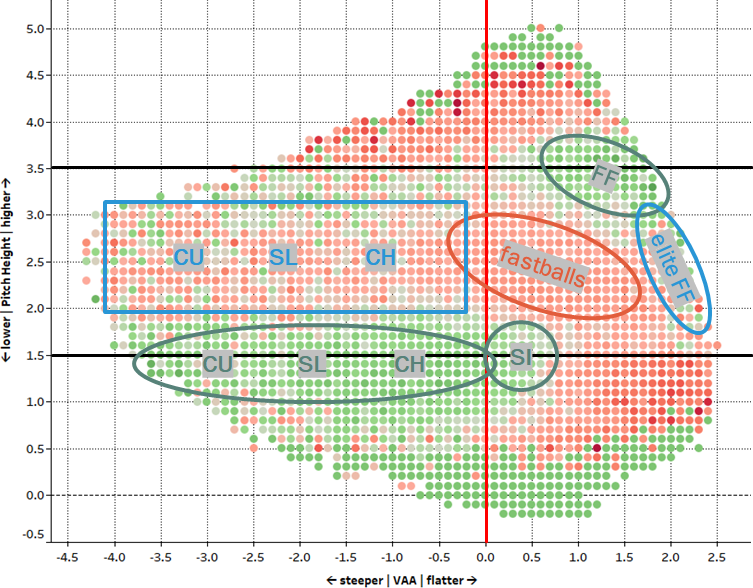
In this house, we celebrate flat four-seamers up (with gutsy, elite four-seamers down the middle), steep sinkers down, all kinds of breaking and off-speed pitches down, and a hanging secondary in favor of a hanging fastball. Also, I know the heat map makes it looks enticing, but I do not endorse spiking pitches in the dirt. Sorry.
Final Thoughts
VAA can be many things, but it isn’t everything. I am reluctant to overstate its importance, although I am also reluctant to understate it. This analysis is deliberately reductive to illustrate broader points. I have made a loose declaration as to where flat four-seamers and steep sinkers work best and why (they appear to rise over/dive under the bat), but they don’t always work for the same reasons — it could be velocity, it could be release point, it could be those dastardly seam-shifted wake effects. Realistically, it’s some combination of all these things, interacting slightly differently for each pitch and pitcher.
VAA is useful, though, because it captures the interaction of multiple pitch attributes at once. Sometimes, we don’t know exactly which attribute within VAA is wielding the greatest influence on a pitcher’s success: deGrom thrives via velocity, whereas Paul Sewald found breakout success thanks to a lower arm slot that begets an absurdly flat fastball. VAA Above Average is even more useful because it helps us cut through this noise a little more quickly. And to be clear, you can also adjust VAA in a myriad of ways. I chose a pitch height adjustment because of the launch angle implications, which are important to contact quality. But it’s not the only way!
The cultivation of a flat four-seamer or a steep sinker is the cultivation of capital-S Stuff. Stuff buys you wider margins for error; it’s why some pitchers can afford to just throw it down the middle. But I will argue, and stubbornly expect you to agree, that many pitchers lack the requisite Stuff to throw it down the middle, with such a decision ranging from “fine, but not ideal” to “extremely ill-advised.”
Accordingly, the less impressive a pitcher’s Stuff, the more dependent he probably ought to be on pitch location. But! You can still achieve good outcomes with bad pitch shapes. Let us not resign pitchers to predetermined fates. Some pitchers will defy the expectations set here. It should be noted, however, that those pitchers are probably outliers in their own right, using extreme pitch specs in atypical ways. This author is convinced there isn’t a “best” way, just different ways, specifically ways that emphasize uniqueness and separate oneself in a manner hitters don’t usually encounter. An elite VAA (Above Average) kind of serves as a nice shorthand for this concept.
It occurs to me that pitchers who (1) throw two fastballs, like a four-seamer and a sinker; (2) can mirror the release speeds, release points, and spin axes of the two fastballs; and (3) can generate wildly different movement profiles on each (especially if the movement includes optimal VAAs in optimal locations) can succeed wonderfully. That’s Zack Wheeler, and Lance Lynn, and Pablo López, just to name a few — and they’re all pretty dang good. I could write an entire post about pitchers who do this (don’t make me!). Ben Clemens happened to get that conversation started this past Friday, highlighting Wheeler, among others, as someone who weaponizes his fastballs to exploit hitter fly ball/groundball splits. I digress, but this thread has barely been pulled.
Lastly, on my Pitch Leaderboard, I host data for VAA (‘Specs’ tab) and VAA Above Average (‘Experimental Stats’ tab). If you’re a baseball nerd who is interested in VAA but wise enough to not want to deal with millions of lines of Statcast data, I hope the Pitch Leaderboard can help you!
Two-time FSWA award winner, including 2018 Baseball Writer of the Year, and 8-time award finalist. Featured in the print edition of Baseball Prospectus since 2022 (2026 edition out now). Biased toward a nicely rolled baseball pant.
This is outstanding! Thank you.
Wow. Really puttin’ the graphs in “Fangraphs!”
Fantastic Post
Ties in nicely with the Joe Ryan article in terms of explaining how he’s produced such excellent results with apparently underwhelming “stuff”.
joe ryan’s FF’s VAA AA is +0.65° and is a pop-up machine. he’s very much a Dude!
Clearest VAA analysis I’ve seen. V4A seems like the way to go!
Oh my goodness, my brain hurts! This is some really good stuff! I have so many questions/comments, but let me check if I got the general gist down first: Other things equal, flatter 4-seamers and steeper 2-seamers are better because they’re able to be thrown at more vertical locations within the zone but are particularly effective up in the zone and down in the zone, respectively. VAA measures steepness/flatness of a pitch and can be calculated (via the aforementioned physics) using Trackman output. Adjusting for pitch height and type, VAA can be measured in degrees and scaled on a 20-80 scale. Correct?
Assuming that’s the general gist (and that’s a big if), the most effective use of VAA would be from a player evaluation standpoint, correct? I’m assuming VAA is similar to spin rate in that it isn’t a skill a pitcher can develop. Rather, it’s more of an innate characteristic of a particular pitch. As a result, not much use from a player development standpoint, other than a game planning standpoint maybe. And I can’t envision it adding much value in terms of advance scouting, above and beyond what’s already available.
If everything I’ve said so far is more or less correct (again, a big if), I have a more esoteric question about the industry as a whole. So from a scouting/recruiting perspective, VAA basically quantifies qualitative characteristics that traditional scouts have used to describe fastballs forever, correct? Every minor-league stadium has a Trackman I believe, but not every college or prep field does presumably. Taking into account those limitations, is it more effective/efficient to scout/measure VAA using traditional scouting or analytics?
I may not be asking that question correctly, but what I’m trying to get at is basically: can a scout eyeball a pitcher’s fastball and do just as good of a job as VAA without having to go through aforementioned calculations (which are intellectually challenging and presumably time consuming) and being limited by the availability of Trackman? Or conversely, do scouts not do that good of a job of evaluating this and VAA is another example of analytics improving upon traditional scouting? Or is it not so black and white?
Obviously, a lot of this is subjective and will depend on the quality of the scout and/or the analytics department, but I’d love to hear your thoughts Alex as well as thoughts from anybody else who might have insight or just a different perspective!
This is essentially quantifying what it means to have a riding fastball or a heavy sinker, yes.
I’m not sure it’s useless from a player development perspective, but it would probably require some pretty fundamental delivery/arm slot changes.
I agree that I don’t think it’s useless from player development. I think Paul Sewald is a great example of that. You can take subpar characteristics and make them great. For him, it took a pretty extreme change in arm slot/release point. But I also think those kinds of changes might become more common. Of course, if you go to Driveline or whatever, you could add 3 ticks to your FF. That could cultivate more flatness, too—unless, of course, you need to raise your arm slot to unlock it. Then it might be zero-sum in that regard.
I think you can probably sight-scout a flat fastball. Like, from the naked eye I’m not sure I would know what a “flat” fastball looks like compared to a regular one when the difference between flat and average is decimal points of a degree (°). But if a dude is getting whiffs up in the zone and has some combination of high velo and/or a lower arm slot, you can kind of intuit that that’s the case. Obviously, data would help confirm, and I think I would always rely on that before I rely on a scout’s guesswork. But I think a scout could guess a pitcher’s VAA very acceptably based on knowing the primary influencers of VAA; you can kind of sleuth your way to the answer if you’re zeroing in on a particular pitch height (like pitches up in the zone), are seeing excess whiffs there, and have existing knowledge of the pitcher’s velo/slot. Not sure if I’m really answering your question, mhartzell415, so feel free to follow up.
What I do think is interesting, and this is apropos of nothing, is I think a lot of the reason flat fastballs work is because hitter muscle memory inhibits the ability to recognize as flatter than usual. But if all pitchers go this direction, it could undercut the effectiveness because hitters will already be calibrated to expect flatter. It’s probably not the kind of thing that happens overnight because hitters cultivate pitch recognition over years, if not decades, of playing baseball, but I could see some kind of equilibrium reached eventually.
Absolutely! As you could probably tell, I was just kind of rambling, so I was really just looking for thoughts. Thanks for the response!
“I could write an entire post about pitchers who do this (don’t make me!).”
…
Please do this!
Second.
Wow. Thank you for this, Alex. Bravo.
This is awesome! I love these kind of articles. I had one thought about the effects of VAA on swing rate. The correlation between VAA and swing rate looks real but the causation is tenuous at best. VAA describes the pitch as it crosses the plate but he swing decision is made well before that (167 msec by tom tangos estimate i would says more in the 170 msec range if you account the time delay for time it take the brain to process visual information). I would think something like location and approach angle of the ball at the point of commitment would be a better way to look at how pitch shapes effect on swing rate. It would probably be highly correlated with VAA but it would help tell more of the full story.
I think swing decisions are largely tied to muscle memory but also to an unconscious encyclopedic knowledge of pitches seen previously. I think the correlation between swing rate and the intersection of pitch height and VAA is a product of this. Another way to put it would be, the correlation between swing% and what the hitter expects the pitch height to be might be perfectly flat. It’s just that a flatter fastball will appear to come in at pitch height X but actually come in at pitch height X+1 (+1 being some distance slightly higher than whatever X is). So I think the correlation between swing% and pitch height is circumstantial, like you said, but I think it’s indicative of how much higher in the zone the pitch is coming in compared to where he expected it to come in. If that makes sense.
For example, this is the FF swing% graphic here. Let’s choose pitch height = 2.2 ft. At 0.0° VAA AA, aka perfectly average VAA, the expected and actual pitch height are the same at 2.2 ft. At +1.0°, however, expected remains 2.2 ft but is actually closer to 2.4 ft; conversely, at -1.0°, expected is 2.2 ft but is actually closer to 2.0 ft. So the swing rate ends up correlating with actual height, but the swing rate is unaffected by the hitter’s expected height, which remains neutral based on muscle memory and subconscious decision making. Let me know what you think of this theory!
Could you explain what the variables y_0 and y_f are in the calculation of VAA?
This one is going to take me a couple of reads to digest and I really appreciate that!
Question: do teams have the ability to create a projection model of how a pitcher’s pitches would move if a pitcher changed his arm slot?
Obviously the Rockies don’t because Rockies, but say another team wanted to aquire Marquez and change his arm slot to potentially make his fastball more effective. In this scenario there’s the potential he’d have to rework his secondaries in the new release point/arm angle and maybe those pitches lose their efficacy, no? Can a team use his spin axis and spin rate and everything else to create a model of how his secondary pitches would work in the new arm slot or would it simply be a gamble?
Sorry for the rambling, didn’t really know how to ask what I wanted to ask.
Incredible stuff! I’m going to have to reread the whole thing.
Including keys to the colors on the different graphs would be hugely helpful I think.