
Angels Pay for Durability, Sign Julio Teheran
Since 2016, only one other team has lost more players to the Injured List than the Los Angeles Angels. They’ve cumulatively lost over 5,600 days to various injuries during the last four seasons, the second highest total in the majors behind the Padres. And a significant number of those injuries have decimated their pitching staff.
| Player | 2016 | 2017 | 2018 | 2019 | Total |
|---|---|---|---|---|---|
| Andrew Heaney | 180 | 139 | 16 | 83 | 418 |
| Garrett Richards | 150 | 153 | 103 | — | 406 |
| J.C. Ramírez | — | 42 | 177 | 125 | 344 |
| Matt Shoemaker | 28 | 107 | 154 | — | 289 |
| Nicholas Tropeano | 97 | 183 | 105 | 63 | 448 |
| Shohei Ohtani | — | — | 26 | 41 | 67 |
| Tyler Skaggs | 115 | 99 | 55 | 14 | 283 |
The pitchers listed above account for over 2,200 days lost to injury over the last four years, nearly 40% of the team’s cumulative total. And that doesn’t even take into account the relievers and other less established starters who also lost time to injuries, or Tyler Skaggs’ tragic passing earlier this year (the days listed above include his 2019 IL stint, not the season days following his death). The Angels’ trouble keeping their pitching staff healthy has been one of the major reasons they haven’t come close to sniffing the postseason since 2014 despite employing the best player in baseball.
Signing Anthony Rendon to a long-term deal is one big step towards providing Mike Trout with a capable supporting cast, but the holes in the pitching staff still needed to be addressed. Shohei Ohtani looks to be fully recovered from his Tommy John surgery, which will definitely give the rotation a boost. Trading for Dylan Bundy was a low-risk, high-variance addition. And on Thursday, the Angels took another step towards solving their pitching woes, signing Julio Teheran to a one-year, $9 million deal.
Since his first full season in 2013, the soon-to-be 29-year-old has made the fourth most starts in the majors and has accumulated the ninth most innings pitched. He’s made at least 30 starts in seven consecutive seasons and only missed out on reaching at least 175 innings pitched in all of them by a third of an inning in 2019. That kind of durability for a pitcher is rare in today’s game, and of all the teams in baseball, the Angels will appreciate it the most.
Even though Teheran has been up on the mound consistently for the past seven years, the quality of those innings has waned a bit recently. From 2013 to 2016, he posted a park and league adjusted ERA 13% better than league average, though his FIP- was two percent below average. More recently, he’s struggled with a rising walk rate and the homer-happy offensive environment, leading to a FIP- 14% below league average over the last three seasons.
Throughout his career, he’s been able to outperform his peripherals. Much of that is due to an ability to suppress hard contact against him despite a batted ball profile that skewed heavily towards fly ball contact. That combination helped him post low BABIPs for much of his career. But with fly balls flying out of ballparks at unprecedented rates, he’s really suffered in spite of the weak fly ball contact he’s inducing.
On major point of concern has been Teheran’s declining velocity over the past few seasons:
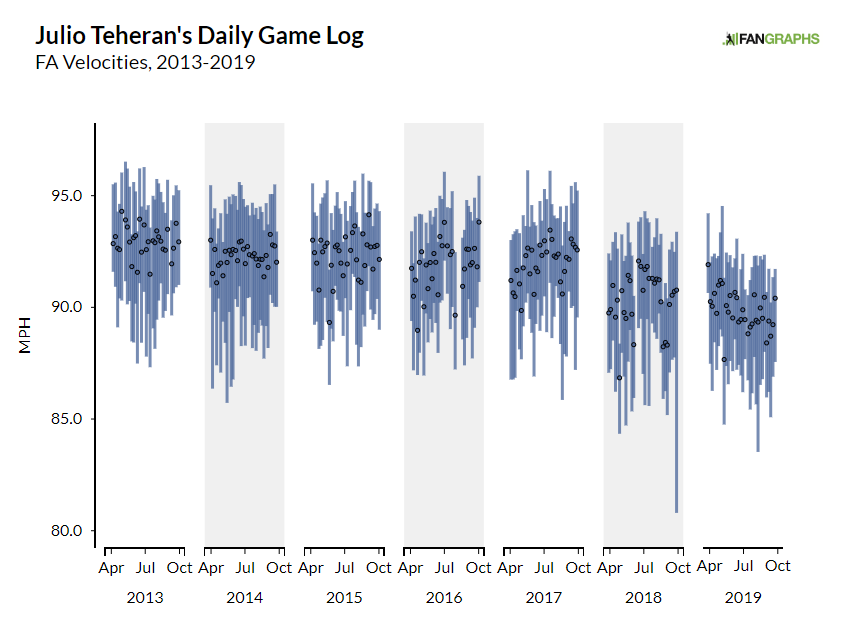
His four-seam fastball has gone from averaging 92 mph in 2017 to just under 90 mph this year. That’s a discouraging trend, and might be an unfortunate side effect of his ability to stay on the mound consistently. The Braves were concerned enough about his slipping peripherals to buy out his 2020 club option that would have been worth $12 million.
With Teheran now in the fold, the Angels have four of their rotation spots filled, with the two youngsters, Griffin Canning and Patrick Sandoval, battling over the remaining slot. With Ohtani back on the mound in 2020, it wouldn’t surprise me to see the Angels employ a six-man rotation for portions of the season to manage his workload. If that’s the case, another starting pitcher acquisition wouldn’t be out of the question. They missed out on the Gerrit Cole sweepstakes, but have been connected to a number of other upper-tier free agents. With Teheran, their starting rotation is projected to accumulate 10.7 WAR (based on our Steamer-powered Depth Charts). That total ranks ninth in the American League but fourth in the AL West behind the Astros, Rangers, and Athletics. Teheran is a good addition that gives their rotation some needed consistency, but he doesn’t necessarily raise the ceiling of the pitching staff much.
Jake Mailhot is a contributor to FanGraphs. A long-suffering Mariners fan, he also writes about them for Lookout Landing. Follow him on BlueSky @jakemailhot.
He’s always beat his FIP historically. This isn’t the pitcher I would have bet on at 9 mil but we’ll see if he can keep beating the peripherals in 2020.
He’s outperformed his FIP by at least 0.39 points every single season since his rookie year. My Braves have had some solid infielders over the years, but they were kinda meh during the rebuilding phase. Not enough credit goes to Teheran – who has the arguably the best right-handed pickoff move I’ve ever seen. He can dominate the running game while fielding his position very well. Not to mention, the Angels are going to have a top-tier infield defense in 2020. I’ve got a feeling that he’s going to be a good addition in LA as a high-volume guy who will continue to outperform his peripherals by a solid amount. He may not be who you want starting for you in a postseason game, but I could see him providing season-long dependability – something they’ve sorely lacked in the Trout era.
I wish nothing but the best for the greatest athlete in Atlanta sports history named Julio. Gonna miss ya JT!
I guess you don’t watch the Falcons.
That’s the joke
$9m for a guy who’s been worth at least 2 wins in 6 of the last 7 seasons, and each of the last 2?
I’d freakin take that gamble.
He hasn’t been worth 2 wins since 2016
Since it’s deeply stupid and afactual to regress a pitcher’s BIP outcomes when we’ve more than doubled the sample size needed for those runs to become stable…I’m not using FIP-WAR
It’s his awful walk rates and average K rates that are keeping him from being worth 2 wins, not the BABIP.
lol.
Do you understand why “look at his K/BB!” doesn’t actually refute the claim that it’s dumb to use FIP-WAR for a pitcher with over 1300 IP worth of BABIP data?
If not, this isn’t a useful conversation.
Teheran 1@9 makes a lot more sense than Perez 1@6.5, but that’s just my opinion
Also, if you include Porcello’s 1@10 as a point of comparison, Teheran’s valuation seems low.
Why? For one million more Porcello offers both more upside and more durability. Just look past he era for a second, Teheran projects as one of the worst starters in the MLB next year, while Porcello projects as average.
In between their HR rates relative to each other and recency bias (Porcello coming off a much worse season), I think Teheran over Porcello is at least a debate. Porcello has had a HR problem emerge over the last three years. A lot of the negative Steamer projection on Teheran is predicting a big HR rate jump. It calls for a 1.77 HR/9 – Teheran has never come close to approaching this throughout his career, and was at 1.13 in 2019 without running a single digit HR/FB. It thinks he’s going to give up 13 more HR than 2019 in only 4.1 additional IP. I don’t buy that part of his projection.
Also, when a guy has a better ERA than FIP and xFIP in every single full season across almost 1400 IP, I’m willing to accept the pitcher has some degree of control over that. That’s a huge sample.
One part of outperforming FIP is controlling base runners and Teheran does a great job at that. He’s one of the best at picking off runners. I know it doesn’t mean a ton, but it counts for something.
FIP is a flawed statistic and I think we should start thinking of it as such. It assumes so much of pitching is random, when we have evidence otherwise.
It’s not a flawed statistic. Perhaps fWAR for pitchers is flawed, but FIP accurately tells you something. It’s just that some people overstate or misinterpret it.
But for smaller samples FIP has been shown to be more predictive of future success.
But when you have a batted ball sample this large, it’s silly to keep pointing to it.
I totally agree. It’s probably still not totally useless. Like, all else equal, I’d still rather have the guy with a lower career FIP over 1400 innings, but it’s relevancy at that point is small, especially when you can’t really point to some amazing defense.
While it would normally be accurate to focus beyond ERA in pitcher projection, as mentioned in the article, Teheran has consistently out-performed his xFIP and FIP year-in and year-out — as in the only season in his MLB career he didn’t out-perform both was a 6.1 stint in 2012 — due to a uniquely low BABIP and high LOB% year-in and year-out.
While FIP is a fairly strong measure, it’s not perfect, and at such large samples as Teheran’s career, his BABIP-reducing skill is statistically very significant.
I disagree that FIP is flawed. It’s not flawed if you know what it’s saying and what it’s not saying. It more accurately reflects a pitcher’s contributions based on his component inputs – BB/9, K/9, HR/9 – than ERA does, because e.g. it cuts through inherited runners and LOB% that introduces noise, especially for relievers.
It’s flawed if you think FIP was introduced as a universal pitching talent metric that solves everything. FIP is going to miss on quality of contact, hit rate and defense, in cases where the pitcher has a demonstrable ability to impact metrics where we might see that reflected – H/9 and BABIP, HR/FB, etc. Fielding metrics and fielding independent pitching have come miles in 10 and 20 years, but there’s still no perfect way to isolate everyone’s impact on everything. FIP will treat a plus stuff and fringe stuff guy the same (beyond whatever the component inputs themselves dictate), and it’s going to assume that a low BABIP, low HR/FB, etc in any given season is an outlier due for regression, because we’ve baked in quality of contact as average across all pitchers, and for more pitchers than not, there is little control over it as the sample grows. Not all pitchers have no impact on quality of contact, so you have to use FIP as a very helpful guide and baseline as you decide which pitchers are pitching over their heads, and which pitchers may have skill here – as other commenters mentioned and I was unaware of, perhaps Teheran’s control of the run game is a skill that FIP doesn’t pick up on, but that does impact the sequencing of the H and HR he surrenders and success at converting base runners into runs.
FIP doesn’t normalize or regress HR/FB, though. That’s one of its major flaws, as it assumes that all home run rates are earned when we know that isn’t true.
It also assumes that no BABIP rates are earned, when we know that’s not true.
FG’s FIP-WAR’s gotten better since they started counting IFFBs as strikeouts, but it still stops being as useful as RA9-WAR after 600 innings or so.
Does this mean they’re not going after Dallas Keuchel? He’s the perfect fit for that team.
I thought for sure they would sign Keuchel, as his GB stuff seems to be a way better fit. I could see the Brewers picking up Keuchel now. They’ve been hanging out in the mid-grade bin all offseason so far, and though Keuchel isn’t really a top-tier FA, he could be there household name this winter.
Padres
It does now that he’s signed with the White Sox.
Man Steamer is harsh on Teheran. I don’t see him being what he was earlier in the decade, but there’s no reason to expect THAT big of a dropoff. This past season Angel Stadium ranked 10th most homer friendly and SunTrust was only a few spots behind, so not much of an impact there. Teheran’s sinker is still extremely useful (his fastball ranked within top 5 this past season, among SP). I think he continues to be a decent innings eater.
It’s interesting that durability is the headline here given it was injuries that took him from a likely #1 type starter velocity to…. not that. Not disagreeing with anything in here, he’s an innings eater, but it’s always a bit sad to think of what might have been.
Yeah, he’s a solid #3…but he could have been a stud.