
Anthony Rendon’s Hot August Adds Third Face to MVP Race
For the first few months of this baseball season, everything had been coming up “Belli vs. Yeli.” Of course, this was for good reason.
Since the two sluggers got off to scorching starts, the race for the National League Most Valuable Player award has centered entirely around Cody Bellinger and Christian Yelich. Major League Baseball itself basically even recognized that these two candidates had lapped the field, releasing a commercial prior to the All-Star break featuring Bellinger and Yelich playing a comical game of M-V-P.
But baseball is a long season, and even the surest things are never a given. We might just be witnessing that right now. Nationals third baseman Anthony Rendon is one of baseball’s most underrated players. Despite ranking ninth in WAR since his debut season in 2013, Rendon was finally voted in to his first All-Star game in 2019, though he did not attend. He is a player who Sam Fortier of The Washington Post described as “infamously attention-averse,” and he is also a player who just completed the third-best offensive month of his career. Anthony Rendon demands attention, and in a big way. With his excellent play last month, he might have thrust himself into the mix for the league’s highest individual player honor.
First, let us gawk at Rendon’s incredible month. In August, he hit .394/.450/.712 with a .467 wOBA and a 189 wRC+. He produced 1.9 WAR, the second-highest total among all position players:
| Player | Team | WAR |
|---|---|---|
| Alex Bregman | Astros | 2.2 |
| Anthony Rendon | Nationals | 1.9 |
| Kyle Seager | Mariners | 1.9 |
| J.D. Martinez | Red Sox | 1.7 |
| Jonathan Villar | Orioles | 1.7 |
| Trevor Story | Rockies | 1.7 |
| J.T. Realmuto | Phillies | 1.6 |
| Mike Trout | Angels | 1.6 |
| Carlos Santana | Indians | 1.6 |
| Juan Soto | Nationals | 1.5 |
Clearly, it was quite the month for Rendon, but it wasn’t even the best offensive month of his season, let alone his career:
| Year | Month | PA | AVG | OBP | SLG | wOBA | wRC+ |
|---|---|---|---|---|---|---|---|
| 2017 | July | 90 | .392 | .500 | .689 | .493 | 206 |
| 2019 | Mar/Apr | 86 | .356 | .442 | .740 | .472 | 192 |
| 2019 | August | 120 | .394 | .450 | .712 | .467 | 189 |
| 2018 | Sept/Oct | 123 | .352 | .439 | .657 | .456 | 189 |
| 2017 | May | 109 | .308 | .422 | .615 | .430 | 165 |
Rendon’s April this season was actually better than his August on a rate basis. It was cut short, however, after Rendon was hit by a pitch on April 20 and placed on the injured list on April 27. From April 21 through May 6, Rendon made just one appearance, going 0-for-3 with a walk on April 26. Since overall value depends heavily on volume, this injury put Rendon into a fairly sizable hole from the get-go. Even though his April was technically better than his August, he produced four more weighted batting runs in August (15.3) than in April (11.3).
What also makes Rendon’s August especially key as it pertains to the NL MVP race is the fact that the two favorites, Bellinger (0.9 August WAR) and Yelich (0.8), are absent from the above list, allowing Rendon to close the gap in full-season WAR and enter this very conversation. Had Bellinger and/or Yelich continued their early-season dominance, Rendon would still be a distant third:
| Month | Bellinger WAR | Yelich WAR | Rendon WAR |
|---|---|---|---|
| March/April | 3.0 | 2.1 | 1.4 |
| May | 1.2 | 0.6 | 0.9 |
| June | 1.0 | 1.8 | 1.0 |
| July | 1.0 | 1.4 | 1.1 |
| August | 0.9 | 0.8 | 1.9 |
As you can see, August was the first month in which Rendon led the other two candidates in WAR. Outside of March/April, however, he’s been pretty close this entire time. In fact, since May 1, Rendon has produced 5.2 WAR, the second-most in the National League, behind only Ketel Marte (5.4). Yelich (4.7) and Bellinger (4.2) are in third and fourth, respectively. Using WAR can be a little iffy with breakdowns like these due to the nature of how defensive stats are treated in smaller samples, so let’s compare their offensive numbers with wRC+:
| Month | Bellinger wRC+ | Yelich wRC+ | Rendon wRC+ |
|---|---|---|---|
| March/April | 246 | 205 | 192 |
| May | 154 | 122 | 140 |
| June | 140 | 187 | 141 |
| July | 143 | 179 | 146 |
| August | 129 | 140 | 189 |
In both tables, we see an interesting trend. Bellinger jumped out to a huge lead over the other two players before Yelich took over in the midsummer months. August was the only month in which Rendon led in either statistic, and you can see he led in both. We can do better at visualizing this though. While putting Rendon’s great August in context is certainly helpful, we can see just how much he has gained on the other two MVP candidates by looking at their cumulative WAR totals throughout the season. Again, it’s worth mentioning that this graph is an approximation, as defensive stats are added in retroactively:
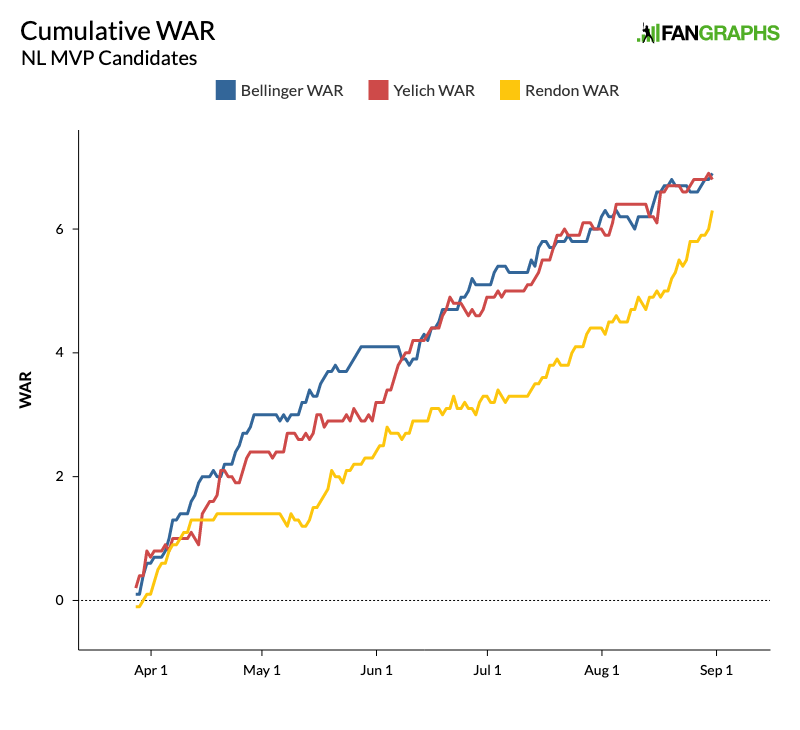
The point is driven home. For the majority of the baseball season, the NL MVP race looked like it had just two candidates. But because Bellinger and Yelich have seen their respective rapid paces slow a touch, in combination with a Rendon leap, we’ve now got three true candidates in the field. Rendon’s August was just that good, and it came at just the right time.
The question is though, can Rendon fully close the gap? It would require another Herculean effort over the final four weeks of the season. Through games on September 1, Rendon trails Bellinger and Yelich in WAR by 0.6 and 0.2 wins, respectively. He’s well outside the home run race, and his park-adjusted offensive numbers just aren’t quite as good. Rendon doesn’t even have the defensive argument to back him up, either; Bellinger’s been better there, too. While it’s certainly no longer a two-man race for the NL MVP, Rendon still remains a long shot.
Regardless, the fact that we’re even having this discussion is good news for both Rendon and the Nationals. In August, while Rendon was tearing up National League pitching, the Nationals went 19-7. Their playoff odds increased from 75.3% on July 31 to 97.9% on August 31. Rendon has been the second-most impactful player by championship win probability added. As the Nationals have solidified their standing in the postseason race, Rendon has been the man to lead their offense.
All of this has come in a contract year for Rendon, too. He’s expected to be one of the most sought-after free agents this offseason, and adding a top-three MVP finish onto his résumé will just confirm what teams already know: Anthony Rendon is one of the best players in baseball. Over the past month, he’s added his name to the list of highly qualified NL MVP candidates, and he might not be in the driver’s seat for now, but he should start to stir some conversation if this level of play is kept up.
Devan Fink is a Contributor at FanGraphs. You can follow him on Twitter @DevanFink.
Habitually underrated/off the radar player, despite how consistently good he’s been. Always feels like a “consolation prize” despite putting up solid numbers year over year.
Is it even a two-man race at this point?
Baseball Reference has Bellinger with a huge lead at this point (8.3 WAR vs 6.3 for Ketel Marte). That’s going to be hard for a lot of voters to ignore.
Yelich’s “calling card” at this point is that he leads the NL is OBP, SLG, and OPS. But Bellinger isn’t far behind. And he’s played in 12 more games which some voters will like. And his team is going to make the playoffs, whereas Yelich’s probably won’t. Again, that will appeal to some voters.
Obviously plenty of games to go but seems to me like this is Bellinger’s to lose.
bWAR’s defensive calculations crush players with negative DRS (and reward positive DRS) in a really dramatic way that fWAR and WARP don’t with their respective defensive calculations. I’m pretty skeptical of it for that reason. I recall last year they had Bryce Harper at replacement level or something like that, which…I know it was a bad year for him defensively, but that is just too much.
Just because one system gives more extreme values than the other doesn’t mean that it’s necessarily wrong or worse. It’s not like we have some sort of “objective reality” that we can compare the numbers to.
Beyond that, I’m not sure how many voters will care. They’ll see that they’re close on Fangraphs, and that Bellinger has a big lead on BR. And they’ll likely split the difference, which gives Bellinger the definite edge. Throw in the other things I mentioned (Bellinger being healthier and the Dodgers being in the playoffs) and Bellinger is the clear favorite at this point.
The betting odds on Bellinger right now are about-325 (76.5%) to -450 (81.8%) which seems about right to me.
I think you give the voters way too much credit. They’ll probably just look at Bellinger’s home runs and his team’s 100 wins and hand it to him. The right guy for the wrong reasons.
Aside from that, I think the real question is whether defense is weighted properly in relation to offense. We should be able to empirically figure out how much offense matters compares to defense. If BR overweights defense it should be pretty obvious to figure out.
Not sure what you mean by “the real question is whether defense is weighted properly in relation to offense.” I’m not aware of that being done. BR has pretty detailed public explanations on their website of how they calculate WAR and there’s no mention of anything like that.
“We should be able to empirically figure out how much offense matters compares to defense.”
And how do you suggest we do this?
Probably with some sort of decomposition. I see people bandy about the idea that offensive performance is more important than defensive performance, and I’m sympathetic to that argument, but I haven’t seen anything yet that shows it.
No idea what “decomposition” is supposed to mean. Beyond that the idea that “offensive performance is more important than defensive performance.” is clearly wrong. One is merely the opposite of the other. We know, for example, the value of a hitting a single. The defensive value of preventing a single would simply be the opposite of hitting a single.
The big issue in defensive stats has to do with assigning responsibility. For example, the left fielder makes a great play and receives all the defensive credit. But maybe the CFer could have made the play as well. But since the CFer wasn’t involved in the play, they receive no credit. Or a catchable ball falls between two fielders. How do you divvy up responsibility between the two fielders for allowing a catchable ball to become a base hit? We know what the value of the hit is but we don’t know how to properly assign responsibility for allowing it to happen.
I guess Alex Bregman is the new Anthony Rendon, as a similar article could have been written about him, but he was overlooked.
By bWAR, which fair or not is used more by voters, Bregman has closed to within 1.4 of Trout, while Rendon is 2.2 back. Bregman also has the advantage of Trout playing for a non-contender and Trout being (inexplicably) the “boring pick.” I still think Trout and Bellinger win, but if I were betting on a dark horse I’d go for Bregman.
I doubt Bregman is going to be winning an MVP barring Trout in poor health – but I do think that Bregman/Rendon are pretty good comp.
WAR accumulating 3B with pretty outstanding eyes for the zone, solid defenders, and have really played in the shadows of teammates in past seasons which causes them to be overlooked (Altuve, Harper both former MVPs for example).
And to be honest, maybe just this year only, but I’ve seen a lot more use of fWAR in media publications rather than bWAR. Obviously bWAR still gets plenty of use from media, but by just my own account (Twitter writers for various outlets, Washington Post/The Athletic has tended to lean more fWAR lately with younger staff/beat writers) I think the split of WAR calculations is closer than we might realize.
Ben Clemens on Bregman/Rendon from earlier this year: https://blogs.fangraphs.com/anthony-rendon-and-alex-bregman-are-the-same-and-also-different/
I don’t know if I would agree that Bregman is “overlooked”.
People paid more attention to Bregman over the last three years than they did to Rendon over the last six years.
https://trends.google.com/trends/explore?date=today%205-y&geo=US&q=%2Fm%2F0ch4jbs,%2Fm%2F0w5s_wl
being more popular than Rendon in Google search terms doesn’t necessarily mean Bregman still isn’t overlooked, particularly when it comes to his own team.
those spikes in his search history are primarily from WS/ALCS games which isn’t something Rendon or Bregman can really control. What can be controlled however were Bregman’s 2018 ASG/HR Derby appearances – which certainly help and explain a difference between the two.
However Bregman since 2017 (first full season) by the same logic has been in the 3rd tier of Astros players with Correa and Springer as Verlander and Altuve hold up the first two tiers.
https://trends.google.com/trends/explore?date=2017-03-25%202019-09-03&geo=US&q=%2Fm%2F0w5s_wl,Jose%20Altuve,Carlos%20Correa,%2Fm%2F09q5m1,George%20Springer
I think the MLB has done a good job of marketing him in recently though, between back to back HR Derby selections and just overall appearance in media circles and it makes sense. But I expect whenever Rendon gets his paycheck there’ll be a significant spike in his search history given it’ll likely be a ton of money – and maybe that will follow with marketing behind him too, especially if it’s with a new team that is excited to show off their new ~$250M man.
Even dismissing the postseason and HR derby spikes, it is pretty clear that Bregman attracted more attention than Rendon.
Also, Altuve and Verlander are well established veterans and have been just as good so being less popular than them is… fair?
I don’t know why you think that it supports your idea.
Overall, in the past three years, Bregman has been searched more than Arenado, Turner, Seager, Freeman, Greinke, etc. and is on par with Chris Sale.
Sounds about right to me.
I was not being literal in calling him overlooked. All I really meant is that he was overlooked in this article since I think he has a better case for “guy that has jumped into the MVP race.”
People always say the uncertainty in WAR is about 1.0. If Bregman narrows the rWAR difference to Trout to that, he will be in serious MVP contention, being the classic best player on the best team (or one of the two best teams). But working against Bregman is that he isn’t leading the league in anything. He’s among the leaders in a lot of categories, but doesn’t have one standout stat that attracts attention. In addition to his usual OBP/SLG/OPS leads (but watch out for Cruz in SLG), Trout will probably lead the league in HR, and maybe RBI. Those two stats, plus a WAR lead, should be enough for him to win.
FWIW, Trout’s WAR lead over Bregman at BBPRo is similar to his lead at FG, whereas at Baseball Gauge, Bregman has almost pulled into a dead heat with Trout.
I don’t know. The Dodgers are so dang good, and Bellinger has been so dang good. He’s the best player on the best team in the NL, and even if voters are hopefully beyond that simplistic metric and look at WAR, I think if the season ended today that is what would push him over. And since that would be a deserving win, I wouldn’t complain. (In contrast to those few people who are inevitably going to vote for Bregman over Trout, who should be publicly shamed).
Remember that it’s the MVP Award, not the Player of the Year Award. It’s become tradition that making the playoffs is an important factor in judging a player’s “value” to his team, and I don’t have a problem with it if the voters see it that way just as long as they’re still willing to vote for a player on a non-playoff team when he’s easily put up the best numbers in his League.
I agree with the first half of your post.
If you take the position that ‘value’ means something other than the performance that would most help any team, you end up inexorably driven to conclude that championship win probability added (cWPA) is the only MVP metric that matters. The current leaders are Christian Yelich (by a mile) in the NL and a tie between Matt Olson and Carlos Santana in the AL.
It’s a consistent and defensible position, but not one that many voters will adopt.
Yelich had a huge finish last year in September to wrap up the award. He’s probably gonna have to do that again if he wants to repeat. He’s pretty clutch, so let’s see if he can do it.
Also, it’s interesting to see who’s 4th in the National League, after these three guys, in wOBA, wRC+, and OPS. A guy who’s 20 years old, and who’s definitely *not* having a sophomore slump!
Rendon has virtually no shot at the MVP award, because he flies too far under the radar. And I say that as a Rendon fan. Even if he were to continue his August assault into September, he somehow will not get noticed except by diehard baseball junkies. I don’t have a sense that this causes Rendon much angst (really, watching him day-to-day, not much of anything seems to cause him angst). But there it is.
What does Freddy Freeman have to do to get some love? While I would only put him 4th behind the 3 acknowledged leaders he should get some mention for another great season. Maybe being consistently excellent instead of an up and down type makes people miss just how good he is every year and, of course, this is another opportunity for me to get some licks in against the defensive penalties that are imposed for reasons that appear specious. I am a huge fan of Pete Alonso but how does he have a higher bWAR than Freeman? Freeman does everything better than Alonso except hit home runs and he is only 5 behind him there. Freeman has more doubles, more BB’s and fewer K’s, but maybe I have found it! It must be the HBP’s.
What does Freeman have to do to get some love?
I dunno, double his WAR for the season?
Not be the 3rd best player on his own team?
Not have statistically the 2nd worst defensive rating in the National League?
3rd best? He is the leader of that time. You could argue that Acuna is a better talent or even has better numbers, but Freeman is right there and is the leader of the team and that is what vaults him to MVP of the team.
Some “quick look” differences- Freeman plays worse defense, he gets caught stealing more often (6/9 total is negative runs) and has about 30 more plate appearances than Alonso in order to have those numbers you’re citing.
These are the kind of numbers that don’t mean #%^&$. I despise defensive metrics but bWAR says Freeman’s defense is better than Alonso’s (-0.5 vs -1.4) and in today’s whiff happy game, when only a handful of balls are put in play on the ground, all a first baseman has to do is catch a few throws in most games. A check of several
well -respected first basemen, Votto, Rizzo, Hosmer and others shows that there is very little to separate them. Even Paul Goldschmidt, acknowledged as the best defender for the past few years has a negative defensive WAR. It is garbage. Who cares if he doesn’t steal bases, absolutely nobody. I doubt if the context of steal attempts is considered. and very few first baseman add much base running value. When and where has WAR become the sole judge of a players talent and value to a team? I guess I still believe that acknowledged team leader, mentor to young players as well as league leader in RBI’s, OMG, I mentioned that terrible acronym. still means more than a few numbers thrown together by people who never played in the majors. The game is played between the lines, not on some bleeping computer program, and Freddie Freeman has played a more important role than any other Brave.
True NATS fans know that Rendon has been our best all round all season player for most of the last 5 years. I really hope he is resigned.
I have trouble knowing if “resigned” here is meant to be read “re-signed” or “re-zined.”
I’ve always felt that we traditionally do the MVP wrong. It should go to the guy who creates the most wins in the league. Runs created in high and medium leverage situations and runs saved defensively in those situations should be the only things considered. Hitting a grand slam when your team is already up 10 runs shouldn’t count.
That is why watching games and not just looking at number totals is so important.
I will give you Rendon, but at this point Yellich has fallen off. He still has time to get back in it, but right now he is not there. Freeman or Acuna, depending on who you ask is better for the Braves team would be apart of the top 3.
Dude’s honestly the second coming of Scott Rolen.