
Are We at Peak Center Field Defense?
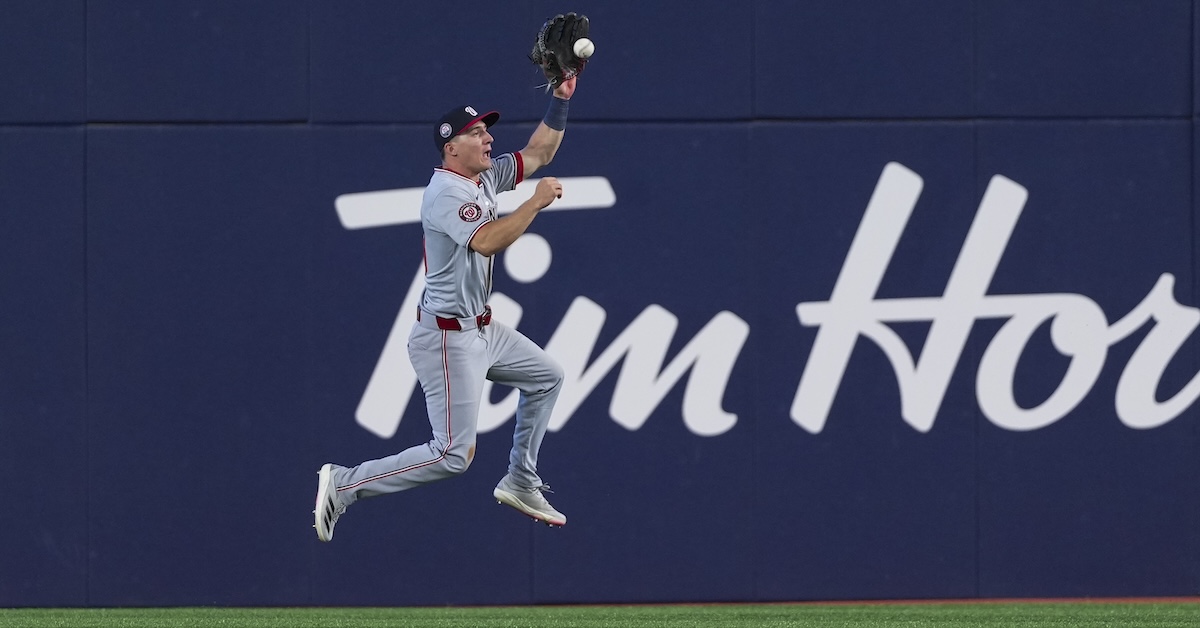
Last week, we received a mailbag question from a Jacob Young fan named David. Actually, it was a multi-part question, and the third sub-question was particularly fun: Are we now in an era of Peak Centerfield Defense? It seems like every team has a centerfielder that can go get it.
My gut reaction to this question was simple: Yes, we’re probably in an era of peak center field defense. I suspect the game has probably been in that era more often than not ever since integration, and that peak has kept on rising. I saved David’s other sub-questions for this Saturday’s mailbag, but for this particular one, I thought it might be fun to think it through and dig deeper than I could in the mailbag.
First, let me explain my gut reaction. More than any other position, center field rewards pure athleticism, and the athletes keep getting better. The player pool keeps expanding, and players (and humans in general) keep getting bigger, stronger, and faster. All of this means the bar to make it to the majors at all is that much higher. I’ve got baseball-specific reasons, too. The league keeps getting better at positioning defenders where the ball is more likely to go, allowing them to make even more of their superlative talents. And because we keep getting better at accurately measuring defensive contributions, we’re able to recognize and reward defensive value better than ever.
After saying all that, though, I have to admit the obvious: There’s no way to know the answer definitively. We have precious little Statcast data about Ty Cobb’s sprint speed or Duke Snider’s reaction time. Up until this century, play-by-play data is all we have to go on in evaluating defenders. Sean Smith analyzed that data to create a defensive metric called Total Zone, which is what informs the defensive grades on our leaderboards up until 2002, when more advanced defensive metrics like UZR, DRS, and FRV take over. Today’s metrics are nowhere near perfect, but take a moment to stop and think about how far we’ve come. Statcast can tell you exactly how much time every outfielder had to reach every ball, how far they traveled, how fast they ran, how efficient their route was, and how quickly they reacted as the ball came off the bat. That’s a long way from extrapolating from play-by-play data.
I realize that David wasn’t necessarily asking about the overall quality of center field play, but whether we’re living in a time when we’ve got a particularly high number of excellent defenders. It feels that way, right? Think of all the center fielders right now whom you’d classify as extremely good defenders. My list would definitely include Young, Pete Crow-Armstrong, Denzel Clarke, Ceddanne Rafaela, Victor Scott II, and Jose Siri, and I wouldn’t argue with anybody who also included Byron Buxton, Julio Rodríguez, Jake Meyers, Kyle Isbel, Michael Harris II, Daulton Varsho, Harrison Bader, or Myles Straw. I’m not sure what’s happened to Brenton Doyle, but before the season we would have put him on this list, as well. All of a sudden, we’ve got half the teams in baseball with an elite center field defender.
Now maybe it’s always felt that way. Just to pick a date out of a hat, if you go back to 1999, you’ve got defensive standouts like Andruw Jones, Mike Cameron, Carlos Beltrán, Steve Finley, Darren Lewis, and Kenny Lofton. If you go back to the 1950s, you’ve got Willie Mays, Mickey Mantle, and Duke Snider all in the same city. For that reason, I decided to see what I could do with the numbers available to me.
Even if we can’t know the answer definitively, we can have some fun with the data at our disposal. We have all these different numbers – TZ, UZR, DRS, DRP, OAA, FRV – but none of them matches up perfectly. They’re all working off different data sources. They’re all using different methods based on different philosophies. They’re looking at different eras with different styles of play. They’re all grading on different curves, judging players according to the league average in their particular year, which makes it very hard to compare players from different eras. It’s a glorious mess, but it means that we need to think of some other ways to analyze things.
Let’s start by considering how center fielders are earning their playing time. If you’re not hitting well and you’re not fielding well, you’re probably not going to stay on the field. If you’re doing one well, you can get away with doing a worse job at the other. Now take a look at how center fielders have hit since 1900.
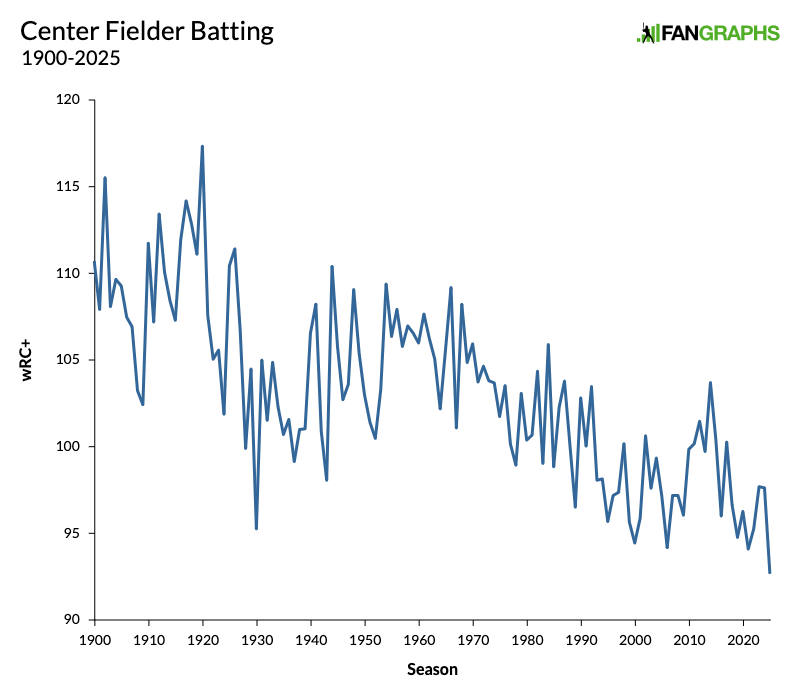
That graph is going nowhere but down, and it’s been on that trajectory since the beginning. This season, the league has a combined wRC+ of 92 at center field. If it holds, it would be the lowest mark ever recorded. However, center fielders aren’t worse players than ever. Here’s a graph that shows defensive run value per 600 plate appearances. This is just the Def column that you see all the way on the right of our main leaderboard. Before you look at it, let me warn you that I’m cheating a little bit by showing it to you.
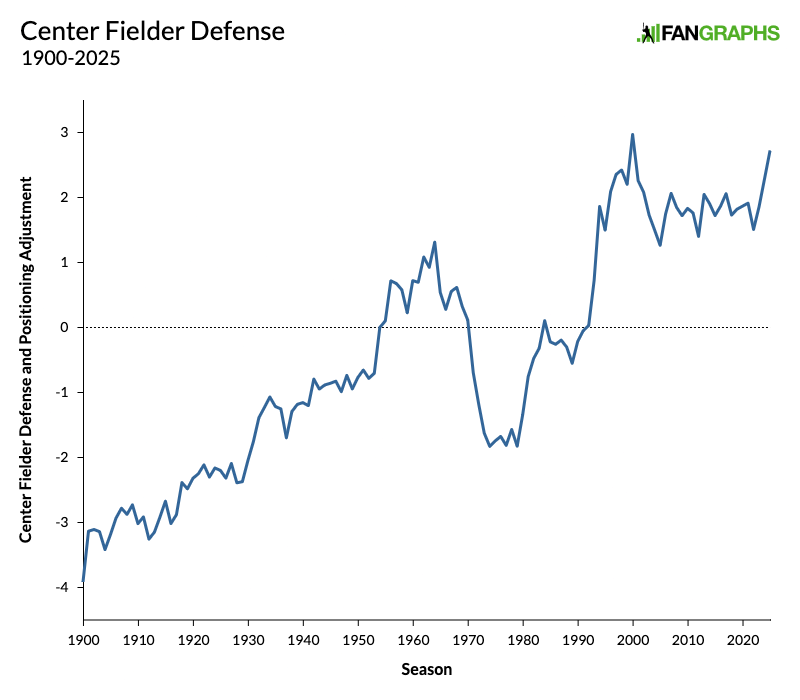
Here’s how I’m cheating. Not everybody is playing center field all the time. It just shows players whose primary position is listed as center field. We stopped using total zone for these numbers in 2002, so the more recent numbers are based on an entirely different formula. But the overall trend is about as unambiguous as it gets. For the first half of baseball history, the numbers say that center fielders weren’t necessarily great defenders, but that changed in the late 1950s, then cemented itself in the late 1980s.
The big reason why this is cheating, though, is because these numbers include a positional adjustment. As you likely know if you’ve made it this far, positional adjustments give more credit to tougher defensive spots and take credit from easier ones. If you look at center field defensive metrics for any one year, they should be right around zero more often than not. However high the bar is, there will be good, average, and bad center fielders, and they’ll cancel each other out. This graph is saying that the bar has gotten higher over time, compared to other positions on the field. That’s all the more apparent if you look at the same graph with the corners included.
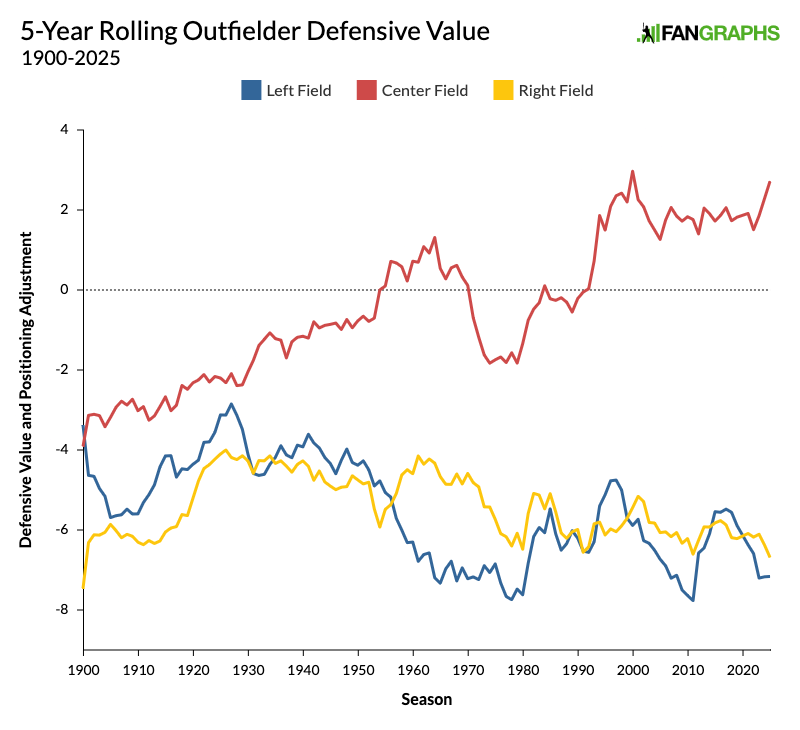
This shouldn’t necessarily be my persuasive argument. After all, I didn’t crunch the numbers and decide on the positional adjustments myself. I’m just showing you their effect on the way we value outfielder defense. However, when you view this alongside the decreasing wRC+ of center fielders, the conclusion is obvious. Defense has never been a more important part of the job, and the gap between defense in center field and the corners has never been higher.
Knowing all this, what makes me say that this very moment could be peak center field defense? For starters, players are just plain faster these days – and I don’t just mean faster than they were in the 1950s. We have 11 years of Statcast data tracking every player’s average sprint speed. For each year, I calculated the sprint speed of the average center fielder, prorating it by innings played (and ignoring any player who didn’t play enough to register a sprint speed). In the first three years, from 2015 to 2017, the average center fielder had a sprint speed of 28.4 feet per second. In the last three years, from 2023 to 2025, the average is 28.6. That may seem like a small change, but it’s also taking place over an awfully short timeframe. We can honestly say that center fielders are measurably faster today than they were just 10 years ago! It’s not hard to extrapolate further back in time.
If we extend our gaze a bit to take in the entirety of the pitch-tracking era, we can see that balls just aren’t falling in the way they used to. The graph below goes back to 2008, and it shows the batting average for every ball classified as either a line drive or a fly ball hit straightaway (not including home runs). It starts at .393 and ends at .346. Nearly 50 points of average just disappeared into the gloves of center fielders.
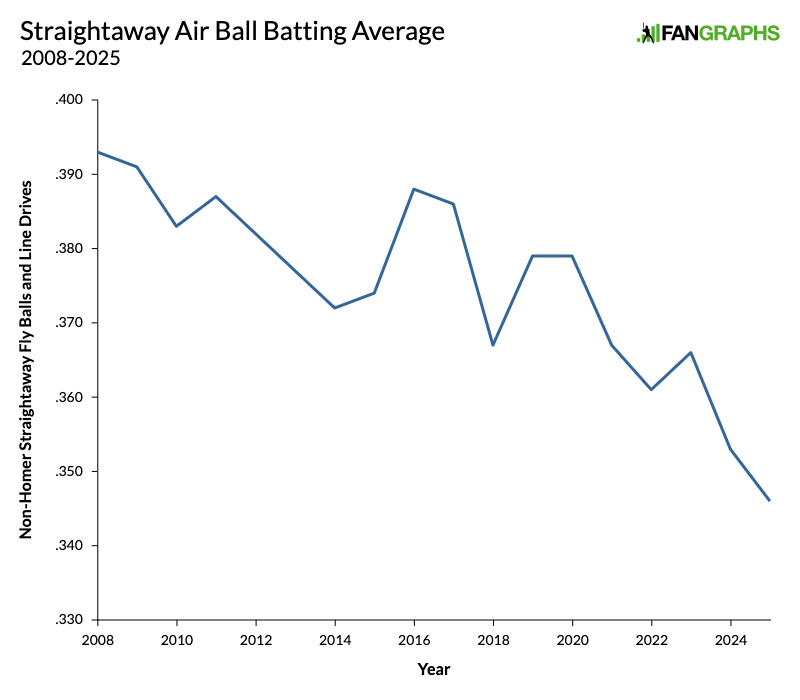
This is pretty stark, but even this graph is underselling the difference a bit. Here’s the same graph, but now it includes wOBA, too. The new red wOBA line falls even steeper than the blue line. Center fielders aren’t just robbing batters of more hits. They’re also better at holding batters to singles and preventing extra-base hits. That drop-off is nearly 60 points.
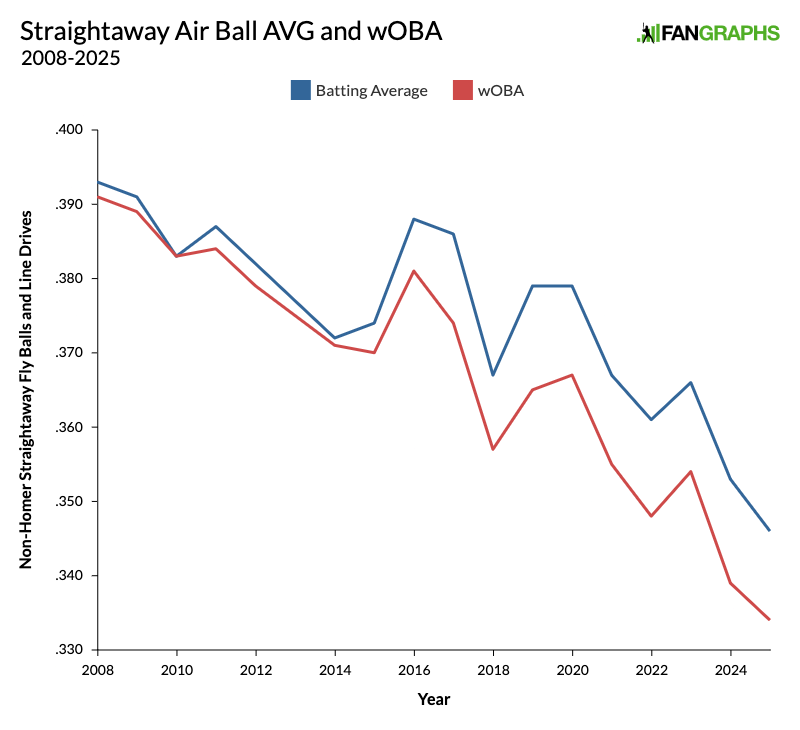
I think this is about as definitive as it gets. Since 2008, there’s never been a worse time to hit the ball to center field. So far as we can tell, defense has never been a more important part of a center fielder’s job, and center fielders have never been so much better than corner outfielders. In all, we’re probably at peak center field defense right now. And we’ll probably stay there.
Davy Andrews is a Brooklyn-based musician and a writer at FanGraphs. He can be found on Bluesky @davyandrewsdavy.bsky.social.
I often think about how much more enjoyable baseball would be if we had outfielders play straight up no matter who is at the plate. Defensive positioning – especially in the outfield – is so good and there’s nothing that can be done about it except continuing to watch batting averages fall.
I am convinced that the only answer is bigger outfields
Yes!
This is my preferred solution to almost everything. Bigger outfields means more hits in the gap, more guys reaching base, then teams will phase out most of the slow plodders in the outfield which will then bring even more guys trying to hit balls in the gap. It would be great!
I think that’s the majority of fangraphs readers but not the majority of people who watch baseball. Look how many views viral street fight videos get. Ball go far. That’s what sells. It won’t change.
Polo Grounds! Polo Grounds!
One thing I don’t see suggested as much around bigger outfields is what if we got there by making infields smaller instead of pushing fences back? Try to get more of the soft liners and flares dropping for hits in between. Little bit easier to implement than large scale construction projects at every stadium, too.
Many stadiums have brought fences in since they were constructed – Citi Field, Comerica. Others can do it by squeezing foul territory – bringing home plate closer to the backstop.
The other thing you could do is if you have a stadium where expanding a short outfield isn’t an option you can erect a huge wall. Green Monster that thing and make outfielders play off it.
KC is one of the only stadiums where I think the outfield is big enough but I love Fenway’s too.
Bigger outfields probably does cure everything. Time of game, strikeouts, vanishing role of starting pitchers – cures it all. More balls in play is more exciting. Fewer cheap HRs means only the biggest boppers have incentive to go up there swinging from the heels. Puts a premium on all the right stuff. 5’9″ middle infielders shouldn’t be hitting 25 HRs and striking out 180 times.
wrong because great defensive plays are way more fun to watch than a single.
Well, they could paint a small circle onto the grass in medium-deep, straightaway center, and require the center fielder to stand in it until the ball is hit. Or, center fielders could be required to wear weights like jockeys. I bet 30 pounds of lead sewn into his jersey would slow Crow-Armstrong down.
Great piece. While positioning plays a giant role, seeing so many guys ranging to (often rather easily) catch balls that off the bat my 80s/90s baseball brain instinctually tells me should find grass did have me wondering how much raw size/athleticism is affecting batting average. That last graph is glaring.
I don’t think it’s a stretch to say that as run prevention has grown more objectively measurable, front offices have become more willing to sacrifice offense for defense in CF. Even beyond starters, plus defenders hang out on the bench. The Brewers entered last season with Blake Perkins as a prototypical 4th/5th OF. When Garrett Mitchell — also a rangy OF — went down early, they happily started the homer-robbing Perk for 3 months and didn’t miss much in total value.
I suspect this modern mindset is partially responsible for the relative drop-off in 3B offense as well.
3B offense hasn’t had the same long-term decline as CF offense, and while it’s been down the last couple of seasons compared to the late 2010’s, it’s still above the level third basemen where hitting at for most of the first half of the 20th century. Offense there has tended to be more cyclical, going through hot periods when third basemen are hitting a bit better than average and cold periods when they’re hitting a bit worse.
yo, what the fuck was going on in the 70s?
If anyone is interested, it appears that the Cubs in the 1970s just trotted out abysmal center fielders (-186 runs). I doubt that explains everything, but it is a hilarious thought
Yup. Mostly Rick Monday and then a mix of Jerry Morales, Greg Gross and Jerry Martin.
Looking at it, a LOT of guys that weren’t that fast played a bunch in CF-Bobby Murcer, Rick Monday, Jerry Morales, George Hendrick, Al Oliver, etc.
Not sure if it was teams ignoring defense or stretching where players could play to get another bat in the lineup.
There were a few great CF’s- Paul Blair & Garry Maddox were both legitimately great fielders.
Front offices tend to move in unison like a school of fish in the ocean. There may be a few outliers, but once a dozen teams do something group think kicks in and another dozen think it’s the new norm and acceptable. I think that’s the best explanation for how the league wide performance of a position so drastically changes for a full decade (and then flips the subsequent decade).
Cocaine and Quaaludes, mostly
Is the WRC+ bump in the 2010’s Mike Trout???
Does the quality of centerfield defense recently change prospect / player value at all?
Trout, McCutchen, Josh Hamilton probably.
Great piece! An example of why I love fangraphs.
That dip in outfield defensive values in the 2000s can be solely blamed on the Yankees. That Matsui/Williams/Sheffield outfield was the worst I had ever seen.
IIRC that is the worst outfield defense of all time and it’s not even close.
One of those teams, I can’t remember which one, probably had the worst defense in general of all time.
That (dis)honor belongs to the 2005 team. In addition to the aforementioned outfield alignment, this team trotted out Giambi at 1st, a rookie Robinson Cano at 2nd, Jeter at SS, and Posada at C. Arod was the only non-attrocious defender in the teams typical alignment.
Yeah and that one great defender was playing the wrong position because… Re2pect.
I always assumed the math was that they would have lost more defensive value from Jeter at 3b than they gained by A-rod at SS.
The move can be both bad and logical simultaneously.
Could have played Jeter at second base and someone else at third til ‘05 when Cano came up and put Robbie and his big arm at third base.
I always felt that Jeter could have transitioned to the outfield. The one thing he seemed really good at was tracking bloops over the infield.
And Torre back in ‘05 played Matsui in CF for like a month! Matsui was a terrible corner OFer so you can imagine how bad he was in CF!
Good stuff! Does this analysis account for changes in fielding opportunities? I’d think CF opportunities would go down as strikeouts have risen, but perhaps more balls hit in the air balances that out?
It’s amazing that this insane number of elite CF defenders is happening while Jose Siri and Blake Perkins are hurt, Michael A Taylor is playing 2/3rds of his game in the corner outfield, and after Kevin Kiermaier hung up his cleats.
Go back a few more years and we have some other ludicrously good defenders like Jackie Bradley Jr, Lorenzo Cain, Ender Inciarte, and Manuel Margot (who spent a good chunk of his time in Tampa Bay playing RF in deference to Kiermaier).
This list of elite CFers is crazy because something like 50% of them lost their rookie eligibility less than 5 years ago.
It really is! That said, there are very few two way CFers as many CFers give you little to nothing offensively.
Which makes some intuitive sense, as speed is a young man’s game. You can be a great CF without elite speed, but having it sure does help.
Yeah although I looked over it again and the four top OAA guys this year have lose rookie eligibility in the last year.
His playing time has been spotty this year due to injury, but Parker Meadows is another quality centerfielder
The fact that you listed 6 guys from 1999 and somehow didn’t mention Jim Edmonds either proves that point or is some serious shade. I’ll assume the former. Similarly, Ben Clemens had a note in 5 things two weeks ago about how good Trent Grisham is defensively – he’s not even mentioned here. That’s how deep it is.
That also means that you have to temper expectations for someone like Oneil Cruz, who isn’t a great defensive CF, but has the speed and arm to be one; compared to the Crow-Armstrong/Rafaella/Young/Clarke crew, he’ll have difficulty being even average.
I feel like part of it too is a shift from CF being the “prestige” position, which now seems to be SS. Which seems counterintuitive until you think about that means there are fewer elite two-way CF — the position is starting become a lot more like C where defense is valued more than offense, so it becomes a self-fulfilling thing. If I can gain a couple of extra DRS or OOA, I’ll take the drop off from 100 wRC+ to a 90 or an 80.
How long does it take for stats like DRS, OAA, or FRV to stabilize? They all seem super volatile over even half a season, but looking at someone like Brenton Doyle (or Adolis García, as another example at a different position) makes me wonder how and when these stats should be considered.