Author Archive

Hit by Pitch & Other Stats

As promised, I’ve added HBP, SF, SH, WP, BK, and GDP to the stats pages. HBP and SF has also been added to the OBP formula and HBP has also been added to the LOB% formula. We’ll probably look into using a more complicated version of RC/G too. This was a rather annoying fix, hopefully nothing broke in the process. If you find any errors please let us know. Also, all the graphs have been wiped (200,000 graphs was taking up a lot of disk space).

Quick reminder to all bloggers and anyone wishing to use the graphs in their work. If you want the graphs to be permanent you must save the graph and host it yourself.


Fliners and Things to Come

I was informed today by Baseball Info Solutions that they will now be tracking “Fliners” which are a new categorization of batted balls. They’ll be breaking down these “Fliners” into two categories for us: Fliner-Fly and Fliner-Liner (that sounds kind of funny). I really like the fact that they are breaking down Fliners into Fly Balls and Line Drives so we’ll still be able to look at Fly Ball/Ground Ball/Line Drive data without Fliners if desired.

So, while I’m here, I may as well give a quick update on what’s coming to FanGraphs this season.

1. Hit by Pitch (HBP) data is on its way. This was an initial oversight, but it should be up this weekend and included in all the stats and graphs where it wasn’t previously included. We’re also going to add SH, SF, WP and BK data (and maybe some other stuff) to the stats pages. This should be available when the Hit by Pitch data goes live.

2. We have made arrangements with Baseball Info Solutions to display raw “pitch data” for retired players! This is currently a work in progress on the programming side of things, but I hope to have the raw data available for each retired player sometime in the next month. We currently only have the 2005 season, but we’ll be receiving 2006 data and are considering the 2004 data.

3. We’ll be trying out a new column called “Speed Plot” which will essentially go through the previous day’s games and point out various performances in an abbreviated Daily Graphing style. Consider it the Daily Graphing lightning round so we can hit on more than one player a day. I’m not sure how it will work out, but we’re going to give it a shot anyway and see what happens.

4. I’ve been slacking a bit on the Daily Graphing column but it should resume being pretty much daily when the regular season starts. We’ll be doing some preliminary Fliner analysis as the 2006 data starts to become significant. Obviously we’ll have to until 2007 to see year-to-year trends.

5. Nightly stat updates will occur between 2am and 5am each night of the regular season. Hopefully everything will go smoothly on the first night, but incase of unforeseen events, we’ll be working round the clock until FanGraphs is working properly with the 2006 data!

We’re very excited about our first full major league season. (I think if FanGraphs were a baseball player, it’d still have rookie status). Hope everyone will find our 2006 offerings useful and insightful, and of course, FanGraphs will remain 100% free.


Daily Graphing – Jeremy Reed

After hanging around Baseball America’s top 100 prospect list for a couple years, Jeremy Reed, at only 24 years of age played his first full major league season in 2005. Compared to the small preview he gave in his 2004 big league debut where he batted .397 in 58 at-bats, his 2005 season was, to put it nicely, sobering. In just under 500 at-bats he batted only .254 with 3 home runs and 12 stolen bases. Let’s see if there’s any chance an improved 2006 on the horizon.

BBK

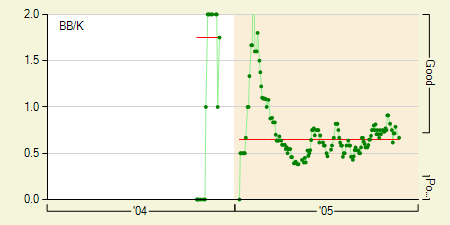
Looking at his walk to strikeout ratio (BB/K), he actually has very solid plate discipline, especially for someone so young. He swings at pitches outside the strike zone around 17% of the time which is better than the average major league player and makes contact when he swings about 86% of the time. He’s particularly aggressive with curveballs inside the strike zone.

ISO

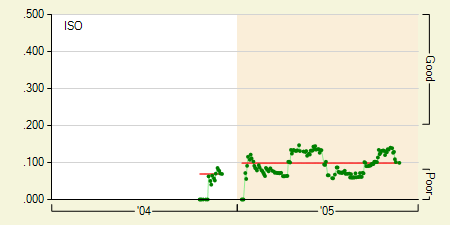
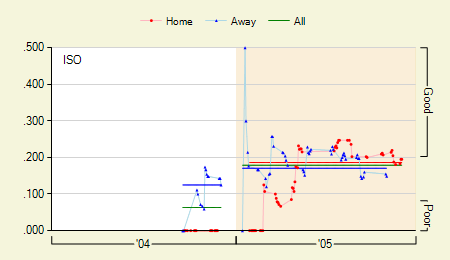
While most everything seems to be in order in terms of plate discipline, his Isolated Power (ISO) leaves much to be desired. It’s a little odd because typically players that have similar plate discipline will hit on average 14 or so home runs which is a far cry from the 3 he actually hit. Playing at SAFECO Field is going to suppress his home runs a bit and his 33 doubles are encouraging, but that still doesn’t explain the discrepancy.

BABIP

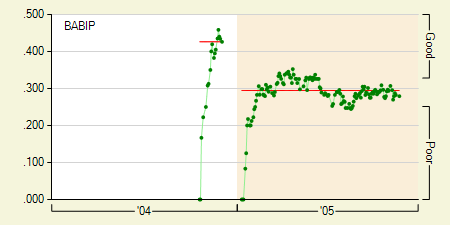
Remember when I said he was aggressive with curveballs inside the strike zone? His batting average on balls in play (BABIP) with those same curveballs was an awful .209 which is part of the reason for his mediocre batting average. Furthermore, his line drive percentage was a mere 18.9% where he struggled not only with breaking pitches but also slightly with fastballs.

I wouldn’t make too much of Jeremy Reed’s batting average and low home run totals in his first full major league season. His plate discipline is solid and I’d venture he improves his power numbers by hitting around 10 home runs next season. Unfortunately, his ground ball tendencies will limit his home run ceiling but hopefully he’ll make the necessary adjustments against breaking balls which would give his batting average a much needed boost.


Daily Graphing – Brandon Webb

Remember back in 2003 when Dontrelle Willis won the National League Rookie of the Year award? If it weren’t for a few extra wins, perhaps Brandon Webb would have won the award instead, since his 2.84 ERA, 180 innings, 172 strikeouts and 1.15 WHIP were all better than Willis. Since then, Webb has been quite consistent throwing over 200 innings in his past two seasons with an ERA just under 3.60. He only has 21 wins to show for his effort, but he’s only received an average of 3 runs per start from his offense, so it hardly seems fair to put the blame on Webb’s shoulders.

So far this spring, Webb has been spectacular, going 3-0 while allowing only 1 hit and no runs in 9 innings of work. It’s not exactly a sample size you can hang your hat on (and it’s spring training), but it is a little impressive. With that in mind, let’s take a closer look and see if he’s capable of becoming one of the elite pitchers in the National League.

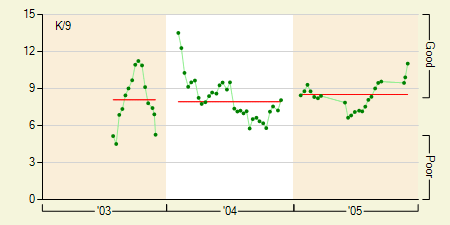
K9

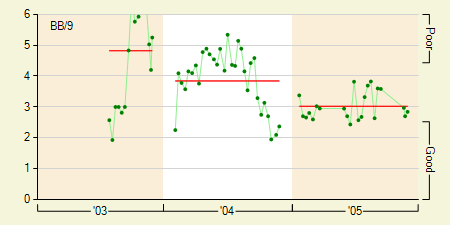
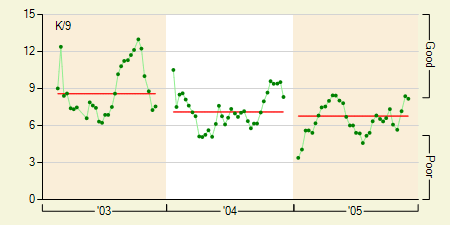
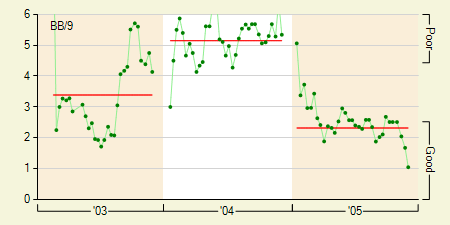
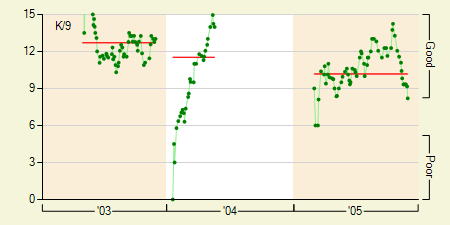
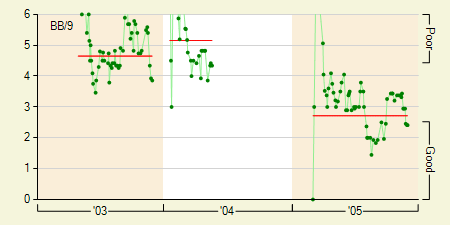
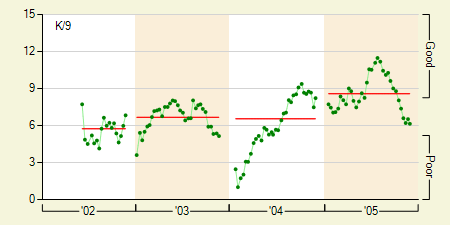
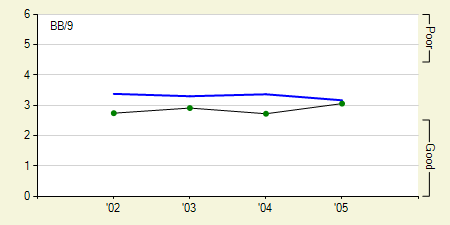
His strikeouts per 9 innings (K/9) decreased for the second year in a row, falling to an adequate 6.7. That’s nearly a two point drop since his rookie season. In 2005, batters swung at his pitches outside the strike zone 21% of the time, which is slightly above average. Fortunately, his walks per 9 innings (BB/9) plummeted nearly three points to a good 2.3 which easily offset any decrease in strikeouts.

BB9

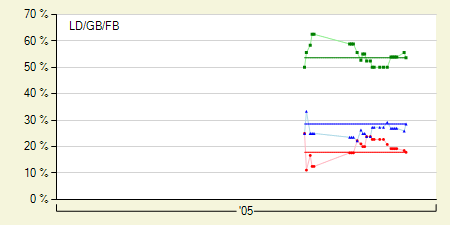
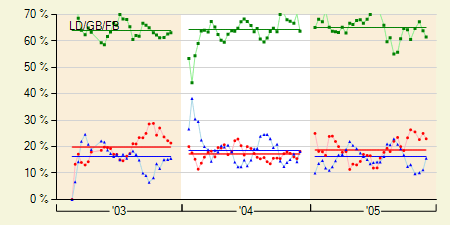
While neither his strikeouts nor walks are off the chart, he induces far and away the most ground balls of any starting pitcher in baseball. He’s led the league in groundball to fly ball ratio the past two seasons and his rookie year he was second only to Derek Lowe. The most successfully pitcher that’s even close to being in the same league as him in terms of ground balls is Roy Halladay who also has a K/9 in the high 6’s. Webb however, has lacked Halladay’s pinpoint control.

GBFBLD

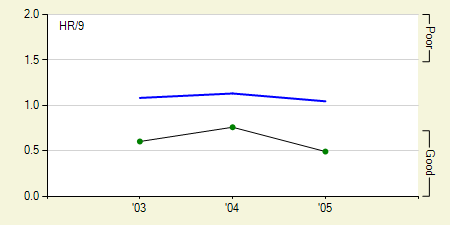
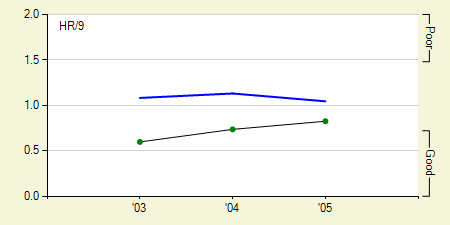
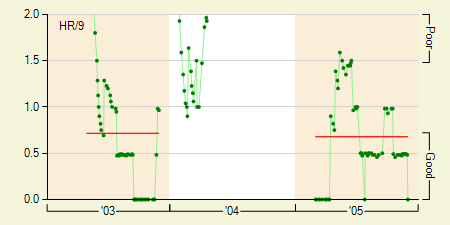
It’s also worth mentioning that while Webb’s home runs per 9 innings (HR/9) have always been pretty good due to his extreme groundball tendencies, he has a very high home runs-per-fly ball (HR/FB) of 18.9%. While it’s not unusual for groundball pitchers to have a higher HR/FB, I’d consider 18.9% freakishly high, so expect there to be some improvement in the home runs department.

BB9

It’s rare to find an extreme groundball pitcher that can also strike batters out and Webb definitely falls into that category. Sure his strikeouts may have dipped a bit, but his control is much improved and he’s apparently added a cut fastball which is supposed to make him a bit less predictable with his sinker. If that helps him strike out a few more batters, he should be primed for an excellent year.


Daily Graphing – Jason LaRue & Javier Valentin

Back in December, the Reds signed Jason LaRue to a 2 year, 9.1 million dollar contract and then in January signed Javier Valentin to a one year 1.15 million dollar contract assuring that the surprising catcher tandem would stay intact for the 2006 season. The two combined for 28 home runs and batted .268 with 110 RBI’s which made them offensively, the most productive catchers in the National League. It’s really too bad they aren’t one person. Let’s take a closer look and see if they’ll continue to be the dynamo combination that they were in 2005.

LaRue will be entering his 8th major league season and for the past 5 years has been pretty consistent hitting no less than 12 home runs and no more than 16. Last year he had a career high batting average of .260, which dipped as low as .230 back in 2003.
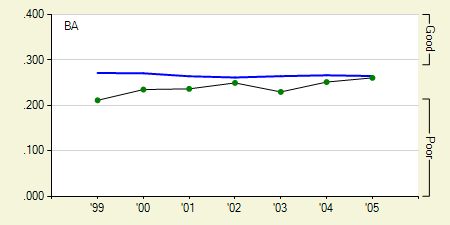
BA

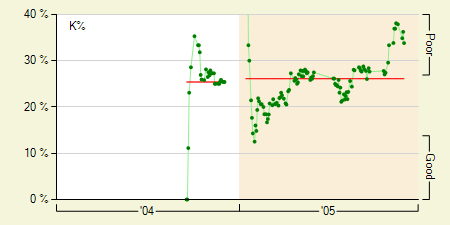
His real problem is making contact with pitches and only does so 68% of the time when he swings the bat. That puts him among the 20 worst in baseball for the 2005 season. Naturally, his strikeout percentage (K%) sits at an ugly 28%. He did however show consistent signs of improvement after striking out a horrible 37% of the time during the first two months of the season; he managed to consistently stay around 24% the rest of the season. Still not great, but it is improvement.
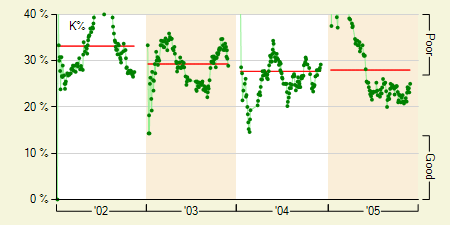
KP

With his decreasing strikeout rate, perhaps he’ll be able to keep his batting average near the .260 mark, but you pretty much know what you’re going to get with LaRue and I wouldn’t expect 2006 to be any different. Valentin on the other hand is a completely different case.

Last season, Valentin exploded with 14 home runs in 221 at-bats after hitting just 6 the previous season. He also had a career high .281 batting average along with career highs in just about everything else. He’s always been a part-time player at the major league level and the last time he played a full season was back in 2002 for AAA-Edmonton where he hit 21 home runs in 455 at-bats.

His plate discipline is actually quite similar to LaRue‘s since they both swing at pitches outside the strike zone about 20% of the time and they both see a similar percentage of pitches inside the strike zone, but there is one major difference. Valentin can actually make contact with the ball and does so around 81% of the time which makes his strikeout percentage (K%) more than 10 points lower than LaRue’s.
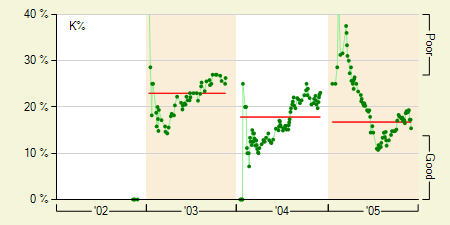
KP

His one big problem is left-handed pitchers. He bat .186 against lefties last season compared to the .301 he bat against righties. In 2004 he bat just .109 against lefties. Actually, in 2004 he was the worst and in 2005, he was in the bottom 20 against left-handed pitchers. Despite his inability to hit lefties, his on-base-percentage splits look pretty good and he’s actually better against both righties and lefties than LaRue.
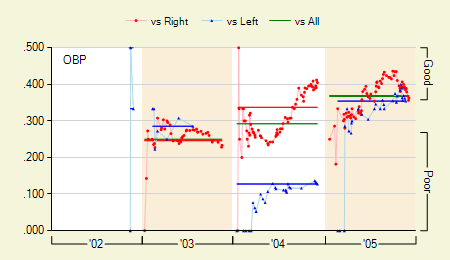
LROBP

Bottom line with Valentin is he hasn’t been given much of a chance in the majors and often Catchers are considered late bloomers offensively so it seems to me that his breakout season was indeed for real. He’s also a better batter than LaRue, but it’s doubtful he’ll be able to avoid the platoon at catcher unless LaRue is injured or performs horribly (which seems unlikely considering his consistency). That being the case, the two of them should once again give the Reds top offensive production from the catcher position. If Valentin does get a chance at 400 at bats, look for him to improve on his 2005 season.

Daily Graphing – Jose Valverde

Since Byung-Hyun Kim in 2003 decided he wanted to fulfill his life long dream of being a starting pitcher, the Arizona Diamondbacks have gone through five different closers. Matt Mantei took over for Kim in 2003 and managed to keep the job the whole year. He entered the 2004 season as the closer but after a rocky start (11.81 ERA) he ended up spending the rest of the year on the disabled list. Jose Valverde was next in line and after saving 8 games in 10 chances, he too was forced to go on the disabled list for the remainder of the season.

In steps Greg Aquino who converted 16 of 19 save opportunities to finish the 2004 season, but a combination of injury and being out pitched by Brandon Lyon lost him the closers job to start the 2005 season. Lyon converted 13 of 14 saves but was derailed by an elbow injury that cost him nearly the rest of the season. Brian Bruney was asked to fill in and two months later with an ERA over 9 and Bob Melvin had seen enough, opening the door for a healthy Valverde.

Valverde pitched masterfully after taking over the closers job in August and converted all 13 of his save chances with an incredibly low ERA of 1.37. For the entire month of September he gave up zero runs and allowed only 6 hits and 2 walks in 16 innings of work. Let’s see if he really is the answer to the Diamondbacks closer woes.

K9

Taking a look at a closer’s most important stat, strikeouts per 9 innings (K/9), he’s has never had a problem striking anyone out. His career K/9 is the 6th highest among all active pitchers. Batters have a lot of trouble making clean contact with his pitches in the strike zone, fouling them off 56% of the time which is nearly the most in baseball.

BB9

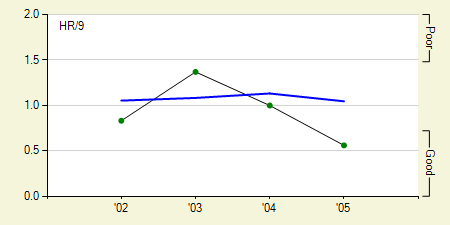
One of his main pitfalls in the past has been his lack of control as he walked over 5 batters per 9 innings (BB/9) in 2004. In 2005 he almost cut that number in half bringing his BB/9 down to a career low 2.17. His other problem in 2004 was his off the charts home runs per 9 innings (HR/9) which resulted in an incredibly high home runs-per-fly ball of 25%! He managed to bring that back down to an excellent 6.9% in 2005. Talk about your extremes.

HR9

Valverde’s strikeouts and walks look like they’re just about everything you’ve ever wanted in a closer. Health is really the key here since he’s been on the disabled list for long periods of time twice in his three year career. He’s apparently improved his delivery which should make him less injury prone. Assuming he stays injury free next year, it looks like the Diamondbacks have potentially found one of the better closers in baseball.


Daily Graphing – John Lackey

After winning game 7 of the World Series in 2002, John Lackey had two very mediocre seasons for the Angels. It was looking like 2005 might not be any different as he had an 8.27 ERA after his first three starts, but he managed to do a complete 180 and went 13-4 with 3.06 ERA the rest of the season. Despite his great season, not everyone seems to be in agreement on what the future holds for Lackey. Let’s take a closer look and see if there’s any reason to think he’ll revert to his pre-2005 form.

K9

Starting with his strikeouts per 9 innings (K/9), you’ll see that he was already laying the groundwork for a breakout season back in 2004 when his strikeouts slowly climbed towards elite territory. In 2005 he picked up right where he left off and by mid-season he had reached some pretty insane strikeout levels. It’s worth noting he did slow down a bit towards the end of the season, but overall he had the 5th highest K/9 of any starting pitching in the American League.

BB9

His control has always been decent as his walks per 9 innings (BB/9) have remained pretty flat his entire career. However, his home runs per 9 innings (HR/9) are a completely different story. In 2005 he allowed only 13 home runs which made for an extremely low home run-per-fly ball of 6.6%. Typically the league average is near 11% and it’s almost a certainty he’ll regress back towards the average. On the other hand, he did have a batting average on balls in play (BABIP) of .333 which was a bit high, so chances are that will also regress a bit back towards the league average.

HR9

When you take everything into account, it seems clear that Lackey’s breakout season wasn’t a fluke. I could see his home runs being more of a problem if he didn’t pitch in Anaheim and if he wasn’t a ground ball pitcher. Hopefully any decrease in BABIP will counter any increase in home runs. His late season decline in strikeouts will be something to keep an eye on, but I honestly don’t think there’s much to be alarmed about here. I fully expect him to repeat his 2005 season.


Daily Graphing – Kelvim Escobar

Last year at this same time I was trying to snag Kelvim Escobar in as many fantasy leagues as possible due to his solid run at the end of the 2004 season. In the final two months he went 6-4 with a 3.20 ERA and had a tantalizing 79 strikeouts in 78 plus innings of work. Two months into the season, Escobar was looking like a fine selection at 2-2 with an ERA just under 3, but he elected to have surgery on bone spurs in his elbow that kept him out until September. When he finally returned he was limited to bullpen duty, but he’ll be back in the starting rotation for the 2006 season. Let’s see if he’s worth taking a chance on again.

K9

Looking at his strikeouts per 9 innings (K/9), he has absolutely no problem striking batters out. In his one month back from surgery he continued to mow batters down with a K/9 just over 8. In 2005, swinging batters failed to make contact with his pitches a whopping 28% of the time which was the second highest in baseball among starting pitchers. Batters clearly have problems with his five pitch repertoire.

BB9

Back in 2002 and early 2003 when he was closing for the Blue Jays, he struggled mightily with his control, but since then he’s been able to bring his walks per 9 innings (BB/9) down to a career low of 3.17. Furthermore, he’s never had much of a problem in the home run department, keeping his home runs per 9 innings (HR/9) below the league average in all but 2 of his 9 seasons. His ground ball tendencies certainly help him out.

HR9

When you get right down to it, Escobar strikes out a ton of batters, has a declining walk rate, doesn’t give up many home runs, and oh yeah… he’s a ground ball pitcher too. Seriously, what’s not to like about this guy? Sure he may be a bit of an injury risk, but who isn’t these days and if he wasn’t 100%, he wouldn’t be pitching for Team Venezuela in the World Baseball Classic. I for one will certainly be looking to snag him again this year and he should pick up right where he left off before undergoing the knife.


Research – Dissecting Plate Discipline: Part 2

In Part 1 of Dissecting Plate, I took a look at three stats which I felt dug a little deeper into a player’s plate discipline and I showed how they correlated with either walks, strikeouts or home runs. Since the correlations are fairly high, we should be able to come up with an expected number of walks, strikeouts and home runs based on the components of a player’s plate discipline.

Let’s start with expected walk percentage (xBB%), you’ll remember that there were two stats that have a high correlation with walks. The first is ZRatio, which also has some correlation with home runs, and the second was OSwing which only correlated well with walks. If you multiply a batter’s ZRatio and OSwing, you essentially come up with a proxy for how often a player should be walking.

BBD

What I find most interesting about xBB% is when you see large discrepancies with actual BB%. Looking at the players who walk more than their xBB% implies, you’ll see highly skilled players like Jason Giambi, Jim Thome, and Todd Helton. Our good friend Russel Branyan also shows up in the top 10. Perhaps behind his monster swing there lays some potential.

Walked More than xBB%		Walked Less than xBB%	
Jason Giambi	7.19%		Todd Linden	-3.35%
Jim Thome	6.92%		Carlos Baerga	-3.37%
Jose Valentin	5.70%		Chris Magruder	-3.45%
Adam Dunn	5.34%		Oscar Robles	-3.46%
Russell Branyan	5.10%		John Olerud	-3.59%
Todd Helton	5.05%		Alex Cora	-3.71%
Angel Berroa	4.58%		N. Garciaparra	-3.81%
John Rodriguez	4.49%		Orlando Hudson	-4.17%
Jim Edmonds	4.44%		Kenny Lofton	-4.18%
Craig Wilson	4.33%		Tike Redman	-4.38%

The players who walk less than their xBB% suggests are mostly contact hitters, but notice how Nomar Garciappara shows up on the list. Is that a sign that he was just unfortunate in 2005 and we can expect a rebound in walks? Since I only have one season of data, it’d be silly to draw multi-season conclusions, but it certainly makes you wonder.

Moving on, the one stat which correlated extremely well with strikeouts was Contact, so we’ll use that to calculate a player’s expected strikeout percentage (xK%). Since striking out and walking appear to be two entirely different skills, I’m not going to use ZRatio in calculating xK%.

Struckout More than xK%		Struckout Less than xK%
Jayson Werth	9.90%		Brian Schneider	-5.38%
Frank Menechino	9.84%		Rondell White	-5.39%
Todd Linden	9.24%		Garret Anderson	-5.49%
Chip Ambres	9.23%		Sammy Sosa	-5.74%
Nick Punto	9.15%		Jorge Cantu	-5.86%
Mark Bellhorn	7.76%		Sal Fasano	-6.02%
Jason Dubois	6.96%		Mike Sweeney	-6.54%
Jamey Carroll	6.84%		Andruw Jones	-7.07%
Jason Giambi	6.83%		Moises Alou	-7.28%
Chris Woodward	6.38%		V. Guerrero	-7.29%

Once again, the large discrepancies are the most interesting. Vladimir Guerrero’s xK% suggests he should strike out a lot more than he does. Most of the best players in baseball are better than their xK% suggests. Looking at the top 10 players that strike out more than their xK% indicates, there are a bunch of not so high profile players except for Jason Giambi. Perhaps he was swinging a little harder than he usually would to prove he could still hit home runs?

Finally, there’s expected Home Runs (xHR), which we’ll calculate using both Contact and ZRatio, which both correlated with home runs-per-fly ball. Multiply the two, and the correlation becomes much stronger. From that we can calculate a player’s expected home runs per fly ball, and then finally actual expected Home Runs.

KD

Looking at the players who hit more home runs than expected, these are obviously many of the power hitters in baseball. What I find more interesting are those who hit less home runs than their xHR suggests. Brad Wilkerson (-13) and Vinny Castilla (-9) were definitely not helped by R.F.K. Stadium’s spacious outfield. It will be interesting to see if these player’s home run totals will rebound this coming season.

More Home Runs than xHR		Less Home Runs than xHR	
Alex Rodriguez	20		Brian Giles	-9
Derrek Lee	19		Marcus Giles	-9
Manny Ramirez	19		Vinny Castilla	-9
Andruw Jones	16		Mike Lowell	-9
Albert Pujols	16		Darin Erstad	-9
Tony Clark	15		J.T. Snow	-9
Mark Teixeira	14		Jeremy Reed	-11
Paul Konerko	14		Adam Kennedy	-11
Ken Griffey Jr.	14		Alex Gonzalez	-12
Jermaine Dye	14		Brad Wilkerson	-13

I honestly don’t know whether these differences in expected versus actual walks, strikeouts, and home runs will hold up from season to season, but all of these stats surely have some element of chance in them. The correlations were too close in my opinion to not do this exercise. Hopefully looking at baseball data on a more granular level will help us better weed out the fluke season.


Research – Dissecting Plate Discipline: Part 1

If you’ve been reading the recent Daily Graphing columns, you’ll notice that I’ve been talking about some not so common stats such as, the percent a player swings at pitches outside the strike zone and actual contact rate. These oddball stats are derived from Baseball Info Solution’s “pitch data” which contains the location and result of each and every pitch, among other things. I’ve decided it’s probably a good idea to go over a bunch of these stats and examine why I think they’re meaningful.

When a pitcher throws the ball, it can land either in or out of the strike zone. Not all batters receive the same amount of pitches in and out of the strike zone and this does make a difference. Batters will see anywhere from 45% to as high as 60% of pitches inside the strike zone. I’ve found it most useful to express this as a ratio. Let’s call this Zone Ratio.

Zone Ratio (ZRatio) – the ratio of pitches inside the strike zone to pitches outside the strike zone

ZRatio

ZRatio correlates quite well with two stats that are frequently used: walks and home runs. It makes a lot of sense that batters who see more pitches outside the strike zone would walk more. Finding it correlated well with home runs was slightly surprising, but also made sense because pitchers would want to be more cautious with batters that can generate more power.

Top 5 ZRatio			Bottom 5 ZRatio
Aaron Miles	1.54		Ryan Klesko	0.89
W. Bloomquist	1.53		Carlos Pena	0.88
Tony Womack	1.49		Chipper Jones	0.86
Tike Redman	1.48		Russell Branyan	0.81
David Eckstein	1.46		V. Guerrero	0.80

If you look at the top and bottom 5 batters in ZRatio, it’s probably no surprise to see Vladimir Guerrero receives the least amount of balls in the strike zone. On the high end, you don’t just have guys like Willie Bloomquist (0 HRs) and Tony Womack (0 HRs), but also David Eckstein (8 HRs). I wonder if David Eckstein will remain in the top 5 in 2006. Quickly shifting back to players that have a low ZRatio you’ll notice Russell Branyan who strikes out more than pretty much anyone in baseball. Unlike Vladimir Guerrero, it’s more likely pitchers are exploiting a weakness instead of respecting his power.

Moving along, after the pitch is thrown, there are two things a batter can do: take the pitch or swing at it. I’ve found that it doesn’t seem to matter how often a batter will swing at pitches inside the strike zone, but how often they’ll swing at pitches outside the strike zone. I’m going to call this stat Outside Swing Percentage.

Outside Swing Percentage (OSwing) – The percentage of pitches outside the strike zone a batter swings at.

OSwing

Probably to no one’s surprise, OSwing correlates quite well with walks. Batters will swing at pitches outside the strike zone as low as 8% of the time to as high as 37% of the time. Looking at the top and bottom 5 lists, you’ll see that batters that you typically consider having great discipline such as Chipper Jones and Jason Giambi round out the bottom of the list. At the top of the list you have batters that really like to swing the bat such as Ivan Rodriguez and Jeff Francouer.

Top 5 OSwing			Bottom 5 OSwing
Ivan Rodriguez	37.69%		Jason Giambi	10.03
Bradley Eldred	37.50%		Dave Roberts	9.39
Angel Berroa	37.01%		Chipper Jones	9.33
Jeff Francoeur	34.91%		Eric Young	9.09
Johnny Estrada	33.22%		Brian Giles	8.33%

Finally, if you do decide to swing the bat, one of two things can happen: you either hit the ball or miss the ball. Batters made contact with the ball anywhere between 54% and 94% of the time. Let’s call this stat simply Contact Percentage.

Contact Percentage (Contact) – The percentage of times a batter hits the ball when he swings the bat.

Contact

There are two things that Contact correlates well with: strikeouts and home runs. The correlation with Strikeouts isn’t a shock. If you can’t lay wood on the baseball, you’re going to be striking out a lot. The correlation with home runs, just like with ZRatio was a little surprising, but once again this also made sense. Typically players who are swinging for the fences are going to swing and miss more often.

Top 5 Contact			Bottom 5 Contact	
David Eckstein	94.26%		Craig Wilson	63.23%
Luis Castillo	94.01%		Carlos Pena	63.02%
Oscar Robles	93.51%		Wily Mo Pena	59.83%
Chris Gomez	93.43%		Russell Branyan	59.21%
Kenny Lofton	92.66%		Bradley Eldred	54.57%

Once again, if we look at the top and bottom 5 players in Contact, you’ll see players like David Eckstein and Kenny Lofton at the top of the list. Just outside the top 5 are players you’d expect to see because they’re considered great contact hitters such as Juan Pierre and Placido Polanco. Remember how Russell Branyan had a very low ZRatio? Being one of the worst contact hitters in baseball, this pretty much confirms that pitchers are indeed exploiting his deficiencies.

So for each of these three stats, I talked about how they correlate well with other more mainstream stats. Based on that, we should be able to come up with the expected number of strikeouts, walks, and home runs for each player based on the components of their actual plate discipline. Later this week in Part 2, I’ll be exploring the discrepancies between what a batter is expected to do based on his plate discipline and what he actually does.