Author Archive

Howie Kendrick Carves His Niche in Postseason History

By the time he stepped to the plate with one out in the seventh inning of Wednesday night’s Game 7, Howie Kendrick had already collected his share of postseason heroics, key hits that stood out even on a team featuring an MVP candidate and a precociously disciplined slugger, not to mention two bona fide aces and a $140 million third starter-turned-reliever. Exactly three weeks earlier, the 36-year-old utilityman-turned-designated hitter had swatted a 10th-inning grand slam in the fifth and deciding game of the Division Series, felling the 106-win Dodgers. His 5-for-14, four-RBI showing against the Cardinals earned him NLCS MVP honors, and he’d lucked into a bases-loaded infield single in the rally that swung Game 2 of the World Series. The best was yet to come.

With Houston’s lead freshly cut to 2-1 by Anthony Rendon’s home run, and starter Zack Greinke — who had been brilliant and stifling through six innings — suddenly exiting after walking Juan Soto, Kendrick etched himself into World Series lore by slicing an 0-1 changeup from Will Harris down the line and off the screen attached to the right field foul pole.
Read the rest of this entry »


Rendon’s Signature Swing Lifts 2019 World Series

Though the final score was once again lopsided, Tuesday night’s Game 6 was this World Series’ most entertaining game since the opener, even if much of it pivoted upon lengthy debates of rules both written (the seventh-inning interference call against Trea Turner) and unwritten (the bat-carrying homers of Alex Bregman and Juan Soto). Beyond those controversies, Stephen Strasburg‘s 8.1 innings and Anthony Rendon’s pair of late-inning hits headlined the Nationals’ winning effort. The latter also helped rescue what has been something of a dull World Series from some ignominious distinctions.

Rendon’s two-run seventh-inning homer off Will Harris did not swing the lead; the fifth-inning homers of Adam Eaton and Soto off Justin Verlander did that job. Rendon’s blow did divert attention away from the scrutiny over Turner’s path to first base after hitting a dribbler to pitcher Brad Peacock, as well as the long on-field delay for what was actually ruled an un-reviewable judgment call. Instead of having runners at second and third with no outs, the Nationals had a runner on first and one out, and boy, were they — and just about everybody outside of Houston — extremely pissed. The tension ratcheted up a few notches when Eaton, the next batter after Turner, popped up to third base on the first pitch from Harris. Two pitches later, Rendon pulverized a cutter that Harris left in the middle of the plate; that’s a 2019 postseason-high 43.4 degree launch angle for you aficionados of such matters:

The ball-don’t-lie homer stretched the Nationals’ lead to 5-2, and while it produced some mutterings about how the lead should have been 6-2 had the umpires not screwed up the call (as well as some terrible puns), such gripes get filed in the category of what Yankees play-by-play voice Michael Kay calls “the fallacy of the predetermined outcome” — the assumption that the inning would have unfolded in exactly the same manner as it did with that one change; we can’t know how Harris, Eaton, and Rendon would have approached their respective tasks in the parallel universe where two runners were on base. Nationals manager Davey Martinez was still hot enough to get run even after the inning finished. Read the rest of this entry »


The Nationals’ Catching Quandary

In a World Series that has been notable for its lack of drama — one lead change in five games, and the largest average margin of victory in at least a decade, as Tony Wolfe discoveredKurt Suzuki owns the biggest swing of the bat. The 36-year-old backstop’s seventh-inning home run off Justin Verlander in Game 2, which broke a 2-2 tie, produced the highest WPA of any single play thus far, at least by our measures. Suzuki has been sidelined since the middle of Game 3 due to a right hip flexor strain, and at this writing, it’s not clear yet whether he will be able to help Stephen Strasburg and the Nationals in their quest to stave off elimination.

On Monday, Suzuki participated in on-field workouts and told reporters that he had been potentially available in an emergency during the two games that he missed, and that his condition was improving: “It feels better, obviously. I got some treatment and stuff like that, and it’s progressing… Going to do some stuff today and we’ll figure out more tonight after we get into Houston about tomorrow. Everything is looking good so far.”

Though he was behind the plate for just 17 of Strasburg’s 33 starts during the regular season — a situation that owed something to a bout of right elbow inflammation that limited the catcher to five September starts, only one of which was paired with Strasburg — Suzuki has caught all four of the 31-year-old righty’s postseason turns. The results have been stellar, as Strasburg has delivered a 2.16 ERA with 36 strikeouts and two walks in 25 innings. Suzuki’s contributions with the bat during that run have been few and far between; he went hitless in 16 plate appearances during the Division Series, was 0-for-17 in 21 PA for the postseason by the time he collected a single off Jack Flaherty in NLCS Game 3, and is batting just .100/.229/.200 in 35 PA this October.

Other aches and pains may be contributing to his struggles; he needed x-rays on his left hand as well as concussion tests after being hit on the wrist and then on the noggin by a single Walker Buehler pitch in Game 5 of the Division Series. Nonetheless, he’s done the heavy lifting behind the plate for the Nationals, starting 10 the team’s 15 postseason games and eight of their 10 wins. Read the rest of this entry »


Road Warriors Again: Astros Take Third Straight in Washington

So much for home field advantage. The visitors won for the fifth straight time in this World Series, which means that after losing the first two games of this series to the Nationals, the Astros are up three games to two. They took advantage of Max Scherzer being scratched from his rematch with Gerrit Cole due to neck spasms, tagging emergency starter Joe Ross with a pair of two-run homers. That was more than enough run support for a dominant Cole, though Houston’s lineup tacked on three more runs in the late innings and won 7-1. During the three games in Washington, they walloped the Nationals by a combined 19-3 score, and they’re now one win away from their second championship in three seasons.

A few quick thoughts on the game, which also featured a shaky strike zone from home plate umpire Lance Barksdale, a pair of flashers behind home plate that distracted Cole, and a visit from Donald Trump that did not go as well as the president envisioned…

Pain in the Neck

The character of Sunday night’s Game 5 changed significantly before a single pitch was thrown. Three and a half hours before game time, the Nationals announced that Scherzer, who had allowed two runs in five innings in Game 1 opposite Cole, had been scratched due to spasms and nerve irritation in his right trapezius, problems for which he had begun undergoing treatment on Friday. Though he had been able to play catch on Saturday, Scherzer had woken up on Sunday in intense pain, and “completely couldn’t get out of bed… I had to basically fall out of bed and pick myself up with my left arm,” as he said during a pregame media session during which his pain and immobility were quite apparent.

“I’m as disappointed as I possibly can be not to be able to pitch tonight,” he said. “I’ve pitched through so much crap in my career that would be easy to pitch through at this point. This is literally impossible to do anything with.” He received a cortisone shot in the hopes of being available for a Game 7, if there is one. Read the rest of this entry »


Fielding the Yordan Alvarez Decision

As the World Series shifts to Washington, the Astros already find themselves in a two-games-to-none hole, and now they have to contend with another loss, namely that of the designated hitter slot. While Yordan Alvarez hasn’t been able to replicate the impressive regular season showing that’s made him the presumptive favorite to win AL Rookie of the Year honors, he’s shown signs of emerging from a slump by getting on base a team-high five times in the series’ first two games. Given his defensive limitations, playing him in the field is no trivial concern, but the Astros — whose offense in October has rarely resembled the juggernaut it was during the regular season — probably need his bat more than they do a better outfield defense.

In Thursday’s media session, manager A.J. Hinch conceded that he was wrestling with the problem:

I do like the at-bats he’s had specifically in the last game or two. The balance of where to play defense, where to keep your weapons on the bench, playing a National League game where you anticipate a few pinch-hits, having some resources on the bench in order for a big at-bat. I put Tucker in that at-bat yesterday with first and second with Strasburg at the end of his outing.

I’m weighing all of that. This is a really big left field, and I’m taking that into consideration… I can probably talk myself in and out of every scenario. I don’t think we play all three games here without him seeing the outfield. I’m not sure that will be tomorrow. Right now I’m kind of leaning against it. But I’ll make that decision when I have to.

Since arriving in the majors in early June, Alvarez has been one of the game’s most productive hitters. From his debut on June 9 — during which he homered off Dylan Bundy, the first of nine longballs in his initial 12 games — to the end of the season, his 178 wRC+ (via a .313/.412/.655 line) was virtually tied with Nelson Cruz for third in the majors, behind only Ketel Marte (183) and Alex Bregman (182); his slugging percentage ranked fourth in that span, his on-base percentage fifth, his 27 homers tied for 10th, and his 3.8 WAR tied for 11th — and that’s with the positional adjustment penalty that comes with regular DH duty. Read the rest of this entry »


Even a Homer Can’t Offset Bregman’s Bad Night and Bad Luck

With one swing of the bat, it appeared that Alex Bregman and the Astros had turned a corner. In the bottom of the first inning of a World Series Game 2 in which his team already trailed the Nationals 2-0, the 25-year-old third baseman pounced on a poorly located Stephen Strasburg changeup, sending it into the Crawford Boxes for a game-tying home run. The shot offered the promise of a fresh start — the superstar snapping his slump, and the powerhouse club washing away the memory of its opening night loss, if not the unending debacle that is the team’s handling of the Brandon Taubman case.

The rest of the night did not go so well, either for the Astros, who only managed to score a single run more, or for Bregman, who did not collect another hit and whose suddenly shaky defense figured prominently in a six-run seventh inning rally by the Nationals. The Astros now trail the Nationals two games to none as the series heads to Washington, and Bregman, whose play during the regular season might well garner him the AL MVP award, is still among the Astros whose offensive output this postseason has left something to be desired.

Bregman spent the past six months as merely the AL’s best player this side of Mike Trout, and thanks to the combination of his durability and versatility — he played 156 games overall, including 65 at shortstop while Carlos Correa was on the shelf — as well as the Astros’ success relative to the Angels, he may take home MVP honors. In his fourth major league season, he set across-the-board career bests with a .296/.423/.592 line, a 168 wRC+, 41 homers, an 8.5 WAR. Among AL qualifiers, his on-base percentage, wRC+, and WAR all ranked second, his slugging percentage and home run total third; he also led the league with 119 walks. While he started the postseason on a tear, hitting .353/.450/.647 with a homer in 20 PA against the Rays during the Division Series, he slipped to .167/.423/.222 in the ALCS against the Yankees, walking a series-high seven times but doing little else.

In Tuesday night’s World Series opener, Bregman went 0-for-4 with three strikeouts, two against Max Scherzer and one against Sean Doolittle, plus a walk against control-challenged Tanner Rainey. “I’ve got to be better,” he told reporters after the game. “Starts with me. I was horrible all night.” Read the rest of this entry »


Astros’ Advantage Against Breaking Balls Could Be Key

Strong pitching — aided, perhaps, by a less lively baseball — has been the predominant story of this postseason, and given the pair of rotations lined up for the the World Series, it may well continue to be. The Nationals’ Max Scherzer and the Astros’ Justin Verlander and Zack Greinke own five Cy Young awards between them, and all are likely bound for the Hall of Fame someday. If Verlander doesn’t win this year’s AL Cy Young award, teammate Gerrit Cole quite likely will, and both Scherzer and his teammate Stephen Strasburg are contenders for the NL award (though they may take a back seat to Jacob deGrom). Oh, and if that’s not enough talent, the Nationals’ Patrick Corbin, who signed last winter’s largest free agent contract, and Aníbal Sánchez, who took a no-hitter into the eighth inning of the NLCS opener against the Cardinals, are here as well. As Craig Edwards wrote, this is one of the greatest pairings of rotations for the Fall Classic since at least 1947.

With that out of the way, a few additional thoughts about pitching, starting and otherwise, as Game 1 approaches.

Breaking Stuff Could Be the Key

As with the ALCS against the Yankees, the Astros appear to have an edge on the Nationals when it comes to matching up against certain pitch types. In terms of pitchers’ wOBAs allowed, the two teams are actually very close except for one pitch type:

Pitcher wOBA Allowed by Pitch Type
Pitch FF FF 95+ FT/SI CU SL CH
Astros .346 .298 .343 .257 .221 .252
Nationals .349 .295 .374 .267 .237 .241
MLB Avg .359 .324 .361 .281 .278 .290
SOURCE: Baseball Savant

This will be a series of hellacious sliders, given that the Astros and Nationals ranked first and second in terms of lowest wOBAs allowed on the pitch; good luck hitting those of Verlander (.164, the majors’ lowest mark), Scherzer (.169, second-lowest), Corbin (.202, sixth-lowest), or Cole (.224, 13th-lowest). Likewise, the Nationals had the majors’ second-lowest mark and the Astros the fourth-lowest on changeups, with Strasburg (an MLB-low .190), Greinke (.224, fifth-lowest), Sánchez (.271, 23rd-lowest), and Scherzer (.286, 28th-lowest) the ones to watch out for. Greinke was the majors’ best when it came to curves (.179), with Strasburg (.202, fifth) and Verlander (.222, sixth) near the head of the class. Read the rest of this entry »


Jose Altuve Has Gotten His Groove Back

With one swing of his bat on a hanging slider from Aroldis Chapman, José Altuve untied Game 6 of the ALCS and sent the Astros to their second World Series in three years. In doing so, he joined some select company, becoming the fifth player in 50 years worth of League Championship Series to hit a pennant-winning walk-off home run, after current Yankees manager Aaron Boone (2003 against the Red Sox) as well as the Yankees’ Chris Chambliss (1976 against the Royals), the Tigers’ Magglio Ordonez (2006 against the A’s), and the Giants’ Travis Ishikawa (2014 against the Cardinals).

Altuve’s shot had an air of inevitability about it. While he has been surpassed by Alex Bregman as the team’s top position player — the two-year WAR totals for the pair are 16.1 for Bregman, 8.4 for Altuve — even at just 29 years old, he’s become something an elder statesman as well as a leader. He’s the longest-tenured Astro, having debuted in 2011, when the team was still in the National League and before Jeff Luhnow was general manager. His first three seasons featured a combined total of 324 losses, and while he was spared the first half of 2011 (he debuted on July 20), that’s a lot of losing for one person to endure, regardless of how one feels about the team’s choice of rebuilding strategies. Now he’s been part of teams that have won a combined total of 311 games over the past three years. Read the rest of this entry »


Yankees Stave Off Elimination and Send ALCS Back to Houston

NEW YORK — The Yankees may not win this year’s American League Championship Series. They may not become the 14th team to rally from a three-games-to-one deficit in a best-of seven, or the eighth to do so by finishing the job on the road — particularly against an Astros team with the majors’ best record and an historically powerful offense. But in the wake of a demoralizing Game 4 loss full of missed opportunities, sloppy defense, and the sudden end of CC Sabathia’s career, they met manager Aaron Boone’s immediate goal of sending the series back to Minute Maid Park with a 4-1 victory that featured strong work by starter James Paxton and a four-run first inning against Justin Verlander, featuring a pair of homers by DJ LeMahieu and Aaron Hicks.

“He’s got to go out and pitch well and set the tone for us,” Boone said of Paxton prior to the game, “because we’ve got to get on that plane and go back to Houston.”

The tone early on Friday evening was all too reminiscent of Thursday’s late-inning sloppiness. Second baseman Gleyber Torres, who made errors in each of the final two innings of Game 4, mishandled leadoff hitter George Springer‘s grounder, which had slipped under Paxton’s glove, though the ball was scored a single. Springer then took second on a passed ball by Gary Sánchez, advanced to third on Jose Altuve’s grounder, and scored on a wild pitch. It was an all-too-familiar story for Paxton, whose 29 first-inning runs allowed in 29 starts tied for the major league lead.

That was all the Astros would get from him, however. Both Alex Bregman and Yuli Gurriel scorched line drives to the outfield —  98.4 mph for the former to left, with Brett Gardner chasing it down, and 96.8 for the latter to center, but right at Hicks — and so Paxton escaped by allowing just one run. He’d failed to get ahead of any of the five batters he faced, gotten just one swinging strike on a total of 23 pitches, and his defense looked anything but sharp. With the Yankees desperately needing length given their plans for an all-bullpen Game 6, it was not an encouraging beginning. Read the rest of this entry »


CC Sabathia’s Storied Career Reaches a Rough Ending

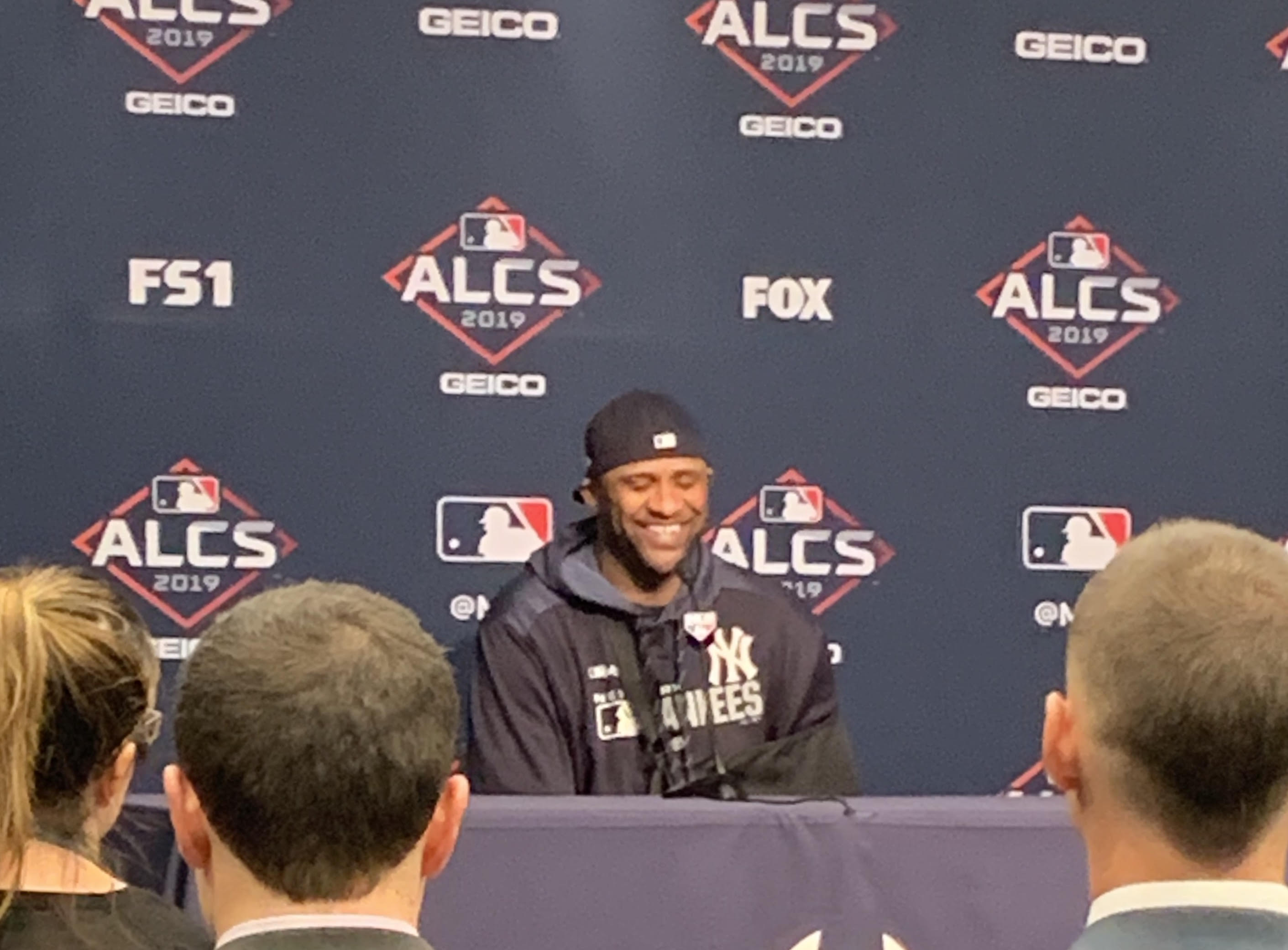
The Yankees’ 8-3 loss in Game 4 of the ALCS did not eliminate them, but between their missed opportunities early (stranding five runners in scoring position in the first five innings) and their sloppiness late (four errors over the final four innings), the game had an air of finality about it. Nowhere was that more true than in the case of CC Sabathia, who departed due to a shoulder injury in what will stand as the final appearance of a 19-year major league career that may well be capstoned by a plaque in Cooperstown.

On Friday morning, the Yankees announced that Sabathia had experienced a subluxation of his shoulder joint and replaced him on the roster with righty Ben Heller. The move means that he would not be allowed to be reactivated for the World Series, almost certainly a moot point given the condition of his shoulder, to say nothing of the Yankees’ precarious position. Sabathia, who appeared to be in good spirits during a pregame press conference on Friday despite pain that he described as “pretty intense,” said that he would “maybe get an MRI after we get back from Houston” and that he doesn’t know yet whether he will need surgery.

Dropped into a difficult situation in his second relief appearance of the series and just the fourth of his career — runners on second and third with no outs in the top of the eighth, with the Yankees already down 6-3 — Sabathia was victimized by the first of Gleyber Torres‘ two errors when Yordan Alvarez’s chopper deflected off the second baseman’s right hand as he positioned himself to throw home; Alex Bregman scored on the play, and Alvarez was safe at first. After retiring Carlos Correa on a soft liner to right field, one in which Aaron Judge nearly doubled Yuli Gurriel off second base, Sabathia hit Robinson Chirinos on the left elbow with a pitch, loading the bases. He got Aledmys Diaz to pop up to shallow right, keeping Gurriel from scoring, but after missing inside on a 1-1 cutter to George Springer, Sabathia grimaced, and both manager Aaron Boone and head athletic trainer Steve Donohue came to the mound.

According to Sabathia, his shoulder popped during his last pitch to Diaz: “I just felt like when I released the ball, my shoulder kind of went with it.” In other words, he pitched through a partial separation when he faced Springer, throwing a first-pitch cutter that reached 91.2 mph.

After throwing one warm-up pitch to check if he could continue, Sabathia told Boone and Donohue, “I’m done,” shook his head, and then departed to a heartfelt ovation from the Yankee Stadium crowd as well as both dugouts. The FS1 broadcast showed both Springer and Gerrit Cole paying their respects, then a slump-shouldered Sabathia covering his face with his glove, understandably overcome with emotion but — and maybe this is just a scribe projecting — ever so slightly tipping his cap to the crowd even as he did. It wasn’t easy to watch, and you’re by no means obligated to, but here’s the whole scene: Read the rest of this entry »