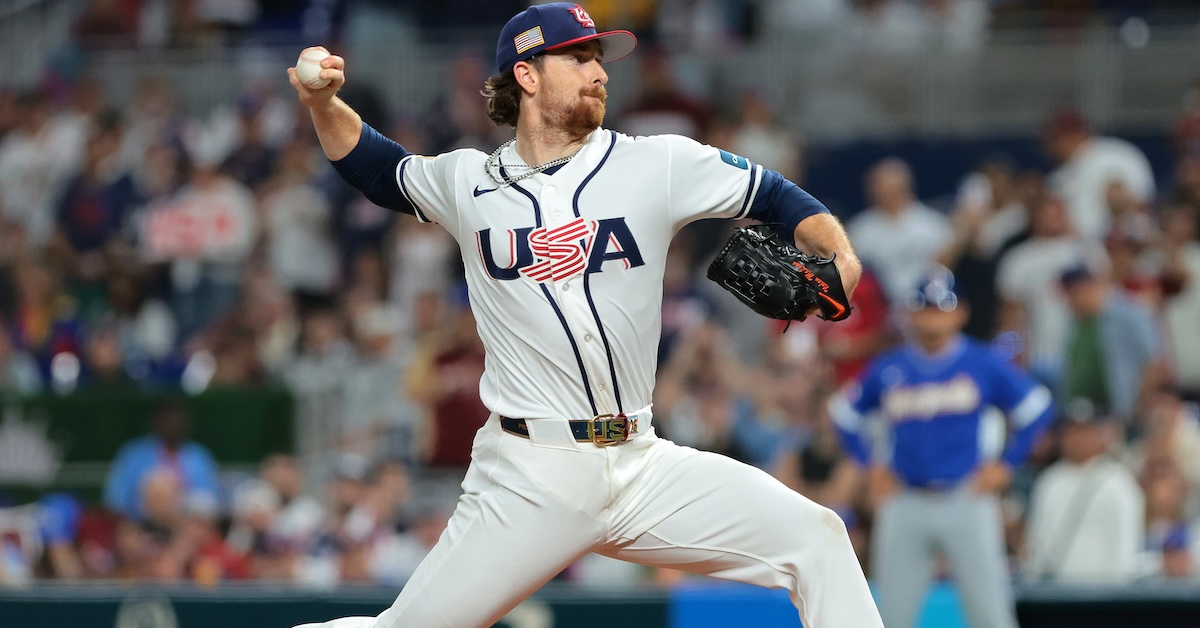
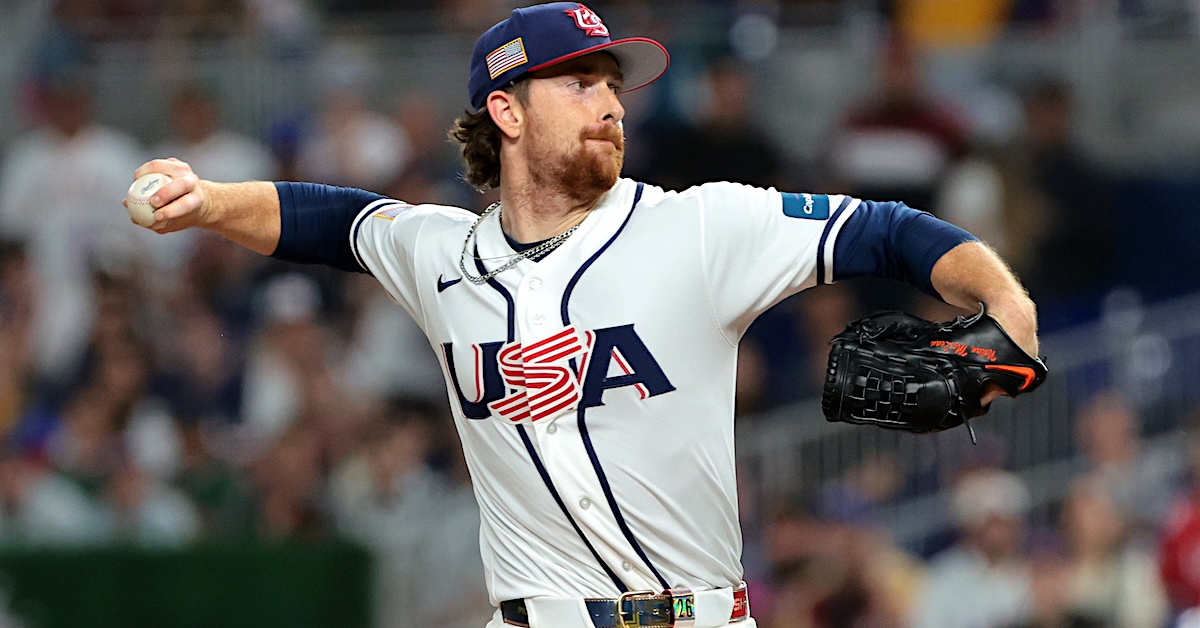
During the championship game of the World Baseball Classic, a Nolan McLean sweeper made me jump off of my couch. It wasn’t even a strike; it just moved so much from such an innocuous starting point that I reacted instinctively. I clearly wasn’t alone; Davy Andrews wrote about how nasty McLean’s pitches look last week. “Dang,” I thought to myself after I’d calmed down. “It’s too bad someone hasn’t gotten PitchingBot to take a look at that one.”
Then I thought about that slightly longer and chuckled. That someone is me. PitchingBot lives in the cloud, but I have a duplicate copy isolated in a sandbox on my computer. MLB records Statcast data for WBC games. I have a machine that ingests Statcast data and turns it into pitch modeling grades. This wasn’t rocket science (give or take how you feel about the machine learning algorithms powering the model) – I took the data, fed it into the machine, and tinkered with the exact settings until I got model grades to come out.
The tournament features a wide variety of skill levels, from Paul Skenes down to semipros and high schoolers. Setting the population average equal to the average quality of WBC pitching would mean that the grades aren’t comparable to the ones we’re all used to looking at. Thus, I ran the PitchingBot model for every pitch in the WBC, but instead of using the WBC average to mean a 50 grade, I used the 2025 MLB average. That means the model is calibrated to how you’d expect the pitches thrown in the WBC to perform against average major league opposition. Read the rest of this entry »
The World Baseball Classic likely provided many fans their first glimpse of Nolan McLean. The 24-year-old right-hander debuted last August and made just eight big league starts. If you missed his work against Italy on March 10 – if you only caught the last six innings, or if you only saw his line at the end of the night – you might have wondered how McLean ended up starting the championship game for the United States against Venezuela. You might have wondered how this prospect with hardly any major league experience, who earned a 9.00 ERA along with the team’s only loss in the tournament to that point, could have possibly earned that honor over the other All-Stars on the roster.
McLean’s line against Italy wasn’t exactly inspiring. He allowed three earned runs across three innings. He struck out four, but he also walked two batters, hit another, and allowed two home runs. Most of the batted balls he gave up were hard hit. And after that ignominy, he was set to face off against Ronald Acuña Jr. in the championship game? The same Ronald Acuña Jr. who did this to the famous McLean sweeper back in August?
Even if that was your frame of reference coming into Tuesday night, it didn’t take long for the pieces to fall into place. As is so often the case with nasty young flamethrowers, McLean looked absolutely unhittable, even when he was getting hit. Eric Longenhagen has described McLean’s pitches as moving “violently,” and I think that’s right on the money. The slider doesn’t look like it’s sweeping so much as it looks like it’s changing its mind halfway to the plate. It’s an optical illusion due to the camera angle behind the pitcher, but it honestly looks like it’s shifting into top gear once it makes its left turn. The sinker looks like it’s teleporting to the catcher’s glove. The curveball looks like it’s suddenly realized that it has left its curling iron plugged in and needs to get back home as soon as possible. (Even a curveball needs to feel pretty every sometimes.) Read the rest of this entry »
The hardest-hit ball of the World Baseball Classic semifinal between the United States and the Dominican Republic only traveled 191 feet. Vladimir Guerrero Jr.’s fourth-inning double left the bat at 116.1 mph, but it was just the 23rd-longest batted ball of the game, a few feet behind a Ketel Marte popout that was hit more than 40 mph softer. None of this was necessarily shocking. After the play, John Smoltz revealed even he was aware that sabermetric types wish Guerrero would find a way to lift the ball more often and turn some of his scorched groundouts into extra-base hits and extra-base hits into home runs.
This decade, 26% of balls hit 116 mph or harder have gone for home runs, and the lowest launch angle among those home runs was 15 degrees. Guerrero hit his double at just five degrees, and over the past five years, he ranks fourth in baseball with 28 non-homers of at least 116 mph. Five degrees is not the optimal launch angle if your goal is to do damage, but hitting a ball that low and that hard can have other benefits.
One benefit is that the ball can really slow down on its way to the wall. When you hit a screaming line drive or a high fly ball to the wall, it maintains much of its velocity and bounces off hard. When you hit a low liner or a grounder, all that contact with the outfield grass slows it down. Hard as it was hit, this ball didn’t have all that much velocity left, and the padding on the wall absorbed much of the remainder. It rolled back across the warning track and likely would have stopped entirely as soon as it encountered the grass. The outfielder has to wait back, wary of a hard carom bouncing past them, so when the ball dies like that, they need extra time to go get it, giving you more time to coast into second or stretch for third.
A weak carom also carries aesthetic benefits. When a ball is moving that slowly, you can’t field it normally. Below a certain velocity threshold, gloves are more hindrance than help. If you’re picking up a stationary baseball, or one moving at anything below a brisk walk, say 5 mph, it’s harder to pick the ball up off the ground with a glove than it is with your bare hand. Stiff leather fingers aren’t as sensitive or as flexible as real fingers, and the ball doesn’t have enough momentum to roll up into the pocket. Since you have to get the ball to your throwing hand anyway, you’re better off cutting out the middle man and barehanding the ball. It happens every day, but usually it happens for infielders who are dealing with bunts or squibbers. They charge hard, then scoop up the ball and throw it in one motion. It’s a thing of beauty, but it works quite differently in the outfield.
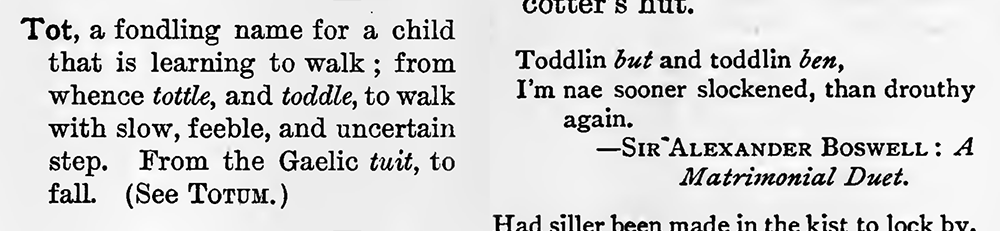
How much have you thought about the word toddler? As you can deduce, it means one who toddles, walking “with short tottering steps in the manner of a young child,” according to Merriam-Webster. The word first appeared in the early 16th century. There were tots, and the way they got around became tottering and tottling, which then became toddling. Finally, a good 300 years later, those tots who toddled became known as toddlers. (Who knows, they may have even enjoyed the occasional hot toddy. It was a different time.)
A Dictionary of Lowland Scotch, Charles Mackay, LL.D., 1888
Of course, toddling isn’t the only hallmark of a toddler. Our balance, motor skills, and proprioception evolve (and then devolve) over time, so we end up moving very differently at each stage of life. For example, when adults bend over to pick something up off the ground, they bend at the waist, but they also tend to put one foot in front of the other and go into a slight lunge to bring their torso closer to ground level. Toddlers have a different approach, getting into a deep crouch and reaching for the item while it’s still way out in front of them. They tuck their chests against their knees and they have to stick their elbows out to make room. Because they’re not yet champions of spatial awareness, they don’t often nail the location of their squat, which is the reason they often end up reaching way out or way across their bodies.
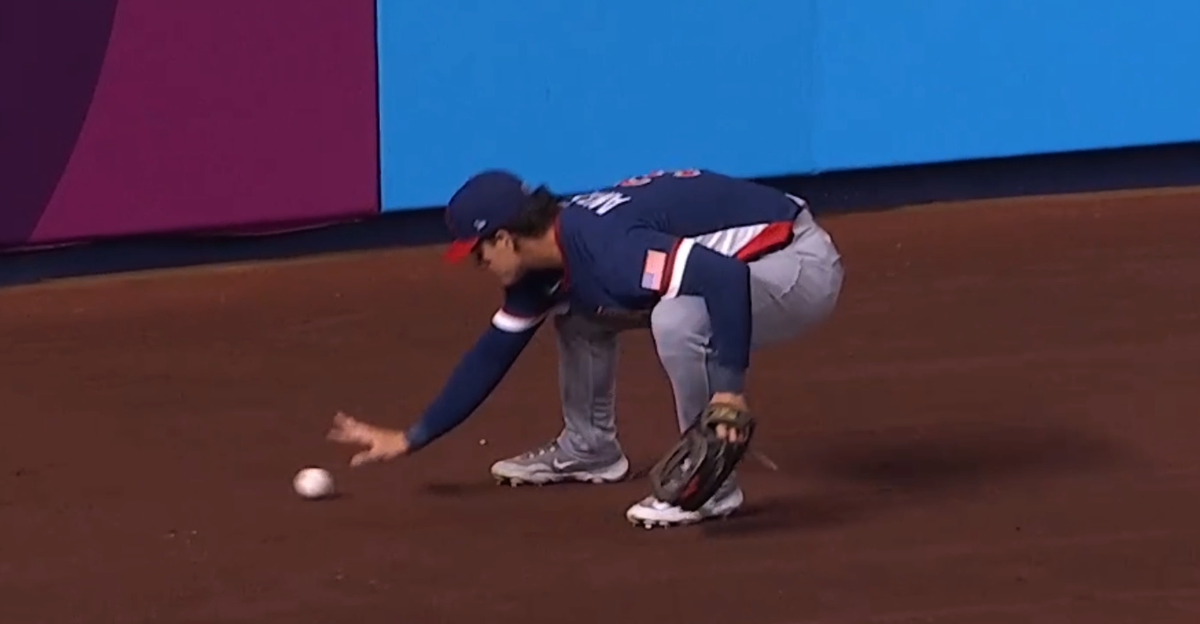
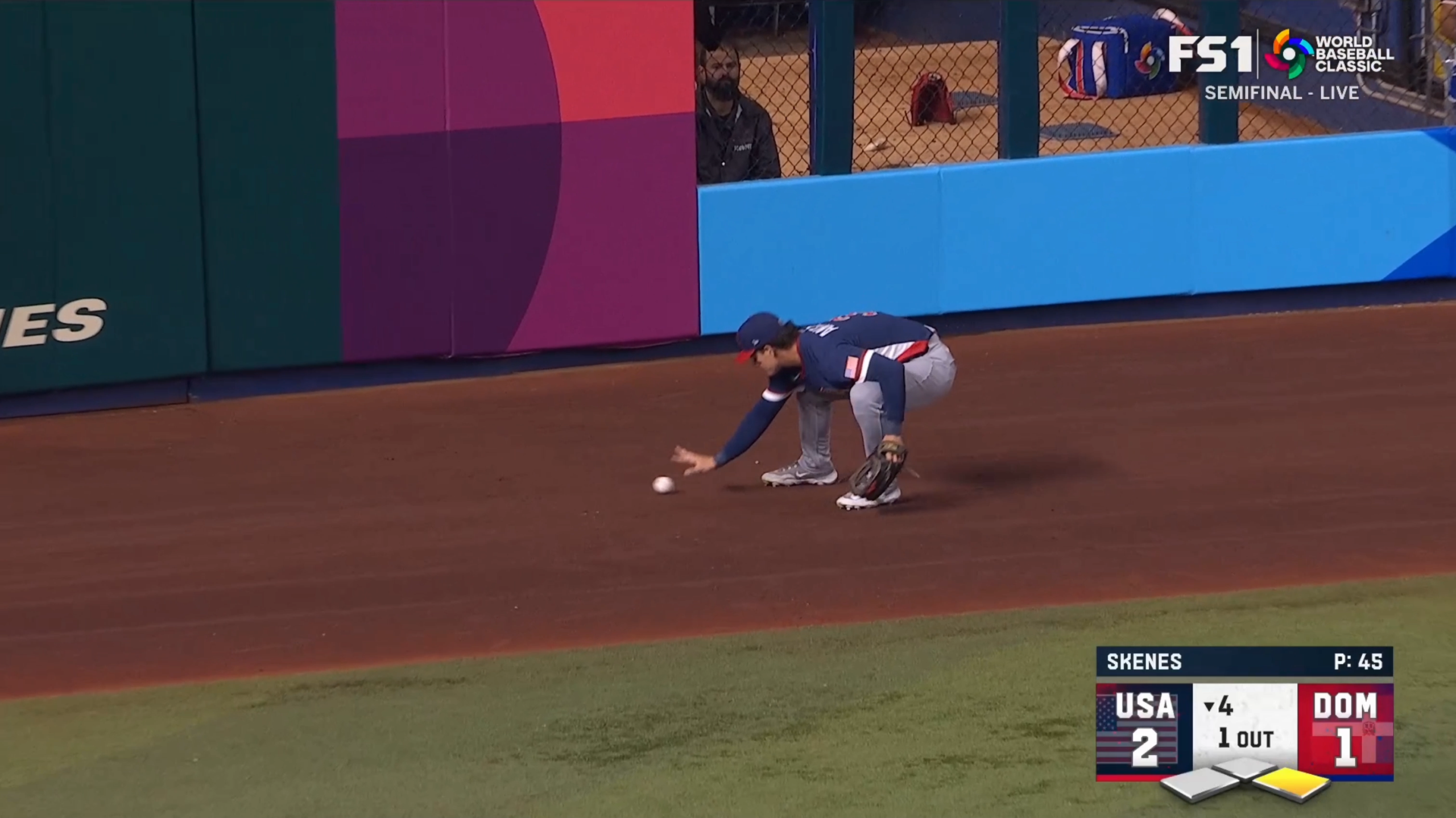
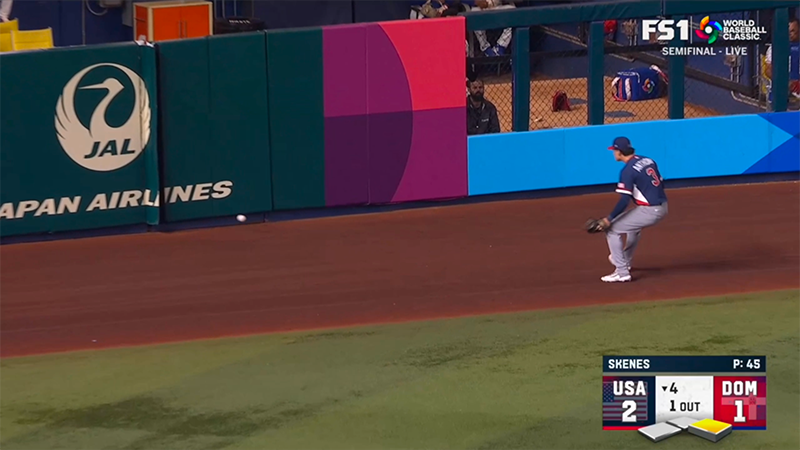
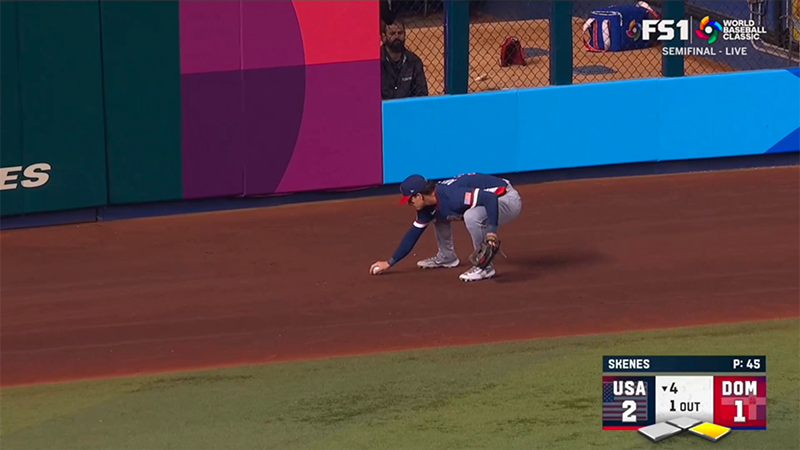
I bring all this up because when Roman Anthony, playing left field for the United States at the time of Guerrero’s blistering low-launch-angle double, loped out to the warning track to field the ball, I couldn’t help but notice that he didn’t exactly look like the Greek god, top-prospect-in-baseball, uber-athlete we’ve come to expect. He looked, uh, different.
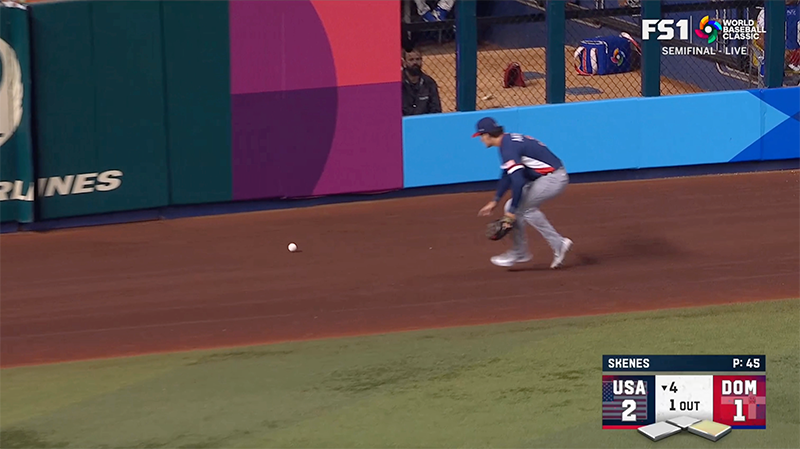
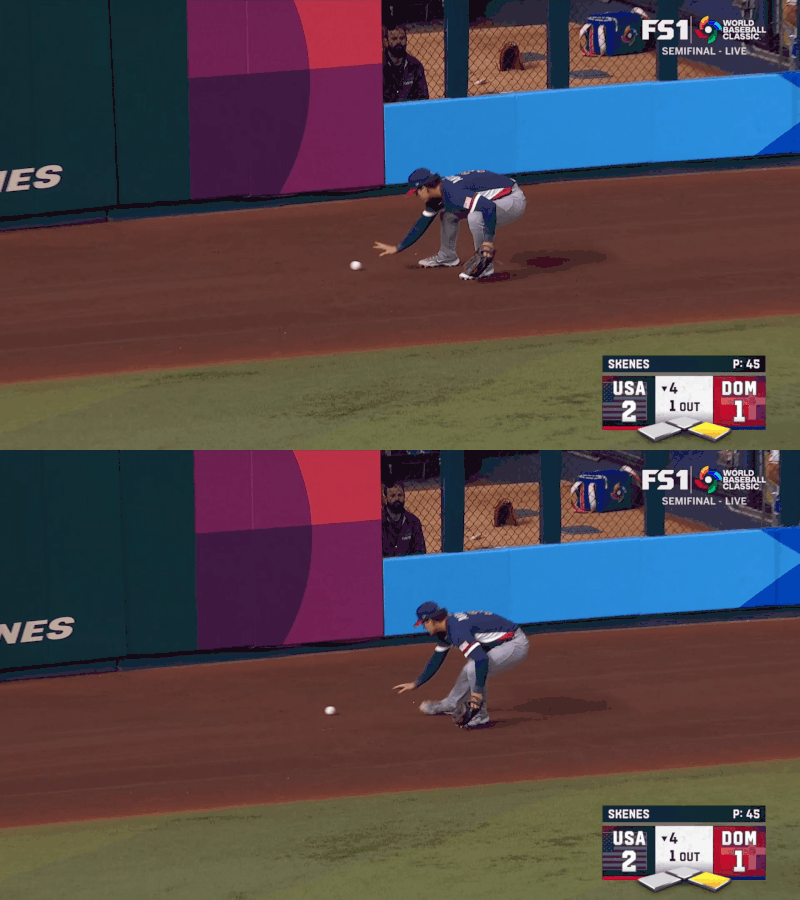
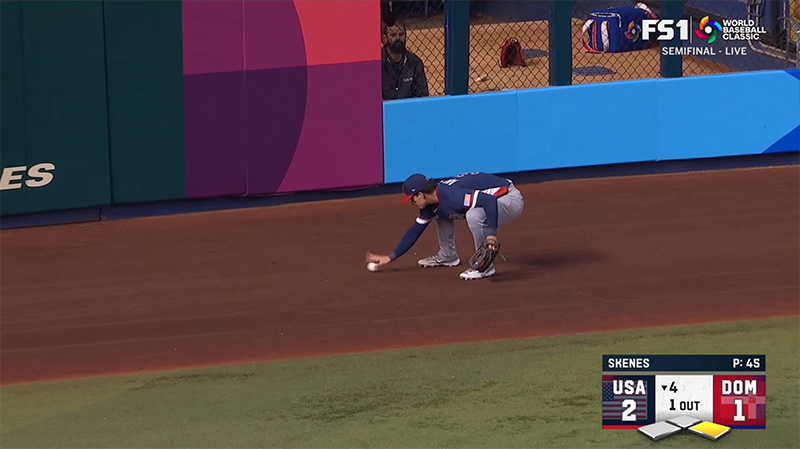
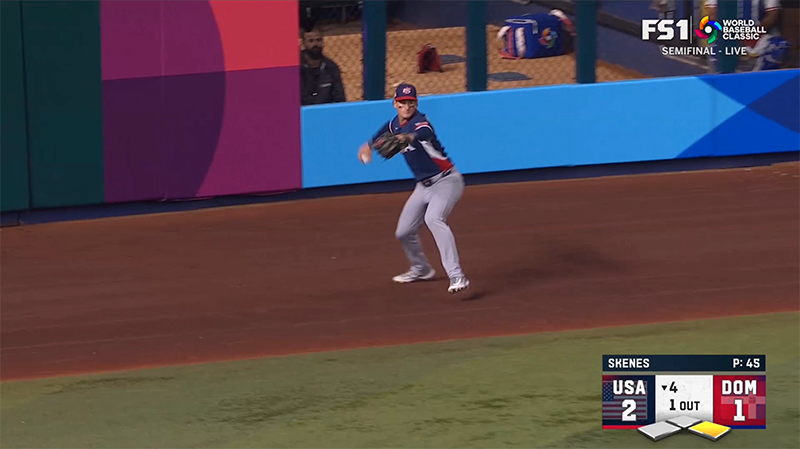
Anthony looked either like a toddler playing with a toy dump truck or a grown man doing a pretty convincing impression of an anteater. I’m going to be honest with you. I went through a bunch of pictures of my nieces and nephews, and it didn’t take long to find a photo of a niece in the exact same pose. She’s two years old, and she’s not wearing a shirt or pants because she was just playing in the sprinklers. She’s crouched down to pick up a worm from the garden. She looks exactly like Anthony in the picture above, and I wish I could show you the two side-by-side in the Miami outfield, which I absolutely mocked up in Photoshop. Alas, I cannot do that to my niece, who is no longer two years old.
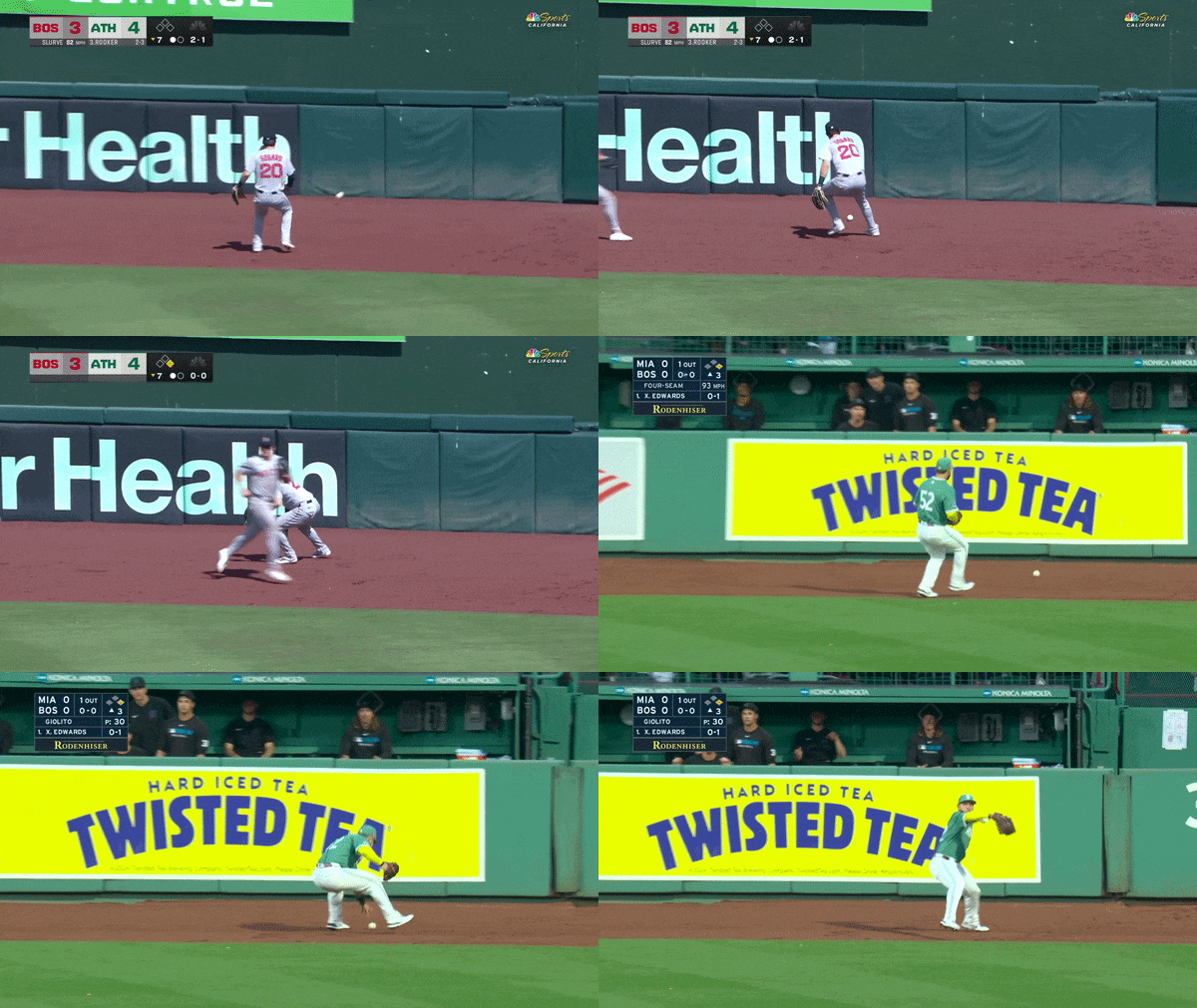
How did Anthony get into this position? For starters, in the outfield, you’re no longer scooping the ball up gracefully and firing it on the move. The weak carom is the only situation where you have to barehand the ball, and you’re always moving away from the infield to get it, which means you’re running, stopping to pick up the ball, then reversing your momentum to throw it into the infield. It’s a halting, graceless maneuver at the best of times. But other outfielders seem to manage it. Here are Anthony’s Red Sox teammates, Nick Sogard and Wilyer Abreu, making similar plays.
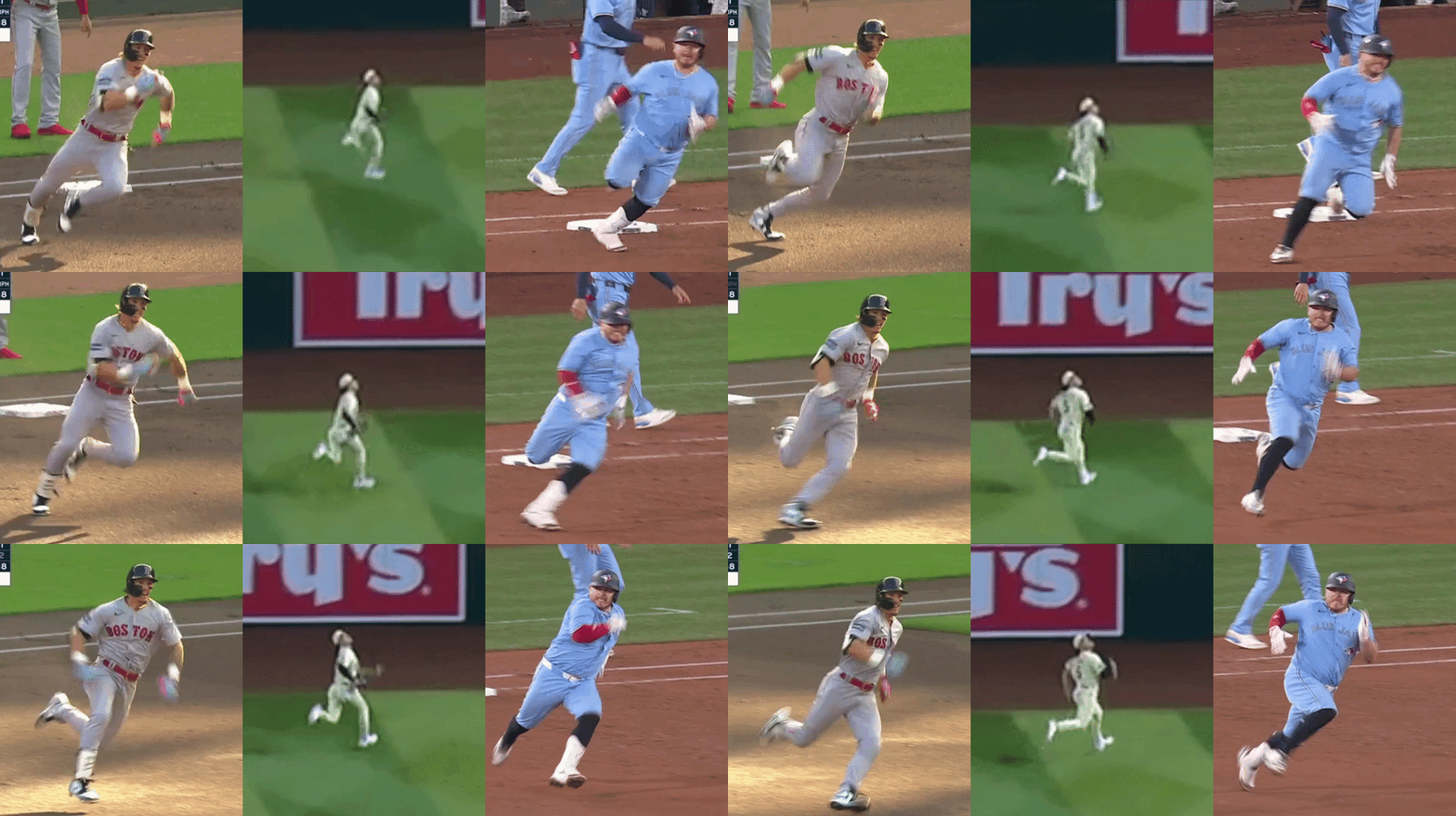
They chop their steps and time things so that the ball arrives between their feet rather than way out in front of them. They get low to field the ball, but their chests aren’t tucked tightly against their knees. They still look like athletes. To be fair, they’re also benefitting from a more flattering angle, but let’s break down the video of Anthony on Guerrero’s double frame by frame just to make sure we understand the progression.
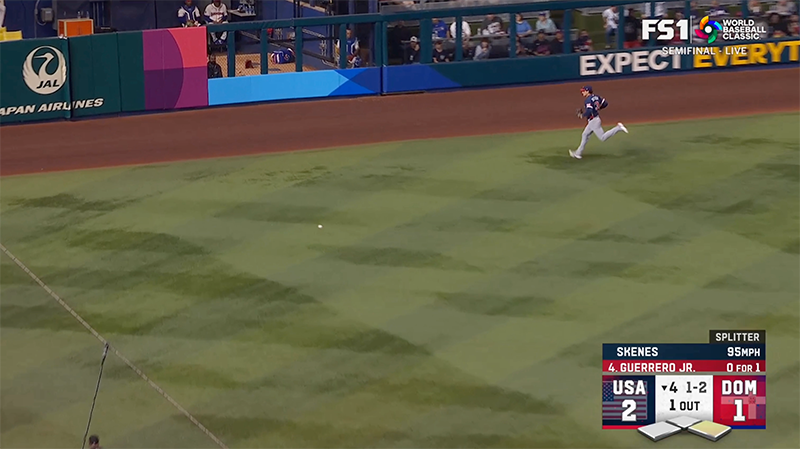
Here’s Anthony running after the ball with his trademark long, graceful strides. He’s a 6-foot-3 miracle with a 55 current value on his run tool.
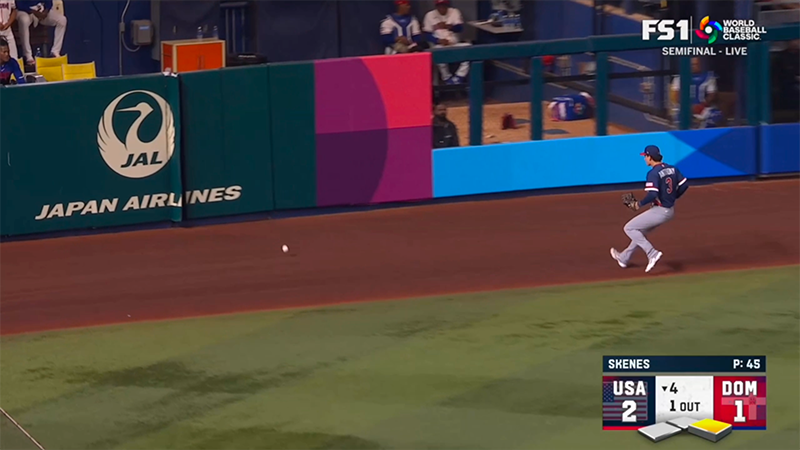
Next, here he is putting on the brakes. He may be slowing down, but the picture is still alive with movement as he powers down into a hover.
And here Anthony is, settling into a defensive crouch as he awaits the carom off the wall. He’s low, he’s alert, he’s ready for anything. Wherever this ball decides to bounce, he’s about pounce.
Um, so this is Anthony scuttling like a crab. He’s scuttling like a crab now. The ball didn’t so much bounce off the wall as it did die on the wall, and Anthony just kind of stayed in the crouch and started – sorry, scuttling is really the only word I can think of that applies here – toward it.
So this is the difference between a professional athlete and a toddler. When the right leg is still extended, planted in the ground for maximum leverage, the foot digging into the dirt at an angle, Anthony is a force to be reckoned with. Once the right leg is bent, he’s completely flat-footed, knees to his chest, left elbow stuck way out to the side so he can wrap his arm around his leg; he’s everyone’s nephew, powerless to stop himself from befriending a worm.
This is the frame that really takes it over the toddler top. For some reason, Anthony doesn’t grab the slow-moving ball with his fingers. He reaches out with his hand angled back. It looks like he doesn’t know what to do, so he’s just going to slap the baseball. He lets it get deep into his palm and grabs it with his whole hand. Professional baseball players do not grip the baseball that way. They have enormous hands and get a four-seam grip, holding the ball with their fingertips. There’s air between the ball and their palm. When Anthony finally picks up the ball, he holds it the way you might cradle a melon.
After that, sadly, Anthony returned to his usual status as a fearsome baseball warrior blessed with grace and agility.
Anthony has a long career ahead of him, and he will awe us with many astounding feats of power and dexterity. For now, though, let’s make sure we treasure this memory of him as an adorable toddler before he hits the terrible twos.
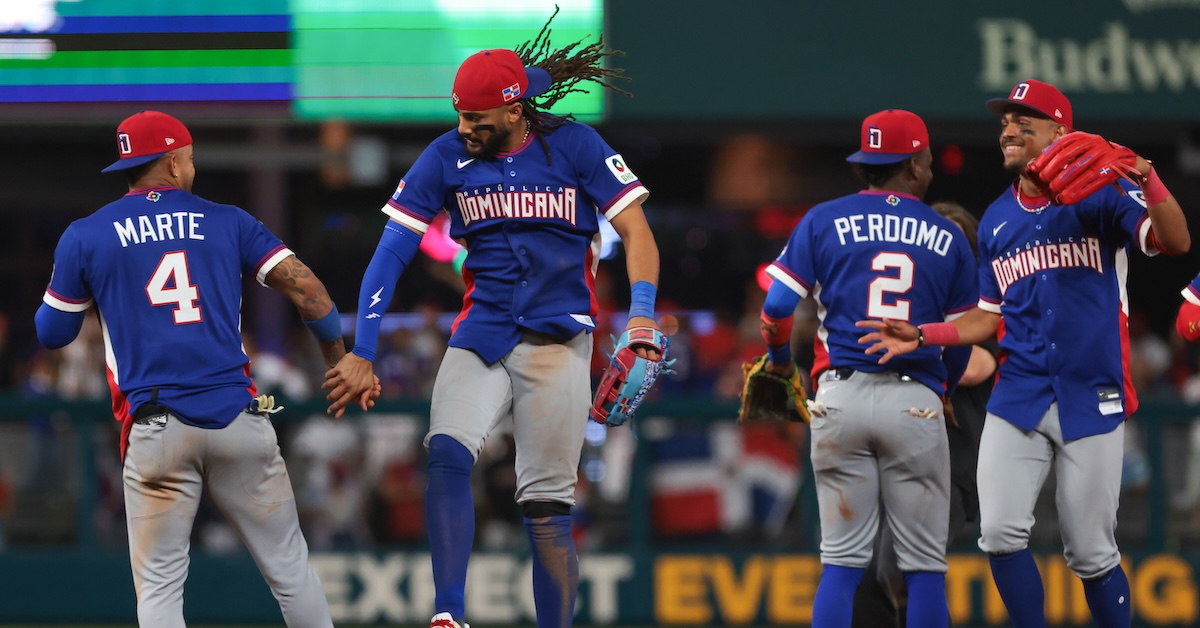
I’ve covered Red October playoff games in Philadelphia, and white out football games at Penn State. I’ve also attended professional games in Panama and covered plenty of Little League World Series games, giving me a taste of how different cultures enjoy baseball. But I have never witnessed a sporting event quite like Wednesday night’s World Baseball Classic game between the Dominican Republic and Venezuela.
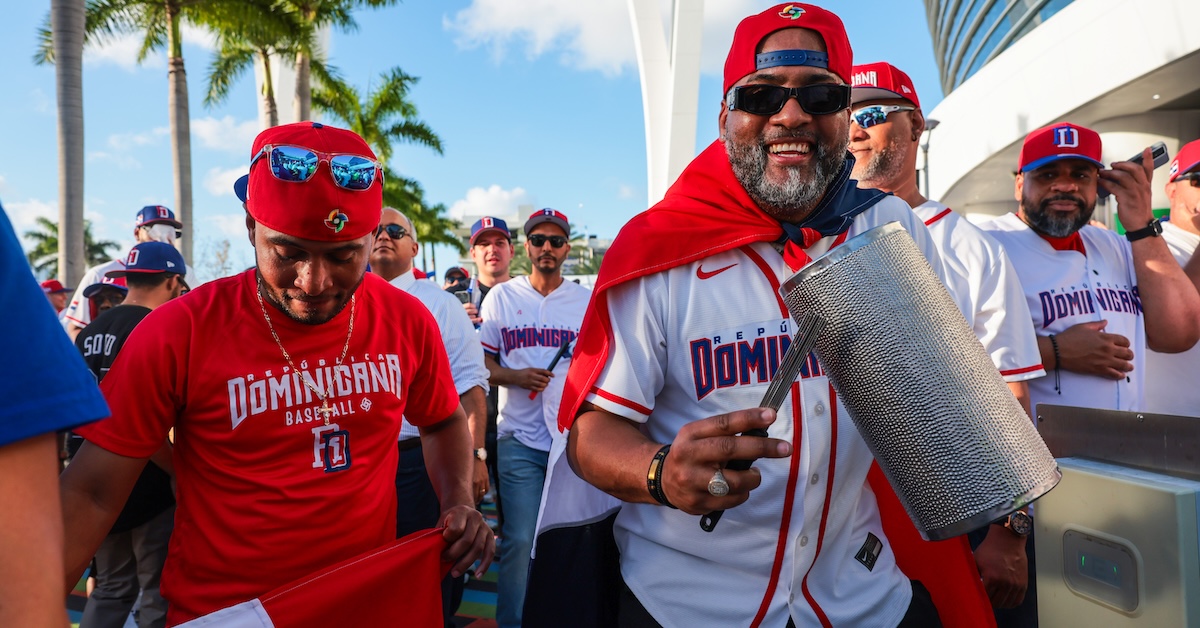
It wasn’t just the chanting, the instruments blaring, or the dancing that made for such an exhilarating experience; all of those things were also a part of the previous Pool D games played by the Dominican Republic and Venezuela. I know what passionate fandom looks and sounds like, and this was something altogether different. Venezuelan and Dominican fans don’t merely watch baseball; they participate in it. It’s kinetic, and when the force of their fandom collided under the closed roof of loanDepot park, it created a unique, unforgettable energy. I hope all of you reading this can experience something like it at some point in your life, because getting to feel that power pulsing through the stadium is one of the great privileges of this job.
That’s the last we’ll talk about the WBC in this week’s mailbag. Instead, we’ll be answering your questions on how baseball would change if it were played exclusively left-handed, how often we might see an Ultimate ABS Challenge, and whether the 2026 Angels roster would’ve been a playoff team in 2024. But first, I’d like to remind you that this mailbag is exclusive to FanGraphs Members. If you aren’t yet a Member and would like to keep reading, you can sign up for a Membership here. It’s the best way to both experience the site and support our staff, and it comes with a bunch of other great benefits. Also, if you’d like to ask a question for an upcoming mailbag, send me an email at mailbag@fangraphs.com.
__
How would baseball change if there was no such thing as right-hand dominance? All hitters and pitchers from the game’s inception to the present performed exactly the same, except now all as left-handed throwers and hitters, exclusively?
How different would that be from a baseball universe in which everyone was exclusively right-handed?
From,
“Transmission”
Michael Baumann: I’d like to begin by saluting you, Transmission — I’m gonna call you Mish for short — for submitting the best mailbag question I’ve ever received. Better than the dog first baseman one, better than the one about why God hates the Reds. Nothing’s even close.
The first thing that comes to mind is that if everyone in the world were left-handed we would absolutely be running the bases the other way. Most obviously because of the way the infield is oriented now, three of the toughest defensive positions are incredibly awkward to play as a left-handed fielder. So much so that you never see it past the dandelion-picking levels of Little League.
I know that lefties get an advantage over righties by being closer to first base, but there’s a logic in having the batter run to the base he’s facing. The big question is whether baseball’s founding fathers would have bothered to create a right-handed batter’s box at all. And conversely, would an all-right-handed baseball league have created a left-handed batter’s box? (For what it’s worth, if everyone threw with the same hand, I don’t think it’d matter which hand it was; all-lefty baseball would look the same as all-righty baseball, just in reverse.)
But if everyone in baseball hit from the same side of the plate, pitching strategy would be enormously different than it is in our ambidextrous world. The value of the platoon advantage was understood very early on in the history of the game; switch-hitters came into existence around the same time as the baseball glove, in the 1870s.
If every player in the league were left-handed, and it was understood that hitters fared better against breaking pitches that moved toward them, would anyone have ever developed the sinker or the changeup? Probably — even now, you see pitchers whose offspeed pitches are dominant enough to be effective against same-handed hitters — but the shape and deployment would probably be different. Creating screwball action would take a backseat to deception; for that matter, maybe breaking pitches would have developed on a continuum of shape and speed, rather than being distinct, the way we separate sliders and curveballs now.
But if I had to guess, I’d say that entirely left-handed baseball would have developed symmetrical batting positions, as ambidextrous baseball has in real life. I’m not aware of a stick-and-ball sport that forces the player to address the ball from a specific side — then again, we live in a world where right-handed people exist, which would not be the case in Mish’s hypothetical.
A left-handed grip on a baseball bat — which is to say, left hand on top, right hand on the bottom — is also a left-handed grip on a variety of tools that would’ve been familiar to 19th Century Americans: axes, brooms, shovels, even swords. It stands to reason that baseball would’ve evolved along those lines.
But maybe not universally so.
When I was growing up, the kids in my neighborhood would play street hockey every afternoon, from when school got out to when it got dark. Hockey has left- and right-handed shooting positions that correspond with the batting positions of the same name. I write right-handed, I throw and hit right-handed, and I play hockey right-handed. Most of the kids I grew up with were also right-handed and played baseball right-handed, but in hockey they shot lefty.
In both baseball and hockey, the fine control of the bat or stick is done with the top hand — that’s where you want your dominant hand. But because the baseball bat is held up, the top hand is further from the knob, while the hockey stick — held close to the ground — has the top hand at the knob. In order to put the dominant hand in control of the stick, a right-handed hockey player would have to shoot lefty.
Most of my left-handed-shooting friends learned how to play hockey before they learned how to play baseball, so if they were right-handed they were taught to shoot lefty. I came to hockey later, after already having committed to a right-hand-over-left baseball grip, so I played hockey with the same hand position.
The point is, it’s easier to hit right-handed if you’re naturally right-hand dominant, but not by much. It can be learned or unlearned fairly quickly; plenty of high-level ballplayers who don’t switch-hit in games will switch-hit in practice for their own amusement.
If a right-handed batter’s box were available by rule, it would take about 10 seconds for someone to try to figure out how to gain an advantage by using it. It would start with the kind of jailbreak swing you see from left-handed fast-pitch softball players. (Remember, we’re running the bases clockwise in this hypothetical.) Before too long, an enterprising switch-hitter would realize that he was having an easier time seeing left-handed breaking pitches and commit to hitting righty full-time.
Eventually, the entire league would follow suit. If every pitcher you face is left-handed, why would you ever subject yourself to a platoon disadvantage if you could avoid it? So eventually, some left-handed pitchers would experiment with throwing righty, which would be awkward but not impossible. Remember, Billy Wagner is naturally right-handed. (So is Michael Vick, if you want a non-baseball example.)
From the start of the National League in 1876, it took 119 years for Greg Harris to come along and pitch with both arms in a single game. That was a novelty act from a pitcher on the verge of retirement; it’d be another 20 years before Pat Venditte reached the majors. Soon, Jurrangelo Cijntje will come to the majors with conventional big league-quality stuff from both sides.
In a world where every pitcher throws left-handed and every hitter is left-handed but bats righty, the evolution toward non-dominant-hand pitching would not take nearly that long. Eventually, we’d see a mix of switch-pitching and switch-hitting players, and maybe even right-handed-throwing first basemen.
From there, how long until baseball players start trying to write with their non-dominant hand, too? Would baseball bring an end to this wholly left-handed world? Is this thought experiment inherently self-negating? Fascinating stuff.
__
Dear Mailbag,
Let’s define the Ultimate ABS Challenge as the following: bottom of the ninth or later, bases loaded, two outs, full count, and either a walk or a strikeout is challenged. Is it possible to estimate the likely frequency of future UABSCs? We would be looking for past walks and strikeouts in that area in which Statcast suggested the ball was within, say, 1.5 inches of the edge of the zone on either side of it, I should think.
Thanks!
Andrew
Ben Clemens: What an incredibly specific query! The answer is that this is probably going to happen almost never. Forget the distance from the borders of the strike zone. From 2021 to 2025, there were exactly 23 pitches that meet the rest of your criteria: bases loaded, bottom of the ninth or later, full count, two outs, taken for a strike or ball. Here’s a Baseball Savant search string for that.
Out of those 23 pitches, 15 were taken for balls. Those balls were all pretty far outside the strike zone. The closest one was 1.7 inches off the plate, and that’s grading generously. Statcast measures the location of the center of the ball; I, of course, included the radius of the ball in my calculations. Sure, the Cardinals would have challenged that one, but I don’t think there’d be much drama. No one on either team thought that it was a strike.
Out of the eight pitches taken for a strike, only one had a location within 1.5 inches of being overturned on a challenge. That’s this bending changeup from Tyler Holton, and it would have been overturned. The closest among the others was this slider from J.B. Bukauskas that dotted the inside corner. I’m sure Amed Rosario would have challenged it, but the truth is that it was in the zone by a lot. It’s a strike if any part of the ball clips the zone, and the center of this one was in the zone. The inside edge of this pitch was nearly two inches into the strike zone; it wouldn’t have been close to getting overturned.
In other words, you might get a few challenges – five pitches in the last five years within two inches, for example – but probably not that many overturns. Maybe zero overturns, in fact. Batters don’t get into this situation — bases loaded, 3-2 count, two outs, bottom of the ninth — very often in the first place. And I doubt they’re going to suddenly start taking more pitches either. When batters swing at close pitches in these situations, it’s not because they’re worried the ump will botch the call. Rather, it’s because they’re tracking a spinning projectile in flight, making a swing decision well before they see where it ends up, and trying to approximate a trajectory. They don’t even know exactly where the strike zone border is. I don’t think this behavior will change much at all. No one’s that good at knowing where a pitch will end up before they swing; even Juan Soto chases. I hope that we see at least a few, but I’m glad that they’ll happen pretty rarely.
__
The Angels are accumulating a large number of players who were good roughly a few years ago, mostly in 2023. Some are declining vets like Jorge Soler and Mike Trout. Some are young enough guys that only had one really good year, like Josh Lowe and Alek Manoah. Some probably had really good projections some spring but never launched, like Grayson Rodriguez and Vaughn Grissom and Oswald Peraza. Some blew out their arms, like Jordan Romano and Robert Stephenson. If you took the best preseason projections in the 2022-2024 period for each player you probably have a playoff team. Could you run the projections to see if my theory is true? — Jason
Dan Szymborski: Hi, Jason, I always appreciate an attempt to make the 2026 Angels seem like an interesting team. We elected to do this exercise for the current Angels roster with their projections entering the 2024 season. You’ll see why in a moment.
The time machine 2024 Angels, in a ZiPS simulation, continue to struggle in the current AL West, though they do improve. You get better projections from Mike Trout, Logan O’Hoppe, Jorge Soler, and Nolan Schanuel, but you also lose Zach Neto’s breakout. Alek Manoah gets a bit of a boost, but both Yusei Kikuchi and José Soriano lose some of their current projected value.
In the end, it’s enough to bump the Angels from what is currently a 69-win projection to a 73-win projection, and their playoff probability from 2.9% to 9.1%, but it’s a team that would still need an awful lot of things to go right.
However, since we’re already using a time machine to violate baseball’s rules, and possibly physical laws of the universe, how about we take the approach of “in for a penny, in for a pound” and also purloin Shohei Ohtani himself entering the 2024 campaign? After all, as Tom Verducci reported in a March 2024 Sports Illustrated cover story, that might’ve happened if Arte Moreno had been willing to match the offer Ohtani got from the Dodgers, deferrals and all.
Now, with Ohtani and the pre-2024 projections, the Angels project as an 81-win team with a 32% chance of making the playoffs in 2026. If that still feels a little disappointing, you have to remember that this is a team that could give a TED Talk about how not to build a good baseball team while employing both Trout and Ohtani, which is a little like losing the Tour de France despite being allowed to use a motorcycle.
__
As someone fascinated by baseball player birthdays, I loved Ben’s response last week about birthday and WAR. It reminded me that a few years ago, I noticed that then-Diamondback teammates David Peralta and Jeremy Hazelbaker were born on exactly the same day (8/14/1987). They, in fact, batted back-to-back one game. It got me to wondering if – besides twins like the O’Briens or Rogers – what other teammates born the same day ever played in the same game as teammates?
Enjoying all of the great work. — jds
Jon Becker: Fun question! Upon querying our game-by-game database, I was surprised to find that this has happened more often than I would have guessed. Teammates with the same birthday (including twins) have played in the same game 4,477 times, with 10 of the 187 distinct pairs doing so at least 100 times:
Same-birthday-teammate games occurred 84 times last year alone, mostly thanks to two pairs: Brandon Nimmo and Clay Holmes, and Matt McLain and Hunter Greene. Nimmo and Holmes are no longer teammates, of course, but McLain and Greene — who’ve shared the field for the Reds 24 times already — will keep moving up the list when Greene returns from his elbow injury around midseason.
No one can deny that the first round of World Baseball Classic play was dramatic; we got the first two walk-off home runs in tournament history, and on the same day no less!
The second capped a thrilling comeback win for Puerto Rico over Panama, in San Juan, in front of one of the loudest home crowds you’ll ever see. I say “one of” because our Matt Martell was in the house for Venezuela-Dominican Republic on Wednesday night, with the roof closed at loanDepot Park, and I think he suffered the kind of systemic sonic shockwave-related physical trauma you’d get from standing too close to a rocket launch. Read the rest of this entry »
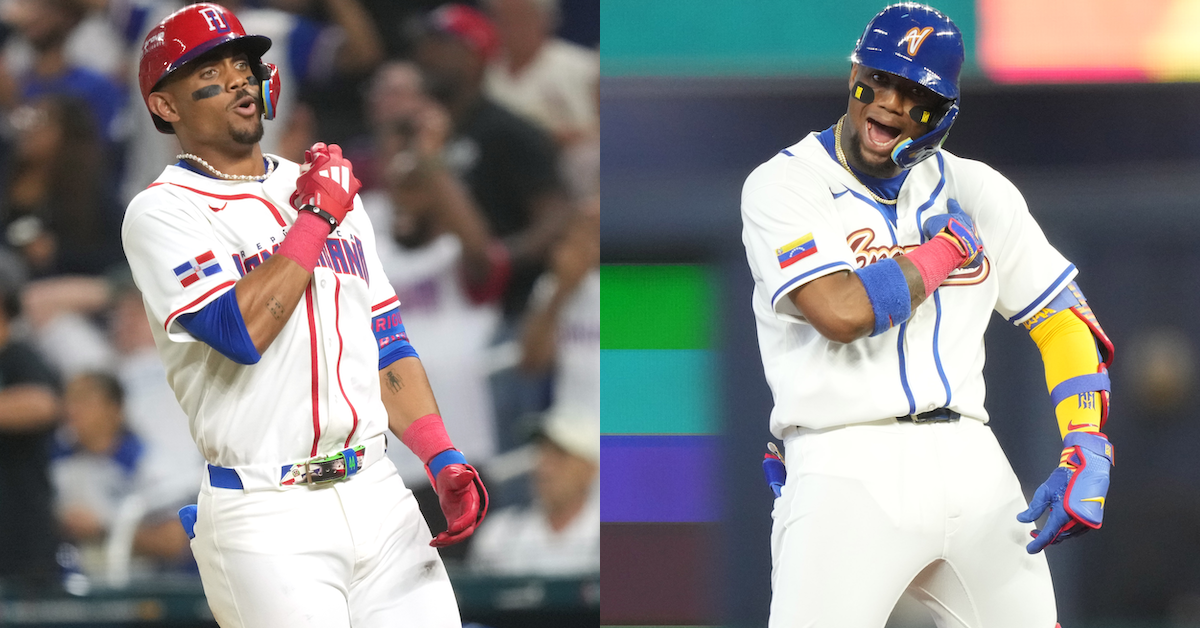
MIAMI — It was the most anticipated, cacophonous World Baseball Classic game of the week, a raucous rivalry featuring the national teams of two baseball-obsessed cultures playing in front of some of the loudest fanbases in professional sports. With air horns blaring, drums pounding, and more than 36,000 people shouting for the entirety of the game’s three-hour run time, the Dominican Republic outslugged and outlasted Venezuela, 7-5, on Wednesday night at loanDepot park.
All that for a game that didn’t matter much. Sure, the winner would finish first in Pool D and not have to face reigning WBC champion Japan in the quarterfinals, but South Korea is also a formidable foe. And yes, the winner would also have a better opportunity to secure one of the two spots in the 2028 Olympics reserved for non-United States teams from the Americas. But no matter the result of Wednesday night’s game, both teams would still have a chance to earn both the WBC title and an Olympic berth.
And yet, from another perspective, the game meant everything, because for the fans of these two countries, baseball means everything. Read the rest of this entry »
MIAMI — Through the first two games of the World Baseball Classic, the Dominican Republic had scored 24 runs, recorded 22 hits, and drawn 18 walks. Fifteen of those 24 runs had come on the team’s seven home runs. Collectively, the Dominican hitters were slashing .361/.506/.754; their 1.260 OPS was two points better than Babe Ruth’s was in 1927. They couldn’t possibly keep this up.
They cooled off some in Monday afternoon’s 10-1 win over Israel, lowering that slash line to a pedestrian .319/.488/.692. Those slackers.
Obviously, these numbers are staggering. Across three games, the Dominican squad has scored 34 runs and tallied 29 hits, nine home runs, and 29 walks; they’ve struck out just 13 times. Their OPS is now 1.180, slightly better than Ruth’s career mark of 1.164.
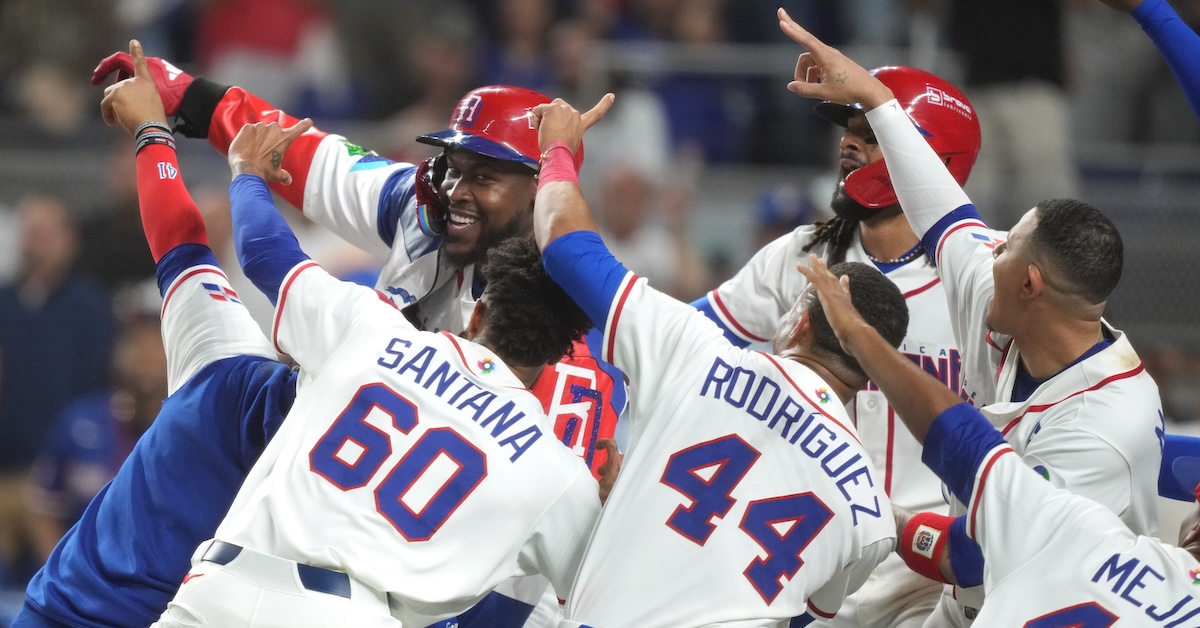
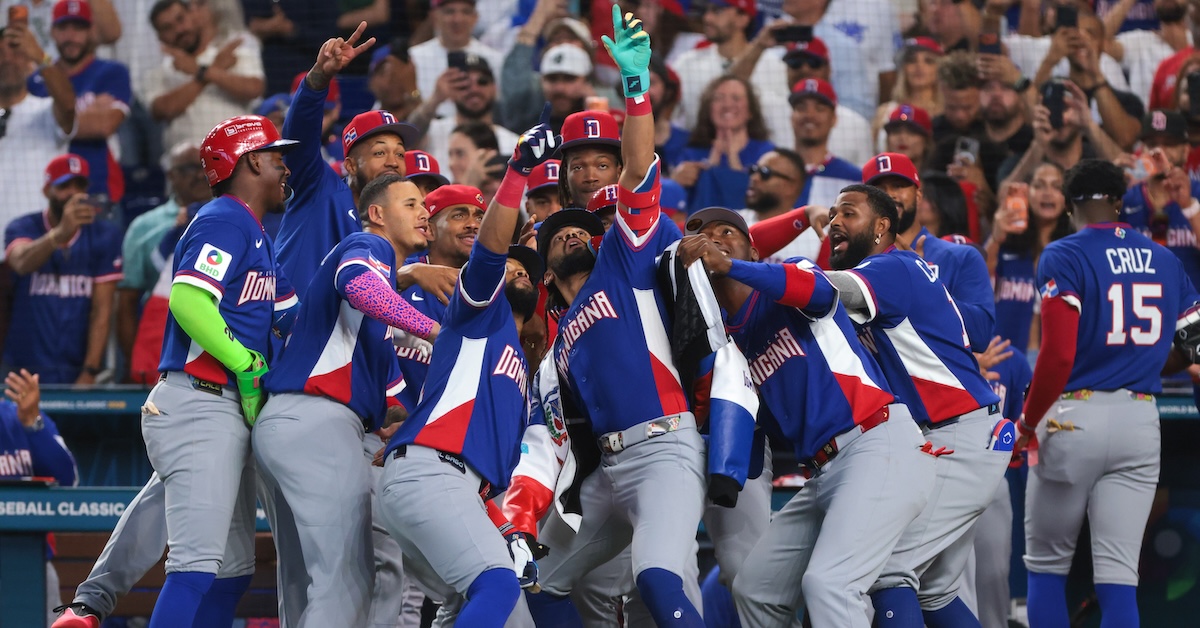
MIAMI — Mere seconds after the ball left his bat in the bottom of the sixth inning, Junior Caminero was booking it around the bases, euphoria smothering all sense of reason. You see, he’d just tattooed a two-run homer to straightaway center field to give the Dominican Republic the lead in its opening game of the World Baseball Classic, and even though nobody could possibly get him out, the 22-year-old slugger couldn’t contain himself.
He sprinted so fast toward second base that his helmet flew off. He skipped to third, where he seemed to finally realize that he didn’t have to run. He paused and gestured toward the Dominican fans behind the dugout, then pranced home.
It was one of the most electric home run celebrations in the history of the World Baseball Classic, a moment of catharsis after five and a half bewildering innings. The blast snapped the Dominican squad out of its temporary daze, as one of the most lethal lineups ever assembled pummeled Nicaragua’s pitchers for the remainder of the game. The final score of 12-3 didn’t reflect the chaos of what could have been. Up until that point, the Dominicans were getting outplayed by a vastly inferior Nicaragua team, whose leadoff batter, Chase Dawson, is from Northern Indiana and has never played affiliated baseball; it was only last year that he established residency in the country while playing winter ball there. Read the rest of this entry »
Hello from loanDepot Park in Miami, where I am covering Pool D of the World Baseball Classic. In the two games here Friday, Venezuela beat the Netherlands, 6-2, and the Dominican Republic defeated Nicaragua, 12-3. I am writing about those two games in a separate piece that will go live later today. You can find all of our WBC preview stories, as well as our coverage throughout the tournament, on the blog roll here.
Of course, those were just two of the eight games that took place on Friday. (Well, Friday in the United States, anyway.) Elsewhere in the WBC, Team Japan was every bit as dominant as expected in the first game of its title defense, blowing out Taiwan 13-0 in seven innings. Shohei Ohtani went 3-for-4, with his grand slam getting Japan on the board and kicking off a 10-run second inning. Cuba opened the action from Pool A in San Juan, Puerto Rico, with a 3-1 win over Panama. Puerto Rico, despite being without many of its best players because of insurance issues, shut out Colombia, 5-0, in the second game of that pool. Over in Houston for Pool B, Great Britain kept things tight with a superior Mexican team for the first seven innings before Mexico exploded for three runs in the eighth and four more in the ninth to win, 8-2. Then, in the second game at Daikin Park, Team USA routed Brazil, 15-5, in one of the oddest-looking blowout box scores that I can recall. The leadoff batter for Brazil, Lucas Ramirez, son of Manny, hit more home runs (2) than the entire United States team. The lone U.S. homer came when Aaron Judge a two-run shot in the first inning. The key difference in the game was the Americans drew 17 walks while issuing only one. Later, back in Tokyo for the final game of the night, a matchup of 0-2 teams, Taiwan trounced Czechia, 14-0, in seven innings.
We’ll be talking more about the World Baseball Classic in today’s mailbag, when we answer your questions about the future Hall of Famers playing in this year’s tournament, as well as the Dominican Republic’s chances of contending for the title with Japan, the United States, and Pool D rival, Venezuela. Also in today’s mailbag, we’ll look at the best baseball birthdays and honor Bill Mazeroski with the all-time Az team. But first, I’d like to remind you that this mailbag is exclusive to FanGraphs Members. If you aren’t yet a Member and would like to keep reading, you can sign up for a Membership here. It’s the best way to both experience the site and support our staff, and it comes with a bunch of other great benefits. Also, if you’d like to ask a question for an upcoming mailbag, send me an email at mailbag@fangraphs.com. Read the rest of this entry »
The World Baseball Classic is officially back! We’re been running preview content for the last two weeks, but now that the tournament is actually underway, you’ve got to pick a team to root for. You may even have to pick one team from each of the four pools. To help you choose a your favorite, I’ll be offering a reason to cheer for each of the 20 teams in the field. This is our last installment. Click the links below to read the previous entries:
Brazil is the clear underdog of Pool B. The team has got a tough road ahead of it, and its roster doesn’t feature a single major leaguer. What it does have, though, is pedigree. If you’ve watched Field of Dreams enough times to believe that baseball is the game of fathers and sons, then this is the team for you. Brazil boasts Joseph Contreras (the son of José Contreras), Lucas Ramirez (the son of Manny Ramirez), and Dante Bichette Jr. (you’ll never guess who his dad is). Also, in its final qualifier, Brazil defeated Germany, hanging a loss on pitcher Jaden Agassi, son of tennis legends Andre Agassi and Steffi Graf.
Now 33, Bichette was a first-round pick of the Yankees back in 2011. He last played affiliated ball in 2019, and he’s now training youth ballplayers in Los Angeles. He may have another gear when suiting up for Brazil. He batted .375 in the qualifiers, and back in the 2016 WBC, he went 4-for-10 in three games with a double, a triple, and two walks.
Ramirez is just 19. The Angels drafted him in the 17th round in 2024. Last year, he earned a promotion to High-A after running a 115 wRC+ in the complex league. He may not be the second coming of his father just yet, but he did have a 12% walk rate in the complex, too. Despite his youth, he batted .385 in the qualifiers.
Contreras is the most exciting son on the team. The 17-year-old right-hander is the youngest player in the entire tournament. He’s a high-school senior who’s committed to Vanderbilt, though that commitment may well get tested. He’s already listed at 6-foot-4, just like his dad, and he’s a serious prospect. “He has legitimate first-round upside,” wrote Mark Chiarelli of Baseball America, which ranked Contreras 34th in its preseason draft rankings. He can touch 98 mph with his fastball, which sits 92-96. He also throws a vulcan-grip forkball and a mid-80s slider that Chiarelli said “flashes plus.” Contreras didn’t play in the qualifiers last year, because, uh, he was 16. Next year, he’ll be old enough to vote, but Friday night, he may well be facing off against Aaron Judge.
Great Britain
How times have changed. Three years ago, the story for Great Britain was all about Harry Ford, the 20-year-old catching phenom with the big bat. He’d hit. 455 with three home runs in three games during the qualifiers. Then, in the actual WBC, fresh off batting .413 in the Arizona Fall League, he batted .308 with two homers and a double in four games.
Today, a fair bit of Ford’s prospect shine has faded. He’s still just 23, plenty young for a catcher, but he was blocked by Cal Raleigh in Seattle, so he was traded to the Nationals during the offseason. But let’s not forget that he’s likely to become Washington’s primary catcher, and he’s still the 74th-ranked prospect in the game, with 50 future values across every tool category. He’s athletic, he’s got a great approach at the plate, and he’s improved his receiving enough that he should be an average defender. He’s about to sink or swim in the majors.
Ford could absolutely be the star of this team again, but he’s got more company this year. Joining him are major leaguers like Tristan Beck, Trayce Thompson, and Nate Eaton (who should really be pitching in this tournament, if you ask me), along with a host of minor leaguers. The 38-year-old Vance Worley is back for one last ride, nine years removed from his final major league appearance. But Great Britain also has a genuine star in Jazz Chisholm Jr. The Bahamian Bomber is fresh off a 2025 season in which he set career highs with 31 home runs and 4.4 WAR. This could be his team now.
Italy
Maybe this is because I just wrote a whole article about Jac Caglianone, but the obvious reason to root for Team Italy is because it’s fun to walk around your house pronouncing all the names the way you imagine an actual Italian speaker would pronounce them. Will I be cheering as hard as I can for Gordon Graceffo? You bet I will.
Team Italy has a solid roster with enough major league regulars to fill out a whole lineup. But I’m still in it for the big boys. You know who I mean: Caglianone and his fellow Royal Vinnie Pasquantino, the 6-foot-3 Italian Nightmare himself. The 6-foot-4 Caglianone already has some nicknames – Cags, Jachtani, JacHammer, and the Vacuum, according to Baseball Reference – and for that matter, Jac is a nickname, too. But I think we can agree that we haven’t found a winner yet, and we definitely haven’t found one that makes the most of his Italian heritage.
For now, we’ll just call him the Italian Daymare. Is it derivative? Very much so. Is it terrible? Yes, it’s that, too. But do the math here. The Pasquatch (man, that guy has a lot of good nicknames) haunts you during the evening hours. The Cagsquatch (just go with it) haunts you during the daytime. It’s 24 hours of terror. You’ve got nowhere to hide. When will you get your precious restorative sleep? Every time you close your eyes you see two hulking lefties with plus bat speed sending flaming fragments of a baseball over the right field wall. Together, they’re a listed 495 pounds of panic (or 225 kilos, if you’re in Italy).
Mexico
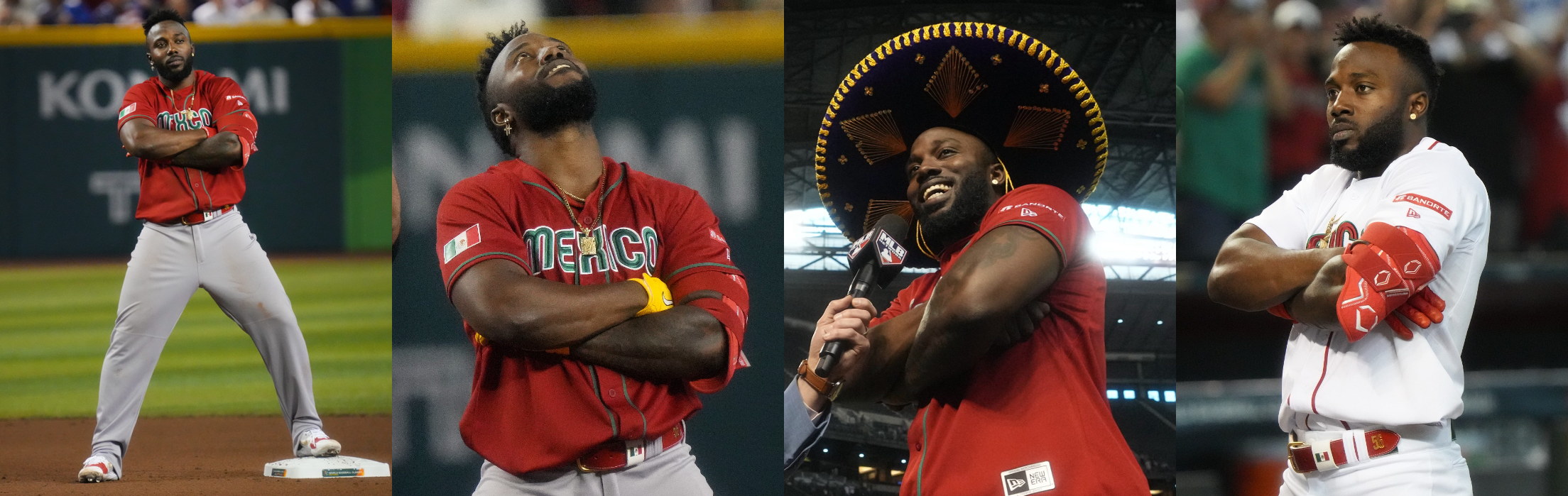
Look, as long as Randy Arozarena is playing for Team Mexico, Randy Arozarena is the reason to be excited about Team Mexico. The Cuba native has always come up huge under the bright lights, and he takes playing for his adopted country very seriously. He has a career 162 wRC+ in the playoffs, and in the 2023 WBC, he batted .450 with nine RBI in just six games. You might also recall that he crossed his arms kind of a lot.
Arozarena is by no means the only fun player on the team. Andrés Muñoz’s cat is a social media star, and Team Mexico leads the WBC in players named Nacho. More importantly, it also leads in diminutive players who have entertaining running styles.
Alek Thomas is 5-foot-9, and his short legs seem to churn up the outfield grass when he tracks down a ball in the gap. The 6-foot Jarren Duran always plays at 100%, and his bandy-legged gait and full-body tilt when he turns a corner have earned him the nickname, “The Lizard.” It’s a joy to watch the 5-foot-8 Alejandro Kirk motor around the bases. As a bonus, both Duran and Kirk have severe cases of karate chop hands when they run. Still, none of them does this.
United States
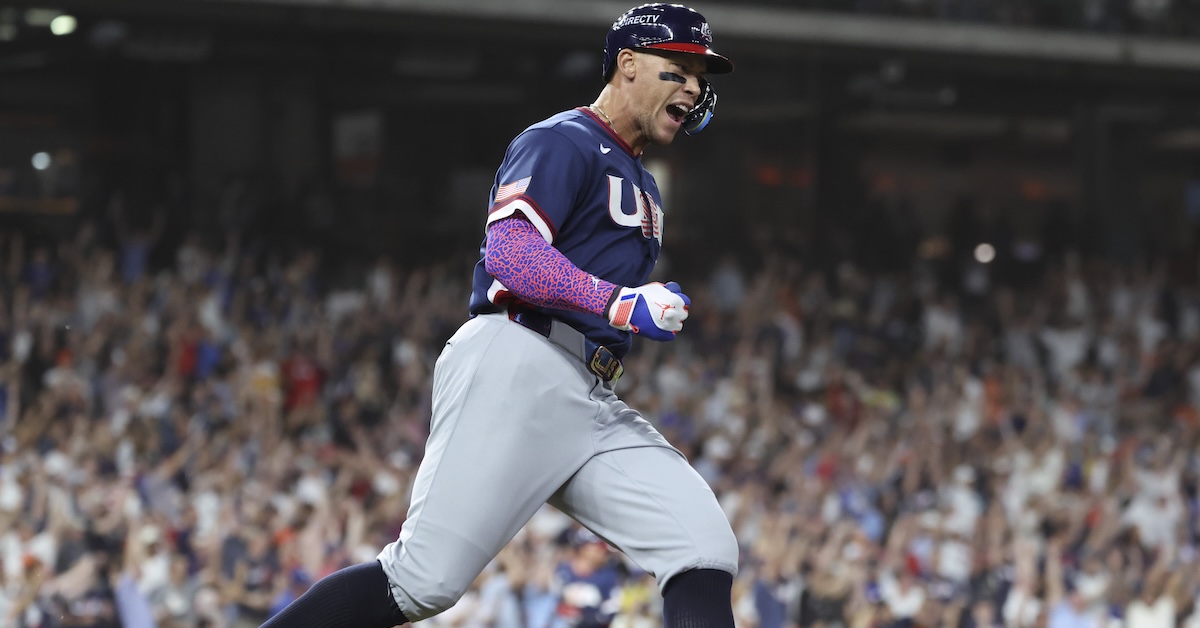
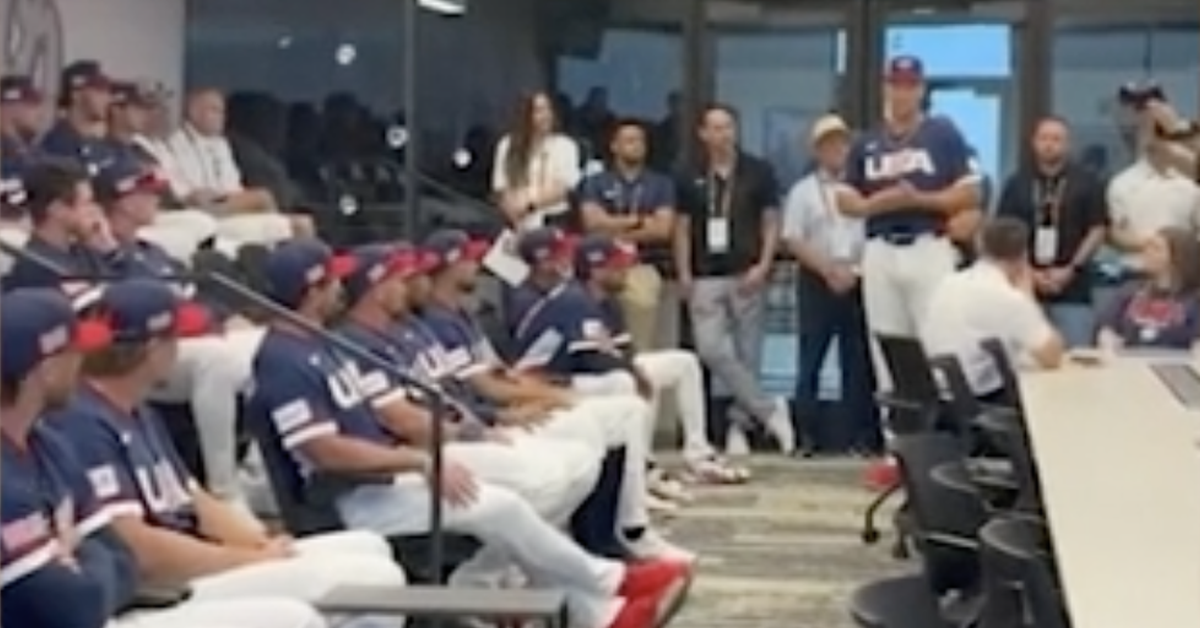
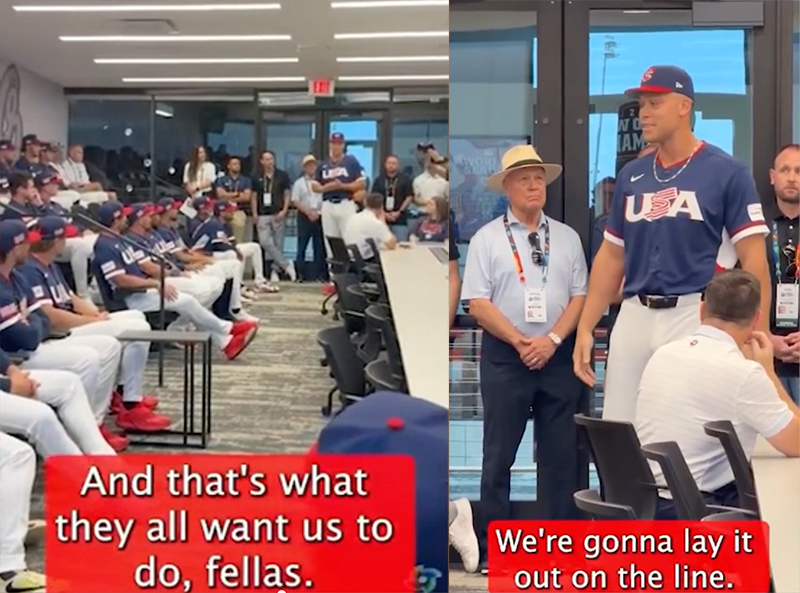
Aaron Judge has taken some heat for the lackluster speech he gave to his teammates earlier this week, but not all of this was Judge’s fault. First, it wasn’t his idea. Tarik Skubal and Paul Skenes pushed him to make the address in spite of his legendary ability to speak to the media without saying anything at all. Second, even if the speech had been a bit more substantive and delivered with a modicum of intonation, the setting wasn’t exactly conducive to rousing oratory. Everything about it felt artificial. The team was in full uniforms, plus sneakers. Judge was addressing his teammates in some sort of conference room with a wall of officials and reporters behind him and a cameraman snapping away. He wasn’t even standing in front of the team. He was off to the side of the room, and studies have proven that it’s physically impossible to be whipped into a frenzy while developing a crick in your neck.
More important than the context, though, is that people are misinterpreting the content. Here’s Judge’s grand finale:
So sacrifice for your family at home, you’re sacrificing for your country, and you’re sacrificing for the brothers in the trenches with you every single day. And that’s one thing I want us to do, fellas. I want to die on that field with you. We’re down, we’re beat up a little bit, man? Lean into each other, man. We’re going to lay it all on the line. And if we do that, we’re bringing the gold home.
Critics have interpreted Judge’s words as a military analogy, which would have been both crass and colossally tone deaf considering what the United States military is doing at this very moment. They’ve wondered what exactly these superstars are sacrificing, aside from a couple weeks of spring training. They’ve wondered whether the winner of the WBC now gets gold medals, too, or whether Judge just spent too much time watching the Olympics.
The critics have it wrong. Judge wasn’t channeling Henry V. That was just a metaphor and a clever bit of double entendre. He was actually talking strategy. Team USA is going to sacrifice its way through this tournament. Since it seems to have gone over so many heads already, let me lay out the Cliff’s Notes for you:
So sacrifice [bunt] for your family at home, you’re sacrificing [flies] for your country, and you’re sacrificing [more bunts] for the brothers in the trenches [fancy word for dugout] with you every single day. And that’s one thing I want us to do, fellas. I want [our bunts] to die on that field with you. We’re down, we’re beat up a little bit, man? Lean into [inside pitches and get hit], man. We’re going to lay it all [our bodies, and also all the bunts] on the line. And if we do that [hit and run], we’re bringing the gold [still unclear] home.
Get it now? Judge and his comrades-in-bats are going to lay bunts on the line. They’re going to safety squeeze and suicide squeeze. They’re going to give away outs like nobody’s business. Manager Mark DeRosa assembled a monster lineup of power hitting superstars as a colossal fake out. They’re going to small ball their way to… some sort of gold something. And even though Judge announced it in a speech, the world will never see it coming.