The All-Star break affords a good opportunity to run a full update of the ZiPS projections, since the lack of action allows me, the system’s flesh-and-blood creator, the time to refresh every speck of data that ZiPS uses before new games push over my tower of dominoes.
The ZiPS projected standings are the product of a million seasonal simulations; there’s a lot of PC power and a unfortunate amount of linear algebra involved. In order to get a better estimate of the upside and downside of a team, ZiPS takes the important additional step of simulating the roster itself before it ever considers a single game on the schedule. To illustrate, in most of the million simulations, Yordan Alvarez continues to treat opposing pitchers in a rather rude fashion, and sometimes, he even wins the Triple Crown. But in some simulations, he’s merely OK, while in others, he misses time due to injury. In a small percentage of those runs, the injury proves significant and prematurely ends his season. When a player is injured in a ZiPS simulation, the computer fills in the depth charts based on who is left standing. While this isn’t a perfect approach, the overall effect is to give us a range of expectations for the Astros, allowing us to peek as far as as we can into the future until the future actually arrives. Read the rest of this entry »
And just like that, the end of winter has been heralded, not by a groundhog or the vernal equinox, but by 6 1/3 shutout innings by Max Fried last night at Oracle Park. Today is the official Opening Day in MLB, and as such, it’s time for the ZiPS projections to spit out its final preseason projections. Hopefully, its numbers are graceful and kind, just in case it has to eat them in six months. This is the 22nd such exercise I’ve done with the ZiPS projections, and as with the other 21 times, there’s not much to do but sit back and wait for reality to destroy the expectations. Most of you already know the methodology by now, but for those who don’t, I’ll do a quick rundown. The rest of you can skip straight to the reason you’re here: the standings!
The ZiPS projected standings are the results of a million simulations of the 2026 season, using the ZiPS projections and the actual team schedules. The methodology isn’t identical to the one we use for our playoff odds. So how does ZiPS calculate the season? Stored within ZiPS are the first- through 99th-percentile projections for each player. I start by making a generalized depth chart, using our Depth Charts as a jumping off point. Since these are my curated projections, I make changes based on arbitrary whimsy my logic and reasoning. ZiPS then generates a million versions of each team in Monte Carlo fashion. These projections do reflect the updated post-spring training projections, which were added to the FanGraphs database on Wednesday afternoon. Read the rest of this entry »
One of the things that people like to ask me about when it comes to the ZiPS projections is how they change over time. While knowing what the projections are now is, of course, highly useful, it’s also interesting to see who has changed the most in the algorithms, since they basically represent the players who we should feel differently about compared to how we did before. Knowing how changes in a player affect performance models can also reveal an interesting fact or two about how players develop and age.
After running through the hitters who have gained and declined the most in my piece yesterday, today I’ll look at the pitchers who have done the same. The methodology I’ve chosen here is a simple one: I’m ranking the difference in 2026 WAR as it’s projected now compared to what it was as of Opening Day 2025. For the decliners, I didn’t include the off-the-radar types. While it’s good to know if a fringe High-A prospect hit a wall at Double-A, it’s more impactful to see the declines among the more roster-relevant players than the poor fellow who saw his -1.0 WAR projection slip to -2.5 WAR. Also left out were guys whose decline in WAR is mostly the result of a major arm injury. It’s worth noting that there will be slight differences between ZiPS WAR and the WAR recorded here on FanGraphs. There are a few methodological differences that can move a few runs here or there, with the most notable being that ZiPS doesn’t purely use FIP, but rather estimates how much of an ERA-FIP discrepancy is attributable to the pitcher based on their history of outperforming or underperforming their defenses.
I’ll start with the gainers, diving deeper on a few of the standouts:
In 2024, I included Hunter Brown in my annual Booms and Busts column, and while he did break out that season, he has basically experienced a second breakout last year, going from a good pitcher to a legitimate Cy Young contender. There’s a lot to love about Brown — he misses bats, he doesn’t walk guys, and he’s difficult to hit hard — and nothing really to dislike. There are no hidden spiders lurking in the Statcast data to give you a jump scare, either. At this point, Brown is probably the most irreplaceable member of the Houston Astros, and if he doesn’t fit your definition of a legitimate ace, then there might only be one or two of them in baseball:
ZiPS Projection – Hunter Brown
Year
W
L
ERA
G
GS
IP
H
ER
HR
BB
SO
ERA+
WAR
2026
13
6
3.06
30
28
167.7
138
57
16
55
178
136
4.1
2027
12
7
3.12
29
27
164.7
138
57
16
51
171
134
3.9
2028
12
7
3.20
28
26
163.3
139
58
17
50
166
130
3.7
2029
11
7
3.27
28
26
157.0
137
57
17
48
156
128
3.4
2030
11
7
3.31
28
26
155.0
138
57
17
48
150
126
3.2
Jacob deGrom is the only pitcher who made this list primarily due to improved health, but I’m going to allow it, as we shouldn’t ignore what a few good late-career seasons would to do to buttress his Hall of Fame chances. Honestly, just adding some bulk to his stats and innings would do a lot; while the electorate has changed greatly in the last decade and will continue to do so, I’m not sure 75% of the voters would want to induct a starting pitcher with fewer than 100 wins. I mean, I still would have voted for him, but I’m weird. deGrom has dialed things back slightly in order to stay healthy, and so far it has been a good tradeoff; plus, he’s still throwing harder than the vast majority of pitchers out there:
ZiPS Projection – Jacob deGrom
Year
W
L
ERA
G
GS
IP
H
ER
HR
BB
SO
ERA+
WAR
2026
10
7
3.48
26
26
144.7
119
56
20
35
154
114
2.6
2027
9
7
3.78
24
24
131.0
115
55
20
34
132
105
1.8
2028
7
7
4.14
21
21
115.3
107
53
19
33
111
96
1.1
The 2025 season saw Cristopher Sánchez take over as the ace of the Phillies’ rotation. Sánchez’s improvement was fairly consistent across the board, and it was supported by Statcast data. Especially interesting was his contact rate, which could support an even higher K/9 rate than the career-high 9.45 he posted last year, and didn’t come at the expense of anything else:
ZiPS Projection – Cristopher Sánchez
Year
W
L
ERA
G
GS
IP
H
ER
HR
BB
SO
ERA+
WAR
2026
10
6
3.28
29
29
178.3
162
65
16
42
172
135
4.1
2027
10
5
3.36
28
28
171.3
158
64
16
40
161
131
3.8
2028
9
6
3.50
27
27
164.7
158
64
17
38
151
126
3.4
2029
8
6
3.66
27
27
155.0
153
63
17
36
139
121
3.0
2030
8
6
3.88
27
27
150.7
153
65
18
36
132
114
2.6
Garrett Crochet put up a Cy Young-esque season in 2024, but naturally, a projection system is going to be a bigger believer in a pitcher when he does something like that twice. Pitchers always come with injury risk, but getting through two healthy seasons does have real predictive value for guys coming off of serious injuries. By the end of his Red Sox contract, ZiPS thinks that Crochet will be around the level of Jon Lester and Mel Parnell in the Red Sox southpaw pecking order:
ZiPS Projection – Garrett Crochet
Year
W
L
ERA
G
GS
IP
H
ER
HR
BB
SO
ERA+
WAR
2026
15
6
2.78
30
30
184.3
152
57
18
49
230
150
5.0
2027
14
7
2.90
29
29
180.0
152
58
18
47
218
144
4.7
2028
14
6
3.01
28
28
176.7
153
59
18
45
209
139
4.4
2029
13
7
3.13
28
28
167.0
149
58
18
43
192
134
3.9
2030
13
7
3.22
28
28
165.0
151
59
18
42
184
130
3.7
After a phenomenal debut for the Pirates in 2024, Skenes basically did it again in 2025, in 50 more big league innings, and with basically no meaningful regression toward the mean. ZiPS never hated Skenes or anything, but now it loves him even more than it did a year ago. Add in his age and contract situation, and he’s the most valuable pitcher in baseball:
ZiPS Projection – Paul Skenes
Year
W
L
ERA
G
GS
IP
H
ER
HR
BB
SO
ERA+
WAR
2026
13
6
2.76
32
32
179.7
143
55
16
46
204
152
5.0
2027
13
6
2.77
33
33
185.0
146
57
16
44
205
151
5.0
2028
12
7
2.81
32
32
185.7
148
58
16
42
202
149
5.0
2029
12
7
2.84
32
32
180.7
146
57
17
40
194
147
4.8
2030
12
7
2.92
32
32
181.7
149
59
17
38
191
143
4.7
While ZiPS doesn’t think Andrew Abbott is a potential ace, it’s fairly confident that he’s a reasonable no. 2 starter, with some upside remaining in his strikeout rate. He has been the ninth-best pitcher in the majors the last two seasons (minimum 200 combined innings) in hard-hit percentage against, which has enabled him to survive in a very good home run-hitting park and without a great offspeed pitch to befuddle righties:
ZiPS Projection – Andrew Abbott
Year
W
L
ERA
G
GS
IP
H
ER
HR
BB
SO
ERA+
WAR
2026
9
8
3.80
30
30
166.0
156
70
20
48
148
112
3.0
2027
9
7
3.83
29
29
157.3
152
67
19
44
138
111
2.7
2028
8
7
3.87
28
28
153.7
152
66
19
43
133
110
2.6
2029
8
7
3.90
28
28
145.3
147
63
19
41
123
109
2.4
2030
8
7
4.02
28
28
143.3
148
64
19
41
119
106
2.2
Before we turn to the decliners, some rapid fire thoughts on the remaining gainers. Nolan McLean probably won’t match the numbers he put up in his first eight starts with the Mets this year, but that’s no reason to be skeptical of him. He improved across a full season in the high minors, facing little resistance from opposing hitters at Triple-A. We could very well be talking about McLean as a Cy Young contender in short order, mirroring Hunter Brown’s trajectory. Shane Smith was one of the highlights on a White Sox team that you probably didn’t watch much otherwise. With his velocity ticking up another notch in his first professional season as a full-time starter, and a changeup that seems almost cruel when it’s working, he’s a legitimate no. 2 starter with room to improve even further. Jesus Lúzardo’s sinker has become a real weapon, and his stats bounced back after an injury-riddled 2024 season. He looks set to get a pretty sizable pay day a year from now, lockout willing.
A sudden dip in strikeout rate from an older pitcher frequently spells imminent misfortune, but Merrill Kelly arrested that decline a bit, and should have at least another year or two as a decent mid-rotation option. ZiPS would still like to see Jacob Misiorowski lose another walk per nine off his stat line, and he may do just that; his 42% first-strike percentage improved to 51% at Triple-A in 2025, and then averaged nearly 58% for the Brewers. ZiPS sees a command collapse as a lot less likely than it did a year ago. Matthew Boyd was shockingly good in eight starts for the Guardians at the end of 2024, and though he didn’t post 10 strikeouts per game again in 2025, he was still good enough be a phenomenal bargain for the Cubs on a two-year, $29.5 million deal. If you believe ZiPS, he’s also pretty important, as the computer sees the Cubs’ rotation depth as one of the things that could stop them in their attempt to knock off the Brewers in the NL Central.
ZiPS knows enough to look at a minor league command pitcher with a healthy dose of skepticism, but Mitch Bratt’s control is so good, and he does miss bats, so the computer thinks there’s a decent chance that he’ll be its next control pitcher obsession after Dean Kremer. Adrian Houser is probably the most puzzling guy on this list for me, as he seems to struggle with a lot of the things ZiPS cares about; he doesn’t throw hard or miss bats, and he can get hit pretty hard. But ZiPS is designed to be more accepting over time when players consistently outperform their peripheral data, as Houser has done in all but his 2024 season. Jack Leiter didn’t dominate last season by any means, but he showed he’s a reasonable mid-rotation option, and he’s still kind of raw, meaning there’s upside left here.
I’m going to talk more briefly about the decliners than the improvers. After all, spring should be about hope, not depression, and there really aren’t any big surprises on this list:
ZiPS was holding out hope for Walker Buehler after a so-so comeback in 2024, but after a 2025 season in which he lost another strikeout per game, added another walk, and saw another tick of velocity evaporate into the Jered Weaver great beyond, ZiPS has gotten to the point where it’s noping out of expecting big things from him in 2026. You know you’re not having a good season when your team cuts you loose in the middle of a hot postseason race. Buehler’s numbers were so poor that I’m not sure he’s going to even have an easy time getting a pillow contract for 2026:
ZiPS Projection – Walker Buehler
Year
W
L
ERA
G
GS
IP
H
ER
HR
BB
SO
ERA+
WAR
2026
6
7
4.89
22
20
105.0
111
57
16
42
83
85
0.5
2027
5
7
4.93
20
18
95.0
102
52
14
39
73
85
0.4
2028
5
6
5.08
19
17
88.7
98
50
14
38
67
82
0.2
2029
4
5
5.24
15
13
67.0
75
39
11
31
49
80
0.0
2030
3
4
5.57
11
10
51.7
60
32
9
25
37
75
-0.1
Unlike a lot of the pitchers on this list, ZiPS still believes in Quinn Mathews’ future, and his higher percentile projections are still very good. He remained damned hard to make contact against in 2025, but it’s very difficult to survive walking nearly 20% of the batters you face. With a first-strike percentage down in the low 40s, that brutal walk rate wasn’t flukey, either:
ZiPS Projection – Quinn Mathews
Year
W
L
ERA
G
GS
IP
H
ER
HR
BB
SO
ERA+
WAR
2026
5
6
4.37
24
24
101.0
93
49
12
54
99
94
0.9
2027
5
6
4.15
24
24
102.0
91
47
11
51
100
99
1.2
2028
5
6
4.04
24
24
104.7
92
47
10
50
102
101
1.4
2029
6
5
3.89
24
24
104.0
91
45
10
48
100
105
1.5
2030
6
5
3.88
24
24
104.3
91
45
9
47
99
106
1.6
ZiPS always had Roki Sasaki done for a less sterling forecast than fellow NPB transplants Yoshinobu Yamamoto and Shota Imanaga, but he turned out to be even more raw than the projections expected. There’s still a great deal of upside here, but it might take a while for the Dodgers to really find it:
ZiPS Projection – Roki Sasaki
Year
W
L
ERA
G
GS
IP
H
ER
HR
BB
SO
ERA+
WAR
2026
5
4
4.11
22
16
85.3
76
39
12
29
98
104
1.3
2027
6
4
3.95
25
18
98.0
86
43
13
31
109
109
1.6
2028
6
5
4.00
27
19
108.0
94
48
14
33
116
107
1.7
2029
6
5
4.01
28
19
107.7
94
48
14
33
113
107
1.7
2030
6
5
4.07
28
19
108.3
95
49
14
32
111
106
1.6
After a successful initial return from Korea, the Cardinals hoped Erick Fedde would continue to be a solid no. 2/3 starter who could eat 160-180 innings. Instead, Fedde’s 2025 was an almost unmitigated disaster, with his strikeout rate plummeting and his walk rate nearly doubling. The Statcast data don’t offer any silver linings:
ZiPS Projection – Erick Fedde
Year
W
L
ERA
G
GS
IP
H
ER
HR
BB
SO
ERA+
WAR
2026
6
10
5.18
26
22
125.0
135
72
20
49
91
79
0.3
2027
5
9
5.40
22
19
106.7
119
64
18
44
76
76
0.0
2028
4
8
5.73
19
16
92.7
107
59
17
41
64
71
-0.3
2029
2
6
6.22
14
11
63.7
77
44
13
32
43
66
-0.5
2030
2
4
6.65
10
8
47.3
61
35
11
26
31
62
-0.7
Sandy Alcantara has the privilege of being the best projected pitcher on the decliners list, as the computer still expects him to be league average in 2026. While he was a lot better than his 5.36 ERA indicated, Alcantara’s return from Tommy John surgery did not go smoothly, so there is significant risk here. I’m actually hopeful that he can comfortably beat his projections. He’s still a target to be traded, but I’m not sure a contender is the best fit for him, at least not one that would really need him to return to his form from a few years ago:
ZiPS Projection – Sandy Alcantara
Year
W
L
ERA
G
GS
IP
H
ER
HR
BB
SO
ERA+
WAR
2026
10
9
3.99
26
26
160.0
148
71
17
44
130
104
2.3
2027
9
9
4.12
24
24
148.7
141
68
16
40
116
101
1.9
2028
8
8
4.20
22
22
139.3
135
65
16
38
106
99
1.7
2029
7
8
4.33
20
20
126.7
126
61
15
35
94
96
1.4
2030
7
8
4.48
20
20
122.7
125
61
15
36
88
93
1.1
I’ll close with a few thoughts on a few of the more interesting remaining decliners. The computer was hoping that Davis Daniel would develop into a solid, back-of-the-rotation innings-eater given his decent history in the high minors, but he couldn’t even get Triple-A hitters out, which is kind of a useful prerequisite for big leauge success of any kind. Cal Quantrill leaving the Mile High City didn’t do anything to salvage him as an innings-eater, and he only landed a minor league deal this offseason. ZiPS was already projecting a big disappointment from Alexis Díaz in 2025, and he more than fulfilled those expectations, even walking seven batters a game in Triple-A. Neither the Dodgers or Braves had any success fixing him after the Reds threw in the towel, but he’s got at least one more chance remaining after signing a one-year deal with the Rangers.
One of the things that people like to ask me about with the projections is how they change over time, rather than what they are. While knowing the actual projections is, of course, highly useful, it’s also interesting to see who has changed the most in the algorithms since they basically represent the players we should feel differently about than we did before. Knowing how changes in a player affect performance models quite often reveals an interesting fact or two about how players develop and age.
The methodology I’ve chosen here is a simple one: I’m ranking the difference in 2026 WAR as projected now against the 2026 projected WAR as of Opening Day in 2025. For the decliners, I didn’t include the off-the-radar types, because while a fringe High-A prospect hitting a wall at Double-A is good info to have, it’s more impactful to see the declines among more roster-relevant players than some poor fellow who saw his -1.0 WAR projection become a -2.5 WAR one.
I would have been very surprised if you had told me before last season that Jakob Marsee was going to snag a spot on my Rookie of the Year ballot, but he hit .292/.363/.478 (133 wRC+) in 234 plate appearances for the Marlins while playing solid defense in center field, good for 2.2 WAR. Though he wasn’t anywhere near as good in the minors prior to his call-up, his 2025 Triple-A wRC+ of 126 translates into a major league performance that would still be quite positive for a competent defensive center fielder, even if he doesn’t maintain the elite offensive output he showed with Miami. Naturally, Marsee does project to regress considerably, into about a league-average hitter, but all the projection systems still see him as a legitimate starter, which was not the case heading into last season.
ZiPS Projection – Jakob Marsee
Year
BA
OBP
SLG
AB
R
H
2B
3B
HR
RBI
BB
SO
SB
OPS+
WAR
2026
.230
.329
.380
548
79
126
25
6
15
73
74
131
37
96
2.9
2027
.233
.331
.383
553
79
129
26
6
15
75
74
128
36
98
3.0
2028
.235
.333
.389
550
81
129
25
6
16
75
75
125
34
100
3.1
2029
.233
.331
.380
545
79
127
25
5
15
74
73
122
31
97
2.8
2030
.234
.333
.384
534
77
125
25
5
15
72
72
118
28
99
2.8
Jacob Reimer gives the top of this list two Jakes, and I swear I really tried to make a joke involving the 1990 Chinatown sequel starring Jack Nicholson and Harvey Keitel, but was sadly unable to do so. The Mets may not feel too happy with the ending of their 2025 season, but Reimer’s breakout performance as a prospect is one of the positives they can take away. The presence of Bo Bichette and Brett Baty means that Reimer doesn’t have a clear path to playing third base for the Mets in the majors, but there’s room for him to grab a corner outfield spot, though I think that’s more likely in 2027 than this year.
ZiPS Projection – Jacob Reimer
Year
BA
OBP
SLG
AB
R
H
2B
3B
HR
RBI
BB
SO
SB
OPS+
WAR
2026
.234
.313
.403
461
74
108
27
3
15
70
41
123
6
102
1.9
2027
.236
.315
.407
479
78
113
28
3
16
76
44
122
6
104
2.1
2028
.240
.321
.420
491
83
118
28
3
18
81
46
119
6
109
2.6
2029
.246
.325
.429
501
86
123
29
3
19
84
47
117
6
113
2.9
2030
.247
.326
.433
510
89
126
29
3
20
87
48
116
6
114
3.1
Obvious AL Rookie of the Year Nick Kurtz has the third-most-improved projection, but unlike Marsee, I had at least an inkling that this might happen. He was one of those players I dread projecting, because when a player has almost no professional experience but an obvious role in the majors, I have to project largely based on college data, which are quite volatile even when you make corrections for conference quality. I noted this in the A’s ZiPS rundown for 2025.
I have no idea if the Nick Kurtz projection is too high, too low, or just right given he has played almost no professional baseball. ZiPS does know his Wake Forest numbers, but college translations are more speculative than crypto currency with meme names.
People have made big sums of money on speculative investments (though I wouldn’t recommend trying to do so), and Kurtz paid off wonderfully for the A’s. After 2025, there’s little doubt about his ability to hit major league pitching. True story: Kurtz is one of only two players I have analyzed under penalty of perjury. I was called for jury duty last October — annoying, during the first few games of the playoffs — and since having “journalist” on your jury questionnaire appears to be something that leads lawyers and the judge to check up on you, I got directly called upon by the defense attorney during voir dire to give my analysis on Roman Anthony’s chances of winning the AL Rookie of the Year award. Strangely, after 90 seconds of my baseball analysis and another question which involved responding to the judge that I couldn’t claim that I wouldn’t be at least slightly distracted with baseball playoff thoughts, I ended up as Juror #2. Hopefully, I was less distracted than Jack Warden’s character in a similar situation. At least I can confidently say that, unlike Nicholas Hoult’s character in Clint Eastwood’s film Juror #2, which was released just before my selection, I was not directly involved in the case.
If Kurtz is as good this season as he was in 2025, he might find his way onto this list again next year!
ZiPS Projection – Nick Kurtz
Year
BA
OBP
SLG
AB
R
H
2B
3B
HR
RBI
BB
SO
SB
OPS+
WAR
2026
.264
.351
.508
508
91
134
29
1
31
103
67
160
2
135
2.9
2027
.267
.357
.520
529
98
141
30
1
34
111
73
160
2
140
3.5
2028
.267
.359
.526
546
103
146
31
1
36
117
77
160
2
142
3.9
2029
.268
.362
.529
556
106
149
32
1
37
120
81
157
2
144
4.1
2030
.268
.365
.528
559
107
150
32
1
37
121
84
154
2
145
4.1
Sal Stewart crushed it in the minors last year, and was more than respectable for the Reds, and I think there’s a reasonable chance that he fully seizes the job at first base from Spencer Steer fairly early in the season. ZiPS never hated Geraldo Perdomo, but he would’ve been a legitimate MVP candidate last year in a world without Shohei Ohtani, and I’m still a bit flabbergasted that a lot of baseball didn’t seem to notice.
ZiPS Projection – Geraldo Perdomo
Year
BA
OBP
SLG
AB
R
H
2B
3B
HR
RBI
BB
SO
SB
OPS+
WAR
2026
.262
.361
.405
504
86
132
25
4
13
68
74
76
20
112
4.1
2027
.262
.361
.411
504
86
132
25
4
14
68
74
75
19
114
4.3
2028
.256
.356
.401
504
85
129
25
3
14
67
74
74
18
110
4.0
2029
.255
.354
.400
505
84
129
25
3
14
66
73
74
17
109
3.8
2030
.249
.347
.385
506
82
126
24
3
13
65
72
73
15
103
3.4
ZiPS thought Ben Rice would hit well entering last season, but his projection took a pretty big dip from his defense at first base, stemming from some really poor minor league defensive numbers. (ZiPS uses ball location data and estimates a catch probability for minor league players.) His glove at first was fine in 2025, so that worry didn’t come to pass, and he beat his offensive projections anyway, meaning we should be even more excited about his bat now. He’ll likely add some WAR to this projection depending on how many stray appearances he gets behind the plate; ZiPS is seeing him here as solely a DH.
ZiPS Projection – Ben Rice
Year
BA
OBP
SLG
AB
R
H
2B
3B
HR
RBI
BB
SO
SB
OPS+
WAR
2026
.241
.330
.462
439
70
106
21
2
24
73
52
104
4
119
2.2
2027
.243
.333
.463
441
71
107
21
2
24
73
54
103
4
120
2.3
2028
.240
.331
.450
438
70
105
21
1
23
71
54
101
3
117
2.0
2029
.237
.330
.441
417
65
99
20
1
21
65
51
96
3
114
1.8
2030
.235
.327
.431
378
57
89
18
1
18
57
46
88
3
111
1.5
ZiPS projected Cal Raleigh to be a star in 2025, but even that turned out to be an undersell, as he put up one of the greatest seasons for a catcher in the history of baseball. Naturally, that has bumped his projection quite a bit, and unless something bad happens or his decline is steeper and earlier than expected, Raleigh has surprisingly started to build a legitimate Hall of Fame case. It’s certainly helpful that he’s a real catcher, not a DH engaging in some baseball-equipment-fetish cosplay.
ZiPS Projection – Cal Raleigh
Year
BA
OBP
SLG
AB
R
H
2B
3B
HR
RBI
BB
SO
SB
OPS+
WAR
2026
.230
.329
.500
538
82
124
22
0
41
108
75
168
7
136
6.2
2027
.223
.322
.474
538
79
120
21
0
38
103
75
168
6
128
5.5
2028
.221
.320
.461
538
77
119
21
0
36
97
75
168
6
124
5.1
2029
.216
.316
.439
538
74
116
21
0
33
92
75
169
5
116
4.6
2030
.210
.310
.415
537
70
113
20
0
30
86
74
170
5
109
3.9
Zach Cole was hardly a big name prospect, but he destroyed the high minors in 2025, and seemingly has solidified a fourth outfielder job in a Houston position group that’s shallow enough that he could conceivably grab a full-time spot if he works out well. Getting to run with the full-time job at third for the Rays, Caminero busted out for 45 homers and a spot in the middle of the lineup written in permanent marker. Yeah, it’s too bad he didn’t end up a shortstop in the majors, but let’s not be too greedy.
ZiPS Projection – Junior Caminero
Year
BA
OBP
SLG
AB
R
H
2B
3B
HR
RBI
BB
SO
SB
OPS+
WAR
2026
.270
.322
.501
585
83
158
27
0
36
115
44
119
6
126
3.9
2027
.275
.330
.516
585
87
161
27
0
38
119
47
114
6
132
4.4
2028
.278
.334
.525
583
89
162
27
0
39
122
49
110
5
136
4.7
2029
.282
.341
.540
581
92
164
27
0
41
125
51
106
5
142
5.2
2030
.283
.344
.542
579
92
164
27
0
41
126
53
102
5
143
5.3
Dylan Jasso and Zach Ehrhard are the two most obscure names on the list, and while they have the weakest projections, they both now have a pretty good shot at being useful role players in the majors. Jasso is probably not going to hit enough to play first base regularly, but if his defense plays at second or third in the majors, he could be a Joey Wendle-esque Useful Dude.
Every year that Aaron Judge decides to skip the whole aging thing and instead put up a historically great season, he’s likely to end up this list the following February. Time always wins in the end, but I’m always happy to see someone give it a good thrashing on the way.
ZiPS Projection – Aaron Judge
Year
BA
OBP
SLG
AB
R
H
2B
3B
HR
RBI
BB
SO
SB
OPS+
WAR
2026
.288
.421
.594
500
107
144
25
1
42
115
113
153
8
181
7.7
2027
.278
.413
.560
468
95
130
22
1
36
100
105
146
7
170
6.4
2028
.267
.404
.525
434
84
116
20
1
30
86
96
138
5
158
5.2
2029
.254
.390
.486
397
71
101
18
1
24
71
86
129
4
144
3.8
2030
.240
.378
.441
358
60
86
15
0
19
58
76
121
3
129
2.6
Carson Roccaforte is an interesting outfield candidate for the Royals, and while we should be suspicious of high-walk, low-contact minor leaguers, he’s also fast enough and a good enough defensive center fielder that he could escape being one of those walk-heavy prospects that just don’t work out. After a dynamite first full professional season, Twins first-rounder Kaelen Culpepper has quickly become one of the projection system’s favorites, and he will appear prominently on the ZiPS Top 100 next week.
Many were disappointed in Drake Baldwin’s projection going into the 2025 season, and I assured people that it could go up quickly if he had a big season. He earned his Rookie of the Year award, and since my pants are not on fire, his projection did in fact improve quickly.
ZiPS had been banging the Eguy Rosario drum for a while. It didn’t think anything crazy like he’d be a superstar, but he was an infielder in his early 20s with experience at all four infield positions who had shown impressive power in the high minors, even after making proper adjustments for the Pacific Coast League. In a few cups of espresso in the majors, he wasn’t overmatched either, with a .783 OPS and five homers in just 100 plate appearances. But after not making the Padres roster at the start of 2025, he had a disaster of a season, with his bat first disappearing so quickly that he was sent down to the Arizona Complex League for a spell, and finished the season with a combined .192/.266/.297 line across four minor league levels. Quite shocking for a guy coming off a .900 OPS season for Triple-A El Paso! Naturally, that has sent his stock collapsing faster than any market crash I can compare it to in order for this analogy to work. Rosario was recently designated for assignment, and despite this, he’s probably worth a pickup for a rebuilding team.
ZiPS Projection – Eguy Rosario
Year
BA
OBP
SLG
AB
R
H
2B
3B
HR
RBI
BB
SO
SB
OPS+
WAR
2026
.199
.272
.346
332
39
66
15
2
10
38
31
113
8
70
-0.1
2027
.203
.276
.358
344
41
70
16
2
11
40
32
114
8
74
0.1
2028
.207
.281
.360
347
42
72
16
2
11
40
33
114
8
76
0.3
2029
.202
.275
.339
248
30
50
11
1
7
29
24
81
5
69
-0.1
2030
.206
.280
.353
170
20
35
8
1
5
19
17
56
3
75
0.0
ZiPS still likes Brayden Taylor’s glove quite a lot, but his struggles upon promotion to Double-A has caused his chances of hitting well enough to start in the majors to take a big hit, especially since he wasn’t young for the level. My colleague David Laurila wrote about Taylor’s season on this very website last week.
Thayron Liranzo was acquired by the Detroit Tigers in the 2024 Jack Flaherty trade with the Dodgers (along with Trey Sweeney), and the hope was that he would be pushing for a catcher/DH role-player spot at this point, but he struggled to hit at Double-A, a bad sign for a catching prospect who is far from a guarantee to be able to handle the position in the majors. The only silver lining is that catching prospects tend to have fairly odd developmental patterns, as catcher is the position where the physical aspects of playing the position defensively appear to have a real effect on offensive development.
ZiPS Projection – Thayron Liranzo
Year
BA
OBP
SLG
AB
R
H
2B
3B
HR
RBI
BB
SO
SB
OPS+
WAR
2026
.194
.277
.324
377
46
73
16
0
11
44
41
138
0
67
0.1
2027
.207
.291
.352
386
51
80
17
0
13
48
43
134
0
78
0.7
2028
.215
.299
.369
390
53
84
18
0
14
51
44
129
0
85
1.1
2029
.220
.304
.380
368
51
81
17
0
14
50
42
118
0
89
1.3
2030
.225
.309
.389
360
51
81
17
0
14
51
41
112
0
93
1.4
Jarred Kelenic’s projections get notably worse every season, and this year isn’t an exception. It’s bad enough that he’s barely hit at all in the majors, but he’s struggling a bit more every year against minor league pitching. Kelenic’s Triple-A wRC+ by year: 147, 127, 116, then after a full year in the majors in 2024, a 62 in 2025. He turns 27 this summer, so the once-reasonable “don’t panic, he’s just 22!” arguments no longer hold water. I’m not sure he can even crack the White Sox roster on merit.
ZiPS Projection – Jarred Kelenic
Year
BA
OBP
SLG
AB
R
H
2B
3B
HR
RBI
BB
SO
SB
OPS+
WAR
2026
.228
.292
.372
425
50
97
21
2
12
45
38
137
9
85
0.0
2027
.229
.293
.374
423
50
97
21
2
12
46
38
133
8
86
0.1
2028
.229
.294
.373
415
49
95
20
2
12
46
38
128
8
86
0.0
2029
.229
.294
.373
327
38
75
16
2
9
36
30
100
6
86
0.0
2030
.228
.295
.368
250
29
57
12
1
7
27
23
76
4
85
-0.1
I was hopeful that Enrique Bradfield Jr. would be the eventual successor to Cedric Mullins in Baltimore, but while he’s fast and can handle center field defensively, he can’t afford to be a middling contact hitter, since he needs to put the ball in play to leverage his speed effectively. He’s certainly not compensating his whiffs with power.
ZiPS Projection – Enrique Bradfield Jr.
Year
BA
OBP
SLG
AB
R
H
2B
3B
HR
RBI
BB
SO
SB
OPS+
WAR
2026
.229
.303
.321
327
51
75
14
2
4
33
32
81
26
78
0.4
2027
.236
.310
.335
343
56
81
15
2
5
35
33
83
27
83
0.7
2028
.240
.314
.341
358
58
86
17
2
5
37
35
84
28
86
0.9
2029
.239
.313
.337
306
49
73
14
2
4
32
30
70
23
85
0.7
2030
.250
.325
.362
260
43
65
13
2
4
28
26
59
19
95
0.9
If you’re still wondering why the Orioles aggressively brought in Pete Alonso and Taylor Ward, note how many of them are here. Alongside Bradfield, there are four more O’s, giving them a third of this list. Joining Bradfield are Jackson Holliday, Heston Kjerstad, Colton Cowser, and Alfredo Velásquez. If this list stretched out to 30 players, we’d also add in Payton Eeles (acquired in November), Coby Mayo, and Tyler O’Neill. I can’t say whether or not the Orioles pay any attention to the ZiPS projections, but I wouldn’t be surprised if their methods had similar concerns about their non-Henderson offensive players.
In case you missed them, the 2026 ZiPS projections are now officially in the site’s projection database for your delight (or disdain), and reflect all of the signings and trades that have transpired this offseason. There’s still a week and a half to go before pitchers and catchers report, but with the full set of projections available, and it being so cold and snowy outside that I have little desire to leave my house, this seemed like a good opportunity to run the first set of ZiPS projected standings for the 2026 season. These, of course, aren’t the final projected standings, as there are likely to be significant changes between now and Opening Day. Instead, think of them as the “state of the preseason” projections.
These standings are the result of a million simulations, not results obtained from binomial or even beta-binomial magic. The methodology isn’t identical to the one we use for our Playoff Odds, which will launch soon. So how does ZiPS calculate the season? Stored within ZiPS are the first- through 99th-percentile projections for each player. I start by making a generalized depth chart, using our Depth Charts as a jumping off point. Since these are my curated projections, I make changes based on my personal feelings about who will receive playing time as filtered through arbitrary whimsy my reasoned understanding of each team. ZiPS then generates a million versions of each team in Monte Carlo fashion.
After that is done, ZiPS applies another set of algorithms with a generalized distribution of injury risk that changes the baseline plate appearances or innings pitched for each player. ZiPS then automatically and proportionally “fills in” playing time from the next players on the list to get to a full slate of plate appearances and innings. Read the rest of this entry »
For the 22nd consecutive season, the ZiPS projection system is unleashing a full set of prognostications. For more information on the ZiPS projections, please consult this year’s introduction, as well as MLB’s glossary entry. The team order is selected by lot, and the ultimate team is the St. Louis Cardinals.
Batters
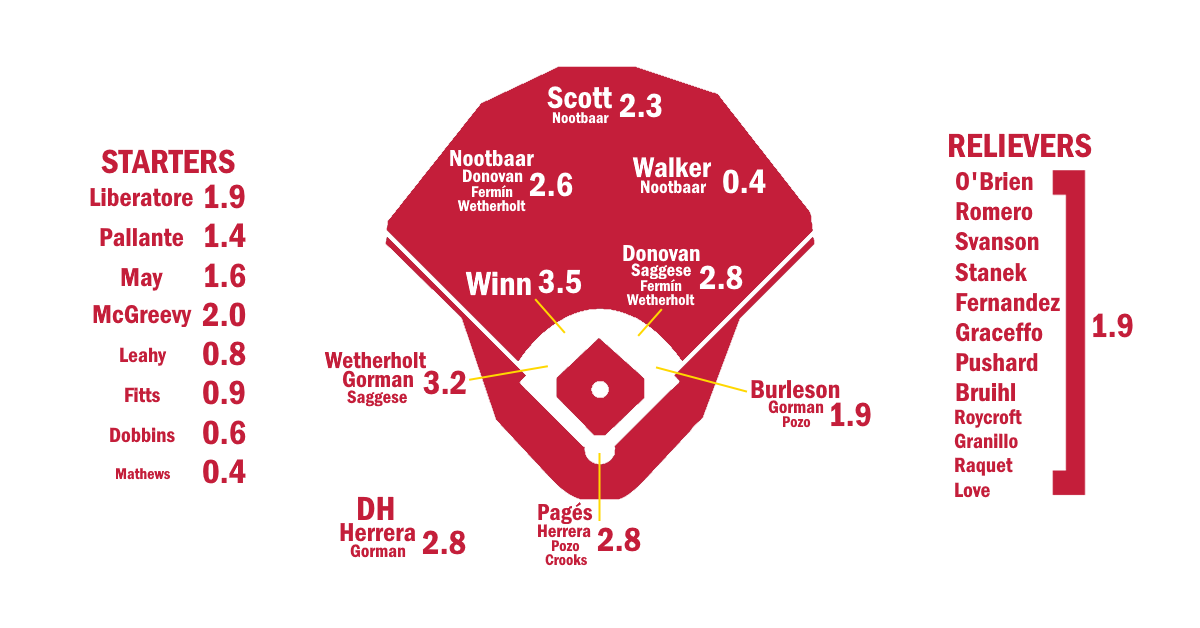
If you looked up “.500 team” in the dictionary, you’d find, well, nothing. THAT’S NOT HOW DICTIONARIES WORK. But if they did have extensive listings of colloquialisms and an editor obsessed with baseball, you might see the 2025 Cardinals. Despite not falling behind by double digits in the NL Central race until late in the season, the Cardinals certainly never felt like they were ever realistically in any playoff race. At the same time, they were also never enough of a doormat team to be interesting out of ineptitude. The Cards spent the season basically playing out the string, in baseball limbo while fans waited out the swan song year of executive vice-president John Mozeliak, with most of the interest surrounding when/if various veterans would be traded.
While roughly a .500-looking team has some wild card upside, St. Louis has the look of a team with an incredibly low ceiling in the short term, like on the level of that room near the start of Willy Wonka’s factory tour. Only Masyn Winn is a high threat to put up a 4-WAR season, and he’s already at that level, not someone who can break out to that level. But except for right field, since ZiPS has long since thrown in the towel on Jordan Walker, the Cardinals also aren’t bad anywhere in their lineup, either. Brendan Donovan is extremely versatile, but he could be traded sometime during the season, if not before then, and players like Nolan Gorman and JJ Wetherholt can also collect plate appearances playing a variety of positions. Wetherholt’s first full professional season was a dynamite one, and he gets a strong projection entering his first year in the big leagues. ZiPS at least sees him as an upgrade on the departed Nolan Arenado in 2026.
ZiPS thinks Lars Nootbaar is still young enough to bounce back from a real down season in 2025. When that may happen, though, is an open question. Last fall, he had surgery to shave down his heels to remedy his Haglund’s deformities, and reading the first half of this sentence makes me wonder if my brain has actually finally lost its last connection with reality. Nootbaar’s lack of ability to do much against lefties limits his upside, but like most of the rest of the team, he’ll be… fine. Also in that wide range of adequacy is Victor Scott II, who plays defense well enough these days to carry his abysmal offense, and Alec Burleson at first, who needs a lefty-crushing platoon partner, though he did improve some against southpaws last season. The Cardinals’ catching situation could be really interesting, depending on when and if Iván Herrera gets back to playing catcher. Even if he doesn’t, he’s shown he’s a good enough player to have value as a DH, and Pedro Pagés hits just enough that he’s not a problem starting behind the plate.
Luckily, the mid- and long-term outlooks for St. Louis are sunnier. Wetherholt has already been mentioned, but ZiPS thinks bothJimmy Crooks and Leonardo Bernal could hold their own as major league catchers. Joshua Baez has a strong long-term ZiPS projection, and the computer sees him as someone who could (and should) replace Walker if/when the former top prospect doesn’t come around.
Pitchers
As with the starting lineup, the Cards look like they’re going to have a very deep rotation, but one that’s almost mindblowingly average. Michael McGreevy has the best projected ERA of the starters, which ought to tell you a lot about the state of the rotation. If you believe ZiPS, St. Louis could field about three major league rotations of starting pitchers with an ERA+ somewhere in the 90s. So there’s not a lot of difference between the guys we have as getting the bulk of the innings on the depth chart (Matthew Liberatore, Andre Pallante, Dustin May, Kyle Leahy, Richard Fitts), and the guys who aren’t (Quinn Mathews, Tink Hence, Hunter Dobbins, Ixan Henderson, Tekoah Roby if not for the Tommy John surgery). In other words, this group probably won’t crack the top 10 in starting pitcher WAR, but there are enough spares that it likely won’t be an embarrassment, either.
While that’s not great for the team’s chances to contend in 2026, that does suggest a path to long-term benefits. The deep stable of no. 3 and no. 4 starters is decidedly on the young side, all in their 20s, and at least some of them ought to develop into something better. Mathews is probably the best candidate to do so, as is Hence, even though there’s a reasonable chance that the latter pitches out of the bullpen in the short term. Liam Doyle didn’t get an official projection here because of his lack of professional experience, but if I instruct ZiPS to use his college translations, he has a very good long-term outlook, too.
ZiPS projects the bullpen as below average, but not in dumpster-fire territory. The computer only really likes three relievers, JoJo Romero, Matt Svanson, and Gordon Graceffo, and a fourth if you believe the Cards will use Hence in relief in 2026. Outside of that quartet, there are a lot of guys with projected ERAs just above four in relief, firmly in C- territory. It’s probably not quite this bad, as the multitude of starting pitching options means the pen will get some reinforcements if the top starters are healthy, so someone like Leahy could end up here after all. In any case, this is a middling bullpen, one that probably won’t approach the production of last year’s unit, which had the ninth-best relief WAR in baseball.
All told, ZiPS sees St. Louis as, you guessed it, about a .500 team.
Ballpark graphic courtesy Eephus League. Depth charts constructed by way of those listed here. Size of player names is very roughly proportional to Depth Chart playing time. The final team projections may differ considerably from our Depth Chart playing time.
Players are listed with their most recent teams wherever possible. This includes players who are unsigned or have retired, players who will miss 2026 due to injury, and players who were released in 2025. So yes, if you see Joe Schmoe, who quit baseball back in August to form a Ambient Math-Rock Trip-Hop Yacht Metal band that only performs in abandoned malls, he’s still listed here intentionally. ZiPS is assuming a league with an ERA of 4.16.
Hitters are ranked by zWAR, which is to say, WAR values as calculated by me, Dan Szymborski, whose surname is spelled with a z. WAR values might differ slightly from those that appear in the full release of ZiPS. Finally, I will advise anyone against — and might karate chop anyone guilty of — merely adding up WAR totals on a depth chart to produce projected team WAR. It is important to remember that ZiPS is agnostic about playing time, and has no information about, for example, how quickly a team will call up a prospect or what veteran has fallen into disfavor.
As always, incorrect projections are either caused by misinformation, a non-pragmatic reality, or by the skillful sabotage of our friend and former editor. You can, however, still get mad at me on Twitter or on Bluesky. This last is, however, not an actual requirement.
For the 22nd consecutive season, the ZiPS projection system is unleashing a full set of prognostications. For more information on the ZiPS projections, please consult this year’s introduction, as well as MLB’s glossary entry. The team order is selected by lot, and the penultimate team is the New York Mets.
Batters
The Mets are a bit like an intellectual character in a 19th Century Russian novel. They’re well-read enough to understand why life just isn’t working, and while they make changes every winter, it always seems to come with the precognition that something will go horribly wrong, and there’s little recourse but to observe their own downfall. Yankees fandom is more transactional, and depending on how the season turns out, you either cheer the empire or curse Brian Cashman. Rooting for the Mets is existential; you go into every season with hope, but an unquenchable feeling that something will go horribly or maybe even comically wrong. Meaning as a Mets fan does not come from celebrating the team’s achievements, but the act of enduring and returning, year after year, with the knowledge that preparation offers no escape. Mets fans essentially become annotators of doomed worlds.
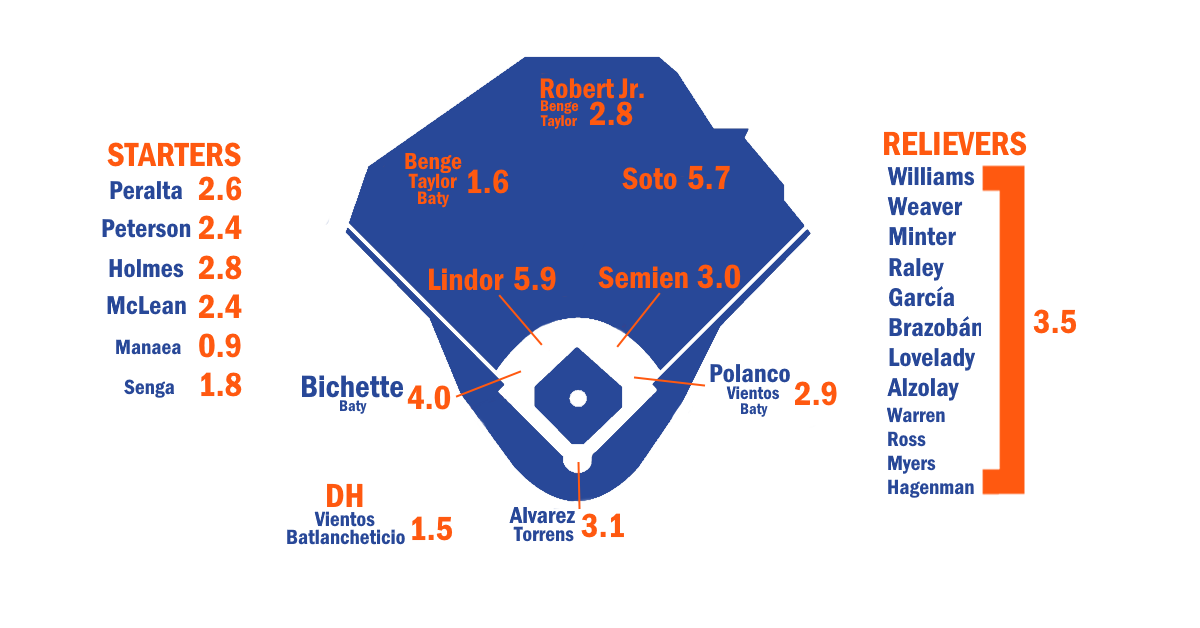
If every moment of Mets triumph is matched with an equal measure of Mets tragedy, the lineup may be in for some dark times when the worm turns. I actually think I’d rather have Pete Alonso for his deal than Jorge Polanco for his if I were the Mets, but the projections suggest that I might be wrong. Either way, this lineup looks extremely solid as a whole. Starting with two players, Juan Soto and Francisco Lindor make up for a lot of sins. But there aren’t really a lot of sins in the lineup. ZiPS thinks Bo Bichette is more valuable at third base than he was at shortstop, and he certainly has All-Star potential. ZiPS also forecasts decent bounce-back seasons for offseason trade acquisitions Luis Robert Jr. and Marcus Semien. Francisco Alvarez is coming off a near .800 OPS season, and under the new rules encouraging stolen bases, Luis Torrens’ value has increased because of his ability at preventing them, making him more than capable at holding up the lighter end of a catching tandem.
The DH situation isn’t amazing, with Mark Vientos getting the bulk of the plate appearances there, but only a few teams really get a ton of WAR from that spot anyway. Carson Benge certainly has upside, and while it’s not a particularly exciting projection, it’s not a bad forecast for a guy who hasn’t hit Triple-A pitchers yet. Brett Baty showed in 2025 that he can hit well enough to provide solid depth for the Mets. Jett Williams was also good depth in the infield, but he didn’t have a clear path to actual playing time in the majors in 2026 outside of a reserve role, so the Mets sent him to Milwaukee on Wednesday night as part of a trade to the get right-handed pitchers Freddy Peralta and Tobias Myers.
Pitchers
ZiPS expects the Mets’ pitching to be pretty good, giving the staff a bit of a bump from last year’s preseason projections. And that was before the trade for Peralta, who was the Brewers’ the most valuable pitcher. While Peralta’s not really a sub-three ERA guy — ZiPS thinks he’s legitimate a low-BABIP pitcher, but .243 is damned hard to maintain — he’s still an excellent pitcher who is a huge addition to New York’s rotation. Clay Holmes isn’t an ace, and he bled a couple strikeouts when he transitioned from the bullpen to the rotation, but his 2025 also demonstrates that his conversion to starting wasn’t just a mad scientist’s latest crazy plan. Nolan McLean looks like a much stronger bet going into 2026 than he did at this time last year, and while Jonah Tong didn’t have instant success in the majors, he also greatly boosted his stock, though we may not see a lot of it in the majors in 2026 unless the team is hit by injuries. Last year, David Peterson didn’t match his 2.90 ERA from 2024, but that never should have been the expectation anyway, and he’s a fairly dependable no. 2 starter type. Kodai Senga’s return went generally well, aside from nobody checking how the ghost fork graphic at the stadium would interact with a strikeout tally.
Sean Manaea ought to get back to effectively eating innings in 2026, and though he’s certainly not the headliner, the acquired Myers is a reasonable option to have in reserve. ZiPS is less excited once we get past Myers, to guys like Christian Scott and Cooper Criswell. But on the plus side, ZiPS thinks there’s a real chance that Jonathan Pintaro’s command will improve just enough for him to have a breakout in 2026.
ZiPS views the Mets as having an above-average bullpen, but one that’s below baseball’s elite. Maybe it’s just cognitive dissonance on my part, but I still have some worries about Devin Williams despite all the objective data suggesting he’s a great bounce-back candidate. And he is, but 2025 will still be in the back of my mind plus, you know, the Mets. Luke Weaver is a good bullpen no. 2 and fallback closer option, and A.J. Minter was at his Mintest last season. Brooks Raley gets a strong projection as well, and ZiPS is unaware of my extreme bias in favor of side-armers; Raley is more low three-quarters, but he’s at least side-arm adjacent. Criswell gets a significantly better projection as a reliever than as a starter. My silicon counterpart is rather meh on the rest of the bullpen, except for maybe Huascar Brazobán, but it still looks like a highly cromulent unit.
Despite last season’s collapse, ZiPS projects the Mets as a highly competitive team in the NL East, and one the league shouldn’t dismiss. Now, come September, six Mets could need Tommy John surgery, or maybe Juan Soto and Francisco Lindor are destined to get trapped inside a leatherbound book given to Carlos Mendoza by a library maintenance worker who looks suspiciously like M.R. James. But predictive algorithms and fuzzy clustering methods allow us to peek only so far behind the veil of fate.
Ballpark graphic courtesy Eephus League. Depth charts constructed by way of those listed here. Size of player names is very roughly proportional to Depth Chart playing time. The final team projections may differ considerably from our Depth Chart playing time.
Players are listed with their most recent teams wherever possible. This includes players who are unsigned or have retired, players who will miss 2026 due to injury, and players who were released in 2025. So yes, if you see Joe Schmoe, who quit baseball back in August to form a Ambient Math-Rock Trip-Hop Yacht Metal band that only performs in abandoned malls, he’s still listed here intentionally. ZiPS is assuming a league with an ERA of 4.16.
Hitters are ranked by zWAR, which is to say, WAR values as calculated by me, Dan Szymborski, whose surname is spelled with a z. WAR values might differ slightly from those that appear in the full release of ZiPS. Finally, I will advise anyone against — and might karate chop anyone guilty of — merely adding up WAR totals on a depth chart to produce projected team WAR. It is important to remember that ZiPS is agnostic about playing time, and has no information about, for example, how quickly a team will call up a prospect or what veteran has fallen into disfavor.
As always, incorrect projections are either caused by misinformation, a non-pragmatic reality, or by the skillful sabotage of our friend and former editor. You can, however, still get mad at me on Twitter or on Bluesky. This last is, however, not an actual requirement.
For the 22nd consecutive season, the ZiPS projection system is unleashing a full set of prognostications. For more information on the ZiPS projections, please consult this year’s introduction, as well as MLB’s glossary entry. The team order is selected by lot, and the antepenultimate team is the Chicago Cubs.
Batters
ZiPS was a big believer in the 2025 Chicago Cubs, and it was right on point about most of their core talent. The problem, though, was that ZiPS wasn’t right about the Milwaukee Brewers, and though Chicago stayed in the NL Central race for most of the season, Milwaukee’s 14-game winning streak all but settled things by mid-August. Add in a five-game loss to the Brew Crew in the NLDS, and a successful season ended in underwhelming fashion for the North Siders. The Cubs went into the offseason looking to replace Kyle Tucker in the lineup and shore up the rotation a bit.
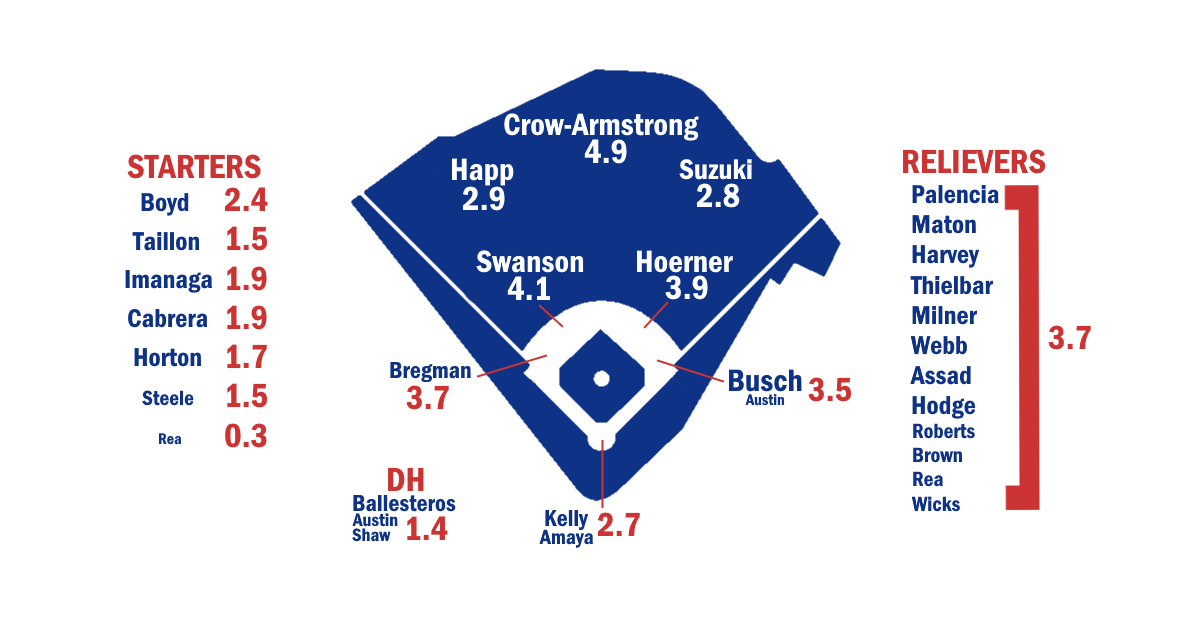
Generally speaking, the Cubs have a rather boring lineup in one manner: It’s mostly well-established players who are largely in the same roles as last season. Carson Kelly and Miguel Amaya, the latter swapped in for Reese McGuire, will be a competent tandem behind the plate. Dansby Swanson, Nico Hoerner, and Pete Crow-Armstrong will play terrific defense, with PCA adding a bunch of homers at the cost of a rather low on-base percentage. Ian Happ and Seiya Suzuki are on the wrong side of 30, but not distressingly so, and the typically B+ corner outfielders will likely put up their typical B+ seasons. One can see why the Cubs felt they could afford to trade Owen Caissie to Miami for Edward Cabrera; he was going to have a hard time finding playing time, and Kevin Alcántara’s defense makes him a more versatile fourth outfielder.
Where there are changes are at third base and designated hitter (by way of Suzuki playing a lot more right field). Alex Bregman is more or less the Kyle Tucker replacement, with a bit less bat and a bit more defensive value. Moisés Ballesteros has a lot of offensive upside, but he’s not really exciting yet as a full-time designated hitter, and Matt Shaw loses significant value as a DH. ZiPS is optimistic about Tyler Austin after a mostly successful six-year run in Japan, though he doesn’t provide a lot of flexibility, as it’s been years since he’s played anywhere but first base. I say mostly successful because he wasn’t particularly durable in NPB, with his most notable — and amusing — injury coming when he smashed his head on the dugout ceiling while changing his jersey.
I’m actually not quite sure what happens with Shaw, who appears to have been musical chaired out of a significant role by the Bregman and Austin signings. I don’t know just how seriously the Cubs consider him a supersub. Swanson and Hoerner were both durable in 2025, so we didn’t get any sneak peeks at how the Cubs truly felt about Shaw’s ability to play the middle infield when the rubber meets the road.
I wonder if the Cubs will be particularly active with non-roster invitations over the next month; ZiPS doesn’t see a great deal in the way of reinforcements in the high minors. Guys like Scott Kingery are probably far too high in the ZiPS WAR rankings than the Cubs ought to be comfortable with.
Pitchers
ZiPS sees the Cubs as having a very deep rotation that’s also very deep in unexcitement. There’s certainly some upside here, especially in Edward Cabrera, but ZiPS largely views the team as having a whole lot of broadly average starting pitching options. The good news here is that if Justin Steele has any setbacks, ZiPS likes the team’s replacement options. Even with especially bad luck in the injury department, the computer thinks Javier Assad will be adequate — it has him with an ERA considerably lower than his FIP, though some of that is thanks to the stellar Cubs defense — and that Ben Brown and Jordan Wicks would both be far more acceptable as starters if called into duty than they’ve shown so far. Heck, if Colin Rea or even Connor Noland were forced into starting some games, that wouldn’t be an apocalyptic scenario for the Cubs.
While deep in meh, ZiPS is more enthusiastic about the Chicago bullpen. Now, as was the case with Assad, some of the bullpen’s projected sufficiency comes down to the defense behind it, but ZiPS largely sees these relievers as having ERAs below four, and generally well below that line. ZiPS especially likes Hunter Harvey, Daniel Palencia, and the relief version of Porter Hodge. In the case of Hodge, remember the rule not to freak out about one-year home run totals for otherwise competent pitchers. The only prominent relievers ZiPS looks at with a bit of a side eye are Ethan Roberts and recent signee Jacob Webb.
All in all, the Cubs look like a team with a win total in the low 90s. The only negative of that projection is that ZiPS feels similarly about the Brewers this time around. We won’t know the end of this story for another nine months.
Ballpark graphic courtesy Eephus League. Depth charts constructed by way of those listed here. Size of player names is very roughly proportional to Depth Chart playing time. The final team projections may differ considerably from our Depth Chart playing time.
Players are listed with their most recent teams wherever possible. This includes players who are unsigned or have retired, players who will miss 2026 due to injury, and players who were released in 2025. So yes, if you see Joe Schmoe, who quit baseball back in August to form a Ambient Math-Rock Trip-Hop Yacht Metal band that only performs in abandoned malls, he’s still listed here intentionally. ZiPS is assuming a league with an ERA of 4.16.
Hitters are ranked by zWAR, which is to say, WAR values as calculated by me, Dan Szymborski, whose surname is spelled with a z. WAR values might differ slightly from those that appear in the full release of ZiPS. Finally, I will advise anyone against — and might karate chop anyone guilty of — merely adding up WAR totals on a depth chart to produce projected team WAR. It is important to remember that ZiPS is agnostic about playing time, and has no information about, for example, how quickly a team will call up a prospect or what veteran has fallen into disfavor.
As always, incorrect projections are either caused by misinformation, a non-pragmatic reality, or by the skillful sabotage of our friend and former editor. You can, however, still get mad at me on Twitter or on Bluesky. This last is, however, not an actual requirement.
For the 22nd consecutive season, the ZiPS projection system is unleashing a full set of prognostications. For more information on the ZiPS projections, please consult this year’s introduction, as well as MLB’s glossary entry. The team order is selected by lot, and the preantepenultimate team is the Baltimore Orioles.
Batters
Baltimore’s pitching looked to be a problem entering the 2025 season, but the lackluster offense turned what was a good team with a run prevention problem into a losing club. After ranking second in the American League in runs scored in 2024, the O’s dropped to 11th in 2025, and suffice it to say, the pitching didn’t bail them out. A 75-87 record looks bad in a comparatively mild way given some of the clunkers the team has crafted since 1997, but it was one of the biggest O’s letdowns in at least my memory (I’m from Baltimore). But like the Blue Jays going into 2025 or the Yankees going into 2024, people tend to underrate good teams coming off of crappy seasons, sometimes horribly. There’s this belief that the lousy year is some baseline expectation and you have to start counting wins added from that point, which is a very poor way to make projections.
Have the O’s done enough with the offense? If the projections here are accurate, probably. With so many underperformances, some righting of the ship was always going to happen anyway, but the O’s didn’t just wait for the magic of regression to do the job for them. I don’t think the end of the Pete Alonso contract will be pretty, but he’s a legitimate big bat in a way the franchise tried to pretend Ryan Mountcastle was for a long time. Taylor Ward isn’t great, but you know who Taylor Ward is. The O’s are now in a position where they don’t needCoby Mayo or Heston Kjerstad to get back on track, though it would of course be nice. Read the rest of this entry »
For the 22nd consecutive season, the ZiPS projection system is unleashing a full set of prognostications. For more information on the ZiPS projections, please consult this year’s introduction, as well as MLB’s glossary entry. The team order is selected by lot, and the next team up is the Los Angeles Dodgers.
Batters
Yes, the Los Angeles Dodgers were an excellent team in 2025, a statement that won’t come as a shock to anyone who was paying even a quarter-attention to baseball last year. The team was adeptly built to weather any storms, navigated said metaphorical weather, and then enjoyed a rotation that was mostly healthy come October, a welcome reversal from their 2024 postseason squad. The Dodgers repeated as World Series champions — the first team in the 21st century to successfully defend a title — earning their third trophy of the 2020s. They’ll look to pull off the three-peat next, something that has only been done once in the last half century (the Yankees from 1998-2000). And they have relatively good odds to pull it off: For the fifth time in the last six years (the 2023 Atlanta Braves being the only exception), ZiPS sees the Dodgers as the best team in baseball.
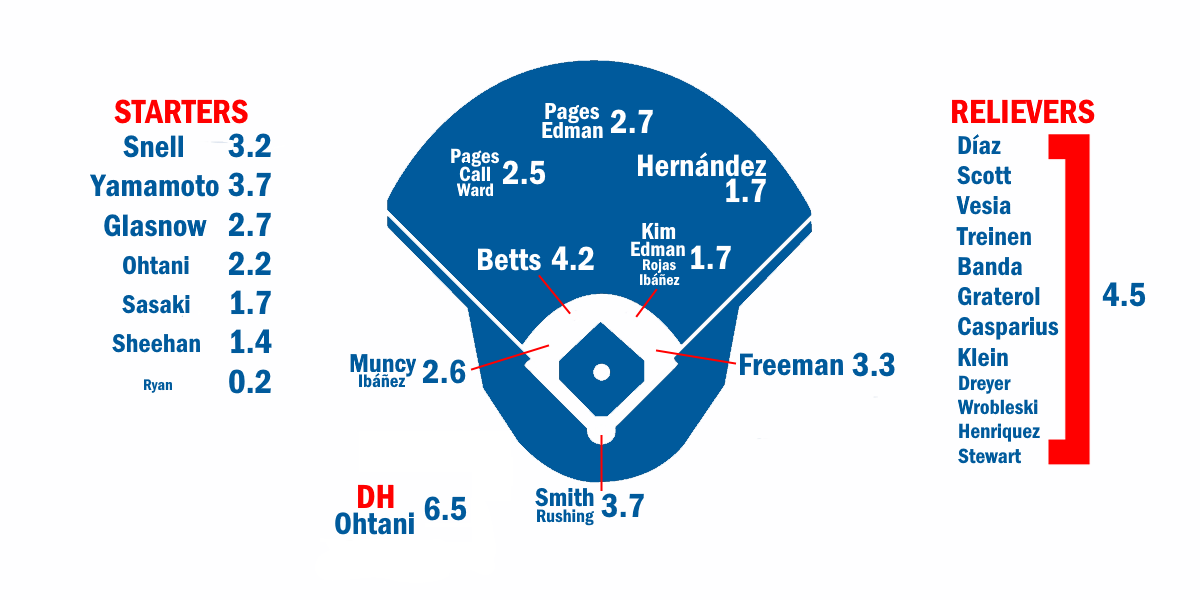
With that, I’m basically done talking about how great the Dodgers are. After all, this isn’t just a great team, but an obviously great one. There’s no mystery to their greatness. They have three future Hall of Famers in the starting lineup (Shohei Ohtani, Freddie Freeman, and Mookie Betts), with a fourth player, Will Smith, who could very well emerge as one. The pitching staff is phenomenally talented, though it admittedly comes with its share of injury concerns. All of these marvelous players get marvelous projections; there honestly isn’t much new to say about them. So instead, I’m going to talk more about what the Dodgers are not, and what could end up being their undoing. Or at least, their undoing by their own lofty standards, which would still probably mean something like a 90-win season.
The Dodgers have a seemingly infinite supply of both cash and brainpower, which is a potent combination, especially for their NL West rivals. But they aren’t a juggernaut in the sense that they dominate games or even short series; the superteam storyline is something that’s been filched from sports with less randomness and awkwardly applied to baseball. There’s a bit of Baseball Calvinism at play, in the sense that because the Dodgers won the last two World Series, some seem to believe that they were always fated to do so. The truth is, like any baseball team, they weren’t truly dominant. They lost 43% of their games during the regular season. In 2022 and 2023, they didn’t even reach the NLCS. And despite getting all of their stars onto the field in the World Series, they still only narrowly bested the Blue Jays. That’s just how baseball works.
And while the lineup is certainly star-studded, there are some risks. The offense is mostly driven by the four guys I mentioned above, and all four are on the wrong side of 30. Freeman in particular showed some signs of aging in 2025, as both his out-of-zone swing rate and his whiff rate jumped, especially the latter, and he’s never had elite bat speed. By the end of this season, he’ll have celebrated his 37th birthday. Betts didn’t experience a huge WAR drop-off thanks to him playing better defense at shortstop than he had any right to, but he’s also coming off the worst offensive season of his big league career and is entering his mid-30s. Smith doesn’t have as many games on his knees as a lot of backstops his age, but the presence of Ohtani and Freeman also means that if he’s too banged up to play catcher, he can’t just slot in at first base or designated hitter to keep his bat in the lineup. Then there’s Ohtani, who’s so amazing that he can practically only surprise negatively at this point.
Outside of the top four, the Dodgers are good, but hardly as intimidating. Max Muncy seems to refuse to age, and the recently signed Andy Ibáñez can spell him against lefties as needed, but time remains undefeated and will likely come for the third baseman sooner than later. Elsewhere, the outfield is rather ordinary, as is second base. And if fortune doesn’t favor the Dodgers on the injury or aging front, the projections suggest that Josue De Paula and Zyhir Hope might not be ready to remedy the situation in the short-term, as ZiPS has both of their 2025 minor league translations with an OPS just shy of .650. The lesser prospects in the high minors don’t really fit the bill, either, as ZiPS likes the team’s fringy guys at Triple-A a lot less than it usually does.
Pitchers
As noted, this is a talented rotation, but as with the lineup, there is some downside risk that can’t be ignored. Yoshinobu Yamamoto was the only Dodger to pitch enough to qualify for the ERA title last year, and the only other pitchers who threw at least 100 innings are either retired (Clayton Kershaw) or in St. Louis (Dustin May). Now, if Los Angeles is able to line up Tyler Glasnow, Ohtani, Blake Snell, and Roki Sasaki in consecutive outings behind Yamamoto, opponents will be grateful that there are no five-game series during the regular season. But as we’ve seen in recent years, the Dodgers have struggled to get all their arms healthy at the same time, and there’s no Emperor of Sports Movie Endings to ensure that they’ll be able to do so come October.
That’s concerning for a few reasons, not least because while there’s obviously still more offseason to go, the Dodgers’ starting pitching depth is decidedly thinner than it has been in recent history. In the past, one of the reasons ZiPS has seen Los Angeles as having a very high floor is that it has usually liked the team’s no. 8-10 starters. But after Emmet Sheehan and his 4.13 projected ERA if he’s used as a starter full-time, ZiPS sees the Dodgers’ spare rotation candidates as a decidedly below-average lot. River Ryan, Kyle Hurt, Gavin Stone, Justin Wrobleski, and Landon Knack all have projected ERAs worse than 4.50 as starters.
After years spent shoring up their bullpen with cleverness, the Dodgers have taken an unusually direct approach the past two winters: giving a great reliever a whole bunch of money. Last offseason, it was Tanner Scott (it hasn’t gone well). This time around, it’s Edwin Díaz, who is an awesome reliever, even if he’s unlikely to reach the heights of his 2018 or 2022 seasons again. ZiPS is pretty happy with the rest of the bullpen, seeing Alex Vesia, Scott (in a bounce-back season), Jack Dreyer, and Wrobleski as all comfortably above average. (You can add in Brusdar Graterol, who also gets a solid projection after ZiPS takes his injury into account.) The computer is a bit more squeamish when it comes to Blake Treinen and Brock Stewart, but it still sees them as having really solid upside. This ought to be a good bullpen.
Even accounting for the potential downside scenarios, the Dodgers look like the best team in baseball. Now, this being baseball, they’re still more likely to end the season with a loss than a champagne shower, but they’re as well positioned to make a deep run as their fans could possibly hope.
Ballpark graphic courtesy Eephus League. Depth charts constructed by way of those listed here. Size of player names is very roughly proportional to Depth Chart playing time. The final team projections may differ considerably from our Depth Chart playing time.
Players are listed with their most recent teams wherever possible. This includes players who are unsigned or have retired, players who will miss 2026 due to injury, and players who were released in 2025. So yes, if you see Joe Schmoe, who quit baseball back in August to form a Ambient Math-Rock Trip-Hop Yacht Metal band that only performs in abandoned malls, he’s still listed here intentionally. ZiPS is assuming a league with an ERA of 4.16.
Hitters are ranked by zWAR, which is to say, WAR values as calculated by me, Dan Szymborski, whose surname is spelled with a z. WAR values might differ slightly from those that appear in the full release of ZiPS. Finally, I will advise anyone against — and might karate chop anyone guilty of — merely adding up WAR totals on a depth chart to produce projected team WAR. It is important to remember that ZiPS is agnostic about playing time, and has no information about, for example, how quickly a team will call up a prospect or what veteran has fallen into disfavor.
As always, incorrect projections are either caused by misinformation, a non-pragmatic reality, or by the skillful sabotage of our friend and former editor. You can, however, still get mad at me on Twitter or on BlueSky. This last is, however, not an actual requirement.