Archive for Daily Graphings

The Orioles and a Reminder About Spring-Training Records

There’s a lot to like about spring training. Hey, it’s baseball! Sort of. Games end in ties, Will Ferrell gets to play all the positions. That’s fun. Also, there’s a lot not to be thrilled about during spring training. Games end in ties! And games don’t actually count.

Although, if you’re a fan of the Cubs, Pirates, and especially the Orioles, you’re probably happy about that last point so far this March. Those teams are a combined 3-23 in spring-training play. Fortunately, we’re just finishing the first full week of baseball games, just getting our first real look at starting rotations, and many teams (like Baltimore, with their 0-9 record) have been marching out many unrecognizable and/or split-squad rosters (which would at least partly explain the zero in the wins column). But what does spring training mean for the season ahead? Can we really glean anything from March performance, especially team-wide? It’s good to remind ourselves of what this means.

We’re mainly going to be looking at the very obvious: how do team win-loss records correlate between spring training and the regular season? Is there any sort of relationship between terrible March teams and terrible regular-season teams, or vice versa with good teams? Take a look at a plot of the spring training and regular season records of all teams between 2006-2015 — and feel free to mouse over the chart:
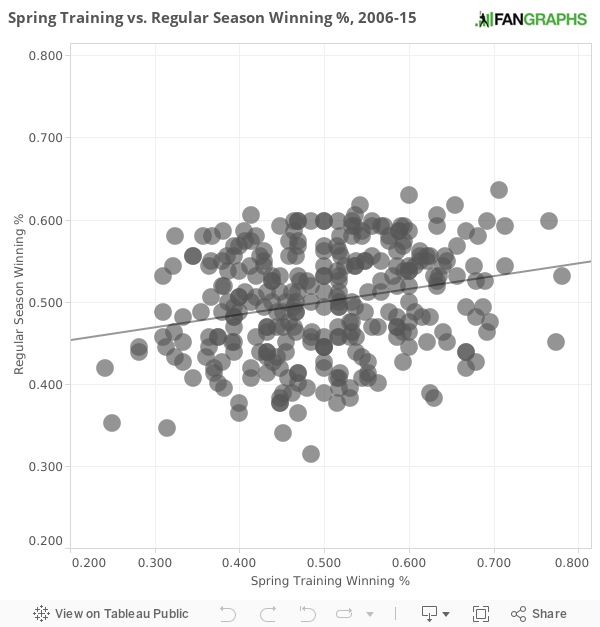
This chart is all over the place: lose more games than you win in spring training? Doesn’t mean you’re going to do so during the regular season. Win more than you lose? Doesn’t mean you’ll be successful. A month of games in March is the same as a month of games at any other point during the season — a relatively small sample, prone to all the pitfalls we see in any other small sample. If we tried to glean something from this 10-year sample, there are examples warning us not to be woefully awful in spring training. If a team covers that — finishing above .300 — our data provides evidence that the team probably won’t be unrecognizably terrible. Then again, we simply don’t see teams lose more than ~110 games very often during a regular season, whereas finishing with a winning percentage that low is doable in one month of baseball.

Read the rest of this entry »


The Top College Players by (Maybe) Predictive Stats

On multiple occasions last year, the author published a statistical report designed to serve as a mostly responsible shorthand for people who, like the author, possess more enthusiasm for collegiate baseball than expert knowledge of it. Those reports integrated concepts central to much of the analysis found at FanGraphs — regarding sample size and regression, for example — to provide something not unlike a “true talent” leaderboard for hitters and pitchers in select conferences.

Two weeks ago, I published the first such report for the 2016 college campaign; last week, the second one. What follows represents the third installment of a possibly infinite series.

As in the original edition of this same thing, what I’ve done here is to utilize principles introduced by Chris Mitchell on forecasting future major-league performance with minor-league stats.

Read the rest of this entry »


KATOH Projects: Los Angeles Dodgers Prospects

Previous editions: Baltimore / Boston / Chicago AL / Chicago NL / Cincinnati  / Cleveland / Colorado / Detroit / Houston / Kansas City / Los Angeles (AL) / Miami / Minnesota / Milwaukee / New York (NL)

Yesterday, lead prospect analyst Dan Farnsworth published his excellently in-depth prospect list for the Los Angeles Dodgers. In this companion piece, I look at that same LA farm system through the lens of my recently refined KATOH projection system. The Dodgers have the third best farm system according to KATOH, trailing only the Brewers and Astros. They have the most projected pitching WAR and the most WAR coming from 3.5+ WAR players.

There’s way more to prospect evaluation than just the stats, so if you haven’t already, I highly recommend you read Dan’s piece in addition to this one. KATOH has no idea how hard a pitcher throws, how good a hitter’s bat speed is, or what a player’s makeup is like. So it’s liable to miss big on players whose tools don’t line up with their performances. However, when paired with more scouting-based analyses, KATOH’s objectivity can be useful in identifying talented players who might be overlooked by the industry consensus or highly-touted prospects who might be over-hyped.

Below, I’ve grouped prospects into three groups: those who are forecast for two or more wins through their first six major-league seasons, those who receive a projection between 1.0 and 2.0 WAR though their first six seasons, and then any residual players who received Future Value (FV) grades of 45 or higher from Dan. Note that I generated forecasts only for players who accrued at least 200 plate appearances or batters faced last season. Also note that the projections for players over a relatively small sample are less reliable, especially when those samples came in the low minors.

1. Corey Seager, SS (Profile)

KATOH Projection: 12.3 WAR
Dan’s Grade: 65 FV

Seager showed what he’s capable of last September when he slashed .337/.425/.561 with the Dodgers. Prior to that, he hit a strong .278/.332/.451 in Triple-A. Seager’s 2015 numbers weren’t particularly gaudy, but he did manage to cut down on his strikeout rate, which was previously the one flaw in an otherwise promising stat line. Shortstops who hit that well at such a young age are few and far between. That’s why Seager has the chance to be a special player.

Corey Seager’s Mahalanobis Comps
Rank Name Proj. WAR Actual WAR
1 Chipper Jones 14.9 33.3
2 Aramis Ramirez 14.4 17.1
3 D’Angelo Jimenez 11.5 7.4
4 Omar Infante 13.2 6.5
5 Jimmy Rollins 12.0 25.6
6 B.J. Upton 16.8 22.4
7 Derek Jeter 11.8 32.9
8 Dustin Pedroia 8.7 30.1
9 Jose Offerman 12.9 7.3
10 Andy Marte 9.3 0.3

Read the rest of this entry »


Seven Observations from Hyun-soo Kim’s Big, Fat Goose Egg

The first thing to consider when we think about Hyun-soo Kim’s hitless, OBP-less first 23 at-bats is that it’s 23 at-bats, and it’s Spring Training. Not that everyone hasn’t been considering this all along, but it’s always worth a reminder. Jose Bautista had an 0-for-25 run last year, and those were in games that count, and that wasn’t his first time ever facing major league pitching. It happens. Sometimes, it even happens to the best of them.

Yet, it’s still fair to wonder on this a bit, because this is the first we’ve seen of Kim, meaning it’s all we’ve seen of Kim, and it’s not like dudes are running 0-fers over 23 at-bats all the time — it would’ve been the 12th-longest hitless streak of last year, and the third-longest streak of not having reached base. This was a notable stretch of futility, Spring Training notwithstanding. The past tense being used here, of course, because Kim has snapped the streak. He reached base for the first time this spring after being hit by pitch on Thursday, and later got his first hit — a bases-loaded, RBI single off a Yankees reliever named James Pazos.

Through 25 plate appearances, Kim’s spring slash line is now .042/.080/.042. The hit is the new story, but we can learn more about Kim through the 23 outs. Let’s see.

* * *

Kim observation No. 1: Not all of this is on video

This one actually serves as a double-observation, with the latter half being a reminder that really, none of this too much matters. Proof of that being, not all of it is even televised. It’s 2016. If something matters, you can sit on your couch in your underwear and watch it on television. You can watch plenty that assuredly doesn’t matter, too, so it says something about those events which are consciously not televised. The first few games of Baltimore’s Spring Training weren’t televised, and neither was a select game in the middle. The rest were, though, and I watched 13 of Kim’s 24 hitless plate appearances and took some notes.

Read the rest of this entry »


Trevor May on his (Cerebral) Approach to Pitching

Trevor May is a thinking man’s pitcher. He’s also a strikeout pitcher, which is something Minnesota has lacked for several seasons. Where he will deploy those traits — the rotation or the bullpen — is one of the biggest questions in Twins camp.

A starter by trade, May moved into a relief role last July. It was a switch dictated more by circumstance than performance, and the 26-year-old right-hander is hoping to once again assume an every-five-days work schedule. Based on his thought-process and his repertoire, it’s where he feels he’s best suited.

Originally drafted by Philadelphia, May came to Minnesota in December 2012, along with Vance Worley, in exchange for Ben Revere. His 2014 10-game cameo was rocky, but he was solid last year in his dual-role. In 48 appearances — 16 starts and 32 relief appearances — he logged a 3.25 FIP and a 8.93 K/9.

May talked about his continued development, and the cerebral approach he brings to the mound, last week in Fort Myers.

———

Trevor May on his pitching philosophy: “I have a specific philosophy. I try to make it a step-by-step process with every pitch. There are three things you do every time you throw the ball. Read the rest of this entry »


What Type of Baseball Dork Are You?

This isn’t going to be one of those online quizzes where you answer a few questions and then some script determines what you are based on your feedback. This is a quiz where you answer one question, a question you might never have been asked before. Maybe you’re going to learn something about yourself. We’re all put here to learn about ourselves.

It should go without saying that, for the most part, FanGraphs is selective for baseball dorks. Sure, casual fans find themselves here from time to time, but mostly, we cater to people who just want to think about baseball in between all of the baseball. That requires a certain intensity, a certain passion for the material, and it’s why we’re sometimes able to write about such complicated subjects without constantly stopping to explain ourselves. The audience is smart, and all of us are dorks.

Read the rest of this entry »


Trying to Improve Corey Kluber

I wouldn’t recommend watching a large percentage of the little spring-training videos they make available at MLB.com, but this is a fun one. Members of the Indians rotation are asked which individual pitch they’d like to borrow from one of their peers. The responses, arranged in my own preferred order for editorial purposes:

It’s a gifted rotation, blessed with a number of elite individual weapons, but you see all the support for Kluber’s hook. By how fast it goes, and by the way that it moves, it’s a pitch unlike almost any other, and it’s been a huge part of Kluber’s emergence. That’s easy to see in the numbers we have. What’s easy to see, as well, is that Kluber throws a cutter that’s been roughly as valuable as the curve. Kluber actually has two elite pitches. What if he pitched like it?

Read the rest of this entry »


2015 Positional Ball-In-Play Retrospective – RF

As we become accustomed to a steady diet of spring-training baseball, let’s continue to take a position-by-position look back at the ball-in-play (BIP) profiles of 2015 semi-regulars and regulars to see if we can find any clues as to their projected performance moving forward. We’ve already looked at all the various infield positions — plus left field and center. Today, let’s complete our tour of the outfield by focusing on right fielders.

First, some ground rules. To come up with an overall player population roughly equal to one player per team per position, the minimum number of batted balls with Statcast readings was set at 164. Players were listed at the position at which they played the most games. There is more than one player per team at some positions and less at others, like catcher and DH. Players are listed in descending OPS+ order. Let’s start with the AL RFs.

Ball-In -Play Overview – AL RF
Name Avg MPH FB/LD MPH GB MPH POP% FLY% LD% GB% CON K% BB% OPS+ Pull% Cent% Opp%
N.Cruz 92.80 97.25 88.71 3.5% 30.5% 20.4% 45.7% 195 25.0% 9.0% 160 38.6% 36.5% 24.8%
J.Bautista 93.83 95.79 92.41 7.0% 41.8% 13.9% 37.3% 121 15.9% 16.5% 149 53.3% 28.1% 18.7%
JD.Martinez 91.86 95.95 85.66 2.1% 41.4% 22.3% 34.2% 181 27.1% 8.1% 140 41.1% 34.7% 24.2%
Springer 89.64 93.75 85.61 1.1% 29.0% 24.5% 45.4% 141 24.2% 11.1% 126 34.2% 38.7% 27.1%
Choo 91.63 95.86 88.52 0.7% 27.8% 20.7% 50.9% 136 22.5% 11.6% 125 44.1% 34.2% 21.7%
Beltran 91.63 93.76 90.03 3.3% 39.6% 21.6% 35.6% 111 16.0% 8.5% 121 44.4% 35.6% 20.1%
Reddick 89.00 91.74 86.82 3.7% 36.9% 21.0% 38.4% 94 11.2% 8.4% 113 35.6% 35.3% 29.1%
C.Young 85.13 89.06 84.18 8.9% 38.1% 17.4% 35.6% 110 20.5% 8.4% 111 58.8% 24.4% 16.8%
Trumbo 92.86 94.22 93.22 5.0% 35.3% 18.0% 41.6% 130 24.2% 6.6% 108 37.1% 32.9% 30.0%
Calhoun 86.87 91.23 81.86 2.5% 32.9% 22.8% 41.8% 115 23.9% 6.6% 104 42.6% 34.3% 23.1%
Souza Jr. 89.16 95.06 84.68 3.6% 31.1% 20.0% 45.3% 140 33.8% 10.8% 99 45.9% 34.2% 19.9%
Moss 89.39 94.48 83.25 3.1% 44.0% 20.4% 32.5% 118 28.1% 9.3% 90 49.4% 30.6% 20.1%
A.Garcia 88.91 92.68 85.77 1.7% 25.0% 24.5% 48.8% 100 23.5% 6.0% 89 36.1% 40.4% 23.6%
T.Hunter 89.09 93.00 85.61 3.4% 30.9% 17.3% 48.4% 90 18.5% 6.2% 89 40.9% 35.9% 23.3%
Chisenhall 87.25 90.14 86.07 8.3% 31.5% 19.5% 40.6% 84 19.1% 6.4% 78 40.2% 33.8% 26.0%
Rios 88.81 89.72 88.57 2.8% 35.2% 22.2% 39.8% 76 16.3% 3.6% 73 42.6% 35.8% 21.6%
AVERAGE 89.87 93.36 86.94 3.8% 34.4% 20.4% 41.4% 121 21.9% 8.6% 111 42.8% 34.1% 23.1%

Most of the column headers are self explanatory, including average BIP speed (overall and by BIP type), BIP type frequency, K and BB rates, and BIP by field sector (pull, central, opposite). Each player’s OPS and Unadjusted Contact Score (CON) is also listed. For those of you who have not read my articles on the topic, Contact Score is derived by removing Ks and BBs from hitters’ batting lines, assigning run values to all other events, and comparing them to a league average of 100.

Read the rest of this entry »


The Myth of the Qualifying Offer

The qualifying-offer system has created considerable discussion this offseason. After Dexter Fowler took smaller deal than expected and Ian Desmond ended up receiving only about half the qualifying-offer amount, there has been talk about changing the system in the next Collective Bargaining Agreement. Dave Cameron discussed a sensible solution that could help the system. The issue has been around in the past, but the CBA discussions combined with the sheer number of qualifying offers extended have increased the exposure this year. While it’s pretty well acknowledged that the QO system is designed to dampen free-agent prices, it’s important to recognize what the system is not: a reward for drafting and developing young talent.

A record 20 players were extended qualifying offers this offseason — this after, 34 offers total were made over the first three years of the system. If nothing else, the sheer quantity of offers led to three acceptances — by Colby Rasmus, Matt Wieters, and Brett Anderson — the first year in which any player had accepted an offer.

In a dreamy view of Major League Baseball, the qualifying offer helps those teams which have experienced success both drafting and developing players, but which also lack the requisite funds to prevent homegrown players from departing by way of free agency. A benevolent qualifying-offer system gifts those teams with draft picks so that they can further develop talent to help their club.

Read the rest of this entry »


Bryce Harper Wants to Change the Game

Over at ESPN today, they published a feature on Bryce Harper. It’s really good, and you should read the whole thing, but there’s one section that stands out; the part where the story shifts from the view of Harper as a person or a player, and to his view of baseball needs to evolve.

He wants to change the game. He wants to change the perception of baseball players, to become a single-name icon like LeBron and Beckham and Cam. “I don’t know much about Bryce,” says his new manager, Dusty Baker, “but I know he’s one of the hippest kids around.” Harper wants to elevate his sport’s profile through his play, through his fashion, through the charisma of his personality, maybe even through the fascination with the size of the first free agent contract ($400 million? $500 million?) that he’ll sign shortly after his 26th birthday. Is this a prodigy’s natural urge to innovate or a sign of youthful hubris?

“Endorsements, fashion — it’s something baseball doesn’t see,” he says. “In soccer, it’s Beckham or Ronaldo. In basketball, it’s Curry and LeBron. In football, it’s Cam. Football and basketball have such good fashion.”

There are impediments endemic to the sport. Everyone knows about Russell Westbrook’s unique couture because he’s wearing it in an interview room. The baseball player, on the other hand, is interviewed at his locker, often shirtless and sporting a hat head that can ruin even Harper’s unique follicle landscaping. As Nationals first baseman Ryan Zimmerman says, “We’re uniformed personnel.”

And then there’s the larger obstacle: the game’s stern code. Case in point: Papelbon vs. Harper. It started when Orioles third baseman Manny Machado hit a home run against the Nationals last September and reacted with too much excitement, so Jonathan Papelbon drilled him the next time Machado came to bat, which caused Harper to suggest to reporters that baseball’s code is “tired,” which led to Papelbon berating and then choking Harper four days later after the closer found his teammate’s hustle lacking — a Rube Goldberg display of baseball’s grim underside.

Harper has admitted fault in going to reporters instead of speaking to Papelbon directly (“If I had a problem with Pap, I should have gone up to Pap,” he says), and both men say it didn’t last beyond that day. But that’s not what Harper wants to talk about now.

“Baseball’s tired,” he says. “It’s a tired sport, because you can’t express yourself. You can’t do what people in other sports do. I’m not saying baseball is, you know, boring or anything like that, but it’s the excitement of the young guys who are coming into the game now who have flair. If that’s Matt Harvey or Jacob deGrom or Manny Machado or Joc Pederson or Andrew McCutchen or Yasiel Puig — there’s so many guys in the game now who are so much fun.

Jose Fernandez is a great example. Jose Fernandez will strike you out and stare you down into the dugout and pump his fist. And if you hit a homer and pimp it? He doesn’t care. Because you got him. That’s part of the game. It’s not the old feeling — hoorah … if you pimp a homer, I’m going to hit you right in the teeth. No. If a guy pimps a homer for a game-winning shot … I mean — sorry.”

He stops, looks around. The hell with it, he’s all in.

“If a guy pumps his fist at me on the mound, I’m going to go, ‘Yeah, you got me. Good for you. Hopefully I get you next time.’ That’s what makes the game fun. You want kids to play the game, right? What are kids playing these days? Football, basketball. Look at those players — Steph Curry, LeBron James. It’s exciting to see those players in those sports. Cam Newton — I love the way Cam goes about it. He smiles, he laughs. It’s that flair. The dramatic.”

Read the rest of this entry »