Archive for Orioles

The Best Pitching Matchups of the Week: April 26-May 2

The end of April always sees some teams with their hands hovering above the panic button, some pitchers wondering what the heck is happening, and others hoping their newfound glory is more than just a phase. As the month comes to a close, we’ll see all of those tropes beautifully on display. Here are the week’s best matchups.

Tuesday, April 27, 6:10 PM ET: Kenta Maeda vs. Aaron Civale

Heading into the season, three AL Central teams had playoff odds above 24%. Nearly a month into things, two of those teams are struggling with losing records (Minnesota and Cleveland), while the Royals, who had the fourth-lowest playoff odds of any AL team, are the surprise of the spring. This week brings the first Minnesota-Cleveland series of the year as both sides try to find their mojo. On Tuesday, they’ll each turn to guys with a wide array of pitches who currently occupy different ends of the success spectrum.

One year removed from finishing second in Cy Young voting and AL starter WAR, Kenta Maeda is searching for answers. He’s only seen the sixth inning once in his four starts this year, going exactly 6.0 innings in a game against the clawless Tigers. He’s had two starts flame out at 4.1 innings; his other outing was a meltdown at the Coliseum on April 21. The A’s clobbered three home runs, whacked five balls with exit velocities above 100 mph, plated seven earned runs, and hooked him after three innings.

Those big-time exit velocities are becoming a troubling trend for Maeda, a pitcher who thrived in his first five major league seasons by limiting hard contact. According to Statcast, Maeda had the lowest average exit velocity among all starters from 2015-20 who threw at least 500 innings. Today, he’s floundering in the 28th percentile for average exit velocity and the 29th percentile for hard-hit percentage, partially due to the fact that his four-seam fastball just flat out ain’t working.

Last season, when Maeda had the lowest average exit velocity of any starter and the highest K% of his career, hitters flailed their way to a .086 batting average and .103 wOBA (.150 xwOBA) on his fastball. The average exit velocity against that pitch (83.4 mph) was even weaker than his league-leading overall average (85.3). This year, that’s all gone awry. His fastball is getting lit up for a .313 average and .372 wOBA (.430 xwOBA). He even allowed a home run on the fastball for the first time in his Twins tenure. This Matt Olson skyscraper, measured at 107.8 mph on a middle-middle meatball, is a perfect encapsulation of how things are going for Maeda when his catcher puts down one finger.

Aaron Civale, on the other hand, has taken the thump out of opponents’ bats. Cleveland’s third-year righty is in the 88th percentile of exit velocity, and his heater is the one steadying the ship. As Devan Fink laid out, Civale has overhauled everything, mainly his philosophy on fastballs. After throwing a four-seam 2.5% of the time in 2020, he’s shot that percentage all the way up near 30.

It’s now Civale’s turn for a tour of the exit velocity leaderboard. His revamped changeup – which, as Devan also mentioned, is now a split-change – is working so well that he may even want to consider upping its dosage. The split-change is sending everyone back to the dugout having made weak contact (or no contact at all), but particularly left-handers, who have yet to record an extra base hit, and are slap boxing a 78.0 average exit velocity against this diverting action.

Like a scrap-hungry seagull or a fan with the day off tomorrow, Civale is also sticking around late into the game. As opposed to Maeda, Civale has pitched into the sixth inning in each of his starts, twice going seven frames or longer. With both teams looking to course-correct after chumpish starts, and the Royals’ making things even more crowded in the Central, Tuesday’s Maeda-Civale ticket is one to pinpoint.

Friday, April 30, 9:40 PM ET: John Means vs. Jesús Luzardo

Fresh off a resounding 8-1 win that ended Oakland’s 13-game winning streak, the Orioles meet the A’s for a second straight weekend series. John Means will attempt to keep Oakland earth-bound on Friday, matched up with the same youngster he defeated last time out. Means and Luzardo had a timeshare of the strike zone when they last linked up, pouring in strikes on over 60% of their identical 101 pitch counts.

Means has stuck to the same script for virtually his entire career, though this season he’s relegating his slider from supporting actor to bit part. With roughly 10 mph separating his fastball and changeup – Means’ most common offerings – the rock of the Orioles’ rotation is letting those two do the lion’s share of the work. Eighty-three of his 101 pitches in the clubs’ first meeting were either a fastball or changeup, and the A’s could only scrape together two hits in 6.1 innings. Will Means follow the same path when they collide this weekend, or will he try to confound Oakland by peppering in more sliders and curves?

Both pitchers will throw their fastballs more often than not, though they use different lanes of the highway. Per Baseball Savant, Luzardo was responsible for each of the 23 highest-velocity pitches in Sunday’s game against Means, topping out just a hair under 98 mph.

The Athletics’ Peruvian prodigy took the L thanks to Austin Hays’ two home runs, giving Luzardo five gopher balls in 25 innings, all provided by right-handed hitters. Since his big-league career began in 2019, Luzardo has allowed 15 home runs, 14 of which have come from the right side of the batter’s box. (To satiate your daily need for useless trivia, the only lefty to take Luzardo deep is Mariners’ 28-year-old rookie José Marmolejos.) Don’t let the Orioles band of nameless, faceless offensive players fool you. Though they’ve managed just one souvenir shot against lefties this season, Baltimore’s left-handed hitters are fifth in wRC+ against same-handed pitchers.

Friday, April 30, 9:40 PM ET: Jon Gray vs. Madison Bumgarner

Friday evening will be extremely conducive to the two-screen lifestyle, as Gray vs. Bumgarner gets underway at the same time as Means vs. Luzardo. Both of these towering NL West staples are intimately familiar with their opponent. Gray has tussled with the Diamondbacks 13 times in his seven-year career while Bumgarner’s career stats against the Rockies read like a full season for a 1960’s workhorse: 37 starts, 230.1 innings, 218 strikeouts, 62 walks. Despite inhabiting the same division as Bumgarner for his whole career, Gray has only matched up with the inimitable lefty twice. Entering round three, both guys are hot.

Gray shut out the non-Bryce Harper parts of Philadelphia’s lineup on Sunday, allowing just two runs on a pair of solo shots to the Phillies’ right fielder. Though he’s running the first double-digit walk rate of his career, Gray is doing well at keeping those base on balls from becoming runs. His 85.8 LOB% will surely come down, and his .208 BABIP will likely come up, but there are some encouraging trends that suggest Gray’s early-season fortune could be here to stay.

Keeping balls on the ground means they can’t be added to the collection of Coors Field moon shots, and Gray has gotten his groundball percentage back above 50%, much more in line with his 46.6% career average than the 36.7% outlier from last season. The Rockies also have to love their ace’s hard-hit rate, as it mirrors the numbers he maintained in 2016-17, the only seasons he’s eclipsed 3.0 WAR. So far Gray has been riding the slider – a pitch that’s been his best since 2019 – until the wheels fall off. Hitters began whiffing on it 40% of the time during that 2019 breakthrough, and this year they’re hardly faring any better, swinging and missing at a 42.5% clip and striking out in 19 of the 51 plate appearances that have ended with this unrighteous pitch.

The desert faithful will get their first look at Bumgarner since his seven-inning no-hitter. The zero hits part jumps out of the box score, but Sunday’s shortened no-no was also MadBum’s best all-around game as a Diamondback. It was his first start for Arizona without a walk, and he matched his Diamondback-high with seven strikeouts. Bumgarner generated 10 swings and misses on his cutter and curveball, the latter of which is quickly becoming an essential out pitch. With a Whiff% of 40.0 (and a staggering 75.0 against lefties), Uncle Charlie is bringing gifts every time he visits Bumgarner.

This could spell doom for Ryan McMahon, the Rockies’ left-handed hitting outfielder who’s carrying around an 0-for-10 with three strikeouts against the legendary lefty. Trevor Story, the only current Rockie with more than 18 plate appearances against Bumgarner, has also had a bad time. His 8-for-41 (.195/.233/.561) numbers are hilariously heightened by the fact that five of those hits have landed in the seats.

Under the Radar Matchup – Friday, April 30, 8:05 PM ET: Nathan Eovaldi vs. Kohei Arihara

Here’s the situation: Eovaldi has one of the lowest barrel percentages of any starter; Arihara has one of the highest. Unsurprisingly, Eovaldi has been one of the more valuable pitchers around, becoming one of the first American League hurlers to hit 1.0 WAR. He’s done it by converting to the church of groundballs, getting disgusting ride on his fastball, and harnessing a curveball that’s experienced a 180-degree turnaround in just two years.

Nathan Eovaldi Curveball
Year % wOBA xwOBA EV
2021 20.0 .151 .295 79.1
2020 17.1 .153 .161 87.9
2019 17.5 .390 .386 86.4
SOURCE: Baseball Savant

As recently as 2019, Nathan Eovaldi was downright bad, trying to smile through the pain of home runs and walks. That is no longer the case, as Eovaldi is working on a streak of 42.2 consecutive innings without allowing a dinger, and his walk rate is a microscopic 4.2%, down from the 11.6% that severely hampered him two years ago.

While Eovaldi’s aversion to hard contact has very plainly made him Boston’s best pitcher, his Friday counterpart’s success has been much more confusing. Arihara was managing a 2.21 ERA (3.05 FIP) heading into his last start despite constantly getting hit on the thick part of the bat. After coming over from Japan on a two-year pact with the Rangers, Arihara experienced unbelievable luck through his first four starts until stopping by Guaranteed Rate Field on Sunday. His 93.9 EV (highest of any starting pitcher), 12.9% Barrel% (fifth-highest), and 50.0% HardHit% (tied for highest in the league), tell us that hitters are having a very easy time squaring him up. Yet, he went longer than five innings with zero earned runs in his two previous starts before getting beat up by the White Sox in his worst showing to date, pushing his ERA to 4.03 (4.17 FIP). Even after getting his “Welcome to MLB” moment in Chicago, Arihara still has a HR/9 under 1.00 and is feeding groundballs to 40.6% of his adversaries.

His teammate Mike Foltynewicz, who has the dubious distinction of being neck-and-neck with Arihara on HardHit Mountain, has a 5.32 ERA, 6.78 FIP, and leads the world in home runs allowed. Baseball is hard and unfair.


Sunday Notes: Cesar Valdez’s Powerful Paralyzing Perfect Pachydermous Percussion Pitch

Cesar Valdez’s name has graced this column a handful of times over the past year, most recently a month ago when I asked him about his powerful paralyzing perfect pachydermous percussion pitch. (No, the Baltimore Orioles reliever doesn’t actually call it that, but given that Bugs Bunny changeups make up the lion’s share of his deliveries, he arguably should). Since the start of last season, Valdez has thrown the mesmerizing offering an eye-popping 83.1% of the time.

The Red Sox have faced the 36-year-old slow-baller on three occasions so far in April, so I asked Boston hitting coach Tim Hyers what kind of advice he gives his charges when Valdez is on the bump.

“First, it is totally different in the batter’s box than it is watching video,” responded Hyers. “I can tell you that.The first time we faced him, the hitters were like, This is not your typical changeup.’ It’s almost like a unique curveball, because it gets to home plate and just dives. And at times it can dive both ways; it can break in, or break out. The guys have probably talked about him more than anybody else so far this season.

“It’s kind of an illusion,” continued Hyers. “You have to wait one tick longer in the contact point to get your swing off. It’s been helpful for us to face him [multiple times in a short time period], but it’s definitely very unique and challenging for hitters to face a guy like that.” Read the rest of this entry »


Cedric Mullins Goes Lefty Full-Time

Scan the WAR leaderboard, and you’ll find some expected names: Ronald Acuña Jr. atop the list with 1.5; Mike Trout comfortably in the top three; Vladimir Guerrero Jr. bashing his way into the top five. Yet nestled in at No. 9 with 0.8 WAR, wedged between a pair of Dodgers, is one of the bigger surprises of the season so far: Orioles centerfielder Cedric Mullins. Thursday’s pair of 0-fers in a doubleheader against the Mariners snapped an 11-game hitting streak to start the year, but his 19 hits are tied for third in the majors with Guerrero and Justin Turner (and one behind fellow sudden star Yermín Mercedes). Through 55 plate appearances, he’s slashing .388/.455/.571 with two steals, a .446 wOBA, and a 190 wRC+ — that last figure better than that of, among others, Aaron Judge, Corey Seager, and Nolan Arenado.

Mullins’ strong performance has been aided by a high BABIP (.500) that has to come down, but there’s more to it than that. His 10.9% walk rate is both a career high and three points above his career rate. His .184 ISO is over 100 points better than his last full-season mark (.063 in 2019). But most notably, Mullins, a switch-hitter throughout his career, is batting exclusively from the left side this season. So far, it’s paying off.

Read the rest of this entry »


The Best Early-Week Pitching Matchups

This is Matthew’s first post as a FanGraphs contributor. Matthew is a staff writer and podcast host at Lookout Landing, where he ponders great existential questions like, “Why would anyone be a Seattle Mariners fan?” and, “What dark curse did the Mariners conjure to make Mark Canha such an annoyance in their life?” He has written about the lack of Black players in Major League Baseball, recorded parody songs about the Astros’ banging scheme, and interviewed several minor leaguers. In addition to his current role at Lookout Landing, Matthew was previously a writer for Baseball Prospectus and a marginally successful open mic comedian. After a public school and Subaru childhood, Matthew attended the University of San Diego before bravely becoming the first FanGraphs writer to ever live in Seattle.

The first full week of the 2021 season is upon us. To avoid getting trampled in the avalanche of games, let’s focus in on the ones with the juiciest matchups, funniest storylines, and richest histories of batter vs. pitcher ownage. Here are the best pitching matchups in the week’s early going.

Monday, April 5, 7 PM ET: Jacob deGrom vs. Matt Moore

A team’s first game of the season almost always pairs their best starter versus the top of the other team’s rotation. But with a COVID-19 postponement pushing the Mets’ opener back, they get to unleash Jacob deGrom’s fury against a Philadelphia reclamation project. This NL East showdown sets the game’s most dominant pitcher against a guy who hasn’t pitched stateside in two years.

Unable to convince an MLB team to give him a job after knee surgery ended his 2019 renaissance, Matt Moore signed in Japan with the Fukuoka Soft Bank Hawks. He’s back after posting a 2.65 ERA in Nippon Professional Baseball. That’s certainly impressive, but Moore’s ERA in NPB was still not as good as the 2.38 deGrom ran last season (his 2.26 FIP was somehow better), or his 2.43 before that, and especially not the 1.70 from the year before that. Monday’s tilt is a classic story of an established, hegemonic force meeting a redemptive arc on its final curve. Read the rest of this entry »


Sunday Notes: Collin McHugh Ponders Pitching Philosophy and Politics

Collin McHugh is cerebral both on and away from the diamond, and that attribute was on full display in a recent Zoom call with reporters. The Tampa Bay Rays right-hander fielded questions on multiple topics, most notably his craft and the possibility of MLB’s moving this summer’s All-Star Game from Atlanta to another locale. I asked McHugh how his new team compares to one of his old ones in terms of pitching analytics.

“The behind-the-scenes things are a little different,” responded McHugh, referring to his tenure with the Houston Astros from 2014-2019. “I think they probably have a more well-versed staff over here, in total, of being able to communicate the advanced information to guys. I worked a lot with [Brent Strom] in Houston, and Strommy and I got to know each other really well. He was kind of my guru, or whatever you want to call it. If I had questions, I went to him.

“Here, it feels, at least to this point, like there is a more holistic approach,” continued McHugh. “From [pitching coach] Kyle Snyder — starting with him — and the pitchers, to Stan [Borowski] in the bullpen, all the way through the data-analytics system, then all the way up the ladder. I’ve had conversations with [General Manager] Eric Neander about these things, and have since we were in negotiations. So it feels like a very top-to-bottom system over here.”

McHugh signed a free-agent contract with the Rays in late February. Asked if he was approached about the possibility of tweaking any facet of his game, he said that wasn’t the case at all. Read the rest of this entry »


Effectively Wild Episode 1675: Season Preview Series: Dodgers and Orioles

EWFI
Ben Lindbergh and Meg Rowley banter about the completion of the season preview series and the Marlins renaming Marlins Park “loanDepot park,” do a draft of current corporate-sponsored MLB ballpark names from least to most objectionable, and then preview the 2021 Dodgers (24:20) with Pedro Moura of the The Athletic and the 2021 Orioles (1:09:03) with Joe Trezza of MLB.com.

Audio intro: Toto, "We Made It"
Audio interstitial 1: Kiwi Jr., "Dodger"
Audio interstitial 2: Matthew Sweet, "Baltimore"
Audio outro: Gene Clark, "Opening Day"

Link to Ben on the Dodgers
Link to Andy McCullough on the Dodgers as champs
Link to Pedro on Lux
Link to Pedro on Bellinger
Link to Pedro on Seager
Link to Pedro on Bauer
Link to Pedro and Dennis Lin on Dodgers-Padres
Link to Zach Kram on the Dodgers-Padres race
Link to Joe on Mancini
Link to Joe on Santander
Link to Joe on the Orioles’ new Dominican facility
Link to Ben on Jannis and the knuckleball
Link to Ben on the Brennameme
Link to Ben on the new baseball

 iTunes Feed (Please rate and review us!)
 Sponsor Us on Patreon
 Facebook Group
 Effectively Wild Wiki
 Twitter Account
 Get Our Merch!
 Email Us: podcast@fangraphs.com


Sunday Notes: Versatility is Value When Benches Are Bereft of Depth

Positional versatility has become increasingly important now that teams are carrying 13 or 14 pitchers on their rosters. That leaves benches bereft of depth, meaning that an ability to move around the diamond makes a player especially valuable — if not essential. One-dimensional non-regulars are marginal assets unless they excel in a specific area.

In the opinion of A.J. Hinch, the term “utility player” is anything but a pejorative. Moreover, everyday players who display versatility make a manager’s job easier.

“I don’t want “utility” to be explained as a negative thing,” the Tigers’ skipper told reporters recently. “A utility player has traditionally been defined as a guy who can’t play every day. And that’s not true. Some guys it is, some guys it isn’t. I caution everybody that it’s not a slight.

“When you have an everyday guy that is elite at that position, absolutely, you’re going to leave him at that position,” continued Hinch, who circled back to his Astros days and cited Alex Bregman having played short when Carlos Correa was hurt. “That’s a multiple position for an elite player.”

Hinch’s Detroit team clearly lacks the top-end talent that he had at his disposal during his Houston tenure, which suggests mixing-and-matching might be common in Motown this summer. If spring training is any indication, it might even be the M.O. Hinch has done no shortage of shuffling, and come the regular season, the likes of Jeimer Candelario, Niko Goodrum, Jonathan Schoop, and Harold Castro will be utilized as moving pieces in hopes of optimizing the lineup. Ditto Isaac Paredes, once he’s called up from the alternate site. Read the rest of this entry »


Orioles Hitting Coach Don Long Answers a Question

I asked Baltimore Orioles hitting coach Don Long a question on Monday morning, and he responded with a lengthy answer. I wanted to know, relative to years past, how much more frequently players are approaching him with ideas of changing their swing, and what he tends to tell them when that happens.

“Honestly, I’m not a believer in changing swings,” the veteran hitting instructor responded. “I operate under the thought that [for] every hitter, their best swing, they already possess. The thing that gets in the way of them being able to access their best swing, consistently, usually has to do with their thinking, their timing, their position, or their ability to be really good with their eyes.

“You’ve probably heard the old Michelangelo story, right? Supposedly, he carved this statue of David out of this block of granite, and they said, ‘How did you carve such a beautiful statue out of a block of stone?’ He said, ‘I simply chipped away at the stone until the statue revealed itself.’ That’s how I look at a hitter’s swing. You already possess your best swing — it’s already there — so let’s not spend time chasing a good swing, or chasing something that you already know how to do. Let’s chip away at the thing that’s getting in the way of that. And for most guys, the thing that interrupts the physical part of their game is the mental part of the game.

“I can give you an example. I had a guy come to me a couple days ago in the cage with an exasperated, ‘Man, what’s going on? I don’t know what to do.’ I said, ‘Let me ask you a question.’ I picked a ball up out of the basket and said, ‘What’s this pitch going to be?’ He looked at me and said, ‘I don’t know.’ I said, ‘Yeah, you do.’ Read the rest of this entry »


Sunday Notes: Ethan Small is a Sneaky-Fast Southpaw (SEC First-Rounders Attest)

Ethan Small’s success comes largely from his heater. Which isn’t to suggest he throws smoke. As Eric Longenhagen wrote when profiling the 23-year-old southpaw for our 2020 Brewers Top Prospects list, Small is “blowing fastballs with mediocre velocity past opposing hitters because he hides the ball well and creates pure backspin.” Velocity-wise, the former Mississippi State Bulldog typically sits in the low 90s.

Professional hitters haven’t seen much of him due to the pandemic — Small’s curriculum vitae comprises 21 A-ball innings — but Southeastern Conference opponents are another story. They had plenty of opportunity to be impressed with the 28th-overall pick in the 2019 draft, particularly in his junior year when he went 10-2 with a 1.93 ERA, and 176 strikeouts in 107 innings.

A pair of fellow 2019 first-rounders sang Small’s praises when I asked which SEC pitchers they’d faced stood out the most.

Braden Shewmake, whom the Atlanta Braves drafted 21st overall out of Texas A&M, began by citing Casey Mize. The second pitcher he mentioned was Small. Read the rest of this entry »


Maikel Franco and Orioles Finally Find Each Other

It’s the third week of spring training games, and the Orioles have added a new starting third baseman who’s been available since December: Maikel Franco, seven-year big league veteran with Philadelphia and Kansas City. Baltimore’s roster construction has hardly changed in that time, and I doubt Franco and his career 1.03 WAR/600 needed to be humbled out of demanding a hefty multi-year contract. Both parties have known their situations for months, but are only just now finding each other. This is an odd transaction. Let’s try to unpack it.

It isn’t as though the deal doesn’t make sense. Baltimore’s incumbent at the hot corner is Rio Ruiz, who has gotten a majority of the team’s starts at third base since the O’s claimed him off waivers before the 2019 season and who’s showed some modest fence-clearing ability, hitting 21 homers in 617 plate appearances. But his overall offensive profile is mediocre: His 90 wRC+ in 2020 stands as his career best. At 26, he’s exhausted much of the faith people had in him as a prospect, and his Statcast data doesn’t suggest there’s anything exciting hidden under the surface numbers. Ruiz’s value might top out at less than one WAR, and he entered camp running virtually unopposed for the starting job.

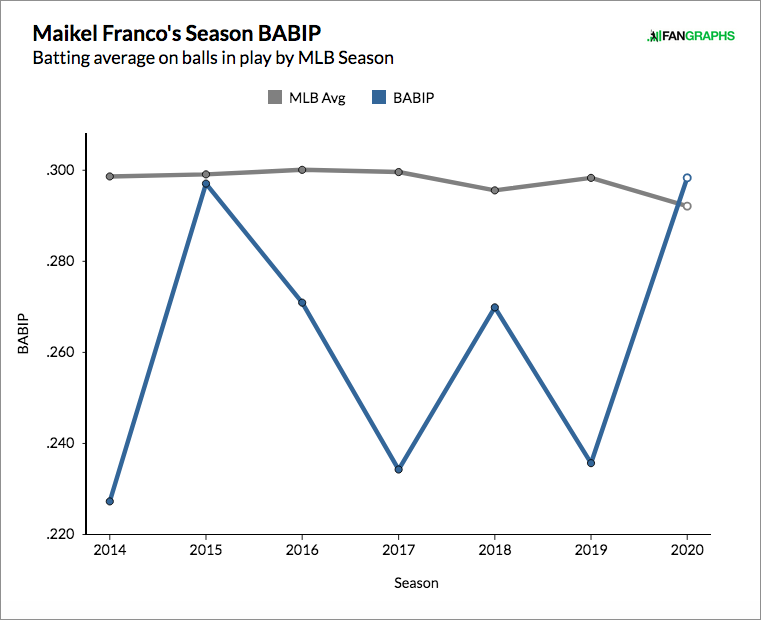
Enter Franco, who signed a change-of-scenery deal with the Royals in 2020 after a disappointing tenure in Philadelphia and turned in his best season in years, hitting .278/.321/.457 with eight homers, a 106 wRC+ and 1.3 WAR. That value placed him ninth among all third basemen, just ahead of peers like Eugenio Suárez and Brian Anderson. The bump in Franco’s production didn’t come from some random explosion in power numbers or a big jump in walk rate, though. He just finally got a normal distribution of balls in play to land for hits.

Read the rest of this entry »