Archive for Q&As

Oakland Prospect Max Muncy Is Trying to Find Himself at High-A

© CLIFFORD OTO/THE STOCKTON RECORD / USA TODAY NETWORK

Max Muncy has been doing lot of experimenting this season. That shouldn’t come as a surprise. Drafted 25th overall last year by the Oakland Athletics out of Thousand Oaks High School in California, Muncy came into the current campaign with all of 11 professional games under his belt. At the tender age of 20 — today is his birthday — it’s understandable that he’s still trying to forge an identity at the plate.

Power could end up being his calling card. A 6-foot-1, 185-pound shortstop who projects to fill out further, Muncy has 19 home runs on the season, 16 at Low-A Stockton and three at High-A Lansing. Making contact has been an issue. Facing pitchers who are almost exclusively older than him, he has fanned 146 times in 483 plate appearances while putting up a .229/.338/.441 slash line and a 104 wRC+.

Muncy — No. 12 on our updated Athletics Top Prospects list — discussed his early career development last week.

———

David Laurila: Let’s start with a question I sometimes ask young players: Give me a self-scouting report.

Max Muncy: “That’s probably different for me, just because I kind of know what’s in the making. But the power is showing up a lot this year. I think I’ll hit for average, for sure, but what I’m going through right now is a learning curve.” Read the rest of this entry »


The Dodgers’ Emmet Sheehan Is a Fast-Rising Pitching Prospect

Peter Aiken-USA TODAY Sports

Emmet Sheehan is opening a lot of eyes in his first full professional season. Selected in the sixth round of last year’s draft by the Los Angeles Dodgers, the 22-year-old right-hander has been nothing short of dominant. Pitching for the High-A Great Lakes Loons, Sheehan has a 2.72 ERA and a 2.27 FIP to go with 93 strikeouts and just 39 hits allowed in 59.2 innings.

Recent outings have added helium to his prospect profile. Over his last three starts, the 6-foot-5, 220-pound Boston College product has fanned 26 batters in 16 innings, surrendering only one earned run. On a pitching staff that includes several high-ceiling arms, Sheehan, in the opinion of multiple people I spoke to when the Loons played in Lansing last week, is the most promising of the bunch.

Sheehan discussed his overpowering repertoire, including what he’s learned about it since joining the Dodgers’ system, prior to his last start.

———

David Laurila: I’ve read that your fastball gets good ride. Is that accurate?

Emmet Sheehan: “Yes, and I actually didn’t know why it plays well up in the zone until I got drafted by the Dodgers. They told me about low-slot ride and how I kind of throw from a weird release height. I’m a little lower but still get on top of the ball, which makes it play almost like it has a couple more inches of break. That’s the way they described it to me.”

Laurila: Did you work up in the zone at Boston College? Read the rest of this entry »


Red Sox Prospect Alex Binelas Believes in Exit Velocity

Alex Binelas
Mike Watters-USA TODAY Sports

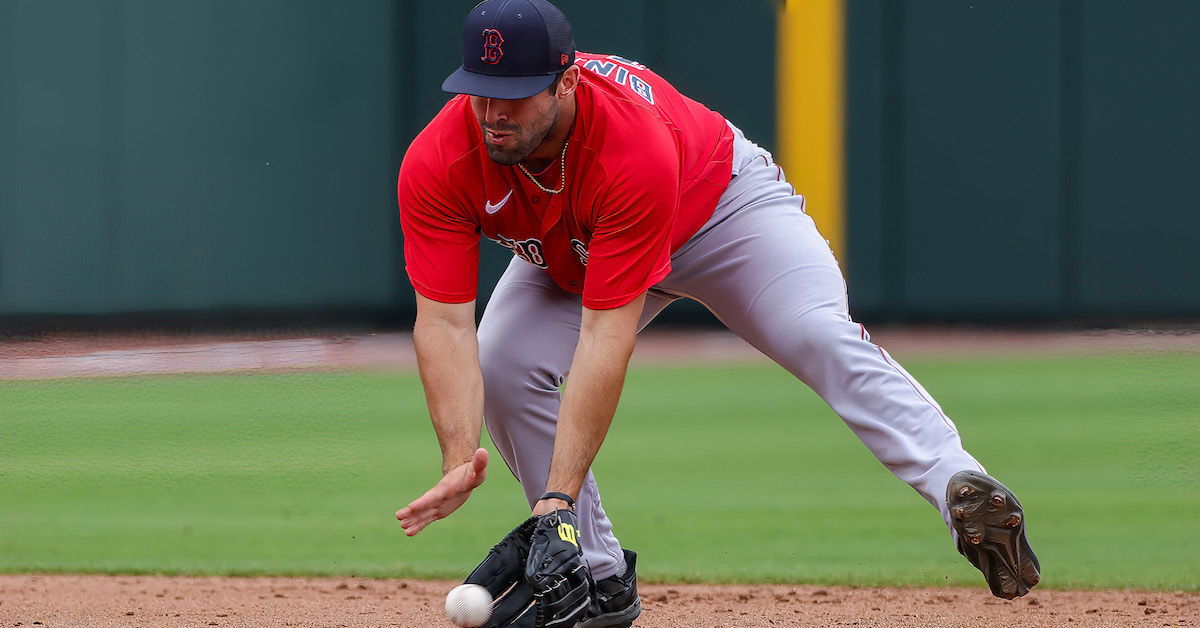
Alex Binelas has big-time power. The extent to which he can get to it will go a long way toward determining his future. The 22-year-old corner infielder has gone deep 23 times this season between High-A Greenville and Double-A Portland, but he’s also fanned 126 times in 418 plate appearances. As Eric Longenhagen wrote this spring, “Binelas’ calling card is plus-plus raw power… but it comes with plenty of swing-and-miss.” His left-handed stroke has produced a 104 wRC+ this season and a .206/.318/.445 slash line.

The potential for Binelas to do far more than he’s shown since being drafted 86th overall last year out of the University of Louisville is real. The Red Sox certainly think so. Enamored by his exit velocities and ability to hit moonshots, Boston acquired the Oak Creek, Wisconsin native from the Milwaukee Brewers last winter as part of the Hunter Renfroe deal.

Binelas discussed his do-damage approach and the in-progress mechanical adjustment he’s hoping will help him turn the corner prior to a recent game at Portland’s Hadlock Field.

———

David Laurila: How would you describe yourself as a hitter?

Alex Binelas: “I go up to the plate looking to impact the ball. I obviously want to put together quality at bats — I want to swing at the right pitches — but my ultimate goal is putting the ball in play as hard as I can. I’m not trying to hit a home run every time, but when you try to impact ball hard with quality swings and are attacking the right pitches, you put yourself in a good position to do damage.”

Laurila: Exit velocity is a priority.

Binelas: “Yes.” Read the rest of this entry »


Ten Years Later, Jameson Taillon Has Changed (Yet Is Much the Same)

Jameson Taillon
Brad Penner-USA TODAY Sports

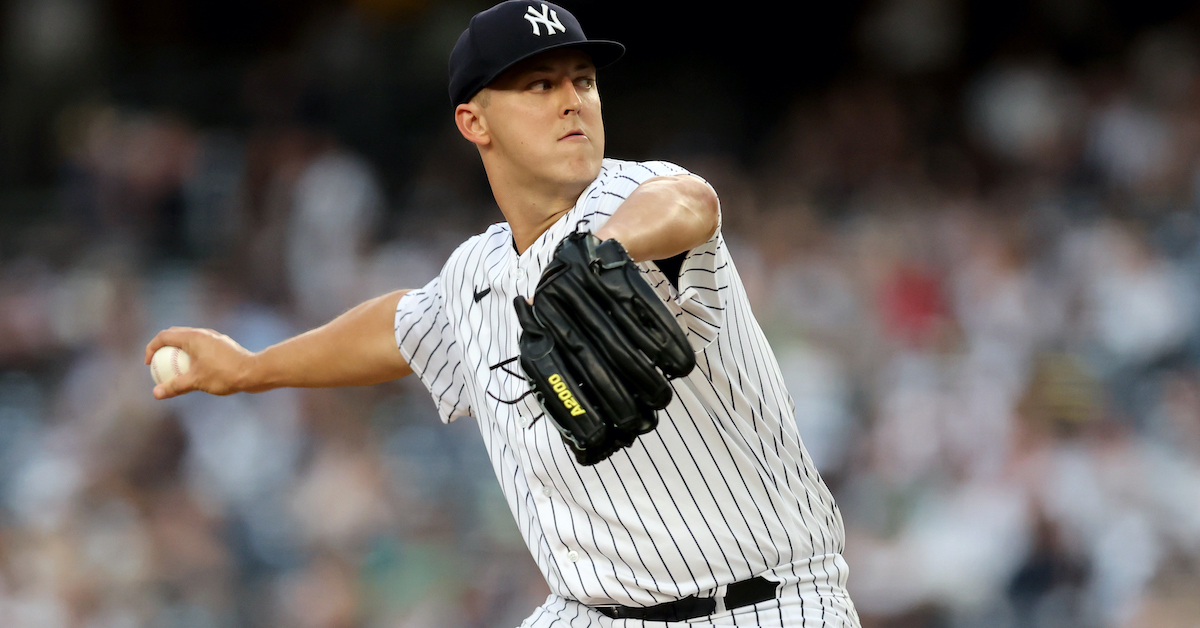
Jameson Taillon was 20 years old when he was first featured here at FanGraphs in September 2012. Drafted second overall by the Pittsburgh Pirates out of Woodland (Texas) High School just two years earlier, he’d only recently been promoted to Double-A when he sat down for an interview. The subjects at hand were his repertoire and his early-career development as a professional pitcher.

A decade later, Taillon is now pitching for the New York Yankees. Acquired from Pittsburgh prior to last season — this after missing most of 2019 and all of the shortened 2020 season while recovering from Tommy John surgery — the 30-year-old right-hander is having a solid campaign. In 23 starts comprising 127.2 innings, he is 11–3 with a 3.95 ERA and a 4.02 FIP.

Taillon discussed his decade-long evolution on the mound when the Yankees visited Fenway Park this past weekend.

———

David Laurila: You were in the minors when we first spoke 10 years ago. How would you describe your progression as a pitcher since that time?

Jameson Taillon: “One of the interesting things about pitching is that you’re in constant pursuit of trying to get better. The trends change, the hitters change, the scouting reports change. But I feel like I’ve kept a lot of my strengths the same. My curveball is still a pretty decent pitch for me, I throw a four- and a two-seam, just like I did 10 years ago.

“I’ve added a slider. I’ve probably used the changeup a little bit more in the big leagues than I did at the beginning of my career. But yeah, for a while there I was heavy sinkers and ground balls. Last year I went heavy four-seam. Now I’m kind of finding that sweet mix, that balance.”

Laurila: Is that mostly based on feel? Read the rest of this entry »


Kyle Harrison Is One of the Top Pitching Prospects in the Game

© Allan Henry-USA TODAY Sports

Kyle Harrison is one of the top pitching prospects in baseball. Drafted 85th overall in 2020 out of Concord, California’s De La Salle High School, the just-turned-21-year-old left-hander is No. 30 on our updated Top 100. Ranked ninth among hurlers, Harrison has dominated at two levels. Currently with the Richmond Flying Squirrels, the Double-A affiliate of the San Francisco Giants, he’s fanned 143 batters and allowed just 57 hits in 86-and-a-third innings this season. In a word, the young southpaw has been overpowering.

Harrison discussed his repertoire when Richmond played in Portland over the weekend.

———

David Laurila: To start, give me a self-scouting report.

Kyle Harrison: “My fastball averages around 94 [mph]. I spin it decently — not too high — but it’s from a low approach angle, so I think it looks like the ball has a little bit of rise. Then I’ll go to my slider. I’ll kind of grip that off the four-seam and really just try to rip it at the bottom of the zone. It’s a little more sweepy-ish than a regular slider. I’m trying to make it harder. I’m able to get it to 85 sometimes — that’s kind of where I want it to be — but those are the max-effort ones. It’s usually more 80-83.

“The changeup I’m playing around with now is a new grip. I’m kind of splitting the two seams there. It’s more of a one-seam, so I can get a little bit more tumble. I’ve been throwing it harder than I’d like. I’m trying to take a little velo off to get some better speed differential.” Read the rest of this entry »


Spencer Strider Analyzes an Overpowering Outing

Spencer Strider
Vincent Carchietta-USA TODAY Sports

One of the leading candidates for this year’s National League Rookie of the Year Award was first featured here at FanGraphs last June in a piece headlined “Atlanta Braves Pitching Prospect Spencer Strider Nerds Out on His Arsenal.” Six months later, the 23-year-old right-hander with the triple-digits heater appeared as a guest on episode 952 of FanGraphs Audio. On each occasion, Strider showed that he’s not just one of the game’s most-exciting young pitchers but also a bona fide analytics geek.

On Monday, I caught up to Strider at Fenway Park, where we focused primarily on a relief outing back in mid-May against the Milwaukee Brewers. Our conversation then segued into some nerdy pitching talk and, for good measure, his six scoreless innings with 12 strikeouts against the St. Louis Cardinals in early July.

On the season, Strider has a 1.96 FIP to go with a 3.11 ERA and 138 strikeouts in 89.2 innings. His average fastball velocity has been 98.1 mph, and he’s topped out at a scintillating 102.5.

———

David Laurila: You had an inning in Milwaukee earlier this year, your only inning that game, where you stuck out the side on 11 pitches. Take me through that outing.

Spencer Strider: “This was before I was starting. I was still in the bullpen and had sort of just earned some more important innings. We were up [4–3 in the seventh inning], it was only my second time pitching with the lead, and I was facing the Brewers for the third time. They knew fastballs were coming, but I think they wanted to see me throw strikes, too. There was a bit of that ‘wait him out and see what he’s got’ to their approach.

“I just went right at guys with fastballs. I struck out the first guy [Victor Caratini] on three pitches, then the second guy [Kolten Wong] on four pitches. I struck out the third guy [Luis Urías] on four pitches as well.”

Laurila: Was the plan to attack almost exclusively with fastballs? Read the rest of this entry »


Shane Bieber on the Art and Science of Pitching

© Ken Blaze-USA TODAY Sports

Shane Bieber isn’t a prototypical modern-day pitcher. Unlike many of his peers who are on the mound pumping gas, the 27-year-old Cleveland Guardians right-hander succeeds by slicing and dicing, carving up the opposition with an array of well-placed offerings. Bieber’s heater is averaging just 91.3 mph on the season, and even in his higher-velocity 2020 Cy Young Award year, he was anything but a radar gun darling. From the time he entered pro ball in 2016 as a fourth-round pick out of the University of California, Santa Barbara, Bieber has been a technician, not a flamethrower.

It’s hard to argue with the results. Over the past four seasons, Bieber is 36-19 with a 3.04 ERA and a 2.99 FIP in 513 innings. Despite a reputation for having nothing-to-write-home-about stuff, he’s fanned 641 batters while allowing just 427 hits. In 20 starts this year, Bieber has a 3.39 ERA and a 2.96 FIP, tied for ninth-best in the junior circuit.

Bieber discussed the art and science of pitching when the Guardians visited Fenway Park in the final week of July.

———

David Laurila: At a time where a lot of guys are trying to overpower hitters, you’re viewed as a “pitcher.” With that in mind, where did you learn to pitch?

Shane Bieber: “I feel like I’ve been ‘pitching’ from a young age. My parents were involved — my dad was super involved — but the guy who taught me the most about pitching was Ben Siff. He was my travel ball coach for nine or 10 years, starting when I was nine years old. I’m still really close with him. Read the rest of this entry »


Steven Kwan, Cleveland’s Mr. Contact, Talks Hitting

© David Richard-USA TODAY Sports

Steven Kwan is having an outstanding rookie season with the Cleveland Guardians. The 24-year-old outfielder is slashing .297/.370/.382 with a 118 wRC+, and he’s doing so with elite plate discipline and contact skills. Kwan’s 8.8% strikeout rate ranks second to Luis Arraez’s 8.3% among qualified hitters, while his 22.6% O-Swing% is tied for sixth-best. Moreover, he’s one of only a handful of hitters with more walks (36) than strikeouts (34). As Ben Clemens wrote back in April, “Kwan’s phenomenal bat control is as real as it gets.”

A 2018 fifth-round pick out of Oregon State University, Kwan came into the current campaign having emerged as one of the game’s most intriguing young players. No. 57 on our preseason Top 100 Prospects list, the slight-of-build left-handed hitter was described as having “short levers and excellent hand-eye coordination.” Brett Gardner was cited as his closest comp.

In the latest installment of our Talks Hitting series, Kwan discusses his innate ability to put the bat on the baseball and sneeze at pitches that aren’t in the strike zone.

———

David Laurila: You got a lot of attention early in the season, almost exclusively for your elite contact skills. What does that mean to you?

Steven Kwan: “It’s a compliment, if anything. I think hitter success is directly correlated to strike zone management — to swinging at strikes and not chasing out of the zone. I definitely see that as a compliment.” Read the rest of this entry »


Mentored by Nolan Arenado, Trevor Story Likes To Keep Hitting Simple

Trevor Story
Brian Fluharty-USA TODAY Sports

Trevor Story is an accomplished hitter. The 29-year-old Boston Red Sox infielder was a stalwart in the middle of the Colorado Rockies’ lineup prior to this season and has 173 home runs and a 110 wRC+ over six-plus MLB campaigns. Twice a National League All-Star, Story blasted 37 home runs in 2018, and he followed that up with 35 more in 2019.

His first go-round in the Junior Circuit has been of the up-and-down variety. Signed to a six-year, $140 million free-agent deal by Boston in March, Story has 15 long balls to his credit, but just a .221/.289/.423 slash line. Currently on the injured list with a hand contusion, the Irving, Texas native is expected to return to the Red Sox lineup in the near future.

Story discussed his evolution as a hitter earlier this week.

———

David Laurila: Nolan Arenado and Daniel Murphy, players with different approaches to their craft, were among the earliest interviews for my Talks Hitting series. [Links here and here.] Which of your former Rockies teammates are you most similar to that regard?

Trevor Story: “It would be Nolan. He was a mentor to me my first few years, and we still talk the game a lot. Nolan pretty much taught me how to pull the ball the right way. But knowing yourself as a hitter… just like Murph did. Murph knew himself, and he knew that he was going to be thinking the other way or thinking up the middle. There are obviously different schools of thinking, and I would say I’m closer to Nolan, trying to get the ball in the air pull-side.”

Laurila: What about in terms of analytics? When I spoke to them, Arenado was all about keeping things as simple as possible, while Murphy was very in-depth and detailed. Have you delved into analytics much over the years? Read the rest of this entry »


Toronto’s Hunter Mense on Developing Good Swing Decisions

© Nick Turchiaro-USA TODAY Sports

Good swing decisions are a core component of the Toronto Blue Jays’ organizational hitting philosophy. That doesn’t make the American League East club unique — every team wants its hitters to be disciplined at the plate — but the degree to which they accentuate attacking the right pitches is noteworthy. From the lowest levels of the minors all the way up to the big leagues, swing decisions are not only a focus, they’re assigned grades.

Hunter Mense has played a key role in the practice. Now doing double-duty as the big league assistant hitting coach, the 37-year-old former Florida Marlins farmhand has been Toronto’s minor league hitting coordinator since 2019.

Mense discussed the organization’s efforts to develop disciplined hitters when the Blue Jays visited Fenway Park last week.

———

David Laurila: What can you tell me about the Blue Jays’ organizational hitting philosophy?

Hunter Mense: “A lot of it has really just filtered over from 2019 and continued to build. Nothing has drastically changed. But I will say this: The things that have changed, probably — what I’ve seen up here — are some of the more important things that play in the big leagues. It’s us doing a better job of that, and learning how to develop it more in the minor leagues.”

Laurila: What plays in the big leagues? Read the rest of this entry »