Archive for Teams

My Favorite Quiet Waiver Claim

Some time ago, I wrote about both Mychal Givens and Tony Zych, two rookie relievers who remained mostly unknown despite breakthrough seasons. I’m a fan of Givens, and I’m a fan of Zych, but while researching those posts, I came across some other names of intrigue. Mostly, I just filed them away in my own brain, but I’ve frequently thought about a few of them. And now that I have a chance, I can’t not write about one of them. One of the players whose names I hung on to just changed organizations over the weekend, and I have to jump in here if only because I wouldn’t forgive myself if I didn’t.

As people waited for the Pedro Alvarez acquisition to become official, any mystery would’ve probably had to do with whether he’d pass an Orioles physical. One could’ve wondered about something else, though: Who would be dropped from the Orioles’ roster to make room? Alvarez did pass that physical, and he’s going to be a full-time DH. The Orioles did have to clear space on the 40-man, and the corresponding move passed by almost unnoticed. After all, what’s most important is the Orioles have Alvarez. But the Orioles no longer have Andrew Triggs. Now the A’s have Andrew Triggs. Let me tell you a little about Andrew Triggs.

Read the rest of this entry »


FanGraphs Audio: Dave Cameron Analyzes All the Strikeouts

Episode 639
Dave Cameron is both (a) the managing editor of FanGraphs and (b) the guest on this particular edition of FanGraphs Audio, during which edition he examines Houston’s relative weakness at first base and designated hitter, the possible implications of Baltimore’s strikeout-heavy lineup following the acquisition of Pedro Alvarez, and a potential blindspot in the BaseRuns run and win estimator.

This edition of the program is sponsored by Draft, the first truly mobile fantasy sports app. Compete directly against idiot host Carson Cistulli by clicking here.

Don’t hesitate to direct pod-related correspondence to @cistulli on Twitter.

You can subscribe to the podcast via iTunes or other feeder things.

Audio after the jump. (Approximately 33 min play time.)

Read the rest of this entry »

00:32:43

Josh Reddick Has Been the Anti-Willie Bloomquist

A short while ago, I published a Willie Bloomquist career retrospective you might have seen. But, I know you’re probably tired of reading Willie Bloomquist career retrospectives. Ever since Bloomquist announced his retirement late last week, the Internet has been dominated by Willie Bloomquist career retrospectives. When I navigate over to Google News, all I see filling every individual section are innumerable different Willie Bloomquist career retrospectives. So in case you didn’t bother to read my latest, out of Willie Bloomquist career retrospective fatigue, let me boil it down: Bloomquist was a lot of different things over the course of his career, but one of those things, interestingly, is that Bloomquist was clutch. He hit a little better when the stakes were a little higher.

I didn’t intend for that post to spark a series. And, really, this isn’t a series — all this is is another post, the subject of which was discovered while researching the earlier post. But, okay: You probably didn’t know before today that Bloomquist was objectively clutch. And you probably didn’t know before right now that Josh Reddick has been objective unclutch. By a lot, I mean. The numbers are dreadful.

Read the rest of this entry »


Willie Bloomquist Was a Lot of Things

Retirement announcements are seldom surprising, because even from the outside it’s pretty simple to tell when a player has outlived his utility. Willie Bloomquist is 38, now, and after spending the offseason making up his mind, he tweeted the following last Friday:

Bloomquist is hanging them up, which means Bloomquist articles on analytical websites must also hang them up. In a way it’s amazing Bloomquist achieved such Internet fame in the first place, being a career reserve, but his name meant a little something over the years, and here, for one last time, I want to talk about what Willie Bloomquist was.

Read the rest of this entry »


The Year the Orioles Wouldn’t Flinch

There are certain statistics that get tallied on scorecards such as hits, walks, runs, and strikeouts.  These aren’t the modern, comprehensive measures of performance we typically use here at FanGraphs, but they are the building blocks of those metrics. Without singles/doubles/triples/etc, there is no way to build wOBA or wRC+. Without strikeouts, walks, home runs, and innings pitched, there is no FIP.

While we’ve generally moved beyond caring about certain counting stats, we use them to build the things about which we care a great deal. But there is at least one standard scorecard event that doesn’t get a lot of attention when we build these metrics because it’s extremely rare and also extremely subjective: the balk.

The layman’s description of a balk is easy enough to understand: it’s a movement made by the pitcher intended to deceive the runner into thinking that same pitcher is about to throw towards home, when in reality he (the pitcher) is not. Any reasonably informed fan knows that the specifics of the balk rule are complicated and enforced at the whims of the umpire. It’s a judgment call, and one that doesn’t seem to be uniformly implemented at any given moment in time. But there are trends in balking:

balks 1

This graph deserves two explanations. First, let’s discuss 1988. The balk rule was changed in 1988 and if you didn’t know the results of the change, the actual difference in the wording of the rule might not catch your eye. I’ll allow Theron Schultz of Recondite Baseball to explain:

Baseball Official Rule 8.01(b): The pitcher, following his stretch, must (a) hold the ball in both hands in front of his body and (b) come to a complete stop.

1988 Baseball Official Rule 8.01(b): The pitcher, following his stretch, must (a) hold the ball in both hands in front of his body, and (b) come to a single complete and discernible stop, with both feet on the ground.

The difference between the two rules is that the 1988 version replaced “complete stop” with “single complete and discernible stop, with both feet on the ground.” This slight change, intended to make balk calls more uniform throughout major league baseball, instead sparked one of most frustrating summers ever for major league hurlers. Only six weeks after opening day, Rick Mahler of the Atlanta Braves committed the 357th balk of the 1988 season, breaking the MLB record for most balks in a complete season… with three-quarters of the season to play. Before all was said and done, American League pitchers were called for a staggering 558 balks. Their National League brethren had it a little easier, “only” committing 366 balks.

This is a wonderful bit of trivia, but it obscures the broader trend: fewer balks are being called across the league. We have data back to 1974, and since that time, there has been a clear decline in the number of balks called in major-league baseball (shown in the graph as balks per 162 games). Here’s the same graph a before, now with a truncated y-axis for easier viewing:

balks 2

It’s unclear if umpires are letting pitchers get away with more balking behavior or if pitchers are less guilty than they used to be, but the trend is rather clear. There was also a rule revision before 2013 outlawing the fake-to-third-throw-to-first move, which shaved about a balk per team season from the league.

Read the rest of this entry »


The Astros’ Interesting 1B/DH Dilemma

The Houston Astros are, in some ways, an odd team. Their best hitter is their 21 year old shortstop, and then their next best hitters are a toolsy outfielder and a 5’5 second baseman. Pretty much around the field, the team has stockpiled well-rounded players, and they have a lot of good athletes who are also good hitters, giving them significant depth in their line-up. In fact, our depth charts project them to get average or better production from seven of their nine spots, and gives them one of the best up-the-middle groups in all of baseball.

But their line-up also has a couple of notable weak spots: first base and designated hitter. These are ostensibly the two easiest positions on the diamond to fill, given that you can focus primarily on offensive production at those spots, widening the pool of available options, but while the Astros have found quality performers at every other spot, they’ve struggled to find guys who specialize in just hitting. Last year, the team got just a 104 wRC+ from their first baseman, and a 101 wRC+ from their designated hitters, ranking in the bottom tier in the league at both positions.

Incumbent first baseman Chris Carter was non-tendered for his lack of production, but interestingly, the team didn’t really make any moves to replace him, and will instead rely on an in-house mix of candidates while looking to get better production than they did a year ago. While there weren’t a lot of quality first baseman moving around this winter, they could have theoretically gotten involved in the Todd Frazier bidding, or gone for a lower-upside play like Yonder Alonso or Adam Lind. But the team was apparently comfortable with what they had internally, and are now using spring training to sort out who is going to grab the jobs at the two bat-first positions. Let’s take a look at those options.

Read the rest of this entry »


The Nationals’ Changing Fastballs

If it weren’t for Bryce Harper, fans of the Washington Nationals might be hard-pressed to admit 2015 ever happened. The team began last season with expectations as high as this year’s Cubs (sorry, Cubs fans) and ended it with a symbolic choke. Nobody could stay off the disabled list — Anthony Rendon, Jayson Werth, Denard Span and Ryan Zimmerman were all hindered by injuries — and the ones who could — Ian Desmond and Wilson Ramos — became liabilities at the plate, seemingly overnight.

But it was the pitching that truly got the hype train a-rollin’ in the preseason — an already star-studded staff with Max Scherzer as the sweetest cherry on top — and the pitching didn’t disappoint. Stephen Strasburg had a rough go of things in the first month and and Doug Fister had his fair share of struggles, but when it was all said and done, the rotation finished with a top-three WAR, a top-five FIP and a top-10 ERA. The expectation was that Washington’s starting pitching would be elite — it ran five deep with proven, quality arms — and Washington’s starting pitching was elite. But even proven arms need to adapt, lest they lose their title of proven. And while, on the surface, Washington’s hurlers for the most part looked like themselves, every member of the starting rotation made an adjustment, all similar in nature but unique to each individual. Unlike a tweak to one’s mechanics or pitch mix, it’s the type of adjustment that alters the very foundation of a pitcher’s DNA — every member of the Nationals starting rotation changed the way they throw their fastball.

Generally speaking, pitchers can be classified as high-fastball guys, or low-fastball guys. Unless you’re Bartolo Colon, you probably don’t want to try your hand at being a down-the-middle-fastball guy, and even a both-sides-of-the-plate-fastball guy like Johnny Cueto shows up as an extreme high-fastballer. High-fastball guys can always throw higher, and low-fastball guys can always throw lower, and last year, the Nationals made an effort toward the extremes.

Read the rest of this entry »


Jenrry Mejia’s Long-Shot Appeal

Once Major League Baseball announced last month that New York Mets relief pitcher Jenrry Mejia had been permanently suspended from the sport after testing positive for performance enhancing drugs for the third time, it was probably only a matter of time until Mejia threatened to pursue legal action against the league. Even though Mejia can petition commissioner Rob Manfred for reinstatement next year, the earliest that he would be allowed to return to the playing field would be 2018. Considering that Mejia only appeared in seven games last season for the Mets — between serving his initial, 80-game suspension and subsequent, 162-game suspension for PED use — by the time Mejia is potentially eligible to return to action he would have effectively missed the better part of a minimum of three seasons, a difficult absence for anyone to overcome.

So given that, it’s not particularly surprising that Mejia announced last week that he intends to challenge his lifetime suspension. In particular, Mejia claims that officials from MLB threatened him in 2015 following his second positive PED test — results that he insists were inaccurate — allegedly telling him that the league would “find a way to find a third positive” if Mejia appealed his 162-game suspension. Even though Mejia did not appeal that second suspension, he is nevertheless now accusing MLB of conspiring to drive him from the game.

Moreover, Mejia’s attorney, Vincent White, went one step further on Friday, announcing that he’d spoken to a witness who claims that MLB has previously hired third party contractors to hack into players’ social-media accounts in order to look for evidence linking the players to PEDs. (MLB has, not surprisingly, officially denied all of these accusations.)

Unfortunately for Mejia, despite the attention-grabbing nature of these allegations, his odds of successfully overturning his permanent suspension appear to be pretty slim.

Read the rest of this entry »


The Orioles and a Reminder About Spring-Training Records

There’s a lot to like about spring training. Hey, it’s baseball! Sort of. Games end in ties, Will Ferrell gets to play all the positions. That’s fun. Also, there’s a lot not to be thrilled about during spring training. Games end in ties! And games don’t actually count.

Although, if you’re a fan of the Cubs, Pirates, and especially the Orioles, you’re probably happy about that last point so far this March. Those teams are a combined 3-23 in spring-training play. Fortunately, we’re just finishing the first full week of baseball games, just getting our first real look at starting rotations, and many teams (like Baltimore, with their 0-9 record) have been marching out many unrecognizable and/or split-squad rosters (which would at least partly explain the zero in the wins column). But what does spring training mean for the season ahead? Can we really glean anything from March performance, especially team-wide? It’s good to remind ourselves of what this means.

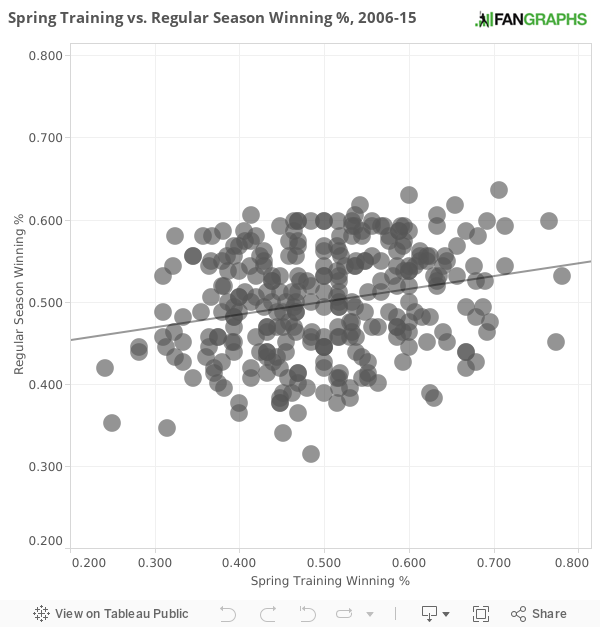
We’re mainly going to be looking at the very obvious: how do team win-loss records correlate between spring training and the regular season? Is there any sort of relationship between terrible March teams and terrible regular-season teams, or vice versa with good teams? Take a look at a plot of the spring training and regular season records of all teams between 2006-2015 — and feel free to mouse over the chart:

This chart is all over the place: lose more games than you win in spring training? Doesn’t mean you’re going to do so during the regular season. Win more than you lose? Doesn’t mean you’ll be successful. A month of games in March is the same as a month of games at any other point during the season — a relatively small sample, prone to all the pitfalls we see in any other small sample. If we tried to glean something from this 10-year sample, there are examples warning us not to be woefully awful in spring training. If a team covers that — finishing above .300 — our data provides evidence that the team probably won’t be unrecognizably terrible. Then again, we simply don’t see teams lose more than ~110 games very often during a regular season, whereas finishing with a winning percentage that low is doable in one month of baseball.

Read the rest of this entry »


KATOH Projects: Los Angeles Dodgers Prospects

Previous editions: Baltimore / Boston / Chicago AL / Chicago NL / Cincinnati  / Cleveland / Colorado / Detroit / Houston / Kansas City / Los Angeles (AL) / Miami / Minnesota / Milwaukee / New York (NL)

Yesterday, lead prospect analyst Dan Farnsworth published his excellently in-depth prospect list for the Los Angeles Dodgers. In this companion piece, I look at that same LA farm system through the lens of my recently refined KATOH projection system. The Dodgers have the third best farm system according to KATOH, trailing only the Brewers and Astros. They have the most projected pitching WAR and the most WAR coming from 3.5+ WAR players.

There’s way more to prospect evaluation than just the stats, so if you haven’t already, I highly recommend you read Dan’s piece in addition to this one. KATOH has no idea how hard a pitcher throws, how good a hitter’s bat speed is, or what a player’s makeup is like. So it’s liable to miss big on players whose tools don’t line up with their performances. However, when paired with more scouting-based analyses, KATOH’s objectivity can be useful in identifying talented players who might be overlooked by the industry consensus or highly-touted prospects who might be over-hyped.

Below, I’ve grouped prospects into three groups: those who are forecast for two or more wins through their first six major-league seasons, those who receive a projection between 1.0 and 2.0 WAR though their first six seasons, and then any residual players who received Future Value (FV) grades of 45 or higher from Dan. Note that I generated forecasts only for players who accrued at least 200 plate appearances or batters faced last season. Also note that the projections for players over a relatively small sample are less reliable, especially when those samples came in the low minors.

1. Corey Seager, SS (Profile)

KATOH Projection: 12.3 WAR
Dan’s Grade: 65 FV

Seager showed what he’s capable of last September when he slashed .337/.425/.561 with the Dodgers. Prior to that, he hit a strong .278/.332/.451 in Triple-A. Seager’s 2015 numbers weren’t particularly gaudy, but he did manage to cut down on his strikeout rate, which was previously the one flaw in an otherwise promising stat line. Shortstops who hit that well at such a young age are few and far between. That’s why Seager has the chance to be a special player.

Corey Seager’s Mahalanobis Comps
Rank Name Proj. WAR Actual WAR
1 Chipper Jones 14.9 33.3
2 Aramis Ramirez 14.4 17.1
3 D’Angelo Jimenez 11.5 7.4
4 Omar Infante 13.2 6.5
5 Jimmy Rollins 12.0 25.6
6 B.J. Upton 16.8 22.4
7 Derek Jeter 11.8 32.9
8 Dustin Pedroia 8.7 30.1
9 Jose Offerman 12.9 7.3
10 Andy Marte 9.3 0.3

Read the rest of this entry »