
Changeups Are Weird

Below are two changeups. Can you tell which one is better?
First up is Griffin Jax’s power changeup. He throws it over 92 mph; at two inches of induced vertical break (IVB) and 15 inches of arm-side run, it almost resembles a filthy left-handed slider:
Second is Hunter Gaddis straight change, floating up to the plate with 10 inches of IVB at an average velocity of 78 mph:
So, which one would you take? That’s a bit of a trick question: By whiff rate, these two pitches are virtually identical. Jax’s changeup ranks second in all of baseball with a 57.3% whiff rate; Gaddis’ is right behind him in third. Stylistically, they’re opposites; by the results, they are indistinguishable.
If you were creating the perfect fastball or the perfect slider in a video game, it’d be a straightforward process. Crank up the velocity, max out the vertical break, and those pitches will generally improve in a roughly linear fashion. Not so with changeups. Pitch models struggle to accurately grade these pitches because their quality can’t as easily be captured by velocity and movement in a vacuum. The Cole Ragans changeup, for example, gets a roughly average grade by Stuff+ despite performing like the best changeup in the sport over the last handful of seasons. It’s slow, and it barely moves — what makes it so good?
Thanks to new data from Baseball Savant, I think the answer might soon be clear.
Generally, I think it’s difficult to capture changeup quality in a stuff model because an individual pitcher’s changeup plays off its relationship to the fastball; that changeup succeeds because hitters think it’s a different pitch, leading them to swing early and mistime it. By this logic, straight changeups like the one Gaddis throws can be just as effective, if not more so, than maxed-out power changes like the one we saw from Jax.
These two changeup groups, broadly defined, tend to be effective in different ways. Jax’s changeup, in the style of fastballs and sliders, gets hitters to miss vertically. Pitching analyst Alex Chamberlain published an essential blog here last week in which he used the new swing-plane data to calculate the implied miss distance on each pitch. He helpfully put those statistics up on his Pitch Leaderboard, where I can see that Jax has the highest average miss distance of any changeup in the sport. On average, hitters swing over Jax’s changeup by roughly seven inches.
| Pitcher | Implied Miss Distance (in.) |
|---|---|
| Griffin Jax | 6.7 |
| Garrett Whitlock | 6.5 |
| Clay Holmes | 5.9 |
| Reese Olson | 5.8 |
| Cristopher Sánchez | 5.7 |
| Ronel Blanco | 5.6 |
| Trevor Williams | 5.6 |
| Paul Skenes | 5.5 |
| Devin Williams | 5.3 |
| Tyler Alexander | 5.3 |
As Alex noted in this article, there’s more than one way to miss a changeup. You can swing over the pitch, as hitters tend to do when they encounter Jax’s changeup. But you can also swing too early, or be out in front. Another new Statcast metric — attack direction — allows us to see how this operates.
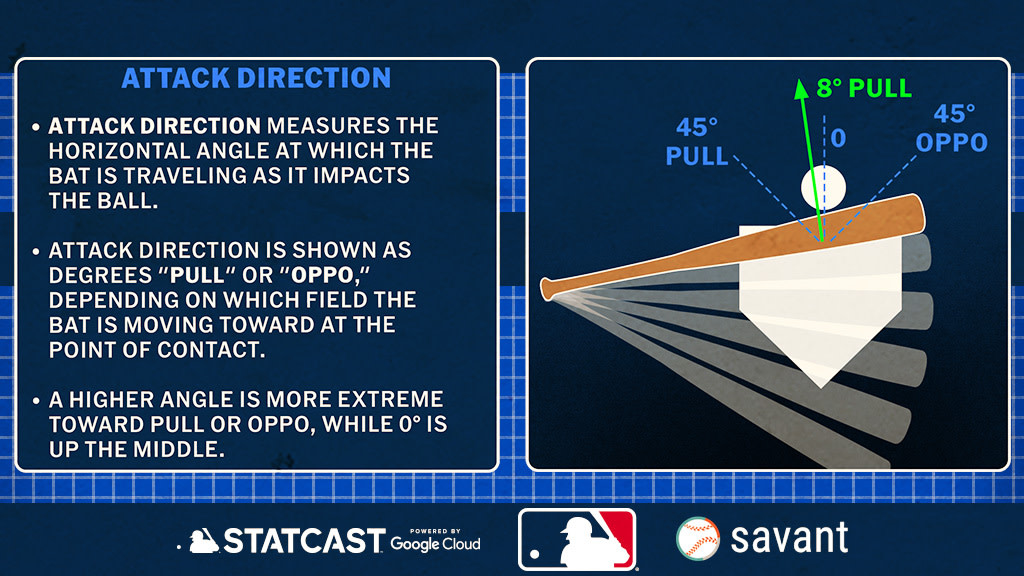
Using the framework of an “ideal” attack direction for sliders, modeling genius Stephen Sutton-Brown of Baseball Prospectus found that hitters were out in front more frequently when they believed the pitch was a fastball.
I can’t do anything as fancy as calculating pitch type probabilities, but I can use Alex’s Pitch Leaderboard to sort by attack direction on changeups. And what I find there, sitting all alone at the top, is Gaddis’ changeup. On average, hitters post an attack direction of 26 degrees to the pull side on the Gaddis changeup, by far the most pull-oriented approach in the sport.
| Pitcher | Attack Direction |
|---|---|
| Hunter Gaddis | -26.1° |
| Cole Ragans | -21.8° |
| Joey Cantillo | -21.7° |
| Mike Burrows | -19.1° |
| Connor Brogdon | -18.7° |
| Tanner Bibee | -18.3° |
| Michael Lorenzen | -18.2° |
| Alek Jacob | -18.2° |
| Angel Chivilli | -18.1° |
| Ryan Weathers | -18.1° |
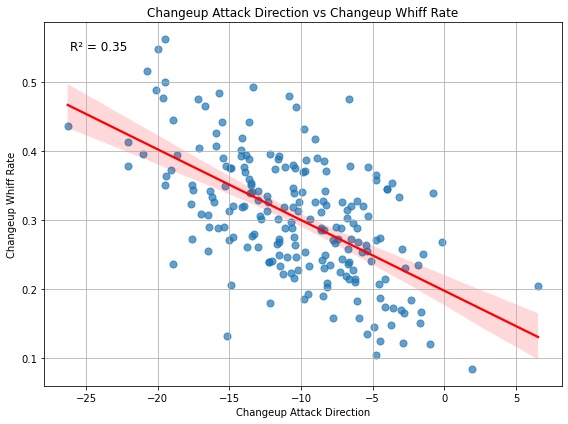
This goes a long way toward explaining why changeups like Gaddis’ manage to thrive despite unremarkable movement and velocity characteristics. When changeups get hitters off balance, they get whiffs. The relationship between attack direction and whiff rate is pretty clear — when swings are more pull-oriented, whiff rates are higher:
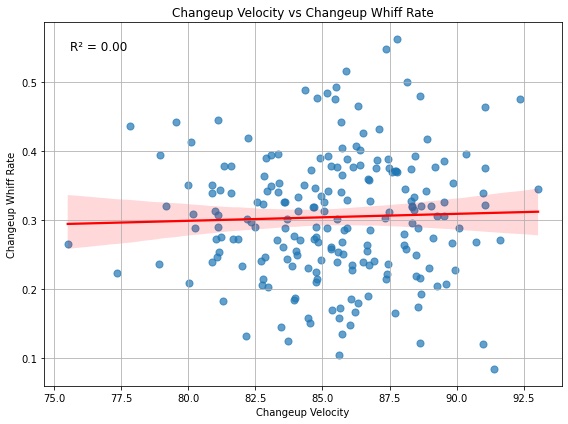
Changeup velocity, by comparison, has basically no relationship to whiff rate:
As a pitch type, changeups unsurprisingly have a pull-oriented attack direction. However, naturally, there are variations between pitchers in the average attack direction. Those variations, it turns out, are strongly associated with the differential between an individual pitcher’s fastball and changeup velocity:
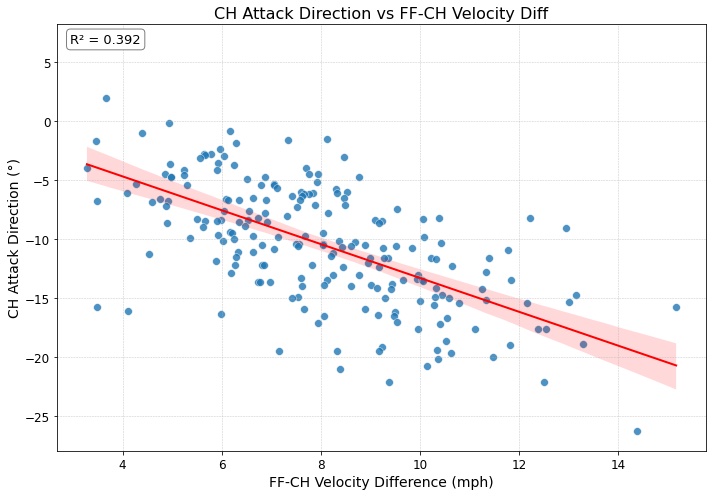
To summarize: Changeup whiffs are largely a function of getting hitters out in front, and getting hitters out in front is a function of maximizing the gap between fastball velocity and changeup velocity. No new ground broken there.
But velo differential isn’t the whole story. Bailey Ober’s fastball-changeup velocity differential is nothing remarkable, but hitters are still way out in front of that pitch. Velo differential explains much of the variation in attack direction, but not all of it.
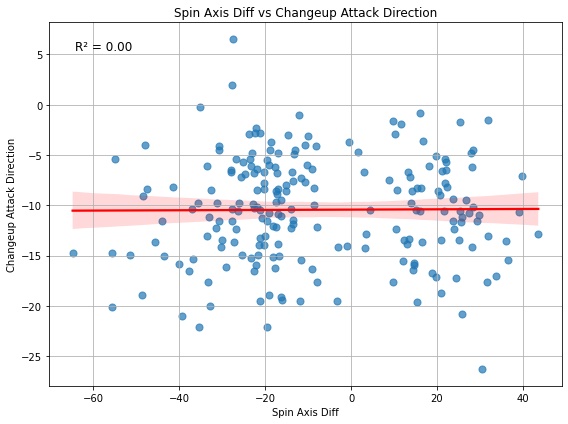
What else causes hitters to flail at changeups? I had two theories. The first one: Similarity in the spin axes of these two pitches would lead to better outcomes. I thought a changeup that spins more like a fastball would be more difficult to read out of the hand. Swing and a miss — there was nothing there.
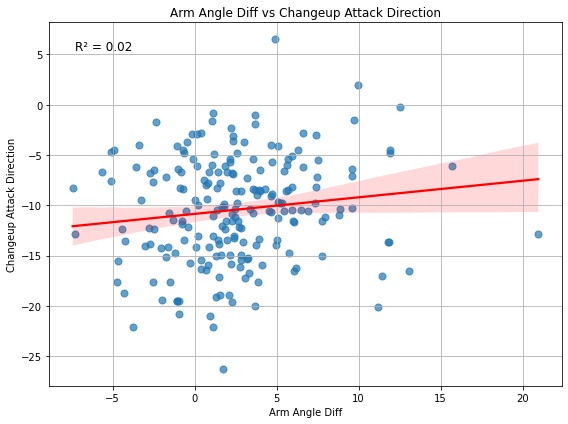
I also considered the similarity of arm angles between fastballs and changeups. Pitchers such as Erik Miller and Max Fried drop their arm angle when throwing changeups, in order to generate more vertical break. I assumed it would be easier for hitters to detect a changeup out of the hand from pitchers who drop their arm angle to throw them. But no dice there either.
There was one last variable I considered: Changeup arm speed. After a pitcher strikes someone out with a changeup, the color commentator will inevitably say something like, “The arm speed there was exactly like the fastball.” Slowing down the speed of the arm will certainly make a changeup slower, but hitters will likely detect mechanical alterations, thereby attenuating the increase in velocity differential. Do pitchers with similar arm speeds on both pitches see better results?
The answer must be yes — it’s hard to fully explain the Ragans changeup otherwise. But are announcers genuinely capable of watching a broadcast and assessing whether a pitcher’s changeup arm speed matches that of their fastball? Teams can probably add arm speed similarity to their models, but on the public side, that variable remains out of reach.
Changeups are weird. But these new data from Statcast, I believe, will demystify the pitch. Instead of using aggregated attack direction, which will inherently have a pitch location bias, someone could calculate a version of Alex’s miss distance for early/late swings. That miss distance could get even closer to identifying pitchers with the ability to disrupt timing. And the pitching analysis community will move closer to understanding what exactly makes certain changeups so good.
Michael Rosen is a transportation researcher and the author of pitchplots.substack.com. He can be found on Twitter at @bymichaelrosen.
Very interesting article, I would have thought for sure spin similarity would have contributed to attack direction.
great article here – changeups are the best pitch. so many nuances.
Adding arm speed to our models was a breakthrough for us when I was working with the Marlins. Even if a batter can’t identify changeup arm speed 100% of the time, a 50% tell can be devastating to a changeup’s performance.
At the end of the day, a changeup is just an inferior — a deliberately inferior — fastball. So if a batter can sense a changeup with the animal part of their body (based on the intuition “the arm speed was slower this time”) before the ball is even released, then it becomes way, way easier to hit.
Even I, the opposite of a talented hitter — an un-talented hitter — was eventually able to read changeups via arm speed in the lower levels of the minors (and able to confirm my suspicions live via Trackman). Changeups tend to get much more refined further up the ladder, but there is still a gradient of arm-speed ability in the majors too.
Great piece! I’ve also wondered if hitters can truly identify a change in arm speed on changeups, I feel like it’d be easier to spot the grip/spin more easily than a slight decrease in arm speed.
Also, I feel like titling an article “Changeups are Weird” and not having Tommy Kahnle mentioned anywhere in the piece is false advertising.
Kind of the opposite (at least according to Trevor Bauer). Velo is usually too high to see spin in time to use the knowledge, so you’re left with shape (tunneling) and arm speed.
This would explain why you see sliders taken down the middle or chased off the plate – they got a slider expecting a fastball, and they did what the initial trajectory told them to do, but in the end it looks bad
Such a great article. Thanks
I think Statcast will have these values available at some point here. Buried at the bottom of their article about the new swing metrics, they specifically mention:
https://www.mlb.com/news/new-statcast-swing-metrics-2025
I’m glad you got to arm speed. I read the whole thing thinking that arm speed, tunneling, and release point were going to be even more important for changeups than for other pitches and that they are a lot more difficult to quantify than things like movement and spin rate.
I will literally read anything Michael Rosen and Alex Chamberlain write on this website
I would love to read an analysis, if there is one, about how Tommy Kahnle makes it work by basically only throwing changeups.
His cambio arm speed is the same as his fastball. Think Trevor Hoffman.
But he has outings where 38 of 38 pitches are changeups so what difference does his fastball arm speed make? Why don’t hitters just sit on the changeup?
The arm is still coming through at a speed indicating FB (and yes hitters are reading arm speed). And it still looks like a FB in flight before dying as it gets to home plate.
I should have mentioned Doug Jones too.
This is an important disclaimer:
Arm Speed is mentioned later as a part of this, but more generally, the more / longer a changeup looks like the pitcher’s fastball the better it is.
But beyond that point, this article helps us to establish that good “changeups” as we know them behave like two different pitches. Which makes me wonder if the differences between changeup styles are more important than we’ve previously assumed.
A quick google search suggests that Cole Ragans throws a circle change, and this article mentions that Hunter Gaddis throws a straight change, so maybe there’s not a big difference there in terms of attack angle. So maybe those are functionally the same pitch, or they have some other similarity.
Meanwhile, Devin Williams, who shows up on the “implied miss distance” table uses a circle change grip but he pronates it weirdly and so some people think he doesn’t really throw a changeup, but a screwball. Paul Skenes is also on this list, and I think he throws a vulcan changeup, which also involves some unusual pronation. Clay Holmes is on that list and throws a kick change, and that doesn’t involve pronation but supination.
I am pretty sure knowledgeable pitching minds have known all of this for a while because the changeup grips have different movement, and maybe it doesn’t break down as neatly by grip but it does seem like there is something here.
“Changeup arm speed”
Nailed it.
Couldn’t a Jax-like changeup with fast velo and high IVB be less dependent on the pitcher’s arm speed than a Gaddis-like changeup with slow velo and low IVB? In my opinion, even if the Jax-like changeup is less deceptive, it can still be played thanks to its physical characteristics. That may be why those changeups are rated higher in the Stuff model than changeups like those thrown by Ragans or Gaddis.
I saw Driveline’s statistics that clustered changeups into nine combinations based on vertical diff and speed diff from fastballs, ranking them in order of expected run value. Changeups with large vertical diff and small velo diff, such as Jax’s, were the best. After that, there were large vertical diff changeups with medium and small velo diff, followed by a changeup with a large velo diff and small vertical diff, such as Gaddis’. After that, there was no significant difference, but it seemed that changeups with a large difference in speed were better than changeups with a moderate difference in speed. Since then, there was one big gap, and it seemed that the large velo diff changeup was slightly better than the small velo diff changeup. Of course, the changeup with small velo diff and small vertical diff was the worst.
Anyway, it was interesting to note that while the diff in velo between fastballs and changeups tends to favor changeups when the diff is large, as shown in the Rosen’s write and the Driveline’s statistics, the opposite is true for large vertical diff changeups like Jax’s. Does this mean that when the vertical diff between fastballs and changeups exceeds a certain threshold, that changeups function more like breaking balls than off-speed pitches?
“Does this mean that when the vertical diff between fastballs and changeups exceeds a certain threshold, that changeups function more like breaking balls than off-speed pitches?”
Or like an old school splitter. I’d put Davis Martin and maybe Edward Cabrera in this category too.
I couldn’t accidentally delete the third sentence from the back, but I don’t know how to edit it. I’m sorry.
You can ignore the phrase “After that, there was no significant difference, but it seemed that changeups with a large difference in speed were better than changeups with a moderate difference in speed.”
Re: spin axis diff. Though there’s no correlation, it’s interesting that the data points seem clustered in two modes. Might be a way to differentiate changeup styles?
Oh it just occurred to me they cluster around +20 & -20. Handedness?
good call, definitely handedness, so that should’ve been split into two different plots