
Checking in on Spencer Strider
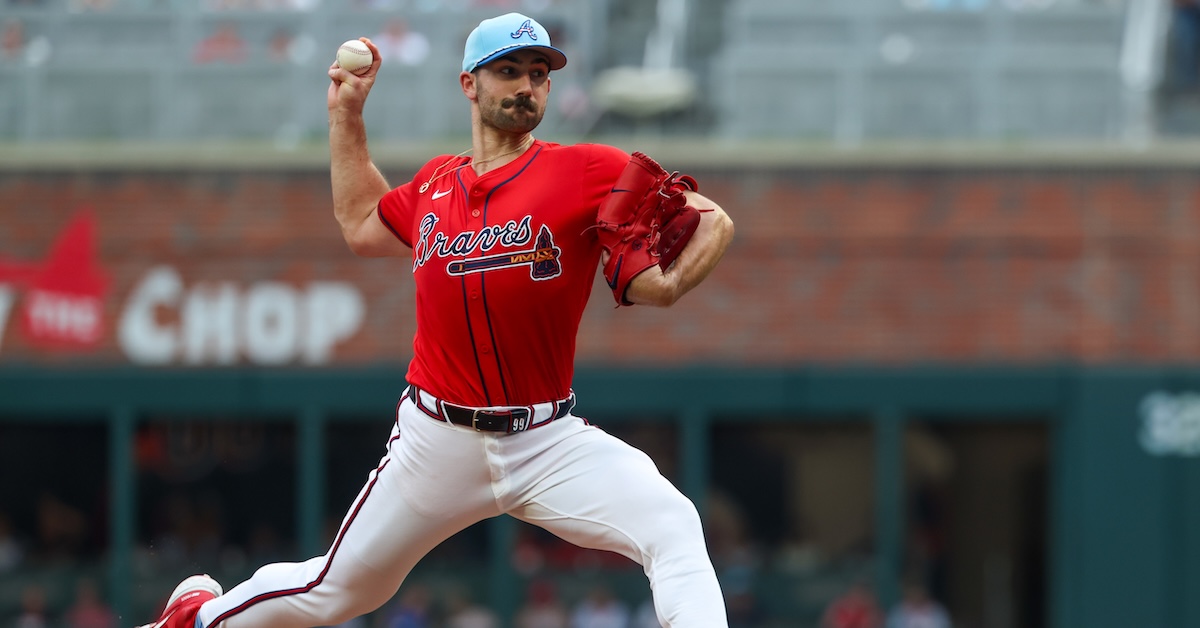
A month ago, I checked in on Spencer Strider’s worrisome return from internal brace surgery. After four starts, Strider was 0-4 with a 5.68 ERA and a 6.40 FIP. His fastball had lost two ticks. His arm angle had fallen by seven degrees. He wasn’t getting chases. He wasn’t missing bats. In short, he didn’t look like Spencer Strider. “There’s no way for us to know how long it might take Strider to get back up to speed,” I wrote, “but the longer he looks like this, the more reason there is to worry.” One month later, I return to you with good news. Strider has made six more starts, and over the last five, he is starting to look different. He’s run a 2.70 ERA and a 2.35 FIP. His strikeout rate is up and his walk rate is down. You might even say that Strider is halfway back.
Once again, the velocity is the big ticket item, so let’s not waste any time:
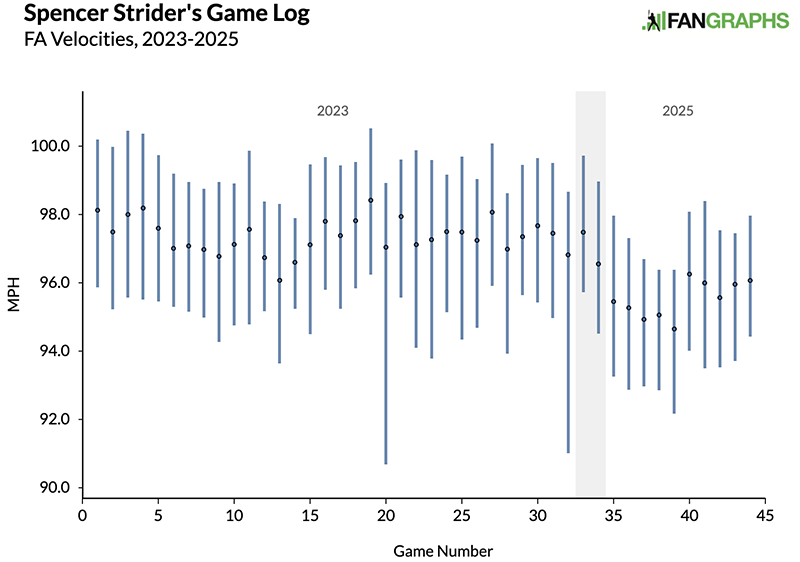
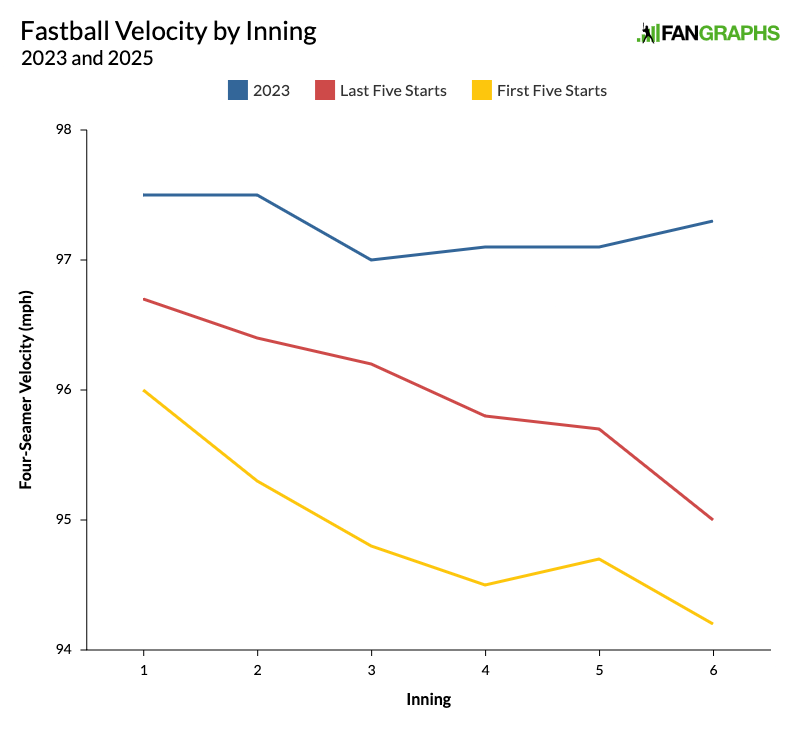
Over his first five starts, Strider’s four-seamer averaged 95.1 mph. Over his last five, it has averaged 96.0. Who knows whether he’ll get there, but he’s nearly halfway to his average velocity from 2023 of 97.2 mph. Strider’s velocity is still fading pretty dramatically as he gets deeper into games, indicating once again that he may still be building up his strength and stamina:
The other big concern I mentioned was Strider’s arm angle. It had fallen from an average of 48 degrees in 2023 to 41 this season. Last week, Hannah Keyser asked Strider whether the lower arm angle was an intentional decision, and he gave a fascinating answer:
No. And I don’t pay much attention to it. There’s so many things that are expected and also totally unpredictable when you’re rebuilding, just even season to season when you’re healthy, I think. So, no I don’t think much of it. And it really hasn’t — I don’t think that that’s impacted anything directly. That’s such a down-the-chain-of-mechanics type of thing. Everything that I’m concerned with is way upstream.
You Aren't a FanGraphs MemberIt looks like you aren't yet a FanGraphs Member (or aren't logged in). We aren't mad, just disappointed. We get it. You want to read this article. But before we let you get back to it, we'd like to point out a few of the good reasons why you should become a Member. 1. Ad Free viewing! We won't bug you with this ad, or any other. 2. Unlimited articles! Non-Members only get to read 10 free articles a month. Members never get cut off. 3. Dark mode and Classic mode! 4. Custom player page dashboards! Choose the player cards you want, in the order you want them. 5. One-click data exports! Export our projections and leaderboards for your personal projects. 6. Remove the photos on the home page! (Honestly, this doesn't sound so great to us, but some people wanted it, and we like to give our Members what they want.) 7. Even more Steamer projections! We have handedness, percentile, and context neutral projections available for Members only. 8. Get FanGraphs Walk-Off, a customized year end review! Find out exactly how you used FanGraphs this year, and how that compares to other Members. Don't be a victim of FOMO. 9. A weekly mailbag column, exclusively for Members. 10. Help support FanGraphs and our entire staff! Our Members provide us with critical resources to improve the site and deliver new features! We hope you'll consider a Membership today, for yourself or as a gift! And we realize this has been an awfully long sales pitch, so we've also removed all the other ads in this article. We didn't want to overdo it. In case you didn't read all that, here's the short version. Membership includes:✓Ad-free browsing✓Unlimited FanGraphs & RotoGraphs articles✓Historical & platoon projections✓Leaderboard & player-page stat heatmaps✓One-click data exports✓Customizable player-page dashboards✓Dark & Classic site modes✓Weekly Members-only mailbag✓FanGraphs Walk-Off, your year in review✓Optional homepage photo removal✓Gift articles to non-Members✓Full postseason coverage
This blew my mind a little bit. First, it seems like an extremely healthy answer from a psychological perspective. Strider views his recovery as a marathon rather than a sprint, so he’s not going to sweat this particular concern right now. That’s pretty impressive. A million things, big and small, go into a successful, repeatable delivery, and he views arm angle as a thing that’ll take care of itself if everything else is in the right place. Lance Brozdowski made a similar point in an explainer video a couple months ago, mentioning that teams care less about the one arm angle number we see on Statcast and more about the granular biomechanical markers that go into it. In Strider’s case, you can see from the GIF I made back in June that the change in arm angle is much less about the relationship between his arm and his body, and much more about how far he’s tilting his torso:
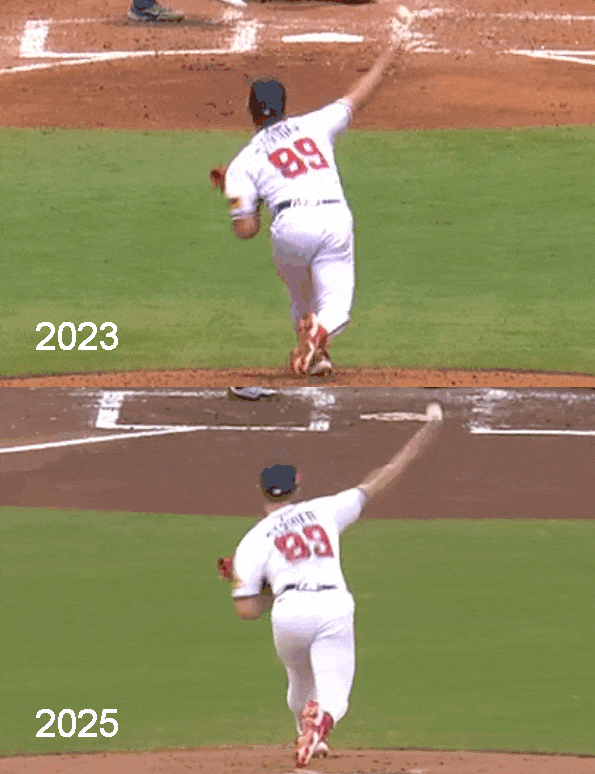
That said, I can’t say I agree that it hasn’t affected the quality of his pitches. No matter how you get there, arm angle really does matter. It’s a huge factor in stuff models, and for good reason. That high arm slot was one of Strider’s biggest weapons. It made his delivery unusual, and showing hitters something they’re not used to seeing gave him a huge advantage. More importantly, it allowed him to impart a huge amount of true backspin on his four-seamer, which gave the pitch its signature jumping-off-the-top-of-the-pitch-movement-chart rise. Coming from a lower slot, it has more horizontal break and less rise. The change made it a lot more like all the other fastballs hitters are used to seeing. Pitching models downgraded it from excellent to way below average, and the results were ugly.
So while I understand what Strider is saying, I’m left with more questions than answers. The Braves are definitely aware that his fastball is a different, less dangerous pitch now that it has a lower release point. Strider isn’t working on raising his arm angle per se, but I’m still curious whether he thinks the mechanics that feed into it are where they need to be, or whether he wants to get back to where they were before the injury. I’m curious whether the Braves want him to work to get to that place, whether they think it’ll happen on its own over time, or whether they think it’s even possible.
What makes all this even more interesting is that Strider’s arm angle has crept up just a little bit in recent weeks. In 2023, Strider’s arm angle when he threw his four-seamer was 48.4 degrees. Over his first five starts, it was 41.7 degrees. Over his last five, it was 42.4. In theory, that should be encouraging, especially when you combine it with the uptick in velocity. But something else has happened too. Strider has continued to trade vertical movement for horizontal movement, which isn’t usually what happens when your arm angle rises. Over his first five starts, the pitch had 17.5 inches of rise and 8.2 inches of arm-side break. Over his last five starts, those numbers are 15.7 inches and 9.4 inches. As a result, despite the increased velocity, both PitchingBot and Stuff+ think the pitch has actually gotten slightly worse:
| Time Period | PitchingBot | Stuff+ |
|---|---|---|
| 2023 | 67 | 118 |
| First Five GS | 51 | 94 |
| Last Five GS | 49 | 92 |
The pitch has performed somewhat better – running similar exit velocity numbers and higher whiff rates – but I suspect that’s more due to its location than its shape. Strider has stopped nibbling up at the top of the zone quite so much, and is going after hitters a bit more:
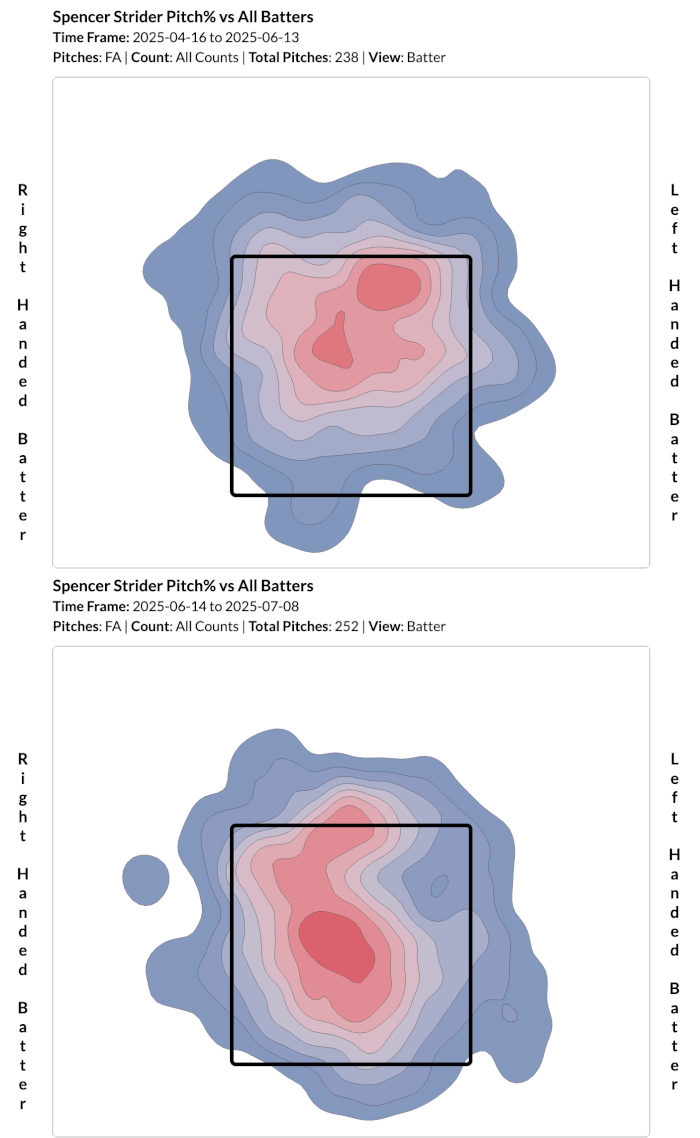
However, Brozdowski mentioned a few weeks ago that he wasn’t sure the change was intentional. “Watching his recent outings,” he wrote, “his four-seam targets don’t seem dramatically shifted from the away or up targets he had previously.”
That was quite a journey, so let’s recap. Strider’s fastball velocity has ticked up to 96 mph. That’s still more than a tick off his 2023 velo, but it’s an encouraging sign. His arm angle has also ticked up very, very slightly, but he’s lost even more rise on the fastball, so pitch models are grading it out worse. These are all small differences, maybe even small enough to be meaningless, but I will definitely be looking out for them going forward.
If that doesn’t sound to you like enough to completely turn around Strider’s season, you’re absolutely right. A slightly worse fastball that’s located a bit better isn’t enough to go from a 5.56 FIP to a 2.35 FIP. The biggest change has been to Strider’s slider. Here’s that same pitch modeling table, but for the slider rather than the four-seamer:
| Time Period | PitchingBot | Stuff+ |
|---|---|---|
| 2023 | 52 | 120 |
| First Five GS | 42 | 99 |
| Last Five GS | 42 | 112 |
PitchingBot has never been big on Strider’s slider, but Stuff+ has, and it likes what it’s seeing right now. Over his past five starts, Strider’s slider has gone from 83.6 to 84.3 mph, added a tiny bit of rise, and lost 1.5 inches of glove-side break. With less sweep and more velocity, it’s more of a bullet slider than it was before, and it’s working. Its whiff rate has risen from 49% to 56%, and its hard-hit rate has fallen from 43% to 35%. Strider is throwing it more, often especially with two strikes. In fact, the only count in which he’s not throwing the slider more often is 0-0. Over his past four starts, he’s throwing the slider nearly 40% of the time, one of the highest rates for any individual breaking ball in the game. In other words, Strider is throwing the fastball just enough to get by and set up the slider. In fact, over his last five starts, he’s throwing the slider and fastball nearly 93% of the time; more than he did even in 2023, before he added his curveball.
When I checked in on Strider last month, I saw two possible paths for him. The first saw him unable to return to his previous heights. Without an unhittable four-seamer and slider combination, I figured he’d have to become a more complete pitcher, working in his rarely used curveball and changeup, and maybe even adding another couple pitches. The second path saw him getting his old stuff back, or at least something approximating his old stuff. At this point, he’s definitely closer to the second path than the first. He doesn’t have the fastball, but he’s got a great slider again, and he’s riding it just about as hard as it’s possible to ride it. So far it’s working, but it seems pretty clear that Strider is still figuring out who he is and who he can be as he works his way back.
Davy Andrews is a Brooklyn-based musician and a writer at FanGraphs. He can be found on Bluesky @davyandrewsdavy.bsky.social.
The old conventional wisdom (which may or may not still be considered correct) was that the first year back after TJ the pitcher was not like their old self, and the year after that it was 50 / 50 whether that was the new normal or they would return to their previous highs.
I think he had an internal brace procedure so things might move a little faster, but I still think if he can get through 2025 as an above-average pitcher that’s good news. I wouldn’t expect him to be back to his devastating old self until next year.
Right, with command taking the longest to come back (if it does). Would love to see a thorough study. I’m tracking Eury similarly.
I’m not really expecting his velo to tick up more from where it has been the last month or so especially since this was his second TJ-type procedure. I do expect his command to take another step forward next year.
Awesome work, and so unique to have the findings paired with a direct quote from the player’s perspective. Very cool to be able to follow his comeback journey through these analyses.
Sure hope he gets close to where he was. Couple of observations, the overall poor performance shadowed by injuries to Braves is a good thing for Strider. He won’t be pushed this year. I was already getting anxious seeing him gather some relatively high pitch counts. There is no need to push him this year. Not in innings pitched, pitch counts or even going on normal 4-5 day schedule. Braves need to start over. They had quite the run. Even when-if Strider gets close to 100%, the depth of roster issue in several positions is real. I think Braves sit playoffs out for 2-4 years.
Their pitching staff was tops in the league last year and is league average so far this year after losing Fried, which was undoubtedly going to be felt, and Morton, which was the smart move. Their starting pitching is still enough to get them to the playoffs without question. Their bullpen has faltered, but even worse their hitting has been wildly inconsistent. They’re 12-23 in one run games, flip that and they’re competing for the NL East despite mediocre hitting. For context, the 2023 Marlins were 33-14 in one run games and made the playoffs with a 93 WRC+.
This is not a team that needs a full rebuild to be competitive, not even remotely. The most they should consider doing is trading Ozuna at the deadline, but they have no reason to think they’re sitting out the playoffs for 2-4 years.
Agree on all of this, though I’d also trade Bummer and Johnson and see if anyone would take on some of Iglasias’ contract.
Strider on mend, AJS =TJ, Schwelly with busted arm, Sale out, Looez a ? Ozuna last year on contract and hip, left field? shortstop? Albies aging bad. Iggy out of pen losing effectiveness; sharing opinions here. I don’t see depth of roster that it takes.
Are you talking about this year or next year and the year after that? There’s no question that they’re done for in 2025, this has been a veritable maelstrom of bad performance and injuries. But what makes you think they won’t be able to rely on the pitchers you’re talking about in later years?
I am speaking about 2026 and beyond. Well,AJS is gone probably 18 months before he gets to where he was, Strider, who knows but to think he comes back to 2023 levels is a pipe dream. Schwelly? A year to 18 months. Sale. Age, tire wear. I am thinking 2026 and beyond. I realize this year is out of reaching all probability. Mets are just getting started, Phillies have real depth in mi ors, Marlins on brink of return. Braves are in tough spot. Again, I am not arguing with any opinion. I am commenting what I forecast.
The top half of their lineup can compete with literally any in the league when they’re on. Acuna, Riley, Olson, and Ozuna is one of the best 1-4 in the league.
Their pitching depth is an injury concern, but the fills in plus soon to be called up prospects ease the concerns quite a bit here. Last year they didn’t have Strider and only had Sale and Fried top 170 innings yet their staff led the league in fwar.
Those two factors alone make this team a consistent playoff team so long as multiple things don’t go sour all at once, like last year – when they still made the playoffs. Last year multiple players in the lineup missed significant time yet they still claimed a playoff spot.
As for the lineup, Nacho will be up next year, trading Ozuna gives Baldwin and Murphy the DH/C swap. So they’ll have 2-3 batters to seriously consider replacing if they don’t rebound (which Harris and Albies very well could). That’s still 5 batters in their lineup that are all well above average hitters.
With the pen, your concern is a single pitcher, I’d argue that shows good depth regardless of where that pitcher typically fits in. Further, I think Iglesias is being given a long leash simply from how the year is currently going to see if he can rebound. Even so, with the depth in the rotation those guys can easily move back to the pen if necessary. But I’d wager any other team in the league would be more than happy having a single pitcher being their only problem out of the pen.
Their margin for error is low in the NL East, but with the top of the lineup and a pitching staff that seems to churn out new rotation pieces as needed and with further rotation depth in the minors they should absolutely not consider themselves out of the playoffs for the next 2-4 years. That’s full on rebuild talk, you don’t do a full rebuild with the pieces the Braves have in place regardless of whether they’re injured or not.
Sorry for the long post, but everyone wants to panic about the Braves because of how the year is going and that’s why I posted the stats on their one run game record. One run wins being the difference in you being a playoff team and not is significant, but it can also just come down to dumb luck too. They also had one of the worst starts to the season – which was caused by one of the hardest starts with 7 games against SD and LA all in Cali. As I said, the 2023 Marlin were a well below average hitting team and won 20 more games than they lost when it came down to a single run. This isn’t a team that can’t compete, which is why so many predicted they’d win the East.
Sharing opinions; my concern as I wrote is much deeper than a single pitcher. It is layered with concerns about roster depth on several areas. There is no panic in what I wrote. I agree with you on a few of your observations; they do have Olsen, Riley, Acuna, and a developing Baldwin. Nacho isn’t going to be make the difference guy, but probably a nice role player. Ozuna… who is trading for expiring contract, bad hip with zero glove skills.His return if … is negligible. Murphy isn’t prime time. Harris who seemingly is just going to swing like always has had 6 of past 9 months in tank. Albies.. and yes the pitching staff is basically broke. It’s broke heading into next year as well. I am not a Braves fan hater. My original context was Strider benefits from a less pressurized 2025 year end due to the injuries and under performing of half that lineup. It is what it is.
You also stated they’d not be a playoff team for 2-4 years, which is what I was replying to.
Strider’s always been interesting to me, because he’s a starter who is *dangerously* close to a two-pitch pitcher, almost in the vein of Dinelson Lamet.
Lamet obviously enjoyed some success before it all fell apart. I think Strider — at his peak powers — is tremendously more talented than Lamet (not that he had an arm to sneeze at), but, for sort of similar reasons, I’ve always been bear-ish on Strider long-term, even before T.J.
For Strider’s pitch mix to work — especially multiple times through the lineup — his fastball has to truly be faster and rise more than batters can even adjust to, such that they almost have to predetermine what they’re looking for (between fastball or slider) and swing accordingly. When batters take that 0.05 seconds to try to determine which the pitch is, the fastball’s already by them, and should they guess right that it was the fastball but only foul it off, the next slider is going to make them look foolish swinging over the top. But, if you lose a little bit off that elite edge — and I really think it only takes a little bit — then batters can more easily sit on one pitch while still being in the range to foul off the other.
Coming back from this injury is the first big test of whether this is true — though maybe he’ll come back throwing more explosively than ever, like some pitchers do, and then age like Verlander, still throwing absolute bullets into his late 30s. But he’s always had the feel of an NFL running back to me — someone to make hay with while the sun shines and then abandon ship after a little bit of tread is put on the tires. (I’m sure I’ll end up with egg on my face for saying this after he wins 2 of the next 3 Cy Youngs or something.)