
Coming Out of My Cags, Below the Mendoza Line
The Kansas City Royals are my dark horse team for 2026. They managed not only to make the playoffs in 2024 but also to win a round despite not having anything resembling a playoff-quality offense, and then went a respectable 82-80 in 2025 even after losing ace Cole Ragans to a rotator cuff strain and watching no. 2 starter Seth Lugo start to suffer the effects of age.
Heading into 2026, the Royals have a deep pitching staff and more good position players than they’ve had at one time in at least 10 years. Maikel Garcia and Bobby Witt Jr. are baseball’s best left-side-of-the-infield duo, and Vinnie Pasquantino is pretty good too. If not for the giant sucking maw at second base, the Royals infield would be among the best in the majors.
Still, they could, as ever, use another thumper. Witt is the team’s only truly transformative offensive player, and while Kansas City has bolstered the lineup with the addition of Isaac Collins, it had only four players last season with double-digit home runs. That’s the lowest total in baseball; 27 teams had at least six such players, 16 had eight, and four had 10.
Seems like a team that could really use a gigantic Floridian with 80-grade power.
The problem is, the Royals have one: Jac Caglianone. They made a substantial effort to get him, spending the sixth overall pick and lavishing the fifth-largest bonus in the class on the former Florida Gator. This despite there being no shortage of talented players left on the board. The next three players picked were JJ Wetherholt, who’d been in the conversation to go 1-1, Christian Moore, who’s already established himself as the Angels’ starting second baseman, and Konnor Griffin, currently the no. 1 prospect in baseball.
I would’ve taken Caglianone at the time, too, because the power was too exceptional to ignore. Caglianone hit 68 homers in 137 games across his final two collegiate seasons, and in his draft year he hit .419/.544/.875 with more than twice as many walks as strikeouts. And Caglianone did all this while moonlighting as a starting pitcher; as a sophomore he’d sandwiched between Brandon Sproat and Hurston Waldrep in a weekend rotation that took Florida to the College World Series final against Paul Skenes and LSU.
Caglianone wasn’t in the minors long, because he tore through the competition like a good bread knife through an overhydrated focaccia. In his first full professional season, he took part in 66 minor league games, all at Double-A and Triple-A, and hit a combined .337/.408/.617 with 20 home runs. College baseball is a bonkers offensive environment right now, and a lot of the pitchers Caglianone cooked are now car salesmen or law students. But switching to a wood bat and facing adults didn’t slow him down much.
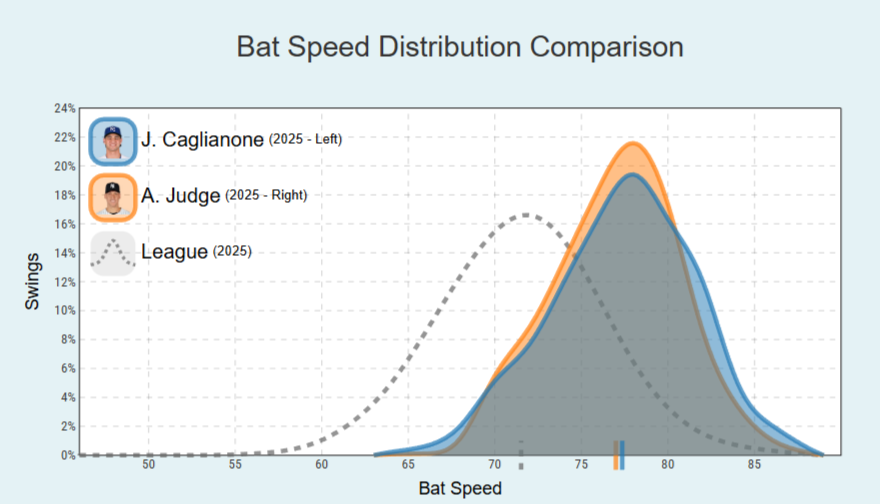
Now, at no point would I have accused Caglianone of being an elegant or sophisticated player. The premise here is simple: This 250-pound man, this three-technique defensive lineman in stirrup socks, can swing a baseball bat about as hard as anyone in the world. Here’s his bat speed from 2025, charted against Aaron Judge’s:
The transition from even the high minors to the majors can be bumpy. It would not have surprised me in the slightest had Caglianone hit in the low .200s over 60 games with 15 home runs but a million strikeouts. But even in the most pessimistic corners of my imagination I never would have predicted what actually happened.
Caglianone hit .157/.237/.295 in 62 games and 232 plate appearances. Among the 348 position players with at least 200 plate appearances last year, he was 344th in wRC+ (at 46) and 347th in WAR (-1.6).
On a per-plate-appearance basis, the difference in WAR between Caglianone and Kyle Isbel (who is, fairly or not, my mental image for the kind of filler the Royals need to improve on) was far greater than the gap between Isbel and Witt. WAR in a small sample can be misleading, and so on and so forth, yadda yadda, but jeez.
One of the most pressing questions for the Royals, for both the short and medium term, is whether this undeniably horrible rookie season will or should dampen their commitment to their one-time top hitting prospect.
I’ll start with two pieces of good news for Caglianone. First, that WAR total is as bad as it is mostly for reasons that have to do with his shortcomings as a player but are outside of his control. Caglianone, a first baseman for all of his college career and most of his brief time in the minors, played right field in his first big league call-up.
As you’d expect for a guy who was a top pitching prospect until recently, Caglianone has a terrific throwing arm from right, but even for a guy his size, he is neither nimble nor quick. Those physical limitations, combined with his inexperience at the position, led to his giving away seven runs of defensive value in just over 400 innings.
You’d have to be crazy to think it’s a good idea to keep him there, and my first inclination would be to show up at Matt Quatraro’s house in the middle of the night like the ghost of Jacob Marley and yell at him until he promises to hide Caglianone’s outfielder’s mitt.
Unfortunately, the Royals are locked into Pasquantino at first, and top catching prospect Carter Jensen was so impressive in his own rookie cameo that he’s got a hand on the DH spot. Jensen can’t move to catcher full-time until franchise legend Salvador Perez, himself the recipient of a recent two-year extension, retires. The result of this logjam: Caglianone made 51 starts in right field as a rookie, but just seven at DH and only one at first.
I’m not going to knock Caglianone for defensive numbers that are really his GM’s fault. Still, a 46 wRC+ is unacceptable for a backup catcher, let alone a would-be cleanup hitter.
Again, there’s evidence that Caglianone might not have been that bad. His BABIP in 2025 was .172, which was the worst in the league (minimum 200 plate appearances) by more than 30 points. He also underproduced his xwOBA by 82 points. Among that same group of hitters, this was also worst in the league by a huge margin: 18 points.
Contrary to my fears, Caglianone struck out 22.4% of the time and whiffed on 26.8% of this total swings, both of which are worse than average overall but well within the range of the acceptable for a hitter with his power. And the power is there; Caglianone was in the top 10 (minimum 200 swings) for both average bat speed and fast swing rate, and 12th (minimum 200 PA) in EV90.
I also wanted to check Caglianone’s major league Z-Contact%.
This is a decent proxy for how often a hitter makes contact when he gets his pitch. The major league average last year was 85.4%, but some of the best power hitters in baseball — Judge, Kyle Schwarber, Shohei Ohtani — live in the high 70s without any trouble.
After that, there’s a cliff, and a Z-Contact% in the low-to-mid 70s can range from a faint long-term concern (Nick Kurtz) to a warning sign of imminent decline (Rafael Devers) to a red flag (Munetaka Murakami) to whatever color flag is worse than red (Christopher Morel). But that’s fine too; Caglianone made contact on 89.3% of pitches in the zone, which was actually slightly better than what he did in Triple-A.
But it wasn’t all bad luck. Caglianone’s xwOBA in 2025 was .321, which is OK but not great: 155th out of 348 players with the 200-plate appearance minimum. That was tied with Alex Call and Carson Kelly, among a few other notable names: Trea Turner and Pete Crow-Armstrong had a .321 xwOBA and finished in the top 15 in position player WAR, though both of those guys play up-the-middle positions and stole 30-plus bases. In order for Caglianone to be a star, he has to hit more.
Now we’re starting to run into stuff that is Caglianone’s fault. Someone who hits the ball as hard as he does ought to be hitting it in the air. At least, if he wants to score runs; hitting the ball down is just fine if your goal is to torment the groundskeepers by pockmarking the infield with divots. Caglianone hit 1.46 grounders for every fly ball in 2025, and his minor league numbers were similar.
By now you’re probably getting an itching feeling in the base of your skull, because we spent most of the early 2020s complaining about Vladimir Guerrero Jr. doing the same thing. Vladito regularly overcomes his ground-and-pound propensity by hitting lots of line drives as well. In 2025, he was 102nd out of 348 in line drive rate; Caglianone was 325th. If you combine line drives and fly balls into a single balls-in-air metric, Caglianone was 322nd.
The Statcast-derived expected stats take into account launch angle and exit velo, but not batted ball direction. Accounting for these numbers does Caglianone no favors. I did the math on this a couple years ago in an article about Ryan Mountcastle, but I’ll give a brief summary here: The most productive batted balls are pull-side fly balls and line drives in any direction. Center field fly balls and opposite-field grounders are about neutral, while pull-side and center field grounders, along with opposite-field fly balls, are almost automatic outs.
In 2025, 24.7% of Caglianone’s batted balls were pull-side grounders (i.e. the zone of death), the 30th-highest rate in baseball. Only 15.8% of his batted balls were in the air and to the pull side (i.e., where cheap home runs come from). The discrepancy between his expected and real stats was so hilariously vast, some of it must’ve been bad luck. But not all of it.
Caglianone was so awful in his first taste of major league action — and so unbelievably dominant at every step before then — that I wouldn’t ask him to make dramatic changes to his swing or approach based on a third of a season. The batted ball numbers being what they were, I’d give him some rope and see how much of the ugliness of last year off-gasses on its own.
But if that doesn’t happen, the Royals will still be at least one big bat away from being able to make a run. Whether Caglianone can put his rookie year behind him — and to what extent — could end up swinging the AL Central race.
Michael is a writer at FanGraphs. Previously, he was a staff writer at The Ringer and D1Baseball, and his work has appeared at Grantland, Baseball Prospectus, The Atlantic, ESPN.com, and various ill-remembered Phillies blogs. Follow him on Twitter, if you must, @MichaelBaumann.
Gotta gotta hit dongs because he wants it all
I didn’t not hear the song reading this title, it’s not unlikely that I didn’t not hear it