
Didi Gregorius vs. Derek Jeter, Importantly
Last offseason, the Diamondbacks participated in a three-way trade that brought them shortstop Didi Gregorius, and that cost them Trevor Bauer. Other pieces were involved, but we’re not going to talk about them here. Arizona drew some criticism, as people weren’t sure Gregorius would stick as a regular shortstop, but general manager Kevin Towers saw to it to compare Gregorius to a young Derek Jeter:
“When I saw him, he reminded me of a young Derek Jeter,” Towers said.
So there’s actually a lot more to the quote:
“I was fortunate enough to see Jeter when he was in high school in Michigan. He’s got that type of range, he’s got speed, more of a line-drive-type hitter, and I think he’s got the type of approach at the plate and separation to where I think there’s going to be power there as well.”
It’s funnier when you don’t think about it, when you just assume Towers predicted that Gregorius would be the next Captain Clutch. It’s funnier when you assume Towers was complimenting Jeter’s major-league defense, instead of his high-school defense. When you sit down and consider Towers’ words, nothing’s particularly outlandish. But the long-term effect is that people remember that there was a comparison between Gregorius and Jeter, just as people remember that there was a comparison between J.A. Happ and Cliff Lee. The details get lost. And the benefit is that now we can use this as a jumping-off point and just compare Gregorius to Jeter now that the former is playing a lot in the bigs. Let’s warp Towers’ words irresponsibly and misleadingly. How do Gregorius and Jeter stack up? Differently! And yet, overall, kind of similarly.
DEFENSE
Defensively, Jeter isn’t a mystery. If you have any level of trust in the numbers at all, you understand that Jeter hasn’t been a very good defensive shortstop, relative to other shortstops. Yet he’s stuck at the position, so he hasn’t been an out-and-out disaster. Jeter’s strengths have been going back on pop-ups and charging softly-hit grounders. He’s well known for making strong, leaping throws from the hole to his right. Laterally, though, he’s never been good, at least not with the Yankees. Jeter has done a terrific job of looking the part while being limited by profoundly mediocre range.
Gregorius is 23 and amazing. When Yuniesky Betancourt was 23, I thought he was amazing, and he wound up being terrible, but I know what my eyes saw, and I know what my eyes see now. Gregorius is capable of making plays anywhere. He can make them to his right:
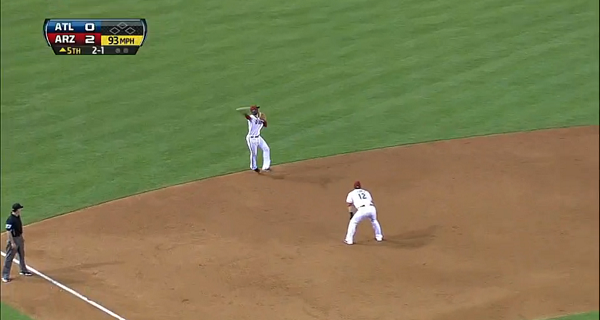
He can make them to his left:

He can make them way behind:
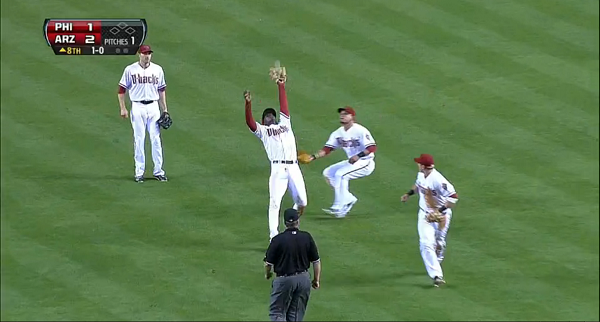
He can make them out in front:
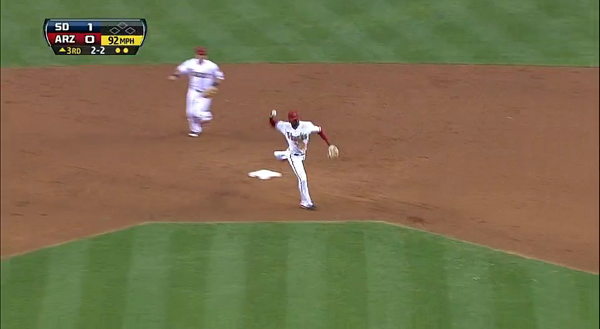
He can make them in the air:
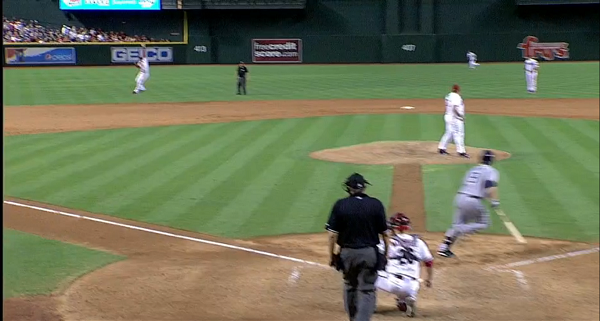
One of the things we think we understand is that defense peaks early, before a player’s agility starts to deteriorate. In this way, defense is like a pitcher’s fastball. Five years from now, Gregorius will probably be a worse shortstop. Ten years from now, Gregorius will probably be a worse shortstop than he was five years earlier. But he seems to be establishing an incredible baseline, and the small-sample numbers are on his side. Consider this statistic! The Diamondbacks have started Gregorius at short 29 times, and they’ve started Cliff Pennington at short 23 times. With Gregorius, there have been 767 balls in play. With Pennington, 596. A split:
With Gregorius at short: .279 team BABIP
With Pennington at short: .315 team BABIP
There’s way too little data to make much of that, but that doesn’t mean it isn’t interesting, and it agrees with observations. Gregorius is the sort of shortstop you’d define as one who scampers. He covers all of the territory, he glides as he does it, and his throws are usually on the money, no matter his body position. Derek Jeter might’ve been a good shortstop in high school. Didi Gregorius appears to be an outstanding shortstop now.
OFFENSE
Jeter has 12,000 career plate appearances of being well above-average. Gregorius has 145. Jeter, between Double-A and Triple-A, posted an OBP north of .400. Gregorius, between Double-A and Triple-A, posted an OBP south of .330. The questions with Jeter would’ve concerned whether he had the defense to stick at short. The questions with Gregorius have concerned whether he’d hit enough to play every day. He’s trying to prove himself now, but he hasn’t yet done it, any more than Jean Segura has done it.
Additionally, Jeter’s always been a strong opposite-field hitter. He’s thrived in New York, and here’s an image from Texas Leaguers showing a Derek Jeter spray chart. This is of Jeter as a relative senior citizen, but his batting profile hasn’t really changed over his career.

Jeter’s right-handed. Here’s a Gregorius spray chart, and he bats left-handed.

Jeter and Gregorius are similar offensively, in that they can hit for some power to right field. But that’s the pull field for Gregorius, and he has yet to hit a ball with true authority to left or left-center. Some good hitters are pull hitters, but I’d expect this to be something pitchers try to exploit as Gregorius sticks around. If they find that Gregorius’ swing is too pull-oriented, they’ll throw pitches more difficult to pull, and Gregorius will have to adjust.
But there are things to be excited about. For one, Gregorius has a 152 wRC+. For Jeter’s career he’s at 122. Of course Gregorius isn’t this good, but he’s already hit more than a lot of people expected. Just Monday, he both tripled and homered off Yu Darvish, and the homer left the bat at 110.5 miles per hour. Gregorius has some dinger strength, and though he’s also showing himself to be more of a free swinger than Jeter, it would be hasty to call him over-aggressive. Consider:
League, 2013: 29.0% O-Swing%
League, 2013: 62.2% Z-Swing%
Gregorius, 2013: 29.2% O-Swing%
Gregorius, 2013: 73.4% Z-Swing%
Gregorius has an above-average swing rate, but those extra swings have come against strikes. Discipline is all about swinging at strikes and laying off balls, so Gregorius hasn’t been swinging himself into trouble. It’s too early to say whether this is sustainable or overrating the quality of Gregorius’ eye, but Gregorius’ plate-discipline numbers are a hell of a lot better than, say, Dee Gordon’s. Gordon’s another wiry shortstop, and his approach has been bad. Gregorius’ approach has been good, statistically, which means he’s at least off to an encouraging start.
INTANGIBLES
Hell if I know. People say Jeter has them. Gregorius might. Gregorius is never going to be a leader in the Jeter mold, but he’s a rookie, and his Diamondbacks teammates already trust him and yield to him on the field. This is a terrible category. This is a terrible comparison!
OVERALL
Kevin Towers never meant to suggest that Didi Gregorius would be the next Derek Jeter. Indeed, that won’t happen, both because they’re different people, and because they’re different players. This was a lousy premise for a baseball blog article. But here’s the similarity between Gregorius and a young Jeter: both their employers have been more than pleased. Jeter instantly hit and took to New York. Gregorius has instantly hit and instantly fielded, even ahead of the Diamondbacks’ intended schedule. Gregorius will be carried by his defense, and his defense is his strength, which we’ve known to be true all along. But there are indications that he could be a threat offensively as well, even if he isn’t going to keep slugging in the .500s. A guy with speed, controlled aggression, and some pull power can hit good pitchers, and what Gregorius has left is to demonstrate some capacity to hit the other way. That’s probably going to be his adjustment, and we can’t predict how it’ll go.
But Gregorius has already exceeded expectations. In a young Derek Jeter, the Yankees saw a guy who could be their shortstop for the next decade. The Diamondbacks thought they might have that guy in Didi Gregorius. He’s done nothing yet to indicate otherwise. No matter your evaluation of Gregorius now, it’s better than it was a couple months ago, and that’s all a team can ask.
Jeff made Lookout Landing a thing, but he does not still write there about the Mariners. He does write here, sometimes about the Mariners, but usually not.
I am pretty sure Didi Gregorius is herpes free too so there is another bonus.
Not for long if his “intangibles” match JETER.
Best comment on this post wins a gift basket! Oh wait….
As a Reds fan I am both glad to see him succed and yet just a bit disappointed that we traded him. (Choo is making up for everything, though)
His name is Didi. Hehe.
Surprisingly, his production may be a little sustainable. I see the average dropping and his ISO dropping, but with his plus defense he becomes a valuable shortstop this year with an even higher ceiling. His plate discipline is so encouraging. I’m not jumping on his bandwagon completely, but he’s surprised everyone by being a 1.4 WAR short stop this year already.
fun read and well researched
my thoughts?
Didi will likely regress as the league adjusts to him and from there we’ll all see the true hitting ability
here is wishing him the best!! he’s a good player and fun to watch
“Discipline is all about swinging at strikes and laying off balls, so Gregorius hasn’t been swinging himself into trouble.”
I would say good discipline is about about swinging at pitches you can hit hard and laying off of ones you can’t. 90% of the time that means swinging at strikes and not at balls, but not always.
Always remember – just because it’s a strike doesn’t mean you should swing.
And just because it’s a ball doesn’t mean you shouldn’t… if you’re Vlad Guerrero. The point is: we don’t have any way to measure the precise set of pitches that a player should swing at; what PitchFX gives us are which pitches are in the zone and which are not. So for the purposes of talking about discipline in a statistical sense and — most significantly for this discussion — comparing two players who may have very different “strikes they shouldn’t swing at” the author took the only possible approach. So while your comment is something to keep in mind (especially for the player) it’s not really something that leads us anywhere.
Mr. Sullivan,
I request permission to use your montage of Gregorius’s fielding pictures as for an upcoming illustrated children’ book.
Sincerely,
Dr. Seuss
I was totally expecting them to rhyme — “yes he can, in the gap / yes he can, without a map”
Maybe he just has grit.
He can make them to his left,
He can make them to his right,
He can make them in the day,
He can make them in the night,
He can make them in left-center,
Or behind the pitchers mound,
He’s Didi Gregorius,
He makes plays all around.
This
I was going to add – the only place Jeff doesn’t show Didi making a play is underground…
Jeter has had a very long and illustrious career. Gregorius is in his first year. For all the negative press on his fielding, Jeter still has had a remarkable career at a premium position (plus, no need to quanify his stats here; they are too numberous). If Gregorius comes anywhere within the spectrum of what Jeter has accomplished, we’d be extremely surprised — that includes offense, defense, intangibles, commercial value, leadership, the simple pleasure of watching him all these many years.
This site’s dedicated to quanifying numberous things.
Exclamation points are awesome!
When using Jeff Zimmerman’s xBABIP calculator, it shows that Didi has an xBABIP of .307 compared to his actual BABIP of .364. When looking at Jean Segura, his xBABIP currently sits at .379 , while his actual BABIP is .395. According to this, Didi is due to regress more significantly than Segura. xBABIP is calculated using a hitter’s batted ball profile (which stabilizes quickly I believe). Why isn’t this statistic used more when analyzing a hitter’s expected future performance on this site?
xBABIP is fun, but it is still playing with human error in deciding what kind of hit a given ball is. Be it the stat stringer for STATS or for MLBAM, it is still a person deciding whether the ball is a liner or a fly ball, or a liner or a ground ball.
What we need is hit f/x data. Unfortunately the amount of people that do have access to the data is very small and they certainly aren’t sharing it.
In what universe has didi done good in his major league career? The guy had one good half season his rookie year and after that he’s been horrible at hitting. You’re telling a 76WRC+ is everyday shortstop potential? what the fuck