
Executive’s View: How Have Analytics Impacted a General Manager’s Job?
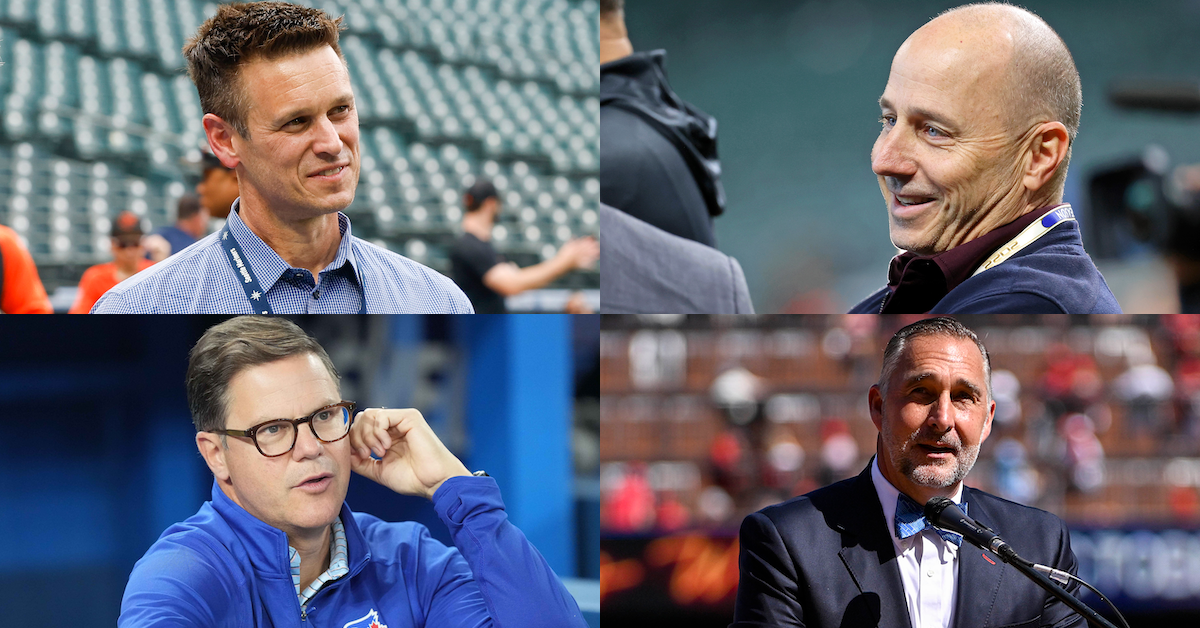
It is well known that analytics have changed the baseball landscape. Moreover, it is widely understood that the evolution is ongoing. Embracing innovation, especially within the technology realm, has increasingly become a must for teams looking to keep up with — and ideally get a step ahead of — the competition. For front offices across the game, it’s adapt or die.
What does that mean for the general managers and presidents of baseball operations who lead those front offices? In other words, how have the ever-continuing advancements impacted their jobs over the years? Wanting to find out, I asked four longtime executives for their perspectives.
———
On how analytics have impacted the job
John Mozeliak, St. Louis Cardinals
“When I first broke in, how you made decisions was basically based on scouting reports and traditional statistics. Now it’s much more analytically driven because of the advanced metrics. If you think about it, in the old days when people would invest in stocks… it’s the same kind of thinking now. The more information you have, the better your decisions are. That’s changed quite a bit over the last 25 years.
“Two things come to mind. One is understanding the longevity of a player. In other words, how long should you be investing in a player? The other thing is prospect evaluation; how much value someone might have, even though they’re still in the minor leagues. When you think back to 20-30 years ago, a lot of times minor league players didn’t have the same type of value that you’re seeing today.
“The economics of baseball have changed drastically. There is more revenue in the game, and higher payrolls, but there is also how you think about moving talent for talent. It’s much more based on economics than just pure ‘I think he’s a good baseball player.’”
Jerry Dipoto, Seattle Mariners
“Thinking back through all the years, including in my specific role now, there is so much more information to manage. When I first started in scouting, and then later in player development, I always stressed to everyone that in each of our independent roles, we are information managers.
“I would say it was right about the time that I was transitioning from Arizona to Anaheim [in 2011] that the volume seemingly tripled overnight. There was already a lot of information to use, but then we started getting into advanced analytics, some of the [biomechanical] information that is available to us today, and how you apply that to your decision-making. No decision is made without considering many different angles of what a player has to offer. I don’t think it’s ever going back the other way. It’s only going to continue to evolve in ways that most of us can’t even imagine.”
Ross Atkins, Toronto Blue Jays
“Cleveland certainly was, and still is, very much on the cutting edge of understanding and leaning into resources, so it had changed a great deal even before I got [to Toronto after the 2015 season]. But even now, it comes down to hiring the best people, identifying the best resources to identify and develop talent. Analytics have grown, but it still comes down to making sure you’re hiring the best people to lead that department. And not just build out research and development; it’s also interacting and engaging with our staff and players in a way that the tools can become more and more usable and deployable.”
Brian Cashman, New York Yankees
“First, it’s the talent pool from your hiring practices. The people who you surround yourself with have to be experts in certain categories of data interpretation, and they need to have the ability to utilize technology to help mine the data that exists. They also have to stay current. A) That’s expensive. B) You’re looking for a sophisticated crew of personnel that fits those qualities.”
———
On hiring the right people
Ross Atkins
“The hiring process has always been paramount. We’ve hired more analysts, more researchers, more developers, and you always have to hire the best tier. I think that’s everything in this job. We’re also hiring from a different demographic. Before, we weren’t hiring as many people who were in research and development. And you hire in different ways. You hire with your values, and with a strong process where you don’t take things for granted. As far as [the size of the department], I’ll just say that we’ve grown at a very fast rate since I’ve been here. I think that’s true of the industry as a whole.”
Brian Cashman
“We post those jobs. A lot of people want to work in baseball. A lot of people who are working in baseball are making less money than they could in a different field. Whether it would be Wall Street, tech, or what have you, they love sports — they love baseball — and they sacrifice to do that.
“Portions of baseball strategy, specific to development, have been rewritten because of analytics and [non-traditional hires]. Through that lens, people have questioned how things are done, and why things are done a certain way. It’s allowed us to find higher ground on how to develop players. Also to evaluate players — how to evaluate true performance on the field versus misinterpreting performance on the field. It’s provided a more efficient lens in our decision-making process.”
John Mozeliak
“Hiring is a big part of the job, and the types of people that are coming into this game have changed. Guys that could have maybe ended up on Wall Street are now getting jobs in baseball. From that standpoint, it’s definitely changed. You’re basically trying to strengthen your decision tree. With the resources, or the tools you have to make decisions, you want to have the right people in place. When we talk about analytics, it’s also about the ability to create a model that you have confidence in, one that you can trust.
“You’re always looking to try to make improvements. Speaking on behalf of the Cardinals, I think we were pretty cutting edge 20-some years ago with our first try at this. But over time… yeah, I think our confidence in how we make decisions has improved. We’re always tinkering, but you’re also digesting more and more information that could be put into your model.”
Jerry Dipoto
“We have people who can help us determine how to help a player improve in a certain area, or how to identify special traits about a player we might want to acquire. These are people who don’t really stay and watch the game; it’s just a special skill that they have. Whether it’s mathematically or biomechanically, they identify and from there effectively just pass it on to the next.
“A variety of different personalities, backgrounds, lines of thinking, leads you to better decisions. Sometimes it’s from the person who is not a baseball lifer, who doesn’t naturally think about it a way that a former player or field staff member would think. Often times, somewhere between that — what I would call complicated simplicity — and what your instinct would tell you on the field, you’re going to reach an intersection where it all marriages and you make good decisions.”
———
On the impact of analytics on scouting
Brian Cashman
“It’s allowed the scouts to utilize another lens of interpretation. Along with what they’re seeing on the field, they have confirmation [data] to run through. They can make sure that what they’re seeing is accurate. Our scouts are gifted with assessing a lot of the physical attributes, and from there applying a lot of the data, because they’re also trained in that world. They’ve been brought up to speed as the world has changed. There are data streams that they can run down to make their reporting more accurate.
“We have the largest scouting department in the industry. We value scouting significantly, and one of the mantras we live by is ‘evolve.’ Don’t be a dinosaur. You better keep up with the changes, or you’re going to wind up on the short end of things. We need to be open-minded and recognize that there might be better platforms of understanding, and of efficiency. We’re constantly in pursuit of that. If you’re not of that mindset, you’re probably not going to last long in any industry.”
Ross Atkins
“I feel that our scouting department has been impacted positively with the changes. It allows us to lean into makeup and target areas for development more efficiently, and with more focus.”
John Mozeliak
“Both departments [scouting and analytics] have seen a lot of growth. When you put it [in terms of] where you started versus where you are, obviously the analytics department has seen a greater percentage of growth. When we originally started, it was two or three people and now it’s around about 20. But scouting has grown, as well.”
Jerry Dipoto
“My role is to make sure that we are paying attention to all of the different elements that go into a decision, and then sitting down with a circle of decision-makers. And that circle may change depending on if it’s the major league team, if it’s happening in scouting and development, if it’s international.
“In international, we’re going out and trying to… this is ongoing, and I think it’s 30 teams. We’re trying to determine how to take some of the measurables that we now have access to — TrackMan, Statcast, etc. — and figure out how they evolve as players go from 12 to 14 to 16, ages we don’t really consider here in domestic amateur baseball. What is average for a 14-year-old? We’re baking this into our first level of evaluation as a player starts to approach signability as a 16-year-old.
“I can’t imagine that there was a single one of us sitting in one of these seats 20 years ago who was thinking about many of the things we’re working with today. We need to manage all of that, and you manage by trusting your people. You have to hire people who are good at what they do, and then you have to ensure that everybody has a group-minded approach to what comes next. There are answers that have helped us make really good decisions, and there are areas where we’ve made poor decisions because we weren’t informed enough.”
———
On the level of expertise needed in the job
Brian Cashman
“I’m an overseer, not an expert. I can’t [speak] with some data expert that has a degree from an amazing university. I just have a general awareness. But I hire well. I hire people that have that information, and I empower them to do their jobs in order to make us better. I’m more of a steward than an expert.”
Jerry Dipoto
“I would say that you can get by with very little [expertise in specific areas]. That’s why you see so many more large baseball operations. Twenty years ago, a baseball operations group might be 15 or 20 people, and then you had your scouting and your player development groups, so it was 70 people in total. Now it’s 250-300 employees in a baseball ops group, because you have unique skill sets that have come to the dance.
“In doing what we do, there are many ‘Go’ moments. You make a trade, or you make a pick, and I shouldn’t be involved in anything that leads up to that. All I can do in some of those areas is pollute the water with what I don’t know. I might wrongly affect the situation by suggesting that we go in a different direction when the facts are pointing us towards it. You have to let your people guide you. We’re all working together. The part I play isn’t the grand master of player evaluation and identification. It’s about hiring the right people and then trusting them to do what they do.
“I’m at the stage of my career where I think I’ve gained enough through the years that most of it makes sense to me. I’m also at the stage of my career where I understand the areas where I need to keep someone sitting directly to my left and to my right — people who just know this better than I do. Decisions aren’t made in a vacuum, or in a room with one person. That said, while I represent our collective thought, I understand that I’m standing in front of the group in a buck-stops-here position. If it doesn’t go well, I’m the one to blame. I think that’s fair.”
Ross Atkins
“Again, it’s about having the right people around you. For example, I don’t have an incredible depth of knowledge of hitting, but I understand a good process, and I can identify people with good values and good content. I’m also not an analyst or a developer.
“You ask yourself, ‘Is it endless? Can you potentially have enough?’ That would be the question. You’re always trying to find the next opportunity, not just follow trends. That takes a lot of time and energy.”
John Mozeliak
“I think a lot of [executives] don’t really like talk about this topic, because a lot of it is proprietary. But like anything, as new technology gets introduced, how you evaluate it, and how you use it, is ever changing. ‘What’s next?’ is always the big question. That’s what we all chase.”
David Laurila grew up in Michigan's Upper Peninsula and now writes about baseball from his home in Cambridge, Mass. He authored the Prospectus Q&A series at Baseball Prospectus from December 2006-May 2011 before being claimed off waivers by FanGraphs. He can be followed on Twitter @DavidLaurilaQA.
What a great piece. The thing that stood out to me, and gave me more than a small bit of “ick” is DiPoto’s line about applying TrackMan and StatCast data to model what’s “normal” for 14 year olds to project who to sign at 16.
I don’t have the chops to describe this as well as I want, but there’s a next-level step in commodifying and objectifying 12 and 14 year-old bodies for the profit of your multi-billion dollar organization that makes me wish these organizations were also hiring a few humanities and social sciences sorts to introduce them to things like post-colonial studies. But of course no team is going to unilaterally step back from figuring out how to standardize and monetize pre-teen bodies from the Dominican Republic.
Oh wow yah how tragic that theyre exploiting these “post-colonial” kids by offering them a pathway to a 100 million dollar dream. Scandalous! How dare they try to figure out which kids might become the best players! These ignorant executives should all take a step back and let themselves be indoctrinated by a bunch of Marxist professors so they can become edjumakated
Happy birthday to Karl Marx! born on cinco de mayo, 1818
Well, I can see that no one has indoctrinated you! Just a bold freethinker right here. A real nonconformist.
It must be exhausting to have one’s brain wired like this
lolwut
I agree; OTOH, credit to DiPoto for being the only one to say it out loud because I’d be shocked if 1-2 dozen other teams aren’t working out the same things, for both foreign and domestic adolescent “talent”
I mean, there’s a decent argument that if the choices are TrackMan or the creepy corrupt regional scouts from Pelotero, the techno-exploitation is ethically preferable for all involved. I’m not saying I like it, but I might hate it less.
The whole problem here is that they’re signing kids at SIXTEEN and reaching agreements with kids at FOURTEEN which means they are poking and prodding these kids before that when they are CHILDREN.
There is always going to be some ick factor when we’re talking about commodifying people’s bodies, and unless we’re talking about not signing athletes from the DR (which would be worse for them) I don’t think there is a way around the fact that these guys are coming from poor countries who have been exploited for a long time. But I just don’t feel good about this sort of stuff at such a young age.
And yes, I am aware that changing the age will deprive these guys of about 2 years where they had the bonus, and that any rationalization of this process carries the risk of ownership suppressing bonuses, but if you want to know why this seems creepy when doing the same to HS kids in the US doesn’t seem creepy, it is because of age.
I agree the MLB should push back the signing age, for sure. However, I’d prioritize on financial literacy class so they’re not exploited, along with nutrition and drivers ed courses.
How will “post-colonial” studies help?
If a team, or all the teams, did “unilaterally step back from figuring out how to standardize and monetize pre-teen bodies from the Dominican Republic,” what would that achieve? Would the world be a better place on net? How so? I would appreciate details please, because right now the comment just gestures vaguely and says to read some books. I would like to know what the books will prescribe and how those actions will improve the world. And I ask this as someone who thoroughly enjoyed my Latin American Studies class taught by a Marxist from a postcolonial perspective. The hot paper back then was “Can the Subaltern Speak?” which seems like a perspective missing from the comment, i.e., would the people of the D.R. *want* teams to stop commodifying their bodies? Thanks in advance.
“Don’t be a dinosaur” says GM hired by team when Reagan was in office
And to his credit, he hasn’t been a dinosaur. He’s old, but he’s adapted to what could have been extinction-level changes for him in his professional environment.
Would you like to know the last time the Yankees won a playoff series against another top 5 payroll team in MLB?
As a dino who is learning new tricks myself, I knew that for the cost of burning a few more pounds of carbon in electricity generation, I could ask AI to handle this task for me.
It told me… the 2018 team, which beat the Atlanta Braves in the American League Division Series, and now I am slightly less worried about AI achieving the singularity any time soon. (Reader, they lost the 2018 ALDS to the Red Sox) Changed the query slightly and… got the 2020 ALDS… Against the Dodgers. (Reader, they lost to the Rays…)
Regardless of AI’s limitations, I don’t think it could generate an answer that would change your view on Cashman, so I didn’t pursue it further.
The answer is the 1999 World Series against the Braves.
Stay gold, ponyboy…
It is not hard to craft a question that gets you the answer you want (“Who has more hits this week: me or Michael Conforto?). The better question is: has Brian Cashman consistently put the Yankees in position to win and perpetuated a sustainably successful org? And, probably, yes (certainly yes if you want to compare him to his peers over time). Can we nitpick his moves? Sure, but hey, Andrew Friedman traded Yordan Alvarez for Josh Fields with all his modern wizardry, and I don’t hear anyone calling him out of touch.
What a weird metric.
“GM hired…” = brought on as an intern 12 years before eventually becoming GM.
Why would that be a weird metric? Isn’t the whole argument for Cashman that yes, he’s given a top-tier payroll to work with but he maximizes the return on it? His team is repeatedly thrashed and outclassed by anyone with even comparable resources and has been for a quarter century, and it’s not like they’re immune to getting knocked out by a team with far inferior resources either. What can you possibly say that indicates he adds positive value as a GM? That 20+ other current GMs wouldn’t have as good a team or better if they had his spot? He’s currently squandering the career of the best hitter in the sport since Bonds btw.
They literally got to the World Series last year (and who knows, may have had a come back for the ages had the best hitter since Bonds not flubbed a catch).
He has a huge amount of financial resources, yes – but fewer compared to the Yankees decades ago. But in terms of drafting, they have mainly been drafting towards the end of the 1st round – if at all. The highest draft pick he’s had has been the 16th. In nearly 30 years! And I think he’d get fired if he ever put the team in position to get a top ten draft pick.
Even with the Yankees’ resources, not just any GM can spam winning records every single year for over a quarter of a century and make the playoffs almost every year over that same span.
Look at the Red Sox, who have had almost as many resources over the same time period. Yes, they’ve won the World Series more recently, but they’ve also had quite a few years when they have finished below .500 and/or even in last place.
Even if you don’t count the years when they had to cut payroll with the McCourt divorce and sale, even the Dodgers have had their down years before their current dynasty.
Given that the Yankees themselves are almost always (if not entirely always) in the Top 5, that leaves 4 other teams to possibly play a playoff series against in any given year. That just does not happen very often, even with the built-in advantage for the richer teams to make the playoffs.
Throw in the fact that the MLB playoffs lean heavily towards being crapshoots, and your question is practically meaningless.
I assume Chris Getz was not included because the White Sox don’t have email.
They couldn’t track down the singular analytics team member as he’s been away for the past three years in Switzerland. He should be back aaaaany day now.
Nah probably because nobody figured he’d still have an aol email.
I laughed hard enough to worry about waking my napping child; thank you
This isn’t related to this post; but what is the f*ck with the sexual/crude ads on this page now? I’ve come across two in a matter of minutes. Cmon guys.
You’ll need to send support@fangraphs.com a screenshot so we can attempt to track them down, as we don’t really have much control over ads, since all ads on FanGraphs are sold programmatically. Without at least a screenshot, it’s impossible to solve the issue.
Yeah I didn’t think of screenshotting them. My apologies.
What have you been searching for lately?
Listen, I’ve been an avid porn watcher since I can remember. This morning I had a very, VERY sexual fake text exchange as an ad. And then minutes later, an ad for a very NSFW site. I’m not angry or anything but I can only imagine others visiting this site at work or just in general, don’t care for that stuff.
lol
At least you owned it.
Have you considered an ad free subscription to Fangraphs?
i ad block anyway, but pay for the subscription here to support them because I read this website every day.
Great article. I hate DiPoto using “marriages” as a verb though. Jesus.
On the level of expertise needed in the job
Ross Atkins: “more than I have, David. More than I have.”
Can the Blue Jays hire someone who understands that it’s important to be good at offense as well as defense?
*NODS VEHEMENTLY*
I hate Cashman’s quote so much. Only the nepo babies get to work their dream jobs, because the rest of us aren’t taking the massive pay cut.
“The great thing about baseball is we can pay our analysts peanuts” is not a good look.
Having personally witnessed “do what you love” destroy academia and the arts, I’m always amazed to see it show up in another field. Do what you love and you’ll never work a day in your life… because you’ll be an unpaid intern working toward a vanity profession for people whose parents pay their rent.
FWIW: I grew up working class poor, made little money as a young adult, and eventually went on to leave a well-paying (but by no means lucrative) job to do what I’ve done for the past two decades. The pay cut was well worth it. With the caveat that rent, or mortgage, needs to be paid, doing what you love is ultimately more satisfying than wealth.
In this case, I’m not so sure. I think we’re talking about paying people who could be quants or software engineers who could make 300k+ a year salary, a decent middle-class wage ( I’m guessing a low 6 figure salary.) Which doesn’t mean you have to be a nepo baby.