
Filling Out My First Hall of Fame Ballot
Last year was my 10th year as a member of the Baseball Writers’ Association of America, so while I’ve voted regularly in the end-of-year awards — nine times out of 10, in fact — this was my first opportunity to cast a ballot for a Hall of Fame election. I’m a huge believer in transparency when it comes to the voting for awards; every time I cast a ballot, I discuss my underlying reasoning at length. Because there is a lot of leeway and wiggle room in the official Hall of Fame election rules, votes come down to the interpretation and philosophy of the individual voters. For that reason, I wanted to take some space to discuss the philosophical decisions I made to determine who ended up with checkmarks on my submitted ballot. This isn’t really an analysis of the individual candidates; for that, you should consult Jay Jaffe’s extensive series, where he goes deep into each player’s career and legacy.
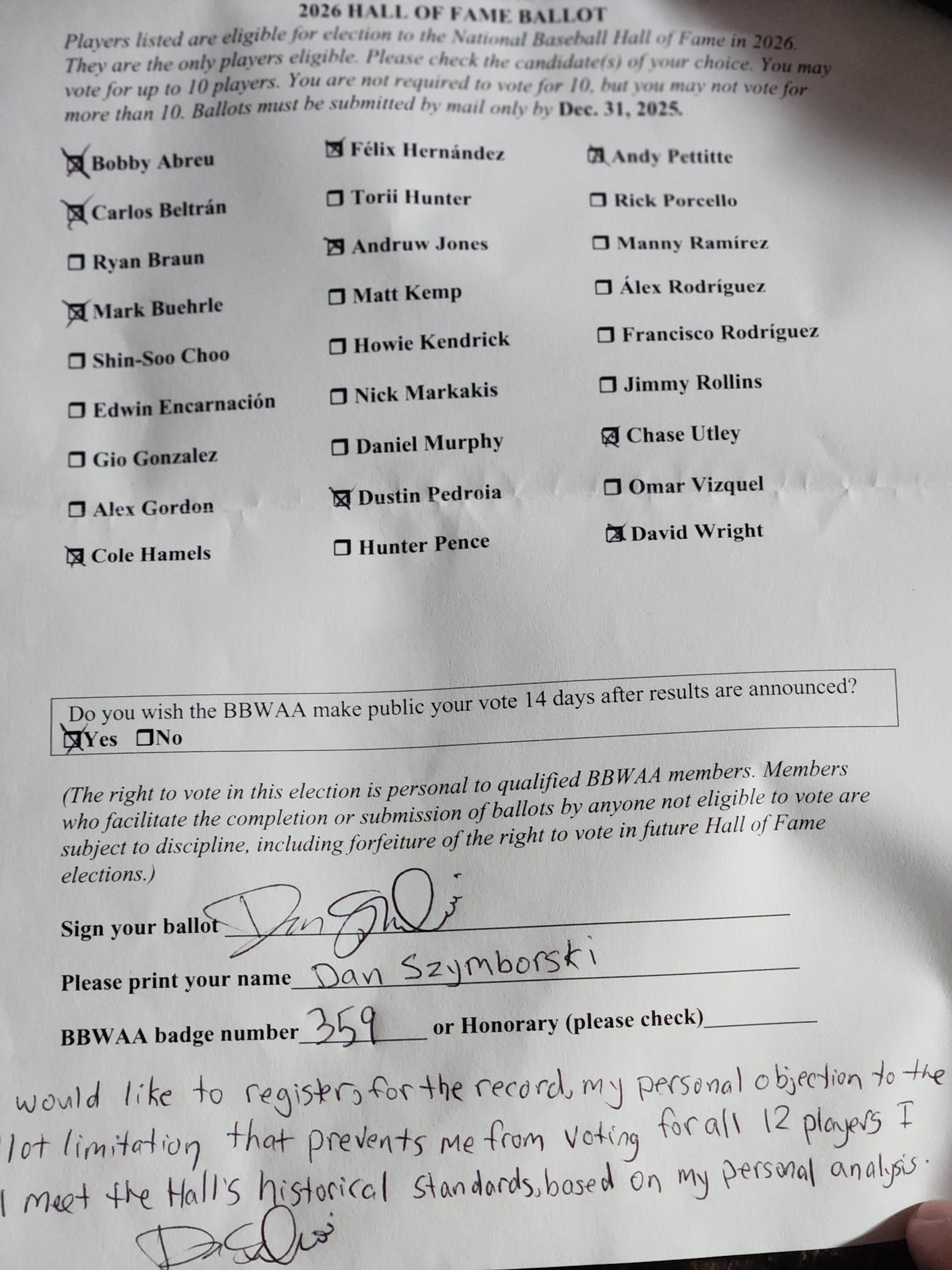
I’ve attached a picture of my ballot. Not the best one in the world since I cut off a few words of my obnoxious, meaningless “signing statement,” but since I sent my ballot off a month ago, there won’t be a better photo forthcoming! Unlike the year-end awards, which are conducted through Google forms, the Hall of Fame balloting process is old school. You physically open an envelope that contains a sheet of paper — made of these things called “trees” — and check boxes yourself before returning the whole thing through the good ol’ U.S. Mail. Thankfully, the whole exercise came with a pre-addressed, postage-paid envelope, as I don’t physically appear to be the owner of any envelopes or stamps. I will also note that I am aware that I have the penmanship of a seven-year-old. My handwriting has always been atrocious.
Anyway, you’ll notice that I voted for the maximum 10 players, and from the signing statement, you’ll see that I would have voted for 12 players if given the opportunity. In recent years, the BBWAA has issued proposals to the Hall of Fame to expand the number of players we’re allowed to vote for and to make all ballots public, but those requests have been turned down.
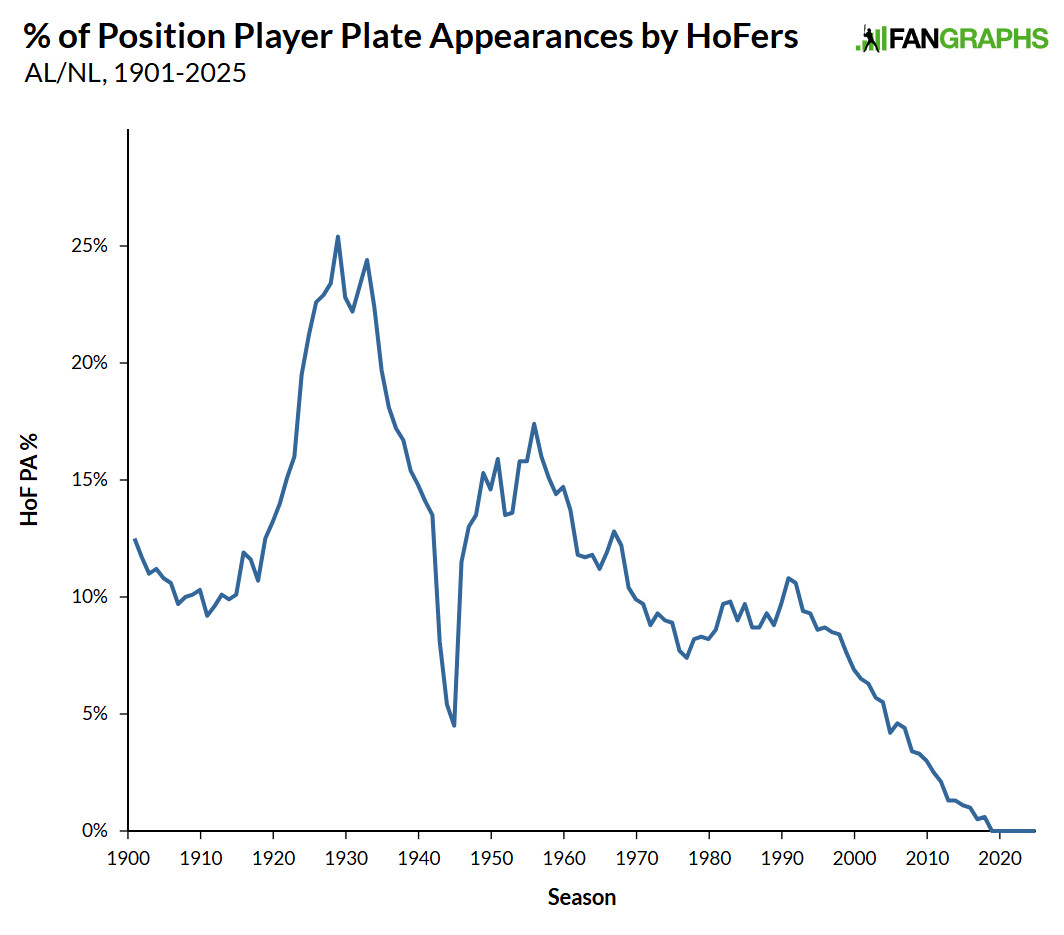
I’m not necessarily a Small Hall or Big Hall guy, but I do think it is important to keep the Hall consistent. What a Hall of Famer is is determined by who the Hall of Famers are. The obvious, inner circle players like Henry Aaron and Lefty Grove are a small minority of the Hall of Fame. What the Hall of Fame does have is a ton of guys like Ted Lyons and Waite Hoyt and Pee Wee Reese and Goose Goslin, those mid-range Hall of Famers who, if they were on today’s ballots, would be derided as Hall of Very Good Candidates by the extreme section of the Small Hall crowd. There’s this idea that modern inductees have watered down the Hall of Fame when, in fact, what the Hall is drowning in is endless inductees from baseball’s supposed Golden Age. Here’s my updated chart of the yearly percentage of position player plate appearances by future Hall of Famers:
Now, the final ruling hasn’t yet been handed down on those 1990s players, but just because the Veterans Committee exists to catch players who fall through the cracks doesn’t strike me as a good reason to let players fall through those cracks. I find the moral value of a great honor is diminished if the honoree has to wait an indefinite amount of time, or even worse, does not live long enough to receive it. It’s an absolute shame that Ron Santo and Dick Allen died without knowing that their careers would ultimately be recognized with baseball’s most prestigious honor. And with baseball’s increasingly illogically designed Eras Committees, it’s going to be harder to catch the BBWAA’s misses.
Even so, I don’t think that all of the players who are better than the worst Hall of Famers should be in the Hall. There are lots of pitchers better than Jack Morris and Rube Marquard who still would not get a Hall of Fame vote from me. If we voted in everyone better than Tommy McCarthy, who was essentially the 19th Century Juan Pierre, the Hall would have quite the influx of outfielders. But all 12 players I wanted to vote for in this election were players I felt were better than the bottom quartile of Hall of Fame inductees, meaning that if they were inducted, they would at least be part of the Hall’s large middle class.
One of the most convincing arguments Bill James ever made about the Hall of Fame came when he introduced the concepts of career value and peak value as different kinds of greatness. The Hall’s record of recognizing peak value is very spotty, and while Sandy Koufax, one of the best examples of peak value, was given his due, players like Johan Santana have frequently gotten the shaft. But when we talk about greatness, how good a player was at his best seems to be very important information. Miguel Cabrera would not have attained the 3,000-hit or 500-homer career milestones if he had retired after the 2016 season at age 33, but did anything that happened after 2016 really enhance his greatness on an abstract level? After 2016, he was mostly a DH who hit .262/.329/.381 and averaged nine home runs a year. Cabrera’s peak is what makes his career great, after all.
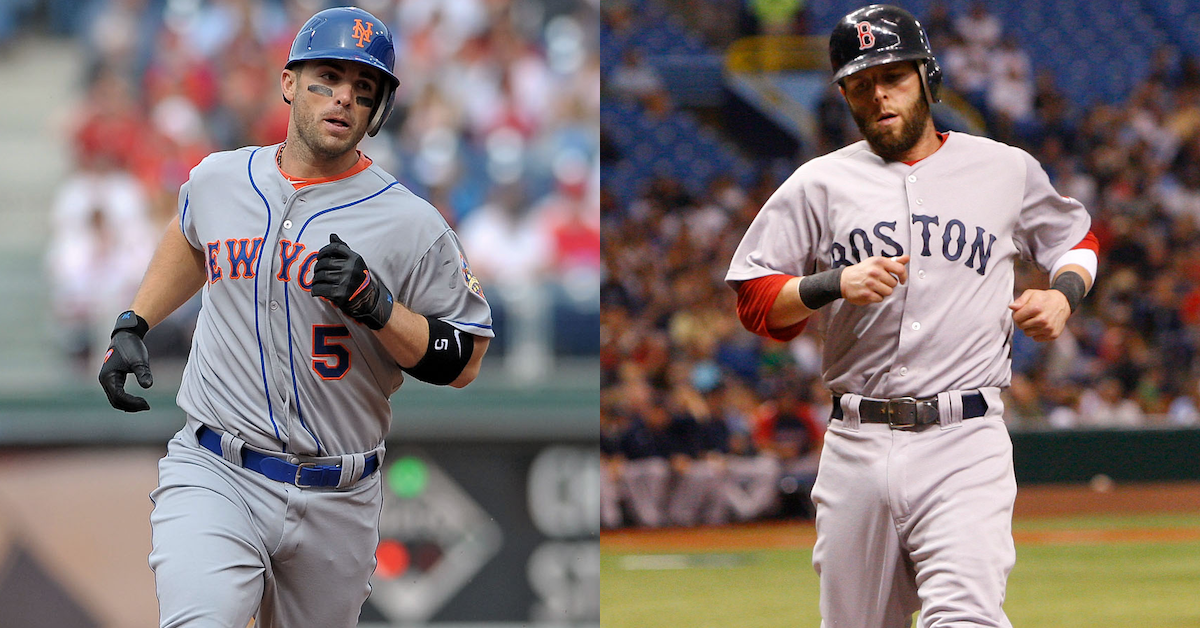
And that is why I checked the boxes for David Wright and Dustin Pedroia. Wright was healthy enough for about a decade to play full time, and over that period, he was perhaps the top third baseman in the majors.
| Name | PA | HR | AVG | OBP | SLG | wRC+ | WAR | WAR/600 PA |
|---|---|---|---|---|---|---|---|---|
| Miguel Cabrera | 6780 | 345 | .326 | .403 | .574 | 157 | 57.8 | 5.1 |
| David Wright | 6248 | 216 | .298 | .379 | .492 | 134 | 48.1 | 4.6 |
| Adrian Beltré | 6183 | 248 | .291 | .341 | .489 | 119 | 45.1 | 4.4 |
| Alex Rodriguez | 4959 | 273 | .291 | .387 | .538 | 144 | 43.5 | 5.3 |
| Evan Longoria | 4119 | 184 | .271 | .351 | .494 | 130 | 37.8 | 5.5 |
| Ryan Zimmerman | 5183 | 184 | .286 | .352 | .476 | 120 | 34.1 | 4.0 |
| Chipper Jones | 3980 | 158 | .303 | .402 | .517 | 142 | 32.0 | 4.8 |
| Aramis Ramirez | 5356 | 242 | .292 | .355 | .514 | 126 | 29.7 | 3.3 |
| José Bautista | 4880 | 246 | .259 | .369 | .498 | 133 | 29.2 | 3.6 |
| Kevin Youkilis | 4188 | 143 | .282 | .383 | .482 | 129 | 28.7 | 4.1 |
| Alex Gordon | 4396 | 121 | .268 | .345 | .435 | 111 | 26.0 | 3.5 |
| Placido Polanco | 4861 | 54 | .298 | .345 | .390 | 97 | 24.5 | 3.0 |
| Scott Rolen | 3396 | 90 | .274 | .344 | .447 | 108 | 22.0 | 3.9 |
| Chase Headley | 3944 | 93 | .265 | .347 | .409 | 114 | 21.8 | 3.3 |
| Pablo Sandoval | 3533 | 106 | .294 | .346 | .465 | 122 | 20.3 | 3.5 |
| Edwin Encarnación | 4885 | 229 | .265 | .349 | .487 | 122 | 19.7 | 2.4 |
| Michael Young | 6096 | 129 | .305 | .353 | .444 | 109 | 18.9 | 1.9 |
| Casey Blake | 3677 | 120 | .264 | .338 | .442 | 108 | 17.3 | 2.8 |
| Juan Uribe | 4262 | 131 | .253 | .299 | .415 | 89 | 17.1 | 2.4 |
| Chone Figgins | 4440 | 30 | .272 | .350 | .355 | 94 | 17.0 | 2.3 |
Cabrera has the edge in WAR, and he had a better postseason record, but he also wasn’t a full-time a third baseman during this period. (He’s second among first basemen in the same years). It’s worth mentioning that Wright received more playing time during his 10-year peak than a lot of the competition, but he also had one of the highest WAR rates over that decade. He’s not the undisputed best third baseman during that span, but he certainly has a strong case for that title. That peak is enough for me. The case for Pedroia is similar.
| Name | PA | HR | AVG | OBP | SLG | wRC+ | WAR |
|---|---|---|---|---|---|---|---|
| Robinson Canó | 6786 | 249 | .305 | .357 | .499 | 129 | 48.0 |
| Dustin Pedroia | 6182 | 131 | .303 | .368 | .447 | 118 | 45.0 |
| Chase Utley | 5517 | 175 | .275 | .361 | .460 | 120 | 44.7 |
| Ian Kinsler | 6397 | 198 | .276 | .344 | .450 | 112 | 42.0 |
| Ben Zobrist | 5446 | 143 | .268 | .362 | .437 | 122 | 40.4 |
| Brandon Phillips | 6312 | 174 | .280 | .325 | .429 | 99 | 28.8 |
| Howie Kendrick | 5174 | 91 | .289 | .333 | .417 | 107 | 25.9 |
| Matt Carpenter | 3016 | 74 | .284 | .376 | .462 | 133 | 21.3 |
| Jose Altuve | 3649 | 60 | .311 | .354 | .437 | 118 | 19.5 |
| Dan Uggla | 4826 | 208 | .236 | .335 | .442 | 109 | 19.0 |
| Jason Kipnis | 3364 | 76 | .272 | .345 | .423 | 111 | 18.5 |
| Daniel Murphy | 4201 | 87 | .296 | .339 | .447 | 115 | 18.3 |
| Placido Polanco | 3815 | 41 | .294 | .342 | .385 | 95 | 18.2 |
| Rickie Weeks Jr. | 4159 | 138 | .245 | .344 | .427 | 109 | 17.8 |
| Neil Walker | 3884 | 116 | .273 | .339 | .436 | 115 | 17.8 |
| Aaron Hill | 5124 | 152 | .264 | .319 | .426 | 98 | 17.1 |
| Marco Scutaro | 4034 | 53 | .284 | .350 | .387 | 100 | 17.1 |
| Kelly Johnson | 4805 | 146 | .252 | .329 | .423 | 102 | 16.8 |
| Brian Dozier | 3065 | 117 | .246 | .320 | .442 | 107 | 16.7 |
| Mark Ellis | 3716 | 66 | .259 | .320 | .373 | 89 | 15.8 |
Neither Wright or Pedroia is a slam-dunk candidate, but each is just over my foggy line.
I’m probably not going to get out of here without discussing how I consider performance-enhancing drug use or general rulebreaking/bending. Even more so than performance, there’s a lot of room for philosophical differences here, so let me emphasize that even though I personally feel that my stance is the best one — after all, why would I not go with what I think is best? — I certainly can’t objectively claim that it’s the right one. Let’s start with the text of the Hall’s so-called character clause, which is actually only just one sliver of a sentence:
Voting shall be based upon the player’s record, playing ability, integrity, sportsmanship, character and contributions to the team(s) on which the player played.
Based on my knowledge of baseball and the Hall of Fame’s history, both in practice and when the rules were being discussed, I function under the belief that we’re talking sportsmanship and character related to their baseball-related life, not so much as a person on a wider level. The rules of the game are pretty important, and so I consider breaking baseball’s rules to be a demerit on a player’s permanent record. In this case, I believe PED rulebreaking to be something I am dutybound to consider after the summer of 2004, when steroid testing was first implemented. I don’t have the same feeling about pre-2004 PED use. Some people cite former commissioner Fay Vincent’s early 1990s memo about steroids as a reason not to vote for PED users in the pre-testing era, but as Vincent himself noted in an interview with Bernie Miklasz, he issued the memo only to make a statement. He pointed out that he didn’t have the power to implement any such rules against PED use without MLBPA approval.
“I sent it out because I believed it was important to take the position that steroids were dangerous, as were other illegal drugs,” Vincent said. “As you know, the union would not bargain with us, would not discuss, would not agree to any form of a coherent drug plan. So my memo really applied to all the people who were not players.”
In other words, Fay Vincent banned Pat Gillick and Dan Duquette from using steroids.
So I consider Barry Bonds’ testing positive for amphetamines in 2006 as a black mark on his résumé, as I do with Alex Rodriguez and Manny Ramirez for failing PED tests. But I also view each black mark as merely a factor to be weighed in a Hall of Fame case, not as a binary “they cheated, so they’re out” scenario. In my eyes, Bonds, A-Rod, and Manny are all worthy Hall of Famers, and a little bit of dirt in their story doesn’t tarnish the tale.
On the other hand, I would not have voted for Pedroia or Wright if they had been found to have broken those rules. I did not vote for Ryan Braun, because I think his performance was on the wrong side of the dividing line, but even if he had a slightly longer peak, I still would not have checked his box because of his situation. I don’t really care about the efficacy of the cheating when it comes to a player’s Hall of Fame case; it makes no difference to me if Carlos Beltrán and the other members of the 2017 Astros actually benefited from their electronic sign-stealing operation. Rather, what matters is that banging on a trash can to relay signs that were stolen in real time via a video camera is a blatant form of cheating. Yet, once again, when considering the totality of Beltrán’s career, he easily belongs in the Hall of Fame, even with the banging-scheme demerit.
Now, I wanted to vote for 12 players, but I could only vote for 10. So, I asked myself: What is the purpose of the checkmarks on a Hall of Fame ballot? I view it as getting deserving players into the Hall of Fame. There are three ways that a single voter can impact a player’s chances of making it to Cooperstown: 1) if a vote helps a player reach the 75% threshold required for induction, 2) if a vote allows a player to exceed the 5% mark necessary to remain eligible for future BBWAA elections, and 3) if a vote adds to the percentage of ballots cast in favor of a player from the previous year, thereby building that player’s momentum of support. The last one is kind of weird, but it does seem to be the case that a number of voters wait for the bandwagon to be rolling behind a player before they get on for the ride, so I have to take that into consideration, too.
Ultimately, my final decision came down to the following question: Which two votes of my desired 12 would be the least impactful at getting a deserving player in the Hall of Fame? I concluded those to be for Manny Ramirez and Alex Rodriguez. There was no chance that my vote would get either of them over 75%, keep them over 5%, or build enough momentum for them to eventually get elected. Most baseball writers have already made up their minds about how they will vote for players who used or likely used PEDs, and there aren’t enough new voters in any given year to make a difference. A-Rod and Manny are not Hall of Famers right now because they used steroids, not because writers are unsure about their baseball merit.
So, that’s my ballot, right or wrong. It’s OK to disagree with me — this would be a boring job if everyone agreed with me — but as I said at the top, I feel it’s my responsibility to you, the readers, to explain why I vote the way I do.
Dan Szymborski is a senior writer for FanGraphs and the developer of the ZiPS projection system. He was a writer for ESPN.com from 2010-2018, a regular guest on a number of radio shows and podcasts, and a voting BBWAA member. He also maintains a terrible Twitter account at @DSzymborski.
Well reasoned. Congrats, Dan!