
Giants Commit Three Years to Tommy La Stella
It would be inaccurate to say the Giants have been big spenders on the market this winter, but it also wouldn’t be right to say they’ve done nothing. Coming into this week, they had added six players on major league contracts, improving their rotation, bullpen, catching and infield depth with nothing other than cold hard cash. What all of those players had in common, though, is that they all were willing to agree to cheap one-year deals. San Francisco has been willing to fill holes and add talent, but only in low-risk situations.
Consider Tuesday’s news, then, somewhat of a reprieve from that strategy. The Giants signed infielder Tommy La Stella to a three-year contract, a few days before his 32nd birthday. Though we don’t know the exact dollar figure yet, it’s the first three-year deal the team has given since Tony Watson’s before the 2018 season, and it will likely be the most money the team has committed to a free agent since Mark Melancon heading into 2017. The risk involved with this deal, however, isn’t anything to sweat over, even if La Stella was basically a career pinch-hitter until just two years ago.
To call La Stella a unique player in 2021 would be an understatement. He’s coming off a season in which he struck out in just 5.3% of plate appearances, with a walk rate more than double that. It was his second-straight season with a strikeout rate under 10%. Even more impressively, La Stella’s transition into a truly elite resistance to whiffs has also included him hitting for more power than he ever has. Doing both of those things at once is something few hitters can accomplish.
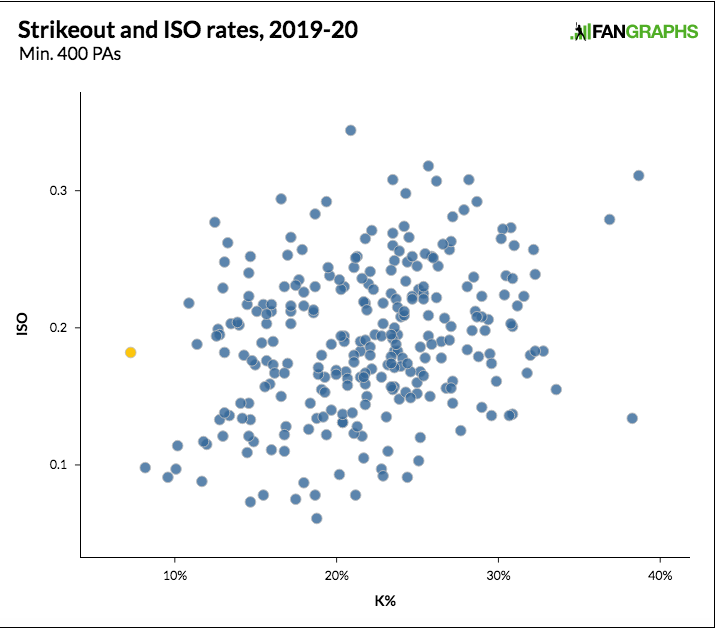
La Stella, highlighted in yellow above, has the lowest strikeout rate in baseball over the last two seasons. His closest competition for that title tends to be slap hitters, with the overall trend of this plot flowing from the bottom left to the top right. La Stella bucks that. He isn’t an elite power hitter by any means, nor will he ever be. But he does manage to get the most out of every swing while still tailoring that swing to miss as infrequently as possible, and while maintaining enough selectivity at the plate to earn a good number of walks.
Those skills have made La Stella an interesting breakout story in recent seasons, but not because he’d previously been a bad player. From 2014 through ’18 with the Braves and Cubs, he logged nearly a thousand big league plate appearances and was just a touch below average with the stick, with a wRC+ of 96. On many teams, he would have had plenty of opportunities to secure a starting job. Chicago, though, had too many other talented hitters who were given greater priority. As a result, La Stella was mostly used as a pinch-hitter and a late-game platoon-breaker against right-handed pitching. In four seasons on the North Side, he played in 303 games but totaled just 587 plate appearances; of those, a whopping 89% came against right-handers.
Then after the 2018 season, La Stella was traded to the Angels, who finally gave him a chance not just to play most days, but also start and log three or four plate appearances a game. He didn’t waste the opportunity, hitting .295/.346/.486 (120 wRC+) in 80 games and 321 plate appearances — a total that would have been much higher had he not fractured his leg in early July and lost nearly three months of the season. His line improved even more in 2020, to .281/.370/.449 (129 wRC+) split between the Angels and A’s. That was his first “full” season as a starter, but that still only amounted to 228 plate appearances. La Stella’s career high in plate appearances for a season is just 360, from his rookie year in Atlanta back in 2014. If there is another free-agent position player in history who landed a three-year deal without ever recording 400 plate appearances in a big league season, I’d love to know who.
Though his time with the Cubs was spent as a role player, La Stella was already showing the traits we now know him for: good contact skills, a decent walk rate, and very few strikeouts. It was fair to wonder, though, how much of his success was because he rarely hit without a platoon advantage. Since then, we’ve gotten an answer, as his move to a starting role in Los Angeles and Oakland meant facing more lefties than ever before. With a larger sample in place, here are his platoon splits from the last two years:
| Hand | PA | AVG | OBP | SLG | BB% | K% | ISO |
|---|---|---|---|---|---|---|---|
| R | 400 | .305 | .368 | .517 | 9.0% | 7.3% | .212 |
| L | 149 | .246 | .309 | .351 | 7.4% | 7.4% | .105 |
There’s a clear disadvantage present when La Stella faces lefties, but it isn’t disastrous. His power hasn’t really shown up against southpaws, and even though he hits more line drives against them, his BABIP, typically quite strong against righties, also lags. Across the board, La Stella just doesn’t hit the ball nearly as hard without a platoon advantage. His plate discipline, however, is consistent enough against both to mitigate the damage. Even a significant drop in contact quality won’t make him unplayable against lefties as long as he’s walking against them about as often as he strikes out.
Fortunately, one of the reasons the Giants are a good fit for La Stella is that they shouldn’t need to play him against lefties any more than they want to. The team’s entrenched starters at second base and third base — La Stella’s primary spots — are Donovan Solano and Evan Longoria, two right-handed hitters. Solano’s batting average-led surge in the last couple years has made him a breakout success in San Francisco, and Longoria still provides value as a good defender with an average bat. If La Stella is keeping his head above water against southpaws, the Giants can play him as much as they want in rotation with the other two. If he isn’t, then there isn’t any pressure to force him into the lineup.
Other aspects of playing in San Francisco are less beneficial to La Stella. His modest power uptick in recent seasons was a little specious, given the lack of movement in his below-average exit velocity readings, and his new home isn’t going to do him any favors. According to Statcast’s Expected Home Runs by Park metric, just 11 of the 22 homers La Stella has hit over the last two seasons would have left Oracle Park; only Kauffman Stadium would have hurt him more. If he’s going to maintain some of his recent power output, it’s likely he’ll need to take a bit of the lift out of his swing and set his sights on the outfield gaps.
The Giants aren’t in an enviable position right now. They have the financial means to acquire talent, but they haven’t had a winning season since 2016, and they share a division with two juggernauts who are going to be a nightmare to contend with for at least a few years. Signing the likes of George Springer and J.T. Realmuto wouldn’t make nearly enough of a difference there. It’s nice, though, to see San Francisco not use the Dodgers and Padres as an excuse to sit on the sidelines. The Giants have filled a few holes with honest-to-God big leaguers, and now they’ve signed a good player to fill a couple positions they might have been able to get away with ignoring. He’s even someone fans can get used to seeing for more than just one year.
Tony is a contributor for FanGraphs. He began writing for Red Reporter in 2016, and has also covered prep sports for the Times West Virginian and college sports for Ohio University's The Post. He can be found on Twitter at @_TonyWolfe_.
Former Braves great.
I absolutely love what the Giants are doing, gearing up for the spectacular FA classes coming up while adding pieces that could make them a fringe Wild Card contender in 2021. You add to that the massive improvement of the farm system and things are really looking up.
Looking up in some ways, down in others. They’re also really old. Their key new contributors in the last couple years aren’t kids. They’re late bloomers like Little Yaz, Donovan Solano, Alex Dickerson, and now La Stella. And of course their core (Posey, Belt, Crawford, Cueto, Longoria) is barely hanging on to the end of their primes (and past it in most cases). Kudos to them for finding those diamonds in the rough, but by the time that farm system comes of age, none of those guys will be playing on an elite level, if playing at all.
“If playing at all”
You make it sound like the core isn’t going to be around until 2025.
I think the hope is they trade these guys for players who will re-inforce the current youth in 2025.
TLS continues his barn storming tour of California! Hopefully they can trade him to Padres or Dodgers to complete the set.
As a Giants fan, my favorite part of this signing is how well La Stella and Flores fit each other. They’re both these lumbering second basemen who should maybe be playing first base or DH, but who swing a surprisingly sweet bat — and Flores is a righty with big platoon splits, while La Stella is a lefty. With both of them on the roster this year, the Giants are going to be able to mix and match really situationally if they want to.
It does actually make me curious, though. Does anyone know how Steamer and ZiPS handle players who are in a platoon? It looks like recently both Flores and La Stella have been too full-time for this to matter, but one could imagine a platoon lefty whose rate statistics looked gaudy because he never faced left-handed pitchers then receiving an over-optimistic counting stat projections if he started to receive regular playing time.
Giants didn’t do 1 yr deals by design. The pitchers insisted on them.
He’s a 1-2 WAR talent. He will hopefully sustain their play, but I’m at loss to see him as building block for improvement, particularly at 32.
La Stella could make an attractive trade chip at the deadline to a contender. With his approach he is a perfect extra bat/utility guy on a playoff roster. Three years, OK, but you trade contracts not players.