
Here Are Some Fun New Pitches From the Early Spring
When pitchers and catchers report, joy abounds. Who doesn’t love grainy cellphone video of a pitcher mounting the slab in the early days of February? But as far as I’m concerned, baseball doesn’t truly start until the first pitch plot surfaces on social media. Not much in spring training matters, but pitch data does. One or two pitches is all it takes to establish the birth of a new pitch or velocity peak. Results — ERA, strikeouts — take a while to stabilize, and in any case, they mean little in the “just trying things out” context of spring ball. But the pitch data — that’s real, man. Nobody throws a new pitch on accident. (For the most part.)
And so, like the well-adjusted baseblogger I am, I’ve spent the first week of spring games knee-deep in the data. Would you believe that as of the final day of February, there have been precisely 4,500 unique pitcher/pitch type combinations? That’s a lot of potential trends to suss out. You, reader, surely don’t want to wade through all of that, so let me present you with a handful of things that have caught my attention in the pitch plot portion of spring training. They fall into three categories: under-the-radar prospects with at least one bonkers pitch, established starters soft-launching new shapes, and relievers with limited big league time popping like potential leverage guys.
Under-the-Radar Prospects
Ryan Lambert, Mets
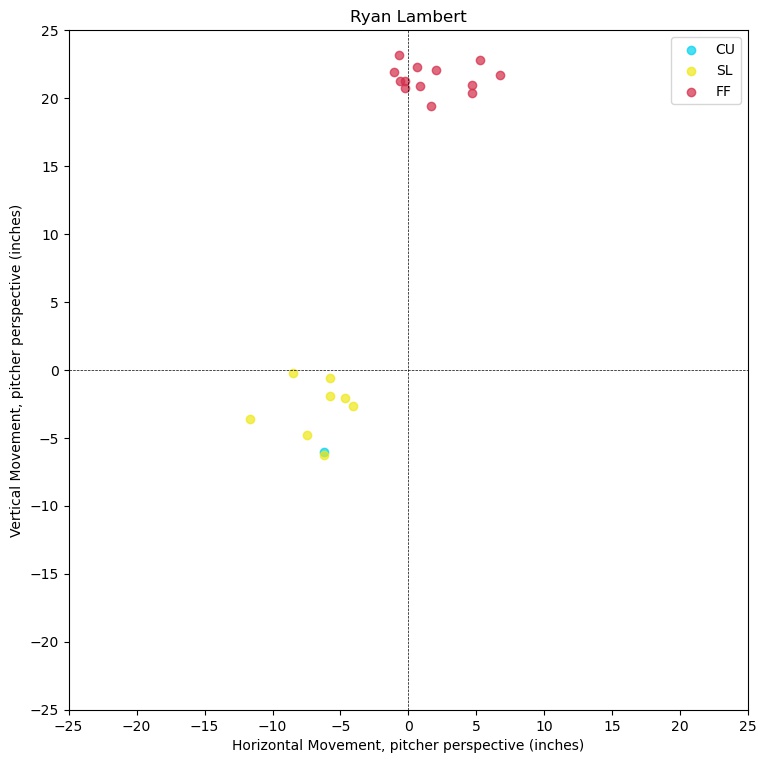
Okay, this one was slightly more under the radar before Lambert went viral for his “30 raw eggs a day” shenanigans. From that story, you surely learned that he throws a fastball with considerable velocity. But what Anthony DiComo’s excellent report elided was the shape of that fastball. In his lone spring outing, Lambert showed off a 98-mph heater with 21.5 inches of induced vertical break. Outside of Lambert’s arm, that pitch doesn’t exist. Only three pitchers topped even 20 inches of induced vertical break on their heater in 2025 — Alex Vesia, Triston McKenzie, and Yaramil Hiraldo (more on Hiraldo later) — and none of them broke 95 on the radar gun.
The closest comp to Lambert’s fastball is probably Jeremiah Estrada’s 70-grade heater, which averaged 97.9 mph and 19.6 inches of IVB in 2025. Maybe Lambert was just jacked up on eggs, and the stuff will dip a little as he settles into full season ball. But provided he sorts out his persistent control issues, I’m still betting on that fastball carrying him to a role in the Mets bullpen sooner rather than later.
Ryan Birchard, Brewers
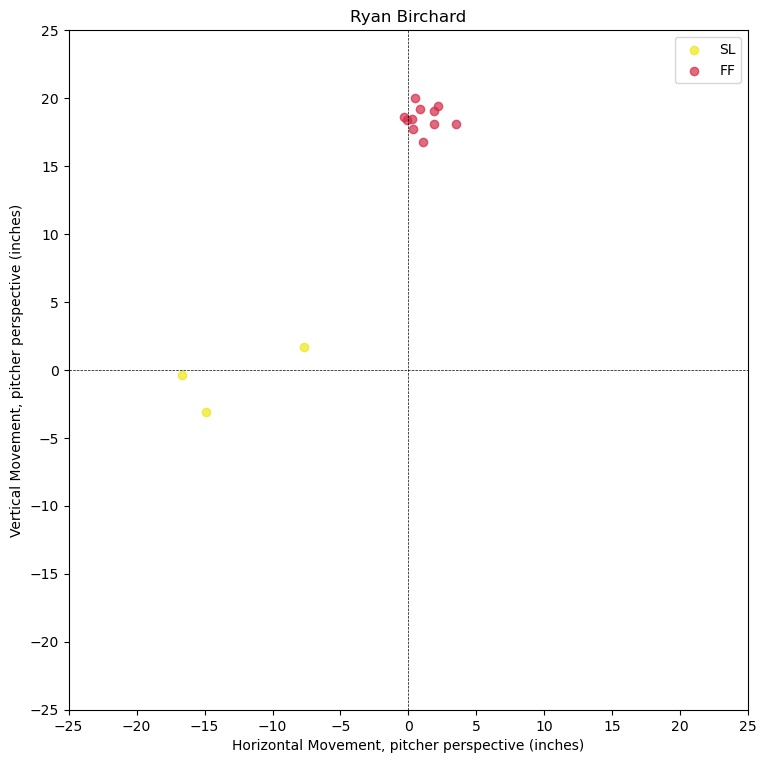
Birchard’s fastball plays like a slightly less deranged version of Lambert’s — 97 mph, 18.5 inches of IVB — but I found the pitch noteworthy due to Birchard’s humble prospect status. This offseason, he landed on our Brewers prospect list as a 35+ FV, with Eric Longenhagen and Brendan Gawlowski noting the tendency for his heater to miss bats despite his middling velocity. If his one spring outing is any indication, he seems to have erased the “middling velocity” concern: The 11 four-seam fastballs he threw averaged 97 mph; as of last season, he was apparently hovering around 91-95. He’s got the same control concerns as Lambert, but the velocity bump would expand his ceiling from middle relief to potential end-of-the-bullpen stuff — assuming he can sustain it.
Riley Cornelio, Nationals
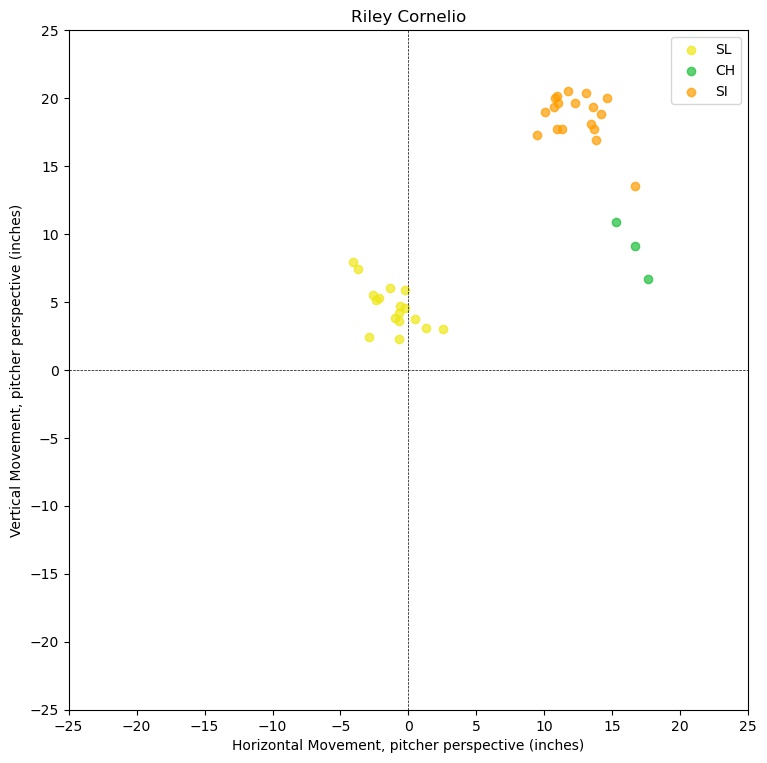
In his 35.1 innings of work at Triple-A Rochester last season, Cornelio’s sinker averaged 94.6 mph with 15 inches of carry and 14 inches of horizontal break from a roughly average release point. In other words, it was a dead-zone stinker. He showed off a completely different offering in his first spring appearance; the pitch jumped nearly two ticks and somehow gained an additional four inches of ride. It’s possible there were environmental factors at play here, and as with any single spring training appearance, there could have been slight calibration issues with the Hawkeye cameras. Things were a little less dramatic in his second go-around, with the pitch up just a tick and having only gained two inches of ride. Even in that diminished form, however, Cornelio’s two-plane carry sinker would be a real outlier.
Nate Garkow, Blue Jays
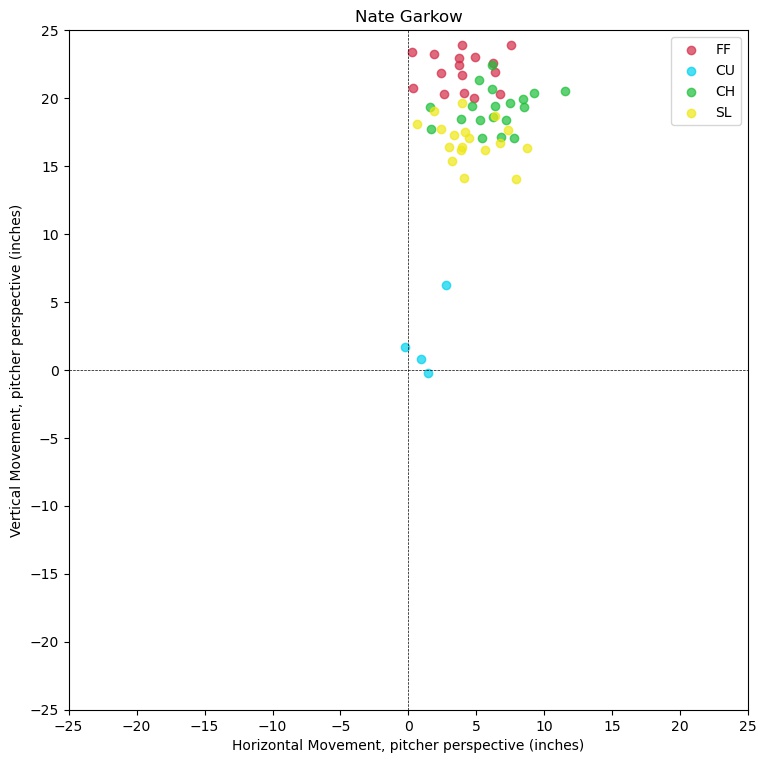
Okay, let’s get into some really weird guys. Check out the changeups on the plot. (The sliders in yellow are also changeups, they’re just mislabeled.) Yes, that is a changeup averaging nearly 20 inches of carry. Garkow landed in the Jays system after three years of independent ball, with his impressive results at Double-A in 2025 (38.6% strikeout rate, 1.22 ERA) earning him a spring training invite. Garkow presents as much promise as one could possibly hope for from a 28-year-old with a fastball that averages 87.8 mph. The changeup is a true freak pitch, though in his recent spring outing against the Yankees, he perhaps got a little too changeup-happy; he’ll need to balance all those dead ducks with a mix of “heat.” I’d love to see him get a shot in Toronto.
Tristan Garnett, Phillies
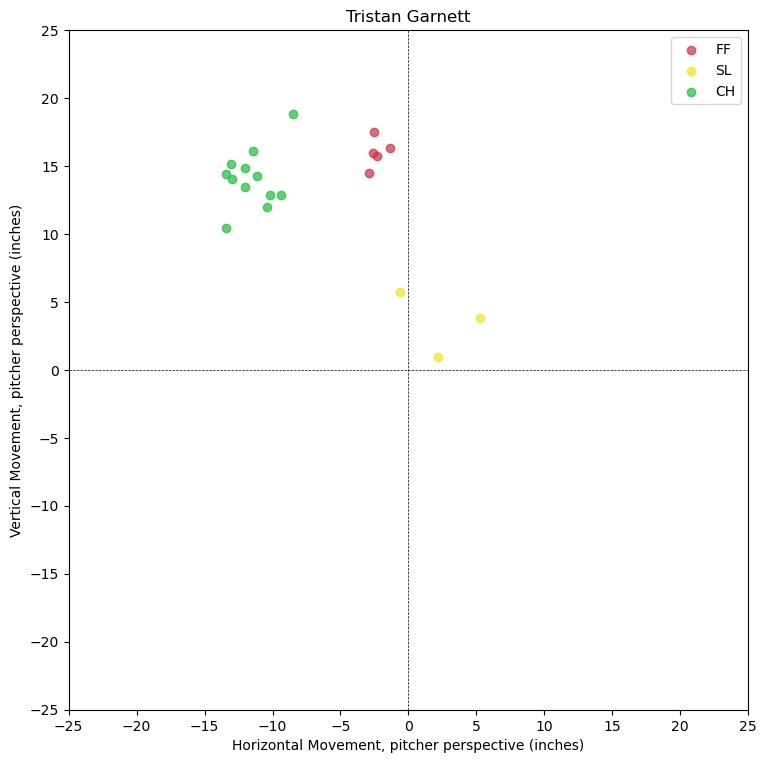
Garnett, who went undrafted in 2021, landed on our most recent Phillies prospect list accompanied by the delightful description of “human trebuchet.” He’s 6-foot-6, throws from way over the top, and barely extends down the mound, giving him what would be the highest release point in the majors (by a good margin) at 7.4 feet. (Justin Verlander is down at 7.1 feet, the next-closest comparison.) From that wild release point, Garnett drops in what Eric calls a “screwball-style” changeup, which was the key to his gaudy whiff rates in Double-A last season. His spring outings have been mixed so far, and I doubt a guy sitting 90 has a legit shot to become a bullpen piece. That said, he’s a lefty, and as far as I’m aware, there’s only one human trebuchet.
New Shapes for Old(er) Pitchers
Logan Gilbert, Mariners: Cutter and splinker/one-seam sinker
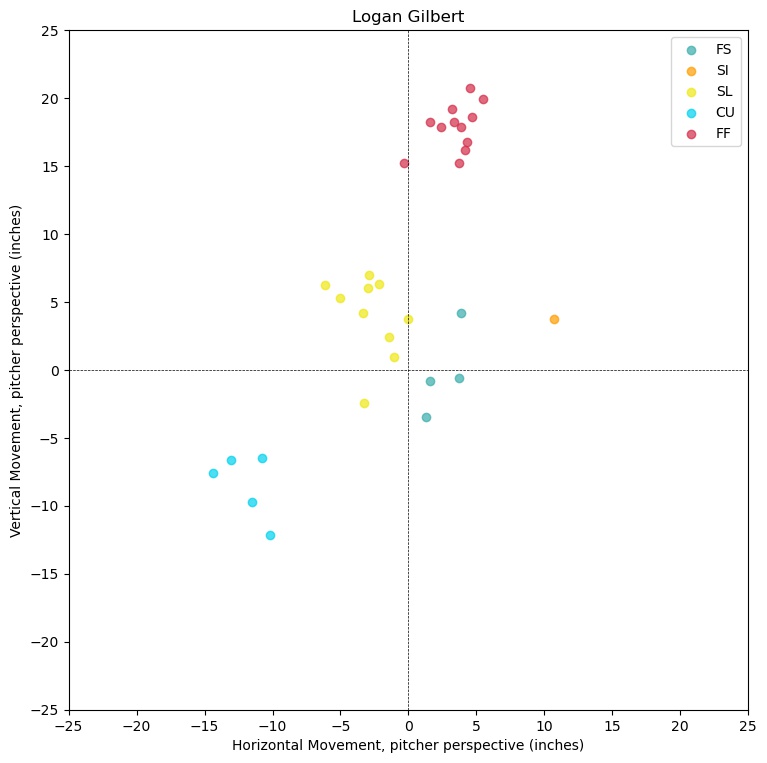
Gilbert has thrown a cutter before, but he ditched it in 2025; he’s also thrown a bullet slider since the 2023 campaign. In his first spring start, he showed some sort of hybrid slider/cutter, throwing it with less velo but more drop. Sadly, it appears that may have been some kind of calibration issue; in his second start, he was back to throwing his regular cutter from 2024. We’ll count it as the return of an old pitch, one that will perhaps help him navigate lineups with a bit more efficiency.
The new splinker, however, is real, and it’s spectacular. Gilbert threw one in his first start and two in his second, and the pitch averaged 93 mph with crazy depth. He has yet to comment on the pitch publicly, at least as far as I’ve seen. I’ll be sad if it’s just something he’s messing around with.
Randy Vásquez, Padres: Cutter
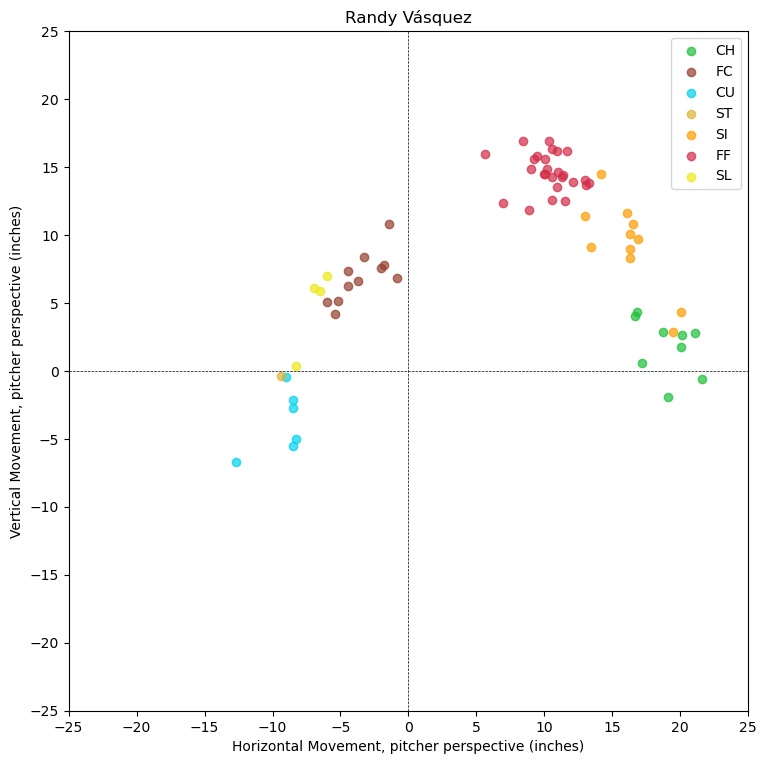
Vásquez did not have a good 2025. Still, he managed a 3.84 ERA over 133.2 innings in spite some of the worst peripherals you’ll see in modern baseball. If spring training is any indication, he’s intent on proving that that ERA was no fluke — or at least, he wants to show that he can achieve that ERA through more legitimate means. Not only is his fastball velocity up two-plus ticks, he’s reworked his primary pitch, the cutter. He’s merged it with his little-used slider, getting to cutterish velocity with more drop and horizontal break than the previous version. It’s all short stints so far, and so the stuff is playing up more than it normally would. But this is a version of Vásquez that the Padres can start to believe in.
Sandy Alcantara, Marlins: Sweeper
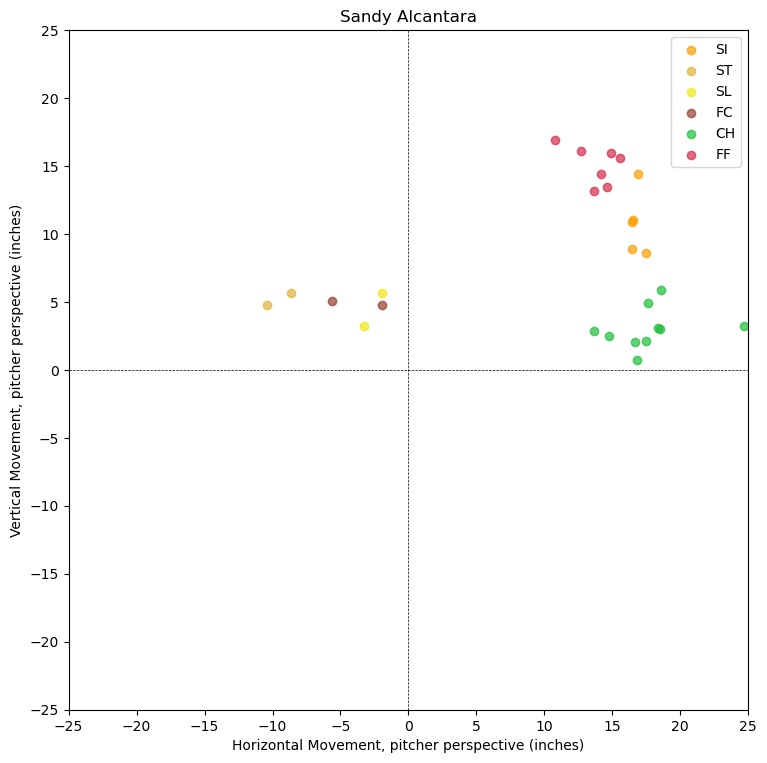
There’s been a bit of buzz about Alcantara’s newest offering. Though it performed quite poorly in his spring debut, the results are less important than the metrics. So how do the specs look? Sadly, not great. The new offering averaged just five inches of horizontal break, which is not particularly sweepy as these pitches go. It expands his pitch plot westward, always a worthwhile goal, but it feels more like a spring dalliance than a mainstay in Alcantara’s regular season arsenal.
Ryan Helsley, Orioles: Splitter
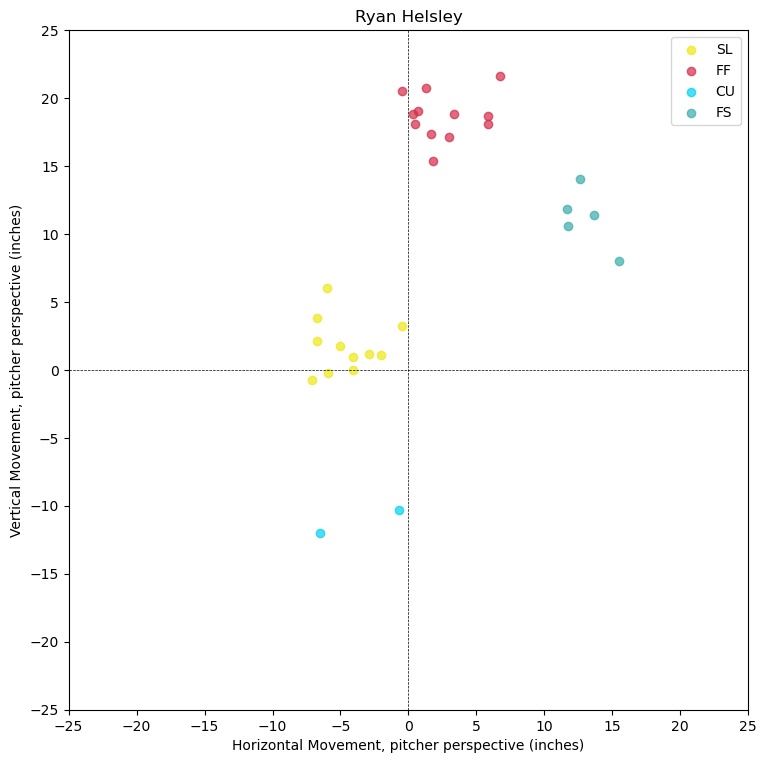
The two-pitch man is taking a third pitch out for a spin in the Grapefruit League. Metrically, it isn’t anything mind blowing; from Helsley’s high slot, it would be tough to get a ton of depth on any offspeed offering. But at 11 inches of induced vertical break, Helsley’s new splitter is dropping a respectable amount relative to his high-carry heater, giving him a whiff option against lefties and a wrinkle to shake up the predictability of his current approach.
Chase Burns, Reds: Kick change
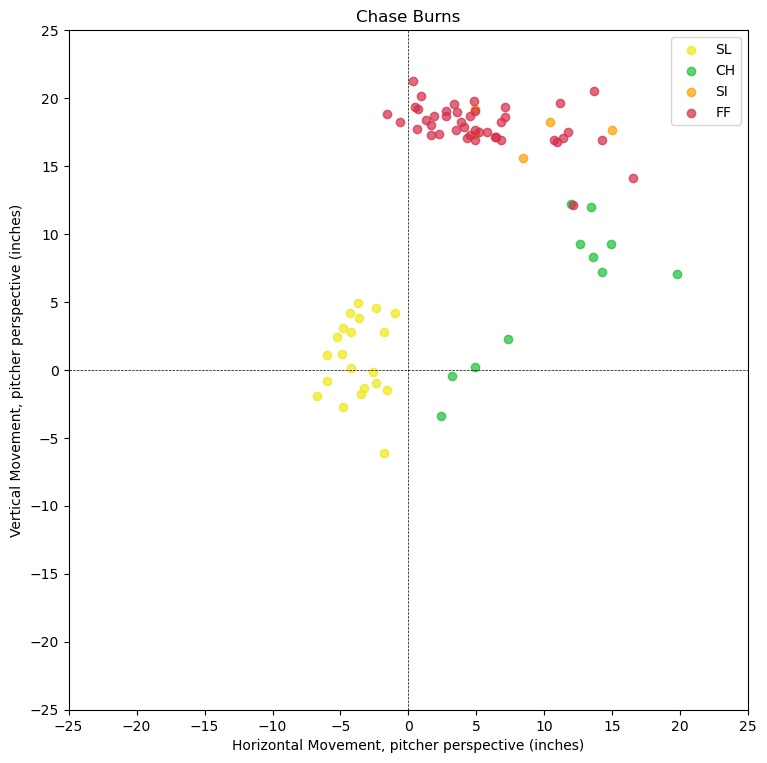
Evidently, Burns is playing around with a couple of changeup variants. The first has a more traditional grip, which he showcased 43 times in his brief 2025 season. The second is a bonkers dive bomb, getting down to the zero line of induced vertical break at 90 mph with minimal arm-side fade. He threw four of him in his first spring start, but to my dismay, he shelved it his next time out. Who knows if he’ll be able to command it to any degree, but if he gets it under control, he’ll have yet another weapon in a truly lethal arsenal.
Relievers You Should Know
Yaramil Hiraldo, Orioles
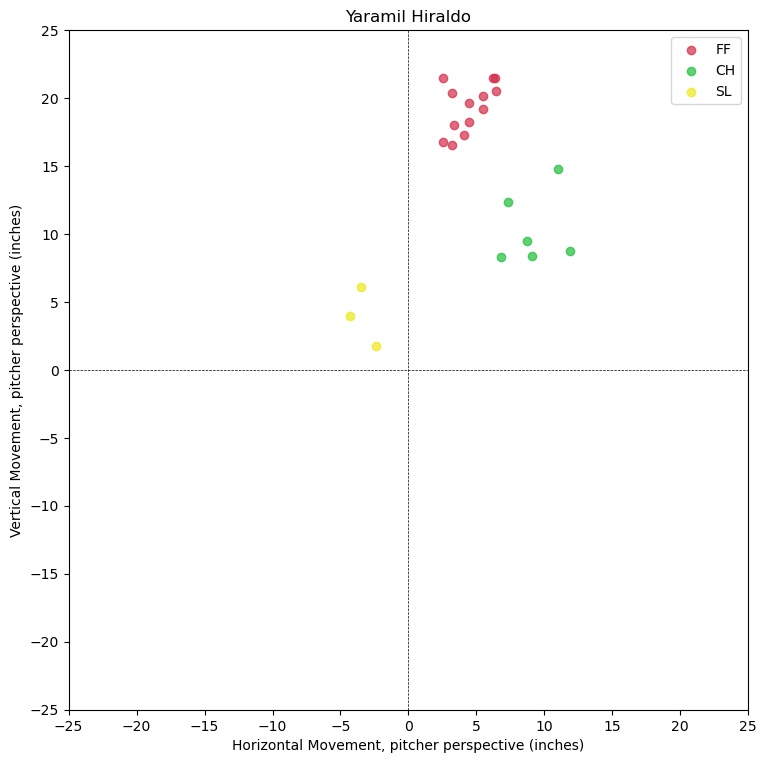
Hiraldo got into 18 games (19.2 innings) for Baltimore last year, and on the surface, he did nothing in particular to distinguish himself. His fastball got torched in that limited sample, and he ran a 4.58 ERA while picking up meaningless late-summer innings for a doomed O’s team. Look under the hood, however, and there’s something spicy brewing. Hiraldo’s changeup had a preposterous 40.6% swinging strike rate, the highest among any pitch thrown 100 times in 2025 by more than 10 percentage points. It was only thrown 111 times, but I mean, come on, that’s crazy! The combination of a fastball with over 20 inches of IVB and a changeup that looks exactly like that fastball until the very last moment in time is something special. Hiraldo even mixes in a respectable slider to keep same-handed hitters at bay. He’s up nearly a tick in spring (95.6 mph average), and that little boost of velo might be enough to turn him into a legit weapon for an Orioles bullpen that has some serious question marks.
Alan Rangel, Phillies
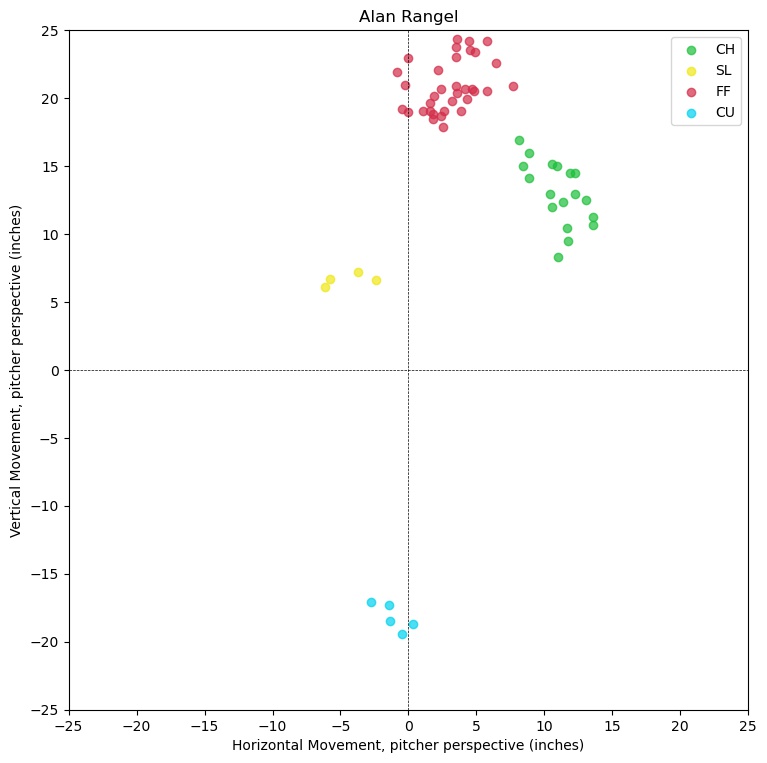
Rangel and Hiraldo look quite similar to one another. Both wield fastballs with absurd vertical movement — as you can see, Rangel’s fastball is almost climbing out of my plot — and use straight changeups as their primary out pitch. Rangel doesn’t throw as hard as Hiraldo, making him a slightly less exciting proposition, but he should be able to work similar magic with his funky change and his outlier arm angle of 72 degrees, the highest of any pitcher in the majors last season.
Jaden Hill, Rockies
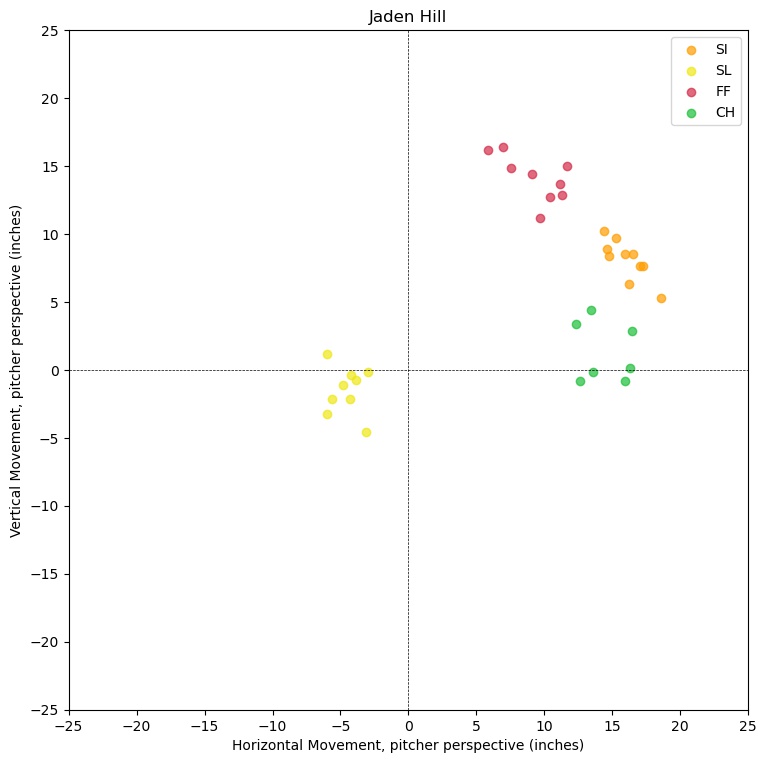
On some level, Rockies relievers are doomed. The high altitude neutralizes funky movement, limiting the extremity of any given pitch. That’s a shame, because Hill’s stuff this spring would scream “high-leverage guy” anywhere besides Denver. After sitting 97 in 2025, Hill came to camp on a mission, adding nearly two ticks to his sinker this spring. He was more effective than you might have realized last year, putting together a 3.44 FIP in his 29.1 innings of work. Now working at 99 mph instead of 97 to go with a legit changeup and slider, he’ll make a bid for leverage work, such as it is.
Gregory Santos, Giants
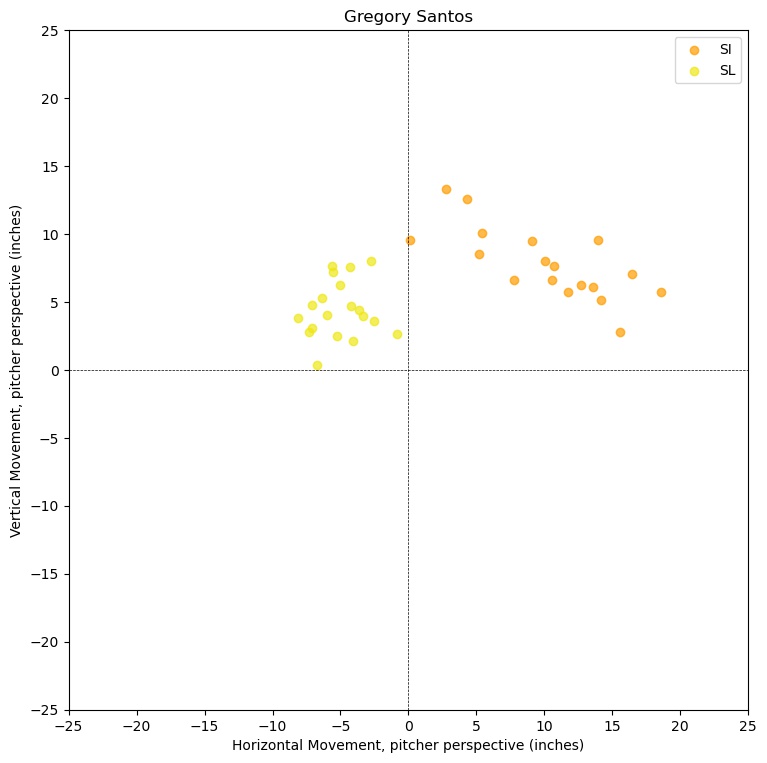
This freakin’ guy! Santos looked amazing as a White Sock in 2023, prompting a trade to the Mariners the following winter. He turned into a pumpkin in Seattle, battling injuries, diminished stuff, and 20-grade command, and throwing just 14.1 innings over his two years in the Pacific Northwest. Cut loose after the 2025 season, Santos landed in San Francisco on a minor league deal, the stuff of washed up guys seeking one last chance. But it turns out Santos isn’t so washed up. He’s only 26, and he’s finding his old triple-digit heat again, unleashing 100 mph bowling ball sinkers and some of the firmest sliders in the sport. He’s even (maybe) throwing a cutter now. It isn’t the fanciest arsenal, but at the velocities he’s found this spring, it won’t need to be to get him back to major league viability.
Jonathan Pintaro, Mets
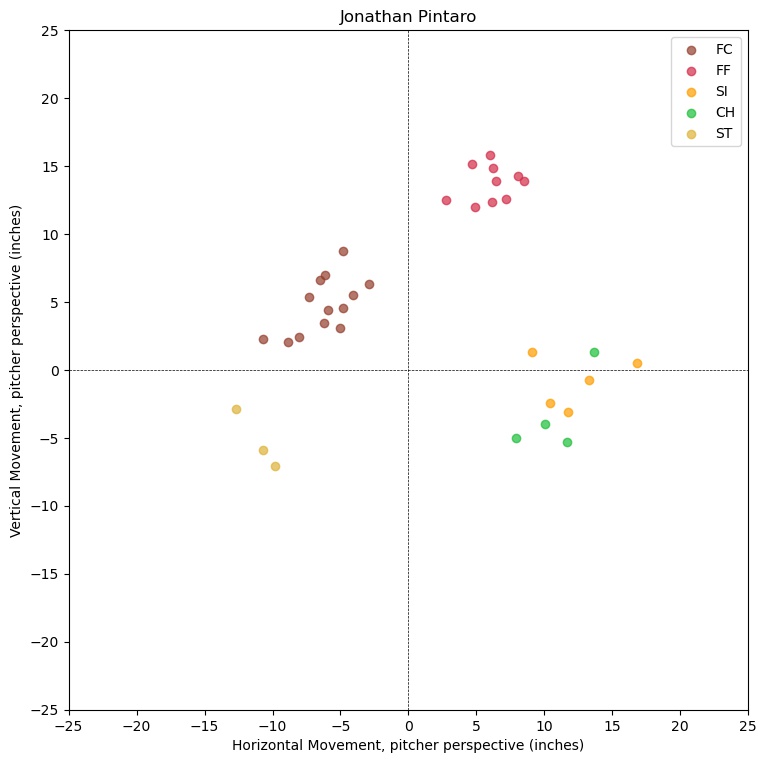
Like many others on this list, Pintaro is another former indy ball guy made surprisingly good, surfacing with the Mets for a brief two-out appearance last year. According to the RosterResource fellas, he’s on the outside looking in when it comes to securing a big league job out of camp, but he’s certainly making an argument. His pure stuff is back of the bullpen material, throwing heat from a Bryan Woo-esque release point and getting to serious lateral break on his 90 mph slider. Commanding shapes like these is a tenuous proposition — he walked nearly 16% of Triple-A hitters in 2025, wildness that simply isn’t viable. But the stuff is there, and for that reason alone, he’s worth keeping an eye on.
Michael Rosen is a transportation researcher and the author of pitchplots.substack.com. He can be found on Twitter at @bymichaelrosen.
This is an excellent piece. Great new information that we really don’t get elsewhere. Thanks for your hard work.
Hate to be that guy, but the choice of bright-yellow-on-white is a nightmare that is practically impossible to see.
that’s fair, i just use the savant colors for the pitches themselves but could definitely soften the background color
What the…
It’s easier for me to pull up whiffs than swinging strike rate (they’re related anyway). Hiraldo’s whiff % is second on the list behind Erik Miller’s slider.
Pretty much everyone at the top of the list is a reliever, which makes sense. But there are a number of starters with an extreme pitch like that (55% whiff or more). We got the changeup for Eury Perez (at 61.1%, wow!) and Ranger Suarez’s slider (55.8%). For whatever reason, Eury Perez’s run value on that pitch was negative which doesn’t make sense at all–a full two thirds of the time it was a strike! I guess when he missed he really missed.
I don’t quite get how all these numbers work, but the negative value for Eury Pérez’s change seems pretty simple and also a case study in the difference between whiff and swinging strike rate; he never threw it in the zone and people didn’t swing at it.
It had a 6.1% zone rate and a 24.4% o-swing, which means that 71% of his changeups were taken for a ball. The swinging strike rate was only 16.8% because the swing rate is so low. (He had no walks on it which must mean he just didn’t throw it in three-ball counts.)
This is why swinging strike rate is a better stat than whiff percentage, but I haven’t figured out how to pull that out for specific pitches. I know it’s in there on Statcast, I just haven’t figured out how to get it.
Once I knew which pitcher I was looking for, I got Pérez’s swinging strike rates per pitch from the pitch-type splits on here, though I don’t see an obvious way to get leaderboards. (And I started by looking at his baseballsavant page and saying “gosh he doesn’t throw the change in the strike zone at all.”)
on statcast, you’d have to do it manually, i think, by doing a savant search where you group by player and pitch type and select “whiffs” in the included stats section, and then download the csv, and then divide whiffs by total number of pitches in excel
or you can use alex chamberlain’s excellent pitch leaderboard, where he’s done all the hard work for you
Awesome, thank you!
Swinging strike rate that isn’t broken down by pitch tells us some pretty neat things about starters:
1) Tarik Skubal, Dylan Cease, Logan Gilbert, and Blake Snell get an absurd number of swinging strikes–over 15%.
2) Out of the 139 starters with at least 150 innings pitched minimum between 2024 and 2025, about 50 of them are between 10% and 12%.
3) The number of starters who have pitched super well without getting swinging to double digits in swnging strike percentage is small. Ranger Suarez, Logan Webb, Drew Rasmussen, Seth Lugo, and Tanner Houck are the only ones that really fit this description.
4) If you’re getting under about 8.3% swinging strikes you probably shouldn’t be starting. The list from that group on down is pretty brutal: Jack Kochanowicz, Austin Gomber, Walker Buehler, Marcus Stroman, Jose Quintana…and then all the way down at the bottom we have Randy Vazquez, Miles Mikolas, Taijuan Walker, and Javier Assad. They aren’t fooling anyone.
The thing that’s really crazy is that despite his fastball being god awful, 2025 Hiraldo was literally top 5 in baseball (min. 10 IP lol) at overall iz-whiff% because his changeup was still getting whiffs every other in-zone swing, per Savant search.
Really strange guy, obviously colored by small sample size. Excellent whiff rate, decent damage suppression (by EV and barrels), but a FB pitcher who walks too many guys, so his xERA looks way better than FIP and xFIP.
The odds are the splinter is just something Gilbert’s messing around with: based on previous spring trainings, he has almost 20 pitches!
Good research, and I love the idea of Gilbert just tinkering for fun.
What Nunez was for the 2024 Mets bullpen Lambert will be for the 2026 bullpen.
Really good stuff. Actionable information. Thanks!
Great article! Super useful for my upcoming draft. Thank you!
Not really under the radar, or a pitcher, I’m big on ralphy v.
Thanks for this. Might not be everyone’s cup of tea, but I loved it
Michael, super-cool piece! Impressive work.