
How Big Is Too Big for Shortstop?
When examining the 2018 draft’s collection of top high-school shortstops, one is confronted with three vastly different physical entities in Santiago HS (CA) SS Brice Turang, Montverde Academy (FL) SS Nader De Sedas, and North Broward Prep (FL) infielder Xavier Edwards.
Edwards is explosive. A plus-plus runner with good hands and enough arm for the left side of the infield, he also possesses gap-to-gap power. He’s performed, in games, against elite pitching and might be my first pick among all 2018 high schoolers if we were picking teams for a game of sandlot ball tomorrow. He’s also a slight 5-foot-9 and 155 pounds.
De Sedas is a switch-hitting hammer who was being covered in his native Panama when he was just 13 years old. He moved to Florida late in adolescence and has shown big raw power from both sides of the plate, as well as feel to hit in games despite having adopted switch-hitting somewhat recently. But while De Sedas has premium arm strength and is smooth for his size, he’s also rather big. At a listed 6-foot-2, 192 pounds, De Sedas is already larger than Manny Machado (6-foot-3, 185) and Evan Longoria (6-foot-2, 170) were when coming out of high school.
Finally, there’s Turang. Lean, rangy, and acrobatic, he also features a plus arm. He’s instinctive, procedurally advanced, and a potential plus defender at short, but he may have limited, one-dimensional offensive impact.
As with any prospect, I’ve attempted to project the future defensive value of the three players mentioned here. Because of their vastly different builds, however, I became curious about the physical makeup of major-league baseball’s current shortstops and how the upcoming draft class — especially De Sedas, who belongs near the top of the class if he can stay at short — fits among them.
To address my curiosity, I began compiling not only the current heights and weights of the league’s shortstops but also their heights and weights at age 17 — or, roughly the age at which each of them was either drafted or signed out of Latin America. I then expanded my criteria to include all players who had recorded at least 450 innings at shortstop during the last three seasons. I also calculated both current BMI and also BMI at age 17 — as well as changes in height, weight, and BMI during that span.
There are some issues with this data. For one, it assumes that MLB teams are forthright about their players’ heights and weights, which is unlikely and, at times, demonstrably false. There was also no single source from which to obtain heights and weights for these players when they were 17. Where possible, I used draft data from MLB.com’s Draft Tracker, but I also dove into past Baseball America Prospect Handbooks, old AZL and GCL rosters, and even some local newspaper articles. (For instance, nothing was written about Wilmer Difo as an amateur and it took a 2014 James Wagner Washington Post article for me to find any record of his teenage weight.)
It was especially hard to find weights for Cuban players like Alexei Ramirez, as many of those players didn’t join MLB clubs until their mid-20s. If I couldn’t find old Cuban National Team rosters with the measurements of a given player at age 17, I got as close as I could. Alexei’s initial weight was measured at age 20, the furthest from 17 of any player on the list.
The entire table of data is located at the bottom of the article. Heights, which rarely changed from age 17 to present, are listed in inches. Here are the averages for current big-league shortstops.
| Height | Wt | BMI | Age-17 Height |
Age-17 Weight |
Age-17 BMI |
Weight Change | BMI Change | |
|---|---|---|---|---|---|---|---|---|
| Average | 72 | 196 | 26 | 72 | 171 | 23 | 28 | 3 |
Shortstop requires terrific lateral range. Modern defensive positioning might hide some deficiencies in this area — and this one specific skill has probably become less important than it once was — but it’s still a requirement. Statcast’s Sprint Speed Leaderboard, for example, indicates that shortstops run better than most other big leaguers, supporting the notion that players must exhibit a baseline level of athleticism for the position.
It’s intuitive that, as players get bigger and heavier, they become slower — and also less likely to remain at shortstop, where lateral quickness matters. I’m actually unable to find any statistical evidence that illustrates the effect of size on defensive performance — not within this sample of shortstops, at least. It’s quite possibly a product of the large sample sizes required for defensive metrics to become reliable, but I found no strong correlation between weight or BMI and any of Defensive Runs Saved, Range Runs, or Defensive Runs Above Average. But I think we can look at the shape of the data and see where the upper bound of physical viability lies. Corey Seager and Carlos Correa are our two tallest shortstops, responsible for the right-most bar on this histogram:

Meanwhile, here are the weights of all current shortstops:

And the BMIs:

The larger BMI figures actually do seem to correlate with a drop-off in defensive performance. Many players with a BMI of 28 or more in our sample have either already moved off of shortstop, are late-career stopgaps, or have clear defensive warts to the naked eye.
| Name | Ht | Wt | BMI | Age-17 Height |
Age-17 Wt |
Age-17 BMI |
DRS | DEF | BMI Delta | Sprint | Weight Delta | Acq |
|---|---|---|---|---|---|---|---|---|---|---|---|---|
| Eugenio Suarez | 71 | 213 | 30 | 71 | 155 | 22 | -12 | -8.0 | 8 | 26.7 | 58 | Int’l |
| Starlin Castro | 74 | 230 | 30 | 73 | 160 | 21 | -4 | 6.2 | 8 | 27 | 70 | Int’l |
| Jean Segura | 70 | 205 | 29 | 71 | 155 | 22 | -6 | 6.0 | 7.8 | 27.3 | 50 | Int’l |
| Jhonny Peralta | 74 | 225 | 29 | 72 | 185 | 25 | -8 | -1.5 | 4 | 27 | 40 | Int’l |
| Jonathan Villar | 73 | 215 | 28 | 73 | 180 | 24 | 6 | -8.0 | 5 | 27.5 | 35 | Int’l |
| Erick Aybar | 70 | 195 | 28 | 70 | 160 | 23 | -10 | -4.0 | 5.0 | 27.4 | 35 | Int’l |
| Wilmer Difo | 71 | 200 | 28 | 70 | 160 | 23 | 14 | 7.1 | 4.9 | 29 | 40 | Int’l |
| D. Robertson | 71 | 200 | 28 | 72 | 190 | 26 | 2 | 2.1 | 27.2 | 10 | Draft | |
| Ruben Tejada | 71 | 200 | 28 | 71 | 162 | 23 | 2 | -1.8 | 5.3 | 27 | 38 | Int’l |
| Pat Valaika | 71 | 200 | 28 | 71 | 170 | 24 | -2 | 4.2 | 27.5 | 30 | Draft | |
| Jorge Polanco | 71 | 200 | 28 | 71 | 165 | 23 | -9 | -7.4 | 4.9 | 28.2 | 35 | Int’l |
| D. Espinosa | 72 | 205 | 28 | 71 | 165 | 23 | 5 | 6.4 | 5 | 27.1 | 40 | Draft |
| A. Cabrera | 72 | 205 | 28 | 72 | 185 | 25 | -24 | -1.0 | 2.7 | 25.7 | 20 | Int’l |
| Trevor Story | 73 | 210 | 28 | 72 | 175 | 24 | 13 | 7.2 | 4.0 | 28.4 | 35 | Draft |
| X. Bogaerts | 73 | 210 | 28 | 73 | 185 | 24 | -23 | 16.7 | 3.3 | 28.2 | 25 | Int’l |
| Zack Cozart | 72 | 204 | 28 | 73 | 180 | 24 | 18 | 27.0 | 3.9 | 26.6 | 24 | Draft |
| B. Crawford | 74 | 215 | 28 | 73 | 180 | 24 | 46 | 57.6 | 3.9 | 26.4 | 35 | Draft |
| Brad Miller | 74 | 215 | 28 | 73 | 175 | 23 | -18 | -3.3 | 5 | 27.6 | 40 | Draft |
By stacking some histograms, it’s possible to see how the weight and BMI of shortstops changes from their earliest days as a prospect to physical maturity. First, with weight:
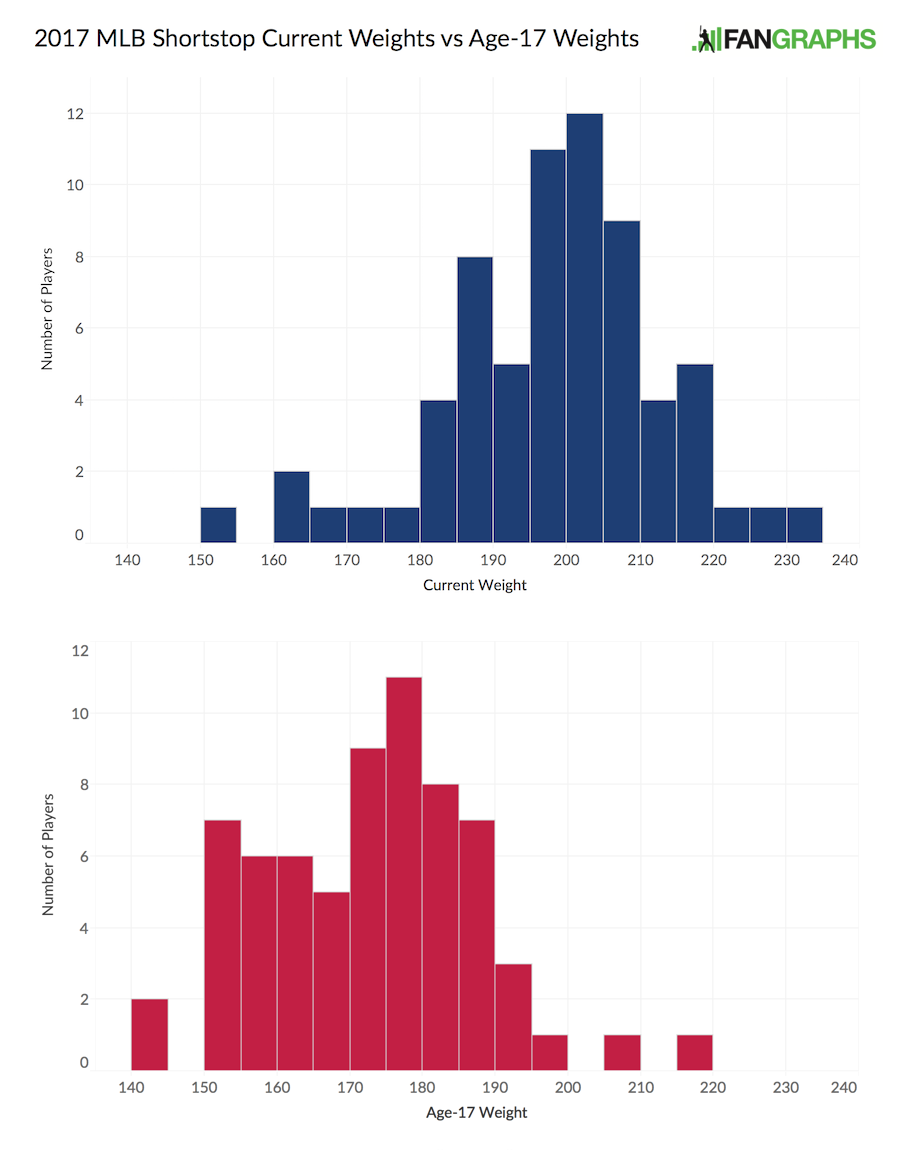
And then BMI:

As I collected the data, it looked as though there were some differences between the way domestic and international amateurs had developed. Here are the results when I split the two groups:
| Ht | Wt | BMI | Age-17 Height |
Age-17 Weight |
17BMI | Weight Change | BMI Change | |
|---|---|---|---|---|---|---|---|---|
| Averages | 72 | 196 | 26 | 72 | 171 | 23 | 28 | 3 |
| Averages (Latin America) | 72 | 193 | 26 | 72 | 164 | 23 | 28 | 4 |
| Averages (Domestic) | 73 | 198 | 26 | 72 | 177 | 24 | 22 | 3 |
On average, Latin American shortstop prospects acquire more mass between age 17 and maturity. Socioeconomic factors are likely responsible for that. Because it’s my desire, however, to project domestic, draft-eligible amateurs, I’ll be using the data from that subgroup of current MLB shortstop as my main resource. There was no correlation between height and weight change within shortstop, so I’ve blanketed the average across all of the 2018 draft class. The names you see below are all 2018 draft-eligible high schoolers whom I’ve seen play shortstop. They’re sorted by projected weight (Prj Weight).
| Name | Prj Ht | Prj Weight | Prj BMI | Ht | Wt | BMI |
|---|---|---|---|---|---|---|
| Cam McMillan | 77 | 227 | 27 | 77 | 205 | 24 |
| Seth Halvorsen | 73 | 220 | 29 | 73 | 198 | 26 |
| Jordan Groshans | 75 | 217 | 27 | 75 | 195 | 24 |
| Nander De Sedas | 74 | 214 | 27 | 74 | 192 | 25 |
| Vinny Tosti | 72 | 212 | 29 | 72 | 190 | 26 |
| Osiris Johnson | 73 | 209 | 28 | 73 | 187 | 25 |
| Kendall Simmons | 74 | 207 | 27 | 74 | 185 | 24 |
| John Rodriguez | 74 | 207 | 27 | 74 | 185 | 24 |
| Bryce Reagen | 73 | 207 | 27 | 73 | 185 | 24 |
| Kevin Vargas | 75 | 205 | 26 | 75 | 183 | 23 |
| Timmy Borden | 74 | 202 | 26 | 74 | 180 | 23 |
| Jake Dukart | 74 | 202 | 26 | 74 | 180 | 23 |
| Raynel Delgado | 73 | 202 | 27 | 73 | 180 | 24 |
| Mateo Gil | 73 | 202 | 27 | 73 | 180 | 24 |
| Kody Darcy | 74 | 197 | 25 | 74 | 175 | 22 |
| Brandon Dieter | 73 | 197 | 26 | 73 | 175 | 23 |
| Emilio Rosas | 73 | 197 | 26 | 73 | 175 | 23 |
| Jeremiah Jackson | 71 | 197 | 27 | 71 | 175 | 24 |
| Brice Turang | 73 | 192 | 25 | 73 | 170 | 22 |
| Blaze Alexander | 71 | 192 | 27 | 71 | 170 | 24 |
| Jonathan Ornelas | 72 | 177 | 24 | 72 | 155 | 21 |
| Xavier Edwards | 69 | 177 | 26 | 69 | 155 | 23 |
The bottom four names on the table are all players whom I’d already projected at shortstop based solely on my in-person evaluations from this summer. You can see De Sedas’ projected weight is right on the fringe of what we currently see at shortstop. Nine current/recent MLB shortstops weigh 215 pounds or more and most of them aren’t currently good defenders there. Corey Seager and Carlos Correa, each very rare talents, feature two of the better gloves in that group. Shortstops can compensate for a lack of range with other attributes (Correa, for example, features excellent arm strength) and it’s possible that De Sedas can do this (he has at least a 60 arm). I think his bat is impressive enough that he’ll garner top-10 consideration in next year’s draft even if he’s evaluated as a third baseman. But for now I think there’s reason to be apprehensive about projecting him as a shortstop. Turang, meanwhile, falls smack into the middle of the group, further supporting the notion that he’s a near lock to stay at short.
I also ran projections for prospects in pro ball based on their age-17 weight. The following table includes prospects who have garnered recent consideration at shortstop. Their projected weights are based on their weight at age 17. I’ve also included their means of acquisition in each case. Only Willy Adames has outgrown projection in a meaningful way.
| Name | Ht | Wt | BMI | Age-17 Height |
Age-17 Weight |
Age-17 BMI |
Acq | Prj Weight | Prj BMI |
|---|---|---|---|---|---|---|---|---|---|
| Bo Bichette | 72 | 200 | 27 | 71 | 201 | 28 | Draft | 223 | 31 |
| Hunter Greene | 76 | 197 | 24 | 76 | 197 | 24 | Draft | 219 | 27 |
| Kevin Maitan | 74 | 190 | 24 | 74 | 190 | 24 | Int’l | 218 | 27 |
| Joe Dunand | 74 | 205 | 26 | 75 | 190 | 24 | Draft | 212 | 27 |
| Carter Kieboom | 74 | 190 | 24 | 74 | 190 | 24 | Draft | 212 | 27 |
| Jean Carmona | 73 | 183 | 24 | 73 | 183 | 24 | Int’l | 211 | 27 |
| Royce Lewis | 74 | 188 | 24 | 74 | 188 | 24 | Draft | 210 | 27 |
| Freudis Nova | 73 | 180 | 24 | 73 | 180 | 24 | Int’l | 208 | 27 |
| Cole Tucker | 75 | 185 | 23 | 75 | 185 | 23 | Draft | 207 | 26 |
| Fernando Tatis, Jr. | 75 | 185 | 23 | 73 | 175 | 23 | Int’l | 203 | 26 |
| Isaac Paredes | 71 | 175 | 24 | 71 | 175 | 24 | Int’l | 203 | 27 |
| Franklin Barreto | 70 | 190 | 27 | 69 | 175 | 26 | Int’l | 203 | 29 |
| J.P. Crawford | 74 | 180 | 23 | 74 | 180 | 23 | Draft | 202 | 26 |
| Kevin Newman | 73 | 180 | 24 | 73 | 180 | 24 | Draft | 202 | 27 |
| Brendan Rodgers | 72 | 180 | 24 | 72 | 180 | 24 | Draft | 202 | 27 |
| Logan Warmoth | 72 | 190 | 26 | 72 | 180 | 24 | Draft | 202 | 27 |
| Lucius Fox | 74 | 175 | 22 | 74 | 170 | 22 | Int’l | 198 | 25 |
| Wander Franco | 70 | 170 | 24 | 70 | 170 | 24 | Int’l | 198 | 27 |
| Chris Seise | 74 | 175 | 22 | 74 | 175 | 22 | Draft | 197 | 25 |
| Nick Gordon | 72 | 160 | 22 | 74 | 175 | 22 | Draft | 197 | 25 |
| Ronny Mauricio | 75 | 166 | 21 | 75 | 166 | 21 | Int’l | 194 | 24 |
| Wander Javier | 73 | 165 | 22 | 73 | 165 | 22 | Int’l | 193 | 25 |
| Andres Gimenez | 71 | 176 | 25 | 71 | 165 | 23 | Int’l | 193 | 26 |
| Gavin Lux | 74 | 190 | 24 | 74 | 170 | 22 | Draft | 192 | 25 |
| Gleyber Torres | 73 | 175 | 23 | 71 | 160 | 22 | Int’l | 188 | 25 |
| Raul A. Mondesi | 73 | 185 | 24 | 71 | 160 | 22 | Int’l | 188 | 25 |
| Willy Adames | 72 | 200 | 27 | 71 | 160 | 22 | Int’l | 188 | 25 |
| Aramis Ademan | 71 | 160 | 22 | 71 | 160 | 22 | Int’l | 188 | 25 |
| Delvin Perez | 75 | 175 | 22 | 75 | 165 | 21 | Draft | 187 | 24 |
| Jurickson Profar | 72 | 190 | 26 | 71 | 165 | 23 | Int’l | 187 | 26 |
| Willi Castro | 73 | 165 | 22 | 72 | 150 | 20 | Int’l | 178 | 23 |
| Jazz Chisholm | 71 | 165 | 23 | 69 | 150 | 22 | Int’l | 178 | 25 |
| Nick Allen | 69 | 155 | 23 | 69 | 155 | 23 | Draft | 177 | 26 |
| Nicky Lopez | 71 | 175 | 24 | 70 | 150 | 22 | Draft | 172 | 25 |
And here’s the full table of data I compiled for major leaguers.
| Name | Ht | Wt | BMI | Age-17 Height |
Age-17 Weight |
Age-17 BMI |
BMI Change | Sprint | Weight Change | Acq |
|---|---|---|---|---|---|---|---|---|---|---|
| Corey Seager | 76 | 220 | 27 | 76 | 205 | 25 | 1.8 | 27.2 | 15 | Draft |
| Carlos Correa | 76 | 215 | 26 | 76 | 190 | 23 | 3.0 | 27.9 | 25 | Draft |
| Ian Desmond | 75 | 215 | 27 | 74 | 185 | 24 | 3 | 27.5 | 30 | Draft |
| Jordy Mercer | 75 | 210 | 26 | 75 | 175 | 22 | 4.4 | 27.5 | 35 | Draft |
| Didi Gregorious | 75 | 205 | 26 | 73 | 152 | 20 | 5.6 | 28.3 | 53 | Int’l |
| Troy Tulowitzki | 75 | 205 | 26 | 74 | 170 | 22 | 3.8 | 25.2 | 35 | Draft |
| Wilmer Flores | 75 | 205 | 26 | 75 | 175 | 22 | 4 | 25.7 | 30 | Int’l |
| Starlin Castro | 74 | 230 | 30 | 73 | 160 | 21 | 8 | 27 | 70 | Int’l |
| Jhonny Peralta | 74 | 225 | 29 | 72 | 185 | 25 | 4 | 27 | 40 | Int’l |
| Brad Miller | 74 | 215 | 28 | 73 | 175 | 23 | 5 | 27.6 | 40 | Draft |
| Brandon Crawford | 74 | 215 | 28 | 73 | 180 | 24 | 3.9 | 26.4 | 35 | Draft |
| Adam Rosales | 74 | 205 | 26 | 74 | 195 | 25 | 1.3 | 27.2 | 10 | Draft |
| Andrelton Simmons | 74 | 200 | 26 | 74 | 170 | 22 | 3.9 | 27.8 | 30 | Draft |
| Chad Pinder | 74 | 195 | 25 | 72 | 170 | 23 | 2.0 | 27.4 | 25 | Draft |
| Nick Ahmed | 74 | 195 | 25 | 72 | 180 | 24 | 0.6 | 28.1 | 15 | Draft |
| Amed Rosario | 74 | 190 | 24 | 74 | 175 | 22 | 1.9 | 29.7 | 15 | Int’l |
| Alexei Ramirez | 74 | 180 | 23 | 73 | 170 | 22 | 1 | 27 | 10 | Int’l |
| Jonathan Villar | 73 | 215 | 28 | 73 | 180 | 24 | 5 | 27.5 | 35 | Int’l |
| Trevor Story | 73 | 210 | 28 | 72 | 175 | 24 | 4.0 | 28.4 | 35 | Draft |
| Xander Bogaerts | 73 | 210 | 28 | 73 | 185 | 24 | 3.3 | 28.2 | 25 | Int’l |
| Marwin Gonzalez | 73 | 205 | 27 | 73 | 186 | 25 | 3 | 26.5 | 19 | Int’l |
| Tim Beckham | 73 | 205 | 27 | 72 | 188 | 25 | 1.5 | 27.6 | 17 | Draft |
| J.J. Hardy | 73 | 200 | 26 | 73 | 170 | 22 | 4.0 | 26.2 | 30 | Draft |
| Clint Barmes | 73 | 200 | 26 | 73 | 190 | 25 | 1 | 27 | 10 | Draft |
| Paul DeJong | 73 | 195 | 26 | 73 | 180 | 24 | 2.0 | 27.8 | 15 | Draft |
| Aledmys Diaz | 73 | 195 | 26 | 72 | 183 | 25 | 1 | 27.9 | 12 | Int’l |
| Dansby Swanson | 73 | 190 | 25 | 72 | 170 | 23 | 2.0 | 28.4 | 20 | Draft |
| Alcides Escobar | 73 | 185 | 24 | 73 | 155 | 20 | 4.0 | 28.2 | 30 | Int’l |
| Trea Turner | 73 | 185 | 24 | 74 | 160 | 21 | 3.9 | 29.2 | 25 | Draft |
| Tim Anderson | 73 | 185 | 24 | 72 | 165 | 22 | 2.0 | 28.6 | 20 | Draft |
| Ketel Marte | 73 | 180 | 24 | 73 | 155 | 20 | 3.3 | 28.6 | 25 | Int’l |
| J.T. Riddle | 73 | 180 | 24 | 75 | 175 | 22 | 1.9 | 28 | 5 | Draft |
| Dixon Machado | 73 | 170 | 22 | 72 | 140 | 19 | 3.4 | 27.1 | 30 | Int’l |
| Luis Sardinas | 73 | 160 | 21 | 73 | 150 | 20 | 1 | 28 | 10 | Int’l |
| D. Espinosa | 72 | 205 | 28 | 71 | 165 | 23 | 5 | 27.1 | 40 | Draft |
| Asdrubal Cabrera | 72 | 205 | 28 | 72 | 185 | 25 | 2.7 | 25.7 | 20 | Int’l |
| Zack Cozart | 72 | 204 | 28 | 73 | 180 | 24 | 3.9 | 26.6 | 24 | Draft |
| Stephen Drew | 72 | 200 | 27 | 72 | 170 | 23 | 4.1 | 25.9 | 30 | Draft |
| Elvis Andrus | 72 | 200 | 27 | 72 | 185 | 25 | 2.0 | 27.5 | 15 | Int’l |
| Addison Russell | 72 | 200 | 27 | 72 | 215 | 29 | -2.0 | 27.7 | -15 | Draft |
| Jose Peraza | 72 | 196 | 27 | 72 | 165 | 22 | 4.2 | 28.1 | 31 | Int’l |
| Eduardo Nunez | 72 | 195 | 26 | 72 | 155 | 21 | 5 | 27.8 | 40 | Int’l |
| Jose Reyes | 72 | 195 | 26 | 72 | 160 | 22 | 4.7 | 27.8 | 35 | Int’l |
| Marcus Semien | 72 | 195 | 26 | 72 | 170 | 23 | 3.4 | 28 | 25 | Draft |
| A. Hechavarria | 72 | 195 | 26 | 71 | 178 | 25 | 1.6 | 27.5 | 17 | Int’l |
| Javier Baez | 72 | 190 | 26 | 72 | 180 | 24 | 1.4 | 28.3 | 10 | Draft |
| Orlando Arcia | 72 | 165 | 22 | 72 | 165 | 22 | 0.0 | 27.4 | 0 | Int’l |
| Eugenio Suarez | 71 | 213 | 30 | 71 | 155 | 22 | 8 | 26.7 | 58 | Int’l |
| Ruben Tejada | 71 | 200 | 28 | 71 | 162 | 23 | 5.3 | 27 | 38 | Int’l |
| Wilmer Difo | 71 | 200 | 28 | 70 | 160 | 23 | 4.9 | 29 | 40 | Int’l |
| Jorge Polanco | 71 | 200 | 28 | 71 | 165 | 23 | 4.9 | 28.2 | 35 | Int’l |
| Ruben Tejada | 71 | 200 | 28 | 71 | 165 | 23 | 5 | 27 | 35 | Int’l |
| Pat Valaika | 71 | 200 | 28 | 71 | 170 | 24 | 4.2 | 27.5 | 30 | Draft |
| D. Robertson | 71 | 200 | 28 | 72 | 190 | 26 | 2.1 | 27.2 | 10 | Draft |
| Miguel Rojas | 71 | 195 | 27 | 69 | 175 | 26 | 1.4 | 27.3 | 20 | Int’l |
| Francisco Lindor | 71 | 190 | 26 | 71 | 175 | 24 | 2.1 | 28.1 | 15 | Draft |
| Danny Santana | 71 | 185 | 26 | 71 | 150 | 21 | 5 | 28.8 | 35 | Int’l |
| Jose Iglesias | 71 | 185 | 26 | 71 | 175 | 24 | 1.4 | 28.2 | 10 | Int’l |
| Jean Segura | 70 | 205 | 29 | 71 | 155 | 22 | 7.8 | 27.3 | 50 | Int’l |
| Erick Aybar | 70 | 195 | 28 | 70 | 160 | 23 | 5.0 | 27.4 | 35 | Int’l |
| Daniel Descalso | 70 | 190 | 27 | 70 | 180 | 26 | 1 | 26.9 | 10 | Draft |
| Eduardo Escobar | 70 | 185 | 27 | 70 | 150 | 22 | 5.0 | 28.1 | 35 | Int’l |
| Freddy Galvis | 70 | 185 | 27 | 70 | 154 | 22 | 4.4 | 27.4 | 31 | Int’l |
| Chris Owings | 70 | 185 | 27 | 71 | 175 | 24 | 2.1 | 27.8 | 10 | Draft |
| Ryan Goins | 70 | 180 | 26 | 69 | 155 | 23 | 2.9 | 26.9 | 25 | Draft |
| Jimmy Rollins | 67 | 175 | 27 | 67 | 154 | 24 | 3 | 28 | 21 | Draft |
| Ronald Torreyes | 67 | 151 | 24 | 67 | 140 | 22 | 1.7 | 27.9 | 11 | Int’l |
| Alexi Amarista | 66 | 160 | 26 | 68 | 150 | 23 | 3 | 27.4 | 10 | Int’l |
Eric Longenhagen is from Catasauqua, PA and currently lives in Tempe, AZ. He spent four years working for the Phillies Triple-A affiliate, two with Baseball Info Solutions and two contributing to prospect coverage at ESPN.com. Previous work can also be found at Sports On Earth, CrashburnAlley and Prospect Insider.
Thoroughly enjoyed this!
Someone needs to get Manny Machado on a scale though, theres no way hes 185.
Lol. Def not, but that was out of High school. It is odd they haven’t updated it. As an O’s fan I’d guess entering the season he’s probably close to 230-235 with a mid-season weight around 225-220.
Does the increase of weightlifting in Amateur ball Change that Picture? your table Shows that the domestic shortstops are heavier than the latin shortstops.
maybe that is because the good american Kids now start to lift heavy weights at 14 to 15 to get good measurables for the college Scouts (Exit Velo, throwing Velo…) so they should be more mature and have less room to add weight as they Age.
So if a SS prospect Comes in at 190 it might Sound a Little scary but if he started to lift weights and drink Protein shakes at Age 14 there might not be as much room to add muscle mass and he might not gain 30 Pounds like the latin guys but only 10 or so.
This is really good stuff, but I worry about the sampling on the dependent variable (staying at shortstop). It makes sense that BMI or height has no real effect on defensive ability because these are individuals who played shortstop in the major leagues, not the ones who had been moved off of it because of height or BMI or defensive liabilities already. Moreover, I wonder about the cross-sectional nature of this–I noticed Jhonny Peralta was listed as having a negative defensive value but he was a big positive for many years.
Something I would be interested in is the population of minor league shortstops and how they developed over time. You could then do a pretty awesome latent growth curve, which was literally designed to measure physical change over time. Could also look at the impact on defensive outcomes. Then you could project each prospect’s physical changes and resulting defensive abilities pretty well.
But that’s also a ton of work, and might not have much of a payoff for us (although for an MLB team, it would have an enormous payoff). I’m fairly skeptical that we’re going to find that body type has a big impact on shortstop defense, mostly because there’s selection on body type to play shortstop in the first place.
Age 17 height: check
Age 17 weight: check
Terrific lateral range: check
Arm: duh
Home run power: check
What might have been. Add in classic good looks and I might have been ARod. Sigh.
You’re only 5-11, Barty, no one’s going to move you off shortstop.
Kind of funny that almost the entire population of major league shortstops is considered overweight by BMI. But no one above 30 into the Obese territory.
“If your Body Mass Index (BMI) is between 25 and 29.9 you are considered overweight. If your BMI is 30 or over you are considered obese”
Yeah, the BMI charts don’t work for people who are very muscular.
Those definitions have no meaning when it comes to athletes, I presume the article uses them only to have a convenient frame of reference for combining height and weight.
The people who developed the BMI statistic explicitly said that it was for population studies and was never meant to be used for individual evaluation. It’s well known that it doesn’t work as a metric for athletes because they have way more muscle mass than the average person.
BMI works for an entire population but not necessarily individually.
Why is the weight difference between age 17 and now not 25? 196-171=25.
Just a typo. If you take the difference of the averages you get the same value as the average of the differences, as you should in a table with no blanks.
“Edwards is explosive…. and might be my first pick among all 2018 high schoolers”
All season long I’ve been thinking who is the best player next year? All Phillies fans have been thinking that way since the Phillies owned the first pick…..right up to the last three weeks of this season and then the Phillies coughed it up and it looks like they’re going to be picking third!
I’d like to Go Postal on the Phillies Front Office right up to and thru the owners.
WINNING SOME GAMES IS FELONY FRAUD
“Edwards is progressing … and this is probably my first choice among high school students in 2018”
For the season, I think who’s the best player next year? All Philadelphia fans thought of Philli in the first … until the last three weeks of the season, then they licked themselves in Philly, and it seemed that they would go to third place.
I want to go to Philadelphia post office next to the house and through the owner.
Cool work! Have you taken a shot at running Statcast sprint speed versus weight, or versus BMI? Speed is nice and measurable, and if we don’t see an effect on speed, we should assume not much effect on range.
In the general population I’m sure we’ll see some amount of weight / speed relation. But athletes mostly are muscle weight, and muscle generates power per weight… not obvious we’ll see an effect.
Defensive position is going to be a confounder, as sluggers are both big and slow for their own reasons.
Bmi, lol. The 1980s called.
Being around baseball I find all the subtle racism funny. “Looks like a ball player” is code for a Latin middle infielder. Might have to move off the position is code for a white middle infielder. The reality is however that with shifting this entire thing is going to change. Range doesn’t matter as much now, and I’d venture a lefty plays on the other side of the infield depending on the batter.
ahh, downvotes. Must not be many ppl in the scouting community here.I can assure you that it is true. Scouts talk like that all the time.
But if the lefty on the other side of the diamond was what the downvote was for, teams should be doing it now. When a pull happy lefty comes to the plate, you assuredly would be better off switching your first baseman to the opposite side of the diamond, and moving your rangier players into the first base position part way into the outfield.
BTW I wonder if the new ball could mean that bigger types get into a bit of a disadvantage?
If smaller guys like lindor can hit 30 bombs just with solid contact and good Launch angle but basically average or a tick better Exit Velo you don’t Need huge guys but you can take faster, smaller guys while getting 90 Cents for the Dollar in power but better defense.
now of course lindor might have his ellsbury year in power and won’t hit 30 every year but only if hits only 22 it might be worth the defensive upgrade over a guy hitting 32.
I think it also depends on how the top developes. last year everyone hit 20 but only a few above 40 so there wasn’t much to gain with power. but this year we have stanton approaching 60 and some others being on a similar pace the first half but falling off (judge, sano, thames).
if the league leaders manage to get over 50 again power can become a difference maker again but if everyone is between 15 and 30 with the best having 45 that is different and you Need just make sure that you are not a Zero power guy like hamilton or gordon (last year yasmani tomas hit one more homer than trout- you don’t Need to say more about that year:)).