
Introducing Ryan Zeferjahn, Basically Unhittable and Largely Anonymous

Hello there, FanGraphs readers. Today I’d like to tell you about a reliever on the Los Angeles Angels. Now sure, just last week, I wrote about how much help the Angels needed on the pitching front, and in the bullpen in particular. And sure, the guy we’ll be discussing today has a 4.05 ERA and a 4.08 FIP so far this year, not exactly stud closer numbers. Was he a trade throw-in last summer, one of four lottery tickets the Angels landed in exchange for a reliever in a contract year? He sure was. But that doesn’t change the fact that he’s interesting. So I’d like to introduce you to Ryan Zeferjahn, the best reliever you’ve probably never heard of.
The first thing you should know about Zeferjahn is that his primary pitch is weird. Everyone calls it a cutter, and in many ways, that makes sense. Let me show it to you in action:
Yep, that’s a cutter. It’s 90-ish mph, with less rise and arm-side fade than a four-seam fastball, and it makes batters look uncomfortable because they can’t quite classify whether it’s a fastball or a breaking ball. Miguel Vargas read that pitch as inside, and then it held the plate thanks to unexpected cut. But Zeferjahn’s cutter has, for lack of a better way of saying it, a lot of cut even for a cutter. This isn’t something you would pick up from watching a GIF or two, but that pitch has about six inches of glove-side break.
How much break is six inches? Well, hard cutters like Zeferjahn’s typically break 2-3 inches to the gloveside. That means his gets around three inches of unexpected movement relative to the cutters that opposing hitters see night in and night out. There’s exactly one pitcher in all of baseball this year throwing a cutter with more velo and more arm-side run: Ben Casparius of the Dodgers. Casparius doesn’t throw his cutter very often, only 15% of the time, while Zeferjahn uses his half the time. In other words, the movement profile of this pitch is weird.
It gets weirder, too. Where does that extra movement come from? It’s not just that he can magically spin the ball more. He’s imparting the spin in a different direction. His cutter has less backspin than most. The average cutter thrown 88.5-90.5 mph features about 7.5 inches of induced vertical movement. That’s far less than a four-seam fastball, which gives a cutter its deceptive shape; hitters expect it to ride and fight gravity by more than it does, but there’s still plenty of backspin. Zeferjahn’s cutter has only about 1.5 inches of induced vertical break. In other words, from the hitter’s perspective, it completely dies.
Another way of saying that? Zeferjahn has an unremarkable four-seam fastball, 98 mph with league average drop. His cutter falls 20 more inches than that fastball, with a velocity gap of 8.3 mph. Chase Dollander, a starter you’d create in a lab to display prototypical pitch shapes, gets about 15 inches of vertical separation between the same two pitches with the same velocity differential. This cutter simply doesn’t behave like hitters expect it to.
In fact, Zeferjahn’s cutter is closer to a high-velocity slider than anything else. I get Ryan Helsley or Emmanuel Clase slider vibes from the pitch. It’s sharp and disruptive, with plenty of glove-side break and that weird, rise-less shape that batters simply don’t expect from something traveling 90 mph.
That puts Zeferjahn in a weird spot, but a great one. The pitch he throws most often, his bread and butter in nearly every count, looks like a closer’s out pitch, with a 23% swinging strike rate that would be right at home ending games. And unlike those closers, he’s flooding the zone with this baby; his 69% zone rate is one of the five highest marks in the game for any fastball, let alone any cutter.
With a primary pitch that good, you might assume that Zeferjahn would strike out the world, and you’d be right – he has faced 27 batters this year and retired 14 via strikeout. At-bats against Zeferjahn are like life, per Thomas Hobbes: nasty, brutish, and short. He even has two useful change-of-pace pitches in a riding fastball and a sweeping slider.
Those pitches are worth breaking down in greater detail, because they also help explain Zeferjahn’s strange line so far this year. As I’ve noted, his fastball is your average four-seamer, 98 mph with unremarkable vertical movement. He spots it above the strike zone when he’s ahead in the count. When he’s behind in the count – well, maybe one day we’ll find out. He’s thrown exactly one four-seamer with more balls than strikes in the count all year, and it was this 3-2 offering to Willy Adames:
His breaking ball – or maybe his other breaking ball, it’s hard to classify with a pitcher who mostly throws a bendy fastball in the strike zone – is an exaggerated version of his cutter, with big glove-side break. A montage of batters swinging at it looks like you’d expect:
Quite frankly, if you didn’t tell me who was throwing these pitches, you could convince me that this was one of the best relievers in baseball. Zeferjahn’s fastball looks good as a show-me pitch, his cutter is an enviable workhorse, and that sweeper is lethal. Stuff+ thinks it’s his best pitch, in fact, though I’d take the cutter any day. The point is, pitchers with this broad an array of plus options tend to do well.
Why don’t his overall run prevention metrics show it, then? How can a guy striking out more than half the batters he faces sport a FIP higher than 4.00? You have to look to what happens when he doesn’t strike his opponents out. So far, Zeferjahn has allowed six fly balls, and two have left the yard. Whoops. First, he got got by baseball’s funniest hack, the Isaac Paredes lift-and-pull scheme:
Then Corey Seager did Corey Seager things:
Truthfully, I’m not too upset about either of those. If Zeferjahn has a long career in the AL West, he can expect more of both. Want proof that it’s probably not worth getting worked up over? Look at a similar pitcher: 2024 Ryan Zeferjahn. He allowed 19 fly balls, none of which left the yard. He never had much issue with contact quality in the minors; command was always the sticking point. If your primary pitch goes 90 mph and is most notable for its deception, you’ll probably give up at least a few home runs when one of those pitches backs up and hangs over the plate, but most of the “avoid home runs” battle comes down to not letting sluggers make contact, and Zeferjahn is very good at that part of the equation.
That leaves me with two questions. First, can he keep throwing his cutter like this? The current shape seems a lot better than last year’s model to me. It sinks and runs more, putting it on the slider/cutter boundary. Every bit of unexpected break helps, and I’m particularly interested in his ability to prevent backspin. Plenty of hitters are swinging over Zeferjahn cutters this year where last year they made contact. Combine that with his newfound ability to throw the pitch in the zone, and you end up with the ludicrous contact numbers he’s currently posting. Bring back last year’s shape and location, and he’s more an interesting middle reliever than a strikeout machine.
The second question is whether Zeferjahn can keep the ball in the strike zone frequently enough to challenge opposing hitters. That was his greatest weakness in the minors; in 2023, he ran a hard-to-believe 19.6% walk rate over a substantial 43 innings in Double-A. Even this year, with his top-of-the-scale zone rate, he’s walking 11.1% of batters. That’s only three walks – we’re still squarely in sample size silly season – but sometimes he just loses control of the zone. Look at this sequence starting from 0-2 against Jung Hoo Lee:
The crazy part? He did this to Lee earlier in that at-bat:
Two of his three walks have gone like that, with four straight balls from an 0-2 count (the last one hardly counts — he got replaced mid-PA after a rain delay). It’s clear both from his minor league track record and from watching him pitch that Zeferjahn is prone to the occasional bout of wildness. It would be more surprising if that weren’t the case; the reason he debuted in the majors at age 26 instead of earlier is because he struggled to throw strikes in the minors, not because he didn’t flash huge strikeout stuff.
I wouldn’t bet on that suddenly improving. If you watch a lot of Zeferjahn outings this year, I think you’re going to see a fair number where neither he nor the guy he’s facing have any clue where the next pitch will end up. And that higher zone rate this year? It’s come from just aiming down the middle, a plan I wholeheartedly approve of:
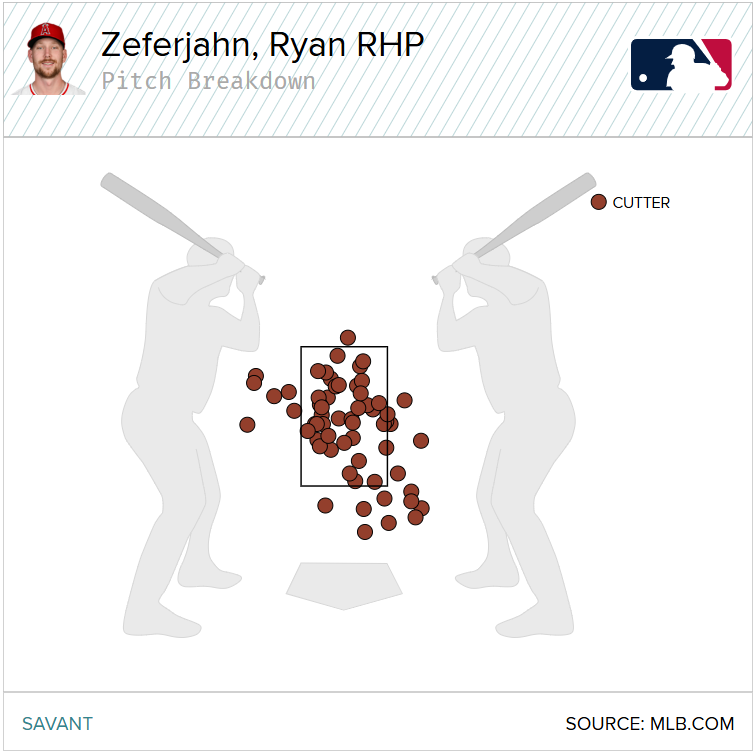
There aren’t a lot of edges in there, to say the least. Hey, if batters can’t hit it, why nibble? Sometimes that will lead to Seager homers, of course, but the tradeoff seems good so far, and I think he’s going to keep doing it.
As is so often the case with these April check-ins on hot relievers who no one has really heard of, this isn’t Zeferjahn’s true talent level. He’s not going to keep striking out half the guys he faces, or putting up contact and zone rate numbers that resemble a video game more than reality. But unlike so many of these April check-ins, I think that Zeferjahn’s ERA and FIP are underrating his true talent level so far. If he’s the closer in Anaheim by year’s end, I would hardly be surprised. You can’t always put a timer on when relievers will figure things out, but for the moment, he has. As long as he maintains his current combination of pitch shapes and command, the data speak loudly: This is one of the top relievers in baseball.
Ben is a writer at FanGraphs. He can be found on Bluesky @benclemens.
Rock chalk!
I would like to request a standardization of the vocabulary for left-right pitch movement. This (great) article uses the following terms to describe glove-side movement: “cut,” “glove-side break,” “sweeping,” and “runs.”
And in the other direction, for arm-side movement, it uses: “arm-side fade,” and “arm-side run.”*
Meanwhile, in another great pitching article at the Athletic, the author uses “run” to describe arm-side movement.
My problem is not just that different authors use “run” inconsistently: it’s that words like “cut,” “run,” and “fade” have no inherent meaning that ties them to glove-side or arm-side movement. So without specifying glove-side or arm-side movement, context is doing a heck of a lot of work to give meaning to the terms. Like, I know that cutters, sliders, and curveballs move glove-side, while two-seamers, changeups, and four-seamers usually move arm-side. But when we’re talking about a weird pitch or a weird pitcher–as this article does–these rules don’t always apply. (See also Rogers, Tyler.)
So my request is as follows: specify glove-side or arm-side movement whenever possible. And have the BBWA establish clear definitions for “run,” “break,” “carry,” “ride,” “sweep,” “cut,” “fade,” and other terms, and use them consistently.
/rant
*In context, did the article mean to say “glove-side run” here? I’m actually not sure.
Thank you for raising this. If we can just be consistent with terms, specifying glove-side or arm-side every time is unnecessary.
“Cut”, “break”, and “sweep” clearly have to be glove-side, otherwise the terms cutter, breaking ball, and sweeper make no sense.
“Run” is probably the most common culprit. It makes more sense as an arm-side term, and is usually used that way. Sometimes people use this to describe glove-side break, but they are wrong.
“Fade” is almost always used for changeups, and also makes more sense arm-side.
“Carry” and “ride” both refer to the vertical, perceived upward movement of fastballs with a lot of backspin.
Agreed. And I do think it was a typo when he mentioned the better cutter
ALL ABOARD THE Z TRAIN!!
in all seriousness, i think the angels bullpen has a chance to be good, or at least a lot better than it has started. Zef, Ryan Johnson, Ben Joyce, Kenley Jansen, plus the wild card of Bob Steve. throw in McDaniels/Detmers/Burke and it should be pretty solid imo
Also, Ian Anderson as the necessary mop up guy to throw those useless multiple innings in a blowout too. I still think they are underutilizing Detmers by leaving him in the bullpen though.
i expect reid to return to the starting lineup with hendricks/jack k being moved to the bullpen. that or hes traded. hard to believe hes a longterm bullpen fit (imo)
Who will finish with a higher K/9 and lower WHIP
Ryan Z or Mason Montgomery…
cause Mason only has one game so far where he’s had a clean inning without a walk or hit.
So looking at Helsley and Clase’s sliders on Baseball Savant, it has pretty much the same movement profile (as you pointed out) albeit from higher arm slots. Both of those however, have relative movement that is close to expected. So I guess what I’m confused about when looking at that and watching Zeferjahn’s pitch break in the gifs, is would the movement be all that unexpected if you just classified it as a slider? Or are all three more like gyro-slider/cutters like I’ve heard the Driveline types talk about and therefore their own beast (like separating sweeper and slurve from a plain slider)?
Two ways of looking at this.
1: Who cares? Both Helsley and Clase have disgustingly great sliders. They’ve produced swinging strike rates above 20% for years on end. Sure, maybe it’s expected – but you expect to strike out when you’re facing Helsley, sooooo
2. What does “unexpected movement” mean? Baseball Savant defines “expected movement” as the average of all pitches within +/-2mph and +/-0.5 feet of extension. For Clase, that’s like 16 guys in all of baseball. For Helsley, it’s slightly more, but still not that many. These are outlier pitches to begin with. Moving a lot like a 90 mph slider is just good. The average 90 mph slider has great stuff grades and is very effective at generating whiffs. I think that ‘unexpected movement’ is most useful when a pitch is like a lot of others – a 95 mph fastball or a mid-80’s slider. Do we care that in 2024, Tyler Rogers’s four-seamer had half an inch less horizontal break than expected? No, because what even does expected mean there? It’s a really cool statistic, but I try not to use it for outliers too much.
Good for him! Those are some cool pitches, and I hope he succeeds. It’s always a little bittersweet to see players who your team traded away do well, but you can’t have them all, and things may have been different if he stayed on the Sox.
I wonder how the other players from that trade are doing:
-Kavadas – AAA, hitting pretty well
-Matthew Lugo – AAA
-Yeferson Vargas – A
-Luis Garcia (LAD now)
As an Angel fan, I was already loving the trade last year. Now, it could end up being even more extremely one-sided. If Kavadas and/or Lugo become MLB regulars, that’s so much value from an expiring contract for a middle reliever.
Lugo was raking in spring training, but Kyren Paris was doing better and they needed more middle infield depth.
I realize the game has changed dramatically over the past two decades, but still very few things have made me feel as old as seeing a 98 mph fastball described as unremarkable.
Probably this was part of your point, but one of the things that’s changed significantly over those decades is how pitch speed is measured! There’s been significant mph inflation in the switch from radar to PitchFX to Statcast, as the point at which the speed is recorded has moved to the release point.
That’s part of it for sure but I suspect a larger factor is simply a shift in focus towards max velo at all times. That measurement location shift adds what, 1-5 mph at most? So that “unremarkable” 98 would probably have been 95 on a traditional gun, which 20 years ago was still an upper-echelon FB velo.
Yeah, I believe that’s about right — and I certainly agree with you that max-effort pitching is the other half of the story (along with all the biomechanical stuff that helps marginal big-leaguers unlock an extra couple mph to help their careers).
As I recall what “throwing 95” meant in the 1990s, it was certainly hard, but there were still a bunch of non-elite relievers throwing what you’d describe as unremarkable, hittably straight fastballs at 95. My mental radar-to-Statcast adjustment makes that today’s “unremarkable” 97-98.
Zeferjahn sounds like one of the names Dan Z has mashed up on his projections graphics.
I bet whoever else had that name who came to the US had it changed to something much less remarkable at Ellis Island.
Trying to define what a pitch is of little or no actual value. Does nomenclature really matter? There are definitely different types of pitches but, as Ben says in the article, defining what each is is hard to measure. To my eyes the most difficult pitch to hit I have seen over the past 10-15 years has been the breaking ball that Chris Sale throws. It has been called a slider but it really breaks much more like a sweeper, BUT, there wasn’t a pitch called a sweeper back when he was as good as anyone. I guess Kyle Hendricks throws something he calls a fastball but, whether it is a 4-seamer, sinker or cutter, it bears absolutely no resemblance to what Hunter Brown (or is it Greene, I get my colors mixed up) is presently throwing. It all comes down to getting outs and not how the outs are gotten.