
Is the New CBA Really Combating Service Time Manipulation? Sort Of.
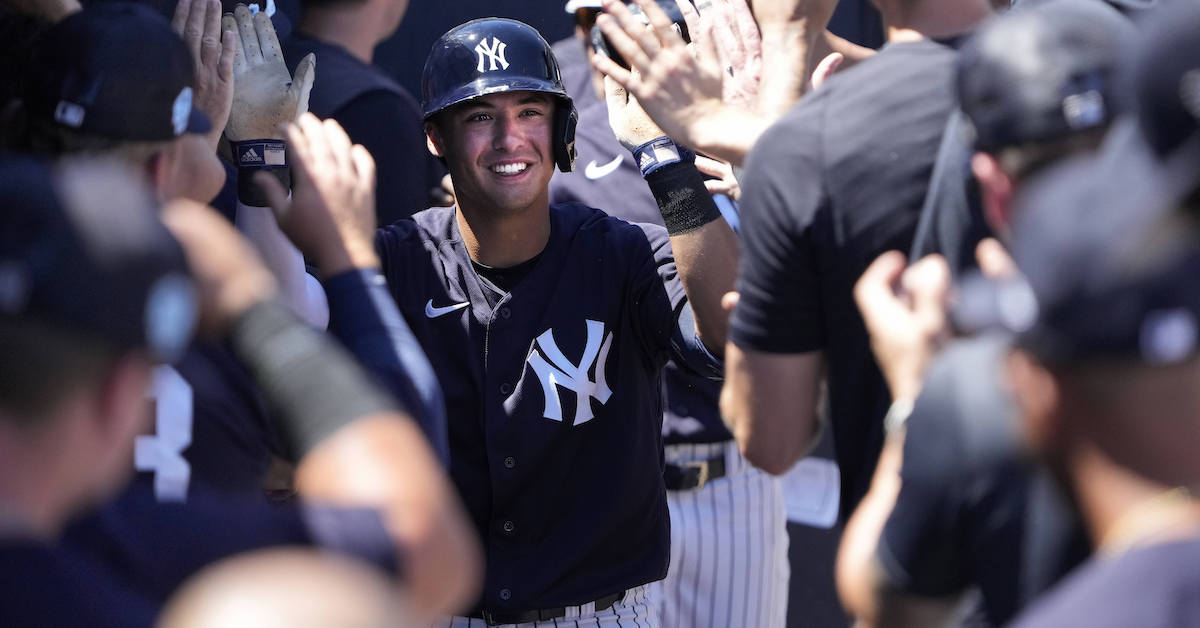
Do you want to see baseball’s brightest young talents get a chance on the biggest stage? Do you want teams to care more about winning now than saving a few bucks six years down the road? If so, you probably had a good weekend. Anthony Volpe, 21 years old and the no. 11 prospect on the FanGraphs Top 100, has made the Yankees out of camp. Jordan Walker, 20 years old and the no. 12 prospect in baseball, has likewise made the Cardinals and will figure into an intriguing outfield rotation. Let us rejoice and be glad.
Jeff Passan summed up the news from the weekend thusly: “Service-time manipulation still exists. But new CBA rules that incentivize teams to start the year with top prospects are working.”
Those rules, which came into force a year ago, reward teams that promote high-performing prospects early. The specific mechanism, which ties top-100 prospect lists and BBWAA award voting to cash bonuses for players and draft pick bonuses for teams, has its issues, but the intent is good. Service time manipulation is black-letter illegal under the CBA, but in practical terms it’s been practically impossible to prove — so much so that executives can talk openly about doing it without fear of repercussion.
Absent enforcement of the actual rules, the new CBA aimed to move the incentives, which is what you do in a capitalist society; rather than using regulatory power to confront corporate malfeasance directly, you offer businesses incentives to play by the rules. So for every chorus of Yankee fans cheering on their young New Jersey-born shortstop, there are as many Mets fans whose hunger for Brett Baty has gone unsatiated. (To say nothing of delaying the inauguration of the Three Men and a Baty infield.) Walker breaking camp with the Cardinals? Good. Grayson Rodriguez being told he’s not good enough to break into a rotation with Kyle Gibson as its no. 1 starter? Not so much.
So where do things stand generally? I went back and looked at the preseason top 100 prospect lists from each of the past four full seasons. I excluded 2020 because the season didn’t start until July with truncated training camps and there was no minor league season at all, and once I got to 2019 I saw Luiz Gohara’s name on the top 100 and decided that was a good place to stop.
From there, I listed all players in the top 50 who had not yet made their MLB debuts but were predicted to do so in that season. (This eliminates cases like Baty but makes the service time math much easier.) Were those players in the majors on Opening Day? And if not, where they in the majors by May 31? May is the service time manipulation sweet spot: late enough to have plausible deniability about the reason for the late call-up, still early enough to impact the bulk of the season.
| Player | Rank | Team | Position | Opening Day? |
|---|---|---|---|---|
| Eury Pérez | 4 | MIA | SP | No |
| Andrew Painter | 5 | PHI | SP | No |
| Anthony Volpe* | 11 | NYY | SS | Yes |
| Jordan Walker | 12 | STL | OF | Yes |
| Brandon Pfaadt | 16 | ARI | SP | No |
| Grayson Rodriguez | 17 | BAL | SP | No |
| Endy Rodriguez | 22 | PIT | C | No |
| Curtis Mead | 27 | TBR | OF | No |
| Owen White | 32 | TEX | SP | No |
| Bobby Miller | 33 | LAD | SP | No |
| Taj Bradley | 37 | TBR | SP | No |
| Michael Busch | 46 | LAD | DH | No |
Right away, there are a couple edge cases. Painter could’ve broken camp with the Phillies if he’d stayed healthy, and O’Hoppe missed the list by one spot on the top 100 and eight days of service time. (If you need another reminder of how much injuries can delay a player’s debut, look out for Brent Honeywell Jr.’s name a couple tables down.)
It’s also worth remembering that not every predicted 2023 debutant is created equal; a year is a big target, from a temporal mechanics perspective, so a player who’s legitimately far from MLB-ready in April could become so by August or September. Still, Volpe and Walker are huge headline names, but they stand alone.
| Player | Rank | Team | Position | Opening Day? | May 31? |
|---|---|---|---|---|---|
| Adley Rutschman | 1 | BAL | C | No | Yes |
| Bobby Witt Jr. | 2 | KCR | SS | Yes | Yes |
| Julio Rodríguez | 4 | SEA | OF | Yes | Yes |
| Spencer Torkelson | 5 | DET | 1B | Yes | Yes |
| Riley Greene | 6 | DET | OF | No | No |
| Josh Jung | 9 | TEX | 3B | No | No |
| Gabriel Moreno | 10 | TOR | C | No | No |
| MJ Melendez | 21 | KCR | C | No | Yes |
| Alek Thomas | 23 | ARI | OF | No | Yes |
| DL Hall | 27 | BAL | SP | No | No |
| George Kirby | 28 | SEA | SP | No | Yes |
| Jeremy Peña | 30 | HOU | SS | Yes | Yes |
| Hunter Greene | 31 | CIN | SP | Yes | Yes |
| Oswald Peraza | 39 | NYY | SS | No | No |
| Brayan Rocchio | 43 | CLE | SS | No | No |
| Nick Pratto | 47 | KCR | 1B | No | No |
Last year’s class made a far more powerful case that service manipulation was on its way out; five top-50 prospects made their debuts in the first few days of the season, and Rutschman and Greene could well have been among them if not for injury. Rodríguez and Rutschman both won bonuses for their high finish in Rookie of the Year voting, and Rutschman was made whole by the new CBA awarding him a full season of service time for only 138 days in the majors.
| Player | Rank | Team | Position | Opening Day? | May 31? |
|---|---|---|---|---|---|
| MacKenzie Gore | 2 | SDP | SP | No | No |
| Adley Rutschman | 3 | BAL | C | No | No |
| Jarred Kelenic | 5 | SEA | OF | No | Yes |
| Andrew Vaughn | 14 | CHW | 1B | Yes | Yes |
| Brandon Marsh | 15 | LAA | OF | No | No |
| Alex Kirilloff | 17 | MIN | OF | No | Yes |
| Matt Manning | 18 | DET | SP | No | No |
| Vidal Bruján | 24 | TBR | 2B | No | No |
| Max Meyer | 26 | MIA | SP | No | No |
| JJ Bleday | 35 | MIA | OF | No | No |
| Trevor Larnach | 36 | MIN | OF | No | Yes |
| Logan Gilbert | 37 | SEA | SP | No | Yes |
| Nolan Gorman | 40 | STL | 3B | No | No |
| Drew Waters | 47 | ATL | OF | No | No |
| Edward Cabrera | 50 | MIA | SP | No | No |
Only one top-50 prospect made it to Opening Day in 2021, the last year of the old CBA. That probably has something to do with the old rule set and something to do with the fact that two-thirds of this prospect class said “Macbeth” in a theater while opening an umbrella on Friday the 13th.
| Player | Rank | Team | Position | Opening Day? | May 31? |
|---|---|---|---|---|---|
| Vladimir Guerrero Jr. | 1 | TOR | 3B | No | Yes |
| Fernando Tatis Jr. | 3 | SDP | SS | Yes | Yes |
| Forrest Whitley | 4 | HOU | SP | No | No |
| Nick Senzel | 7 | CIN | 3B | No | Yes |
| Eloy Jiménez | 8 | CHW | OF | Yes | Yes |
| Keston Hiura | 13 | MIL | 2B | No | Yes |
| Brendan McKay | 14 | TBR | SP/1B | No | No |
| Brent Honeywell | 25 | TBR | SP | No | No |
| Jesús Luzardo | 27 | OAK | SP | No | No |
| Brendan Rodgers | 28 | COL | SS | No | Yes |
| Casey Mize | 30 | DET | SP | No | No |
| Austin Riley | 33 | ATL | 3B | No | Yes |
| Chris Paddack | 34 | SDP | SP | Yes | Yes |
| Sean Murphy | 35 | OAK | C | No | Yes |
| Mitch Keller | 37 | PIT | SP | No | Yes |
| A.J. Puk | 40 | OAK | SP | No | No |
| Pete Alonso | 48 | NYM | 1B | Yes | Yes |
| Corbin Martin | 50 | HOU | SP | No | Yes |
If we’re looking for a real historical turning point, 2019 is it. In a strong rookie class, four top-50 prospects with no major league experience made the roster out of camp. That spring, I wrote that the service time manipulation epidemic had reached an untenable level of brazenness. I was happy to be proved partially wrong when Tatis, Alonso, and Paddack made their respective teams out of camp to huge fanfare, even if Guerrero had to wait another month for his debut.
But the big number here is not that four top-50 prospects debuted in the first days of the 2019 season; it’s that eight more followed them. That kind of separation hasn’t been repeated in any subsequent season, and that’s the key figure here. It’s one thing for a rookie to need more time in the minors. It’s another for a rookie to be ready and twiddle his thumbs in Triple-A for six weeks until the service time ticker drops under 172. Not only is it tantamount to wage theft, but it’s also anti-competitive. Prospects should be promoted to the majors when they’re ready — no earlier, no later.
Which brings up another point. In 2019, the top 50 contained not only 18 rookies predicted to debut that year, but also nine players who had already seen major league action and retained their rookie status. In 2023, there are 12 predicted debutants, including Volpe, against 13 players with MLB experience, including Kodai Senga. (If you don’t count Senga as a prospect, O’Hoppe, with his eight days in the majors, is next in line at no. 51.) Of those 13, only Baty, Álvarez, and Peraza are currently bound for the minors. Maybe there’s something in the water in New York.
It’s not bulletproof evidence, but that would seem to indicate a shift in standard practice for MLB teams. Service time manipulation is still a problem, but not to the extent it was five years ago. There might not be a carrot you could dangle in front of the premier tightwad franchises in baseball that would get them to promote their top prospects early, but there’s plenty of evidence that playing it down the middle, instead of trying to game the rules, has its advantages.
Surely neither the Mariners nor Astros regret calling up Rodríguez and Peña for Opening Day last season. Nor would the Mariners regret the extension they just gave Rodríguez to keep him in Seattle into the mid-2030s. And the pennies saved by ruthless salary-cutting measures can damage relationships with players, as evidenced by Kris Bryant’s exit from Chicago or Corbin Burnes’ blunt appraisal of his arbitration experience. Smarter teams are realizing that superstars are too rare a thing to screw around with.
Michael is a writer at FanGraphs. Previously, he was a staff writer at The Ringer and D1Baseball, and his work has appeared at Grantland, Baseball Prospectus, The Atlantic, ESPN.com, and various ill-remembered Phillies blogs. Follow him on Twitter, if you must, @MichaelBaumann.
The top prospect can get the call. Others have to wait a month or two. Much better than before. We get to see those top guys for a full season!
Teams will always work around the edges of rules. When you push the edge, they just work around the new edge. So any change in rules help, but there will always be manipulation around the new rule. If a team isn’t pushing the envelope then its front office isn’t doing its job, so really it’s up to the MLBPA to understand and target the rules that most help their constituents.
Pretty sure the last remaining parts of Twitter that remain standing would have been blown up by Yankees Twitter had Volpe not made the team after how he looked this spring.
Twitter is not a real place. Yankee management and ticket sales would weather the Twitter storm just fine.
Eloy Jimenez was optioned to AAA about 2 weeks before the 2019 season started, but signed a long term deal a week later, before the season started. That’s why he started the season in Chicago instead of in Charlotte. Without that, he would have had his service time manipulated as well.
You didn’t do 2020, but Luis Robert signed a similar contract in January 2020, before ST even started. It is widely assumed that if 2020 had been a normal year and if he hadn’t signed that contract, he also would have somehow needed another 6 weeks in AAA to “work on” some aspect of his game before being promoted.
I’m not sure how many other players on the lists above fall into that same category.
How much have teams ever bothered to manipulate the service time of the Trevor Larnachs and Mitch Kellers of the world? It seems like something that mostly happens to the elite of the elite, the Kerry Woods and Kris Bryants. I’m not sure going all the way down to the 50th best prospect makes sense.
Time manipulation only matters to the top names. Even if it delays the second-best prospects, it’s fine (usually the SPs). We are seeing the ones that we truly wanted to watch compete for the rookie of the year. There isn’t a need to call for more because it is solving what hurt the fans before the changes.
It still hurts those individual players. While they do get some of it back via Super Two status, they still lose a bunch of money and leverage they would’ve otherwise had.
Very much appreciate the tone of this article in that it’s getting better, but not solved. I’ll be convinced if we have similar results in May of next year.
It’s interesting that there is somewhat a pattern of which teams are changing behavior. Definitely feels like those competing (aside from the Mets) are shifting their approach (NYY, STL) whereas non competitive teams continue to pinch pennies (BAL, PIT)
Not really sure what the Mets have to do with this, they were arguably the first team to stop caring about service time with Alonso making the opening day roster back in his rookie year.
Baty spent March slugging .300 and didn’t look good in his cup of coffee last year. Vientos doesn’t make contact. Alvarez was rough in spring and actually should “improve his defense.” Mauricio makes Javy Baez look disciplined. None of them are ready for the majors.
To be fair it must be tough being a Mets fan, and sometimes you just want to vent.
In the past, the Cardinals and Yankees were never that guilty of service time manipulation in the first place, so I don’t think you can really say they’ve changed their approach.
The only instance for the Yanks in relative recent memory would have maybe been Gleyber Torres.
EDIT: in which the extra year may not really matter in the grand scheme of things for the Yanks.
I wonder too if these new rules would incentivize some teams to not call up their top prospects mid-season in hopes that if they waited till OD the following year, they’d have a shot at a bonus draft pick.
And you don’t even have to wait that long. Just ensure that they’ll still have rookie status. So for legit studs the sweet spot might be a late-August call-up.
See: Henderson, Gunnar.
Including BAL in this with Grayson isn’t really fair. Their GM told reporters that Grayson was going to be in the rotation to begin the season. Grayson then proceeded to play his way off the team. I know, I know “spring doesn’t matter” but he was getting torched by AA players. It’s because they are trying to win-now that he is in the minors figuring things out instead of losing them games while he tries to figure it out.
“I wasn’t expecting this, and we were hoping that he would show up as a better version of himself than I think we got here.”
Peraza’s only in the minors because Volpe isn’t and the Yanks have way too many infielders for not enough spots.