It Already Looks Like the Fly Balls Are Here
I don’t know if you just watched the Royals and the Tigers. Probably not. Neither team is very good. The Royals won 1-0. Jakob Junis was terrific. The teams combined for just eight hits, and seven of them were singles. Somewhat more notably, the teams combined for a ground-ball rate of 32%. The average launch angle in the game, according to Baseball Savant, was a hair over 22 degrees. What does it mean? By itself, hardly anything. The game, however, was not by itself.
Nothing that follows ought to come as much of a surprise. We’ve been talking about air balls and launch angle for a couple of years. It’s not just fan sentiment, either; we know that more and more players are buying in. And, based on the data from this most recent spring training, it seemed as if something was going to happen. More balls were being hit in the air in the spring, suggesting we could see the same when the games started to count. There have been hints. We know that hitters are less fond of grounders than ever.
Even so, I didn’t expect quite the numbers we have. You don’t need to remind me of how early it is. Yet, already, there’s evidence of a significant batted-ball shift.
We’re into our fourth season of Statcast data, right? And the stuff everyone loves are exit velocity and launch angle. Check out these league-average launch angles. You might notice a pattern.
- 2015: 10.1 degrees
- 2016: 10.8
- 2017: 11.1
- 2018: 13.3
Between 2015 and 2017, there was a league-wide increase of one degree. Already, we’re seeing a sign of a league-wide increase of more than two degrees. Yes, of course, nothing can be confirmed until we have a lot more information, but this is the kind of thing you’d expect to fairly rapidly find its level. This is the sixth day of the 2018 regular season. We can break launch angle down on a day-to-day basis!
- March 29: 12.5 degrees
- March 30: 13.0
- March 31: 13.5
- April 1: 14.8
- April 2: 12.0
- April 3: 22.4 (incomplete)
Five straight days of 12 degrees or higher. The average for all of 2017 was 11.1. And while any single-day sample is small, each of the first five days had well more than 600 batted balls. On the league-wide scale, numbers aren’t quite as volatile as you’d think. On any given day, there’s an awful lot of baseball being played, and that helps to smooth out some of the randomness.
Launch angle is one way to attack this, but it’s also limiting. We just don’t have that much of a Statcast history. And, I don’t know, maybe you aren’t such a fan of the batted-ball calibration, or whatever. Maybe you don’t trust that sort of technology. Similar to launch angle, we have ground-ball rate. Here are league-average ground-ball rates going back to 2008. The y-axis is truncated, but I’m not trying to deceive you. That’s why I’m including this note that the y-axis is truncated.
Huge drop. Last season, 44.2% of batted balls were grounders. In the early going this season, 40.7% of batted balls have been grounders. It’s not like grounders have completely disappeared, and if there were a given hitter who experienced this sort of shift, you wouldn’t even call him that different. But this isn’t about one hitter. This is everyone, combined. It’s difficult for a league-average number to change by very much, but that’s what we might be seeing.
You’re absolutely right to point out that it’s not fair to compare 2018 to previous full seasons. 2018 is literally just a few days old. Thankfully, our splits leaderboard can come in handy here. There have already been more than 3,000 batted balls. I pulled up the splits leaderboard and examined the league on a week-to-week basis going back to 2008, including only weeks with at least 2,000 batted balls. That query yielded 263 weeks of major-league play in all. This plot shows weekly ground-ball rates.
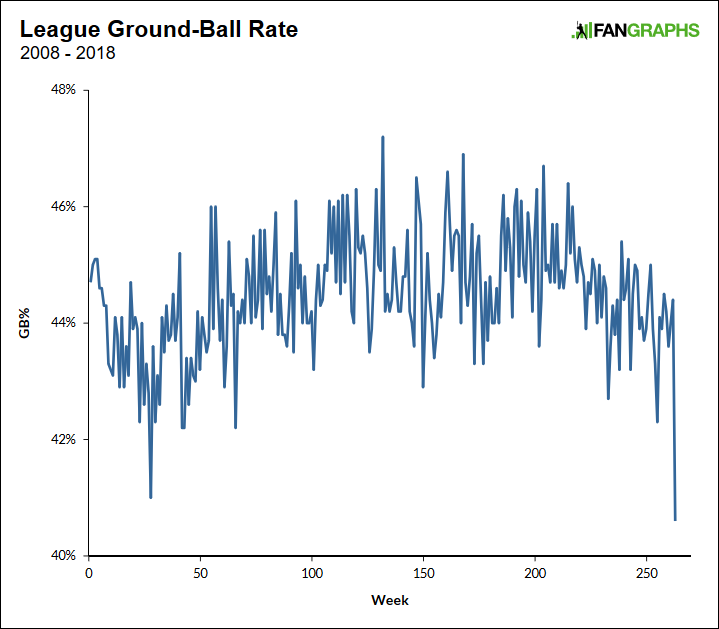
This, I think, is the strongest evidence that something is changing. That is, aside from all the anecdotal evidence we already had. We’re looking at the lowest ground-ball rate in a week in at least a decade. The current rate is 40.6%. The lowest rate in any week last season was 42.3%. That was the lowest rate in a week since July of 2010. And the further back you go with this, the more you run into changes in how grounders, liners, and flies were recorded. Definitely, just considering the last handful of years, we’re seeing something we haven’t seen. It could be random noise, and we’ll find that out eventually, but I think that idea is unlikely to be true.
In many ways, it’s absurd to look at any league averages so early on. We’re not even at a point where every starting pitcher has started a game. I wouldn’t have written this post at all had that weekly analysis not turned out as it did. That’s what sold me that we’re probably seeing a change. As a side note, there’s a consequence of this: we’re also looking at our second-highest weekly infield-fly rate since 2008. Batters can try to hit the ball in the air. Not every air ball is a winner.
To repeat what I noted, this isn’t a shock. You could argue the trend started a short while ago, when the ball started acting more lively, so this wouldn’t even be anything new. And maybe it’s the sort of thing that would snowball — as hitters try to lift pitches down, pitchers will throw more pitches up, and those pitches seldom get hit on the ground. So the ground-ball rate would over-shift, until hitters level out again. A lot of the trends we see end up being cyclical. Baseball is a never-ending tug-of-war. Hitters and pitchers are forever just trying to figure one another out.
It’s just, we’ve talked about air balls, but we haven’t yet observed a big change in the grounder rate. Based on early indications, the change is underway. Part of it is that certain hitters have changed their approaches. Part of it is that teams are selecting hitters with certain approaches. The air balls already look like they’re here. The statement itself is not a surprise. That we can make it so early in 2018 is what’s more surprising.
Jeff made Lookout Landing a thing, but he does not still write there about the Mariners. He does write here, sometimes about the Mariners, but usually not.


Jeff you are a very smart and good person.
Welp. RIP Giants. 46% GB%, second to Marlins.
Yeah, but the y-axis is trunc…Oh, never mind.
i am so sick of home runs
I don’t have this sentiment. Home runs are up, yes, but it’s from about 1 HR/G in ’08 to 1.3 HR/G now. To me, that’s nothing to be sick over, they’re still rare enough that they’re exciting and fun.
Thats a 30% increase, which is huge, on top of what was already historic and making many people sick . How much is it up over 2014? Many people disagree with your take. I also like HR, so am not sick, but it is not hard to understand why some are.
How high does the average launch angle have to get before Joey Votto hits a popup?
Which Votto? April or ROS Votto?
I agree strongly with Matt Brown’s comment. Hitters have been swinging for the fences for the last 25 years. MLB will condone ALMOST anything to help that cause. Why can’t science help pitchers to enable them to throw pitches that will go straight into the ground. Plus on a s side note…It’s ridiculous how teams stock their teams with 7 or 8 relievers and wonder why games take too long to play. a golf cart isn’t going to help. Too many issues are destroying the game. Launch angle analysis just shows how driven teams are have a blow horn go off every time they hit a HR to get the aging population excited
1) Hitters have been swinging for the fences for the last 25 years
Proof?
2) MLB will condone ALMOST anything to help that cause.
Again, proof?
3) Why can’t science help pitchers to enable them to throw pitches that will go straight into the ground
It is…
4) It’s ridiculous how teams stock their teams with 7 or 8 relievers and wonder why games take too long to play
Do teams really complain? And is 7 relievers a team a new idea…? Nope.
5) A golf cart isn’t going to help.
Its for fun.
6) Too many issues are destroying the game
Viewer counts and revenue begs to differ.
7) Launch angle analysis just shows how driven teams are have a blow horn go off every time they hit a HR to get the aging population excited
Didn’t know you spoke for an entire population in an age group. Plus, you ever stop to consider you’re wrong about your perspective on baseball? Pitchers DOMINATED for a few years, and the launch angle changes were batter-benefiting counters to the pitchers’ increased dominance.
IMO – it is not science fueling HRs. It is the physics of the ball. If you want to help pitchers, then you will need to change the physics – it has been done before.
I can agree with this opinion. Science / analytics / whatever is just finding the optimal behavior for a given set of conditions, and it’s easy to see that teams are now smarter and more reactive (and innovative) than ever. If the ball is changed back / de-juiced or the mound is lowered or something, teams will just respond by employing the optimal way to maximize run scoring and prevention. Maybe in that case it won’t be as beneficial for guys like Scooter Gennett and Brett Gardner to raise their launch angle but instead flatten their swings to hit more liners so they’re not constantly just hitting fly balls that aren’t making it over the fence. Of course a change in ball would affect the pitchers too; maybe a de-juiced ball has raised seams and allows pitchers to get more movement, etc.
Science is simply just telling them how to act most optimally and rationally, but if you change the conditions of the environment then you would expect behavior to change as well. And that includes how players are valued.
is this good or bad tho?
It’s really weird, but I can’t find Sullivan’s article about Kevin Pillar stealing 2nd, 3rd & home off Betances. Did it get taken down for being too salacious? Hasn’t it been written yet?
This and e5’s improbable inside the park HR would be must-read baseball nerd content.
Joe Posnanski’s article will have to do for now.
http://joeposnanski.com/is-this-an-error/
Unfortunately, I don’t think Fangraph writers enjoy writing about the Jays. Not a lot of clicks and some Jays fans can be very cantankerous if they disagree with the premise of the article.
You do realize the team from Toronto has the most fans in baseball? They average about 1 million TV views for any game of consequence. They have an entire country behind them. They generate clicks and yes a lot of terrible commenters.
Teams selecting for launch angle, or players changing launch angle? Probably both, but it would be interesting to try and figure out in what proportion.
At what point does the juiced ball and fly ball revolution change the math on taking the 3-0 pitch? At some point the value of putting that ball in play starts to outweigh the value of potentially walking, right?
Jed Gyorko jacked a 3-0 pitch for a double yesterday. That suggests there may be a lot of green lights going around.
I am extremely skeptical of any red lights actually existing. I think it is something that people say, but I don’t think there is a sign coming from anyone or any spoken agreements regarding 3-0 pitches.
Red lights probably exist in little league, but not beyond that. Red lights might exist for particularly incompetent HS hitters, but beyond that I can’t imagine a hitter being allowed not to swing. If what you really mean is the general approach employed by hitters… well, that could change. That is also a lot more complicated than what we pretend it is – the approach is generally to sit on one pitch in one location – if you don’t get it then you take it… which looks like a red light but is just being a smart hitter and executing a plan.
The math on taking a 3-0 pitch is long ago changed. You should not auto-take.
The math?
Today Grichuk swung 3-0 after the pitcher had thrown 8 straight balls with the bases loaded and a 5 run lead.
Are there more high fastballs? Higher pitches have a higher launch angle than low pitches.
3 fewer ground balls per 100 balls put in play than this historical average in the 2nd chart? I’d have to see more to jump to any big conclusion.
Let’s have an article about the significant drop in BABIP this season, from .300 to .281
Small sample size maybe?
Maybe, probably partially. BABIP is lower on flyballs though, so it’s not contradictory with a higher launch angle.
Also HRs aren’t included in BABIP — if doubles are turning into HRs, that should result in a lower number too.
Btw in the early to mid 2000s grounder rate was lower than 16-17 and without talk about launch angle. Then in late 00s grounder rate would go up, those probably were the years the sinker proliferated. The rising again LA then was probably hitters learning to lift the low sinker.
But it is not just the swing but still swing-pitch interaction. As I said before in 2005 there was a higher air ball rate than in 2017.
Pitch type and location has a huge effect on LA and EV https://www.fangraphs.com/community/effect-of-pitch-selection-on-launch-angle-and-exit-velocity/
Even the modern low ball lifting swing only yields a 5 degree la in the lower third (which is a gain, used to be almost negative) and 20 degrees upper third.
Baseball players always lifted middle and up pitches, otherwise there wouldn’t have been guys clobbing 50 bombs 15 years ago, the fly ball revolution is really a hit low pitches not on the ground revolution.
Now if pitchers respond with elevating that could lead to an even lower gb rate.
“I don’t know if you just watched the Royals and the Tigers. Probably not. Neither team is very good.”
Well, sir, you misunderestimate how much I’d rather watch a baseball game at 1PM, even a crappy one, than continue to respond to work emails.
What’s the best approach for a pitcher to take against a hitter who is attempting to hit the ball in the air?
I think you can’t prevent an air ball hitter who lift the low pitch to hit the ground. You can prevent a selective high ball hitter who waits for a pitch up to lift by pounding him low but if you have a guy like trout who can lift pitches below the knees you can’t prevent elevating because the high pitch is very easy to lift even without an uppercut.
What you maybe can do is try to limit ev, induce pop ups and limit contact with pitch selection.
In tangos “the book” he says fb hitters do better against gb pitchers and vice versa. A real fb hitter the best chance is probably to get them to hit too high or whiff but that is a risky gamble.
Hard to live up and in in the zone.
Work ahead in the count.
I mean, this is the best approach for a pitcher period, but it’s so strong it pretty much trumps any approach the batter has.
Not sure when HR/FB and IFFB% should stabilize, but so far this year HR/FB is at its lowest since 2015, before the juiced ball, and IFFB% is higher than… I’m not sure, maybe ever? Higher than any time since 2002 where Fangraphs started recording it anyway.
Are we reaching the point of negative returns on increasing launch angle? Are pitchers finding ways of exploiting new swing paths with higher pitches or something? Is it a data blip?
Could cold weather be eating into the HR/FB rate right now? Hard to compare March & early April numbers to full-season stats.
Can some wise person give me an idea of what impact (if material) this will have on positional adjustments for defense for purposes of calculating things like WAR?
Less of a defensive “penalty” for being in the OF as opposed to the IF than before?
Frankly the huge increase in strikeouts should also result in changes to the WAR approach. If there are fewer balls in play, defense should be worth less generally.
I wonder if they have overdone the flyball revolution now, or maybe the pitchers are fighting back? I get that yes, it’s only a week. But like Jeff pointed out, IFFB are spiked. HR/FB has dropped back down below 2016 levels, 1.5 points below 2017. League wide wOBA has also dropped a similar amount.
This is probably just a result of pitchers being ahead of hitters this early, but it’s also interesting to note.
There is certainly a line that will be crossed at some point that we will find in the near future. At this point, I don’t think we can conclude much of anything.
No, probably not. But it does at least go to show that baseball does have a way of correcting itself, whether it’s happening now or still years down the road.
The more interesting thing to me is not the changes that the players make, but the changes to the environment. If these balls ever came back to earth, everything would shift dramatically. I think the idea that players should increase launch angle is 100% fueled by the new environment. Players are trying to find the balance as this is a new world that people don’t quite understand yet but that could change whenever MLB decides it wants to.
Question — do defensive WAR ratings take this into account? For example, if this trend were to persist for the remainder of the season, would Andrelton Simmons be less valuable?
The defensive stat component – UZR or DRS or whatever – is dependent on chances, so fewer chances will lead to a lower score (or a lower absolute value of the score, for those who are terrible).
The positional adjustment component isn’t actually based on defensive value but on difficulty of replacement. This is sort of subtle, but as long as major-league teams believe that shortstops have to be excellent fielders it would be appropriate to keep the positional adjustment where it is even if no one ever hit the ball to them. So single-season differences in batted-ball distribution don’t really make a difference or need to be adjusted for. We’d be looking for a significant-enough trend that teams change their staffing behavior.
Thanks — query if we might see a decline in the variance among infielder’s range scores due to shifts, which might suggest a declining level of importance for infielder defense.
How long will I have to wait to see how the flyball revolution works out with non-juiced baseballs? I was hoping to see it this year, but I don’t think that is going to be the case.
With a juiced ball made juicier by storing them in air conditioned rooms players obviously want to hit the ball in the air more. The ball is the driving this change. Take the juice out of the ball and guys will go back to hitting LD and GB
I am waiting for the first manager to employ 4 OF’ers. At some point a player with a FB rate approaching 70% is going to merit another OFer
Apologies for being late to this conversation. Great article. I have heard a number of analysts discuss this spring that pitchers are adjusting to the higher launch angle swing by attacking the zone with high fastballs, preferably with a high spin rate. The idea is that it is very difficult for a batter using an uppercut high launch angle swing to catch up to these high fastballs, and when they do, the result is often a popup. This would explain the increase in popup rate and decrease in ground ball rate. It will be interesting to see if this trend continues.