
Jeff McNeil Bound for Sacramento as Metsodus Continues
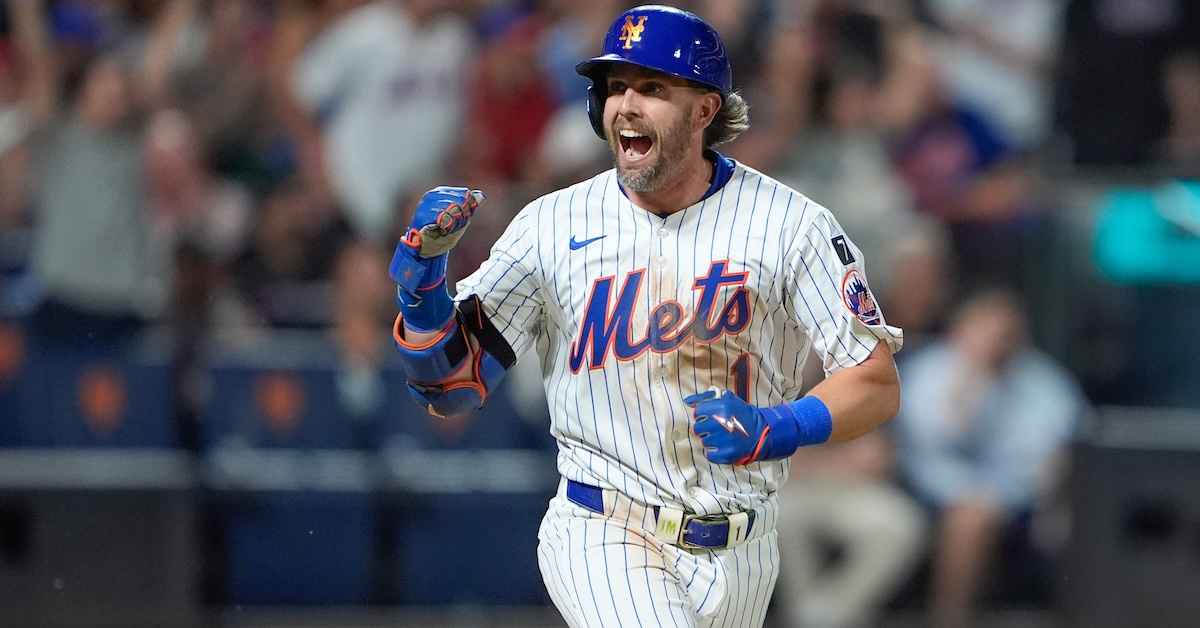
Another day, another Met out the door. Jeff McNeil, who to this point had spent his entire 13-year professional career in the Mets organization, is now an Athletic. The 33-year-old second baseman and outfielder is headed to Sacramento (or, to use the Athletics’ official branding, Parts Unknown), in exchange for 17-year-old pitching prospect Yordan Rodriguez. The Mets will pay down $5.75 million of the $15.75 million due to McNeil in 2026, and if the A’s decline McNeil’s club option for 2027, Steve Cohen will cover the $2 million buyout.
At the time of the trade, McNeil was the Mets’ active leader in games played, plate appearances, and hits. If you want a sense of how the Mets’ offseason is going, here’s a fun fact. In the past 30 days, the franchise has had four active leaders in those categories: Brandon Nimmo, who was traded to Texas just before Thanksgiving; then Pete Alonso, who signed with the Orioles during Winter Meetings; then McNeil; and now Francisco Lindor. All that upheaval without playing a single game.
All told, 16 of the 63 players who suited up for the Mets in 2025 have departed since the end of the season. Come February, “Meet the Mets” might be more than a song. They’re going to have to spend the first week of camp wearing name tags and doing icebreakers.
Not all of those 16 players were as important as Alonso, or McNeil, or Edwin Díaz. There are some rentals, some relievers, and some depth guys. I admit I had forgotten that Frankie Montas was on the Mets. Surely Mets fans would like to forget that their team ever employed Cedric Mullins.
But as much as those same fans will miss McNeil — a 12th-round pick who turned into one of the best contact hitters in the league — it’s been clear for some time now that his time in New York was winding down. The former Long Beach State star is now three seasons removed from his last truly outstanding campaign; since 2023, he’s hit .253/.326/.389, which is a wRC+ of 102, and averaged within a rounding error of 2.0 WAR per season.
That’s still a very useful player — a team as perpetually miserly as the Athletics would not spend $10 million on him otherwise — but no longer an indispensable part of a team with championship aspirations. The Mets are spending $26 million on Marcus Semien this year, leaving McNeil out of the second base picture. And while McNeil’s bat is still useful, it’s not ideal for left field or DH. (For what it’s worth, McNeil’s defensive numbers were just fine at second in 2025.)
The Mets’ loss is the Athletics’ gain. McNeil is a terrific bat-to-ball hitter, usually one of the hardest guys in the league to strike out. In McNeil’s best seasons, he posted OBPs in the .380s. With one exception, he never hit for much power, and he’s never been a stolen base threat. Peak McNeil was sort of a poor man’s Millennial Wade Boggs. He’d just spray soft line drive singles all over the field, stand on first, and wait for Alonso to crank a ball over the fence so they could both jog home. In the best of times, he was good to score around 80 runs a year.
If McNeil wants to keep doing that — get on base through any means necessary, and wait to be driven in by a massive dude with plus power — West Sacramento is one of the best places in the league to be.
The A’s have, somewhat sneakily, built out a lineup with tons of power: Nick Kurtz and Brent Rooker, most notably, but also Lawrence Butler, Shea Langeliers, and Tyler Soderstrom. They also have Jacob Wilson, who’s one of the few hitters in the league who’s harder to strike out than McNeil. Is it controversial to say I’d take this lineup over the Mets lineup, as currently constituted? Because I would.
As McNeil has aged, he’s evolved as a hitter. Daniel Murphy is now a better historical comparison than Boggs, because over the past three seasons, McNeil has learned to lift and pull.
In 2023, the first season for which Baseball Savant has bat tracking data, McNeil had an average swing speed of 68.1 mph and a fast-swing rate (bat speed of 75 mph or more) of 2.6%. For context, that’s eighth-percentile bat speed. In each of the past two years, his swing has gotten longer and more forceful, and he’s letting it eat on a greater percentage of his swings. In 2025, McNeil’s average swing speed climbed to 70.7 mph (still only 27th percentile, but faster than it was before), with a fast-swing rate of 10.2%.
The effects of this change were about what you’d expect. McNeil has actually slightly increased his in-zone contact rate, and while he’s whiffing more outside the zone, who cares? That’s not where he’s going to do damage anyway. He’s swinging less in general, and walking more — in 2025, McNeil posted the first double-digit walk rate of his major league career.
He’s also pulling the ball more, and doing so in the air, where hard contact turns into extra-base hits. In 2021, 13.1% of McNeil’s batted balls were pulled and in the air, which was 183rd out of the 232 hitters who qualified for Baseball Savant’s leaderboard. This season, his in-air pull rate was 26.9%, which was 13th out of 251.
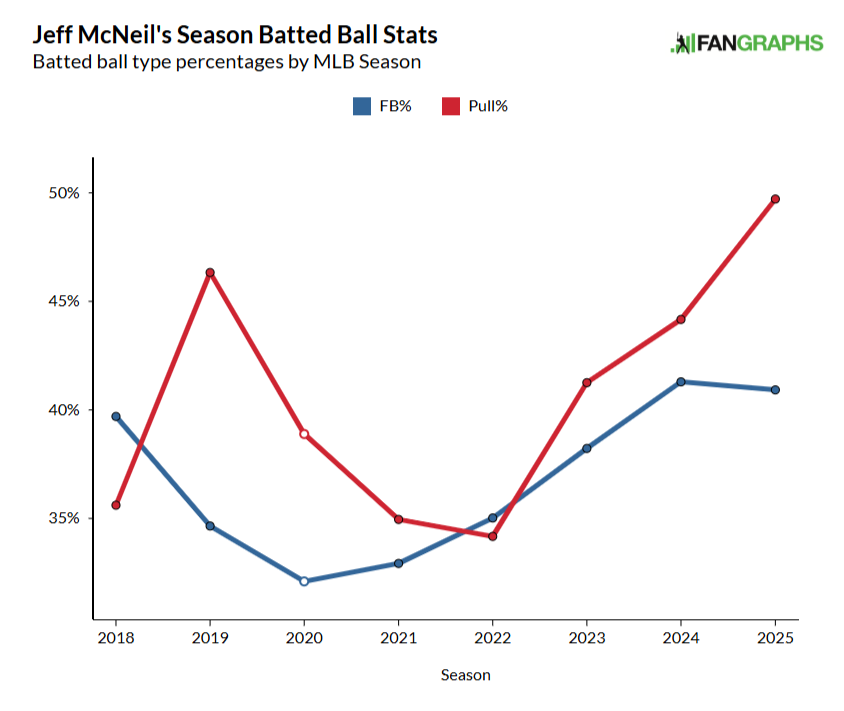
This hasn’t exactly led to a power surge… well, maybe it has, by McNeil’s standards. In 2019, when McNeil was in his prime and the baseballs were filled with Flubber, he hit 23 home runs. Until 2023, that was the only double-digit home run total of his career. Now, McNeil has hit 12 home runs in back-to-back seasons.
All that power has come to the pull side. McNeil hasn’t hit an opposite-field home run since August 5, 2022. Since that date, all 30 of his big league dingers have come to the right side of dead center.
Is there more power to come with a change of home stadium? Maybe. Sutter Health Park was the second-most hitter-friendly stadium in the league in 2025, trailing only Coors Field. Citi Field usually plays around neutral. But for left-handed hitters alone, Citi Field was actually quite a productive venue in 2025; it ranked fifth, just two spots behind Sutter Health Park, though the Athletics’ stadium remained more homer-friendly. McNeil might pick up an extra home run or two at the margins, but I’d be shocked if he suddenly discovered 25-homer power.
If he did, this would be the steal of a lifetime for the A’s. As it stands, they’ve got a solid, reliable second baseman, for not that much money, in exchange for a teenager nobody had heard of 12 months ago.
Rodriguez signed with the Athletics in January, just before his 17th birthday, for $400,000. (Yes, that means I’m writing up a player who was born in 2008. I’m asking for a coffin for Christmas.) And it’s been a good first year in the pros for the Cuban teenager. At 6-foot-3, 190 pounds, he’s athletic and projectable, and ought to develop as a starter for the foreseeable future.
That’s backed up by his stuff: His fastball sits at 91 to 95 mph and touched 96. But the best thing Rodriguez has going for him is the slider.
Rodriguez’s breaker sits in the low 80s, with ridiculous depth. Eric Longenhagen told me this pitch has so much bend, the automatic pitch tagging system calls it a curveball pretty frequently. It’s a true weapon, and hitters in the Dominican Summer League didn’t know what to do with it.
As exciting as that is, Rodriguez is nowhere close to being a top-100-type prospect; Eric put a grade of 35+ on him. As a rule, it’s not a good idea to get out over one’s skis over a teenage pitching prospect who’s thrown in eight professional games ever, all of them in the DSL. Even if Rodriguez does turn into a big leaguer — and he might — it’ll be many years before he’ll be helpful to the Mets.
Rodriguez is a decent get in a salary dump trade, but make no mistake, that’s what this is. That makes it hard to evaluate, because whenever a team sheds payroll, we have to wait to see what they spend that money on instead.
Getting rid of those 16 players has saved the Mets, by my math, somewhere in the neighborhood of $130 million, after accounting for the money they’ve eaten to cut Montas and grease the skids to jettison Nimmo and McNeil. Between Semien, Devin Williams, Luke Weaver, and Jorge Polanco, they’ve used up only a little more than half of those savings.
Mets president of baseball operations David Stearns therefore has quite a bit of money to spend, even before he asks Cohen to reach into his pockets for more. Does losing McNeil make it easier for the Mets to go after Cody Bellinger, or Alex Bregman, or Framber Valdez? Maybe more than one of them? If so, you’d have to say this move was worth it.
To Cohen’s credit, the Mets are one of the few clubs that I’m willing to assume will reinvest the money they’ve just saved. But while we know now that the A’s did good business here, we’ll have to wait and see how the Mets made out.
Michael is a writer at FanGraphs. Previously, he was a staff writer at The Ringer and D1Baseball, and his work has appeared at Grantland, Baseball Prospectus, The Atlantic, ESPN.com, and various ill-remembered Phillies blogs. Follow him on Twitter, if you must, @MichaelBaumann.
Man, I know this is ostensibly a website for being rational about baseball or whatever, but this offseason is making me really sad.
And again I have to note that whatever the outcome of this rebuild — it still may well be that the Mets check into spring training with a team that’s better, and/or better positioned for the future, than it would’ve been if they’d retained all the fan favorites — Stearns is really not handling the media and fan communication side of the rebuild well. (He still hasn’t even called it a rebuild! Imagine how differently people would see this offseason if he’d just gotten in front of the story with an October “hey everyone, expect to see big changes” announcement.) He’s still just issuing chilly two-sentence “we thank Jeff for his years as a Met” press statements and calling it good, I think truly not understanding that the fans are feeling like he’s taken half of their best friends away and left a lump of coal in the stocking.
It isn’t a rebuild it is a retool he wouldn’t be bringing in guys like Weaver, Williams, Semien and Polanco if it was. I’m not sure what you want him to say? The fans will be angry regardless.
You can have sentiment or you can have success, but you can’t have both. Stearns understands this. And don’t forget, he grew up a Mets fan.
Yes, I get your point and I’m not actually advocating for signing tens or hundreds of millions of dollars away for exclusively sentimental reasons — but fans still do have sentiment, whether front offices want them to or not. You can break up a group of players and make the fans feel like things are going to be okay, because there’s a long-term plan… or you can do it by unceremoniously dumping half the dudes whose jerseys kids wear to the park, leaving people waiting for the good part of the plan to happen later.
was talking about this with some met fan friends who are gutted from watching one favorite after another go out the door. maybe stearns works his magic and the mets look like juggernauts in april, but i don’t think you have to be a rank sentimentalist to see the value in setting expectations
Yeah to me it’s telling that most of the communication from the team to fans has been Steve Cohen texting with New York Post reporters. Stearns either doesn’t realize how upset fans are, doesn’t care, or is hoping to let his subsequent moves speak for themselves. Hoping it’s the latter!
I’m guessing he probably doesn’t realize that this is an important thing when you’re in a media market with a dozen major news outlets instead of one (#1). But I would also think that even if he did know, he would figure things would get better when the team wins a bunch (#3). I don’t think he’s wrong about the latter point, but you can’t count on that happening immediately!
I think there’s a decent chance the FO is not clued in to the magnitude of just how upset their fans are. Every Mets fan I know is utterly despondent.
I guess it’s time to find out if Stearns knows how to build a roster without constantly having to save nickels and dimes like he did in Wisconsin.
Dude, Stearns is a Mets fan he knows how they feel and think.