
Just How Hot Has Cody Bellinger Been?
By now, most baseball fans are probably aware of Cody Bellinger’s start to the 2019 season. Through 31 games and 132 plate appearances, Bellinger has put up an almost-immortal .431/.508/.890 slash line, with a 256 wRC+, swatting 14 home runs, drawing 19 walks and striking out just 15 times.
He’s leading baseball in batting average, on-base percentage, slugging percentage, wOBA, wRC+, home runs, RBI, and runs scored. (He’s even stolen five bases so far this year, good for 15th.) As the calendar has now officially turned, Bellinger has tied the record for most home runs before May 1, and has set the record for most RBI before May 1.
Now, this season, baseball’s March 28 Opening Day was the earliest that it has been in history, giving Bellinger (and, Christian Yelich, who also tied the home run record) a few more games than their historical counterparts to set these marks. And, as we know, more games equals more opportunities to pad one’s numbers, especially counting stats like home runs and RBIs.
(Warning: I’m about to talk some about RBI. I also know that RBI isn’t an especially illuminating stat. I am writing about this for historical sake, so just bear with me.)
Consider this: Bellinger set his RBI record on April 29, his 30th game of the season. Mark McGwire and Juan Gonzalez — who previously shared the RBI-prior-to-May-1 record with 36, each doing so in 1998 — had only played 25 and 24 games, respectively, upon reaching that pinnacle.
Just how hot has Cody Bellinger been? We probably have some idea as to the answer, but let’s go ahead and put his first 30 games in true historical perspective to be absolutely certain.
For one, according to Evan Boyd of Stat by STATS, Bellinger’s 1.413 OPS through 30 player games was the highest since Barry Bonds (1.540) in 2004, and the fifth-highest mark through 30 games in the live ball era, going back to 1920. Secondly, according to the Elias Sports Bureau, Bellinger’s Triple Crown stats (.434 average, 14 HR, 37 RBIs) were the highest of any player in major league history after 30 games.
What’s more, Bellinger has produced 3.0 WAR in just 31 games. If that sounds like a lot, that’s because it is. In fact, since 2002, Bellinger’s April 2019 WAR is the fourth-highest of any player in any given month:
| Player | Year | Month | WAR |
|---|---|---|---|
| Lance Berkman | 2008 | May | 3.12 |
| Randy Winn | 2005 | Sep/Oct | 3.02 |
| Barry Bonds | 2002 | Aug | 3.00 |
| Cody Bellinger | 2019 | Mar/Apr | 2.95 |
| Barry Bonds | 2004 | Mar/Apr | 2.83 |
Want further proof? Just look at Bellinger’s odds to win the National League MVP award. On March 1, Vegas had him at 25-to-1, trying him for the 11th-best odds in the league. But, as of April 29, he’s already an 8-to-5 favorite.
I want to go deeper, though. It’s obviously important to how we perceive Bellinger’s performance that he is putting up these numbers to start a season. If he put up a 30-game stretch like this in, say, mid-July, we might not pay as much attention to it. It’s only because we, as humans, see his season wRC+ of 259 and react in shock. But, even when looking at the best individual months by any hitter since 2010, Bellinger’s April ranks very highly.
| Player | Year | Month | AVG | OBP | SLG | wOBA | wRC+ |
|---|---|---|---|---|---|---|---|
| Matt Kemp | 2012 | Mar/Apr | .417 | .490 | .893 | .566 | 269 |
| Edwin Encarnacion | 2015 | Aug | .407 | .460 | .919 | .555 | 263 |
| Bryce Harper | 2015 | May | .360 | .495 | .884 | .556 | 262 |
| Mike Trout | 2015 | Jul | .367 | .462 | .861 | .544 | 260 |
| Cody Bellinger | 2019 | Mar/Apr | .434 | .508 | .906 | .559 | 259 |
| Mike Napoli | 2011 | Sep/Oct | .429 | .518 | .843 | .562 | 258 |
| David Ortiz | 2011 | Aug | .411 | .494 | .836 | .553 | 253 |
| Josh Hamilton | 2010 | Jun | .454 | .482 | .815 | .553 | 248 |
| Jose Bautista | 2011 | Mar/Apr | .366 | .532 | .780 | .541 | 248 |
| Mike Trout | 2014 | Jun | .361 | .471 | .759 | .515 | 245 |
Perhaps the most interesting thing about the above chart is that Bellinger’s April isn’t the only April there. Assuming an equal chance that any hitter puts up a phenomenal month at any point during the season, we’d expect to see just 1.67 March/Aprils on a monthly chart of 10 hitters. Instead, there are three; Matt Kemp (2012) and Jose Bautista (2011) join Bellinger as the hitters who put up elite months in the game’s first month. If this tiny sample serves as more good news for Bellinger, both Kemp and Bautista went on to have solid years (though Kemp’s was injury-shortened).
| Player | Year | PA | AVG | OBP | SLG | wOBA | wRC+ | WAR |
|---|---|---|---|---|---|---|---|---|
| Jose Bautista | 2011 | 655 | .302 | .447 | .608 | .443 | 181 | 8.1 |
| Matt Kemp | 2012 | 449 | .303 | .367 | .538 | .383 | 145 | 3.8 |
Bautista actually had a phenomenal year after his hot start, finishing third in the majors in WAR behind Jacoby Ellsbury (9.5) and, funnily enough, Matt Kemp (8.3). The next year was the year of Kemp’s blistering start, and he scuttled to the finish line, hitting just .273/.333/.445 in 351 plate appearances from May 1 on.
As I said above, this is a tiny sample of just two hitters. On a greater scale, a hitter’s wRC+ in their first month correlates moderately strongly to their full season wRC+. For simplicity’s sake, to demonstrate this concept, I took a quick glance at 2018 hitters, comparing their April wRC+ to their full season wRC+.
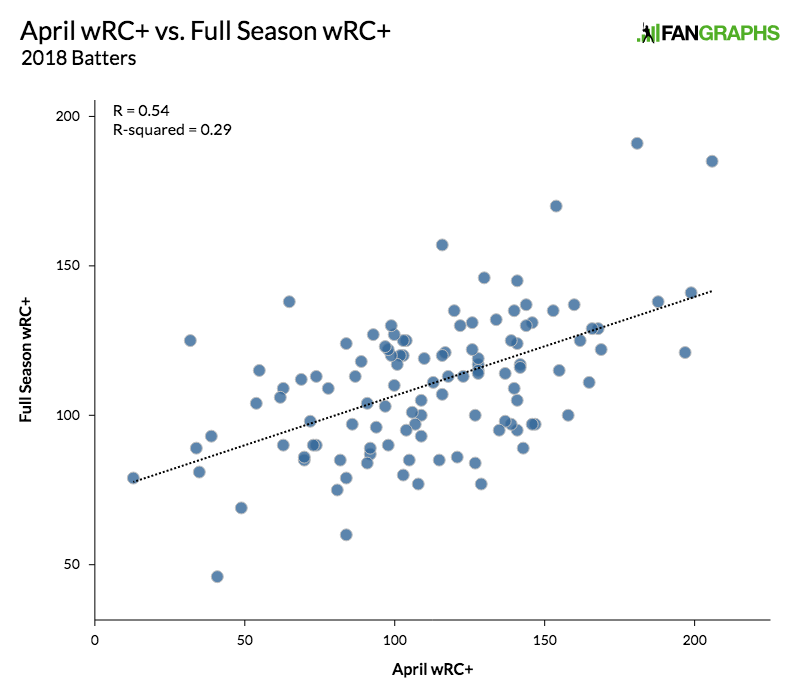
Matt Kemp clearly provides a great lesson. Bellinger’s scorching April does not necessarily mean he’s going to go on to hit like Barry Bonds for the rest of the season; the above chart has an R-squared value of 0.29, though, if we use our LSRL to attempt to predict Bellinger’s full season wRC+ based on his first month, we would expect his full season wRC+ to end around 159. Of course, even though there’s still a lot of variability here, that mark would rank as the fifth-best wRC+ in baseball in 2018.
Does that mean it’s wrong to marvel at Bellinger’s hot start? Absolutely not. Baseball history is something that we should all appreciate, including Bellinger’s extraordinary performance so far. After all, he was worth 3.0 WAR in April, and even with the slight differences in the number of games it has been possible to play in other seasons prior to May, that’s just mind-boggling. Since our monthly WAR splits began in 1974, no hitter has produced three wins in April. That is, until Cody Bellinger.
Devan Fink is a Contributor at FanGraphs. You can follow him on Twitter @DevanFink.
Wait wait wait wait wait.
Randy…Winn?
Winn had a nutty batting month and also was 2 runs above average in CF with the larger positional adjustment.
Imagine if Bellinger had played CF this year instead of the Pollock signing.
Specifically Winn had a 1.331 OPS while playing CF in San Francisco.
27 extra-base hits in 30 games!
Bellinger is reminding me a lot of peak Bautista right now, except with good defense.
With triple slash numbers so impressive, I’m surprised that the +WRC is so much lower than that of other players in other years with inferior slash number. And I guess that’s why we need a league adjustment. But that’s a much bigger adjustment than I expected.
Trout in 2015 has a triple slash substantially lower than Bellinger’s in 2019: .367/.462/.861 to .434/.508/.906. Bellinger has a .067 higher batting average (that’s a lot!) AND .046 more on base AND .045 more power, and yet Bellinger has the lower WRC+…
Around sabermetric parts where Matt Kemp is disparaged daily, people tend to forget that after his insanely good 2011, Matt Kemp had an otherworldly April the next year. In late April he pulled his first hamstring and about 6 weeks later pulled the other one. He never reached those heights again. After that great April following a great year though, people had started calling him the best player in baseball. Shame really.
what about that month that Stanton had with the Marlins? didn’t he have a scorching month or two during his MVP year?
yes, July 2017 with a 189 wRC+ in 113 PA’s… then August 2017 a 233 wRC+ in 127 PA’s
My biggest takeaway from this article is that Lance Berkman had the greatest month in baseball since 2002. Huh!
Oh how much i hate the WAR stat… Its so misleading. In the case of Bellinger, it actually proves a point, that he WAS he best player in the NL.
But can we REALLY say that about Trout this month, or at least as decisively as his WAR suggests. Shouldnt Tim Anderson, playing an equally hard position at shortstop have a much closer WAR to Trout’s. Noooooo. because this stat seems like it was designed by someone who had a hard on for Trout.
And to even suggest that Trout approached Bellinger this month as much as their respective WARs suggest is pure folly. The first just got free walks all month, which accounted to near nothing. The other was a pure run machine, both scoring and batting wise. Yet Trout only trails Bellinger by not even one WAR. Its ludicrous.
Trout’s WAR has been tainted all his career by the fact that other CF’s are usually more defensive guys without much pop at the plate. But does that make himself a better hitter. No. A hitter at the plate doesnt carry a glove, only a bat. So comparing hitters according to which glove they wear in the field is kinda flawed.
Bellinger was about one WAR better than Trout in April. That’s pretty significant for a single month. Less than a quarter of Trout’s walks were intentional, so not sure where the “free walks all month” comes from. As for his career, Trout “seems” like a great hitter not because other CFs don’t have much pop, but because he’s ran a .991 OPS and 175 OPS+ through almost 5000 PA. He’s one of the greatest offensive players of all-time at any position.
How much I hate war … if definitely. In the case of Belya, she really proved one thing, that he is the best NL player.
But we can really talk about salmon this month, or at least stabilize when the war shows. “NT Team Anderson”, playing a badly wrong position, has a fight close to salmon. Even because this statistic was designed by someone with hard salmon.
And even recommend that salmon is approaching this month, but their fight shows that this is pure madness. First, they are free to go all month, but nothing really. The second is a clean lifting machine, both for marking and for punching. However, salmon is only after the fight. The ludiche.
The war salmon is all about his career because of the fact that the rest of the CFs are usually defenseless, there is not much music on the disc. But it does not look like a better picture. even the number on the glove without a glove, just a bat. So, compare the footage that gloves on the floor on the floor have failed.
“But we can really talk about salmon this month”
There is never a bad time to talk about salmon.
Offensively Anderson has been pretty close to Trout (172 wRC+ to Trout’s 179). The big difference is that Anderson has been rated as a very poor defensive shortstop, while Trout is a strong centerfielder. In fact, their defensive numbers are almost mirror inverses of each other. Anderson has a -8 DRS and a -2.4 UZR, while Trout is +8 DRS and +2.5 UZR. So even though both are playing important positions, only one of them is playing well.
I too hate this biased stat that shows a player I like having a season that’s 50% better than an inner-circle HOF on track for a career year. I would prefer WAR if it showed Bellinger at “eleventy million” and Trout at “Cody Bellinger is better”.
Great analysis. Would love see some age-based adjustments as well. The fact that this is his age 24 season augurs well for the idea that he’s reached a new level (obviously with LOTS of regression factored in) as opposed to just being completely streaky hot for a month.
Thanks for plunging Bellinger into a 2-game May slump! … 2 for 9, no HR, no BB, no runs, and 4 Ks including his first 3-K game this year. Chopped 60 points off his OPS in a heartbeat.
I’m kidding, of course. But Bellinger also had a hot start as a rookie. First 24 games, .300 BA and 1.048 OPS. After that, ,259 and .907.
Just for fun, I looked at all April/March lines since 1961 with at least 1.200 OPS and 90+ PA.
There were 41 such guys who went on to have 500+ PA for the year.
The medians:
— First month, 1.280
— Season, .994
— Drop from first month to season, -.277
All had SOME drop.
Lowering the threshold to 1.100 OPS, we get 141 guys and these medians:
— First month, 1.161
— Season, .955
— Drop, -.228
Only 3 had no drop; only Bonds had big gains (twice).
And at the elite 1.300 OPS, just 12 guys and these medians:
— First month, 1.425
— Season, 1.025
— Drop, -.380
Bellinger’s start is fun as hell for both general fans and us stat geeks. But it’s still very likely he winds up with a year not unlike his track record.
Obviously, no one should expect Bellinger to keep up his current performance, but if you’re talking about regression to his baseline, I don’t think it’s probably right to think his baseline is made up of his career averages, given that he’s literally only been in the year 2+ years and these were his age 21-22 and age 22-23 seasons. We should expect growth and improvement at this age!
Better narrative imo: he started out super hot, pitchers figured out weaknesses to exploit, he adjusted.
I think his baseline is probably somewhere between his rookie season and his current performance, which means he’s going to be a perennial MVP candidate.
You added good context there, but there’s still more.
His minors stats don’t suggest future MVP candidate. They show good power and walks, but a modest BA. Which is just what we showed his first 2 MLB years.
Yes, he’s always been young for his level, and at 23 we generally expect gains. His hot start clearly makes him an MVP candidate this year. It MIGHT represent a real quantum leap to perennial MVP candidate, but probably not.
Bellinger logged an impressive 8.4 bWAR over ages 21-22. But the growth curve is less steep for guys who were already STARS at a young age. Here’s the other 11 guys between 8 and 9 bWAR at 21-22, who debuted since 1946:
Dick Allen, Chris Speier, Miguel Cabrera, Paul Molitor, Jack Clark, Robin Yount, Tom Brunansky, Lou Whitaker, Willie Davis, Mookie Betts, Orlando Cepeda.
How many were mainly better after that?
Not Allen; his best WAR was 8.8 at 22, then averaged 5.3 from 23-30.
Speier and Brunansky were much worse after age 22.
Davis had one bigger year after 22, but was basically a 4-WAR guy from 23-30. So was Cepeda.
Clark peaked at 22, averaged 3.2 WAR for 23-30.
Whitaker improved some, but was never an MVP candidate, just an incredibly consistent good player for years and years.
Molitor was similar, if less consistent. He averaged 3.4 WAR from 23-30, kept going strong thru his 30s but not a real MVP threat in WAR terms.
Cabrera, Yount and (so far) Betts had the kind of growth we dream on for very young stars. That’s not quite the success rate some folks expect.
Jason Heyward just missed this list. No growth since 22. So did Corey Seager; his 23 was like his 22, then he got hurt, so we’ll see. Bryce Harper was a VERY young star who exploded to MVP at 22, but averaged 2.5 bWAR the next 3 years. The list goes on.
Some young stars make a leap. More don’t.